A Comparison of cluster algebra structures arising from i-boxes and Demazure weaves
Pith reviewed 2026-06-27 20:05 UTC · model grok-4.3
The pith
An algebra isomorphism equates the cluster structure from i-box chains to the coordinate ring of a braid variety via Demazure weaves.
A machine-rendered reading of the paper's core claim, the machinery that carries it, and where it could break.
Core claim
For a positive element b in the braid group of finite ADE type, given an expression i and admissible chain C, an explicit Demazure weave W_Δ(C) can be constructed such that the map φ_i from the localized bosonic extension ~A_C(b) to C[X(Δ i)] is an algebra isomorphism compatible with the seeds from C and W_Δ(C), and it sends each PBW vector p_i,k to the coordinate z_k indexed by the letters of i.
What carries the argument
The explicit Demazure weave W_Δ(C) constructed from each admissible chain C of i-boxes, which induces the seed-compatible isomorphism φ_i sending PBW vectors to braid variety coordinates.
Load-bearing premise
An explicit Demazure weave W_Δ(C) can be constructed for every admissible chain C associated with the expression i such that the initial seeds from C and from W_Δ(C) are compatible under the isomorphism.
What would settle it
An admissible chain C for which the constructed Demazure weave fails to produce initial seeds compatible with the claimed isomorphism, or for which the map φ_i is not an algebra isomorphism or does not send the PBW vectors to the indexed coordinates.
Figures
read the original abstract
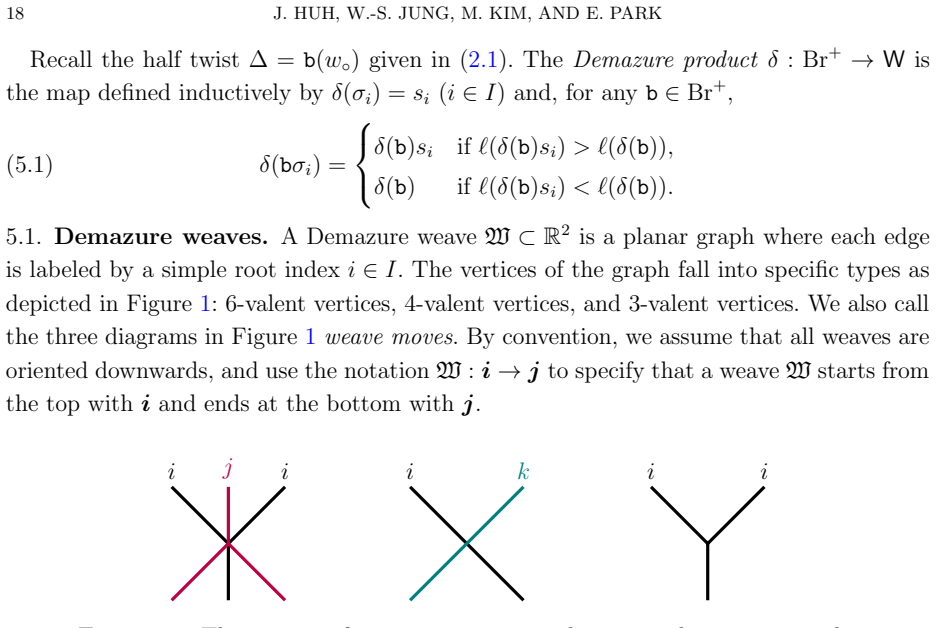
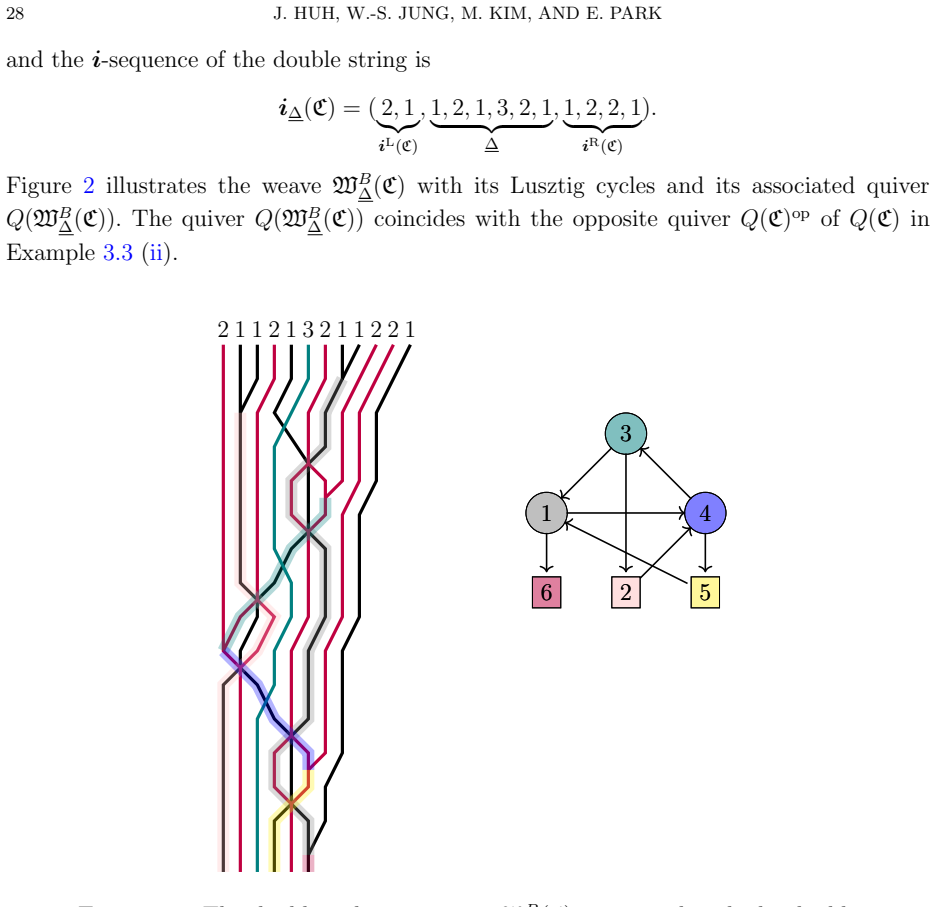
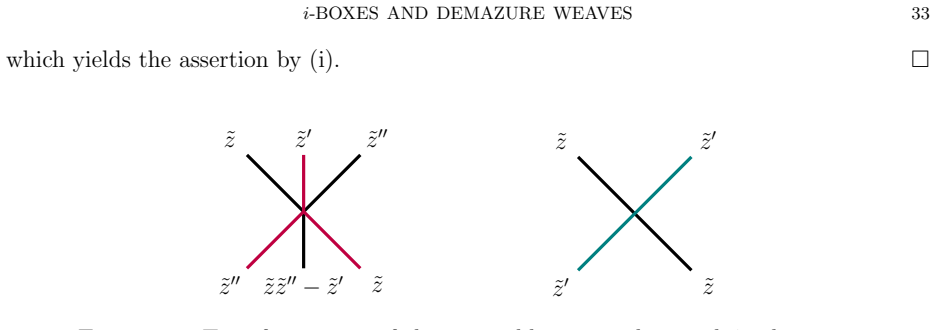
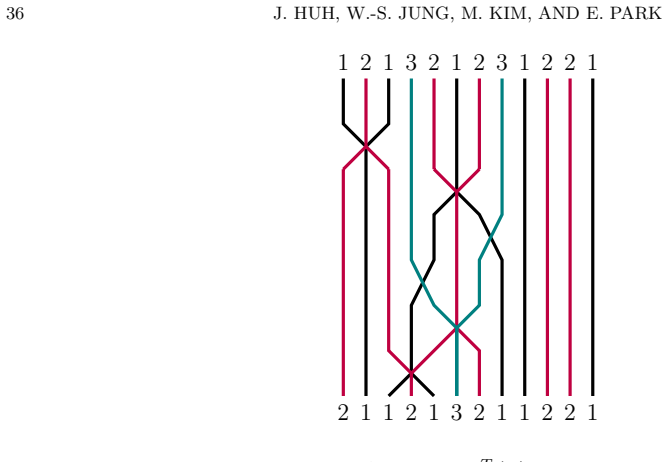
We compare two cluster algebras related to a positive element $\mathtt{b}$ in the braid group of finite $ADE$ type. One is the localized bosonic extension ${\widetilde{\mathbb{A}}}_\mathbb{C}(\mathtt{b})$ equipped with an initial seed arising from an admissible chain $\mathfrak{C}$ of $i$-boxes, which is deeply connected to monoidal categorification. The other is the coordinate ring $\mathbb{C}[X({\underline{\Delta}} {\boldsymbol{i}})]$ of the braid variety $X({\underline{\Delta}} {\boldsymbol{i}})$ equipped with an initial seed arising from a Demazure weave $\mathfrak{W}$, where ${\boldsymbol{i}}$ and ${\underline{\Delta}}$ are expression sequences of $\mathtt{b}$ and the half twist $\Delta$, respectively. We explicitly construct a Demazure weave $\mathfrak{W}_{{\underline{\Delta}}}(\mathfrak{C})$ for each admissible chain $\mathfrak{C}$ associated with ${\boldsymbol{i}}$, and prove that there exists an algebra isomorphism $\varphi_{{\boldsymbol{i}}}\colon {\widetilde{\mathbb{A}}}_\mathbb{C}(\mathtt{b})\to\mathfrak{C}[X({\underline{\Delta}} {\boldsymbol{i}})]$ which is compatible with the two seeds arising from $\mathfrak{C}$ and $\mathfrak{W}_{{\underline{\Delta}}}(\mathfrak{C})$. Moreover, the isomorphism $\varphi_{{\boldsymbol{i}}}$ sends the PBW vectors ${\overline{\mathsf{p}}}_{{\boldsymbol{i}},k} \in {\widetilde{\mathbb{A}}}_\mathbb{C}(\mathtt{b})$ to the coordinates $z_k \in \mathfrak{C}[X({\underline{\Delta}} {\boldsymbol{i}})]$ indexed by the letters of ${\boldsymbol{i}}$. As applications, we investigate a connection between Demazure weaves and signed words via the $i$-boxes and interpret the isomorphism $\varphi_{{\boldsymbol{i}}}$ from the viewpoint of monoidal categorification using Hernandez--Leclerc categories.
Editorial analysis
A structured set of objections, weighed in public.
Referee Report
Summary. The manuscript compares two cluster algebra structures associated to a positive element b in the braid group of finite ADE type. One structure is the localized bosonic extension ~A_C(b) equipped with an initial seed from an admissible chain C of i-boxes. The other is the coordinate ring C[X(Δ i)] equipped with an initial seed from a Demazure weave W. The paper explicitly constructs a Demazure weave W_Δ(C) for every admissible chain C associated to an expression i of b, and proves the existence of an algebra isomorphism φ_i : ~A_C(b) → C[X(Δ i)] that is compatible with the two seeds and sends the PBW vectors p_i,k to the coordinates z_k indexed by the letters of i. Applications to signed words via i-boxes and to monoidal categorification in Hernandez-Leclerc categories are discussed.
Significance. If the stated isomorphism and explicit construction hold, the work supplies a direct, seed-preserving bridge between the i-box approach (tied to monoidal categorification) and the Demazure-weave approach (tied to braid varieties). The explicit mapping of PBW basis elements to geometric coordinates is a concrete strength that could allow transfer of results between the two settings. The construction for every admissible chain addresses a natural compatibility question in the theory of cluster structures on positive braids.
minor comments (2)
- [Introduction] The introduction and abstract introduce multiple specialized notations (i-boxes, admissible chains C, Demazure weaves W_Δ(C), PBW vectors p_i,k, half-twist Δ) in rapid succession; a short table or diagram clarifying the correspondence between these objects would improve readability.
- The statement of the main isomorphism (in the abstract and presumably §3 or §4) uses the symbol φ_i without an immediate reminder of its domain and codomain; repeating the full arrow notation at the first use in the body would aid navigation.
Simulated Author's Rebuttal
We thank the referee for their careful reading of the manuscript and for the positive recommendation to accept. The referee's summary accurately reflects the main contributions of the paper.
Circularity Check
No significant circularity identified
full rationale
The paper presents an explicit construction of the Demazure weave W_Δ(C) for each admissible chain C and proves the algebra isomorphism φ_i is seed-compatible while mapping PBW vectors to indexed coordinates z_k. No load-bearing step reduces by definition or by self-citation chain to its own inputs; the central claim rests on a direct mathematical construction and proof rather than fitted parameters, self-definitional relations, or uniqueness theorems imported from overlapping prior work. The derivation is therefore self-contained.
Axiom & Free-Parameter Ledger
axioms (1)
- standard math Standard properties of cluster algebras, braid groups of finite ADE type, and monoidal categorification via Hernandez-Leclerc categories hold.
Reference graph
Works this paper leans on
-
[1]
Roger Casals, Pavel Galashin, Mikhail Gorsky, Linhui Shen, Melissa Sherman-Bennett, and Jos´ e Si- mental,Comparing cluster algebras on braid varieties, arXiv 2508.03816 (2025). 42 J. HUH, W.-S. JUNG, M. KIM, AND E. PARK
arXiv 2025
-
[2]
2, 369–479
Roger Casals, Eugene Gorsky, Mikhail Gorsky, Ian Le, Linhui Shen, and Jos´ e Simental,Cluster struc- tures on braid varieties, Journal of the American Mathematical Society38(2025), no. 2, 369–479
2025
-
[3]
Math.342 (2026), no
Alessandro Contu, Fan Qin, and Qiaoling Wei,Fromi-boxes to signed words, Pacific J. Math.342 (2026), no. 1, 63–78. MR 5049283
2026
-
[4]
Sergey Fomin and Andrei Zelevinsky,Cluster algebras. I. Foundations, J. Amer. Math. Soc.15(2002), no. 2, 497–529. MR 1887642
2002
-
[5]
Math.243(2026), no
Pavel Galashin, Thomas Lam, and Melissa Sherman-Bennett,Braid variety cluster structures, II: general type, Invent. Math.243(2026), no. 3, 1079–1127. MR 5008161
2026
-
[6]
Pavel Galashin, Thomas Lam, Melissa Sherman-Bennett, and David Speyer,Braid variety cluster structures, I: 3D plabic graphs, arXiv 2210.04778 (2022)
arXiv 2022
-
[7]
Mark Gross, Paul Hacking, Sean Keel, and Maxim Kontsevich,Canonical bases for cluster algebras, J. Amer. Math. Soc.31(2018), no. 2, 497–608. MR 3758151
2018
-
[8]
David Hernandez and Bernard Leclerc,Cluster algebras and quantum affine algebras, Duke Math. J. 154(2010), no. 2, 265–341. MR 2682185
2010
-
[9]
Reine Angew
,Quantum Grothendieck rings and derived Hall algebras, J. Reine Angew. Math.701(2015), 77–126. MR 3331727
2015
-
[10]
,A cluster algebra approach toq-characters of Kirillov-Reshetikhin modules, J. Eur. Math. Soc. (JEMS)18(2016), no. 5, 1113–1159. MR 3500832
2016
-
[11]
Il-Seung Jang, Kyu-Hwan Lee, and Se-jin Oh,Braid group action on quantum virtual grothendieck ring through constructing presentations, arXiv preprint (2023), arXiv:2305.19471, 2023
arXiv 2023
-
[12]
,Quantization of virtual Grothendieck rings and their structure including quantum cluster al- gebras, Comm. Math. Phys.405(2024), no. 7, Paper No. 173, 83. MR 4773249
2024
-
[13]
Math.485(2026), Paper No
Masaki Kashiwara and Myungho Kim,Exchange matrices of I-boxes, Adv. Math.485(2026), Paper No. 110711, 67. MR 4993404
2026
-
[14]
3, 13–18
Masaki Kashiwara, Myungho Kim, Se-jin Oh, and Euiyong Park,Braid group action on the mod- ule category of quantum affine algebras, Proceedings of the Japan Academy, Series A, Mathematical Sciences97(2021), no. 3, 13–18
2021
-
[15]
1, 168–210
,Simply laced root systems arising from quantum affine algebras, Compositio Mathematica158 (2022), no. 1, 168–210
2022
-
[16]
,Braid symmetries on bosonic extensions, arXiv 2408.07312 (2024)
arXiv 2024
-
[17]
Math.236(2024), no
,Monoidal categorification and quantum affine algebras II, Invent. Math.236(2024), no. 2, 837–924. MR 4728243
2024
-
[18]
,Global bases for Bosonic extensions of quantum unipotent coordinate rings, Proc. Lond. Math. Soc. (3)131(2025), no. 2, Paper No. e70076, 39. MR 4947282
2025
-
[19]
,Monoidal categorification and quantum affine algebras III, arXiv 2509.14552 (2025)
arXiv 2025
-
[20]
110, Birkh¨ auser Boston, Inc., Boston, MA, 1993
George Lusztig,Introduction to quantum groups, Progress in Mathematics, vol. 110, Birkh¨ auser Boston, Inc., Boston, MA, 1993. MR 1227098
1993
-
[21]
Se-jin Oh and Euiyong Park,PBW theory for bosonic extensions of quantum groups, Int. Math. Res. Not. IMRN (2025), no. 6, Paper No. rnaf049, 33. MR 4881016 i-BOXES AND DEMAZURE WEA VES 43
2025
-
[22]
Fan Qin,Analogs of the dual canonical bases for cluster algebras from Lie theory, arXiv:2407.02480v4 (2024)
arXiv 2024
-
[23]
,Based cluster algebras of infinite rank, arXiv:2409.02881v4 (2024)
Pith/arXiv arXiv 2024
-
[24]
Sigma 9(2021), Paper No
Linhui Shen and Daping Weng,Cluster structures on double Bott-Samelson cells, Forum Math. Sigma 9(2021), Paper No. e66, 89. MR 4321011 (J. Huh)Department of Mathematics, University of Seoul, Seoul 02504, Republic of Ko- rea Email address:hyunyjia@yonsei.ac.kr (W.-S. Jung)Department of Mathematics, University of Seoul, Seoul 02504, Republic of Korea Email ...
2021
discussion (0)
Sign in with ORCID, Apple, or X to comment. Anyone can read and Pith papers without signing in.