Bulk Superconductivity driven by Disorder-Induced Delocalization in 4Hb-Ta(S_(1-x)Se_x)₂
Pith reviewed 2026-06-27 20:07 UTC · model grok-4.3
The pith
Disorder induces bulk superconductivity in 4Hb-Ta(S_{1-x}Se_x)_2 by delocalizing carriers in the Mott-like layer to form a new Fermi surface.
A machine-rendered reading of the paper's core claim, the machinery that carries it, and where it could break.
Core claim
In 4Hb-TaS2, a natural heterostructure interleaving Mott-like and metallic layers, quenched disorder from Se/S substitution induces bulk superconductivity. The disorder drives delocalization of carriers in the 1T-Mott layer, forming a new Fermi surface absent in the cleanest samples and thereby bringing to life strongly correlated electrons that support the superconducting state.
What carries the argument
Disorder-driven delocalization of carriers in the 1T-Mott layer that forms a new Fermi surface.
If this is right
- Bulk superconductivity appears only in samples where disorder has delocalized the 1T layer and created the new Fermi surface.
- Clean samples without the new Fermi surface show no bulk superconductivity.
- The fragility of the Mott state, when destabilized by disorder, supplies the correlated electrons needed for superconductivity.
- Delocalization in the Mott-like layer is a primary driver for the observed superconducting transition.
Where Pith is reading between the lines
- The same disorder-delocalization route could be tested in other natural heterostructures that interleave Mott and metallic layers.
- Varying the Se concentration might map a phase diagram in which superconductivity onsets exactly when the new Fermi surface appears.
- The strongly correlated electrons on the new Fermi surface may show unusual pairing or transport properties distinct from conventional bands.
Load-bearing premise
The bulk superconductivity is caused by the disorder-driven delocalization and new Fermi surface in the 1T layer rather than by other disorder effects, interface changes, or experimental artifacts.
What would settle it
Observation of bulk superconductivity in a clean sample that lacks the new Fermi surface, or absence of superconductivity in a disordered sample that has the Fermi surface, would falsify the mechanism.
Figures




read the original abstract
The unconventional superconductor 4Hb-TaS$_2$ is a natural heterostructure that can be broadly understood as interleaving Mott-like and metallic layers. We study the properties of this material as a function of quenched disorder in the form of Se/S substitution and find that while disordered samples show bulk superconductivity, clean samples do not. We show that a disorder-driven delocalization of carriers in the Mott-like ($1T$-) layer forms a new Fermi surface that is absent in the cleanest samples. This suggests that one of the primary drivers for superconductivity is the fragility of the Mott state, whose delocalization brings to life a sea of strongly correlated electrons.
Editorial analysis
A structured set of objections, weighed in public.
Referee Report
Summary. The manuscript studies 4Hb-Ta(S_{1-x}Se_x)_2, a natural heterostructure interleaving Mott-like 1T and metallic 1H layers. It reports that Se/S substitution (quenched disorder) induces bulk superconductivity in disordered samples while clean samples remain non-superconducting. The authors link this to disorder-driven carrier delocalization in the 1T layer that generates a new Fermi surface absent in the clean limit, proposing that fragility of the Mott state is a primary driver of superconductivity via the resulting sea of strongly correlated electrons.
Significance. If the central claim is supported by the data, the result would demonstrate that controlled disorder can delocalize carriers in a Mott layer to create an emergent Fermi surface and induce bulk superconductivity in a layered heterostructure. This would provide a concrete experimental example of how Mott-state fragility can be tuned to generate strongly correlated metallic states that host superconductivity, with potential implications for understanding unconventional SC mechanisms in similar systems.
major comments (2)
- [Abstract and central claim] The manuscript does not isolate the proposed mechanism (1T-layer delocalization and new Fermi surface) from other possible effects of Se/S substitution. Because the material is a natural heterostructure, substitution could simultaneously modify interface coupling, scattering rates in the 1H layers, or overall carrier density; without layer-selective probes or control experiments that vary only the 1T delocalization while holding other parameters fixed, the causal link to the new FS remains unestablished.
- [Results on superconductivity] The claim that clean samples lack bulk superconductivity while disordered ones exhibit it requires quantitative comparison of superconducting volume fractions (e.g., via specific-heat jump or Meissner fraction) across the full range of x; if these metrics are not reported or if the transition is filamentary, the bulk nature and its absence in the clean limit cannot be taken as established.
minor comments (2)
- Notation for the substitution variable (S_{1-x}Se_x) should be used consistently in all figures and text; ensure that x values for 'clean' and 'disordered' samples are explicitly stated.
- Figure captions should clarify which data correspond to clean versus disordered samples and include error bars or statistical information where appropriate.
Simulated Author's Rebuttal
We thank the referee for their careful reading of the manuscript and for highlighting points that require clarification. We address each major comment below.
read point-by-point responses
-
Referee: [Abstract and central claim] The manuscript does not isolate the proposed mechanism (1T-layer delocalization and new Fermi surface) from other possible effects of Se/S substitution. Because the material is a natural heterostructure, substitution could simultaneously modify interface coupling, scattering rates in the 1H layers, or overall carrier density; without layer-selective probes or control experiments that vary only the 1T delocalization while holding other parameters fixed, the causal link to the new FS remains unestablished.
Authors: We acknowledge the difficulty of fully isolating the 1T-layer delocalization in a natural heterostructure. The manuscript presents evidence from transport, magnetotransport, and spectroscopy showing that the new Fermi surface emerges only when disorder induces delocalization in the 1T layers, with the onset of bulk superconductivity tracking this feature across the substitution series. We have added a dedicated discussion paragraph addressing alternative contributions from interface coupling, 1H-layer scattering, and carrier-density shifts, noting that these parameters vary more gradually and do not correlate as sharply with the superconducting transition as the 1T delocalization does. While layer-selective probes or perfectly controlled experiments that vary only the 1T state are not available in this system, the multi-probe consistency supports the proposed link. The abstract and introduction have been revised to qualify the causal claim accordingly. revision: partial
-
Referee: [Results on superconductivity] The claim that clean samples lack bulk superconductivity while disordered ones exhibit it requires quantitative comparison of superconducting volume fractions (e.g., via specific-heat jump or Meissner fraction) across the full range of x; if these metrics are not reported or if the transition is filamentary, the bulk nature and its absence in the clean limit cannot be taken as established.
Authors: We have added a new supplementary figure and accompanying text that reports the Meissner fraction (from zero-field-cooled magnetization) for all measured x values. Disordered samples (x ≥ 0.1) show shielding fractions of 80–95 %, consistent with bulk superconductivity, while the cleanest samples (x = 0) exhibit fractions below 5 % down to the lowest temperatures. This quantitative comparison is now included in the revised results section. Specific-heat data are not currently available but would provide an independent confirmation; we note this limitation explicitly. revision: yes
Circularity Check
No significant circularity; experimental observation only
full rationale
The manuscript is an experimental study reporting bulk superconductivity in disordered 4Hb-Ta(S1-xSex)2 samples but not in clean ones, with the interpretation that disorder delocalizes carriers in the 1T layer to create a new Fermi surface. No equations, fitted parameters, derivations, or self-citation chains appear in the abstract or described content. The central claim rests on direct measurements (resistivity, ARPES, etc.) rather than any reduction of a prediction to its own inputs by construction. This is the expected outcome for a purely observational paper with no mathematical modeling.
Axiom & Free-Parameter Ledger
axioms (1)
- standard math Standard condensed-matter assumptions that Mott-like layers host localized electrons and that Fermi surfaces determine metallic behavior.
Reference graph
Works this paper leans on
-
[1]
windmill
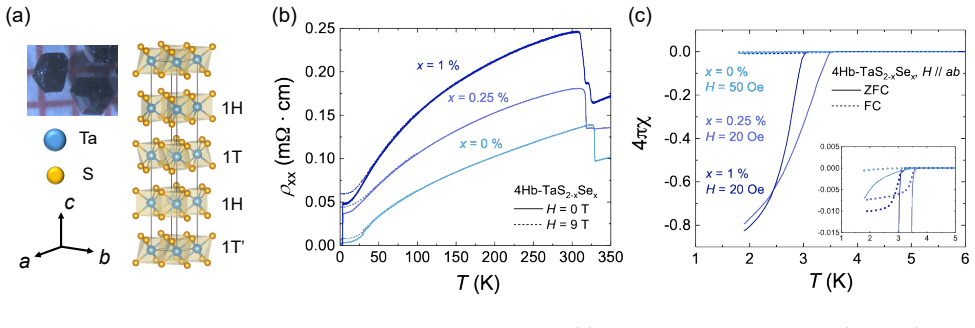
symmetry in the 1T layers [18]. The magnetization shows its own peculiarities. As shown in Fig. 1 (c), the onset of superconductivity occurs at temperatures as high asT c = 3.5 K for thex= 0.25 % sample, whereas thex= 1 % sample shows an onset at ∼3 K. However, the most important observation is the striking contrast of the volume fraction with the pristin...
-
[2]
Paschen, T
S. Paschen, T. L¨ uhmann, S. Wirth, P. Gegenwart, O. Trovarelli, C. Geibel, F. Steglich, P. Coleman, and Q. Si, Hall-effect evolution across a heavy-fermion quan- tum critical point, Nature432, 881 (2004)
2004
-
[3]
Badoux, W
S. Badoux, W. Tabis, F. Lalibert´ e, G. Grissonnanche, B. Vignolle, D. Vignolles, J. B´ eard, D. A. Bonn, W. N. Hardy, R. Liang, N. Doiron-Leyraud, L. Taillefer, and C. Proust, Change of carrier density at the pseudogap critical point of a cuprate superconductor, Nature531, 210 (2016)
2016
-
[4]
Maksimovic, D
N. Maksimovic, D. H. Eilbott, T. Cookmeyer, F. Wan, J. Rusz, V. Nagarajan, S. C. Haley, E. Maniv, A. Gong, S. Faubel, I. M. Hayes, A. Bangura, J. Singleton, J. C. Palmstrom, L. Winter, R. McDonald, S. Jang, P. Ai, Y. Lin, S. Ciocys, J. Gobbo, Y. Werman, P. M. Oppeneer, E. Altman, A. Lanzara, and J. G. Analytis, Evidence for a delocalization quantum phase ...
2022
-
[5]
J. A. Wilson, F. J. Di Salvo, and S. Mahajan, Charge- density waves in metallic, layered, transition-metal dichalcogenides, Phys. Rev. Lett.32, 882 (1974)
1974
-
[6]
C. A. Balseiro and L. M. Falicov, Superconductivity and charge-density waves, Phys. Rev. B20, 4457 (1979)
1979
-
[7]
Sipos, A
B. Sipos, A. F. Kusmartseva, A. Akrap, H. Berger, L. Forr´ o, and E. Tutiˇ s, From Mott state to supercon- ductivity in 1TTaS 2, Nat. Mater7, 960 (2008)
2008
-
[8]
Y. D. Wang, W. L. Yao, Z. M. Xin, T. T. Han, Z. G. Wang, L. Chen, C. Cai, Y. Li, and Y. Zhang, Band insu- lator to Mott insulator transitions in 1TTaS2, Nat. Com- mun.11, 4215 (2020)
2020
-
[9]
K. T. Law and P. A. Lee, 1TTaS 2 as a quantum spin liquid, Proc. Natl. Acad. Sci. U.S.A.114, 6996 (2017)
2017
-
[10]
Y. J. Yu, Y. Xu, L. P. He, M. Kratochvilova, Y. Y. Huang, J. M. Ni, L. Wang, S.-W. Cheong, J.-G. Park, and S. Y. Li, Heat transport study of the spin liquid can- didate 1TTaS2, Phys. Rev. B96, 081111 (2017)
2017
-
[11]
F. J. Di Salvo, B. G. Bagley, J. M. Voorhoeve, and J. V. Waszczak, Preparation and properties of a new polytype of tantalum disulfide 4HbTaS 2, J. Phys. Chem. Solids 34, 1357 (1973)
1973
-
[12]
Ribak, R
A. Ribak, R. Majlin Skiff, M. Mograbi, P. K. Rout, M. H. Fischer, J. Ruhman, K. Chashka, Y. Dagan, and A. Kanigel, Chiral superconductivity in the alter- nate stacking compound 4HbTaS2, Sci. Adv.6, eaax9480 (2020)
2020
-
[13]
A. K. Nayak, A. Steinbok, Y. Roet, J. Koo, G. Mar- galit, I. Feldman, A. Almoalem, A. Kanigel, G. A. Fi- ete, B. Yan, Y. Oreg, N. Avraham, and H. Beidenkopf, Evidence of topological boundary modes with topologi- cal nodal-point superconductivity, Nat. Phys.17, 1413 (2021)
2021
-
[14]
Persky, A
E. Persky, A. V. Bjø rlig, I. Feldman, A. Almoalem, E. Altman, E. Berg, I. Kimchi, J. Ruhman, A. Kanigel, and B. Kalisky, Magnetic memory and spontaneous vor- tices in a van der waals superconductor, Nature607, 692 (2022)
2022
-
[15]
Silber, S
I. Silber, S. Mathimalar, I. Mangel, A. K. Nayak, O. Green, N. Avraham, H. Beidenkopf, I. Feldman, A. Kanigel, A. Klein, M. Goldstein, A. Banerjee, E. Sela, and Y. Dagan, Two-component nematic superconductiv- ity in 4HbTaS 2, Nat. Commun.15, 824 (2024)
2024
-
[16]
Almoalem, I
A. Almoalem, I. Feldman, I. Mangel, M. Shlafman, Y. E. Yaish, M. H. Fischer, M. Moshe, J. Ruhman, and A. Kanigel, The observation ofπ-shifts in the LittleParks effect in 4HbTaS 2, Nat. Commun.15, 4623 (2024)
2024
-
[17]
J. J. Gao, J. G. Si, X. Luo, J. Yan, Z. Z. Jiang, W. Wang, Y. Y. Han, P. Tong, W. H. Song, X. B. Zhu, Q. J. Li, W. J. Lu, and Y. P. Sun, Origin of the large magnetore- 13 sistance in the candidate chiral superconductor 4HbTaS2, Phys. Rev. B102, 075138 (2020)
2020
-
[18]
F. Meng, Y. Fu, S. Pan, S. Tian, S. Yan, Z. Li, S. Wang, J. Zhang, and H. Lei, Exteme orbitalab-plane upper criti- cal fields far beyond the Pauli limit in 4HbTa(S, Se)2 bulk crystals, Phys. Rev. B109, 134510 (2024)
2024
-
[19]
S. F. Meyer, R. E. Howard, G. R. Stewart, J. V. Acrivos, and T. H. Geballe, Properties of intercalated 2H- NbSe2, 4Hb-TaS2, and 1T-TaS2, The Journal of Chemi- cal Physics62, 4411 (1975)
1975
-
[20]
Y. Yang, S. Fang, V. Fatemi, J. Ruhman, E. Navarro- Moratalla, K. Watanabe, T. Taniguchi, E. Kaxi- ras, and P. Jarillo-Herrero, Enhanced superconductiv- ity upon weakening of charge density wave transport in$2H{\text{TaS}} {2}$in the two-dimensional limit, Physical Review B98, 035203 (2018)
2018
-
[21]
Almoalem, R
A. Almoalem, R. Gofman, Y. Nitzav, I. Mangel, I. Feldman, J. Koo, F. Mazzola, J. Fujii, I. Vobornik, J. S’anchez-Barriga, O. J. Clark, N. C. Plumb, M. Shi, B. Yan, and A. Kanigel, Charge transfer and spin-valley locking in 4HbTaS 2, npj Quantum Mater.9, 36 (2024)
2024
- [22]
-
[23]
R. A. Gofman, A. Dishi, H. Bae, Y. Nitzav, I. Man- gel, N. Ragoler, S. K.P., A. Louat, M. D. Watson, C. Cacho, D. Marchenko, A. Varykhalov, I. Feldman, B. Yan, and A. Kanigel, Chiral charge density wave in 4Hb- and 1TTaS2: the role of interlayer coupling (2025), arXiv:2508.16559 [cond-mat.str-el]
-
[24]
Y. Li, L. Xu, S. Zhang, L. Liu, Y. Zhou, Q. Wan, S. Chen, S. Liang, Y. Chen, Y.-f. Yang, X. Luo, Y. Sun, N. Xu, and Z. Liu, Interlayer Coupling Driven Correlated and ChargeOrdered Electronic States in a Transition Metal Dichalcogenide Superlattice (2025), version Number: 1
2025
- [25]
-
[26]
M. D. Watson, A. Tonelli, M. Zerabza, S. Hayward, R. Wilkinson, E. Carpene, C. Cacho, V. De Renzi, S. Crampin, and E. Da Como, Folded pseudochiral Fermi surface in 4HbTaSe2 from band hybridization with a charge density wave, Communications Materials6, 24 (2025)
2025
-
[27]
F. Z. Yang, T. T. Zhang, F. Y. Meng, H. C. Lei, C. Nel- son, Y. Q. Cai, E. Vescovo, A. H. Said, P. M. Lozano, G. Fabbris, and H. Miao, Charge density waves in the 2.5-dimensional quantum heterostructure, Phys. Rev. B 111, L041101 (2025)
2025
-
[28]
F. Z. Yang, H. D. Zhang, S. Mandal, F. Y. Meng, G. Fab- bris, A. H. Said, P. M. Lozano, A. Rajapitamahuni, E. Vescovo, C. Nelson, S. Lin, Y. Park, E. M. Clements, T. Z. Ward, H.-N. Lee, H. C. Lei, C. X. Liu, and H. Miao, Signature of magnetoelectric coupling driven finite mo- mentum pairing in 3d ising superconductor, Nat. Com- mun.16, 6626 (2025)
2025
-
[29]
S. Shen, T. Qin, J. Gao, C. Wen, J. Wang, W. Wang, J. Li, X. Luo, W. Lu, Y. Sun, and S. Yan, Coexistence of Quasi-two-dimensional Superconductivity and Tunable Kondo Lattice in a van der Waals Superconductor, Chi- nese Physics Letters39, 077401 (2022)
2022
-
[30]
S. Yan, D. Iaia, E. Morosan, E. Fradkin, P. Abbamonte, and V. Madhavan, Influence of domain walls in the in- commensurate charge density wave state of Cu interca- lated 1TTiSe2, Phys. Rev. Lett.118, 106405 (2017)
2017
-
[31]
Z. Wang, J. O. Rodriguez, L. Jiao, S. Howard, M. Gra- ham, G. D. Gu, T. L. Hughes, D. K. Morr, and V. Mad- havan, Evidence for dispersing 1D Majorana channels in an iron-based superconductor, Science367, 104 (2020)
2020
-
[32]
Fazekas and E
P. Fazekas and E. Tosatti, Charge carrier localization in pure and doped 1TTaS2, Physica B+C99, 183 (1980)
1980
-
[33]
Petocchi, C
F. Petocchi, C. W. Nicholson, B. Salzmann, D. Pasquier, O. V. Yazyev, C. Monney, and P. Werner, Mott ver- sus Hybridization Gap in the LowTemperature Phase of 1TTaS2, Physical Review Letters129, 016402 (2022)
2022
-
[34]
Y. Chen, W. Ruan, M. Wu, S. Tang, H. Ryu, H.-Z. Tsai, R. L. Lee, S. Kahn, F. Liou, C. Jia, O. R. Al- bertini, H. Xiong, T. Jia, Z. Liu, J. A. Sobota, A. Y. Liu, J. E. Moore, Z.-X. Shen, S. G. Louie, S.-K. Mo, and M. F. Crommie, Strong correlations and orbital texture in single-layer 1TTaSe2, Nature Physics16, 218 (2020)
2020
-
[35]
H. Lin, W. Huang, K. Zhao, S. Qiao, Z. Liu, J. Wu, X. Chen, and S.-H. Ji, Scanning tunneling spectroscopic study of monolayer 1TTaS2 and 1TTaSe2, Nano Re- search13, 133 (2020)
2020
-
[36]
Lin, Kondo enabled transmutation between spinons and superconducting vortices Origin of magnetic memory in 4HbTaS2, Physical Review Research6, 023224 (2024)
S.-Z. Lin, Kondo enabled transmutation between spinons and superconducting vortices Origin of magnetic memory in 4HbTaS2, Physical Review Research6, 023224 (2024)
2024
-
[37]
E. J. K¨ onig, Type-II heavy Fermi liquids and the mag- netic memory of 4HbTaS2, Physical Review Research6, L012058 (2024)
2024
-
[38]
A. K. Nayak, A. Steinbok, Y. Roet, J. Koo, I. Feldman, A. Almoalem, A. Kanigel, B. Yan, A. Rosch, N. Avra- ham, and H. Beidenkopf, First-order quantum phase transition in the hybrid metal–Mott insulator transition metal dichalcogenide 4Hb-TaS 2, Proceedings of the Na- tional Academy of Sciences120, e2304274120 (2023)
2023
-
[39]
Vaˇ no, M
V. Vaˇ no, M. Amini, S. C. Ganguli, G. Chen, J. L. Lado, S. Kezilebieke, and P. Liljeroth, Artificial heavy fermions in a van der Waals heterostructure, Nature599, 582 (2021)
2021
-
[40]
Y. Fei, Z. Wu, W. Zhang, and Y. Yin, Understanding the Mott insulating state in 1T-TaS2 and 1T-TaSe2, AAPPS Bulletin32, 20 (2022)
2022
-
[41]
Gonzalez Ayani, Study of TaS2 polymorphic Van der Waals heterostructures by means of low temperature scanning tunnelling microscopy / spectrocopy, Ph.D
C. Gonzalez Ayani, Study of TaS2 polymorphic Van der Waals heterostructures by means of low temperature scanning tunnelling microscopy / spectrocopy, Ph.D. thesis, Universidad Autonoma de Madrid (2022)
2022
-
[42]
Bovet, D
M. Bovet, D. Popovic, F. Clerc, C. Koitzsch, U. Probst, E. Bucher, H. Berger, D. Naumovic, and P. Aebi, Pseu- dogapped fermi surfaces of 1ttas2 and 1ttase2 a charge density wave effect, Physical Review B69, 125117 (2004)
2004
-
[43]
R. Ang, Y. Miyata, E. Ieki, K. Nakayama, T. Sato, Y. Liu, W. J. Lu, Y. P. Sun, and T. Takahashi, Supercon- ductivity and bandwidth-controlled Mott metal-insulator transition in 1TTaS2xSex, Physical Review B88, 115145 (2013)
2013
-
[44]
R. M. Fleming, Oscillatory magnetotransport in the layer compounds 4hb-tas2 and and 2h-tase2, Physical Review B16, 302 (1977)
1977
-
[45]
L. Chen, E. Lefran¸ cois, A. Vallipuram, Q. Barth´ elemy, A. Ataei, W. Yao, Y. Li, and L. Taillefer, Planar thermal Hall effect from phonons in a Kitaev candidate material, Nat. Commun.15, 3513 (2024)
2024
-
[46]
L. Chen, L. Le Roux, G. Grissonnanche, M.-E. Boulanger, S. Th´ eriault, R. Liang, D. A. Bonn, W. N. Hardy, S. Pyon, T. Takayama, H. Takagi, K.-J. Xu, Z.- 14 X. Shen, and L. Taillefer, Planar thermal Hall effect from phonons in cuprates, Phys. Rev. X14, 041011 (2024)
2024
-
[47]
Liu, W.-Y
G.-B. Liu, W.-Y. Shan, Y. Yao, W. Yao, and D. Xiao, Three-band tight-binding model for monolayers of groupVIB transition metal dichalcogenides, Physical Re- view B88, 085433 (2013)
2013
-
[48]
Y. Geng, J. Guo, F. Meng, M. Wang, S. Mi, L. Huang, R. Xu, F. Pang, K. Liu, S. Wang, H.-J. Gao, W. Zhou, W. Ji, H. Lei, and Z. Cheng, Correlated electrons in the flat band in the charge density wave state of 4HbTaSexS2−x, Phys. Rev. B110, 115107 (2024)
2024
-
[49]
W. Yang, S. Karbasizadeh, H. Jeon, S. Hus, A. P. Bad- dorf, S. Mu, T. Berlijn, H. Zhou, W. Ko, and A.-P. Li, Nanoscale modulation of flat bands via controllable charge density wave defects in 4HbTaS2, Physical Review B112, 245126 (2025)
2025
-
[50]
Moser, An experimentalist’s guide to the matrix ele- ment in angle resolved photoemission, Journal of Elec- tron Spectroscopy and Related Phenomena214, 29 (2017)
S. Moser, An experimentalist’s guide to the matrix ele- ment in angle resolved photoemission, Journal of Elec- tron Spectroscopy and Related Phenomena214, 29 (2017)
2017
-
[51]
M. D. N´ u˜ nez Regueiro, J. M. Lopez-Castillo, and C. Ay- ache, Thermal conductivity of 1TTaS 2 and 2HTaS 2, Phys. Rev. Lett.55, 1931 (1985)
1931
-
[52]
Chen, M.-E
L. Chen, M.-E. Boulanger, Z.-C. Wang, F. Tafti, and L. Taillefer, Large phonon thermal Hall conductivity in the antiferromagnetic insulator Cu 3TeO6, Proc. Natl. Acad. Sci. U.S.A.119, e2208016119 (2022). 15 -1.5 -1 -0.5 0 0.5 1 1.5 VBias [meV] 0 0.2 0.4 0.6 0.8 1 1.2dI/dV [a.u] 1 Å-1 I II III III II I -1.5 -1 -0.5 0 0.5 1 1.5 VBias [meV] 0 0.2 0.4 0.6 0.8...
2022
discussion (0)
Sign in with ORCID, Apple, or X to comment. Anyone can read and Pith papers without signing in.