Bidirectional Semantic Complementary Tool Retrieval for Remote Sensing Agents
Pith reviewed 2026-07-01 08:37 UTC · model grok-4.3
The pith
Bidirectional semantic complementary retrieval overcomes asymmetry between natural language queries and tool documentation for remote sensing agents.
A machine-rendered reading of the paper's core claim, the machinery that carries it, and where it could break.
Core claim
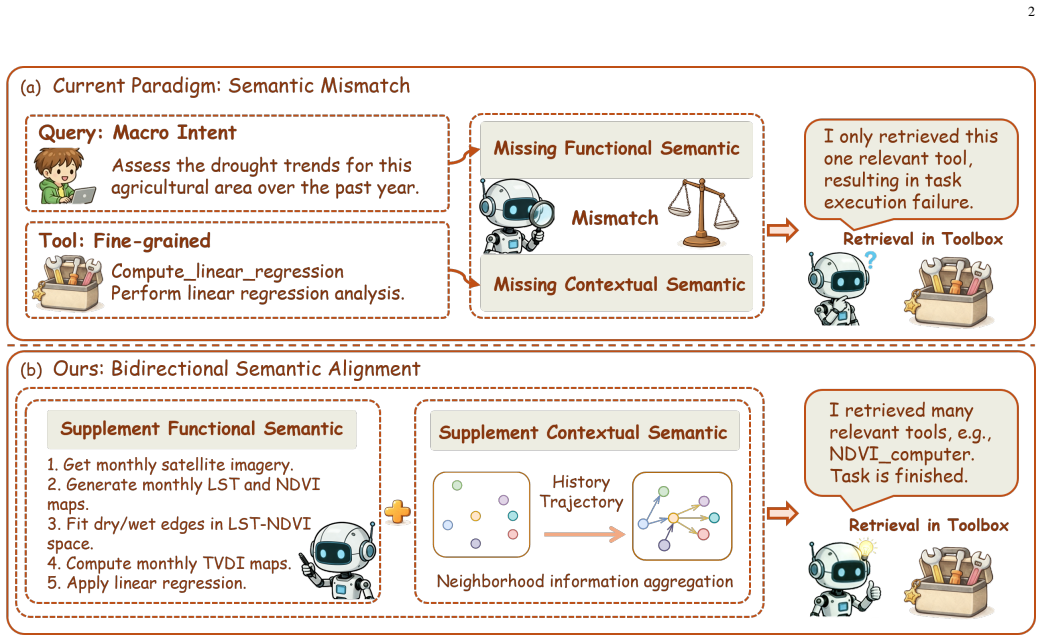
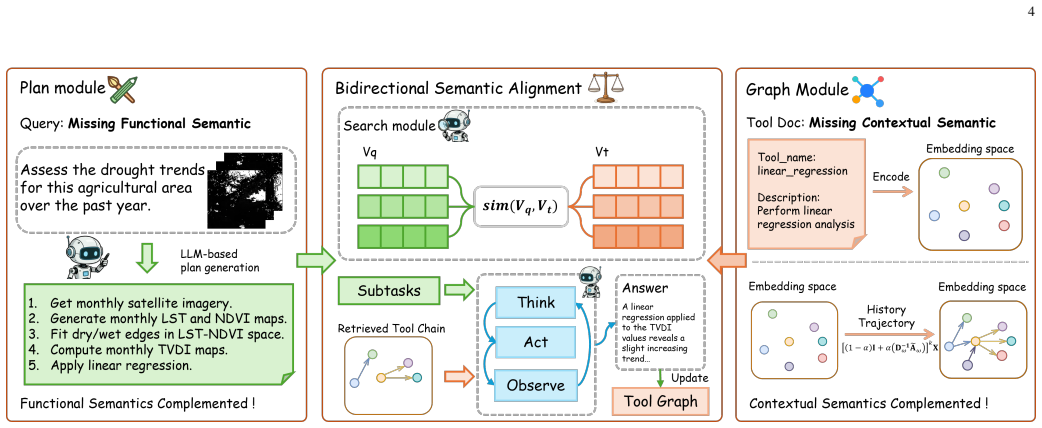
The bidirectional mechanism first applies planning-based query enhancement to decompose abstract intentions into logical subtasks that inject functional semantics, then builds a dynamic tool dependency graph whose neighborhood aggregation injects precursor-tool context into each node's embedding, jointly closing the semantic asymmetry and raising retrieval precision for chained remote-sensing workflows.
What carries the argument
Bidirectional semantic complementary retrieval: planning-based query enhancement on the query side plus neighborhood aggregation over a dynamic tool dependency graph on the tool side.
If this is right
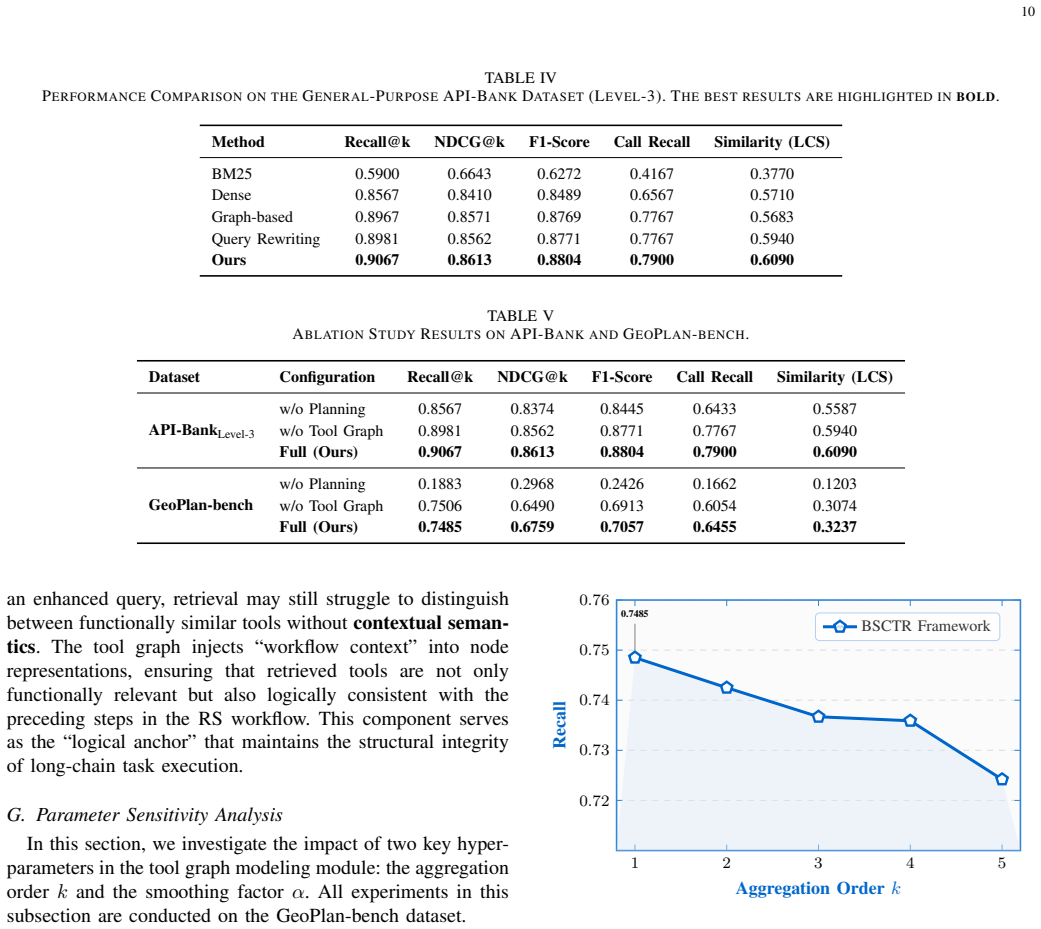
- Tool retrieval accuracy rises measurably on complex remote-sensing tasks in GeoPlan-bench.
- The same approach transfers to general-domain tool retrieval on API-Bank without domain-specific retraining.
- Strongly coupled RS tool chains receive explicit contextual semantics through the dependency graph.
- Agents can select precise tools even when full documentation exceeds the LLM context window.
Where Pith is reading between the lines
- The same query-planning plus graph-aggregation pattern may apply to other agent settings where user goals are abstract and tools are technical.
- Continual updates to the dependency graph could let agents incorporate new tools without rebuilding embeddings from scratch.
- Lower context-window pressure from better retrieval could reduce token usage and latency in long agent sessions.
Load-bearing premise
Semantic asymmetry between queries and tool documentation is the dominant retrieval bottleneck, and the two proposed mechanisms close the gap without creating new mismatches.
What would settle it
If the method is run on GeoPlan-bench and shows no statistically significant accuracy lift over standard retrieval baselines, the claim that the bidirectional enhancements solve the asymmetry problem would be falsified.
Figures
read the original abstract
Large language model (LLM)-based agents provide a novel paradigm for the automated processing of remote sensing(RS) data. Their success in complex RS tasks rely on extensive specialized tool libraries. However, tool documentation often exceeds the context window limits of LLMs, making precise tool retrieval essential for agentic workflows. Existing tool retrieval methods face "semantic asymmetry" bottleneck: natural language queries typically express macro-level intentions lacking tool-specific semantics, while tool documentation provides fine-grained technical descriptions lacking operational context for workflows. To bridge this semantic gap, this paper proposes a bidirectional semantic complementary tool retrieval method. First, on the query side, we introduce a planning-based query enhancement mechanism that leverages the reasoning capabilities of agents to decompose abstract intentions into logical subtasks, thereby actively supplementing the query with missing functional semantics. Second, on the tool side, addressing the strong coupling characteristics of RS tool chains, we construct a dynamic tool dependency graph with continual learning capabilities. By employing a neighborhood information aggregation mechanism, contextual information from precursor tools is explicitly injected into the current node representation, enriching tool descriptions with contextual semantics. Experimental results on the RS dataset GeoPlan-bench and the general-purpose dataset API- Bank demonstrate that the proposed method not only significantly improves tool retrieval accuracy for complex RS tasks but also exhibits robust extensibility for transfer to general-domain tasks. The source code and dataset are available at https://github.com/geox-lab/BSCTR.
Editorial analysis
A structured set of objections, weighed in public.
Referee Report
Summary. The paper claims that existing tool retrieval methods suffer from a 'semantic asymmetry' bottleneck between macro-level natural language queries and fine-grained tool documentation. It proposes a bidirectional semantic complementary tool retrieval (BSCTR) approach: (1) a planning-based query enhancement mechanism that uses agent reasoning to decompose intentions into logical subtasks, and (2) a dynamic tool dependency graph with continual learning and neighborhood aggregation to inject precursor-tool context into tool representations. Experiments on the RS-specific GeoPlan-bench and the general API-Bank dataset are asserted to demonstrate significant accuracy gains for complex RS tasks plus robust transferability to general domains.
Significance. If the claimed accuracy improvements and transfer results hold under rigorous evaluation, the work would address a practical bottleneck in LLM-based agents for remote sensing workflows, where tool libraries are large and chained. The bidirectional framing (query planning plus graph-based context) is a reasonable response to the asymmetry problem and could generalize beyond RS if the mechanisms prove robust.
major comments (3)
- [Abstract] Abstract: The central claim of 'significantly improves tool retrieval accuracy' on GeoPlan-bench and API-Bank supplies no numerical metrics, baselines, statistical tests, error bars, or dataset statistics. Without these, the magnitude, reliability, and reproducibility of the reported gains cannot be assessed.
- [Abstract] Abstract (method description): The query-side planning step assumes LLM decomposition will reliably add functional semantics without introducing hallucinations or incorrect subtasks, yet no ablation, error analysis, or failure-case discussion is referenced to support this assumption.
- [Abstract] Abstract (method description): The tool-side dynamic dependency graph with 'continual learning' and neighborhood aggregation is presented as addressing strong coupling in RS tool chains, but the abstract provides no implementation details on graph construction, update mechanism, or how aggregation avoids diluting representations or creating spurious edges.
minor comments (2)
- [Abstract] The GitHub link is provided, but the abstract does not indicate whether the released code includes the exact experimental configurations, dataset splits, or hyper-parameters used for the reported results.
- [Abstract] The term 'semantic asymmetry' is introduced without a formal definition or quantitative measure of the asymmetry (e.g., embedding distance statistics between queries and tools).
Simulated Author's Rebuttal
We thank the referee for the detailed and constructive comments on our manuscript. We address each major comment below and outline the revisions we will make to strengthen the presentation, particularly in the abstract.
read point-by-point responses
-
Referee: [Abstract] Abstract: The central claim of 'significantly improves tool retrieval accuracy' on GeoPlan-bench and API-Bank supplies no numerical metrics, baselines, statistical tests, error bars, or dataset statistics. Without these, the magnitude, reliability, and reproducibility of the reported gains cannot be assessed.
Authors: We agree that the abstract would be strengthened by including key quantitative results. In the revised manuscript, we will update the abstract to report specific accuracy improvements (e.g., top-1 and top-5 retrieval gains over baselines), the primary evaluation metrics, and dataset sizes for both GeoPlan-bench and API-Bank. Full statistical tests, error bars, and complete dataset statistics remain in the experimental section (Section 4) and will be referenced. revision: yes
-
Referee: [Abstract] Abstract (method description): The query-side planning step assumes LLM decomposition will reliably add functional semantics without introducing hallucinations or incorrect subtasks, yet no ablation, error analysis, or failure-case discussion is referenced to support this assumption.
Authors: The assumption is supported by ablations in Section 4.3, which isolate the contribution of the planning-based enhancement and show consistent gains without degradation attributable to hallucinations. We will revise the abstract to briefly note that the mechanism is validated through controlled experiments. A more detailed error analysis and failure cases are already present in the main text and supplementary material; we can add a one-sentence pointer in the abstract if space allows. revision: partial
-
Referee: [Abstract] Abstract (method description): The tool-side dynamic dependency graph with 'continual learning' and neighborhood aggregation is presented as addressing strong coupling in RS tool chains, but the abstract provides no implementation details on graph construction, update mechanism, or how aggregation avoids diluting representations or creating spurious edges.
Authors: Implementation details for graph construction, the continual learning update rule, and the neighborhood aggregation (including safeguards against dilution and spurious edges) are provided in Section 3.2. We will revise the abstract to include a concise clause indicating that the graph is built dynamically from tool co-occurrence patterns with explicit aggregation controls. This addresses the brevity concern without altering the technical content. revision: yes
Circularity Check
No circularity: method is a new construction evaluated on external benchmarks
full rationale
The paper introduces a bidirectional retrieval approach consisting of planning-based query enhancement on the query side and neighborhood aggregation over a dynamic tool dependency graph on the tool side. No equations, fitted parameters, or self-citations appear in the provided text that would reduce any claimed accuracy gain to a definitional identity or to a prior result by the same authors. The central claims rest on experimental evaluation against the external datasets GeoPlan-bench and API-Bank rather than on any internal re-labeling or self-referential fitting, rendering the derivation self-contained.
Axiom & Free-Parameter Ledger
axioms (1)
- domain assumption Semantic asymmetry between macro-level queries and fine-grained tool documentation is the main retrieval bottleneck in RS agent workflows.
Reference graph
Works this paper leans on
-
[1]
React: Synergizing reasoning and acting in language models,
S. Yao, J. Zhao, D. Yu, N. Du, I. Shafran, K. R. Narasimhan, and Y . Cao, “React: Synergizing reasoning and acting in language models,” inThe eleventh international conference on learning representations, 2022
2022
-
[2]
Plan-and-Solve Prompting: Improving Zero-Shot Chain-of-Thought Reasoning by Large Language Models
L. Wang, W. Xu, Y . Lan, Z. Hu, Y . Lan, R. K.-W. Lee, and E.-P. Lim, “Plan-and-solve prompting: Improving zero-shot chain-of-thought reasoning by large language models,”arXiv preprint arXiv:2305.04091, 2023
work page internal anchor Pith review Pith/arXiv arXiv 2023
-
[3]
RS- Agent: Automating remote sensing tasks through intelligent agent,
W. Xu, Z. Yu, B. Mu, Z. Wei, Y . Zhang, G. Li, and M. Peng, “Rs- agent: Automating remote sensing tasks through intelligent agent,”arXiv preprint arXiv:2406.07089, 2024
-
[4]
Designing domain-specific agents via hierarchical task abstraction mechanism,
K. Li, J. Wang, Z. Wang, H. Qiao, W. Zhang, D. Meng, and X. Cao, “Designing domain-specific agents via hierarchical task abstraction mechanism,”arXiv preprint arXiv:2511.17198, 2025
-
[5]
Tool Learning with Foundation Models
Y . Qin, S. Hu, Y . Lin, W. Chen, N. Ding, G. Cui, Z. Zeng, Y . Huang, C. Xiao, C. Han, Y . R. Fung, Y . Su, H. Wang, C. Qian, R. Tian, K. Zhu, S. Liang, X. Shen, B. Xu, Z. Zhang, Y . Ye, B. Li, Z. Tang, J. Yi, Y . Zhu, Z. Dai, L. Yan, X. Cong, Y . Lu, W. Zhao, Y . Huang, J. Yan, X. Han, X. Sun, D. Li, J. Phang, C. Yang, T. Wu, H. Ji, Z. Liu, and M. Sun, ...
work page internal anchor Pith review Pith/arXiv arXiv 2024
-
[6]
(2025, Feb) Benchmarking single agent performance
LangChain Team. (2025, Feb) Benchmarking single agent performance. Accessed: YYYY-MM-DD. [Online]. Available: https://blog.langchain. com/react-agent-benchmarking/
2025
-
[7]
Gorilla: Large language model connected with massive apis,
S. G. Patil, T. Zhang, X. Wang, and J. E. Gonzalez, “Gorilla: Large language model connected with massive apis,”Advances in Neural Information Processing Systems, vol. 37, pp. 126 544–126 565, 2024
2024
-
[8]
ToolLLM: Facilitating Large Language Models to Master 16000+ Real-world APIs
Y . Qin, S. Liang, Y . Ye, K. Zhu, L. Yan, Y . Lu, Y . Lin, X. Cong, X. Tang, B. Qianet al., “Toolllm: Facilitating large language models to master 16000+ real-world apis,”arXiv preprint arXiv:2307.16789, 2023
work page internal anchor Pith review Pith/arXiv arXiv 2023
-
[9]
Foundations of the theory of signs,
C. W. Morris, “Foundations of the theory of signs,” inInternational encyclopedia of unified science. Chicago University Press, 1938, pp. 1–59
1938
-
[10]
Toolreagt: tool retrieval for llm-based complex task solution via retrieval augmented generation,
N. Braunschweiler, R. Doddipatla, and T.-C. Zorila, “Toolreagt: tool retrieval for llm-based complex task solution via retrieval augmented generation,” inProceedings of the 3rd Workshop on Towards Knowl- edgeable Foundation Models (KnowFM), 2025, pp. 75–83
2025
-
[11]
Improving tool retrieval by leveraging large language models for query generation,
M. Kachuee, S. Ahuja, V . Kumar, P. Xu, and X. Liu, “Improving tool retrieval by leveraging large language models for query generation,” inProceedings of the 31st International Conference on Computational Linguistics: Industry Track, 2025, pp. 29–38
2025
-
[12]
Toolnet: Connecting large language models with massive tools via tool graph,
X. Liu, Z. Peng, X. Yi, X. Xie, L. Xiang, Y . Liu, and D. Xu, “Toolnet: Connecting large language models with massive tools via tool graph,” arXiv preprint arXiv:2403.00839, 2024
-
[13]
E. Lumer, P. H. Basavaraju, M. Mason, J. A. Burke, and V . K. Subbiah, “Graph rag-tool fusion,”arXiv preprint arXiv:2502.07223, 2025
-
[14]
Simplifying graph convolutional networks,
F. Wu, A. Souza, T. Zhang, C. Fifty, T. Yu, and K. Weinberger, “Simplifying graph convolutional networks,” inInternational conference on machine learning. Pmlr, 2019, pp. 6861–6871
2019
-
[15]
Api-bank: A comprehensive benchmark for tool-augmented llms,
M. Li, Y . Zhao, B. Yu, F. Song, H. Li, H. Yu, Z. Li, F. Huang, and Y . Li, “Api-bank: A comprehensive benchmark for tool-augmented llms,” in Proceedings of the 2023 conference on empirical methods in natural language processing, 2023, pp. 3102–3116
2023
-
[16]
Geochat: Grounded large vision-language model for remote sensing,
K. Kuckreja, M. S. Danish, M. Naseer, A. Das, S. Khan, and F. S. Khan, “Geochat: Grounded large vision-language model for remote sensing,” inProceedings of the IEEE/CVF Conference on Computer Vision and Pattern Recognition, 2024, pp. 27 831–27 840
2024
-
[17]
Earthgpt: A universal multimodal large language model for multisensor image comprehension in remote sensing domain,
W. Zhang, M. Cai, T. Zhang, Y . Zhuang, and X. Mao, “Earthgpt: A universal multimodal large language model for multisensor image comprehension in remote sensing domain,”IEEE Transactions on Geo- science and Remote Sensing, vol. 62, pp. 1–20, 2024
2024
-
[18]
Allspark: A multimodal spatio-temporal general intelligence model with ten modalities via language as a reference framework,
R. Shao, C. Yang, Q. Li, L. Xu, X. Yang, X. Li, M. Li, Q. Zhu, Y . Zhang, Y . Liet al., “Allspark: A multimodal spatio-temporal general intelligence model with ten modalities via language as a reference framework,”IEEE Transactions on Geoscience and Remote Sensing, 2025
2025
-
[19]
Earth-agent: Unlocking the full landscape of earth observation with agents,
P. Feng, Z. Lv, J. Ye, X. Wang, X. Huo, J. Yu, W. Xu, W. Zhang, L. Bai, C. He, and W. Li, “Earth-agent: Unlocking the full landscape of earth observation with agents,” 2026. [Online]. Available: https://arxiv.org/abs/2509.23141
-
[20]
Geogpt: An assistant for understanding and processing geospatial tasks,
Y . Zhang, C. Wei, Z. He, and W. Yu, “Geogpt: An assistant for understanding and processing geospatial tasks,”International Journal of Applied Earth Observation and Geoinformation, vol. 131, p. 103976, 2024
2024
-
[21]
Chain-of-thought prompting elicits reasoning in large language models,
J. Wei, X. Wang, D. Schuurmans, M. Bosma, F. Xia, E. Chi, Q. V . Le, D. Zhouet al., “Chain-of-thought prompting elicits reasoning in large language models,”Advances in neural information processing systems, vol. 35, pp. 24 824–24 837, 2022
2022
-
[22]
Llm-planner: Few-shot grounded planning for embodied agents with large language models,
C. H. Song, J. Wu, C. Washington, B. M. Sadler, W.-L. Chao, and Y . Su, “Llm-planner: Few-shot grounded planning for embodied agents with large language models,” inProceedings of the IEEE/CVF international conference on computer vision, 2023, pp. 2998–3009
2023
-
[23]
Tree of thoughts: Deliberate problem solving with large language models,
S. Yao, D. Yu, J. Zhao, I. Shafran, T. Griffiths, Y . Cao, and K. Narasimhan, “Tree of thoughts: Deliberate problem solving with large language models,”Advances in neural information processing systems, vol. 36, pp. 11 809–11 822, 2023
2023
-
[24]
Re-invoke: Tool invocation rewriting for zero- shot tool retrieval,
Y . Chen, J. Yoon, D. S. Sachan, Q. Wang, V . Cohen-Addad, M. Bateni, C.-Y . Lee, and T. Pfister, “Re-invoke: Tool invocation rewriting for zero- shot tool retrieval,”arXiv preprint arXiv:2408.01875, 2024
-
[25]
Tooldreamer: Instilling llm reasoning into tool retrievers,
S. Sengupta, Z. Zhou, J. Araki, X. Wang, B. Wang, S. Wang, and Z. Feng, “Tooldreamer: Instilling llm reasoning into tool retrievers,” arXiv preprint arXiv:2510.19791, 2025
-
[26]
Autotool: Efficient tool selection for large language model agents,
J. Jia and Q. Li, “Autotool: Efficient tool selection for large language model agents,”arXiv preprint arXiv:2511.14650, 2025
-
[27]
Scitoolagent: a knowledge-graph-driven scientific agent for multitool integration,
K. Ding, J. Yu, J. Huang, Y . Yang, Q. Zhang, and H. Chen, “Scitoolagent: a knowledge-graph-driven scientific agent for multitool integration,” Nature Computational Science, vol. 5, no. 10, pp. 962–972, 2025
2025
-
[28]
Tool graph retriever: Exploring dependency graph-based tool retrieval for large language models,
L. Gao, Y . Wang, M. Peng, J. Tang, Y . Shang, M. Sun, and J. Su, “Tool graph retriever: Exploring dependency graph-based tool retrieval for large language models,”arXiv preprint arXiv:2508.05152, 2025
-
[29]
Semi-Supervised Classification with Graph Convolutional Networks
T. Kipf, “Semi-supervised classification with graph convolutional net- works,”arXiv preprint arXiv:1609.02907, 2016
work page internal anchor Pith review Pith/arXiv arXiv 2016
-
[30]
Predict then propagate: Graph neural networks meet personalized pagerank,
J. Gasteiger, A. Bojchevski, and S. G ¨unnemann, “Predict then propagate: Graph neural networks meet personalized pagerank,”arXiv preprint arXiv:1810.05997, 2018. 13
-
[31]
Reciprocal rank fusion outperforms condorcet and individual rank learning methods,
G. V . Cormack, C. L. Clarke, and S. Buettcher, “Reciprocal rank fusion outperforms condorcet and individual rank learning methods,” inProceedings of the 32nd international ACM SIGIR conference on Research and development in information retrieval, 2009, pp. 758–759
2009
-
[32]
Robertson and H
S. Robertson and H. Zaragoza,The probabilistic relevance framework: BM25 and beyond. Now Publishers Inc, 2009, vol. 4
2009
-
[33]
Dense passage retrieval for open-domain question answering,
V . Karpukhin, B. Oguz, S. Min, P. Lewis, L. Wu, S. Edunov, D. Chen, and W.-t. Yih, “Dense passage retrieval for open-domain question answering,” inProceedings of the 2020 conference on empirical methods in natural language processing (EMNLP), 2020, pp. 6769–6781
2020
-
[34]
DeepSeek-V3.2: Pushing the Frontier of Open Large Language Models
A. Liu, A. Mei, B. Lin, B. Xue, B. Wang, B. Xu, B. Wu, B. Zhang, C. Lin, C. Donget al., “Deepseek-v3.2: Pushing the frontier of open large language models,”arXiv preprint arXiv:2512.02556, 2025
work page internal anchor Pith review Pith/arXiv arXiv 2025
discussion (0)
Sign in with ORCID, Apple, or X to comment. Anyone can read and Pith papers without signing in.