Evolution of Coronal Mass Ejection Properties through Superposed Epoch Analysis from 0.2 to 2.2 au
Pith reviewed 2026-06-29 19:24 UTC · model grok-4.3
The pith
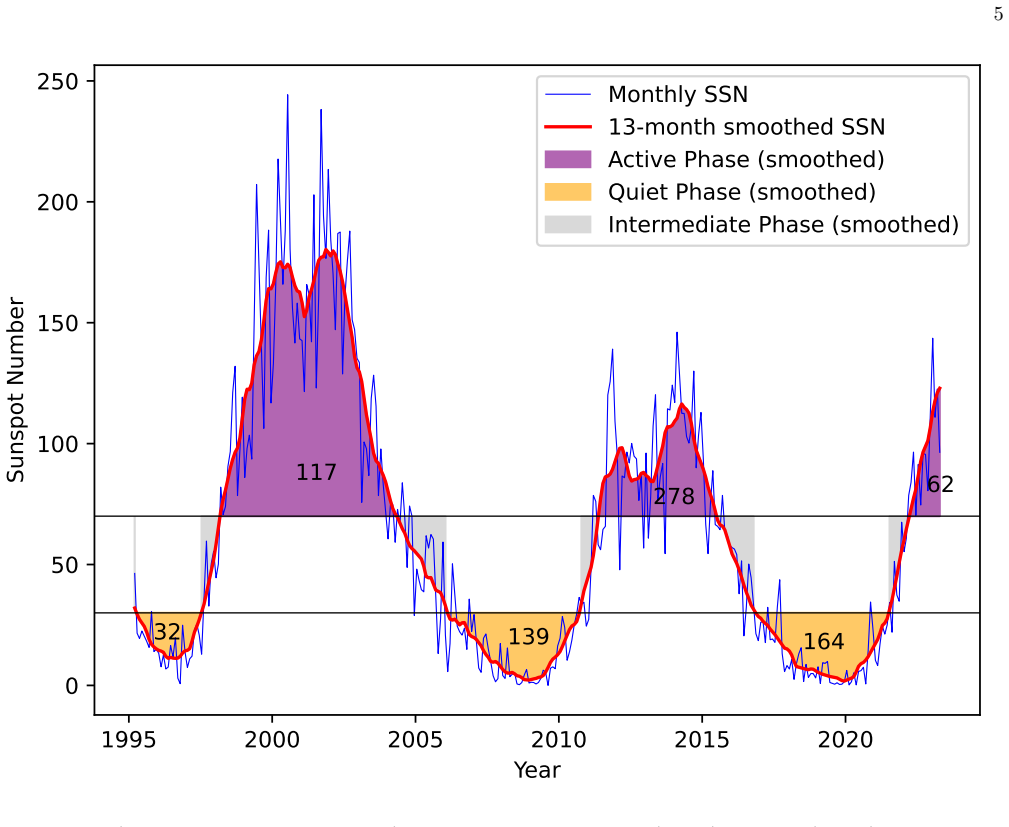
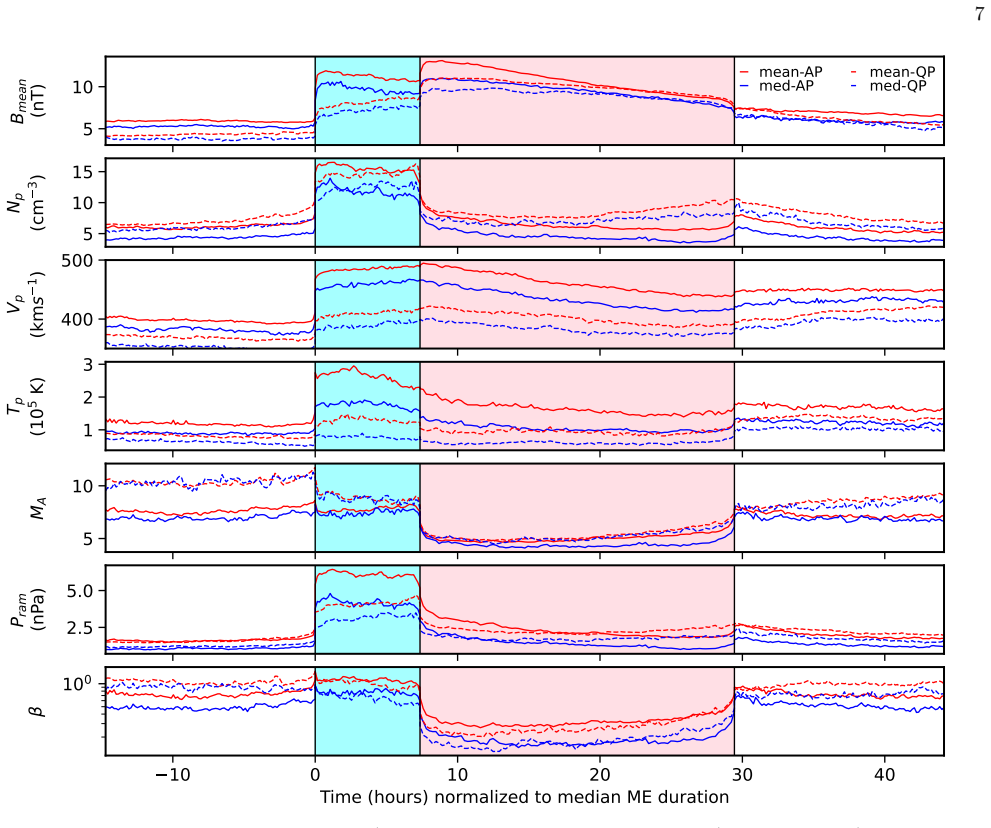
CMEs in the active solar cycle phase are faster with stronger magnetic fields than quiet-phase events, even after matching speeds.
A machine-rendered reading of the paper's core claim, the machinery that carries it, and where it could break.
Core claim
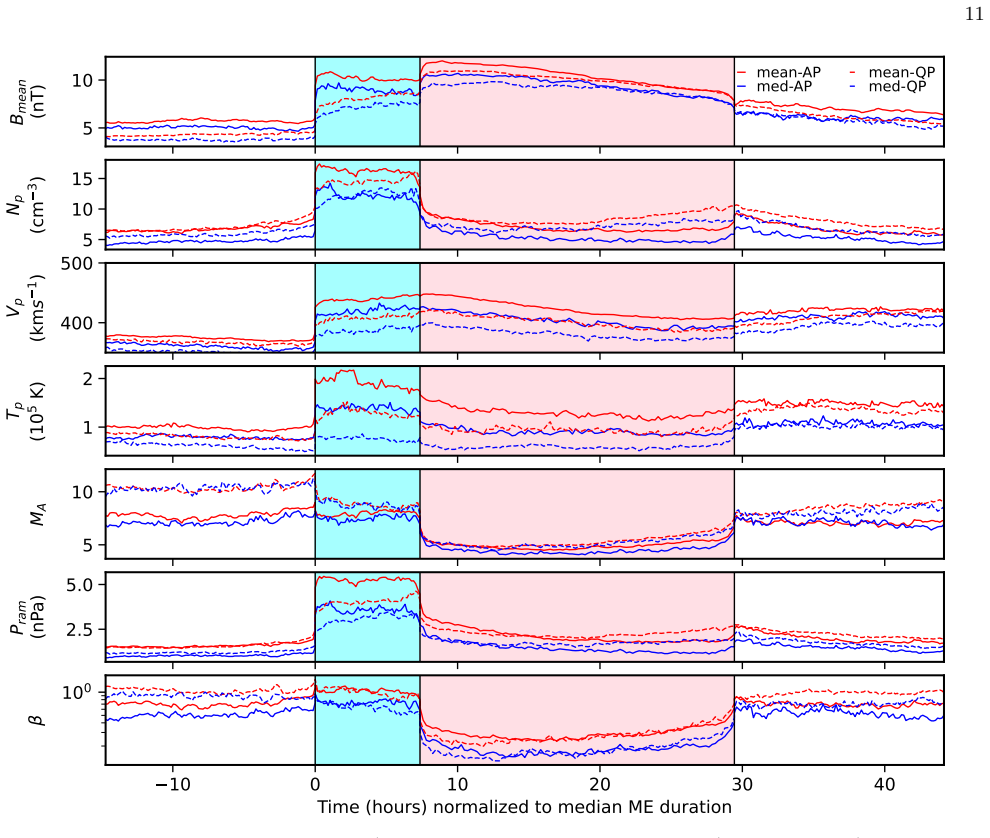
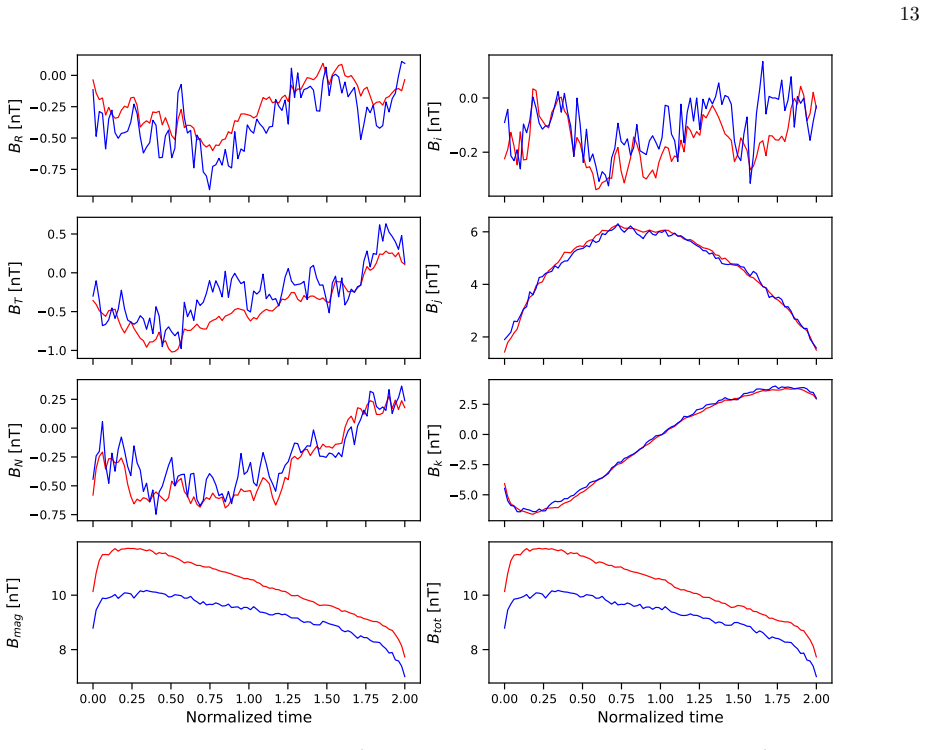
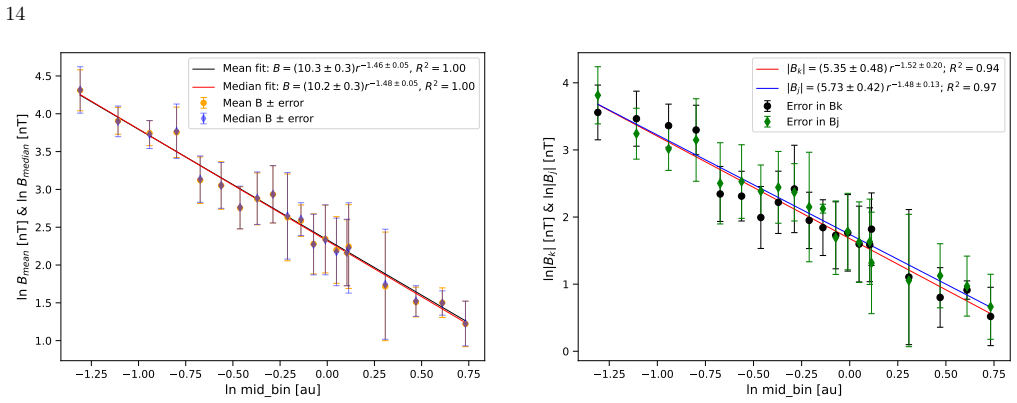
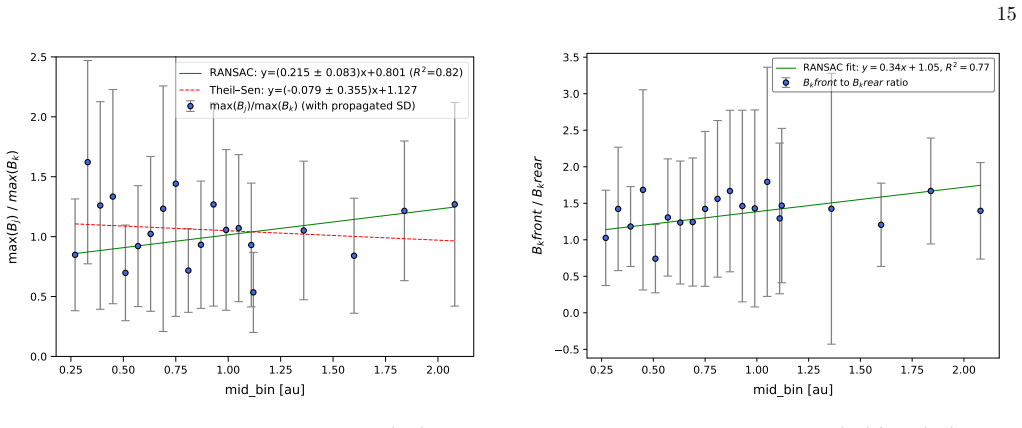
During the active phase of the solar cycle, occurring CMEs are faster and have stronger magnetic field strength than during the quiet phase, which has denser but weaker magnetic strength. These differences in magnetic field strength and density remain even when controlling for the speed. This may indicate that the enhanced profiles observed during the active phase are not only a consequence of the CME propagation speed but may also reflect intrinsic differences in the eruption mechanism during different solar cycle phases. The toroidal and poloidal magnetic ejecta components decrease with similar power laws in distance, and the front-to-rear ratio of the toroidal component rises with helioce
What carries the argument
Superposed epoch analysis performed on the HELIO4CAST catalog of over 1600 CME events, with separation by active versus quiet solar cycle phase and tracking of magnetic field component evolution versus heliocentric distance.
If this is right
- CME magnetic field strength and density profiles differ between solar cycle phases beyond what propagation speed alone can explain.
- Toroidal and poloidal components of the magnetic ejecta expand at comparable rates with distance.
- Front-to-rear magnetic asymmetry inside CMEs grows systematically outward from the Sun.
- Eruption models may need to include solar cycle phase as a controlling variable for initial CME properties.
Where Pith is reading between the lines
- Forecast models could gain accuracy by conditioning expected CME magnetic strength on the current phase of the solar cycle.
- Multi-spacecraft data sets that sample the same CME at different distances could test whether the observed phase differences persist beyond 2 au.
- Linking these in-situ trends to photospheric or coronal source-region properties could clarify how the solar dynamo modulates eruption mechanisms.
Load-bearing premise
The catalog events form an unbiased sample across heliocentric distances and solar cycle phases, and matching solely on speed is enough to separate intrinsic eruption differences from propagation effects.
What would settle it
A larger or independent catalog in which magnetic field strength and density differences vanish after events are matched on both speed and distance would falsify the claim of phase-dependent intrinsic properties.
Figures
read the original abstract
Coronal mass ejections (CMEs) are explosive and energetic events consisting of strong magnetic structures erupting from the solar corona. We use superposed epoch analysis to investigate the general properties of CMEs as measured {\it in situ} from 0.2 to 2.2 au based on over 1600 events obtained from the HELIO4CAST catalog. We examine the dependence of the CME global properties on solar cycle phase, and compare the CME parameters derived in the active phase (AP) with the quiet phase (QP). Our findings show that during the AP of the solar cycle, the occurring CMEs are faster and have stronger magnetic field strength than during the QP, which has denser but weaker magnetic strength. These differences in magnetic field strength and density remain even when controlling for the speed. This may indicate that the enhanced profiles observed during the AP are not only a consequence of the CME propagation speed but may also reflect intrinsic differences in the eruption mechanism during different solar cycle phases. We also study how the magnetic field strength and components of the CME magnetic ejecta (ME) structure evolve with heliocentric distance. We find that the toroidal and poloidal ME magnetic field components have a similar power law decrease with distance, indicating a comparable expansion behavior of CMEs in these dimensions. We further quantify the CME magnetic field asymmetry %(often associated with CME aging) using the front-to-rear ratio of the toroidal component across heliocentric distance and find evidence of an increase of this ratio with heliocentric distance.
Editorial analysis
A structured set of objections, weighed in public.
Referee Report
Summary. The paper applies superposed epoch analysis to over 1600 in-situ CME events from the HELIO4CAST catalog spanning 0.2–2.2 au. It reports that active-phase (AP) CMEs are faster and have stronger magnetic fields than quiet-phase (QP) CMEs, which are denser but weaker in |B|; these |B| and density differences persist after speed matching. The work also examines radial evolution of toroidal and poloidal magnetic field components in the magnetic ejecta, finding similar power-law declines with distance and an increasing front-to-rear toroidal asymmetry.
Significance. If robust, the results would indicate that solar-cycle phase affects CME eruption properties intrinsically rather than solely through propagation speed, with implications for heliospheric modeling and space-weather prediction. The large event sample and multi-spacecraft radial coverage are strengths; the finding of comparable toroidal/poloidal expansion is a useful observational constraint.
major comments (2)
- [Methods] Methods: The speed-matching procedure between AP and QP events, including binning details, matching criteria, and any statistical significance tests on the residual |B| and density differences, is not described. This is load-bearing for the central claim that differences reflect intrinsic eruption variations rather than propagation effects.
- [Data] Data selection: No completeness estimates, distance-dependent detection thresholds, or phase-dependent weighting are provided for the HELIO4CAST catalog. Systematic variations in event detection probability with heliocentric distance or cycle phase would confound the speed-matched AP–QP comparison.
minor comments (2)
- [Abstract] The abstract states clear findings but omits any mention of error bars or uncertainty quantification on the reported differences.
- Figure captions should explicitly state the number of events contributing to each superposed-epoch profile and the averaging window used.
Simulated Author's Rebuttal
We thank the referee for their constructive and detailed review. The comments highlight important areas where additional methodological transparency and discussion of data limitations will strengthen the manuscript. We address each major comment below and will incorporate the requested details in the revised version.
read point-by-point responses
-
Referee: [Methods] Methods: The speed-matching procedure between AP and QP events, including binning details, matching criteria, and any statistical significance tests on the residual |B| and density differences, is not described. This is load-bearing for the central claim that differences reflect intrinsic eruption variations rather than propagation effects.
Authors: We agree that the speed-matching procedure must be described in full detail to support the central claim. In the revised manuscript we will expand the Methods section to specify the speed binning (width and centering), the exact matching algorithm (e.g., nearest-neighbor within bins or propensity-score matching), the number of matched pairs retained, and the statistical tests (including p-values or confidence intervals) applied to the residual |B| and density differences after matching. These additions will make the control for propagation speed explicit and reproducible. revision: yes
-
Referee: [Data] Data selection: No completeness estimates, distance-dependent detection thresholds, or phase-dependent weighting are provided for the HELIO4CAST catalog. Systematic variations in event detection probability with heliocentric distance or cycle phase would confound the speed-matched AP–QP comparison.
Authors: We acknowledge that a quantitative treatment of catalog completeness is needed. In the revision we will add a dedicated paragraph on data selection that (i) reports any completeness estimates supplied with the HELIO4CAST catalog, (ii) discusses distance-dependent detection thresholds with reference to the underlying spacecraft instrumentation and prior studies, and (iii) examines whether phase-dependent weighting is required or feasible. Where quantitative estimates are unavailable we will state the limitation explicitly and describe any qualitative checks performed to assess robustness of the AP–QP comparison. revision: yes
Circularity Check
No circularity; purely empirical catalog analysis
full rationale
The paper conducts superposed epoch analysis on >1600 in-situ events drawn from the HELIO4CAST catalog, reporting direct statistical comparisons of CME speed, |B|, density, and magnetic-component power-law indices between active/quiet solar-cycle phases and across heliocentric distance. No equations, fitted functional forms, or self-citations are invoked to generate the reported differences; all quantities are measured observables summarized by averaging. The central claim that AP/QP distinctions persist after speed matching is therefore an empirical statement about the catalog sample, not a quantity forced by construction or by prior author work. This is the normal, non-circular outcome for an observational study.
Axiom & Free-Parameter Ledger
axioms (2)
- domain assumption The HELIO4CAST catalog provides a representative sample of CME events across the heliocentric distances and solar cycle phases studied.
- standard math Superposed epoch analysis can reveal intrinsic average properties when events are aligned at a common reference point and optionally matched on speed.
Reference graph
Works this paper leans on
-
[1]
2025, SSRv, 221, 12, doi: 10.1007/s11214-025-01138-w
Al-Haddad, N., & Lugaz, N. 2025, SSRv, 221, 12, doi: 10.1007/s11214-025-01138-w
-
[2]
Alexander, D., Richardson, I. G., & Zurbuchen, T. H. 2006, in Coronal Mass Ejections, ed. H. Kunow, N. U. Crooker, J. A. Linker, R. Schwenn, & R. von Steiger, Vol. 21 (Springer), 3–21, doi: 10.1007/978-0-387-45088-9 1
-
[3]
Banu, S. A., Winslow, R. M., Scolini, C., et al. 2024, ApJ, 976, 79, doi: 10.3847/1538-4357/ad833e
-
[4]
Berdichevsky, D. B., Lepping, R. P., & Farrugia, C. J. 2003, PhRvE, 67, 036405, doi: 10.1103/PhysRevE.67.036405
-
[5]
Borrini, G., Gosling, J. T., Bame, S. J., & Feldman, W. C. 1982, J. Geophys. Res., 87, 7370, doi: 10.1029/JA087iA09p07370
-
[6]
1998, Annales Geophysicae, 16, 1, doi: 10.1007/s00585-997-0001-x
Bothmer, V., & Schwenn, R. 1998, Annales Geophysicae, 16, 1, doi: 10.1007/s00585-997-0001-x
-
[7]
Burlaga, L., Sittler, E., Mariani, F., & Schwenn, R. 1981, J. Geophys. Res., 86, 6673, doi: 10.1029/JA086iA08p06673
-
[8]
Cartwright, M. L., & Moldwin, M. B. 2010, Journal of Geophysical Research (Space Physics), 115, A08102, doi: 10.1029/2009JA014271
-
[9]
Chree, C. 1913, Philosophical Transactions of the Royal Society of London Series A, 212, 75, doi: 10.1098/rsta.1913.0003
-
[10]
Connerney, J. E. P., Benn, M., Bjarno, J. B., et al. 2017, SSRv, 213, 39, doi: 10.1007/s11214-017-0334-z
-
[11]
Cremades, H., & St. Cyr, O. C. 2007, Advances in Space Research, 40, 1042, doi: 10.1016/j.asr.2007.01.088
-
[12]
2021, ApJ, 923, 136, doi: 10.3847/1538-4357/ac2ccb
Lugaz, N. 2021, ApJ, 923, 136, doi: 10.3847/1538-4357/ac2ccb
-
[13]
Davies, E. E., Winslow, R. M., & Lawrence, D. J. 2023, ApJ, 943, 83, doi: 10.3847/1538-4357/acaca1
-
[14]
Davies, E. E., Winslow, R. M., Scolini, C., et al. 2022, ApJ, 933, 127, doi: 10.3847/1538-4357/ac731a
-
[15]
Lepping, R. P. 1992, in Solar Wind Seven Colloquium, ed. E. Marsch & R. Schwenn, 611–614, doi: 10.1016/B978-0-08-042049-3.50127-7
-
[16]
Farrugia, C. J., Burlaga, L. F., Osherovich, V. A., et al. 1993, J. Geophys. Res., 98, 7621, doi: 10.1029/92JA02349
-
[17]
Farrugia, C. J., Erkaev, N. V., Biernat, H. K., & Burlaga, L. F. 1995, J. Geophys. Res., 100, 19245, doi: 10.1029/95JA01080
-
[18]
Fischler, M. A., & Bolles, R. C. 1981, Communications of the ACM, 24, 381, doi: 10.1145/358669.358692
-
[19]
Good, S. W., & Forsyth, R. J. 2016, SoPh, 291, 239, doi: 10.1007/s11207-015-0828-3
-
[20]
2016, Geoscience Letters, 1
Gopalswamy, N. 2016, Geoscience Letters, 1
2016
-
[21]
Gosling, J. T. 1993, Journal of Geophysical Research, 98, 18937
1993
-
[22]
Gosling, J. T., Baker, D. N., Bame, S. J., & Zwickl, R. D. 1986, J. Geophys. Res., 91, 11352, doi: 10.1029/JA091iA10p11352
-
[23]
Gosling, J. T., Bame, S. J., McComas, D. J., & Phillips, J. L. 1990, Geophys. Res. Lett., 17, 901, doi: 10.1029/GL017i007p00901
-
[24]
Gosling, J. T., Pizzo, V., & Bame, S. J. 1973, J. Geophys. Res., 78, 2001, doi: 10.1029/JA078i013p02001
-
[25]
2010, A&A, 509, A39, doi: 10.1051/0004-6361/200912375
Marsch, E. 2010, A&A, 509, A39, doi: 10.1051/0004-6361/200912375
-
[26]
L., Mittelholz, A., Al Asad, M
Hanneson, C., Johnson, C. L., Mittelholz, A., Al Asad, M. M., & Goldblatt, C. 2020, Journal of Geophysical Research (Space Physics), 125, e27139, doi: 10.1029/2019JA027139
-
[27]
Koomen, M. J. 1982, ApJL, 263, L101, doi: 10.1086/183932
-
[28]
1999, in The many faces of the sun: a summary of the results from NASA’s Solar Maximum Mission., ed
Hundhausen, A. 1999, in The many faces of the sun: a summary of the results from NASA’s Solar Maximum Mission., ed. K. T. Strong, J. L. R. Saba, B. M. Haisch, & J. T. Schmelz, 143
1999
-
[29]
Hutchinson, J. A., Wright, D. M., & Milan, S. E. 2011, Journal of Geophysical Research (Space Physics), 116, A09211, doi: 10.1029/2011JA016463
-
[30]
Janvier, M., Winslow, R. M., Good, S., et al. 2019, Journal of Geophysical Research (Space Physics), 124, 812, doi: 10.1029/2018JA025949
-
[31]
Jian, L., Russell, C. T., Luhmann, J. G., & Skoug, R. M. 2006, SoPh, 239, 393, doi: 10.1007/s11207-006-0133-2
-
[32]
Jones, S. R., Scott, C. J., Barnard, L. A., et al. 2020, Space Weather, 18, e02556, doi: 10.1029/2020SW00255610.1002/essoar.10503318.1
work page doi:10.1029/2020sw00255610.1002/essoar.10503318.1 2020
-
[33]
Kaiser, M. L., Kucera, T. A., Davila, J. M., et al. 2008, SSRv, 136, 5, doi: 10.1007/s11214-007-9277-0
-
[34]
Kilpua, E., Koskinen, H. E. J., & Pulkkinen, T. I. 2017, Living Reviews in Solar Physics, 14, 5, doi: 10.1007/s41116-017-0009-6
-
[35]
Klein, L. W., & Burlaga, L. F. 1982, J. Geophys. Res., 87, 613, doi: 10.1029/JA087iA02p00613
-
[36]
2022, A&A, 668, A160, doi: 10.1051/0004-6361/202245062
Lanabere, V., D´ emoulin, P., & Dasso, S. 2022, A&A, 668, A160, doi: 10.1051/0004-6361/202245062
-
[37]
Lavraud, B., & Borovsky, J. E. 2008, Journal of Geophysical Research (Space Physics), 113, A00B08, doi: 10.1029/2008JA013192 18
-
[38]
Leitner, M., Farrugia, C. J., M¨ ostl, C., et al. 2007, Journal of Geophysical Research (Space Physics), 112, A06113, doi: 10.1029/2006JA011940
-
[39]
Liu, Y., Richardson, J. D., & Belcher, J. W. 2005, Planet. Space Sci., 53, 3, doi: 10.1016/j.pss.2004.09.023
-
[40]
Lugaz, N., Salman, T. M., Winslow, R. M., et al. 2020, ApJ, 899, 119, doi: 10.3847/1538-4357/aba26b
-
[41]
Mariani, F., & Neubauer, F. M. 1990, in Physics of the Inner Heliosphere I, ed. R. Schwenn & E. Marsch (Berlin: Springer-Verlag), 183–322 Mas´ ıas-Meza, J. J., Dasso, S., D´ emoulin, P., Rodriguez, L., & Janvier, M. 2016, A&A, 592, A118, doi: 10.1051/0004-6361/201628571
-
[42]
Moestl, C., Isavnin, A., Boakes, P. D., et al. 2017, Space Weather, 15, 955, doi: 10.1002/2017SW001614
-
[43]
Moestl, C., Weiss, A. J., Bailey, R. L., et al. 2020, The Astrophysical Journal, 44, 1 M¨ ostl, C., Bailey, R. L., Amerstorfer, U. V., et al. 2020, in EGU General Assembly Conference Abstracts, EGU General Assembly Conference Abstracts, 5202, doi: 10.5194/egusphere-egu2020-5202 M¨ ostl, C., Amla, K., Hall, J. R., et al. 2014, ApJ, 787, 119, doi: 10.1088/0...
-
[44]
Nieves-Chinchilla, T., Vourlidas, A., Raymond, J. C., et al. 2018, SoPh, 293, 25, doi: 10.1007/s11207-018-1247-z
-
[45]
Osherovich, V. A., Farrugia, C. J., & Burlaga, L. F. 1993, Advances in Space Research, 13, 57, doi: 10.1016/0273-1177(93)90391-N
-
[46]
E., Matteini, L., Squire, J., et al
Raouafi, N. E., Matteini, L., Squire, J., et al. 2023, SSRv, 219, 8, doi: 10.1007/s11214-023-00952-4
-
[47]
2023, ApJ, 957, 49, doi: 10.3847/1538-4357/acef16 —
Regnault, F., Al-Haddad, N., Lugaz, N., et al. 2023, ApJ, 957, 49, doi: 10.3847/1538-4357/acef16 —. 2024a, ApJ, 962, 190, doi: 10.3847/1538-4357/ad1883 —. 2024b, ApJL, 966, L17, doi: 10.3847/2041-8213/ad3806
-
[48]
2021, in 43rd COSPAR Scientific Assembly
Regnault, F., Dasso, S., Auchere, F., et al. 2021, in 43rd COSPAR Scientific Assembly. Held 28 January - 4
2021
-
[49]
2021, in 43rd COSPAR Scientific Assembly
Reiss, M., Pevtsov, A., Linker, J., et al. 2021, in 43rd COSPAR Scientific Assembly. Held 28 January - 4
2021
-
[50]
Richardson, I. G., & Cane, H. V. 1995, J. Geophys. Res., 100, 23397, doi: 10.1029/95JA02684
-
[51]
Rodriguez, L., Mas´ ıas-Meza, J. J., Dasso, S., et al. 2016, SoPh, 291, 2145, doi: 10.1007/s11207-016-0955-5 R¨ udisser, H. T., Nguyen, G., Le Lou¨ edec, J., Davies, E. E., & M¨ ostl, C. 2026, Space Weather, 24, e2025SW004537, doi: 10.1029/2025SW004537
-
[52]
Salman, T. M., Lugaz, N., Farrugia, C. J., et al. 2020a, ApJ, 904, 177, doi: 10.3847/1538-4357/abbdf5
-
[53]
Salman, T. M., Winslow, R. M., & Lugaz, N. 2020b, Journal of Geophysical Research (Space Physics), 125, e27084, doi: 10.1029/2019JA027084
-
[54]
2021, A&A, 649, A69, doi: 10.1051/0004-6361/202040226
Poedts, S. 2021, A&A, 649, A69, doi: 10.1051/0004-6361/202040226
-
[55]
2002, Earth, Planets and Space, 54, 783, doi: 10.1186/BF03351731
Shimazu, H., & Vandas, M. 2002, Earth, Planets and Space, 54, 783, doi: 10.1186/BF03351731
-
[56]
2008, Journal of Geophysical Research (Space Physics), 113, A00B07, doi: 10.1029/2008JA013142
Siscoe, G., & Odstrcil, D. 2008, Journal of Geophysical Research (Space Physics), 113, A00B07, doi: 10.1029/2008JA013142
-
[57]
Solomon, S. C., McNutt, R. L., Gold, R. E., et al. 2001, Planet. Space Sci., 49, 1445, doi: 10.1016/S0032-0633(01)00085-X
-
[58]
2021, SoPh, 296, 111, doi: 10.1007/s11207-021-01852-y
Song, H., Li, L., Sun, Y., et al. 2021, SoPh, 296, 111, doi: 10.1007/s11207-021-01852-y
-
[59]
Sonnerup, B. U. O., & Cahill, Jr., L. J. 1967, J. Geophys. Res., 72, 171, doi: 10.1029/JZ072i001p00171
-
[60]
Stone, E. C., Frandsen, A. M., Mewaldt, R. A., et al. 1998, SSRv, 86, 1, doi: 10.1023/A:1005082526237
-
[61]
Totten, T. L., Freeman, J. W., & Arya, S. 1995, J. Geophys. Res., 100, 13, doi: 10.1029/94JA02420
-
[62]
1973, in Space Research Conference, ed
Tousey, R. 1973, in Space Research Conference, ed. M. J. Rycroft & S. K. Runcorn, Vol. 2, 713–730
1973
-
[63]
Vourlidas, A., Howard, R. A., Esfandiari, E., et al. 2010, ApJ, 722, 1522, doi: 10.1088/0004-637X/722/2/1522
-
[64]
Wang, C., Du, D., & Richardson, J. D. 2005, Journal of Geophysical Research (Space Physics), 110, A10107, doi: 10.1029/2005JA011198
-
[65]
Weiler, E., M¨ ostl, C., Davies, E. E., et al. 2025, Space Weather, 23, 2024SW004260, doi: 10.1029/2024SW004260
-
[66]
J., Nieves-Chinchilla, T., & M¨ ostl, C
Weiss, A. J., Nieves-Chinchilla, T., & M¨ ostl, C. 2024, ApJ, 975, 169, doi: 10.3847/1538-4357/ad7940
-
[67]
J., Moestl, C., Nieves-Chinchilla, T., et al
Weiss, A. J., Moestl, C., Nieves-Chinchilla, T., et al. 2021, in 43rd COSPAR Scientific Assembly. Held 28 January - 4 February, Vol. 43, 1050
2021
-
[68]
Wilson, R. M. 1987, Planetary and Space Science, 35
1987
-
[69]
Wimmer-Schweingruber, R. F., Crooker, N. U., Balogh, A., et al. 2006, SSRv, 123, 177, doi: 10.1007/s11214-006-9017-x
-
[70]
Winslow, R. M., Anderson, B. J., Johnson, C. L., et al. 2013, Journal of Geophysical Research (Space Physics), 118, 2213, doi: 10.1002/jgra.50237 19
-
[71]
M., Lugaz, N., Philpott, L
Winslow, R. M., Lugaz, N., Philpott, L. C., et al. 2015, Journal of Geophysical Research: Space Physics, 120, 6101
2015
-
[72]
Yermolaev, Y. I., Lodkina, I. G., Yermolaev, M. Y., et al. 2020, Journal of Geophysical Research (Space Physics), 125, e27878, doi: 10.1029/2020JA027878
-
[73]
Yu, W., Al-Haddad, N., Farrugia, C. J., et al. 2024, ApJ, 974, 289, doi: 10.3847/1538-4357/ad71cc
-
[74]
L., Baumjohann, W., Delva, M., et al
Zhang, T. L., Baumjohann, W., Delva, M., et al. 2006, Planet. Space Sci., 54, 1336, doi: 10.1016/j.pss.2006.04.018
-
[75]
2024, A&A, 682, A107, doi: 10.1051/0004-6361/202347561
Zhuang, B., Lugaz, N., Al-Haddad, N., et al. 2024, A&A, 682, A107, doi: 10.1051/0004-6361/202347561
-
[76]
Zurbuchen, T. H., & Richardson, I. G. 2006, SSRv, 123, 31, doi: 10.1007/s11214-006-9010-4
discussion (0)
Sign in with ORCID, Apple, or X to comment. Anyone can read and Pith papers without signing in.