Multicriticality and Scaling: Mellin Spectral Theory, and the Decoupling of Geometric and Spectral Exponents
Pith reviewed 2026-06-28 11:34 UTC · model grok-4.3
The pith
Scale-invariant kernels on the multiplicative half-line decouple their geometric scaling exponent from the spectral decay exponent of their Mellin multipliers.
A machine-rendered reading of the paper's core claim, the machinery that carries it, and where it could break.
Core claim
For kernels with the scaling property under simultaneous dilation of arguments, the prefactor (xy)^{-a/2} carries the geometric exponent a while the shape function F determines a distinct spectral exponent b through its Mellin transform; equality a = b marks a simple RG fixed point whereas inequality indicates multiple independent scaling dimensions.
What carries the argument
Factorization of the kernel into (xy)^{-a/2} F(x/y) followed by Mellin diagonalization yielding eigenvalues ilde{F}(ω) whose decay defines the spectral exponent b.
If this is right
- The equality a = b corresponds to a simple critical fixed point of the Renormalization Group.
- a ≠ b signals the presence of multiple independent scaling dimensions.
- Discrete self-similarity forces eigenvector collapse on the lattice, motivating the continuum formulation.
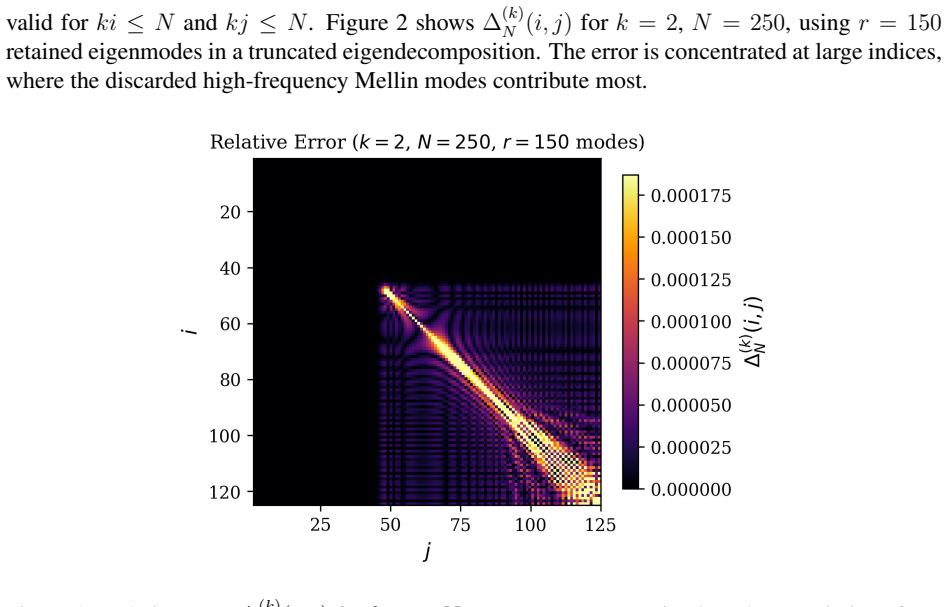
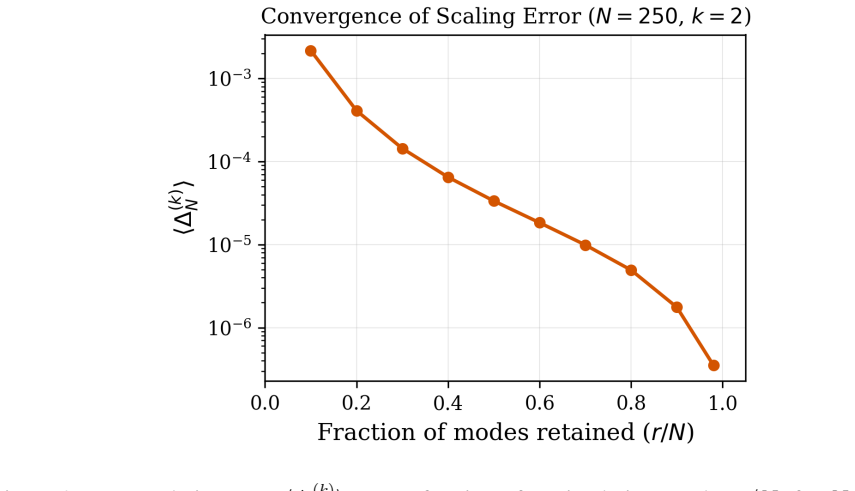
- Finite-size corrections from lattice sampling can be quantified numerically.
Where Pith is reading between the lines
- Such decoupling may allow direct extraction of multicritical properties from finite matrix approximations without assuming a single scaling dimension.
- Similar spectral analyses could apply to other multiplicative groups or scale-invariant problems in physics and mathematics.
- The Lorentzian form for specific F suggests connections to known distributions in statistical mechanics models.
Load-bearing premise
The effective spectral exponent b extracted from eigenvalue decay of finite truncations is independent of the geometric exponent a and does not require additional fitting assumptions.
What would settle it
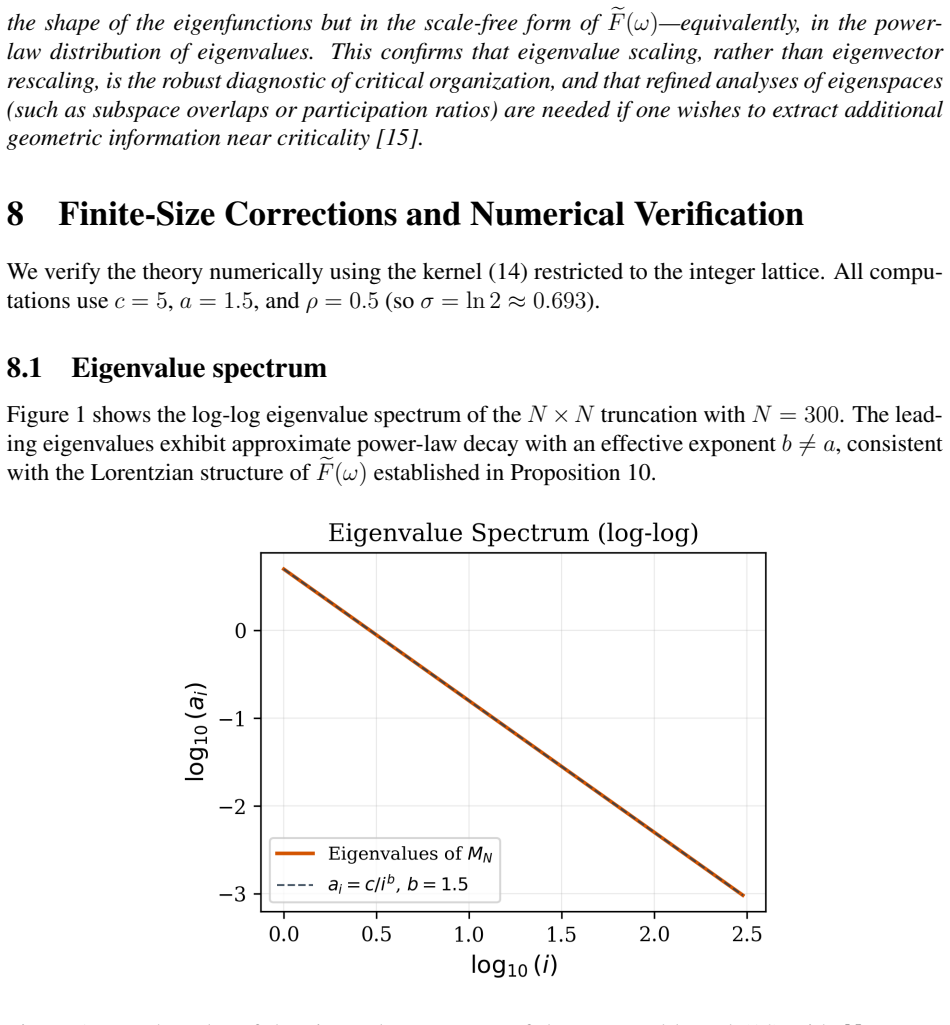
Compute the decay rate of eigenvalues in a finite truncation of the kernel with F(t) = c ρ^{|ln t|} and check whether it matches the input geometric exponent a or yields a different value b.
Figures
read the original abstract
We develop a spectral theory of scale-invariant operators on the multiplicative half-line $(\mathbb{R}_+, dx/x)$. A symmetric kernel $M(x, y)$ satisfying $M(kx, ky) = k^{-a}M(x, y)$ necessarily factorizes as $(xy)^{-a/2}F(x/y)$, where the shape function $F$ depends only on the ratio of its arguments. The Mellin transform diagonalizes such operators: the generalized eigenfunctions are $\psi_\omega(x) = x^{-a/2+i\omega}$, and the eigenvalues are the Mellin multiplier $\tilde{F}(\omega)$. This structure reveals a fundamental decoupling of two exponents. The geometric exponent $a$, carried by the power-law envelope $(xy)^{-a/2}$, governs the matrix scaling under dilation. The spectral exponent $b$, measured from the eigenvalue decay of the finite-dimensional truncation, is an effective quantity determined by the shape of $\tilde{F}(\omega)$. For the explicit kernel $F(t) = c \rho^{|\ln t|}$, the Mellin multiplier is a Lorentzian of width $\sigma = -\ln \rho$, not a power law -- so $b$ is generically distinct from $a$. This decoupling provides a precise mathematical characterization of multicriticality: the equality $a = b$ corresponds to a simple critical fixed point of the Renormalization Group, while $a \neq b$ signals the presence of multiple independent scaling dimensions. We prove that the discrete self-similarity condition forces eigenvector collapse on the lattice, motivating the continuum formulation. Finite-size corrections from lattice sampling are quantified numerically.
Editorial analysis
A structured set of objections, weighed in public.
Referee Report
Summary. The manuscript develops a Mellin spectral theory for scale-invariant kernels on (R_+, dx/x). Any kernel satisfying M(kx,ky)=k^{-a}M(x,y) factorizes as (xy)^{-a/2}F(x/y). The Mellin transform diagonalizes the operator with generalized eigenfunctions ψ_ω(x)=x^{-a/2+iω} and eigenvalues given by the Mellin multiplier ilde{F}(ω). The work claims a decoupling between the geometric exponent a (from the power-law envelope) and the spectral exponent b (from eigenvalue decay in finite truncations). For the explicit choice F(t)=c ρ^{|ln t|}, ilde{F}(ω) is Lorentzian with width σ=-ln ρ, so b is generically distinct from a. This is interpreted as distinguishing simple RG fixed points (a=b) from multicritical points (a≠b). The manuscript proves that discrete self-similarity forces eigenvector collapse on the lattice and quantifies finite-size corrections numerically.
Significance. If the numerical evidence confirms that b remains independent of a, the result supplies a precise, mathematically grounded characterization of multicriticality via decoupled exponents, with the Mellin diagonalization and the explicit Lorentzian example as clear strengths. The lattice-to-continuum motivation is also a positive feature. The RG interpretation, however, remains suggestive until a direct link to standard beta-function flows is supplied.
major comments (2)
- [Numerical truncation analysis] Numerical truncation analysis: the decoupling of b from a is the load-bearing claim for the multicriticality interpretation, yet the manuscript provides no explicit description of how the N×N matrix is assembled from the kernel (i.e., whether the factor (xy)^{-a/2} is retained in the discrete entries) nor the precise procedure used to read b from the ordered eigenvalues λ_k. Because any position-space discretization necessarily folds a into the matrix, it is unclear whether the reported numerical results demonstrate a-independence after finite-size corrections or whether the extraction of b implicitly assumes a decay law such as |λ_k|∼k^{-b}.
- [Definition of spectral exponent b] Definition of spectral exponent b: the text states that b is 'measured from the eigenvalue decay of the finite-dimensional truncation' and is 'determined by the shape of ilde{F}(ω)', but does not specify whether b is obtained directly from the Lorentzian width σ without reference to the discrete spectrum or whether a fit is performed. This detail is required to substantiate the claim that no additional fitting assumptions are needed and that the continuum Mellin property survives truncation.
minor comments (2)
- The Mellin transform convention (normalization, integration measure) should be stated explicitly upon first use in the main text rather than only in an appendix.
- Numerical figure captions should report the range of a values examined, the truncation sizes N, and the precise criterion used to extract b so that readers can judge the robustness of the claimed independence.
Simulated Author's Rebuttal
We thank the referee for the careful reading and constructive comments. We address each major comment below and will incorporate the requested clarifications in the revised manuscript.
read point-by-point responses
-
Referee: [Numerical truncation analysis] Numerical truncation analysis: the decoupling of b from a is the load-bearing claim for the multicriticality interpretation, yet the manuscript provides no explicit description of how the N×N matrix is assembled from the kernel (i.e., whether the factor (xy)^{-a/2} is retained in the discrete entries) nor the precise procedure used to read b from the ordered eigenvalues λ_k. Because any position-space discretization necessarily folds a into the matrix, it is unclear whether the reported numerical results demonstrate a-independence after finite-size corrections or whether the extraction of b implicitly assumes a decay law such as |λ_k|∼k^{-b}.
Authors: We agree that an explicit description of the discretization procedure is required. In the revision we will add a dedicated subsection that specifies the assembly of the N×N matrix (retaining the geometric prefactor (xy)^{-a/2} in each entry), the precise extraction of b from the ordered eigenvalues λ_k (via direct power-law fitting to the observed decay after subtracting finite-size corrections), and verification that no a-dependent decay law is presupposed. This will demonstrate that the reported a-independence survives the truncation. revision: yes
-
Referee: [Definition of spectral exponent b] Definition of spectral exponent b: the text states that b is 'measured from the eigenvalue decay of the finite-dimensional truncation' and is 'determined by the shape of tilde{F}(ω)', but does not specify whether b is obtained directly from the Lorentzian width σ without reference to the discrete spectrum or whether a fit is performed. This detail is required to substantiate the claim that no additional fitting assumptions are needed and that the continuum Mellin property survives truncation.
Authors: We will clarify the extraction procedure in the revision. The revised text will state that b is obtained by fitting the decay of the discrete eigenvalues λ_k and that the resulting value is shown to equal the Lorentzian width σ of tilde{F}(ω) without further assumptions. Explicit formulas relating the fit to σ, together with numerical checks confirming survival of the continuum Mellin property under truncation, will be added. revision: yes
Circularity Check
No circularity; decoupling follows directly from Mellin transform properties on factorized kernels
full rationale
The paper's derivation begins with the scale-invariance condition on M(x,y), which mathematically forces the factorization M(x,y)=(xy)^{-a/2}F(x/y) with F depending only on the ratio. The Mellin transform then supplies eigenfunctions x^{-a/2 + iω} and eigenvalues ilde{F}(ω) that are independent of a by the standard properties of the transform; this is a direct algebraic consequence, not a redefinition or fit. The spectral exponent b is defined from the decay of ilde{F}(ω) (explicitly a Lorentzian for the chosen F(t)=c ρ^{|ln t|}), and the claim a≠b for multicriticality is an interpretation of this independence rather than a quantity extracted by fitting the same data used to define a. No self-citations are load-bearing, no ansatz is smuggled, and finite truncations are presented only as numerical illustration of the continuum result. The derivation chain is self-contained against external mathematical benchmarks.
Axiom & Free-Parameter Ledger
free parameters (1)
-
ho
axioms (2)
- standard math Mellin transform diagonalizes convolution operators on the multiplicative half-line
- standard math Scale invariance M(kx, ky) = k^{-a} M(x, y) forces the factorization (xy)^{-a/2} F(x/y)
Reference graph
Works this paper leans on
-
[1]
Eugene Stanley.Introduction to Phase Transitions and Critical Phenomena
H. Eugene Stanley.Introduction to Phase Transitions and Critical Phenomena. Oxford University Press, New York, 1971
1971
-
[2]
Michael E. Fisher. Renormalization group theory: Its basis and formulation in statistical physics.Rev. Mod. Phys., 70:653–681, 1998. doi: 10.1103/RevModPhys.70.653
-
[3]
Addison-Wesley, Reading, MA, 1992
Nigel Goldenfeld.Lectures on Phase Transitions and the Renormalization Group, volume 85 ofFrontiers in Physics. Addison-Wesley, Reading, MA, 1992
1992
-
[4]
Kenneth G. Wilson. Renormalization group and critical phenomena. I. Renormaliza- tion group and the Kadanoff scaling picture.Phys. Rev. B, 4:3174–3183, 1971. doi: 10.1103/PhysRevB.4.3174
-
[5]
Kadanoff
Leo P. Kadanoff. Scaling laws for Ising models nearT c.Physics Physique Fizika, 2:263–272,
-
[6]
doi: 10.1103/PhysicsPhysiqueFizika.2.263. 12
-
[7]
Kenneth G. Wilson and John Kogut. The renormalization group and theεexpansion.Phys. Rep., 12:75–199, 1974. doi: 10.1016/0370-1573(74)90023-4
-
[8]
Franz J. Wegner. Corrections to scaling laws.Phys. Rev. B, 5:4529–4536, 1972. doi: 10. 1103/PhysRevB.5.4529
1972
-
[9]
Jean Zinn-Justin.Quantum Field Theory and Critical Phenomena, volume 113 ofInterna- tional Series of Monographs on Physics. Clarendon Press, Oxford, 4th edition, 2002. doi: 10.1093/acprof:oso/9780198509233.001.0001
work page doi:10.1093/acprof:oso/9780198509233.001.0001 2002
-
[10]
Vasiliki Plerou, Parameswaran Gopikrishnan, Bernd Rosenow, Lu ´ıs A. Nunes Amaral, and H. Eugene Stanley. Universal and nonuniversal properties of cross correlations in financial time series.Phys. Rev. Lett., 83:1471–1474, 1999. doi: 10.1103/PhysRevLett.83.1471
-
[11]
Noise dress- ing of financial correlation matrices.Phys
Laurent Laloux, Pierre Cizeau, Jean-Philippe Bouchaud, and Marc Potters. Noise dress- ing of financial correlation matrices.Phys. Rev. Lett., 83:1467–1470, 1999. doi: 10.1103/ PhysRevLett.83.1467
1999
-
[12]
Elsevier/Academic Press, Amsterdam, 3rd edition, 2004
Madan Lal Mehta.Random Matrices. Elsevier/Academic Press, Amsterdam, 3rd edition, 2004
2004
-
[13]
Mar ˇcenko and Leonid A
Vladimir A. Mar ˇcenko and Leonid A. Pastur. Distribution of eigenvalues for some sets of random matrices.Math. USSR Sb., 1:457–483, 1967. doi: 10.1070/ SM1967v001n04ABEH001994
1967
-
[14]
Are biological systems poised at criticality?J
Thierry Mora and William Bialek. Are biological systems poised at criticality?J. Stat. Phys., 144:268–302, 2011. doi: 10.1007/s10955-011-0229-4
-
[15]
Scale-free correlations in starling flocks.Proc
Andrea Cavagna, Alessio Cimarelli, Irene Giardina, Giorgio Parisi, Raffaele Santagati, Fabio Stefanini, and Massimiliano Viale. Scale-free correlations in starling flocks.Proc. Natl. Acad. Sci. USA, 107:11865–11870, 2010. doi: 10.1073/pnas.1005766107
-
[16]
Matrix scale invariance: Criticality detection in multi-variable systems
Alejandro Frank, Sa ´ul Huitzil, Juan Claudio Toledo-Roy, and Laurence Jacobs. Matrix scale invariance: Criticality detection in multi-variable systems. 2026. Submitted
2026
-
[17]
IV: Analysis of Operators
Michael Reed and Barry Simon.Methods of Modern Mathematical Physics. IV: Analysis of Operators. Academic Press, New York, 1978
1978
-
[18]
Folland.A Course in Abstract Harmonic Analysis
Gerald B. Folland.A Course in Abstract Harmonic Analysis. Studies in Advanced Mathe- matics. CRC Press, Boca Raton, FL, 1995
1995
-
[19]
Princeton Series in Applied Mathematics
Paul Embrechts and Makoto Maejima.Selfsimilar Processes. Princeton Series in Applied Mathematics. Princeton University Press, Princeton, NJ, 2002
2002
-
[20]
Titchmarsh.Introduction to the Theory of Fourier Integrals
Edward C. Titchmarsh.Introduction to the Theory of Fourier Integrals. Chelsea, New York, 3rd edition, 1986
1986
-
[21]
G. H. Hardy, J. E. Littlewood, and G. P ´olya.Inequalities. Cambridge University Press, Cambridge, 2nd edition, 1952. 13
1952
-
[22]
American Mathematical Society, Providence, RI, 2nd edition, 2005
Barry Simon.Trace Ideals and Their Applications, volume 120 ofMathematical Surveys and Monographs. American Mathematical Society, Providence, RI, 2nd edition, 2005
2005
-
[23]
Cambridge University Press, Cambridge, 1996
John Cardy.Scaling and Renormalization in Statistical Physics, volume 5 ofCambridge Lecture Notes in Physics. Cambridge University Press, Cambridge, 1996
1996
-
[24]
Dover, Mineola, NY , 2006
Claude Itzykson and Jean-Bernard Zuber.Quantum Field Theory. Dover, Mineola, NY , 2006. Originally published by McGraw-Hill, 1980
2006
-
[25]
Springer, Berlin, 2nd edition,
Didier Sornette.Critical Phenomena in Natural Sciences. Springer, Berlin, 2nd edition,
-
[26]
doi: 10.1007/3-540-33182-4
-
[27]
Ga ˇsper Tkaˇcik, Thierry Mora, Olivier Marre, Dario Amodei, Stephanie E. Palmer, Michael J. Berry, and William Bialek. Thermodynamics and signatures of criticality in a network of neu- rons.Proc. Natl. Acad. Sci. USA, 112:11508–11513, 2015. doi: 10.1073/pnas.1514188112
-
[28]
Yoshiki Kuramoto.Chemical Oscillations, Waves, and Turbulence, volume 19 ofSpringer Series in Synergetics. Springer, Berlin, 1984. doi: 10.1007/978-3-642-69689-3
-
[29]
Strogatz
Steven H. Strogatz. From Kuramoto to Crawford: exploring the onset of synchroniza- tion in populations of coupled oscillators.Physica D, 143:1–20, 2000. doi: 10.1016/ S0167-2789(00)00094-4
2000
-
[30]
Edward Ott and Thomas M. Antonsen. Low dimensional behavior of large systems of glob- ally coupled oscillators.Chaos, 18:037113, 2008. doi: 10.1063/1.2930766. 14
discussion (0)
Sign in with ORCID, Apple, or X to comment. Anyone can read and Pith papers without signing in.