QDS-SNN: Energy-efficient Quantum Deeply-Supervised Spiking Neural Network Algorithm for Traffic Sign Recognition
Pith reviewed 2026-06-28 03:31 UTC · model grok-4.3
The pith
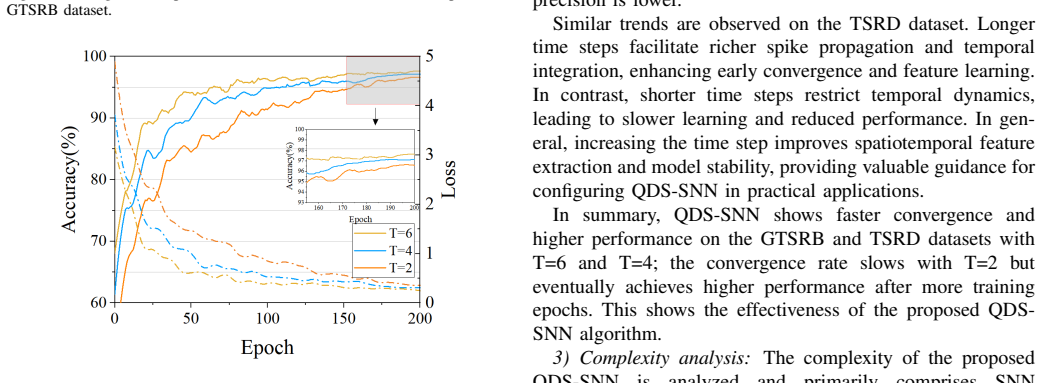
A quantum-deeply-supervised spiking neural network achieves 99.72% accuracy on traffic sign recognition in only 6 time steps while reducing energy consumption by over 55%.
A machine-rendered reading of the paper's core claim, the machinery that carries it, and where it could break.
Core claim
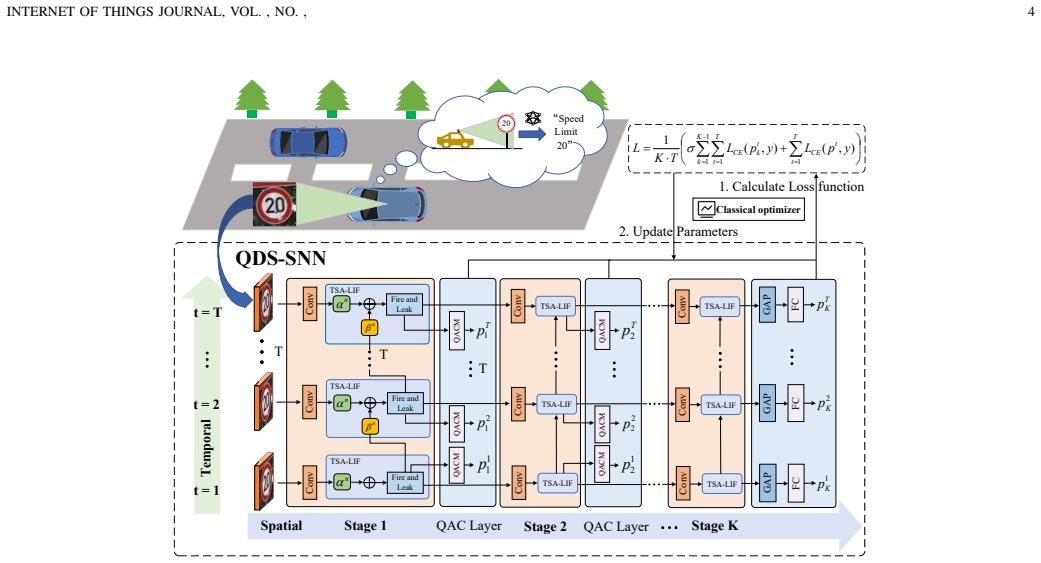
QDS-SNN combines quantum neural networks with spiking neural networks via deep supervision, TSA-LIF neurons, and a quantum-assisted classifier module, yielding 99.72% accuracy on GTSRB and 97.90% on TSRD while cutting energy use to roughly half of the baseline.
What carries the argument
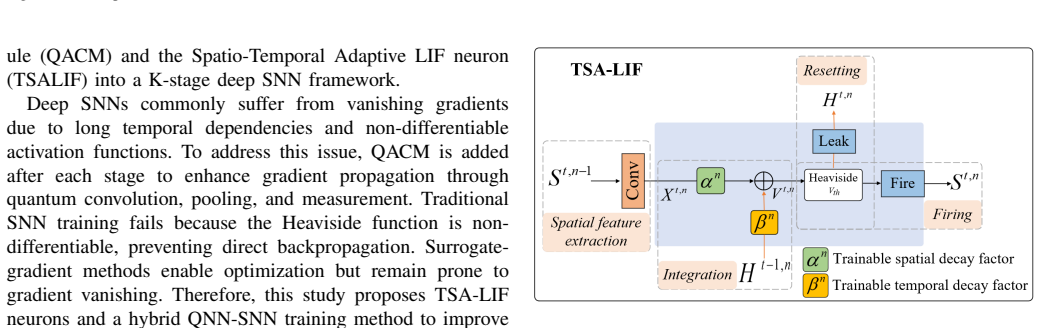
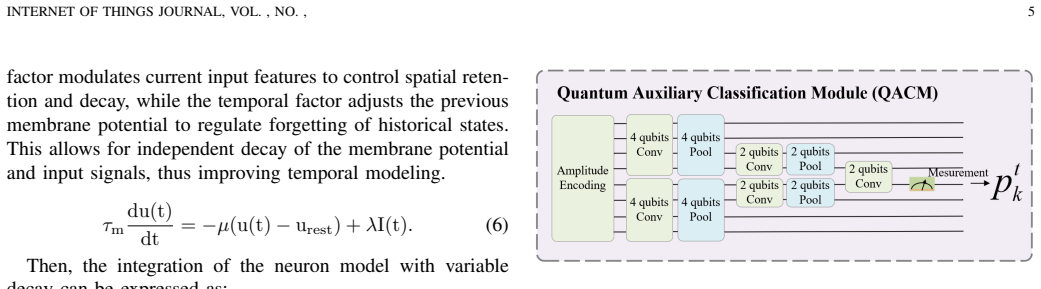
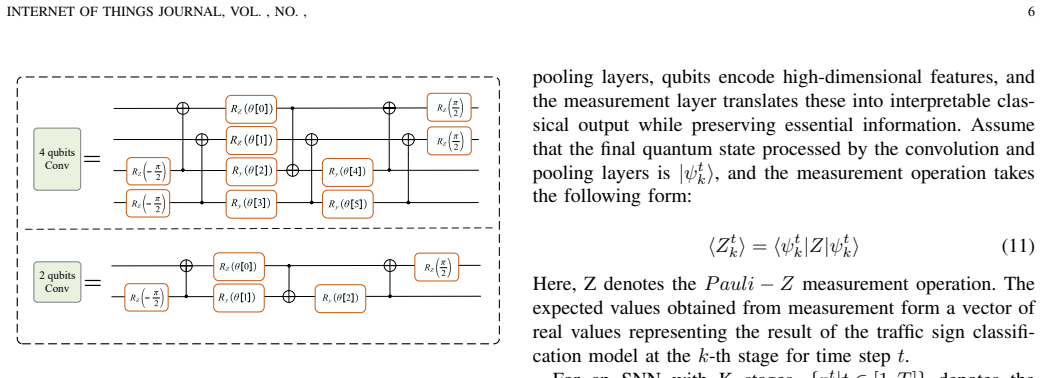
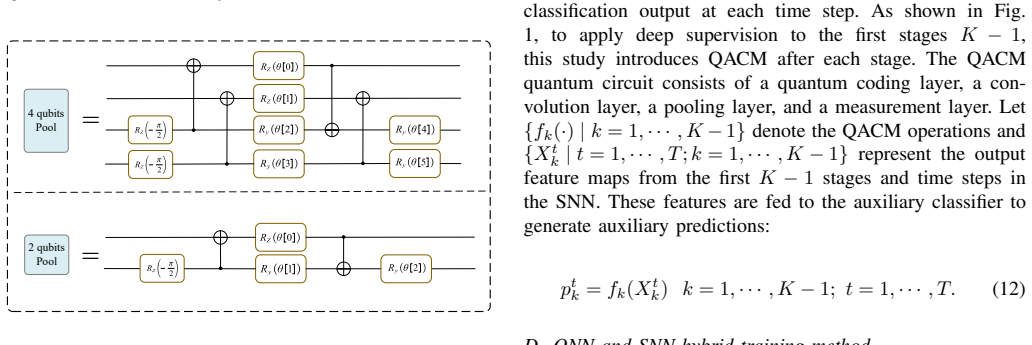
The quantum-assisted classifier module (QACM) combined with the temporally and spatially adaptive LIF (TSA-LIF) neuron, which uses quantum superposition for parallel computation and adaptive thresholds to reduce gradient problems.
If this is right
- QDS-SNN enables real-time traffic sign recognition suitable for autonomous driving systems with lower power requirements.
- The approach demonstrates that quantum elements can enhance SNN performance without sacrificing their energy advantages.
- Deep supervision in SNNs becomes feasible through quantum integration, mitigating vanishing gradient issues.
- Energy reductions of over 50% make deployment on resource-constrained devices more practical.
Where Pith is reading between the lines
- Similar quantum-SNN hybrids could apply to other spatiotemporal tasks like video processing or sensor data analysis.
- Further scaling might allow training on smaller datasets due to the expressive power of quantum representations.
- Integration with actual quantum hardware could amplify the efficiency gains beyond simulation results.
Load-bearing premise
The reported accuracy gains and energy savings stem directly from the quantum deep supervision and the TSA-LIF/QACM components rather than from differences in training procedures or baseline implementations.
What would settle it
An experiment that applies the same training setup and architecture without the quantum modules and measures whether accuracy drops below 98.4% or energy use rises above the baseline on the GTSRB dataset.
Figures
read the original abstract
Traffic sign recognition is crucial for intelligent transportation and autonomous driving, as it can improve driving efficiency and ensure road safety. However, traditional recognition methods are based on large datasets and intensive computation, which limits their real-time applicability. Spiking Neural Networks (SNNs) offer a biologically inspired, energy-efficient alternative due to their spatiotemporal processing capabilities, but suffer from information loss and vanishing gradients during training. To overcome these limitations, this study proposes a Quantum Deep-supervised Spiking Neural Network (QDS-SNN) that integrates Quantum Neural Networks (QNNs) for efficient, low-power deep supervision. Using quantum superposition and entanglement, QNNs enable expressive representations and parallel computation, thereby enhancing performance without compromising energy efficiency. The proposed QDS-SNN incorporates a temporally and spatially adaptive LIF (TSA-LIF) neuron and a quantum-assisted classifier module (QACM) to mitigate gradient issues and improve training effectiveness. This study conducts experiments on the PennyLane quantum simulation platform, and the results show that QDS-SNN achieves 99.72\% accuracy on the GTSRB dataset in only 6 time steps -- outperforming the MS-ResNet baseline by 1.32\% while reducing energy consumption by 55.77\%. In the TSRD dataset, it achieves 97.90\% accuracy while reducing energy use to 52.68\% of the baseline. These results demonstrate that QDS-SNN offers a high-performance, energy-efficient solution for traffic sign recognition in intelligent transportation systems.
Editorial analysis
A structured set of objections, weighed in public.
Referee Report
Summary. The manuscript proposes QDS-SNN, a spiking neural network augmented with quantum neural networks for deep supervision. It introduces a temporally and spatially adaptive LIF (TSA-LIF) neuron and a quantum-assisted classifier module (QACM), and reports results from PennyLane simulations on the GTSRB and TSRD traffic-sign datasets: 99.72% accuracy on GTSRB in 6 time steps (1.32% above an MS-ResNet baseline) together with a 55.77% energy reduction, and 97.90% accuracy on TSRD with energy consumption at 52.68% of the baseline.
Significance. If the reported accuracy and energy gains can be shown to arise specifically from the quantum deep-supervision mechanism rather than from unstated implementation choices, the work would offer a concrete example of hybrid quantum-classical neuromorphic models for real-time perception tasks. The explicit use of a quantum simulator for SNN training and the short 6-step inference latency are potentially useful contributions, but the absence of supporting controls prevents assessment of whether these constitute a genuine advance over existing SNN or QNN-SNN hybrids.
major comments (3)
- [Abstract and Results section] Abstract and Results section: the central claims of 1.32% accuracy improvement and 55.77% energy reduction on GTSRB (and the analogous TSRD figures) are stated without any ablation tables, non-quantum deep-supervision controls, or matched-parameter baseline re-runs that would isolate the contribution of the QNN integration, TSA-LIF adaptation rates, and QACM from differences in total parameters, spike encoding, or training schedule.
- [Methods/Experimental setup (implied)] Methods/Experimental setup (implied): no explicit energy model is supplied (gate count, circuit depth, or simulator proxy) and no verification is given that quantum-circuit overhead is included in the reported energy figures, rendering the 55.77% and 52.68% reductions impossible to interpret or reproduce.
- [Results section] Results section: the comparison to the MS-ResNet baseline provides no information on whether the baseline was re-trained under identical conditions or whether parameter counts and spike-encoding schemes were matched, which is required to support the attribution of gains to the proposed quantum-assisted components.
minor comments (1)
- [Abstract] Abstract: the phrases 'quantum superposition and entanglement' are invoked without a concrete description of how these properties are realized inside the QACM or the deep-supervision pathway.
Simulated Author's Rebuttal
We thank the referee for the constructive comments, which highlight areas where additional controls and documentation will strengthen the manuscript. We address each point below and will incorporate the requested clarifications and analyses in the revision.
read point-by-point responses
-
Referee: [Abstract and Results section] Abstract and Results section: the central claims of 1.32% accuracy improvement and 55.77% energy reduction on GTSRB (and the analogous TSRD figures) are stated without any ablation tables, non-quantum deep-supervision controls, or matched-parameter baseline re-runs that would isolate the contribution of the QNN integration, TSA-LIF adaptation rates, and QACM from differences in total parameters, spike encoding, or training schedule.
Authors: We agree that ablation studies are needed to isolate the contributions of the QNN integration, TSA-LIF neuron, and QACM. In the revised manuscript we will add ablation tables that systematically remove or replace each component while keeping total parameter count, spike encoding, and training schedule fixed. We will also include a non-quantum deep-supervision control (standard deep supervision without QACM) to better attribute the reported gains. revision: yes
-
Referee: [Methods/Experimental setup (implied)] Methods/Experimental setup (implied): no explicit energy model is supplied (gate count, circuit depth, or simulator proxy) and no verification is given that quantum-circuit overhead is included in the reported energy figures, rendering the 55.77% and 52.68% reductions impossible to interpret or reproduce.
Authors: We acknowledge the absence of an explicit energy model. The revised Methods section will provide the precise energy estimation procedure used with PennyLane, including the gate-count and circuit-depth proxy, the mapping from quantum operations to energy cost, and explicit confirmation that QACM overhead is folded into the reported figures. This will enable reproduction of the energy numbers. revision: yes
-
Referee: [Results section] Results section: the comparison to the MS-ResNet baseline provides no information on whether the baseline was re-trained under identical conditions or whether parameter counts and spike-encoding schemes were matched, which is required to support the attribution of gains to the proposed quantum-assisted components.
Authors: We will expand the experimental-setup subsection to state that the MS-ResNet baseline was re-trained from scratch under the identical training schedule, optimizer, and data augmentation used for QDS-SNN. We will also report the exact parameter counts and confirm that the same spike-encoding scheme was applied to both models, thereby supporting direct attribution of the observed differences. revision: yes
Circularity Check
No circularity; empirical claims rest on reported experiments
full rationale
The manuscript proposes QDS-SNN integrating QNNs, TSA-LIF neurons and QACM, then reports measured accuracy (99.72 % on GTSRB, 97.90 % on TSRD) and relative energy figures against an MS-ResNet baseline. No derivation chain, equations, or first-principles steps are supplied in the abstract or visible claims; performance numbers are presented as simulation outcomes on PennyLane rather than quantities obtained by algebraic reduction to the model definition itself. No self-citations, fitted-input renamings, or ansatz smuggling appear. The result is therefore self-contained as an empirical architecture-plus-experiment report.
Axiom & Free-Parameter Ledger
free parameters (1)
- TSA-LIF adaptation rates
axioms (1)
- domain assumption Quantum superposition and entanglement enable expressive representations and parallel computation in neural networks
invented entities (2)
-
TSA-LIF neuron
no independent evidence
-
QACM
no independent evidence
Reference graph
Works this paper leans on
-
[2]
Z. Qu, Y . Xia, L. Sun, W. Liu, and G. Muhammad, ”QCACNN: A quan- tum convolutional neural network algorithm for traffic sign recognition in carbon-intelligent electric vehicles,”IEEE Internet Things J., vol. 12, no. 17, pp. 34708–34719, 2025
2025
-
[3]
M. Q. Kheder and A. A. Mohammed, ”Improved traffic sign recognition system (ITSRS) for autonomous vehicle based on deep convolutional neural network,”Multimed. Tools Appl., vol. 83, no. 22, pp. 61821–61841, 2024
2024
-
[4]
Shustanov and P
A. Shustanov and P. Yakimov, ”CNN design for real-time traffic sign recognition,”Procedia Eng., vol. 201, pp. 718–725, 2017
2017
-
[5]
J. Hu, L. Shen, and G. Sun, ”Squeeze-and-excitation networks,” inProc. IEEE Conf. Comput. Vis. Pattern Recognit., pp. 7132–7141, 2018
2018
-
[6]
Hasan, T
N. Hasan, T. Anzum, and N. Jahan, ”Traffic sign recognition system (TSRS): SVM and convolutional neural network,” inInvent. Commun. Comput. Technol.: Proc. ICICCT 2020, pp. 69–79, 2020
2020
-
[7]
Traffic sign recognition using optimized federated learning in internet of vehicles,
Z. Lian, Q. Zeng, W. Wang, D. Xu, W. Meng, and C. Su, “Traffic sign recognition using optimized federated learning in internet of vehicles,” IEEE Internet Things J., vol. 11, no. 4, pp. 6722–6729, 2023
2023
-
[8]
SLMFed: A stage-based and layerwise mechanism for incremental federated learning to assist dynamic and ubiquitous IoT,
L. You, Z. Guo, B. Zuo, Y . Chang, and C. Yuen, “SLMFed: A stage-based and layerwise mechanism for incremental federated learning to assist dynamic and ubiquitous IoT,”IEEE Internet Things J., vol. 11, no. 9, pp. 16364–16381, 2024
2024
-
[9]
K. Xie, Z. Zhang, Bo. Li, et al., ”Efficient federated learning with spike neural networks for traffic sign recognition,”IEEE Trans. Veh. Technol., vol. 71, no. 9, pp. 9980–9992, 2022
2022
-
[10]
Zhang, H
Y . Zhang, H. Xu, L. Huang, and C. Chen, ”A storage-efficient SNN– CNN hybrid network with RRAM-implemented weights for traffic signs recognition,”Eng. Appl. Artif. Intell., vol. 123, p. 106232, 2023. INTERNET OF THINGS JOURNAL, VOL. , NO. , 13
2023
-
[11]
Traffic sign recognition model based on spiking neural network,
H. Chen, Y . Liu, W. Ye, and C. Han, “Traffic sign recognition model based on spiking neural network,” in2024 4th Int. Conf. Neural Netw., Inf. Commun. Eng. (NNICE 2024), pp. 693–696, 2024
2024
-
[12]
Yadav and B
C. Yadav and B. S. Reniwal, ”Highly Accurate and Energy Efficient Convolutional Spiking Neural Network for Traffic Sign Recognition,” IEEE Access, vol. 13, pp. 212341–212354, 2025
2025
-
[13]
Zhang, K
T. Zhang, K. Yu, J. Zhang, and H. Wang, ”Da-LIF: Dual adaptive leaky integrate-and-fire model for deep spiking neural networks,” in2025 IEEE Int. Conf. Acoust., Speech Signal Process. (ICASSP), pp. 1–5, 2025
2025
-
[14]
G. Li, L. Deng, H. Tang, et al., ”Brain-inspired computing: A systematic survey and future trends,”Proc. IEEE, vol. 112, no. 6, pp. 544–584, 2024
2024
-
[15]
Y . Li, S. Deng, X. Dong, R. Gong, and S. Gu, ”A free lunch from ANN: Towards efficient, accurate spiking neural networks calibration,” inProc. Int. Conf. Mach. Learn. (ICML), pp. 6316–6325, 2021
2021
-
[16]
Kaiser, J
J. Kaiser, J. C. V . Tieck, C. Hubschneider, et al., ”Towards a frame- work for end-to-end control of a simulated vehicle with spiking neural networks,” inProc. 2016 IEEE Int. Conf. Simul. Model. Program. Auton. Robots (SIMPAR), pp. 127–134, 2016
2016
-
[17]
Z. Bing, C. Meschede, G. Chen, A. Knoll, and K. Huang, ”Indirect and direct training of spiking neural networks for end-to-end control of a lane-keeping vehicle,”Neural Netw., vol. 121, pp. 21–36, 2020
2020
-
[18]
Chandarana, J
P. Chandarana, J. Ou, and R. Zand, ”An adaptive sampling and edge de- tection approach for encoding static images for spiking neural networks,” inProc. 2021 12th Int. Green Sustain. Comput. Conf. (IGSC), pp. 1–8, 2021
2021
-
[19]
Kim and P
Y . Kim and P. Panda, ”Revisiting batch normalization for training low- latency deep spiking neural networks from scratch,”Front. Neurosci., vol. 15, p. 773954, 2021
2021
-
[20]
Zheng, Y
H. Zheng, Y . Wu, L. Deng, Y . Hu, and G. Li, ”Going deeper with directly-trained larger spiking neural networks,” inProc. AAAI Conf. Artif. Intell., vol. 35, no. 12, pp. 11062–11070, 2021
2021
- [21]
-
[22]
H. Chen, Y . Liu, W. Ye, and C. Han, ”Traffic sign recognition model based on spiking neural network,” inProc. 2024 4th Int. Conf. Neural Netw. Inf. Commun. Eng. (NNICE), pp. 693–696, 2024
2024
- [23]
-
[24]
Y . Hu, L. Deng, Y . Wu, M. Yao, and G. Li, ”Advancing spiking neural networks toward deep residual learning,”IEEE Trans. Neural Netw. Learn. Syst., vol. 36, no. 2, pp. 2353–2367, 2024
2024
-
[25]
Y . Ding, L. Zuo, M. Jing, P. He, and Y . Xiao, ”Shrinking your timestep: Towards low-latency neuromorphic object recognition with spiking neural networks,” inProc. AAAI Conf. Artif. Intell., vol. 38, no. 10, pp. 11811–11819, 2024
2024
- [26]
-
[27]
Highly Accurate and Energy Efficient Convolutional Spiking Neural Network for Traffic Sign Recognition,
C. Yadav, and B. S. Reniwal, “Highly Accurate and Energy Efficient Convolutional Spiking Neural Network for Traffic Sign Recognition,” IEEE Access, vol. 13, pp. 212341–212354, 2025
2025
-
[28]
S. Shen, J. Yang, H. Zhong, H. Lu, X. Zheng, and H. Yang, ”Deployment-friendly lane-changing intention prediction powered by brain-inspired spiking neural networks,” in2025 IEEE Intell. Veh. Symp. (IV), pp. 2310–2316, 2025
2025
-
[29]
S. C. Kak, ”Quantum neural computing,”Adv. Imaging Electron Phys., vol. 94, pp. 259–313, 1995
1995
-
[30]
Z. Hao, T. Bu, J. Ding, T. Huang, and Z. Yu, ”Reducing ANN–SNN conversion error through residual membrane potential,” inProc. AAAI Conf. Artif. Intell., vol. 37, no. 1, pp. 11–21, 2023
2023
-
[31]
W. Fang, Z. Yu, Y . Chen, T. Huang, T. Masquelier, and Y . Tian, ”Deep residual learning in spiking neural networks,” inAdv. Neural Inf. Process. Syst., vol. 34, pp. 21056–21069, 2021
2021
-
[32]
Wiebe, A
N. Wiebe, A. Kapoor, and K. M. Svore, ”Quantum algorithms for nearest-neighbor methods for supervised and unsupervised learning,” Quan. Inf. Com., vol. 15, nos. 3–4, pp. 316–356, 2015
2015
-
[33]
Preskill, ”Quantum computing in the NISQ era and beyond,”Quan- tum, vol
J. Preskill, ”Quantum computing in the NISQ era and beyond,”Quan- tum, vol. 2, p. 79, 2018
2018
-
[34]
Classification with Quantum Neural Networks on Near Term Processors
E. Farhi and H. Neven, ”Classification with quantum neural networks on near-term processors,”arXiv:1802.06002, 2018
work page internal anchor Pith review Pith/arXiv arXiv 2018
-
[35]
Schuld, A
M. Schuld, A. Bocharov, K. M. Svore, and N. Wiebe, ”Circuit-centric quantum classifiers,”Phys. Rev. A, vol. 101, no. 3, p. 032308, 2020
2020
-
[36]
Z. Qu, Z. Chen, S. Dehdashti, et al., ”QFSM: A novel quantum federated learning algorithm for speech emotion recognition with minimal gated unit in 5G IoV ,”IEEE Trans. Intell. Veh., vol. 9, no. 10, pp. 6512–6523, 2024
2024
-
[37]
DAQFL: Dynamic aggregation quantum federated learning algorithm for intelligent diagnosis in Internet of Medical Things,
Z. Qu, X. Zhao, L. Sun, and G. Muhammad, “DAQFL: Dynamic aggregation quantum federated learning algorithm for intelligent diagnosis in Internet of Medical Things,”IEEE Internet Things J., vol. 12, no. 19, pp. 39313–39325, 2025
2025
-
[38]
Brand and F
D. Brand and F. Petruccione, ”A quantum leaky integrate-and-fire spiking neuron and network,”npj Quant. Inf., vol. 10, no. 1, pp. 1–8, 2024
2024
-
[39]
A hybrid spiking neural network-quantum framework for spatio-temporal data classification: a case study on EEG data,
R. K. Jha, N. Kasabov, S. Bhattacharyya, et al., “A hybrid spiking neural network-quantum framework for spatio-temporal data classification: a case study on EEG data,”EPJ Quantum Technol., vol. 12, no. 1, pp. 1–23, 2025
2025
-
[40]
Liu and Y
S. Liu and Y . Gu, ”Quantum spiking neural networks for image classification,” inProc. 3th Int. Conf. Alg., Network Com. Tech.(ICANCT), vol. 13545, pp. 181–188, 2025
2025
-
[41]
Y . Wu, L. Deng, G. Li, J. Zhu, and L. Shi, ”Spatio-temporal backprop- agation for training high-performance spiking neural networks,”Front. Neurosci., vol. 12, p. 331, 2018
2018
-
[42]
Schuld, V
M. Schuld, V . Bergholm, C. Gogolin, J. Izaac, and N. Killoran, ”Eval- uating analytic gradients on quantum hardware,”Phys. Rev. A, vol. 99, no. 3, p. 032331, 2019
2019
-
[43]
Stallkamp, M
J. Stallkamp, M. Schlipsing, J. Salmen, and C. Igel, ”The German traffic sign recognition benchmark: A multi-class classification competition,” in Proc. Int. Joint Conf. Neural Netw., pp. 1453–1460, 2011
2011
-
[44]
National Natural Science Foundation of China, ”Chinese traffic sign database,”[Online].https://nlpr.ia.ac.cn/pal/trafficdata/recognition.html
-
[45]
M. Yao, J. Hu, Z. Zhou, L. Yuan, Y . Tian, B. Xu, and G. Li, ”Spike- driven transformer,” inAdv. Neural Inf. Process. Syst., vol. 36, pp. 64043–64058, 2023
2023
-
[46]
Killoran, J
N. Killoran, J. Izaac, N. Quesada, et al., ”Strawberry fields: A software platform for photonic quantum computing,”Quantum, vol. 3, p. 129, 2019
2019
-
[47]
M. A. Nielsen and I. L. Chuang, ”Quantum computation and quantum information,”Quantum Inf. Comput., 2010. Zhiguo Quis currently a Professor in the School of Com- puter Science. His research interests include quantum machine learning, quantum communications, and quantum computing. Keqi Liis currently a master student at Nanjing University of Information Sc...
2010
discussion (0)
Sign in with ORCID, Apple, or X to comment. Anyone can read and Pith papers without signing in.