REVIEW 4 major objections 4 minor 79 references
Some hypotheses on how chatbots work in problem-solving-driven conversations. Large Language Models as confirmation of the Innovation Illusion
T0 review · 4 major / 4 minor · reviewed 2026-08-04 · deepseek-v4-flash
Pith's one-line read A chatbot, as a conversation partner, is not and cannot become an analytical thinking partner through text-only training.
desk verdict A clearly written speculative essay that is honest about its own status, but the central impossibility claim rests on an unmeasured 'onward text' premise and an untested reconstruction hypothesis; worth a serious discussion, not a conclusive result. read the letter →
The pith
A machine-rendered reading of the paper's core claim, the machinery that carries it, and where it could break.
The reading
What carries the argument
The central object is the 'metaphorical problem propagation' — a model of the human thought space as a network of problem positions and solution steps, structured by metaphors and powered by predictive processing. It carries the argument by linking human cognition, human text, and LLM behavior: thought is modeled as propagation through this space; text is a reduced verbalization of it; LLM training is said to reconstruct artificial versions of it from text. The 'onward text' hypothesis is the load-bearing premise: most training text is assumed to be solution-oriented, coherent, non-experimental prose that moves from problem to conclusion without reflection, and this determines the System 1-l
What would settle it
Compile a training corpus of deliberately analytical, reflective texts — for example, philosophical debates, contradictory position papers, and open-ended problem analyses that withhold conclusions — train an LLM on it, and test whether it reliably catches its own inconsistencies, revises assumptions on feedback, and withholds answers under uncertainty. If it does so robustly, the paper's claim that text-only training cannot produce analytical thinking would be falsified.
Extended reading notes
Core claim
The central claim, stated in Section 10.4, is that 'a chatbot, as a conversational partner, is not an analytical thinking partner, nor can it become one with its current architecture and through text-only training.' The paper reaches this by combining four perspectives: a systems theory that views life as problem-solving, a metaphor-based account of concepts, a predictive view of perception and action, and a dual-process psychology distinguishing fast, automatic thinking from slow, analytical thinking. It introduces 'metaphorical problem propagation' as the mental space in which humans frame problems, propose solutions, and generate predictions. The paper then hypothesizes that most text use
Load-bearing premise
The load-bearing premise is that most text in LLM training datasets is 'onward text' — solution-oriented, non-reflective System 1-style prose — and that the training process encodes these as artificial metaphorical problem propagations; if training data were not dominated by such text, or if the training did not encode it in this way, the conclusion that chatbots are irredeemably System 1 would collapse.
Editorial extensions
If this is right
- Chatbots are best understood as System 1 conversation partners: they provide plausible, fast answers that confirm a user's worldview rather than critiquing it.
- They can still serve as creative aids — for example, finding analogies or 'dark knowledge' — but only when guided by an alert prompt writer.
- Scaling up models or adding more text of the same kind will not produce analytical thinking; the bottleneck is the lack of experiential grounding and the reduced nature of text.
- Safety and reliability efforts should focus on barriers, monitoring, and user vigilance, not on the expectation that chatbots will become trustworthy reasoning partners.
- The model gives interpretability researchers a target: look for concept clusters and activation paths that correspond to problem-solution 'riverbeds.'
Reading between the lines
- A testable extension is to measure the 'onward-ness' of a training corpus and correlate it with an LLM's performance on analytical reasoning tasks; the paper's model predicts a strong negative correlation.
- If the 'onward text' hypothesis is correct, injecting deliberately reflective, contradictory, and open-ended texts into pretraining should measurably shift chatbot behavior, even if — as the paper argues — it cannot fully overcome the structural limitation.
- The paper's view implies that the gap between chatbot and human cognition is narrower in routine problem-solving domains (where humans also rely on System 1) and wider in open-ended analytical tasks, a differentiation the authors leave implicit.
- The 'artificial metaphorical problem propagation' account suggests a possible evaluation metric: quantify the extent to which a chatbot's responses stay 'at the problem front' versus exploring alternative branches or revisiting assumptions.
Editorial analysis
A structured set of objections, weighed in public.
Referee Report
Summary. The paper develops a speculative account of why basic LLM-based chatbots cannot be analytical thinking partners. It introduces 'metaphorical problem propagation' (MPP) as a synthesis of Aggregation Dynamics, Cognitive Linguistics, and Predictive Processing. It then argues that most LLM training text is 'onward text' (System 1-like, solution-oriented, non-reflective), that LLM training reconstructs 'artificial MPPs' from this text, and that consequently chatbots are confined to System-1-like thinking and cannot become analytical partners even with larger models or analytical training sets. The conclusion is an impossibility claim.
Significance. If the impossibility claim were established, it would be a significant contribution to the debate on LLM reasoning and human-AI interaction. The paper deserves credit for attempting to connect interpretability research, cognitive linguistics, and dual-process theory into a structured model, and for being explicit about its speculative character. However, the manuscript as it stands is a hypothesis sketch rather than a demonstration: the key premises are asserted, not measured, and the authors themselves disclaim the ability to assess their central model (§10.5). The paper's value lies in proposing questions and a vocabulary, not in providing a validated answer.
major comments (4)
- [§8.1 and §9] The premise that most training texts are 'onward text' is load-bearing but never operationalized. §8.1 lists subjective traits ('strategically oriented', 'tailored to an audience seeking comfort') with no metric; §9 simply says 'We now assume that most of the texts ... are of the previously postulated onward type.' The cited survey [50] states that narrative texts are abundant, but 'narrative' is not equivalent to 'onward' — indeed, narrative theory includes reflective, non-linear forms. Without empirical support for the dominance of onward text, the System-1 conclusion collapses.
- [§9 and §10.5] The inference from LLM training to 'artificial metaphorical problem propagation' is not derived. The evidence [17,48] shows that LLM activations map onto human brain responses and can represent evolving discourse situations; it does not show that these representations are 'onward' or lack reflective potential. The paper's own §10.5 admits 'we are too far removed from this highly technical field of research to assess the value of our model.' A central claim cannot rest on a model whose validity the authors disclaim.
- [§10.4] The claim that even an analytical training set cannot produce an analytical thinking partner depends on an unargued necessity of embodied experience for System-2 thinking. No evidence is provided that text-only training cannot acquire reflective competence; indeed, publications such as [68] indicate that prompting and training can elicit multi-step reasoning. The strong negative conclusion therefore outruns the support.
- [§9–§10] Circularity: §10 opens 'Suppose an LLM encodes metaphorical problem propagation, as argued above,' and then derives the System-1 conclusion from that supposition. Since the 'onward' character was built into the MPP hypothesis in §8–9, the conclusion is a restatement of the hypothesis rather than an independent result. The conclusion should be framed as a conditional, not a categorical claim.
minor comments (4)
- [§2.2] 'Bereska en Gavves' should be 'Bereska and Gavves' (Dutch 'en' in otherwise English text).
- [Reference [20]] Typo: 'Consulted om May 29, 2026' should be 'Consulted on May 29, 2026'.
- [§3] The term 'aggregation' is used extremely broadly ('jealousy of the gods' as a player); a formal definition or at least a clearer scope condition would help the reader follow the later argument.
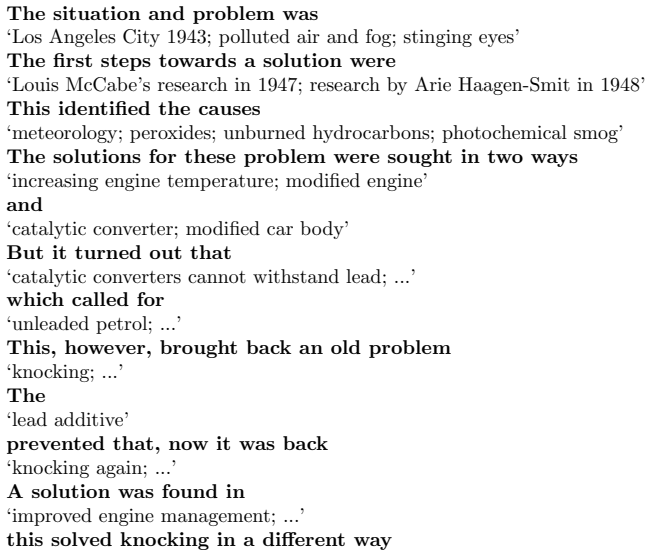
- [Figure 3] The last line of Figure 3, 'The', appears to be a fragment; either complete the sentence or remove the stray article.
Circularity Check
The impossibility claim is the onward-text assumption restated under a stipulated reconstruction; §10.5 concedes the model cannot be assessed.
-
self definitional
[Section 8.1 -> Section 9 -> Section 10.2 -> Section 10.4]
"We refer to this as onward text. ... We now assume that most of the texts in the text dataset for training publicly accessible systems such as ChatGPT, Claude and Grok are of the previously postulated onward type. ... Our hypothesis is that the training text for public chatbots has an onward character (Section 8.1). This has an effect on the metaphorical problem propagation distilled from it. It seems highly plausible that this, too, therefore has an onward character. By this we mean that a chatbot simulates a form of thinking that is more akin to System 1 thinking than to analytical thinking."
In §8.1, 'onward text' is defined by System-1-like qualities: strategically oriented, solution-pointing, coherent, not experimental, and explicitly tied to the suspicion that much human text 'has a System 1 character.' Section 9 then assumes most LLM training text is onward. Section 10.2 concludes that the chatbot's simulated thinking is System 1 by transferring the 'onward' label to the distilled propagation ('this, too, therefore has an onward character'). The 'prediction' that a basic chatbot is System 1 is thus the assumed onwardness of the input restated under the stipulated reconstruction hypothesis; no independent mechanism or measurement is supplied. Section 10.4's denial that an analytical training set could help adds only an unargued embodied-cognition assertion, so the central i
full rationale
The paper is explicitly speculative: it labels its positive account as hypotheses, and the core inference is conditional on 'Suppose an LLM encodes metaphorical problem propagation, as argued above.' That conditionality is not itself circular. The circularity is that the central output — 'a chatbot simulates a form of thinking more akin to System 1' — is obtained by defining the training text as 'onward' (System-1-like) and then assuming the trained LLM reconstructs those propagations, so the System-1 character of the chatbot is the System-1 character of the input by construction. The chain would be a legitimate conditional argument if the premise were empirically measured and the reconstruction mechanism independently evidenced, but the paper does neither; it states the premise as an assumption and the reconstruction as a hypothesis. The self-citations [77,78] supply the AD vocabulary of finite problem types and the Innovation Illusion, but those are also framed as assumptions/conjectures rather than forced results, so I do not treat them as the primary circularity. External citations [17,48,56,80] provide some independent support for LLM representations and for the view that LLMs resemble System 1, but they do not break the definitional transfer from 'onward text' to 'System-1 chatbot.' The paper's own §10.5 admission that 'we are too far removed from this highly technical field of research to assess the value of our model' is an honest limitation, but it reinforces rather than resolves the circularity concern. Overall: one central 'prediction' reduces by construction, so the score is 6 rather than 0–2; the residual independent content is the argument that even an analytical training set would not help, which is asserted rather than derived.
Assumptions & free parameters
assumptions (7)
- domain assumption The 'Innovation Illusion': problem types and solution repertoires form a finite, domain-independent set of patterns.
- domain assumption All human thought is metaphorically structured and grounded in bodily experience (Cognitive Linguistics).
- domain assumption Predictive Processing Theory: the brain generates predictions and perception is a 'controlled hallucination'.
- domain assumption Dual-process theory: System 1 is fast and automatic, System 2 is effortful and analytical.
- ad hoc to paper Most texts used for LLM training are 'onward text': goal-directed, coherent, non-reflective, and tailored to a comfort-seeking audience.
- ad hoc to paper LLM training reconstructs artificial metaphorical problem propagations from onward text.
- domain assumption A physical, experiencing body is required for genuine understanding; text alone cannot provide the embodied conceptual grounding needed for analytical thought.
invented entities (3)
-
Metaphorical problem propagation (MPP)
-
Artificial metaphorical problem propagation
-
Onward text
Cite this review
Pith. "Pith review of Some hypotheses on how chatbots work in problem-solving-driven conversations. Large Language Models as confirmation of the Innovation Illusion." pith.science (2026). https://pith.science/paper/ZZX3ATEB
@misc{pith2026260607722,
  author       = {Pith},
  title        = {Pith review of: Some hypotheses on how chatbots work in problem-solving-driven conversations. Large Language Models as confirmation of the Innovation Illusion},
  year         = {2026},
  howpublished = {\url{https://pith.science/paper/ZZX3ATEB}},
  note         = {Machine review of arXiv:2606.07722}
}
read the original abstract
We discuss the nature of chatbots as conversation partners in problem-solving. What can chatbots do and what can't they do? We develop hypotheses on how this can this be explained. Our argument draws on insights from Aggregation Dynamics, Cognitive Linguistics, Neuropsychology and Psychology. We establish that chatbots are multifaceted and composite systems. Our argument focuses on basic chatbots in the hope of thereby making statements about the core functionality of more advanced chatbots. Basic chatbots are assumed to consist of a Large Language Model (LLM) with a simple interface. The main results of our research are: a description of human imagination, understanding and thinking based on so-called metaphorical problem propagations; the hypothesis that the texts in the text dataset used for training LLMs have specific characteristics and that these texts only partially imitate human thinking and understanding; the hypothesis that the LLM training process encodes artificial metaphorical problem propagations into an LLM from these text datasets. Our conclusions are that a basic chatbot cannot be a thinking partner capable of matching the cognitive flexibility of humans, and that further development of the Large Language Model will not lead to this either. But chatbots exist, they are being used on a massive scale, by both individuals and organisations. It is therefore socially and politically important to understand them. Our article aims to contribute to the discussion on the functioning, benefits and drawbacks of chatbots. Cognitive Linguistics shows how the use of metaphor is an expression of our thinking. Aggregation Dynamics, is an attempt at a comprehensive systems theory. We believe that the concept of metaphorical problem propagation could provide an interesting addition for both. Chatbots a solution? For what?
Figures


Figures from the paper (3 more)


Reference graph
Works this paper leans on
-
[56]
Philipp Mondorf and Barbara Plank,Beyond Accuracy: Evaluating the Reasoning Behavior of Large Language Models – A Survey, 2024, arXiv, DOI
2024
-
[80]
Webster,Natural and artificial intelligence – the psychotechnical agenda of the 21st century, Journal of Psychology and AI1(2025), no
Craig S. Webster,Natural and artificial intelligence – the psychotechnical agenda of the 21st century, Journal of Psychology and AI1(2025), no. 1, 2491445, DOI
2025
-
[50]
Liu, Aditya Joshi, and Paul Dawson,Narrative Theory-Driven LLM Methods for Automatic Story Generation and Understanding: A Sur- vey, 2026, arXiv, DOI
David Y. Liu, Aditya Joshi, and Paul Dawson,Narrative Theory-Driven LLM Methods for Automatic Story Generation and Understanding: A Sur- vey, 2026, arXiv, DOI. 38
2026
-
[17]
Charlotte Caucheteux, Alexandre Gramfort, and Jean-Remi King,Evi- dence of a predictive coding hierarchy in the human brain listening to speech, Nature Human Behaviour7(2023), no. 3, pp. 430–441, DOI
2023
-
[48]
Belinda Z. Li, Maxwell Nye, and Jacob Andreas,Implicit representations of meaning in neural language models, Proceedings of the 59th Annual Meeting of the Association for Computational Linguistics and the 11th International Joint Conference on Natural Language Processing (Volume 1: Long Papers) (Online) (Chengqing Zong, Fei Xia, Wenjie Li, and Roberto Nav...
2021
-
[68]
Surv.58(2025), no
Aske Plaat, Annie Wong, Suzan Verberne, Joost Broekens, Niki Van Stein, and Thomas B¨ ack,Multi-Step Reasoning with Large Language Models, a Survey, ACM Comput. Surv.58(2025), no. 6, DOI
2025
-
[5]
Het begin van het computertijdperk in Nederland, AUP, Amsterdam, 2016, In Dutch
Gerard Alberts and Bas van Vlijmen,Computerpioniers. Het begin van het computertijdperk in Nederland, AUP, Amsterdam, 2016, In Dutch
2016
-
[6]
Tomas Humberto Montiel Alcantara, David Kr¨ utli, Revathi Ravada, and Thomas Hanne,Multilingual Text Summarization for German Texts Using Transformer Models, Information14(2023), no. 6
2023
Show all 79 references
-
[7]
Bailey,When push comes to shove: A computational model of the role of motor control in the acquisition of action verbs, Ph.D
David R. Bailey,When push comes to shove: A computational model of the role of motor control in the acquisition of action verbs, Ph.D. thesis, EECS Department, University of California, Berkeley, 1997
1997
-
[8]
Lochan Basyal and Mihir Sanghvi,Text summarization using large language models: A comparative study of mpt-7b-instruct, falcon-7b-instruct, and openai chat-gpt models, ArXiv (2023), DOI
2023
-
[9]
Townsend,Ecology: From individuals to ecosystems, 5e ed., Wiley Blackwell, 2021
Michael Begon and Colin R. Townsend,Ecology: From individuals to ecosystems, 5e ed., Wiley Blackwell, 2021
2021
-
[10]
Emily M. Bender, Timnit Gebru, Angelina McMillan-Major, and Shmar garet Shmitchell,On the Dangers of Stochastic Parrots: Can Language Models Be Too Big?, Conference on Fairness, Accountability, and Trans- parency, ACM F AccT ’21, 2021, DOI. 35
2021
-
[11]
Leonard Bereska and Stratis Gavves,Mechanistic Interpretability for AI Safety – A Review, Transactions on Machine Learning Research (2024), URL
2024
-
[12]
Eric Bigelow Bigelow and Tomer Ullman,People Evaluate Agents Based on the Algorithms That Drive Their Behavior, Open Mind9(2025), 1411– 1430, DOI
2025
-
[13]
1 & 2, Clarendon, Oxford University Press, 2006
Margaret Boden,Mind As Machine: A History Of Cognitive Science, vol. 1 & 2, Clarendon, Oxford University Press, 2006
2006
-
[14]
Margaret Boden,Artificial Intelligence, Oxford University Press, 2018
2018
-
[15]
John Brockman (ed.),What to Think about Machines that Think, Harper Perennial, 2015
2015
-
[16]
Alexander Cameron,What is 4E cognitive science?, Phenomenology and the Cognitive Sciences (2025), DOI
2025
-
[18]
How Our Minds Predict and Shape Reality, Penguin, 2024 (2023)
Andy Clark,The Experience Machine. How Our Minds Predict and Shape Reality, Penguin, 2024 (2023)
2024
-
[19]
Dewey,Don ’t Breathe the Air: Air Pollution and U.S
S.H. Dewey,Don ’t Breathe the Air: Air Pollution and U.S. Environmental Politics, 1945-1970, Environmental History Series, no. 16, Texas A&M University Press, 2000
1945
-
[20]
Consulted om May 29, 2026
de.wikipedia.org,Paul Watzlawick, URL. Consulted om May 29, 2026
2026
-
[21]
Aniket Didolkar, Anirudh Goyal, Nan Rosemary Ke, Siyuan Guo, Michal Valko, Timothy Lillicrap, Danilo Rezende, Yoshua Bengio, Michael Mozer, and Sanjeev Arora,Metacognitive capabilities of LLMs: an exploration in mathematical problem solving, Proceedings of the 38th Internation...
2024
-
[22]
September 2025, pp
Maximilian Dreyer, Jim Berend, Tobias Labarta, Johanna Vielhaben, Thomas Wiegand, Sebastian Lapuschkin, and Wojciech Samek,Mecha- nistic understanding and validation of large AI models with SemanticLens, Nature Machine Intelligence7, no. September 2025, pp. 1572–1585, DOI
2025
-
[23]
In Dutch, translated from French by Hans E
Giuliano da Empoli,Het uur van de wolven, Atlas Contact, 2025, Original title:L’Heure des pr´ edateurs. In Dutch, translated from French by Hans E. van Riemsdijk
2025
-
[24]
Conceptual blending and the mind’s hidden complexities, Basic Books, 2002
Gilles Fauconnier and Mark Turner,The way we think. Conceptual blending and the mind’s hidden complexities, Basic Books, 2002. 36
2002
-
[25]
Feldman,From Molecule to Metaphor
Jerome A. Feldman,From Molecule to Metaphor. A Neural Theory of Lan- guage, MIT Press, 2006
2006
-
[26]
Elliot Glazer, Ege Erdil, Tamay Besiroglu, Diego Chicharro, Evan Chen, Alex Gunning, Caroline Falkman Olsson, Jean-Stanislas Denain, Anson Ho, Emily de Oliveira Santos, Olli J¨ arviniemi, Matthew Barnett, Robert Sandler, Matej Vrzala, Jaime Sevilla, Qiuyu Ren, Elizabeth Pratt,...
2025
-
[27]
Hugo Gon¸ calo Oliveira, Brad Spendlove, Pablo Gerv´ as, and Dan Ventura (eds.),Proceedings of the Sixteenth International Conference on Computa- tional Creativity, Association for Computational Creativity, 2025, PDF
2025
-
[28]
Kazjon Grace, Maria Teresa Llano, Pedro Martins, and Maria Hedblom (eds.),Proceedings of the Fifteenth International Conference on Computa- tional Creativity, Association for Computational Creativity, 2024, PDF
2024
-
[29]
Heyes,New thinking: the evolution of human cognition, Philosophical Transactions of the Royal Society (2012), pp
C. Heyes,New thinking: the evolution of human cognition, Philosophical Transactions of the Royal Society (2012), pp. 2091–6, August 5, 367(1599), Biological Science, DOI
2012
-
[30]
Analogy as the Fuel and Fire of Thinking, Basic Books, 2013
Douglas Hofstadter and Emmanuel Sander,Surfaces and Essences. Analogy as the Fuel and Fire of Thinking, Basic Books, 2013
2013
-
[31]
Holyoak, Nicholas Ichien, and Hongjing Lu,Analogy and the Gen- eration of Ideas, Creativity Research Journal36(2024), no
Keith J. Holyoak, Nicholas Ichien, and Hongjing Lu,Analogy and the Gen- eration of Ideas, Creativity Research Journal36(2024), no. 3, 532–543, DOI
2024
-
[32]
Kelly,Smogtown: The Lung-Burning History of Pollution in Los Angeles, Overlook Press, Woodstock & New York, 2008
Chip Jacobs and William J. Kelly,Smogtown: The Lung-Burning History of Pollution in Los Angeles, Overlook Press, Woodstock & New York, 2008
2008
-
[33]
1, 155–205, DOI
Di Jin, Zhijing Jin, Zhiting Hu, Olga Vechtomova, and Rada Mihalcea, Deep learning for text style transfer: A survey, Computational Linguistics 48(2022), no. 1, 155–205, DOI
2022
-
[34]
How our bodies give rise to understanding, The University of Chicago Press, 2017
Mark Johnson,Embodied mind, meaning and reason. How our bodies give rise to understanding, The University of Chicago Press, 2017
2017
-
[35]
James Joyce,Finnegans Wake, Wordsworth Editions, 2012 (1939)
2012
-
[36]
Daniel Kahneman,Thinking, Fast and Slow, Farrar, Straus & Giroux Inc, 2012
2012
-
[37]
The New Science of Animal Com- munication, Penguin, 2025
Arik Kershenbaum,Why Animals Talk. The New Science of Animal Com- munication, Penguin, 2025. 37
2025
-
[38]
Jon Kleinberg and Sendhil Mullainathan,We built them, but we don ’t un- derstand them, What to Think about Machines that Think (John Brock- man, ed.), Harper Perennial, 2015
2015
-
[39]
Koyejo, S
Takeshi Kojima, Shixiang (Shane) Gu, Machel Reid, Yutaka Matsuo, and Yusuke Iwasawa,Large language models are zero-shot reasoners, Ad- vances in Neural Information Processing Systems (S. Koyejo, S. Mohamed, A. Agarwal, D. Belgrave, K. Cho, and A. Oh, eds.), vol. 35, Curran Ass...
2022
-
[40]
September 20-21, Achtergrond pp
Marloes de Koning,ChatGPT leek vol begrip over Adams zelfmoordplan, NRC (2025), no. September 20-21, Achtergrond pp. 4–6, in Dutch
2025
-
[41]
Kumar,Large language models (LLMs): survey, technical frameworks, and future challenges, Artificial Intelligence Review57(2024), p
P. Kumar,Large language models (LLMs): survey, technical frameworks, and future challenges, Artificial Intelligence Review57(2024), p. 260 et seq., DOI
2024
-
[42]
When we merge with AI, The Bodley Head, Penguin, 2024
Ray Kurzweil,The singularity is nearer. When we merge with AI, The Bodley Head, Penguin, 2024
2024
-
[43]
George Lakoff,The Neural Theory of Metaphor, 2009 (2008), UC Berkeley Previously Published Works, URL
2009
-
[44]
ed., The University of Chicago Press, Chicago, IL, 2003 (1980)
George Lakoff and Mark Johnson,Metaphors we live by, [with a new after- word]. ed., The University of Chicago Press, Chicago, IL, 2003 (1980)
2003
-
[45]
Yann LeCun and Courant,A path towards autonomous machine intelli- gence version 0.9.2, 2022-06-27, 2022, URL
2022
-
[46]
Taewhoo Lee, Minju Song, Chanwoong Yoon, Jungwoo Park, and Jaewoo Kang,The curious case of analogies: Investigating analogical reasoning in large language models, 2025, arXiv, DOI
2025
-
[47]
Martha Lewis and Melanie Mitchell,Evaluating the robustness of analogi- cal reasoning in large language models, Transactions on Machine Learning Research (2025), OpenReview.net, URL
2025
-
[49]
Litseller.com,Finnegans Wake, consulted on April 13, 2026, URL
2026
-
[51]
Yang Liu, Jiahuan Cao, Chongyu Liu, Kai Ding, and Lianwen Jin,Datasets for large language models: a comprehensive survey, Artificial Intelligence Review58(2025), article number 403, DOI
2025
-
[52]
Op zoek naar het bewustzijn van mens, dier en plant (en misschien zelfs AI), Uitgeverij Balans, 2025, in Dutch
Sebastiaan Mathˆ ot,Een wereld vol denkers. Op zoek naar het bewustzijn van mens, dier en plant (en misschien zelfs AI), Uitgeverij Balans, 2025, in Dutch
2025
-
[53]
Maturana and Francisco J
Humberto R. Maturana and Francisco J. Varela,The tree of knowledge: The biological roots of human understanding, revised ed., Shambhala Pub- lications Inc., Boston (Mass.), 1998
1998
-
[54]
65–93, Springer International Publishing, 2018, European Studies in Philosophy of Science,volume 9, DOI
Anne Sophie Meincke,Bio-Agency and the Possibility of Artificial Agents, pp. 65–93, Springer International Publishing, 2018, European Studies in Philosophy of Science,volume 9, DOI
2018
-
[55]
A Guide for Thinking Humans, paperback, 2020 ed., Pelican Books & Penguin Random House, 2019
Melanie Mitchell,Artificial Intelligence. A Guide for Thinking Humans, paperback, 2020 ed., Pelican Books & Penguin Random House, 2019
2020
-
[57]
Muraki and Penny M
Emiko J. Muraki and Penny M. Pexman,The role of emotion in acquisition of verb meaning, Cognition and Emotion39(2025), no. 7, 1457–1464, DOI
2025
-
[58]
16366–16393, URL
Tarek Naous, Michael J Ryan, Alan Ritter, and Wei Xu,Having Beer after Prayer? Measuring Cultural Bias in Large Language Models, Proceedings of the 62nd Annual Meeting of the Association for Computational Linguis- tics (Volume 1: Long Papers) (Bangkok, Thailand) (Lun-Wei Ku, A...
2024
-
[59]
Arvind Narayanan and Sayash Kapoor,AI Snake Oil: what artificial in- telligence can do, what it can ’t, and how to tell the difference, Princeton University Press, 2024
2024
-
[60]
Simon, Echo Point Books & Media, 2019 (1972)
Allen Newell and Herbert A. Simon, Echo Point Books & Media, 2019 (1972)
2019
-
[61]
2, 349–366, DOI
Doroteya Nikolova,Predictive Processing Theory in Mind Studies: Cross Points with 4e Cognition and Cognitive Linguistics, Open Journal of Phi- losophy15(2025), no. 2, 349–366, DOI
2025
-
[62]
Stevenson,Analogical reasoning inside large language models: Concept vectors and the limits of abstraction, 2025, arXiv, DOI
Gustaw Opie lka, Hannes Rosenbusch, and Claire E. Stevenson,Analogical reasoning inside large language models: Concept vectors and the limits of abstraction, 2025, arXiv, DOI
2025
-
[63]
Andrew Ortony (ed.),Metaphor and Thought, second ed., Cambridge Uni- versity Press, 1993 (1979). 39
1993
-
[64]
1263– 1280, DOI
Matteo Pasquinelli and Vladan Joler,The Nooscope manifested: AI as instrument of knowledge extractivism, AI & SOCIETY36(2021), pp. 1263– 1280, DOI
2021
-
[65]
Jonathon Phillips, Carina A
P. Jonathon Phillips, Carina A. Hahn, Peter C. Fontana, Amy N. Yates, Kristen Greene, David A. Broniatowski, and Mark A. i Przybock,Four Principles of Explainable Artificial Intelligence, Tech. Report Interagency or Internal Report 8312, National Institute of Standards and Tec...
2021
-
[66]
Streven naar veiligheid in een wereld vol risico en onzekerheid, Boom juridische uitgevers, 2008, in Dutch
Roel Pieterman,De voorzorgcultuur. Streven naar veiligheid in een wereld vol risico en onzekerheid, Boom juridische uitgevers, 2008, in Dutch
2008
-
[67]
298–311, URL
Andrew Piper, Richard Jean So, and David Bamman,Narrative Theory for Computational Narrative Understanding, Proceedings of the 2021 Con- ference on Empirical Methods in Natural Language Processing (Online and Punta Cana, Dominican Republic) (Marie-Francine Moens, Xuanjing Huan...
2021
-
[69]
Karl Popper,All Life is Problem Solving, Routlegde, 2001 (1999)
2001
-
[70]
23993–24010, URL
Chengwei Qin, Wenhan Xia, Tan Wang, Fangkai Jiao, Yuchen Hu, Bosheng Ding, Ruirui Chen, and Shafiq Joty,Relevant or Random: Can LLMs Truly Perform Analogical Reasoning?, Findings of the Association for Compu- tational Linguistics: ACL 2025 (Vienna, Austria) (Wanxiang Che, Joyc...
2025
-
[71]
Herman de Regt and Hans Dooremalen,Het snapgevoel: Hoe de illusie van begrip ons denken gijzelt, Boom, Amsterdam, 2015, in Dutch
2015
-
[72]
A new science of consciousness, paperback 2022 ed., Faber & Faber ltd., 2021
Anil Seth,Being you. A new science of consciousness, paperback 2022 ed., Faber & Faber ltd., 2021
2022
-
[73]
Reddy, Neural Abstractive Text Summarization with Sequence-to-Sequence Models, ACM/IMS Trans
Tian Shi, Yaser Keneshloo, Naren Ramakrishnan, and Chandan K. Reddy, Neural Abstractive Text Summarization with Sequence-to-Sequence Models, ACM/IMS Trans. Data Sci.2(2021), no. 1, DOI
2021
-
[74]
Consulted on April 13, 2026
Tensorflow.org,Tensorflow C4 dataset, URL. Consulted on April 13, 2026
2026
-
[75]
Transmathematica, Consulted on May 21, 2026, see: URL
2026
-
[76]
Jan Verplaetse,Zonder vrije wil: Een filosofisch essay over verantwoordeli- jkheid, Uitgeverij Nieuwezijds, 2011. 40
2011
-
[77]
van Vlijmen,Exploration of Problem and Solution Types in Los Angeles County Smog Control 1943-1976, Transmathematica (2025), DOI
S.F.M. van Vlijmen,Exploration of Problem and Solution Types in Los Angeles County Smog Control 1943-1976, Transmathematica (2025), DOI
1943
-
[78]
van Vlijmen,Problem Positions and Nineteen Instances in the Smog Control Case Los Angeles County 1943-1976, Transmathematica (2025), DOI
S.F.M. van Vlijmen,Problem Positions and Nineteen Instances in the Smog Control Case Los Angeles County 1943-1976, Transmathematica (2025), DOI
1943
-
[79]
7097–7135, URL
Mengru Wang, Yunzhi Yao, Ziwen Xu, Shuofei Qiao, Shumin Deng, Peng Wang, Xiang Chen, Jia-Chen Gu, Yong Jiang, Pengjun Xie, Fei Huang, Huajun Chen, and Ningyu Zhang,Knowledge Mechanisms in Large Lan- guage Models: A Survey and Perspective, Findings of the Association for Comput...
2024
-
[81]
Consulted on May 21, 2026
wikipedia.org,Houston, we have a problem, URL. Consulted on May 21, 2026
2026
-
[82]
and Why Does It Work?, Kindle ed., Wolfram Media, Inc., 2023
Stephen Wolfram,What Is ChatGPT Doing ... and Why Does It Work?, Kindle ed., Wolfram Media, Inc., 2023
2023
-
[83]
656–668, DOI
Xiao Yu, Zexian Zhang, Feifei Niu, Xing Hu, Xin Xia, and john Grundy, What Makes a High-Quality Training Dataset for Large Language Mod- els: A Practitioners’ Perspective, Proceedings of the 39th IEEE/ACM International Conference on Automated Software Engineering, ASE ’24, IEE...
2024
Reviewed August 4, 2026 · model on record in the stance chip above.
Discussion (0). Sign in to comment.