Core Composition Effects on the QCD Axion Mass Limit from Neutron Star Cooling
Pith reviewed 2026-06-27 21:36 UTC · model grok-4.3
The pith
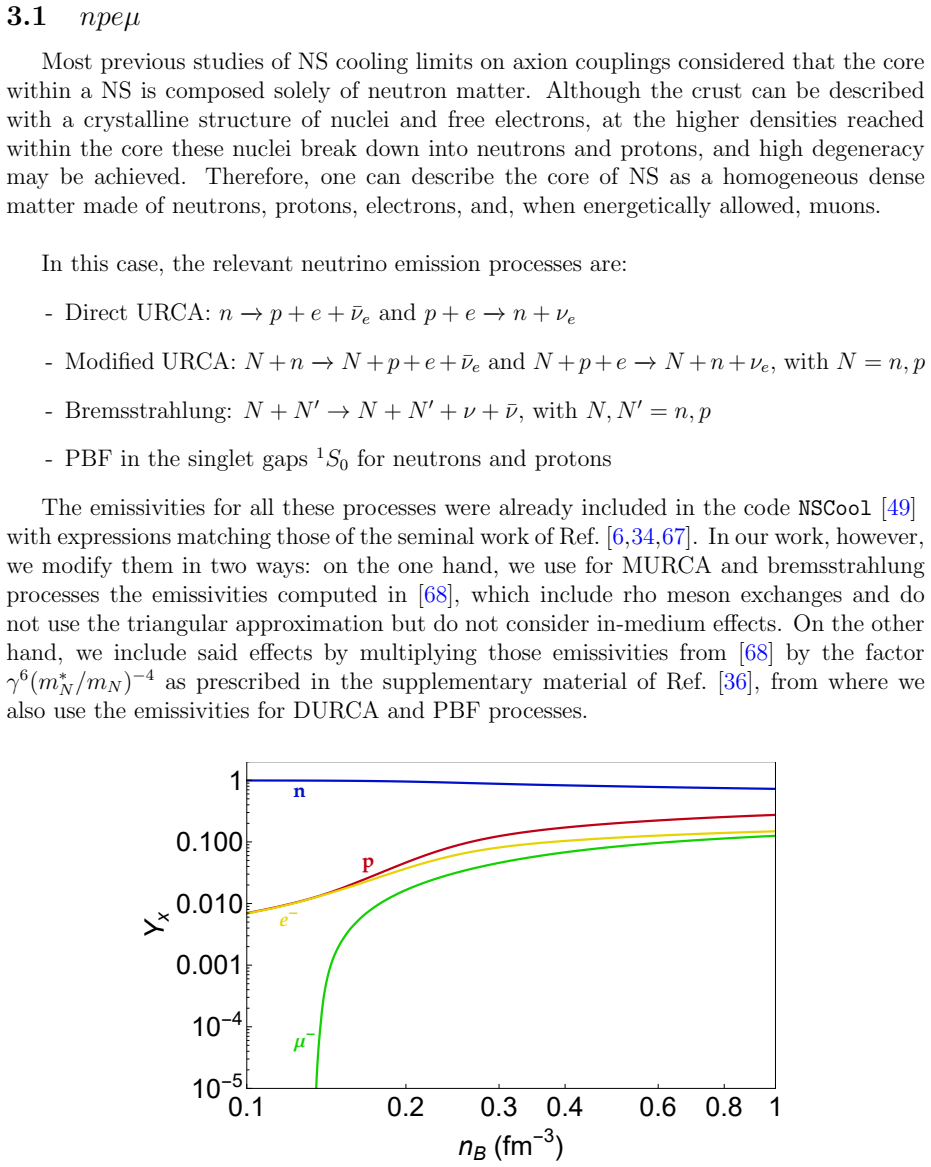
Neutron star axion mass limit changes only mildly with core composition
A machine-rendered reading of the paper's core claim, the machinery that carries it, and where it could break.
Core claim
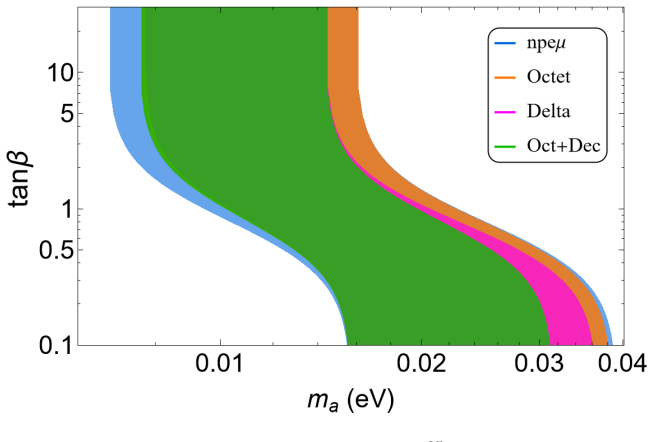
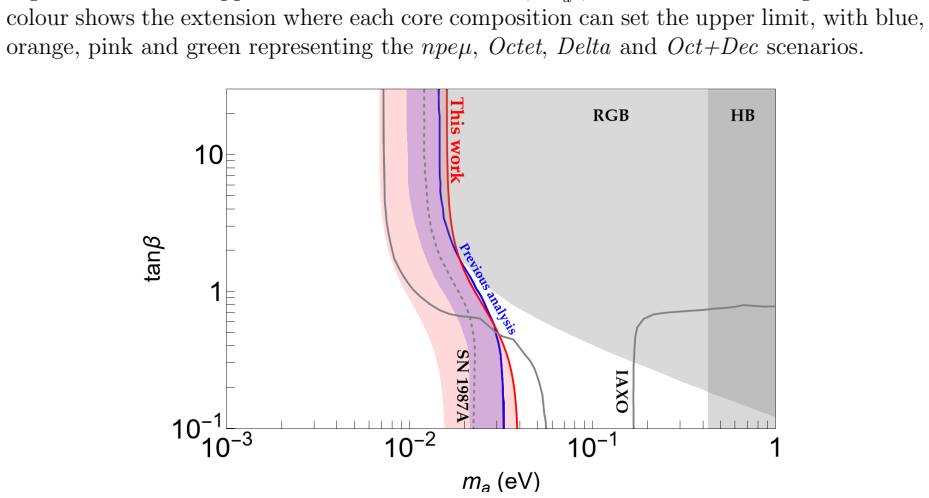
When different equations of state that permit hyperons and Delta resonances are used, the upper bound on the QCD axion mass extracted from neutron star cooling exhibits only mild variation relative to the conventional case restricted to nucleons and leptons. This holds for both KSVZ and DFSZ invisible axions. In the DFSZ scenario the bound can shift into the sensitivity range of IAXO, providing a potential observational handle on neutron star core composition.
What carries the argument
Equations of state that incorporate hyperons and Delta resonances to recompute axion production rates and the resulting neutron star cooling curves.
If this is right
- The existing upper limit on the QCD axion mass from neutron star cooling remains reliable across a range of core compositions.
- In the DFSZ model the adjusted limit enters the sensitivity window of IAXO.
- Detection of an axion within that window would indicate the presence of hyperons or Delta resonances in the core.
Where Pith is reading between the lines
- Axion bounds derived from neutron stars appear more robust against uncertainties in dense-matter composition than might have been expected.
- Joint analysis of axion signals and neutron star observables could simultaneously constrain both particle-physics parameters and the equation of state at high density.
Load-bearing premise
The chosen equations of state accurately capture the possible presence and effects of hyperons and Delta resonances in the neutron star core without significantly altering other cooling mechanisms or axion production rates.
What would settle it
An IAXO measurement of the axion mass lying outside the narrow range spanned by the family of equations of state, or neutron star cooling data exhibiting much larger variations with core composition than the mild dependence calculated.
Figures
read the original abstract
Neutron stars are very dense media in which axions may be produced. This has been used to set limit on the QCD axion mass, usually under the assumption that only neutrons, protons, electrons, and muons appear in the star core. Given the extreme conditions reached within neutron stars, it is reasonable to consider that other particles, such as hyperons and $\Delta$ resonances, may exist on-shell. In this work, we study how the limit on the mass of QCD axions, namely KSVZ and DFSZ invisible axions, is altered when different equations of state are used, allowing for heavier particles to appear in the neutron star core. We find that this dependence is in general mild and thus reinforces the reliability of the known limit. Additionally, in the DFSZ scenario, it may drive the limit within the sensitivity window for IAXO. This would allow this experiment to discern the composition of neutron star cores if an axion were to be observed within that window.
Editorial analysis
A structured set of objections, weighed in public.
Referee Report
Summary. The manuscript investigates how the inclusion of hyperons and Δ resonances in neutron star cores, modeled through various equations of state, affects the upper limits on the mass of KSVZ and DFSZ QCD axions derived from neutron star cooling observations. The authors find that the dependence on the equation of state is generally mild, reinforcing the reliability of the standard axion mass limit, and note that in the DFSZ scenario this may place the limit within the sensitivity range of the IAXO experiment, potentially allowing it to probe neutron star core composition.
Significance. Should the result hold, the work demonstrates the robustness of axion constraints from neutron star cooling against uncertainties in core particle content, which is a key strength for the credibility of these limits. The potential for IAXO to distinguish core compositions via axion observations provides an interesting link between particle physics experiments and astrophysics. The explicit computation of modified cooling curves and axion emissivities for each EOS is a positive feature supporting the central claim.
Simulated Author's Rebuttal
We thank the referee for the positive assessment of our work and the recommendation to accept the manuscript. The referee's summary accurately captures our main findings on the mild impact of hyperons and Δ resonances on the QCD axion mass limits from neutron star cooling, as well as the potential relevance for IAXO in the DFSZ case.
Circularity Check
No significant circularity identified
full rationale
The paper derives axion mass limits by explicitly computing modified cooling curves and axion emissivities for multiple equations of state that incorporate hyperons and Δ resonances, then comparing the resulting temperature evolution against observed neutron star data. No step reduces a prediction to a fitted input by construction, invokes a self-citation as the sole justification for a uniqueness claim, or renames an empirical pattern as a new derivation. The central result (mild dependence on core composition) follows directly from the numerical models without circular reduction to the paper's own inputs.
Axiom & Free-Parameter Ledger
axioms (2)
- standard math Standard model of particle physics and general relativity apply to neutron star interiors.
- domain assumption Axion production rates can be calculated perturbatively in the dense medium.
Reference graph
Works this paper leans on
-
[1]
J. M. Lattimer and M. Prakash, The Ultimate energy density of observable cold matter , Phys. Rev. Lett. 94 (2005) 111101, [ astro-ph/0411280]
Pith/arXiv arXiv 2005
-
[2]
D. Page, Thermal evolution of isolated neutron stars , in NATO Advanced Study Institute: The Many Faces of Neutron Stars, 6, 1997. astro-ph/9706259
Pith/arXiv arXiv 1997
-
[3]
D. G. Yakovlev, A. D. Kaminker, O. Y. Gnedin, and P. Haensel, Neutrino emission from neutron stars, Phys. Rept. 354 (2001) 1, [ astro-ph/0012122]
Pith/arXiv arXiv 2001
-
[4]
D. Page, U. Geppert, and F. Weber, The Cooling of compact stars , Nucl. Phys. A 777 (2006) 497–530, [astro-ph/0508056]
Pith/arXiv arXiv 2006
-
[5]
O. V. Maxwell, Neutrino Emission Processes in Hyperon Populated Neutron Stars , Astrophys. J. 316 (1987) 691–707
1987
-
[6]
Prakash, M
M. Prakash, M. Prakash, J. M. Lattimer, and C. J. Pethick, Rapid cooling of neutron stars by hyperons and Delta isobars , Astrophys. J. Lett. 390 (1992) L77
1992
-
[7]
T. Muto, T. Tatsumi, and N. Iwamoto, Axion emission from meson condensates , Phys. Rev. D 50 (1994) 6089–6099
1994
-
[8]
D. D. Ivanenko and D. F. Kurdgelaidze, Quark stars, Sov. Phys. J. 13 (1970) 1015–1019
1970
-
[9]
Iwamoto, Neutrino emissivities and mean free paths of degenerate quark matter , Annals Phys
N. Iwamoto, Neutrino emissivities and mean free paths of degenerate quark matter , Annals Phys. 141 (1982) 1–49
1982
-
[10]
J. M. Lattimer and M. Prakash, The physics of neutron stars , Science 304 (2004) 536–542, [astro-ph/0405262]. 22
Pith/arXiv arXiv 2004
-
[11]
Yakovlev and C
D. Yakovlev and C. Pethick, Neutron star cooling, Annual Review of Astronomy and Astrophysics 42 (Sept., 2004) 169–210
2004
-
[12]
MUSES Collaboration, N. Cruz-Camacho, R. Kumar, M. Reinke Pelicer, J. Peterson, T. A. Manning, R. Haas, V. Dexheimer, and J. Noronha-Hostler, Phase stability in the three-dimensional open-source code for the chiral mean-field model , Phys. Rev. D 111 (2025), no. 9 094030, [arXiv:2409.06837]
arXiv 2025
-
[13]
R. D. Peccei and H. R. Quinn, CP Conservation in the Presence of Instantons , Phys. Rev. Lett. 38 (1977) 1440–1443
1977
-
[14]
R. D. Peccei and H. R. Quinn, Constraints Imposed by CP Conservation in the Presence of Instantons, Phys. Rev. D 16 (1977) 1791–1797
1977
-
[15]
Wilczek, Problem of Strong P and T Invariance in the Presence of Instantons , Phys
F. Wilczek, Problem of Strong P and T Invariance in the Presence of Instantons , Phys. Rev. Lett. 40 (1978) 279–282
1978
-
[16]
Weinberg, A New Light Boson? , Phys
S. Weinberg, A New Light Boson? , Phys. Rev. Lett. 40 (1978) 223–226
1978
-
[17]
C. Abel et. al., Measurement of the Permanent Electric Dipole Moment of the Neutron , Phys. Rev. Lett. 124 (2020), no. 8 081803, [ arXiv:2001.11966]
arXiv 2020
-
[18]
Preskill, M
J. Preskill, M. B. Wise, and F. Wilczek, Cosmology of the Invisible Axion , Phys. Lett. B 120 (1983) 127–132
1983
-
[19]
L. F. Abbott and P. Sikivie, A Cosmological Bound on the Invisible Axion , Phys. Lett. B 120 (1983) 133–136
1983
-
[20]
Dine and W
M. Dine and W. Fischler, The Not So Harmless Axion , Phys. Lett. B 120 (1983) 137–141
1983
-
[21]
P. Carenza, T. Fischer, M. Giannotti, G. Guo, G. Mart´ ınez-Pinedo, and A. Mirizzi, Improved axion emissivity from a supernova via nucleon-nucleon bremsstrahlung , JCAP 10 (2019), no. 10 016, [arXiv:1906.11844]. [Erratum: JCAP 05, E01 (2020)]
arXiv 2019
-
[22]
N. Viaux, M. Catelan, P. B. Stetson, G. Raffelt, J. Redondo, A. A. R. Valcarce, and A. Weiss, Neutrino and axion bounds from the globular cluster M5 (NGC 5904) , Phys. Rev. Lett. 111 (2013) 231301, [arXiv:1311.1669]
Pith/arXiv arXiv 2013
-
[23]
O. Straniero, I. Dominguez, M. Giannotti, and A. Mirizzi, Axion-electron coupling from the RGB tip of Globular Clusters , in 13th Patras Workshop on Axions, WIMPs and WISPs , pp. 172–176, 2018. arXiv:1802.10357
Pith/arXiv arXiv 2018
-
[24]
L. B. Leinson, Axion mass limit from observations of the neutron star in Cassiopeia A , JCAP 08 (2014) 031, [ arXiv:1405.6873]
Pith/arXiv arXiv 2014
-
[25]
K. Hamaguchi, N. Nagata, K. Yanagi, and J. Zheng, Limit on the Axion Decay Constant from the Cooling Neutron Star in Cassiopeia A , Phys. Rev. D 98 (2018), no. 10 103015, [ arXiv:1806.07151]
Pith/arXiv arXiv 2018
-
[26]
Sedrakian, Axion cooling of neutron stars , Phys
A. Sedrakian, Axion cooling of neutron stars , Phys. Rev. D 93 (2016), no. 6 065044, [arXiv:1512.07828]
Pith/arXiv arXiv 2016
-
[27]
P. Carenza, M. Giannotti, J. Isern, A. Mirizzi, and O. Straniero, Axion astrophysics, Phys. Rept. 1117 (2025) 1–102, [ arXiv:2411.02492]
arXiv 2025
-
[28]
J. Keller and A. Sedrakian, Axions from cooling compact stars , Nucl. Phys. A 897 (2013) 62–69, [arXiv:1205.6940]
Pith/arXiv arXiv 2013
-
[29]
Sedrakian, Axion cooling of neutron stars
A. Sedrakian, Axion cooling of neutron stars. II. Beyond hadronic axions , Phys. Rev. D 99 (2019), no. 4 043011, [ arXiv:1810.00190]
Pith/arXiv arXiv 2019
-
[30]
Yadav, M
S. Yadav, M. Mishra, and T. G. Sarkar, Magnetic field and EOS effects on Axion emission from the non-rotating Neutron Stars, J. Subatomic Part. Cosmol. 4 (2025) 100175. 23
2025
-
[31]
A. G´ omez-Ba˜ n´ on, K. Bartnick, K. Springmann, and J. A. Pons,Constraining Light QCD Axions with Isolated Neutron Star Cooling , Phys. Rev. Lett. 133 (2024), no. 25 251002, [arXiv:2408.07740]
arXiv 2024
-
[32]
Iwamoto, Axion Emission from Neutron Stars , Phys
N. Iwamoto, Axion Emission from Neutron Stars , Phys. Rev. Lett. 53 (1984) 1198–1201
1984
-
[33]
Iwamoto, Nucleon-nucleon bremsstrahlung of axions and pseudoscalar particles from neutron star matter, Phys
N. Iwamoto, Nucleon-nucleon bremsstrahlung of axions and pseudoscalar particles from neutron star matter, Phys. Rev. D 64 (2001) 043002
2001
-
[34]
D. G. Yakovlev, A. D. Kaminker, and K. P. Levenfish, Neutrino emission due to Cooper pairing of nucleons in cooling neutron stars , Astron. Astrophys. 343 (1999) 650, [ astro-ph/9812366]
Pith/arXiv arXiv 1999
-
[35]
Navas et
Particle Data Group Collaboration, S. Navas et. al., Review of particle physics , Phys. Rev. D 110 (2024), no. 3 030001
2024
-
[36]
M. Buschmann, C. Dessert, J. W. Foster, A. J. Long, and B. R. Safdi, Upper Limit on the QCD Axion Mass from Isolated Neutron Star Cooling , Phys. Rev. Lett. 128 (2022), no. 9 091102, [arXiv:2111.09892]
arXiv 2022
-
[37]
J. E. Kim, Weak Interaction Singlet and Strong CP Invariance , Phys. Rev. Lett. 43 (1979) 103
1979
-
[38]
M. A. Shifman, A. I. Vainshtein, and V. I. Zakharov, Can Confinement Ensure Natural CP Invariance of Strong Interactions? , Nucl. Phys. B 166 (1980) 493–506
1980
-
[39]
M. Dine, W. Fischler, and M. Srednicki, A Simple Solution to the Strong CP Problem with a Harmless Axion, Phys. Lett. B 104 (1981) 199–202
1981
-
[40]
A. R. Zhitnitsky, On Possible Suppression of the Axion Hadron Interactions. (In Russian) , Sov. J. Nucl. Phys. 31 (1980) 260
1980
-
[41]
M. Cavan-Piton, D. Guadagnoli, M. Oertel, H. Seong, and L. Vittorio, Axion Emission from Strange Matter in Core-Collapse SNe , Phys. Rev. Lett. 133 (2024), no. 12 121002, [ arXiv:2401.10979]
arXiv 2024
-
[42]
J. M. Camalich, J. Terol-Calvo, L. Tolos, and R. Ziegler, Supernova Constraints on Dark Flavored Sectors, Phys. Rev. D 103 (2021), no. 12 L121301, [ arXiv:2012.11632]
arXiv 2021
-
[43]
T. A. Manning, Muses calculation engine , 2, 2025
2025
-
[44]
M. Reinke Pelicer et. al., Building neutron stars with the MUSES calculation engine , Phys. Rev. D 111 (2025), no. 10 103037, [ arXiv:2502.07902]
arXiv 2025
-
[47]
V. Dexheimer, Tabulated Neutron Star Equations of State Modeled within the Chiral Mean Field Model, Publ. Astron. Soc. Austral. 34 (2017) E006, [ arXiv:1708.08342]
arXiv 2017
-
[48]
V. Dexheimer, R. O. Gomes, T. Kl¨ ahn, S. Han, and M. Salinas, GW190814 as a massive rapidly rotating neutron star with exotic degrees of freedom , Phys. Rev. C 103 (2021), no. 2 025808, [arXiv:2007.08493]
Pith/arXiv arXiv 2021
-
[49]
Page, Nscool, 2016
D. Page, Nscool, 2016
2016
-
[50]
K. P. Levenfish and D. G. Yakovlev, Suppression of neutrino energy losses in reactions of direct urca processes by superfluidity in neutron star nuclei , Astronomy Letters 20 (Jan., 1994) 43–51
1994
-
[51]
M. C. Miller et. al., The Radius of PSR J0740+6620 from NICER and XMM-Newton Data , Astrophys. J. Lett. 918 (2021), no. 2 L28, [ arXiv:2105.06979]
Pith/arXiv arXiv 2021
-
[52]
J. W. Negele and D. Vautherin, Neutron star matter at subnuclear densities , Nucl. Phys. A 207 (1973) 298–320. 24
1973
-
[53]
N. Chamel and P. Haensel, Physics of Neutron Star Crusts , Living Rev. Rel. 11 (2008) 10, [arXiv:0812.3955]
Pith/arXiv arXiv 2008
-
[54]
X. Du, A. W. Steiner, and J. W. Holt, Hot and dense homogeneous nucleonic matter constrained by observations, experiment, and theory , Phys. Rev. C 99 (2019) 025803, [ arXiv:1802.09710]
Pith/arXiv arXiv 2019
-
[55]
X. Du, A. W. Steiner, and J. W. Holt, Hot and dense matter equation of state probability distributions for astrophysical simulations , Phys. Rev. C 105 (2022) 035803, [ arXiv:2107.06697]
arXiv 2022
-
[56]
R. Machleidt and D. R. Entem, Chiral effective field theory and nuclear forces , Phys. Rept. 503 (2011) 1–75, [ arXiv:1105.2919]
Pith/arXiv arXiv 2011
-
[57]
Weinberg, Nuclear forces from chiral lagrangians, Physics Letters B 251 (1990), no
S. Weinberg, Nuclear forces from chiral lagrangians, Physics Letters B 251 (1990), no. 2 288–292
1990
-
[58]
C. Wellenhofer, J. W. Holt, N. Kaiser, and W. Weise, Nuclear thermodynamics from chiral low-momentum interactions, Phys. Rev. C 89 (2014), no. 6 064009, [ arXiv:1404.2136]
Pith/arXiv arXiv 2014
-
[59]
L. Coraggio, J. W. Holt, N. Itaco, R. Machleidt, and F. Sammarruca, Reduced regulator dependence of neutron-matter predictions with perturbative chiral interactions , Phys. Rev. C 87 (2013), no. 1 014322, [arXiv:1209.5537]
Pith/arXiv arXiv 2013
-
[60]
P. Papazoglou, D. Zschiesche, S. Schramm, J. Schaffner-Bielich, H. Stoecker, and W. Greiner, Nuclei in a chiral SU(3) model , Phys. Rev. C 59 (1999) 411–427, [ nucl-th/9806087]
Pith/arXiv arXiv 1999
-
[61]
V. Dexheimer and S. Schramm, Proto-neutron and neutron stars in a chiral SU(3) model , Astrophys. J. 683 (2008) 943–948, [ arXiv:0802.1999]
Pith/arXiv arXiv 2008
-
[62]
V. A. Dexheimer and S. Schramm, A novel approach to model hybrid stars , Phys. Rev. C 81 (2010) 045201, [arXiv:0901.1748]
Pith/arXiv arXiv 2010
- [63]
-
[64]
M. Hanauske, D. Zschiesche, S. Pal, S. Schramm, H. Stoecker, and W. Greiner, Neutron star properties in a chiral SU(3) model , Astrophys. J. 537 (2000) 958, [ astro-ph/9909052]
Pith/arXiv arXiv 2000
-
[65]
K. Masuda, T. Hatsuda, and T. Takatsuka, Hadron–quark crossover and massive hybrid stars , PTEP 2013 (2013), no. 7 073D01, [ arXiv:1212.6803]
Pith/arXiv arXiv 2013
-
[66]
D. G. Yakovlev and K. P. Levenfish, Modified URCA process in neutron star cores. , Astronomy and Astrophysics 297 (May, 1995) 717
1995
-
[67]
B. L. Friman and O. V. Maxwell, Neutron Star Neutrino Emissivities , Astrophys. J. 232 (1979) 541–557
1979
-
[68]
S. Bottaro, A. Caputo, and D. F. G. Fiorillo, Neutrino emission in cold neutron stars: Bremsstrahlung and modified urca rates reexamined, JCAP 11 (2024) 015, [ arXiv:2406.18640]
arXiv 2024
-
[69]
A. Akmal, V. R. Pandharipande, and D. G. Ravenhall, The Equation of state of nucleon matter and neutron star structure, Phys. Rev. C 58 (1998) 1804–1828, [ nucl-th/9804027]
Pith/arXiv arXiv 1998
-
[70]
J. M. Pearson, N. Chamel, A. Y. Potekhin, A. F. Fantina, C. Ducoin, A. K. Dutta, and S. Goriely, Unified equations of state for cold non-accreting neutron stars with Brussels–Montreal functionals – I. Role of symmetry energy , Mon. Not. Roy. Astron. Soc. 481 (2018), no. 3 2994–3026, [arXiv:1903.04981]. [Erratum: Mon.Not.Roy.Astron.Soc. 486, 768 (2019)]
arXiv 2018
-
[71]
https://compose.obspm.fr/
-
[72]
M. Oertel, M. Hempel, T. Kl¨ ahn, and S. Typel, Equations of state for supernovae and compact stars, Rev. Mod. Phys. 89 (2017), no. 1 015007, [ arXiv:1610.03361]
Pith/arXiv arXiv 2017
- [73]
-
[74]
V. Thorsson, M. Prakash, and J. M. Lattimer, Composition, structure and evolution of neutron stars with kaon condensates , Nucl. Phys. A 572 (1994) 693–731, [ nucl-th/9305006]. [Erratum: Nucl.Phys.A 574, 851 (1994)]
Pith/arXiv arXiv 1994
-
[75]
D. K. Campbell, R. F. Dashen, and J. T. Manassah, Chiral Symmetry and Pion Condensation. 1. Model Dependent Results, Phys. Rev. D 12 (1975) 979
1975
-
[76]
P. J. Ellis, R. Knorren, and M. Prakash, Kaon condensation in neutron star matter with hyperons , Phys. Lett. B 349 (1995) 11–17, [ nucl-th/9502033]
Pith/arXiv arXiv 1995
-
[77]
Freedman and L
B. Freedman and L. D. McLerran, Quark Star Phenomenology , Phys. Rev. D 17 (1978) 1109
1978
-
[78]
K. Schertler, C. Greiner, J. Schaffner-Bielich, and M. H. Thoma, Quark phases in neutron stars and a ’third family’ of compact stars as a signature for phase transitions , Nucl. Phys. A 677 (2000) 463–490, [astro-ph/0001467]
Pith/arXiv arXiv 2000
-
[79]
M. Alford, M. Braby, M. W. Paris, and S. Reddy, Hybrid stars that masquerade as neutron stars , Astrophys. J. 629 (2005) 969–978, [ nucl-th/0411016]
Pith/arXiv arXiv 2005
-
[80]
Arias-Arag´ on and F
F. Arias-Arag´ on and F. Nola,To be determined, arXiv:27XX.XXXXX
-
[81]
G. Grilli di Cortona, E. Hardy, J. Pardo Vega, and G. Villadoro, The QCD axion, precisely , JHEP 01 (2016) 034, [ arXiv:1511.02867]
Pith/arXiv arXiv 2016
-
[82]
L. Di Luzio, M. Giannotti, E. Nardi, and L. Visinelli, The landscape of QCD axion models , Phys. Rept. 870 (2020) 1–117, [ arXiv:2003.01100]
Pith/arXiv arXiv 2020
discussion (0)
Sign in with ORCID, Apple, or X to comment. Anyone can read and Pith papers without signing in.