Detector performance at SHiP for cascade-produced long-lived particles
Pith reviewed 2026-06-27 21:30 UTC · model grok-4.3
The pith
Cascade production yields only moderate or negligible gains in observable long-lived particles at SHiP once detector acceptance is included.
A machine-rendered reading of the paper's core claim, the machinery that carries it, and where it could break.
Core claim
For the nominal SHiP detector design, cascade ALPs give at most a moderate enhancement over primary production, and only at the lightest masses; at higher masses, the cascade contribution becomes subdominant or negligible. For HNLs from secondary kaons, the cascade contribution is already subdominant after imposing daughter-level geometric acceptance.
What carries the argument
Semi-analytic event-rate calculation combined with detector-level ALP reconstruction study in the electromagnetic calorimeter.
If this is right
- At higher masses primary production alone sets the expected signal rate.
- Geometric acceptance on daughter particles already removes most of the cascade contribution for HNLs.
- Relaxed event-selection criteria can recover part of the lost cascade rate.
- An active-target subdetector could capture additional soft particles from cascades.
Where Pith is reading between the lines
- The same acceptance suppression is likely to appear in other thick-target beam-dump setups that rely on soft-particle detection.
- Sensitivity projections for SHiP should weight primary production more heavily than cascade-enhanced estimates.
- Detector upgrades focused on low-momentum tracking and calorimetry would be needed to make cascade channels competitive.
Load-bearing premise
The semi-analytic event-rate calculation combined with the detector-level ALP reconstruction study accurately represents the full cascade kinematics and reconstruction efficiencies without unaccounted systematic biases in the soft-particle regime.
What would settle it
A complete Monte Carlo simulation of the full cascade chain and detector response that yields reconstruction efficiencies for soft particles substantially higher than those obtained from the semi-analytic model.
Figures
read the original abstract
Previous studies have shown that cascade production in the thick target of the SHiP experiment may substantially enhance the number of light long-lived particles (LLPs) decaying in the fiducial volume. However, cascade-produced LLPs are typically soft, so daughter-level acceptance and reconstruction effects can strongly suppress the observable event rate. We quantify this suppression for two representative cases: photophilic axion-like particles produced in electromagnetic cascades, and heavy neutral leptons produced in decays of secondary kaons. We combine a semi-analytic event-rate calculation with a detector-level study of ALP reconstruction in the electromagnetic calorimeter. For the nominal SHiP detector design, cascade ALPs give at most a moderate enhancement over primary production, and only at the lightest masses; at higher masses, the cascade contribution becomes subdominant or negligible. For HNLs from secondary kaons, the cascade contribution is already subdominant after imposing daughter-level geometric acceptance. We also identify possible ways to recover part of the cascade event rate, including relaxed event-selection criteria and an active-target subdetector.
Editorial analysis
A structured set of objections, weighed in public.
Referee Report
Summary. The manuscript claims that for the nominal SHiP detector design, cascade production of long-lived particles yields at most a moderate enhancement over primary production for photophilic ALPs and only at the lightest masses; at higher masses the cascade contribution becomes subdominant or negligible. For HNLs produced in decays of secondary kaons, the cascade contribution is already subdominant after imposing daughter-level geometric acceptance. The analysis combines a semi-analytic event-rate calculation with a detector-level study of ALP reconstruction in the electromagnetic calorimeter and identifies possible recovery strategies such as relaxed event-selection criteria and an active-target subdetector.
Significance. If the quantitative conclusions on acceptance suppression hold, the result is significant for SHiP sensitivity projections because it shows that soft-particle acceptance and reconstruction effects largely offset the potential rate enhancement from cascades in the thick target. This tempers earlier expectations of substantially increased LLP yields and supplies concrete guidance on detector modifications that could recover part of the cascade rate.
major comments (2)
- [semi-analytic event-rate calculation] The central claim that cascade ALPs give only moderate enhancement at low mass and become subdominant at higher mass rests on the semi-analytic cascade kinematics correctly predicting net suppression for soft daughters. The manuscript provides no explicit validation (e.g., comparison of analytic distributions to full Monte Carlo in the soft-particle regime) that correlations between production angle, energy, and subsequent scattering are captured; without this, the quantitative conclusion on subdominance cannot be confirmed.
- [detector-level ALP reconstruction study] The detector-level ALP reconstruction study in the electromagnetic calorimeter is used to derive efficiencies that suppress the cascade contribution. No section demonstrates that these efficiencies remain accurate for the softer spectrum characteristic of cascade-produced ALPs rather than primary ones; this assumption is load-bearing for the claim that reconstruction effects dominate over the cascade enhancement.
minor comments (1)
- The abstract and main text should specify the mass ranges corresponding to 'lightest masses' and 'higher masses' so that the transition point between moderate enhancement and subdominance is quantitatively clear.
Simulated Author's Rebuttal
We thank the referee for their careful reading and constructive comments on our manuscript. We address the major comments point by point below, agreeing that additional validation would strengthen the quantitative claims, and outline the revisions we intend to make.
read point-by-point responses
-
Referee: The central claim that cascade ALPs give only moderate enhancement at low mass and become subdominant at higher mass rests on the semi-analytic cascade kinematics correctly predicting net suppression for soft daughters. The manuscript provides no explicit validation (e.g., comparison of analytic distributions to full Monte Carlo in the soft-particle regime) that correlations between production angle, energy, and subsequent scattering are captured; without this, the quantitative conclusion on subdominance cannot be confirmed.
Authors: We agree that explicit validation of the semi-analytic cascade model against full Monte Carlo in the soft-particle regime would increase confidence in the predicted suppression. The model follows established iterative cascade techniques that incorporate production-angle, energy, and scattering correlations, but we acknowledge the absence of a direct side-by-side comparison in the current text. We will add a dedicated appendix or figure in the revised manuscript showing such a comparison for the relevant kinematic distributions. revision: yes
-
Referee: The detector-level ALP reconstruction study in the electromagnetic calorimeter is used to derive efficiencies that suppress the cascade contribution. No section demonstrates that these efficiencies remain accurate for the softer spectrum characteristic of cascade-produced ALPs rather than primary ones; this assumption is load-bearing for the claim that reconstruction effects dominate over the cascade enhancement.
Authors: The calorimeter efficiencies were extracted from a GEANT4 simulation covering a wide energy range, yet we concur that a specific demonstration for the softer cascade spectrum is necessary to support the claim that reconstruction effects dominate. In the revised manuscript we will present separate efficiency curves (or tables) for primary versus cascade-produced ALPs to verify applicability across the relevant spectra. revision: yes
Circularity Check
No circularity: forward semi-analytic rate and acceptance calculations
full rationale
The paper computes LLP production rates and detector acceptances via explicit semi-analytic cascade modeling plus calorimeter reconstruction studies. These are forward calculations from production cross-sections, kinematics, and geometric efficiencies; no quantity is defined in terms of the final observable rates, no fitted parameters are relabeled as predictions, and no load-bearing uniqueness claims rest on self-citations. The central results (moderate or negligible cascade enhancement) emerge directly from the computed suppression factors rather than by construction from the inputs.
Axiom & Free-Parameter Ledger
Reference graph
Works this paper leans on
-
[1]
For this purpose, we used calibratedPythia8on the data from collisions of a 400 GeV proton beam with a thin target within 20% precision, see Ref
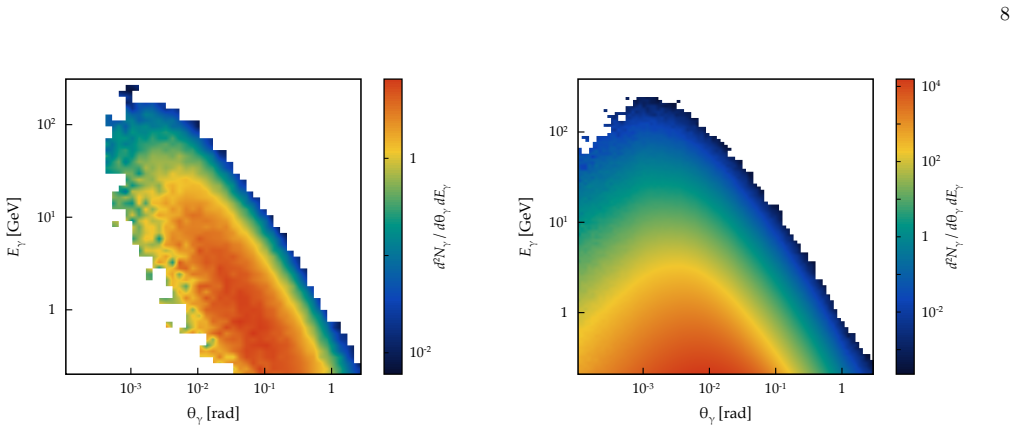
Photons We have generated the flux of the primary photons originating from the decays ofπ 0, η→2γproduced in the interactions of the proton beam with the target. For this purpose, we used calibratedPythia8on the data from collisions of a 400 GeV proton beam with a thin target within 20% precision, see Ref. [44] for details. The pri- mary photons were used...
-
[2]
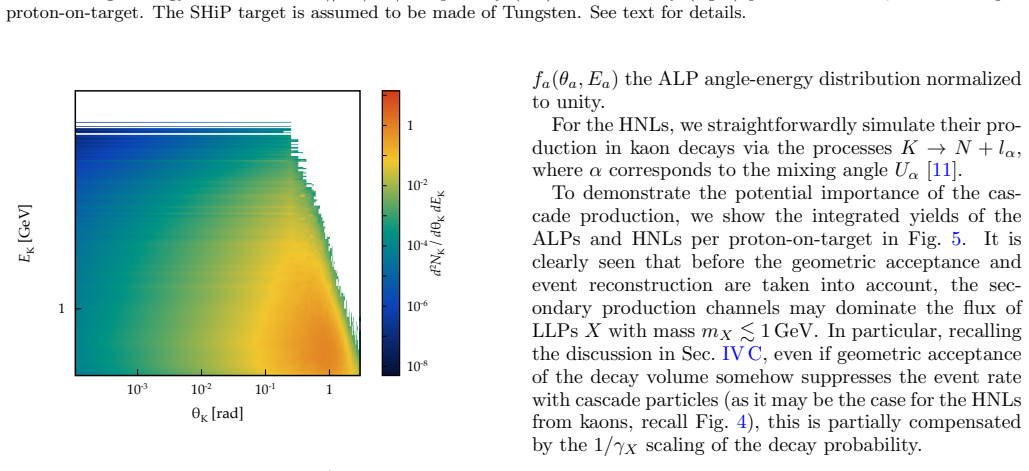
Kaons For the decaying kaon flux and multiplicities, we will use the results of Ref. [34]. The authors prepared the flux of charged kaons assuming the Molybdenum-Tungsten target. The flux may be somewhat smaller for the cur- rent SHiP target design, which is made solely of Tung- sten. Nevertheless, this is enough for obtaining quali- tative conclusions ab...
-
[3]
The detector geometry is described usingGeo- Model[54] and passed ontoGEANT4, which then handles propagation of particles in matter using the FTFP BERTphysics list
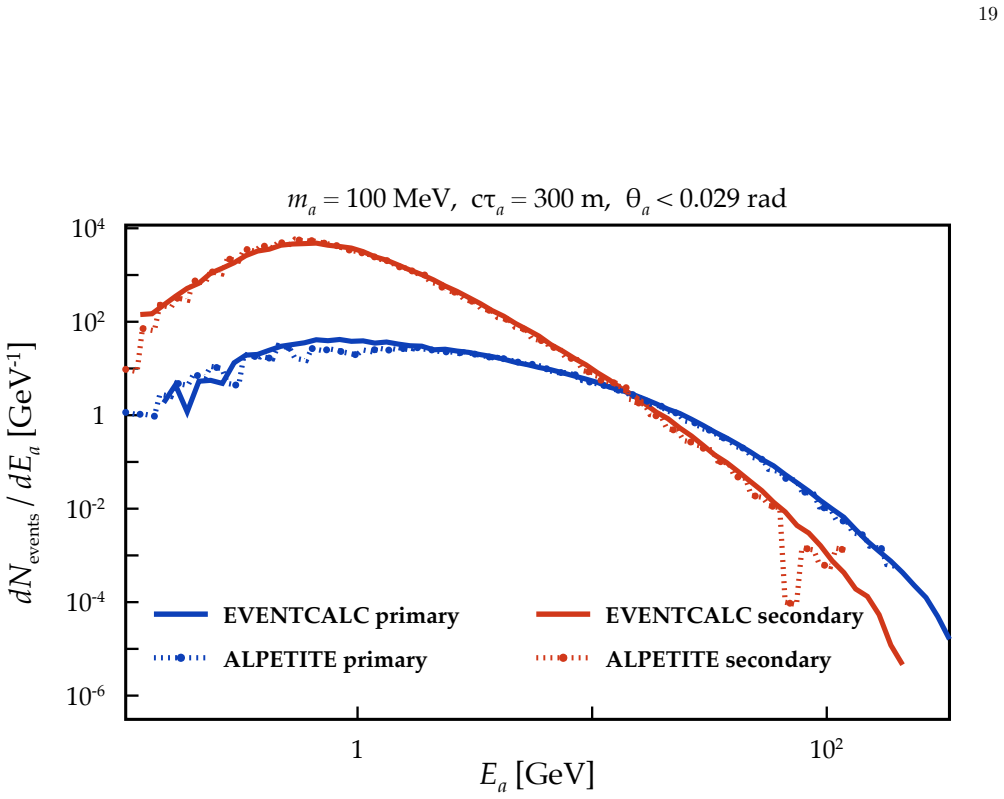
GEANT4 simulation framework The tabulatedEventCalc-SHiPdata is propagated into a custom simulation faithfully representing the SHiP ECAL and HCAL (although only the former is used in this work). The detector geometry is described usingGeo- Model[54] and passed ontoGEANT4, which then handles propagation of particles in matter using the FTFP BERTphysics lis...
-
[4]
The spatial distribution of hits in each cluster is then analyzed using a principal component analysis (PCA) [56]
Event vertex and invariant mass reconstruction The cluster energy is computed and calibrated in units of minimum-ionizing-particle depositions (MIPs) using a muon particle gun sample as a reference. The spatial distribution of hits in each cluster is then analyzed using a principal component analysis (PCA) [56]. The shower direction is estimated from the ...
-
[5]
ϵ dec = 1
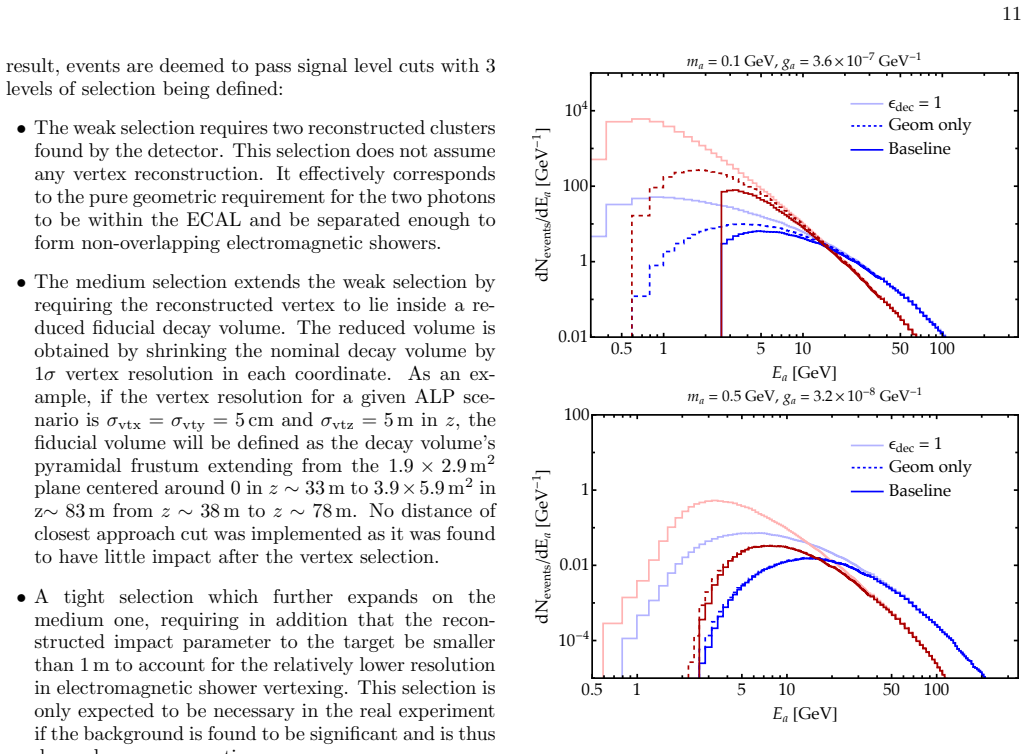
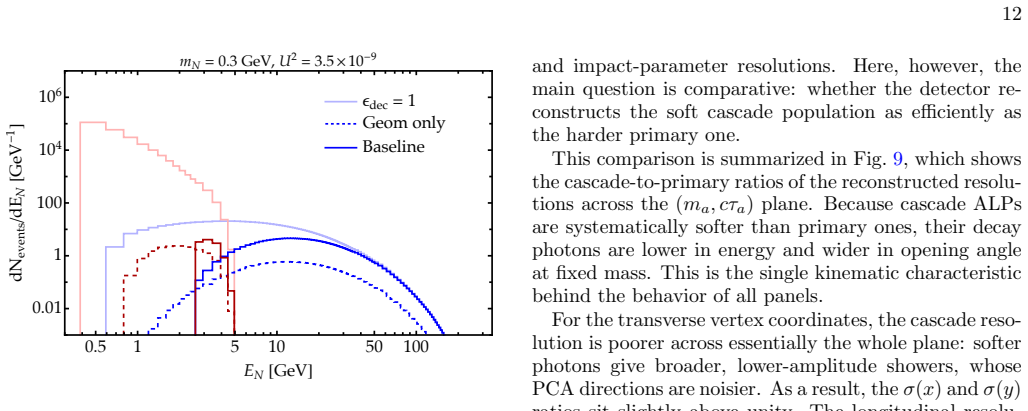
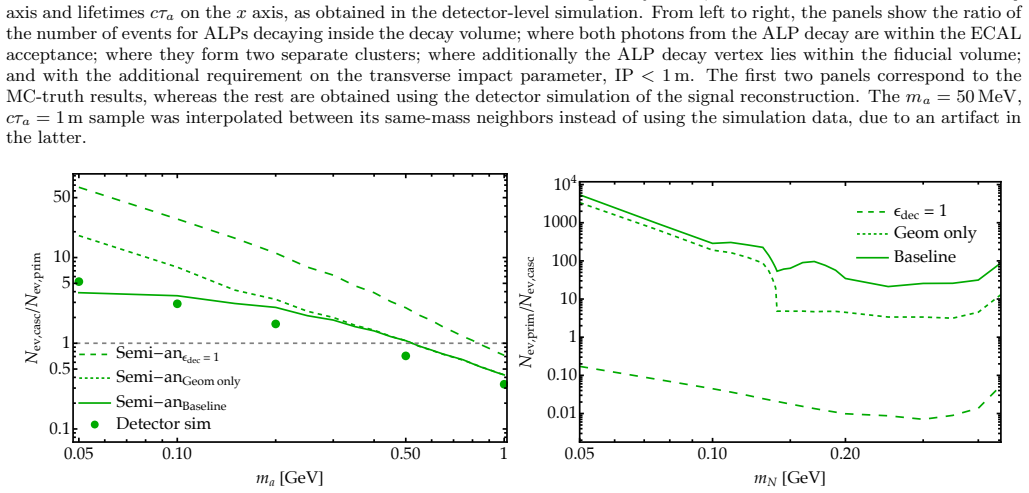
Semi-analytic estimates We start with the semi-analytic analysis by Eq. (26), and apply it to the “ϵ dec = 1”, “Geom only”, and “Base- line” selections on decay products summarized in Tab. I. To demonstrate the effects of adding the selection crite- ria, we consider the differential distribution of the decay ϵdec =1 Geom only Baseline 0.5 1 5 10 50 1000.0...
-
[6]
ϵ dec = 1
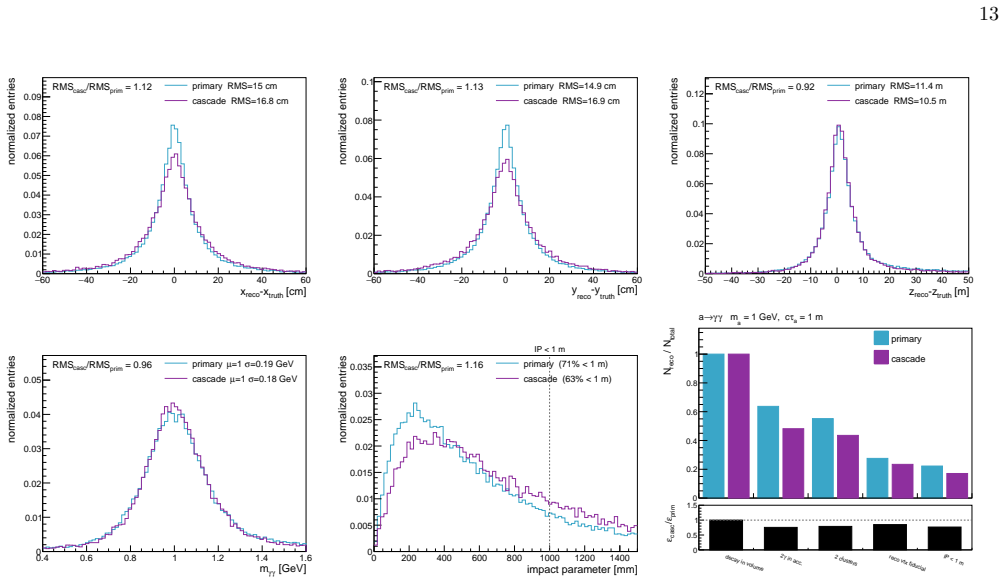
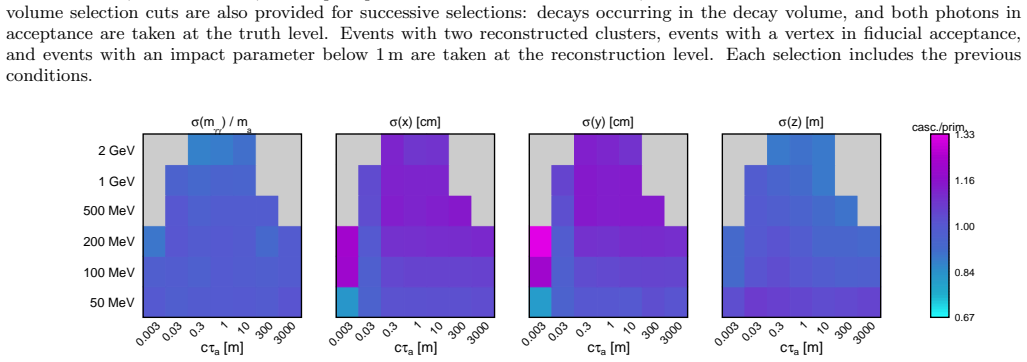
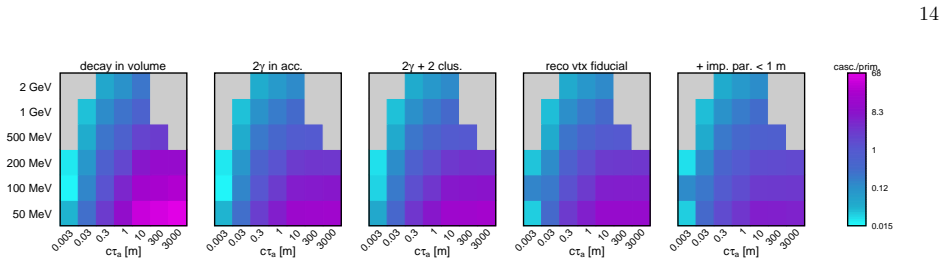
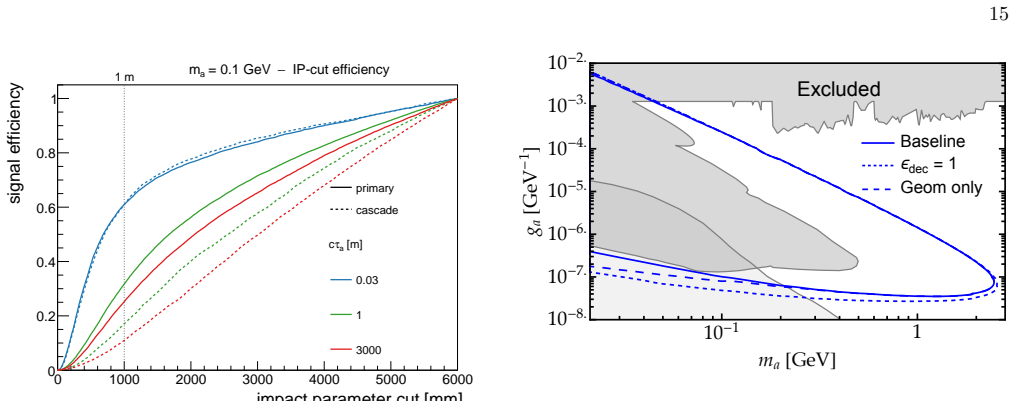
Detector-level reconstruction Let us now turn to the detector-level reconstruction of the ALP signal. A representative working point, ma = 1 GeV andcτ a = 1 m, is shown in Fig. 8 to il- lustrate the absolute scale of the vertex, invariant-mass, and impact-parameter resolutions. Here, however, the main question is comparative: whether the detector re- cons...
2000
-
[7]
This would imply leveraging the detector’s full coverage of the decay vessel andO(cm) position resolution to reconstruct otherwise incomplete or fully missing events
to attempt reconstruction of LLP reaching the de- cay vessel but whose final states fail to (all) reach the downstream detectors. This would imply leveraging the detector’s full coverage of the decay vessel andO(cm) position resolution to reconstruct otherwise incomplete or fully missing events. The detector has poor efficiency for photon reconstruction b...
-
[8]
The nuMSM, dark matter and neutrino masses,
T. Asaka, S. Blanchet, and M. Shaposhnikov, “The nuMSM, dark matter and neutrino masses,”Phys. Lett. B631(2005) 151–156,arXiv:hep-ph/0503065
Pith/arXiv arXiv 2005
-
[9]
A Possible symmetry of the nuMSM,
M. Shaposhnikov, “A Possible symmetry of the nuMSM,”Nucl. Phys. B763(2007) 49–59, arXiv:hep-ph/0605047
Pith/arXiv arXiv 2007
-
[10]
M. Pospelov, A. Ritz, and M. B. Voloshin, “Secluded WIMP Dark Matter,”Phys. Lett. B662(2008) 53–61, arXiv:0711.4866 [hep-ph]
Pith/arXiv arXiv 2008
-
[11]
Light inflaton Hunter’s Guide,
F. Bezrukov and D. Gorbunov, “Light inflaton Hunter’s Guide,”JHEP05(2010) 010,arXiv:0912.0390 [hep-ph]
Pith/arXiv arXiv 2010
-
[12]
Probing Light Thermal Dark-Matter With a Higgs Portal Mediator,
G. Krnjaic, “Probing Light Thermal Dark-Matter With a Higgs Portal Mediator,”Phys. Rev. D94(2016) no. 7, 073009,arXiv:1512.04119 [hep-ph]
Pith/arXiv arXiv 2016
-
[13]
Inelastic Dark Matter at the LHC Lifetime Frontier: ATLAS, CMS, LHCb, CODEX-b, FASER, and MATHUSLA,
A. Berlin and F. Kling, “Inelastic Dark Matter at the LHC Lifetime Frontier: ATLAS, CMS, LHCb, CODEX-b, FASER, and MATHUSLA,”Phys. Rev. D 99(2019) no. 1, 015021,arXiv:1810.01879 [hep-ph]
Pith/arXiv arXiv 2019
-
[14]
High Quality QCD Axion and the LHC,
A. Hook, S. Kumar, Z. Liu, and R. Sundrum, “High Quality QCD Axion and the LHC,”Phys. Rev. Lett. 124(2020) no. 22, 221801,arXiv:1911.12364 [hep-ph]
arXiv 2020
-
[15]
How to find neutral leptons of theνMSM?,
D. Gorbunov and M. Shaposhnikov, “How to find neutral leptons of theνMSM?,”JHEP10(2007) 015, arXiv:0705.1729 [hep-ph]. [Erratum: JHEP 11, 101 (2013)]
Pith/arXiv arXiv 2007
-
[16]
Serendipity in dark photon searches,
P. Ilten, Y. Soreq, M. Williams, and W. Xue, “Serendipity in dark photon searches,”JHEP06(2018) 004,arXiv:1801.04847 [hep-ph]
Pith/arXiv arXiv 2018
-
[17]
Coupling QCD-Scale Axionlike Particles to Gluons,
D. Aloni, Y. Soreq, and M. Williams, “Coupling QCD-Scale Axionlike Particles to Gluons,”Phys. Rev. Lett.123(2019) no. 3, 031803,arXiv:1811.03474 [hep-ph]
arXiv 2019
-
[18]
Phenomenology of GeV-scale Heavy Neutral Leptons,
K. Bondarenko, A. Boyarsky, D. Gorbunov, and O. Ruchayskiy, “Phenomenology of GeV-scale Heavy Neutral Leptons,”JHEP11(2018) 032, arXiv:1805.08567 [hep-ph]
Pith/arXiv arXiv 2018
-
[19]
Phenomenology of GeV-scale scalar portal,
I. Boiarska, K. Bondarenko, A. Boyarsky, V. Gorkavenko, M. Ovchynnikov, and A. Sokolenko, “Phenomenology of GeV-scale scalar portal,”JHEP11 (2019) 162,arXiv:1904.10447 [hep-ph]. 17
arXiv 2019
-
[20]
Dark sector production via proton bremsstrahlung,
S. Foroughi-Abari and A. Ritz, “Dark sector production via proton bremsstrahlung,”Phys. Rev. D105(2022) no. 9, 095045,arXiv:2108.05900 [hep-ph]
arXiv 2022
-
[21]
Advancing the phenomenology of GeV-scale axionlike particles,
M. Ovchynnikov and A. Zaporozhchenko, “Advancing the phenomenology of GeV-scale axionlike particles,” Phys. Rev. D112(2025) no. 1, 015001, arXiv:2501.04525 [hep-ph]
arXiv 2025
-
[22]
A facility to Search for Hidden Particles at the CERN SPS: the SHiP physics case,
S. Alekhinet al., “A facility to Search for Hidden Particles at the CERN SPS: the SHiP physics case,” Rept. Prog. Phys.79(2016) no. 12, 124201, arXiv:1504.04855 [hep-ph]
Pith/arXiv arXiv 2016
-
[23]
Proposed Inclusive Dark Photon Search at LHCb,
P. Ilten, Y. Soreq, J. Thaler, M. Williams, and W. Xue, “Proposed Inclusive Dark Photon Search at LHCb,” Phys. Rev. Lett.116(2016) no. 25, 251803, arXiv:1603.08926 [hep-ph]
Pith/arXiv arXiv 2016
-
[24]
ForwArd Search ExpeRiment at the LHC,
J. L. Feng, I. Galon, F. Kling, and S. Trojanowski, “ForwArd Search ExpeRiment at the LHC,”Phys. Rev. D97(2018) no. 3, 035001,arXiv:1708.09389 [hep-ph]. [18]Belle-IICollaboration, W. Altmannshoferet al., “The Belle II Physics Book,”PTEP2019(2019) no. 12, 123C01,arXiv:1808.10567 [hep-ex]. [Erratum: PTEP 2020, 029201 (2020)]
Pith/arXiv arXiv 2018
-
[25]
Physics Beyond Colliders at CERN: Beyond the Standard Model Working Group Report,
J. Beachamet al., “Physics Beyond Colliders at CERN: Beyond the Standard Model Working Group Report,” J. Phys. G47(2020) no. 1, 010501,arXiv:1901.09966 [hep-ex]. [20]NA64Collaboration, D. Banerjeeet al., “Search for Axionlike and Scalar Particles with the NA64 Experiment,”Phys. Rev. Lett.125(2020) no. 8, 081801,arXiv:2005.02710 [hep-ex]
arXiv 2020
-
[26]
Searches for long-lived particles at the future FCC-ee,
A. Blondelet al., “Searches for long-lived particles at the future FCC-ee,”Front. in Phys.10(2022) 967881, arXiv:2203.05502 [hep-ex]
arXiv 2022
-
[27]
Feebly Interacting Particles: FIPs 2022 workshop report,
C. Antelet al., “Feebly Interacting Particles: FIPs 2022 workshop report,”arXiv:2305.01715 [hep-ph]
arXiv 2022
-
[28]
LHCb potential to discover long-lived new physics particles with lifetimes above 100 ps,
V. Gorkavenko, B. K. Jashal, V. Kholoimov, Y. Kyselov, D. Mendoza, M. Ovchynnikov, A. Oyanguren, V. Svintozelskyi, and J. Zhuo, “LHCb potential to discover long-lived new physics particles with lifetimes above 100 ps,”Eur. Phys. J. C84(2024) no. 6, 608,arXiv:2312.14016 [hep-ph]. [24]DUNECollaboration, A. Abed Abudet al., “DUNE Phase II: scientific opportu...
arXiv 2024
-
[29]
Physics Briefing Book: Input for the 2026 update of the European Strategy for Particle Physics,
J. de Blaset al., “Physics Briefing Book: Input for the 2026 update of the European Strategy for Particle Physics,”arXiv:2511.03883 [hep-ex]
arXiv 2026
-
[30]
Braking protons at the EIC: from invisible meson decay to new physics searches,
R. Balkin, T. Coren, A. Jentsch, H. Liu, M. Ovchynnikov, Y. Soreq, and S. Trifinopoulos, “Braking protons at the EIC: from invisible meson decay to new physics searches,”arXiv:2601.00068 [hep-ph]. [27]SHiPCollaboration, O. Aberleet al., “BDF/SHiP at the ECN3 high-intensity beam facility,” tech. rep., CERN, Geneva, 2022. http://cds.cern.ch/record/2839677. ...
Pith/arXiv arXiv 2022
-
[31]
Towards the optimal beam dump experiment to search for feebly interacting particles,
K. Bondarenko, A. Boyarsky, R. Jacobsson, O. Mikulenko, and M. Ovchynnikov, “Towards the optimal beam dump experiment to search for feebly interacting particles,”Eur. Phys. J. C83(2023) no. 12, 1126,arXiv:2304.02511 [hep-ph]. [30]SHiPCollaboration, R. e. a. Albanese, “BDF/SHiP Annual Report 2025,” tech. rep., CERN, Geneva, 2025. https://cds.cern.ch/record...
arXiv 2023
-
[32]
Heavy Neutral Leptons from kaon decays in the SHiP experiment,
D. Gorbunov, I. Krasnov, Y. Kudenko, and S. Suvorov, “Heavy Neutral Leptons from kaon decays in the SHiP experiment,”Phys. Lett. B810(2020) 135817, arXiv:2004.07974 [hep-ph]
arXiv 2020
-
[33]
Dark fluxes from electromagnetic cascades,
N. Blinov, P. J. Fox, K. J. Kelly, P. A. N. Machado, and R. Plestid, “Dark fluxes from electromagnetic cascades,” JHEP07(2024) 022,arXiv:2401.06843 [hep-ph]
arXiv 2024
-
[34]
Long-lived vectors from electromagnetic cascades at SHiP,
T. Zhou, R. Plestid, K. J. Kelly, N. Blinov, and P. J. Fox, “Long-lived vectors from electromagnetic cascades at SHiP,”JHEP02(2025) 107,arXiv:2412.01880 [hep-ph]
arXiv 2025
-
[35]
L µ −L τ gauge bosons in beam dumps and supernovae,
N. Blinov, P. J. Fox, K. J. Kelly, R. Plestid, and T. Zhou, “L µ −L τ gauge bosons in beam dumps and supernovae,”arXiv:2511.09619 [hep-ph]
-
[36]
Long-lived axionlike particles from electromagnetic cascades,
S. Patrone, N. Blinov, and R. Plestid, “Long-lived axionlike particles from electromagnetic cascades,” Phys. Rev. D113(2026) no. 7, 075009, arXiv:2509.14310 [hep-ph]. [39]SHiPCollaboration, W. M. Bonivento, “Studies for the electro-magnetic calorimeter SplitCal for the SHiP experiment at CERN with shower direction reconstruction capability,”JINST13(2018) ...
arXiv 2026
-
[37]
M. A. V. Climescu,Design and development of calorimetry at SHiP and SND@LHC. PhD thesis, Mainz U., Johannes Gutenberg University Mainz, 2025
2025
-
[38]
Sensitivities to feebly interacting particles: Public and unified calculations,
M. Ovchynnikov, J.-L. Tastet, O. Mikulenko, and K. Bondarenko, “Sensitivities to feebly interacting particles: Public and unified calculations,”Phys. Rev. D 108(2023) no. 7, 075028,arXiv:2305.13383 [hep-ph]. [42]SHiPCollaboration, H. Dijkstra and T. Ruf, “Heavy Flavour Cascade Production in a Beam Dump.” Online at https://cds.cern.ch/record/2115534, Dec, ...
arXiv 2023
-
[39]
ALPtraum: ALP production in proton beam dump experiments,
B. D¨ obrich, J. Jaeckel, F. Kahlhoefer, A. Ringwald, and K. Schmidt-Hoberg, “ALPtraum: ALP production in proton beam dump experiments,”JHEP02(2016) 018, arXiv:1512.03069 [hep-ph]
Pith/arXiv arXiv 2016
-
[40]
Light in the beam dump - ALP production from decay photons in proton beam-dumps,
B. D¨ obrich, J. Jaeckel, and T. Spadaro, “Light in the beam dump - ALP production from decay photons in proton beam-dumps,”JHEP05(2019) 213, arXiv:1904.02091 [hep-ph]. [Erratum: JHEP 10, 046 (2020)]
arXiv 2019
-
[41]
ALPINIST: Axion-Like Particles In Numerous Interactions Simulated and Tabulated,
J. Jerhot, B. D¨ obrich, F. Ertas, F. Kahlhoefer, and T. Spadaro, “ALPINIST: Axion-Like Particles In Numerous Interactions Simulated and Tabulated,” JHEP07(2022) 094,arXiv:2201.05170 [hep-ph]. 18
arXiv 2022
-
[42]
Nucleosynthesis and CMB bounds on photophilic ALPs: a fresh look,
M. Escudero Abenza, C. Garcia-Perez, and M. Ovchynnikov, “Nucleosynthesis and CMB bounds on photophilic ALPs: a fresh look,”Eur. Phys. J. C86 (2026) no. 5, 500,arXiv:2511.00157 [hep-ph]. [47]GEANT4Collaboration, S. Agostinelliet al., “GEANT4 - A Simulation Toolkit,”Nucl. Instrum. Meth. A506(2003) 250–303
Pith/arXiv arXiv 2026
-
[43]
Geant4 developments and applications,
J. Allisonet al., “Geant4 developments and applications,”IEEE Trans. Nucl. Sci.53(2006) 270
2006
-
[44]
Recent developments in Geant4,
J. Allisonet al., “Recent developments in Geant4,” Nucl. Instrum. Meth. A835(2016) 186–225
2016
-
[45]
M. Ovchynnikov, “Senscalc.” Online at https://doi.org/10.5281/zenodo.20030983, May, 2026.https://doi.org/10.5281/zenodo.20030983
-
[46]
SensCalc
M. Ovchynnikov, “SensCalc.” Online at https://github.com/maksymovchynnikov/SensCalc, 2026. https://github.com/maksymovchynnikov/SensCalc
2026
-
[47]
The EvtGen particle decay simulation package,
D. J. Lange, “The EvtGen particle decay simulation package,”Nucl. Instrum. Meth. A462(2001) 152–155
2001
-
[48]
EventCalc-SHiP
M. Ovchynnikov, “EventCalc-SHiP.” Online athttps: //github.com/maksymovchynnikov/EventCalc-SHiP, 2026.https: //github.com/maksymovchynnikov/EventCalc-SHiP
2026
-
[49]
The GeoModel tool suite for detector description,
M. Bandieramonte, R. M. Bianchi, J. Boudreau, A. Dell’Acqua, and V. Tsulaia, “The GeoModel tool suite for detector description,”EPJ Web Conf.251 (2021) 03007
2021
-
[50]
KLauS: a low power Silicon Photomultiplier charge readout ASIC in 0.18 UMC CMOS,
K. Briggl, H. Chen, D. Schimansky, W. Shen, V. Stankova, and H. C. Schultz-Coulon, “KLauS: a low power Silicon Photomultiplier charge readout ASIC in 0.18 UMC CMOS,”JINST11(2016) no. 03, C03045
2016
-
[51]
PRINCIPAL COMPONENT ANALYSIS AND ITS APPLICATIONS TO TRACK FINDING,
H. Wind, “PRINCIPAL COMPONENT ANALYSIS AND ITS APPLICATIONS TO TRACK FINDING,”
-
[52]
A. Brignoliet al., “Performance of prototypes with different reflector materials for the SHiP liquid scintillator surrounding background tagger,”JINST20 (2025) no. 07, P07023,arXiv:2503.10250 [physics.ins-det]
arXiv 2025
-
[53]
M. Ferrillo, M. Ovchynnikov, F. Resnati, and A. De Roeck, “Improving the potential of BDF@SPS to search for new physics with liquid argon time projection chambers,”JHEP02(2024) 196,arXiv:2312.14868 [hep-ph]. 19 m a = 100 MeV, c τ a = 300 m, θ a < 0.029 rad 1 10 2 10 -6 10 -4 10 -2 1 10 2 10 4 E a [GeV] dN events / dE a [GeV -1 ] EVENTCALC primary EVENTCAL...
arXiv 2024
discussion (0)
Sign in with ORCID, Apple, or X to comment. Anyone can read and Pith papers without signing in.