Machine learning assisted molecular dynamics of charge-transfer mechanisms at Li/Ga-doped Li₇La₃Zr₂O₁₂ (LLZO) interfaces
Pith reviewed 2026-06-27 21:20 UTC · model grok-4.3
The pith
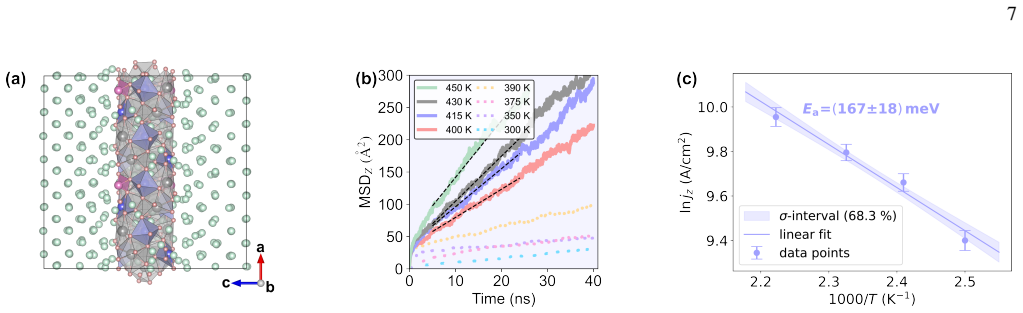
MLMD simulations find 167 meV activation energy for charge transfer at Li/Ga-LLZO interfaces, showing the step is not rate-limiting.
A machine-rendered reading of the paper's core claim, the machinery that carries it, and where it could break.
Core claim
Using machine-learning molecular dynamics with moment tensor potentials, the charge-transfer activation energies are 167 meV at the Li/Ga-LLZO interface and 200 meV in Ga-LLZO, corresponding to resistances of approximately 10^{-5} Ω cm². These values demonstrate that intrinsic Li/Ga-LLZO charge transfer is not rate-limiting.
What carries the argument
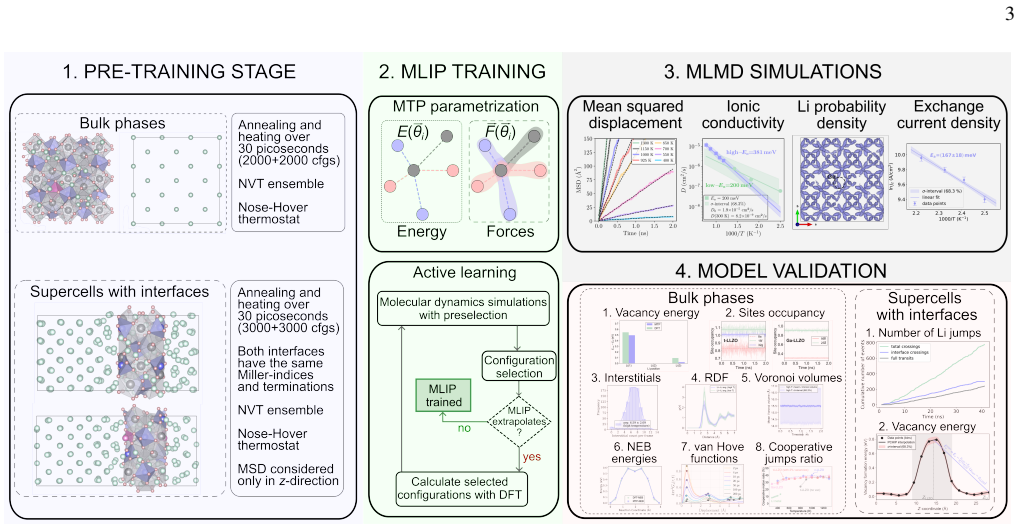
Moment tensor potentials trained for MLMD of Li+ diffusion, together with the residence-time window method that isolates genuine charge-transfer events by excluding ion rattling.
If this is right
- Intrinsic charge transfer at the Li/Ga-LLZO interface proceeds rapidly enough to avoid limiting cell performance.
- The MLMD approach with residence-time filtering can be applied to screen other solid-electrolyte interfaces for rate-limiting steps.
- Attention in Li/LLZO systems can shift from charge-transfer kinetics to mechanical or electronic interface properties.
- The reported barriers and resistances supply a concrete benchmark for interface optimization efforts.
Where Pith is reading between the lines
- If the low barriers hold, interface design priorities would move toward preventing dendrites or improving physical contact rather than lowering transfer resistance.
- The residence-time method could be adapted to analyze temperature-dependent impedance spectra to separate bulk diffusion from interfacial transfer contributions.
- Similar simulations on undoped or differently doped LLZO variants would test whether gallium specifically keeps the barrier low.
Load-bearing premise
The trained moment tensor potentials accurately reproduce the many-body correlations and finite-temperature effects at the lithium-solid electrolyte interface.
What would settle it
An experimental measurement of Li/Ga-LLZO interfacial resistance substantially higher than 10^{-5} Ω cm² at operating temperature would show the simulated barriers are too low.
Figures
read the original abstract
Interfacial charge transfer between solid electrolytes (SEs) and Li metal is a key factor limiting all-solid-state battery performance. Conventional density functional theory and nudged elastic band calculations neglect many-body correlations and finite-temperature effects, which can lead to inaccurate activation barriers. Here, we trained moment tensor potentials (MTPs) for garnet LLZO systems (t-LLZO, c-LLZO, and Ga-LLZO) and Li metal, enabling machine-learning molecular dynamics (MLMD) simulations of Li$^+$ diffusion in the bulk and at Li/SE interfaces. We also introduce a residence-time window method that filters out ion rattling and isolates genuine charge-transfer events. The resulting charge-transfer activation energies are low: 167 meV at the Li/Ga-LLZO interface and 200 meV in Ga-LLZO, corresponding to resistances of $\sim \, 10^{-5} \, \Omega \,\mathrm{cm}^{2}$. These results indicate that intrinsic Li/Ga-LLZO charge transfer is not rate-limiting. Overall, our findings clarify the fast interfacial kinetics in Li/LLZO systems, and the proposed methodology can aid further interface optimization in solid-state batteries.
Editorial analysis
A structured set of objections, weighed in public.
Referee Report
Summary. The manuscript trains moment tensor potentials (MTPs) for t-LLZO, c-LLZO, Ga-LLZO, and Li metal to enable MLMD simulations of Li+ diffusion in bulk and at Li/SE interfaces. A residence-time window method is introduced to isolate genuine charge-transfer events from rattling. The resulting activation energies are 167 meV at the Li/Ga-LLZO interface and 200 meV in Ga-LLZO, corresponding to resistances of ~10^{-5} Ω cm², leading to the conclusion that intrinsic charge transfer is not rate-limiting.
Significance. If the MTPs are shown to reproduce DFT barriers on interface configurations and the residence-time method is robust, the low barriers would indicate fast intrinsic kinetics at Li/LLZO interfaces, shifting research focus to other rate-limiting processes in all-solid-state batteries. The methodological contribution of the residence-time window for MD event detection could be broadly useful.
major comments (3)
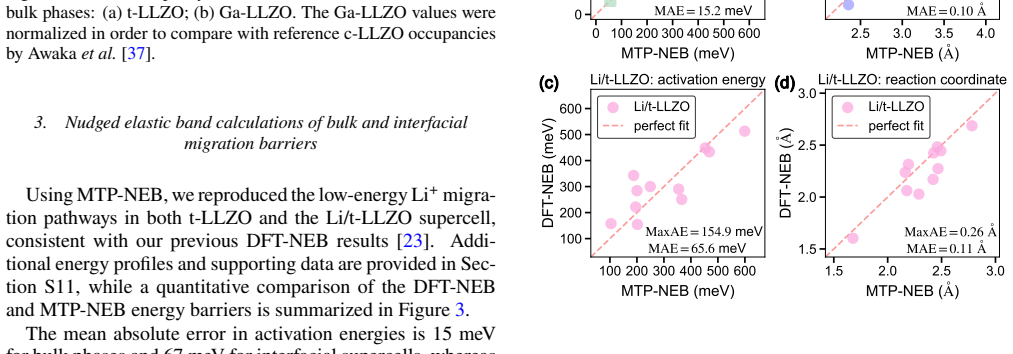
- [Abstract and MTP training/results sections] Abstract and MTP training/results sections: No validation metrics (e.g., energy/force RMSE, or direct comparison of MTP vs. DFT barriers on held-out interface configurations) are reported for the trained MTPs. This is load-bearing for the central claim, as the abstract motivates MLMD precisely because it captures many-body/finite-T effects missed by DFT+NEB; without benchmarking, the 167 meV value cannot be confirmed to be more accurate than conventional calculations.
- [Methods section describing the residence-time window] Methods section describing the residence-time window: The cutoff parameters for the window are free parameters with no reported sensitivity analysis or validation against known diffusion data or alternative event-detection schemes (e.g., continuous-time random walk or committor analysis). This directly affects the extracted activation energies.
- [Results section on activation energies] Results section on activation energies: No error bars or statistical uncertainties are provided on the 167 meV and 200 meV values, nor is the number of observed events or simulation length stated, undermining the quantitative comparison to experimental resistances.
minor comments (1)
- [Abstract] The abstract states 'corresponding to resistances of ∼10^{-5} Ω cm²' but does not show the conversion formula or assumptions (e.g., attempt frequency, temperature) used to obtain this from the activation energy.
Simulated Author's Rebuttal
We thank the referee for their careful reading and constructive comments, which have identified important areas for clarification and strengthening of the manuscript. We address each major comment below.
read point-by-point responses
-
Referee: [Abstract and MTP training/results sections] Abstract and MTP training/results sections: No validation metrics (e.g., energy/force RMSE, or direct comparison of MTP vs. DFT barriers on held-out interface configurations) are reported for the trained MTPs. This is load-bearing for the central claim, as the abstract motivates MLMD precisely because it captures many-body/finite-T effects missed by DFT+NEB; without benchmarking, the 167 meV value cannot be confirmed to be more accurate than conventional calculations.
Authors: We agree that quantitative validation metrics are necessary to support the reliability of the MTPs for the reported activation energies. Although the training protocol is outlined in the Methods, explicit RMSE values and interface-specific comparisons were not included in the main text. In the revised manuscript we will add a table reporting energy and force RMSE on training and held-out test sets, together with direct MTP-versus-DFT barrier comparisons for a representative set of interface configurations. These additions will confirm that the MTPs reproduce the underlying DFT energetics while enabling the extended timescales required to capture finite-temperature many-body effects. revision: yes
-
Referee: [Methods section describing the residence-time window] Methods section describing the residence-time window: The cutoff parameters for the window are free parameters with no reported sensitivity analysis or validation against known diffusion data or alternative event-detection schemes (e.g., continuous-time random walk or committor analysis). This directly affects the extracted activation energies.
Authors: The residence-time cutoffs were selected on the basis of the clear timescale separation between rattling and diffusive hops observed in preliminary trajectories. We acknowledge that a systematic sensitivity study was not presented. In the revision we will add a dedicated paragraph and supplementary figure showing how the extracted activation energies vary with reasonable changes in the cutoff parameters; the values remain stable within the reported precision. We will also note the consistency of the chosen window with literature timescales for Li+ diffusion in LLZO. revision: yes
-
Referee: [Results section on activation energies] Results section on activation energies: No error bars or statistical uncertainties are provided on the 167 meV and 200 meV values, nor is the number of observed events or simulation length stated, undermining the quantitative comparison to experimental resistances.
Authors: We thank the referee for highlighting this omission. The activation energies were obtained from Arrhenius fits across multiple independent MLMD runs, yet the underlying statistics were not reported. In the revised Results section we will state the total accumulated simulation time, the number of observed charge-transfer events, and the uncertainties on the fitted activation energies (derived from the linear regression). These details will allow readers to assess the statistical robustness of the ~10^{-5} Ω cm² resistance estimate. revision: yes
Circularity Check
Derivation chain is self-contained; activation energies are simulation outputs
full rationale
The paper trains MTPs (on external DFT data), runs MLMD trajectories, applies a residence-time window filter to isolate events, and extracts activation energies (167 meV interface, 200 meV bulk) as direct outputs of those trajectories. No step reduces by construction to fitted inputs, no self-citation load-bearing premise, no uniqueness theorem imported from the authors, and no ansatz or renaming that collapses the result to the inputs. The reported low barriers therefore constitute independent simulation results rather than tautological re-statements of the training procedure.
Axiom & Free-Parameter Ledger
free parameters (2)
- MTP fitting parameters
- residence-time window cutoff
axioms (1)
- domain assumption Trained MTPs reproduce the relevant many-body and finite-temperature physics at the Li/LLZO interface
invented entities (1)
-
residence-time window method
no independent evidence
Reference graph
Works this paper leans on
-
[1]
Prospects and limits of energy storage in bat- teries.The journal of physical chemistry letters, 6(5):830–844, 2015
KM Abraham. Prospects and limits of energy storage in bat- teries.The journal of physical chemistry letters, 6(5):830–844, 2015
2015
-
[2]
New concepts in electrolytes.Chemical reviews, 120(14):6783–6819, 2020
Matthew Li, Chunsheng Wang, Zhongwei Chen, Kang Xu, and Jun Lu. New concepts in electrolytes.Chemical reviews, 120(14):6783–6819, 2020
2020
-
[3]
Progress in thermal stability of all-solid-state-li-ion-batteries
Yujing Wu, Shuo Wang, Hong Li, Liquan Chen, and Fan Wu. Progress in thermal stability of all-solid-state-li-ion-batteries. InfoMat, 3(8):827–853, 2021
2021
-
[4]
Recent advances in energy chemistry between solid-state electrolyte and safe lithium-metal anodes.Chem, 5(1):74–96, 2019
Xin-Bing Cheng, Chen-Zi Zhao, Yu-Xing Yao, He Liu, and Qiang Zhang. Recent advances in energy chemistry between solid-state electrolyte and safe lithium-metal anodes.Chem, 5(1):74–96, 2019
2019
-
[5]
Ionic conductivity of Ga-doped LLZO prepared using couette–taylor reactor for all-solid lithium batteries.Jour- nal of industrial and engineering chemistry, 56:422–427, 2017
Seung Hoon Yang, Min Young Kim, Da Hye Kim, Ha Young Jung, Hye Min Ryu, Jong Hoon Han, Moo Sung Lee, and Ho- Sung Kim. Ionic conductivity of Ga-doped LLZO prepared using couette–taylor reactor for all-solid lithium batteries.Jour- nal of industrial and engineering chemistry, 56:422–427, 2017
2017
-
[6]
Xiyuan Tao, Li Yang, Jiali Liu, Zihao Zang, Peng Zeng, Changfei Zou, Lingguang Yi, Xiaoyi Chen, Xiaolin Liu, and Xianyou Wang. Preparation and performances of gallium-doped LLZO electrolyte with high ionic conductivity by rapid ultra- high-temperature sintering.Journal of Alloys and Compounds, 937:168380, 2023
2023
-
[7]
Excess-lithium-free llzo enabling fast ion conduction and ultra-low interfacial resistance for solid-state lithium metal batteries.Energy Storage Materials, 81:104482, 2025
Mohammad Nasir, Jun Seo, Jae In Song, Yong Seok Choi, and Hee Jung Park. Excess-lithium-free llzo enabling fast ion conduction and ultra-low interfacial resistance for solid-state lithium metal batteries.Energy Storage Materials, 81:104482, 2025
2025
-
[8]
Stabilization of cubic Li7La3Zr2O12 phase solid electrolyte by gallium doping and its effect on structural and energy storage properties.Journal of Energy Storage, 121:116537, 2025
Atul Kumar Mishra, Supriya Sau, YashKumar Patel, Naznin Shaikh, Hiral Odedra, Bansiben Vagadiya, Abhijit Ray, Sagar Mitra, and Indrajit Mukhopadhyay. Stabilization of cubic Li7La3Zr2O12 phase solid electrolyte by gallium doping and its effect on structural and energy storage properties.Journal of Energy Storage, 121:116537, 2025
2025
-
[9]
Low temperature synthesis of Ga-doped Li 7La3Zr2O12 garnet-type solid electrolyte by mechanical method.Advanced Powder Technology, 32(10):3860–3868, 2021
Kazuaki Kanai, Shinji Ozawa, Takahiro Kozawa, and Makio Naito. Low temperature synthesis of Ga-doped Li 7La3Zr2O12 garnet-type solid electrolyte by mechanical method.Advanced Powder Technology, 32(10):3860–3868, 2021
2021
-
[10]
Investigating the electrochemical stability of Li7La3Zr2O12 solid electrolytes using field stress experiments.Journal of Materials Chemistry A, 9(27):15226–15237, 2021
Stefan Smetaczek, Eva Pycha, Joseph Ring, Matth ¨aus Sieben- hofer, Steffen Ganschow, Stefan Berendts, Andreas Nenning, Markus Kubicek, Daniel Rettenwander, Andreas Limbeck, et al. Investigating the electrochemical stability of Li7La3Zr2O12 solid electrolytes using field stress experiments.Journal of Materials Chemistry A, 9(27):15226–15237, 2021
2021
-
[11]
Impact of air exposure and surface chemistry on Li–Li 7La3Zr2O12 interfacial resistance
Asma Sharafi, Seungho Yu, Michael Naguib, Marcus Lee, Cheng Ma, Harry M Meyer, Jagjit Nanda, Maiofang Chi, Don- ald J Siegel, and Jeff Sakamoto. Impact of air exposure and surface chemistry on Li–Li 7La3Zr2O12 interfacial resistance. Journal of Materials Chemistry A, 5(26):13475–13487, 2017
2017
-
[12]
Thorben Krauskopf, Hannah Hartmann, Wolfgang G Zeier, and Jurgen Janek. Toward a fundamental understand- ing of the lithium metal anode in solid-state batteries—an electrochemo-mechanical study on the garnet-type solid elec- trolyte Li6.25Al0.25La3Zr2O12.ACS applied materials & inter- faces, 11(15):14463–14477, 2019
2019
-
[13]
Li 7La3Zr2O12
Henrik Buschmann, Janis D ¨olle, Stefan Berendts, Alexan- der Kuhn, Patrick Bottke, Martin Wilkening, Paul Heit- jans, Anatoliy Senyshyn, Helmut Ehrenberg, Andriy Lotnyk, et al. Structure and dynamics of the fast lithium ion conduc- tor “Li 7La3Zr2O12”.Physical Chemistry Chemical Physics, 13(43):19378–19392, 2011
2011
-
[14]
Lei Cheng, Ethan J Crumlin, Wei Chen, Ruimin Qiao, Huam- ing Hou, Simon Franz Lux, Vassilia Zorba, Richard Russo, Robert Kostecki, Zhi Liu, et al. The origin of high electrolyte– electrode interfacial resistances in lithium cells containing garnet type solid electrolytes.Physical Chemistry Chemical Physics, 16(34):18294–18300, 2014
2014
-
[16]
Interface instability of fe-stabilized Li7La3Zr2O12 versus Li metal.The Journal of Physical Chemistry C, 122(7):3780–3785, 2018
Daniel Rettenwander, Reinhard Wagner, Andreas Reyer, Max- imilian Bonta, Lei Cheng, Marca M Doeff, Andreas Limbeck, Martin Wilkening, and Georg Amthauer. Interface instability of fe-stabilized Li7La3Zr2O12 versus Li metal.The Journal of Physical Chemistry C, 122(7):3780–3785, 2018
2018
-
[17]
Interfacial stability of Li metal– solid electrolyte elucidated via in situ electron microscopy.Nano letters, 16(11):7030–7036, 2016
Cheng Ma, Yongqiang Cheng, Kuibo Yin, Jian Luo, Asma Sharafi, Jeff Sakamoto, Juchuan Li, Karren L More, Nancy J Dudney, and Miaofang Chi. Interfacial stability of Li metal– solid electrolyte elucidated via in situ electron microscopy.Nano letters, 16(11):7030–7036, 2016
2016
-
[18]
Kinetic versus thermodynamic stability of LLZO in contact with lithium metal.Chemistry of Materials, 32(23):10207–10215, 2020
Justin G Connell, Till Fuchs, Hannah Hartmann, Thorben Krauskopf, Yisi Zhu, Joachim Sann, Regina Garcia-Mendez, Jeff Sakamoto, Sanja Tepavcevic, and Jurgen Janek. Kinetic versus thermodynamic stability of LLZO in contact with lithium metal.Chemistry of Materials, 32(23):10207–10215, 2020
2020
-
[19]
Machine-learning interatomic potentials for materials science.Acta Materialia, 214:116980, 2021
Y Mishin. Machine-learning interatomic potentials for materials science.Acta Materialia, 214:116980, 2021
2021
-
[20]
Performance and cost as- sessment of machine learning interatomic potentials.The Jour- nal of Physical Chemistry A, 124(4):731–745, 2020
Yunxing Zuo, Chi Chen, Xiangguo Li, Zhi Deng, Yiming Chen, J´’org Behler, G ´abor Cs ´anyi, Alexander V Shapeev, Aidan P Thompson, Mitchell A Wood, et al. Performance and cost as- sessment of machine learning interatomic potentials.The Jour- nal of Physical Chemistry A, 124(4):731–745, 2020
2020
-
[21]
Nudged elastic band method for finding minimum energy paths of tran- sitions
Hannes J ´onsson, Greg Mills, and Karsten W Jacobsen. Nudged elastic band method for finding minimum energy paths of tran- sitions. InClassical and quantum dynamics in condensed phase simulations, pages 385–404. World Scientific, 1998
1998
-
[22]
Origin of fast ion diffusion in super-ionic conductors.Nature Communications, 8(May):1–7, 2017
Xingfeng He, Yizhou Zhu, and Yifei Mo. Origin of fast ion diffusion in super-ionic conductors.Nature Communications, 8(May):1–7, 2017
2017
-
[23]
Mechanism of Li + charge transfer at Li/Li7La3Zr2O12 interfaces: A density functional theory study
Arseniy S Burov, Anton O Boev, Artem M Abakumov, and Dmitry A Aksyonov. Mechanism of Li + charge transfer at Li/Li7La3Zr2O12 interfaces: A density functional theory study. Physical Review B, 109(4):045305, 2024
2024
-
[24]
The ab initio calcula- tions on the areal specific resistance of Li-metal/Li7La3Zr2O12 interphase.Advanced Theory and Simulations, 2(6):1900028, 2019
Jian Gao, Xuyun Guo, Yutao Li, Zhaohui Ma, Xiangxin Guo, Hong Li, Ye Zhu, and Weidong Zhou. The ab initio calcula- tions on the areal specific resistance of Li-metal/Li7La3Zr2O12 interphase.Advanced Theory and Simulations, 2(6):1900028, 2019
2019
-
[25]
Statistical variances of diffusional properties from ab initio molecular dynamics simulations.npj Computational Materi- als, 4(1):18, 2018
Xingfeng He, Yizhou Zhu, Alexander Epstein, and Yifei Mo. Statistical variances of diffusional properties from ab initio molecular dynamics simulations.npj Computational Materi- als, 4(1):18, 2018
2018
-
[26]
Modelling and understanding battery materi- als with machine-learning-driven atomistic simulations.Journal of Physics: Energy, 2(4):041003, 2020
Volker L Deringer. Modelling and understanding battery materi- als with machine-learning-driven atomistic simulations.Journal of Physics: Energy, 2(4):041003, 2020
2020
-
[27]
Review on the lithium transport mechanism in solid-state battery materi- als.Wiley Interdisciplinary Reviews: Computational Molecular Science, 13(1):e1621, 2023
Zhong-Heng Fu, Xiang Chen, and Qiang Zhang. Review on the lithium transport mechanism in solid-state battery materi- als.Wiley Interdisciplinary Reviews: Computational Molecular Science, 13(1):e1621, 2023
2023
-
[28]
An atomistic study of reactivity in solid-state electrolyte interphase formation for Li/Li 7P3S11.The Journal 15 of Physical Chemistry C, 129(36):16043–16054, 2025
Bryant Y Li, Vir Karan, Aaron D Kaplan, Mingjian Wen, and Kristin A Persson. An atomistic study of reactivity in solid-state electrolyte interphase formation for Li/Li 7P3S11.The Journal 15 of Physical Chemistry C, 129(36):16043–16054, 2025
2025
-
[30]
Microstructural and electrochemical properties of Al-and Ga-doped Li 7La3Zr2O12 garnet solid electrolytes.ACS Applied Energy Materials, 3(5):4708–4719, 2020
Chao Chen, Yao Sun, Linchun He, Masashi Kotobuki, Emil Hanc, Yu Chen, Kaiyang Zeng, and Li Lu. Microstructural and electrochemical properties of Al-and Ga-doped Li 7La3Zr2O12 garnet solid electrolytes.ACS Applied Energy Materials, 3(5):4708–4719, 2020
2020
-
[31]
Dembitskiy, Danil M
Artem D. Dembitskiy, Danil M. Chernyshov, Arseniy S. Burov, Tatiana N. Kobernik, Andrey Geondzhian, Anton O. Boev, Stanislav S. Fedotov, and Dmitry A. Aksyonov. Reducing false positives in the search for solid-state battery coating.npj Com- putational Materials, 1(1):1, 2026
2026
-
[32]
Man- ufacturing strategies for solid electrolyte in batteries.Frontiers in Energy Research, 8:571440, 2020
Annan Chen, Conghang Qu, Yusheng Shi, and Feifei Shi. Man- ufacturing strategies for solid electrolyte in batteries.Frontiers in Energy Research, 8:571440, 2020
2020
-
[33]
Ai-accelerated materials informatics method for the discovery of ductile alloys.Journal of Materials Research, 37(21):3491–3504, 2022
Ivan Novikov, Olga Kovalyova, Alexander Shapeev, and Max Hodapp. Ai-accelerated materials informatics method for the discovery of ductile alloys.Journal of Materials Research, 37(21):3491–3504, 2022
2022
-
[34]
A moment tensor potential for lattice thermal conductivity calculations of𝛼and𝛽phases of Ga2O3.Journal of Applied Physics, 135(20), 2024
Nikita Rybin and Alexander Shapeev. A moment tensor potential for lattice thermal conductivity calculations of𝛼and𝛽phases of Ga2O3.Journal of Applied Physics, 135(20), 2024
2024
-
[35]
Surface properties of anode materials as an indicator of dendrite growth
Timur Guskov, Arslan Mazitov, and Ivan Kruglov. Surface properties of anode materials as an indicator of dendrite growth. Journal of Applied Physics, 136(17), 2024
2024
-
[36]
Julian Holland, Tom Demeyere, Arihant Bhandari, Felix Hanke, Victor Milman, and Chris-Kriton Skylaris. A workflow for identifying viable crystal structures with partially occupied sites applied to the solid electrolyte cubic Li7La3Zr2O12.The Journal of Physical Chemistry Letters, 14(45):null, 2023
2023
-
[39]
First-principles calculations of absolute concentrations and self-diffusion con- stants of vacancies in lithium.Physical review letters, 77(3):518, 1996
W Frank, U Breier, C Els ¨asser, and M F¨ahnle. First-principles calculations of absolute concentrations and self-diffusion con- stants of vacancies in lithium.Physical review letters, 77(3):518, 1996
1996
-
[40]
Nuclear magnetic relaxation by self- diffusion in solid lithium: T 1-frequency dependence.Applied physics, 6(1):79–88, 1975
R Messer and F Noack. Nuclear magnetic relaxation by self- diffusion in solid lithium: T 1-frequency dependence.Applied physics, 6(1):79–88, 1975
1975
-
[41]
Interfacial defect of lithium metal in solid-state batteries.Angewandte Chemie, 133(39):21664– 21671, 2021
Menghao Yang and Yifei Mo. Interfacial defect of lithium metal in solid-state batteries.Angewandte Chemie, 133(39):21664– 21671, 2021
2021
-
[42]
Self-diffusion in bulk lithium and sodium and its impact on the whisker growth during electrodepo- sition.Journal of The Electrochemical Society, 171(12):120508, 2024
Artem V Sergeev, Yevgeniya O Kondratyeva, Konstantin O Borodin, and Lada V Yashina. Self-diffusion in bulk lithium and sodium and its impact on the whisker growth during electrodepo- sition.Journal of The Electrochemical Society, 171(12):120508, 2024
2024
-
[43]
Melting temperature, adiabats, and gr¨ uneisen param- eter of lithium, sodium and potassium versus pressure.Physical Review B, 27(11):6754, 1983
R Boehler. Melting temperature, adiabats, and gr¨ uneisen param- eter of lithium, sodium and potassium versus pressure.Physical Review B, 27(11):6754, 1983
1983
-
[45]
Origin of the Phase Transition in Lithium Garnets.Journal of Physical Chemistry C, 122(4):1963–1972, 2018
Fei Chen, Junyang Li, Zhifeng Huang, Ying Yang, Qiang Shen, and Lianmeng Zhang. Origin of the Phase Transition in Lithium Garnets.Journal of Physical Chemistry C, 122(4):1963–1972, 2018
1963
-
[46]
Natalia B Timusheva, Alexander A Golubnichiy, Anatolii V Mo- rozov, Arseniy S Burov, Dmitry A Aksyonov, Aleksandra A Sav- ina, Roman G Markopolskii, and Artem M Abakumov. Chemi- cal compatibility at the interface of garnet-type Li-LLZO solid electrolyte and high-energy Li-rich layered oxide cathode for all-solid-state batteries.Scientific Reports, 15(1):241, 2025
2025
-
[47]
A new class of solid electrolytes with an ultra-low na-ion migration barrier
Artem D Dembitskiy, Sergey N Marshenya, Evgeny V Antipov, Stanislav S Fedotov, and Dmitry A Aksyonov. A new class of solid electrolytes with an ultra-low na-ion migration barrier. Journal of Power Sources, 642:236979, 2025
2025
-
[48]
Jun Li, Hao Luo, Keke Liu, Jiaxu Zhang, Huiyu Zhai, Xianli Su, Jinsong Wu, Xinfeng Tang, and Gangjian Tan. Excellent stability of Ga-doped garnet electrolyte against Li metal anode via eliminating LiGaO2 precipitates for advanced all-solid-state batteries.ACS Applied Materials & Interfaces, 15(5):7165– 7174, 2023
2023
-
[49]
Comparative analysis of reactivity of Al and Ga doped garnet solid state electrolyte at the interface with Li metal.ACS Materials Letters, 6(12):5216–5221, 2024
Matthew Klenk, Neelima Paul, Michael J Counihan, Zachary D Hood, Yisi Zhu, Justin G Connell, Charles Hervoches, Ralph Gilles, Jeff Sakamoto, Sanja Tepavcevic, et al. Comparative analysis of reactivity of Al and Ga doped garnet solid state electrolyte at the interface with Li metal.ACS Materials Letters, 6(12):5216–5221, 2024
2024
-
[50]
On the Origin of Zero Interface Resistance in the Li6.25Al0.25La3Zr2O12—Li 0 System: An Atomistic Investiga- tion.ACS Applied Materials and Interfaces, 13(44):52629– 52635, 2021
Lisette Haarmann, Jochen Rohrer, and Karsten Albe. On the Origin of Zero Interface Resistance in the Li6.25Al0.25La3Zr2O12—Li 0 System: An Atomistic Investiga- tion.ACS Applied Materials and Interfaces, 13(44):52629– 52635, 2021
2021
-
[51]
Impact of lithium nonstoichiom- etry on ionic diffusion in tetragonal garnet-type Li7La3Zr2O12
Zihan Yan and Yizhou Zhu. Impact of lithium nonstoichiom- etry on ionic diffusion in tetragonal garnet-type Li7La3Zr2O12. Chemistry of Materials, 36(23):11551–11557, 2024
2024
-
[52]
Data mining of molecular dynamics data reveals Li diffusion characteristics in garnet Li7La3Zr2O12.Scientific Reports, 7(December 2016):1– 8, 2017
Chi Chen, Ziheng Lu, and Francesco Ciucci. Data mining of molecular dynamics data reveals Li diffusion characteristics in garnet Li7La3Zr2O12.Scientific Reports, 7(December 2016):1– 8, 2017
2016
-
[53]
Lincoln J Miara, Shyue Ping Ong, Yifei Mo, William David- son Richards, Youngsin Park, Jae-Myung Lee, Hyo Sug Lee, and Gerbrand Ceder. Effect of rb and ta dop- ing on the ionic conductivity and stability of the garnet Li7+2x–y (La3 –xRbx)(Zr2 –yTay)O12 (0≤𝑥≤0.375,0≤𝑦≤1) superionic conductor: A first principles investigation.Chem- istry of Materials, 25(15...
2013
-
[54]
Ab ini- tio molecular dynamics study of lithium diffusion in tetragonal Li7La3Zr2O12.Materials Chemistry and Physics, 185:210–217, 2017
Bohdan Andriyevsky, Klaus Doll, and Timo Jacob. Ab ini- tio molecular dynamics study of lithium diffusion in tetragonal Li7La3Zr2O12.Materials Chemistry and Physics, 185:210–217, 2017
2017
-
[55]
Phase transition in lithium garnet oxide ionic conductors Li7La3Zr2O12: The role of ta substitution and H2O/CO2 exposure.Journal of Power Sources, 275:612– 620, 2015
Yuxing Wang and Wei Lai. Phase transition in lithium garnet oxide ionic conductors Li7La3Zr2O12: The role of ta substitution and H2O/CO2 exposure.Journal of Power Sources, 275:612– 620, 2015
2015
-
[56]
Allen, and Jeffrey Sakamoto
Jeff Wolfenstine, Ezhiyl Rangasamy, Jan L. Allen, and Jeffrey Sakamoto. High conductivity of dense tetragonal Li7La3Zr2O12. Journal of Power Sources, 208:193–196, 2012
2012
-
[57]
Atomistic mechanisms underlying the maximum in diffusivity in doped Li7La3Zr2O12.The Journal of Physical Chemistry C, 127(22):10806–10812, 2023
Juan C Verduzco, Ernesto E Marinero, and Alejandro Strachan. Atomistic mechanisms underlying the maximum in diffusivity in doped Li7La3Zr2O12.The Journal of Physical Chemistry C, 127(22):10806–10812, 2023
2023
-
[58]
Effects of gallium doping in garnet-type Li7La3Zr2O12 solid electrolytes.Chemistry of Materials, 27(8):2821–2831, 2015
Randy Jalem, MJD Rushton, William Manalastas Jr, Masanobu Nakayama, Toshihiro Kasuga, John A Kilner, and Robin W Grimes. Effects of gallium doping in garnet-type Li7La3Zr2O12 solid electrolytes.Chemistry of Materials, 27(8):2821–2831, 2015
2015
-
[59]
Kresse and J
G. Kresse and J. Furthm¨ uller. Efficient iterative schemes for ab initio total-energy calculations using a plane-wave basis set. 16 Phys. Rev. B, 54:11169–11186, 1996
1996
-
[60]
Kresse and D
G. Kresse and D. Joubert. From ultrasoft pseudopotentials to the projector augmented-wave method.Phys. Rev. B, 59:1758– 1775, 1999
1999
-
[61]
Perdew, Kieron Burke, and Matthias Ernzerhof
John P. Perdew, Kieron Burke, and Matthias Ernzerhof. Gen- eralized gradient approximation made simple.Phys. Rev. Lett., 77:3865–3868, 1996
1996
-
[62]
Perdew, Kieron Burke, and Matthias Ernzerhof
John P. Perdew, Kieron Burke, and Matthias Ernzerhof. Gen- eralized gradient approximation made simple.Phys. Rev. Lett., 78:1396–1396, 1997
1997
-
[63]
P. E. Bl ¨ochl. Projector augmented-wave method.Phys. Rev. B, 50:17953–17979, 1994
1994
-
[64]
Improved tangent estimate in the nudged elastic band method for finding minimum energy paths and saddle points.The Journal of chemical physics, 113(22):9978–9985, 2000
Graeme Henkelman and Hannes J ´onsson. Improved tangent estimate in the nudged elastic band method for finding minimum energy paths and saddle points.The Journal of chemical physics, 113(22):9978–9985, 2000
2000
-
[65]
Moment tensor potentials: A class of systematically improvable interatomic potentials.Multiscale Modeling & Simulation, 14(3):1153–1173, 2016
Alexander V Shapeev. Moment tensor potentials: A class of systematically improvable interatomic potentials.Multiscale Modeling & Simulation, 14(3):1153–1173, 2016
2016
-
[66]
Active learn- ing of linearly parametrized interatomic potentials.Computa- tional Materials Science, 140:171–180, 2017
Evgeny V Podryabinkin and Alexander V Shapeev. Active learn- ing of linearly parametrized interatomic potentials.Computa- tional Materials Science, 140:171–180, 2017
2017
-
[67]
The mlip package: moment tensor potentials with mpi and active learning.Machine Learning: Science and Technology, 2(2):025002, 2020
Ivan S Novikov, Konstantin Gubaev, Evgeny V Podryabinkin, and Alexander V Shapeev. The mlip package: moment tensor potentials with mpi and active learning.Machine Learning: Science and Technology, 2(2):025002, 2020
2020
-
[68]
A. P. Thompson, H. M. Aktulga, R. Berger, D. S. Bolintineanu, W. M. Brown, P. S. Crozier, P. J. in ’t Veld, A. Kohlmeyer, S. G. Moore, T. D. Nguyen, R. Shan, M. J. Stevens, J. Tranchida, C. Trott, and S. J. Plimpton. LAMMPS - a flexible simulation tool for particle-based materials modeling at the atomic, meso, and continuum scales.Comp. Phys. Comm., 271:1...
2022
-
[70]
Ewald summation techniques in perspective: a survey.Computer physics commu- nications, 95(2-3):73–92, 1996
Abdulnour Y Toukmaji and John A Board Jr. Ewald summation techniques in perspective: a survey.Computer physics commu- nications, 95(2-3):73–92, 1996
1996
-
[71]
Aksyonov, S.S
D.A. Aksyonov, S.S. Fedotov, K.J. Stevenson, and A. Zhugayevych. Understanding migration barriers for monova- lent ion insertion in transition metal oxide and phosphate based cathode materials: A dft study.Computational Materials Sci- ence, 154:449 – 458, 2018
2018
-
[72]
Python materials genomics (pymatgen): A robust, open-source python library for materials analysis.Computational Materials Science, 68:314–319, 2013
Shyue Ping Ong, William Davidson Richards, Anubhav Jain, Geoffroy Hautier, Michael Kocher, Shreyas Cholia, Dan Gunter, Vincent L Chevrier, Kristin A Persson, and Gerbrand Ceder. Python materials genomics (pymatgen): A robust, open-source python library for materials analysis.Computational Materials Science, 68:314–319, 2013
2013
-
[73]
The atomic simulation environment—a python library for work- ing with atoms.Journal of Physics: Condensed Matter, 29(27):273002, 2017
Ask Hjorth Larsen, Jens Jørgen Mortensen, Jakob Blomqvist, Ivano E Castelli, Rune Christensen, Marcin Du lak, Jesper Friis, Michael N Groves, Bjørk Hammer, Cory Hargus, et al. The atomic simulation environment—a python library for work- ing with atoms.Journal of Physics: Condensed Matter, 29(27):273002, 2017
2017
-
[74]
Vesta 3 for three-dimensional visualization of crystal, volumetric and morphology data.Jour- nal of applied crystallography, 44(6):1272–1276, 2011
Koichi Momma and Fujio Izumi. Vesta 3 for three-dimensional visualization of crystal, volumetric and morphology data.Jour- nal of applied crystallography, 44(6):1272–1276, 2011
2011
-
[75]
Visualization and analysis of atomistic simulation data with ovito–the open visualization tool.Mod- elling and simulation in materials science and engineering, 18(1):015012, 2009
Alexander Stukowski. Visualization and analysis of atomistic simulation data with ovito–the open visualization tool.Mod- elling and simulation in materials science and engineering, 18(1):015012, 2009. SUPPLEMENTARY MATERIALS FOR Charge-transfer mechanisms at Li/Ga-doped Li7La3Zr2O12 (LLZO) interfaces from machine learning assisted molecular dynamics Arsen...
2009
-
[76]
Synthesis and structure analysis of tetragonal Li 7La3Zr2O12 with the garnet-related type structure.Journal of Solid State Chemistry, 182(8):2046 – 2052, 2009
Junji Awaka, Norihito Kijima, Hiroshi Hayakawa, and Junji Akimoto. Synthesis and structure analysis of tetragonal Li 7La3Zr2O12 with the garnet-related type structure.Journal of Solid State Chemistry, 182(8):2046 – 2052, 2009
2046
-
[77]
Origin of the Phase Transition in Lithium Garnets
Fei Chen, Junyang Li, Zhifeng Huang, Ying Yang, Qiang Shen, and Lianmeng Zhang. Origin of the Phase Transition in Lithium Garnets. Journal of Physical Chemistry C, 122(4):1963–1972, 2018
1963
-
[78]
Origin of the structural phase transition in Li 7La3Zr2O12.Physical review letters, 109(20):205702, 2012
N Bernstein, MD Johannes, and Khang Hoang. Origin of the structural phase transition in Li 7La3Zr2O12.Physical review letters, 109(20):205702, 2012
2012
-
[79]
Crystal structure of fast lithium-ion-conducting cubic Li7La3Zr2O12.Chemistry Letters, 40(1):60–62, 2011
Junji Awaka, Akira Takashima, Kunimitsu Kataoka, Norihito Kijima, Yasushi Idemoto, and Junji Akimoto. Crystal structure of fast lithium-ion-conducting cubic Li7La3Zr2O12.Chemistry Letters, 40(1):60–62, 2011
2011
-
[80]
Thorben Krauskopf, Hannah Hartmann, Wolfgang G Zeier, and Jurgen Janek. Toward a fundamental understanding of the lithium metal anode in solid-state batteries—an electrochemo-mechanical study on the garnet-type solid electrolyte Li6.25Al0.25La3Zr2O12.ACS applied materials & interfaces, 11(15):14463–14477, 2019
2019
-
[81]
Impact of air exposure and surface chemistry on Li–Li7La3Zr2O12 interfacial resistance.Journal of Materials Chemistry A, 5(26):13475–13487, 2017
Asma Sharafi, Seungho Yu, Michael Naguib, Marcus Lee, Cheng Ma, Harry M Meyer, Jagjit Nanda, Maiofang Chi, Donald J Siegel, and Jeff Sakamoto. Impact of air exposure and surface chemistry on Li–Li7La3Zr2O12 interfacial resistance.Journal of Materials Chemistry A, 5(26):13475–13487, 2017
2017
-
[82]
Phase transition in lithium garnet oxide ionic conductors Li 7La3Zr2O12: The role of ta substitution and H2O/CO2 exposure.Journal of Power Sources, 275:612–620, 2015
Yuxing Wang and Wei Lai. Phase transition in lithium garnet oxide ionic conductors Li 7La3Zr2O12: The role of ta substitution and H2O/CO2 exposure.Journal of Power Sources, 275:612–620, 2015
2015
-
[83]
Natalia B Timusheva, Alexander A Golubnichiy, Anatolii V Morozov, Arseniy S Burov, Dmitry A Aksyonov, Aleksandra A Savina, Roman G Markopolskii, and Artem M Abakumov. Chemical compatibility at the interface of garnet-type Li-LLZO solid electrolyte and high-energy Li-rich layered oxide cathode for all-solid-state batteries.Scientific Reports, 15(1):241, 2025. 49
2025
-
[84]
Miara, William Davidson Richards, Yan E
Lincoln J. Miara, William Davidson Richards, Yan E. Wang, and Gerbrand Ceder. First-principles studies on cation dopants and electrolyte—cathode interphases for lithium garnets.Chemistry of Materials, 27(11):4040–4047, 2015
2015
-
[85]
Crystallographic databases.International Union of Crystallography, Chester, 360:77–95, 1987
G¨ unter Bergerhoff, ID Brown, F Allen, et al. Crystallographic databases.International Union of Crystallography, Chester, 360:77–95, 1987
1987
-
[86]
Mechanism of Li + charge transfer at Li/Li7La3Zr2O12 interfaces: A density functional theory study.Physical Review B, 109(4):045305, 2024
Arseniy S Burov, Anton O Boev, Artem M Abakumov, and Dmitry A Aksyonov. Mechanism of Li + charge transfer at Li/Li7La3Zr2O12 interfaces: A density functional theory study.Physical Review B, 109(4):045305, 2024
2024
discussion (0)
Sign in with ORCID, Apple, or X to comment. Anyone can read and Pith papers without signing in.