The Chemotactic Index for Spatial Gradient Sensing
Pith reviewed 2026-06-27 19:52 UTC · model grok-4.3
The pith
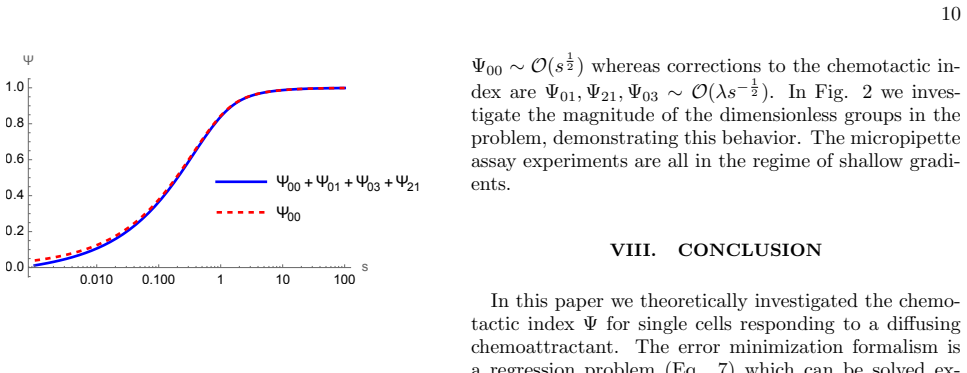
The Gaussian approximation for the chemotactic index works because experimental gradients are shallow.
A machine-rendered reading of the paper's core claim, the machinery that carries it, and where it could break.
Core claim
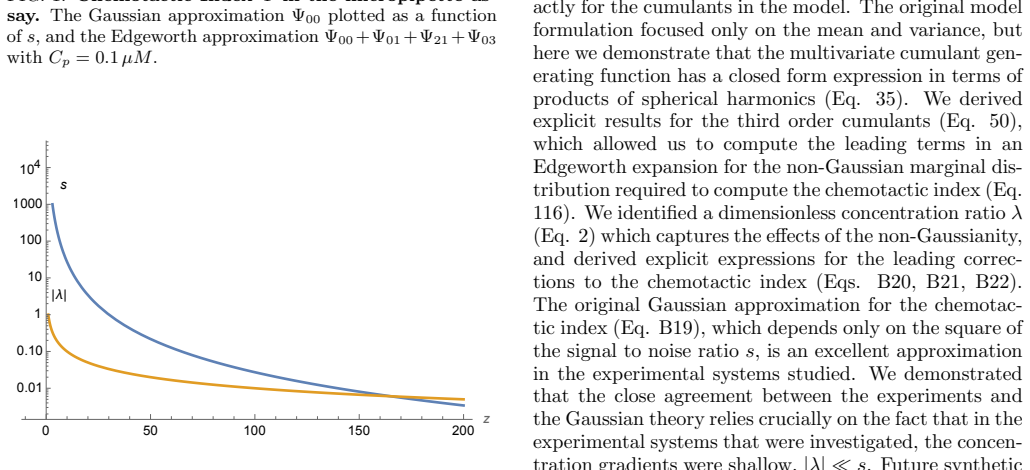
In the direct-sensing model, the chemotactic index Ψ receives corrections from non-Gaussian statistics of the concentration field; these corrections are expressed through multivariate cumulants up to third order and depend on the additional dimensionless group λ. The Edgeworth expansion shows the corrections vanish when |λ| << s, and comparison with slime mold chemotaxis experiments confirms that the gradients in those measurements were shallow enough for the Gaussian approximation to hold.
What carries the argument
Edgeworth expansion of the chemotactic index Ψ controlled by the concentration-ratio parameter λ, using exact multivariate cumulants expressed via diffusive current density and Gaunt coefficients.
If this is right
- The chemotactic index depends on both s and λ when gradients are not shallow.
- Exact third-order cumulants allow direct translation of Burg-Purcell uncertainty bounds into values of Ψ.
- Gaussian approximation for Ψ holds specifically when |λ| << s.
- Leading non-Gaussian corrections can be written explicitly using Gaunt coefficients and diffusive currents.
Where Pith is reading between the lines
- Experiments using steeper gradients could test the predicted size of the λ-dependent corrections.
- The same cumulant machinery might apply to other biological sensing problems that involve noisy spatial measurements.
- Navigation models could incorporate λ to predict when cells lose efficiency in steep or fluctuating gradients.
Load-bearing premise
The prior direct-sensing model framework permits exact calculation of the multivariate cumulants from the diffusive currents.
What would settle it
Measure the chemotactic index in experiments with steeper gradients where |λ| is comparable to s and check whether the observed Ψ deviates from the pure Gaussian prediction by the amount and sign given by the third-order Edgeworth term.
Figures
read the original abstract
We consider the problem of quantifying the chemotactic efficiency of single cells as measured by the chemotactic index $\Psi$. Previous work in a model framework for direct sensing of spatial gradients indicated that $\Psi$ depends on a single dimensionless group $s$, which plays the role of the square of the signal to noise ratio in the problem. We revisit this problem theoretically and demonstrate that the cumulants in the model can be calculated exactly. We derive explicit results for the multivariate cumulants up to third order in terms of the diffusive current density and Gaunt coefficients. We discuss the machinery required to translate Burg-Purcell style limits on concentration gradient uncertainty into results for the chemotactic index. We compute the leading corrections to $\Psi$ in an Edgeworth expansion, and identify a dimensionless group $\lambda$ in the problem which is a ratio of concentrations that captures the effects of the non-Gaussianity. By careful consideration of experimental results on slime mold chemotaxis, we demonstrate that the explanatory success of the original Gaussian approximation for the chemotactic index stems in part from the fact the concentration gradients were shallow, $|\lambda| \ll s$.
Editorial analysis
A structured set of objections, weighed in public.
Referee Report
Summary. The paper analyzes the chemotactic index Ψ in a direct spatial gradient sensing model. It derives exact multivariate cumulants up to third order in terms of diffusive current density and Gaunt coefficients, translates Burg-Purcell gradient uncertainty limits into Ψ, obtains leading non-Gaussian corrections via Edgeworth expansion controlled by a new dimensionless ratio λ, and shows that |λ| ≪ s in cited slime-mold experiments, thereby explaining the success of the prior Gaussian approximation for Ψ.
Significance. If the central derivations hold, the work supplies exact, closed-form cumulant expressions (a clear strength) that remove the need for numerical approximation in this framework and identifies λ as the controlling parameter for non-Gaussianity. This furnishes a concrete, falsifiable account of why the Gaussian model matched experiment in the shallow-gradient regime without post-hoc fitting, strengthening the link between Burg-Purcell-type limits and observable chemotactic efficiency.
minor comments (2)
- [§3] §3: the transition from the exact third-order cumulant expressions to the Edgeworth series for Ψ would benefit from an explicit intermediate equation showing how the Gaunt coefficients enter the skewness term.
- [final section] The experimental comparison in the final section cites specific |λ| and s values but does not tabulate them; adding a short table of the cited slime-mold parameters would improve traceability.
Simulated Author's Rebuttal
We thank the referee for their positive assessment of the manuscript and for recommending acceptance. The report accurately captures the central contributions regarding exact cumulant calculations, the role of the dimensionless parameter λ, and the explanation for the success of the Gaussian approximation in the cited experiments.
Circularity Check
No significant circularity; derivation supplies independent explicit cumulants and external experimental check
full rationale
The paper derives explicit multivariate cumulants up to third order in terms of diffusive current density and Gaunt coefficients, introduces the dimensionless group λ as a ratio of concentrations, and performs an Edgeworth expansion for corrections to Ψ. The central claim—that the Gaussian approximation succeeds because experimental gradients satisfy |λ| ≪ s—is supported by direct comparison to published slime-mold chemotaxis data, which are external to the model. No step reduces by the paper's own equations to a fitted parameter or to a self-citation whose validity depends on the present result. Prior model framework is cited only as the setting in which the new exact cumulant expressions are obtained; the load-bearing steps (exact cumulants, identification of λ, and experimental regime check) are self-contained and falsifiable against independent measurements.
Axiom & Free-Parameter Ledger
axioms (2)
- domain assumption The model framework for direct sensing of spatial gradients permits exact calculation of multivariate cumulants up to third order.
- standard math The Edgeworth expansion supplies the leading corrections to the Gaussian approximation for Ψ.
Reference graph
Works this paper leans on
-
[1]
L. Song, S. M. Nadkarni, H. U. B¨ odeker, C. Beta, A. Bae, C. Franck, W.-J. Rappel, W. F. Loomis, and E. Boden- schatz, Dictyostelium discoideum chemotaxis: threshold for directed motion, European journal of cell biology85, 981 (2006)
2006
-
[2]
D. B. Dusenbery, Spatial sensing of stimulus gradients can be superior to temporal sensing for free-swimming bacteria, Biophysical journal74, 2272 (1998)
1998
-
[3]
J. Rode, M. Novak, and B. M. Friedrich, Information theory of chemotactic agents using both spatial and tem- poral gradient sensing, PRX Life2, 023012 (2024)
2024
-
[4]
Mora and N
T. Mora and N. S. Wingreen, Limits of sensing tempo- ral concentration changes by single cells, Physical review letters104, 248101 (2010)
2010
-
[5]
R. G. Endres and N. S. Wingreen, Accuracy of direct gra- dient sensing by single cells, Proceedings of the National Academy of Sciences105, 15749 (2008)
2008
-
[6]
B. Hu, W. Chen, W.-J. Rappel, and H. Levine, Physical limits on cellular sensing of spatial gradients, Physical review letters105, 048104 (2010)
2010
-
[7]
Fisher, R
P. Fisher, R. Merkl, and G. Gerisch, Quantitative anal- ysis of cell motility and chemotaxis in dictyostelium dis- coideum by using an image processing system and a novel chemotaxis chamber providing stationary chemical gra- dients., The Journal of cell biology108, 973 (1989)
1989
-
[8]
P. J. van Haastert and M. Postma, Biased random walk by stochastic fluctuations of chemoattractant-receptor interactions at the lower limit of detection, Biophysical Journal93, 1787 (2007)
2007
-
[9]
Fuller, W
D. Fuller, W. Chen, M. Adler, A. Groisman, H. Levine, W.-J. Rappel, and W. F. Loomis, External and internal constraints on eukaryotic chemotaxis, Proceedings of the National Academy of Sciences107, 9656 (2010)
2010
-
[10]
H. C. Berg and E. M. Purcell, Physics of chemoreception, Biophysical journal20, 193 (1977)
1977
-
[11]
Bialek and S
W. Bialek and S. Setayeshgar, Physical limits to biochem- ical signaling, Proceedings of the National Academy of Sciences102, 10040 (2005)
2005
-
[12]
Bialek and S
W. Bialek and S. Setayeshgar, Cooperativity, sensitiv- ity, and noise in biochemical signaling, Physical Review Letters100, 258101 (2008)
2008
-
[13]
R. G. Endres and N. S. Wingreen, Maximum likelihood and the single receptor, Physical review letters103, 158101 (2009)
2009
-
[14]
A. M. Berezhkovskii and A. Szabo, Effect of ligand diffu- sion on occupancy fluctuations of cell-surface receptors, The Journal of chemical physics139(2013)
2013
-
[15]
Kaizu, W
K. Kaizu, W. De Ronde, J. Paijmans, K. Takahashi, F. Tostevin, and P. R. Ten Wolde, The berg-purcell limit revisited, Biophysical journal106, 976 (2014)
2014
-
[16]
H. H. Mattingly, K. Kamino, B. B. Machta, and T. Emonet, Escherichia coli chemotaxis is information limited, Nature physics17, 1426 (2021)
2021
-
[17]
H. H. Mattingly, K. Kamino, J. Ong, R. Kottou, T. Emonet, and B. B. Machta, E. coli chemosensing accu- racy is not limited by stochastic molecule arrivals, Nature Physics , 1 (2026)
2026
-
[18]
P. R. ten Wolde, N. B. Becker, T. E. Ouldridge, and A. Mugler, Fundamental limits to cellular sensing, Jour- nal of Statistical Physics162, 1395 (2016)
2016
-
[19]
Aquino, N
G. Aquino, N. S. Wingreen, and R. G. Endres, Know the single-receptor sensing limit? think again, Journal of statistical physics162, 1353 (2016)
2016
-
[20]
Ueda and T
M. Ueda and T. Shibata, Stochastic signal processing and transduction in chemotactic response of eukaryotic cells, Biophysical journal93, 11 (2007)
2007
-
[21]
Aquino and R
G. Aquino and R. G. Endres, Increased accuracy of lig- and sensing by receptor internalization, Physical Review E—Statistical, Nonlinear, and Soft Matter Physics81, 021909 (2010)
2010
-
[22]
Aquino and R
G. Aquino and R. G. Endres, Increased accuracy of ligand sensing by receptor diffusion on cell surface, Physical Re- view E—Statistical, Nonlinear, and Soft Matter Physics 82, 041902 (2010)
2010
-
[23]
Aquino, D
G. Aquino, D. Clausznitzer, S. Tollis, and R. G. Endres, Optimal receptor-cluster size determined by intrinsic and extrinsic noise, Physical Review E—Statistical, Nonlin- ear, and Soft Matter Physics83, 021914 (2011)
2011
-
[24]
Skoge, S
M. Skoge, S. Naqvi, Y. Meir, and N. S. Wingreen, Chemical sensing by nonequilibrium cooperative recep- tors, Physical review letters110, 248102 (2013)
2013
-
[25]
Wang, W.-J
K. Wang, W.-J. Rappel, R. Kerr, and H. Levine, Quanti- fying noise levels of intercellular signals, Physical Review E—Statistical, Nonlinear, and Soft Matter Physics75, 061905 (2007)
2007
-
[26]
Rappel and H
W.-J. Rappel and H. Levine, Receptor noise and direc- tional sensing in eukaryotic chemotaxis, Physical review letters100, 228101 (2008)
2008
-
[27]
C. C. Govern and P. R. ten Wolde, Fundamental limits on sensing chemical concentrations with linear biochemical networks, Physical review letters109, 218103 (2012)
2012
-
[28]
Hu, W.-J
B. Hu, W.-J. Rappel, and H. Levine, How input noise lim- its biochemical sensing in ultrasensitive systems, Physical Review E90, 032702 (2014)
2014
-
[29]
B. Hu, W. Chen, W.-J. Rappel, and H. Levine, How ge- ometry and internal bias affect the accuracy of eukaryotic gradient sensing, Phys. Rev. E83, 021917 (2011)
2011
-
[30]
Tweedy, B
L. Tweedy, B. Meier, J. Stephan, D. Heinrich, and R. G. Endres, Distinct cell shapes determine accurate chemo- taxis, Scientific reports3, 2606 (2013)
2013
-
[31]
Skoge, H
M. Skoge, H. Yue, M. Erickstad, A. Bae, H. Levine, A. Groisman, W. F. Loomis, and W.-J. Rappel, Cellu- lar memory in eukaryotic chemotaxis, Proceedings of the National Academy of Sciences111, 14448 (2014)
2014
-
[32]
Mugler, A
A. Mugler, A. Levchenko, and I. Nemenman, Limits to the precision of gradient sensing with spatial communi- cation and temporal integration, Proceedings of the Na- tional Academy of Sciences113, E689 (2016)
2016
-
[33]
Kashyap, W
A. Kashyap, W. Wang, and B. A. Camley, Trade-offs in concentration sensing in dynamic environments, Bio- physical Journal123, 1184 (2024)
2024
-
[34]
S. Ward, Chemotaxis by the nematode caenorhabditis elegans: identification of attractants and analysis of the response by use of mutants, Proceedings of the National Academy of Sciences70, 817 (1973)
1973
-
[35]
Amselem, M
G. Amselem, M. Theves, A. Bae, C. Beta, and E. Bo- denschatz, Control parameter description of eukaryotic chemotaxis, Physical review letters109, 108103 (2012)
2012
-
[36]
Buckingham, On physically similar systems; illustra- tions of the use of dimensional equations, Physical review 4, 345 (1914)
E. Buckingham, On physically similar systems; illustra- tions of the use of dimensional equations, Physical review 4, 345 (1914)
1914
-
[37]
Bialek,Biophysics: searching for principles(Prince- 15 ton University Press, 2012)
W. Bialek,Biophysics: searching for principles(Prince- 15 ton University Press, 2012)
2012
-
[38]
S´ ebilleau, On the computation of the integrated prod- ucts of three spherical harmonics, Journal of Physics A: Mathematical and General31, 7157 (1998)
D. S´ ebilleau, On the computation of the integrated prod- ucts of three spherical harmonics, Journal of Physics A: Mathematical and General31, 7157 (1998)
1998
-
[39]
Rajagopal and E
A. Rajagopal and E. Sudarshan, Some generalizations of the marcinkiewicz theorem and its implications to certain approximation schemes in many-particle physics, Physi- cal Review A10, 1852 (1974)
1974
-
[40]
McCullagh,Tensor methods in statistics: Mono- graphs on statistics and applied probability(Chapman and Hall/CRC, 2018)
P. McCullagh,Tensor methods in statistics: Mono- graphs on statistics and applied probability(Chapman and Hall/CRC, 2018)
2018
-
[41]
On the use of the Edgeworth expansion in cosmology I: how to foresee and evade its pitfalls
E. Sellentin, A. H. Jaffe, and A. F. Heavens, On the use of the edgeworth expansion in cosmology i: how to foresee and evade its pitfalls, arXiv preprint arXiv:1709.03452 (2017)
work page internal anchor Pith review Pith/arXiv arXiv 2017
discussion (0)
Sign in with ORCID, Apple, or X to comment. Anyone can read and Pith papers without signing in.