Near-deterministic single-atom loading on a photonic integrated circuit
Pith reviewed 2026-06-27 21:33 UTC · model grok-4.3
The pith
An optical conveyor belt with real-time transmission feedback loads single atoms onto a microring resonator at 82 percent success.
A machine-rendered reading of the paper's core claim, the machinery that carries it, and where it could break.
Core claim
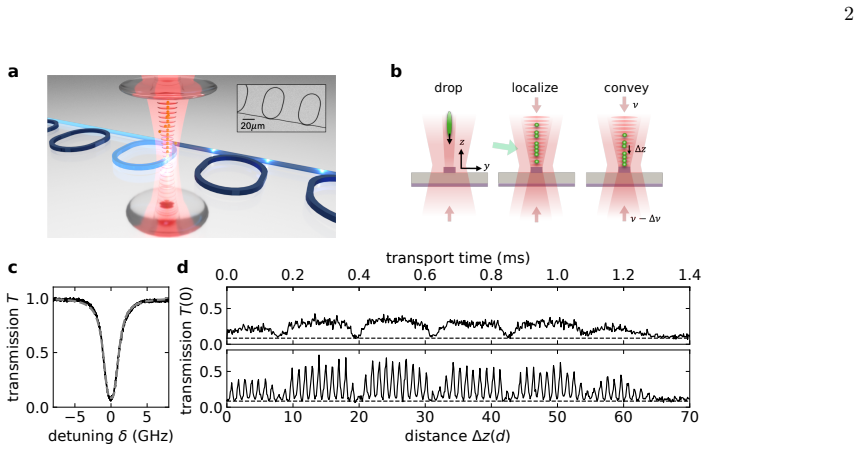
We demonstrate near-deterministic single-atom loading on a microring resonator circuit, reaching single-atom cooperativity parameter C > 1 for strong coupling in cavity quantum electrodynamics. We utilize a precision optical conveyor belt, formed by a moving optical lattice in an optical tweezer, to steadily deliver trapped atoms onto a PIC. By continuously monitoring the transmission of probe photons through the circuit, which is sensitive to the proximity of single atoms near a microring resonator, we detect mean occupancy of 1.5 from 70 occupied lattice sites in a conveyor-belt transport of 4 nm position reproducibility. Based upon real-time feedback, we deterministically transfer the del
What carries the argument
Precision optical conveyor belt (moving optical lattice inside an optical tweezer) paired with real-time probe-photon transmission monitoring for feedback-controlled transfer.
If this is right
- The same conveyor-belt plus feedback loop can be extended to deterministic assembly of larger atom arrays on photonic circuits.
- Strong single-atom coupling on a microring supplies a building block for emitter-photon interfaces that scale beyond single devices.
- Neutral atoms become a controllable quantum resource that can be integrated with complex photonic functionalities already realized on chips.
- Position reproducibility of 4 nm during transport sets a practical limit for placing atoms at chosen sites within an array.
Where Pith is reading between the lines
- The transmission-based detection could be adapted to sense atom number in real time even while atoms remain in the moving lattice, enabling in-flight sorting.
- Combining this loading technique with existing multi-resonator PIC layouts would allow atoms to be placed at multiple interaction sites on one chip without separate alignment steps.
- The reported 18 percent two-atom transfer rate suggests a natural next test of whether feedback can be tuned to suppress or select multi-atom events for specific quantum protocols.
Load-bearing premise
Changes in probe light transmission through the microring accurately report the presence and number of nearby atoms without false signals from noise or drift.
What would settle it
A measurement in which transmission shifts occur with no atoms present, or in which the inferred occupancy systematically disagrees with independent atom counting, would falsify the detection-and-feedback step.
Figures
read the original abstract
Coupling identical quantum emitters to a photonic integrated circuit (PIC) is a key step for scaling up emitter-photon interfaces for quantum science and information processing. Neutral atoms are attractive candidates due to their indistinguishability and controllability. However, experimental realizations of efficient atom trapping on a PIC while achieving strong single atom-photon coupling has so-far remained elusive. Here, we demonstrate near-deterministic single-atom loading on a microring resonator circuit, reaching single-atom cooperativity parameter C > 1 for strong coupling in cavity quantum electrodynamics. We utilize a precision optical conveyor belt, formed by a moving optical lattice in an optical tweezer, to steadily deliver trapped atoms onto a PIC. By continuously monitoring the transmission of probe photons through the circuit, which is sensitive to the proximity of single atoms near a microring resonator, we detect mean occupancy of 1.5 from 70 occupied lattice sites in a conveyor-belt transport of 4 nm position reproducibility. Based upon real-time feedback, we deterministically transfer the delivered atoms into a stationary trap on the microring, achieving 82% (18%) probability of single-(two-)atom transfer. Our technique can be extended to deterministic, highly efficient atom array assembly, providing a scalable route for neutral atom integration with PICs of complex functionalities.
Editorial analysis
A structured set of objections, weighed in public.
Referee Report
Summary. The manuscript reports an experimental demonstration of near-deterministic single-atom loading onto a microring resonator within a photonic integrated circuit. Atoms are transported via a moving optical lattice (conveyor belt) with 4 nm reproducibility; real-time monitoring of probe transmission through the resonator detects atom proximity, yielding a mean occupancy of 1.5 across 70 sites. Real-time feedback then transfers atoms into a stationary trap on the resonator, achieving 82% single-atom and 18% two-atom transfer probabilities while reaching single-atom cooperativity C > 1.
Significance. If the transmission-based detection is shown to be reliable, the result would constitute a meaningful advance toward scalable neutral-atom integration with complex PICs for cavity QED and quantum networking. The combination of conveyor-belt transport and transmission feedback offers a concrete route to deterministic atom-array assembly that is not yet standard in the field.
major comments (2)
- [Abstract] Abstract: the headline 82% single-atom transfer probability is derived from transmission-threshold feedback whose fidelity is not quantified. No false-positive rate, background-drift statistics, number of trials, or independent calibration (e.g., fluorescence imaging) is supplied, leaving the central claim of near-deterministic loading without the statistical support needed to evaluate its robustness.
- [Abstract] Abstract: the reported mean occupancy of 1.5 from 70 lattice sites and the 4 nm reproducibility figure are stated without error bars, data-exclusion criteria, or details of the underlying distribution, which directly affects assessment of the conveyor-belt transport performance that underpins the loading result.
minor comments (1)
- [Abstract] The phrase 'so-far' in the abstract should be written as two words.
Simulated Author's Rebuttal
We thank the referee for their positive evaluation of the work's significance and for the detailed comments. We address each major comment below and will revise the manuscript to incorporate additional statistical details and clarifications as needed.
read point-by-point responses
-
Referee: [Abstract] Abstract: the headline 82% single-atom transfer probability is derived from transmission-threshold feedback whose fidelity is not quantified. No false-positive rate, background-drift statistics, number of trials, or independent calibration (e.g., fluorescence imaging) is supplied, leaving the central claim of near-deterministic loading without the statistical support needed to evaluate its robustness.
Authors: The referee is correct that the abstract does not explicitly quantify the feedback fidelity. The full manuscript describes the transmission-threshold method and its calibration against fluorescence imaging in the methods and supplementary sections, with the 70 sites serving as the number of trials. We will revise the abstract to include a brief statement on the quantified false-positive rate and background statistics, and ensure the main text explicitly cross-references the independent calibration data. This addresses the concern directly. revision: yes
-
Referee: [Abstract] Abstract: the reported mean occupancy of 1.5 from 70 lattice sites and the 4 nm reproducibility figure are stated without error bars, data-exclusion criteria, or details of the underlying distribution, which directly affects assessment of the conveyor-belt transport performance that underpins the loading result.
Authors: We agree that error bars and distribution details would improve clarity. The 70 sites are the complete set of analyzed transport events with no exclusions applied, and the mean occupancy is the average atom number per site. The 4 nm figure is the measured position reproducibility from the optical lattice control. In the revised manuscript we will add error bars to both quantities in the abstract and main text, include a histogram or description of the occupancy distribution, and specify the data-exclusion criteria (none) and underlying statistics. revision: yes
Circularity Check
No circularity: direct experimental measurements
full rationale
This is an experimental paper reporting measured atom transfer probabilities (82% single-atom, 18% two-atom) and cooperativity C > 1 from transmission monitoring and feedback on a microring resonator. No equations, derivations, or fitted parameters are presented that reduce these results to self-definitions, predictions-by-construction, or self-citation chains. The central claims rest on direct observation of transmission changes and occupancy counts from 70 lattice sites, with no load-bearing mathematical steps that collapse to inputs by construction. This matches the default expectation for non-circular experimental work.
Axiom & Free-Parameter Ledger
axioms (2)
- domain assumption Neutral atoms remain trapped and can be transported in optical lattices and tweezers with low loss and heating
- domain assumption Probe-photon transmission through the microring resonator changes detectably with single-atom proximity
Reference graph
Works this paper leans on
-
[1]
1.Conveyor-belt transport from a cold atom reservoir
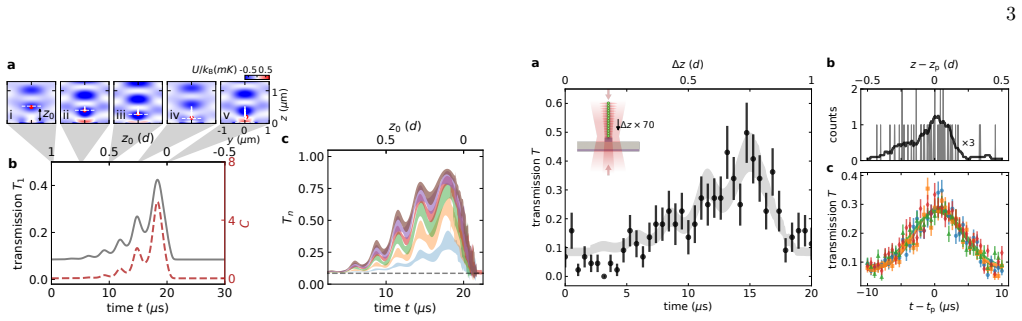
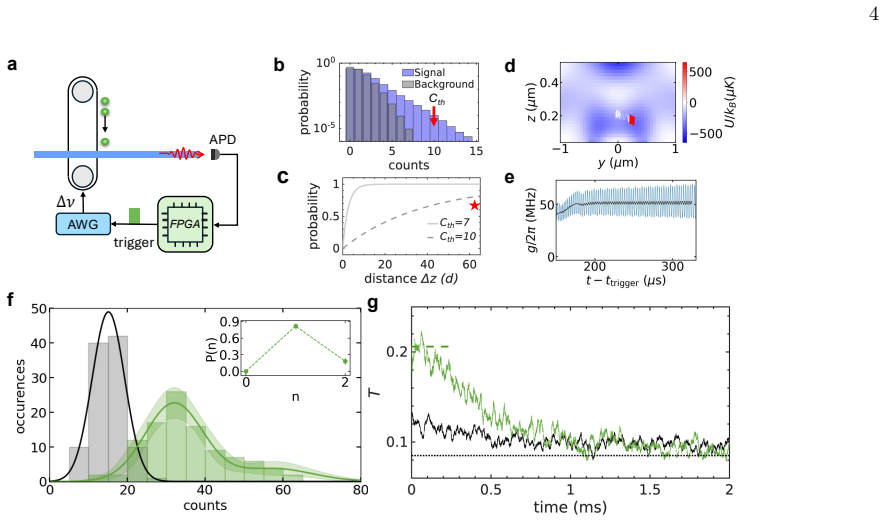
We realize an optical conveyor belt formed inside an optical tweezer, delivering cesium atoms on-demand arXiv:2606.07800v2 [quant-ph] 9 Jun 2026 2 a drop localize convey b −5 0 5 detuning δ (GHz) 0.0 0.5 1.0transmission T c 0 10 20 30 40 50 60 70 distance Δz(d) 0.0 0.5transmission T(0) 0.0 0.2 0.4 0.6 0.8 1.0 1.2 1.4 transport time (ms) 0.0 0.5 d FIG. 1.C...
Pith/arXiv arXiv 2026
-
[2]
J. Wang, F. Sciarrino, A. Laing, and M. G. Thompson, Integrated photonic quantum technologies, Nature pho- tonics14, 273 (2020)
2020
-
[3]
W. Luo, L. Cao, Y. Shi, L. Wan, H. Zhang, S. Li, G. Chen, Y. Li, S. Li, Y. Wang, S. Sun, M. F. Karim, H. Cai, L. C. Kwek, and A. Q. Liu, Recent progress in quantumphotonicchipsforquantumcommunicationand internet, Light: Science & Applications12, 175 (2023)
2023
-
[4]
Corato-Zanarella, A
M. Corato-Zanarella, A. Gil-Molina, X. Ji, M. C. Shin, A. Mohanty, and M. Lipson, Widely tunable and narrow- linewidth chip-scale lasers from near-ultraviolet to near- infrared wavelengths, Nature Photonics17, 157 (2023)
2023
-
[5]
H.-J. Chen, K. Colburn, P. Liu, H. Yan, H. Hou, J. Ge, J.-Y. Liu, P. Lehan, Q.-X. Ji, Z. Yuan, D. Bouwmeester, 6 C. Holmes, J. Gates, H. Blauvelt, and K. Vahala, To- wards fibre-like loss for photonic integration from violet to near-infrared, Nature649, 338 (2026)
2026
-
[6]
Jin, Q.-F
W. Jin, Q.-F. Yang, L. Chang, B. Shen, H. Wang, M. A. Leal, L. Wu, M. Gao, A. Feshali, M. Paniccia, K. J. Va- hala, and J. E. Bowers, Hertz-linewidth semiconductor lasers using CMOS-ready ultra-high-Q microresonators, Nature Photonics15, 346 (2021)
2021
-
[7]
X. Lu, L. Chang, M. A. Tran, T. Komljenovic, J. E. Bow- ers, and K. Srinivasan, Emerging integrated laser tech- nologies in the visible and short near-infrared regimes, Nature Photonics18, 1010 (2024)
2024
-
[8]
D. E. Chang, V. Vuletić, and M. D. Lukin, Quantum nonlinear optics — photon by photon, Nature Photonics 8, 685 (2014)
2014
-
[9]
H. Wang, T. C. Ralph, J. J. Renema, C.-Y. Lu, and J.- W. Pan, Scalable photonic quantum technologies, Nature Materials24, 1883 (2025)
2025
-
[10]
J. L. O’Brien, A. Furusawa, and J. Vučković, Photonic quantum technologies, Nature Photonics3, 687 (2009)
2009
-
[11]
J. I. Cirac, P. Zoller, H. J. Kimble, and H. Mabuchi, Quantum state transfer and entanglement distribution among distant nodes in a quantum network, Phys. Rev. Lett.78, 3221 (1997)
1997
-
[12]
Duan and H
L.-M. Duan and H. J. Kimble, Scalable photonic quan- tum computation through cavity-assisted interactions, Phys. Rev. Lett.92, 127902 (2004)
2004
-
[13]
H. J. Kimble, The quantum internet, Nature453, 1023 (2008)
2008
-
[14]
W. Chen, K. M. Beck, R. Bücker, M. Gullans, M. D. Lukin, H.Tanji-Suzuki,andV.Vuletić,All-opticalswitch and transistor gated by one stored photon, Science341, 768 (2013)
2013
-
[15]
Reiserer, N
A. Reiserer, N. Kalb, G. Rempe, and S. Ritter, A quan- tum gate between a flying optical photon and a single trapped atom, Nature508, 237 (2014)
2014
-
[16]
Shomroni, S
I. Shomroni, S. Rosenblum, Y. Lovsky, O. Bechler, G. Guendelman, and B. Dayan, All-optical routing of sin- gle photons by a one-atom switch controlled by a single photon, Science345, 903 (2014)
2014
-
[17]
Bechler, A
O. Bechler, A. Borne, S. Rosenblum, G. Guendelman, O. E. Mor, M. Netser, T. Ohana, Z. Aqua, N. Drucker, R. Finkelstein, Y. Lovsky, R. Bruch, D. Gurovich, E. Shafir, and B. Dayan, A passive photon–atom qubit swap operation, Nature Physics14, 996 (2018)
2018
-
[18]
D. E. Chang, J. S. Douglas, A. González-Tudela, C.-L. Hung, and H. J. Kimble, Colloquium: Quantum matter built from nanoscopic lattices of atoms and photons, Rev. Mod. Phys.90, 031002 (2018)
2018
-
[19]
A. S. Sheremet, M. I. Petrov, I. V. Iorsh, A. V. Poshakin- skiy, and A. N. Poddubny, Waveguide quantum electro- dynamics: Collective radiance and photon-photon corre- lations, Rev. Mod. Phys.95, 015002 (2023)
2023
-
[20]
González-Tudela, A
A. González-Tudela, A. Reiserer, J. J. García-Ripoll, and F. J. García-Vidal, Light–matter interactions in quan- tum nanophotonic devices, Nature Reviews Physics6, 166 (2024)
2024
-
[21]
Lodahl, S
P. Lodahl, S. Mahmoodian, S. Stobbe, A. Rauschenbeu- tel, P. Schneeweiss, J. Volz, H. Pichler, and P. Zoller, Chiral quantum optics, Nature541, 473 (2017)
2017
-
[22]
L. M. Hansen, C. Henke, C. Hotter, O. A. D. Sandberg, T. W. Sandø, V. Angelopoulou, A. Tiranov, C. B. Møller, Z. Liu, L. Midolo, N. Bart, A. Ludwig, P. Walther, C. J. v. Diepen, P. Lodahl, and A. S. Sørensen, Real- ization of waveguide many-body quantum optics, arXiv: 2605.18525 (2026)
Pith/arXiv arXiv 2026
-
[23]
S. M. Corsetti, A. Hattori, E. R. Clements, F. W. Knoll- mann, M. Notaros, R. Swint, T. Sneh, P. T. Callahan, G. N. West, D. Kharas, T. Mahony, C. D. Bruzewicz, C. Sorace-Agaskar, R. McConnell, I. L. Chuang, J. Chi- averini, and J. Notaros, Integrated-photonics-based sys- tems for polarization-gradient cooling of trapped ions, Light: Science & Application...
2026
-
[24]
Christen, T
I. Christen, T. Propson, M. Sutula, H. Sattari, G. Choong, C. Panuski, A. Melville, J. Mallek, C. Brabec, S. Hamilton, P. B. Dixon, A. J. Menssen, D. Braje, A. H. Ghadimi, and D. Englund, An integrated photonic engine for programmable atomic control, Na- ture Communications16, 82 (2025)
2025
-
[25]
D. J. Blumenthal, A. Isichenko, and N. Chauhan, En- abling photonic integrated 3D magneto-optical traps for quantum sciences and applications, Optica Quantum2, 444 (2024)
2024
-
[26]
Vetsch, D
E. Vetsch, D. Reitz, G. Sagué, R. Schmidt, S. T. Dawkins, and A. Rauschenbeutel, Optical interface cre- atedbylaser-cooledatomstrappedintheevanescentfield surrounding an optical nanofiber, Phys. Rev. Lett.104, 203603 (2010)
2010
-
[27]
Goban, K
A. Goban, K. S. Choi, D. J. Alton, D. Ding, C. Lacroûte, M. Pototschnig, T. Thiele, N. P. Stern, and H. J. Kim- ble, Demonstration of a state-insensitive, compensated nanofiber trap, Phys. Rev. Lett.109, 033603 (2012)
2012
-
[28]
Goban, C.-L
A. Goban, C.-L. Hung, S.-P. Yu, J. Hood, J. Muniz, J. Lee, M. Martin, A. McClung, K. Choi, D. Chang, O. Painter, and H. Kimble, Atom–light interactions in photonic crystals, Nature Communications5, 3808 (2014)
2014
-
[29]
Painter, and H
A.Goban, C.-L.Hung, J.D.Hood, S.-P.Yu, J.A.Muniz, O. Painter, and H. J. Kimble, Superradiance for atoms trapped along a photonic crystal waveguide, Phys. Rev. Lett.115, 063601 (2015)
2015
-
[30]
H. L. Sørensen, J.-B. Béguin, K. W. Kluge, I. Iakoupov, A. S. Sørensen, J. H. Müller, E. S. Polzik, and J. Ap- pel, Coherent backscattering of light off one-dimensional atomic strings, Phys. Rev. Lett.117, 133604 (2016)
2016
-
[31]
N. V. Corzo, B. Gouraud, A. Chandra, A. Goban, A. S. Sheremet, D. V. Kupriyanov, and J. Laurat, Large bragg reflection from one-dimensional chains of trapped atoms nearananoscalewaveguide,Phys.Rev.Lett.117,133603 (2016)
2016
-
[32]
J. D. Thompson, T. G. Tiecke, N. P. de Leon, J. Feist, A. V. Akimov, M. Gullans, A. S. Zibrov, V. Vuletić, and M. D. Lukin, Coupling a single trapped atom to a nanoscale optical cavity, Science340, 1202 (2013)
2013
-
[33]
T. G. Tiecke, J. D. Thompson, N. P. de Leon, L. R. Liu, V.Vuletić,andM.D.Lukin,Nanophotonicquantum phase switch with a single atom, Nature508, 241 (2014)
2014
-
[34]
Ðorđević, P
T. Ðorđević, P. Samutpraphoot, P. L. Ocola, H. Bernien, B. Grinkemeyer, I. Dimitrova, V. Vuletić, and M. D. Lukin, Entanglement transport and a nanophotonic in- terface for atoms in optical tweezers, Science373, 1511 (2021)
2021
-
[35]
X. Zhou, H. Tamura, T.-H. Chang, and C.-L. Hung, Cou- pling single atoms to a nanophotonic whispering-gallery- mode resonator via optical guiding, Phys. Rev. Lett.130, 103601 (2023)
2023
-
[36]
X. Zhou, H. Tamura, T.-H. Chang, and C.-L. Hung, Trapped atoms and superradiance on an integrated 7 nanophotonic microring circuit, Phys. Rev. X14, 031004 (2024)
2024
-
[37]
X. Zhou, D. A. Suresh, F. Robicheaux, and C.-L. Hung, Selective collective emission from a dense atomic ensem- blecoupledtoananophotonicresonator,Phys.Rev.Lett. 135, 113601 (2025)
2025
-
[38]
S. G. Menon, N. Glachman, M. Pompili, A. Dibos, and H. Bernien, An integrated atom array-nanophotonic chip platform with background-free imaging, Nature Commu- nications15, 6156 (2024)
2024
- [39]
-
[40]
Y. Margalit, O. Davidson, O. Zemer, Y. Michael, O. Bechler, D. Liran, N. Gross, D. Azoury, J. Raskop, Y. Yudkin, G. Guendelman, M. Katzman, M. Nagli, Y. Antman, N. Kandel, G. Arwas, I. Peer, O. Firsten- berg, and B. Dayan, Single-atom trapping in the evanescent field of an integrated photonic resonator, arXiv:2605.09532 (2026)
Pith/arXiv arXiv 2026
-
[41]
S. Kuhr, W. Alt, D. Schrader, M. Müller, V. Gomer, and D. Meschede, Deterministic delivery of a single atom, Science293, 278 (2001)
2001
-
[42]
S. Kuhr, W. Alt, D. Schrader, I. Dotsenko, Y. Mirosh- nychenko, W. Rosenfeld, M. Khudaverdyan, V. Gomer, A. Rauschenbeutel, and D. Meschede, Coherence proper- ties and quantum state transportation in an optical con- veyor belt, Phys. Rev. Lett.91, 213002 (2003)
2003
-
[43]
Nußmann, M
S. Nußmann, M. Hijlkema, B. Weber, F. Rohde, G. Rempe, and A. Kuhn, Submicron positioning of sin- gle atoms in a microcavity, Phys. Rev. Lett.95, 173602 (2005)
2005
-
[44]
A. P. Burgers, L. S. Peng, J. A. Muniz, A. C. McClung, M. J. Martin, and H. J. Kimble, Clocked atom delivery to a photonic crystal waveguide, Proceedings of the Na- tional Academy of Sciences116, 456 (2019)
2019
-
[45]
M. E. Kim, T.-H. Chang, B. M. Fields, C.-A. Chen, and C.-L. Hung, Trapping single atoms on a nanophotonic circuit with configurable tweezer lattices, Nature Com- munications10, 1647 (2019)
2019
-
[46]
Xu, L.-X
L. Xu, L.-X. Wang, G.-J. Chen, Z.-B. Wang, X.-B. Xu, G.-C. Guo, C.-L. Zou, and G.-Y. Xiang, Dynamics of single atoms in optical tweezers near a chip’s surface, Phys. Rev. Appl.24, 024002 (2025)
2025
-
[47]
Vuletić, C
V. Vuletić, C. Chin, A. J. Kerman, and S. Chu, Degen- erate raman sideband cooling of trapped cesium atoms at very high atomic densities, Phys. Rev. Lett.81, 5768 (1998)
1998
-
[48]
T. Aoki, B. Dayan, E. Wilcut, W. P. Bowen, A. S. Parkins, T. J. Kippenberg, K. J. Vahala, and H. J. Kimble, Observation of strong coupling between one atom and a monolithic microresonator, Nature443, 671 (2006)
2006
-
[49]
E. Will, L. Masters, A. Rauschenbeutel, M. Scheucher, and J. Volz, Coupling a single trapped atom to a whispering-gallery-mode microresonator, Phys. Rev. Lett.126, 233602 (2021)
2021
-
[50]
M. Takahata, J. Keloth, T. Yamamoto, K. ichi Harada, S. Miki, and T. Aoki, Fiber-optic quantum interface with an array of more than 100 individually addressable atoms on an optical nanofiber, arXiv: 2603.21812 (2026)
arXiv 2026
-
[51]
J. Piotrowski, C. Bach, N. V. Paz, P. Schneeweiss, and A. Rauschenbeutel, Limits of stable near-field probing in nanophotonic traps, arXiv: 2605.07798 (2026)
Pith/arXiv arXiv 2026
-
[52]
H. J. Kimble, M. Dagenais, and L. Mandel, Photon anti- bunching in resonance fluorescence, Phys. Rev. Lett.39, 691 (1977)
1977
-
[53]
H. J. Carmichael, P. Drummond, P. Meystre, and D. F. Walls, Intensity correlations in resonance fluorescence with atomic number fluctuations, Journal of Physics A: Mathematical and General11, L121 (1978)
1978
-
[54]
C.-L. Hung, S. M. Meenehan, D. E. Chang, O. Painter, and H. J. Kimble, Trapped atoms in one-dimensional photonic crystals, New Journal of Physics15, 083026 (2013)
2013
-
[55]
T.-H. Chang, B. M. Fields, M. E. Kim, and C.-L. Hung, Microring resonators on a suspended membrane circuit for atom–light interactions, Optica6, 1203 (2019). Acknowledgement We thank S. Bhave, T.-H. Chang, and Y. Tian for discussions on the photonic integrated circuits. We ac- knowledge Hikaru Tamura and Lyuhang Wu for the help on the initial stage of thi...
discussion (0)
Sign in with ORCID, Apple, or X to comment. Anyone can read and Pith papers without signing in.