Redox-Active Halide Materials for Cathode Applications
Pith reviewed 2026-06-27 21:17 UTC · model grok-4.3
The pith
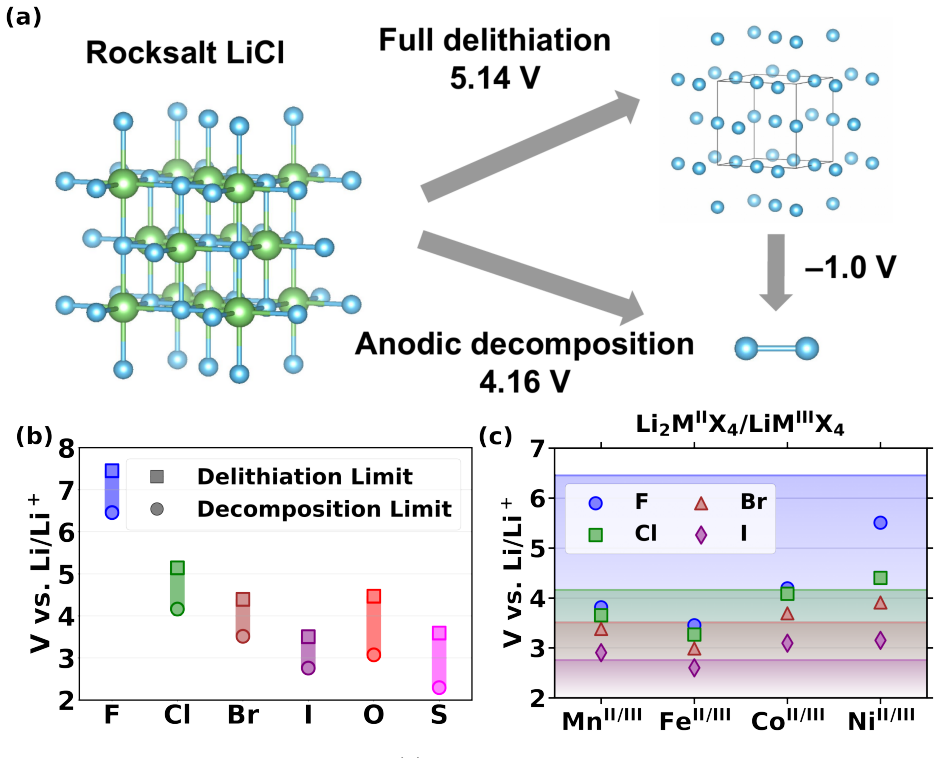
High ionicity of metal-Cl bonds in ternary halides raises cation redox potentials above oxides but promotes Cl oxidation and dimerization at high voltages.
A machine-rendered reading of the paper's core claim, the machinery that carries it, and where it could break.
Core claim
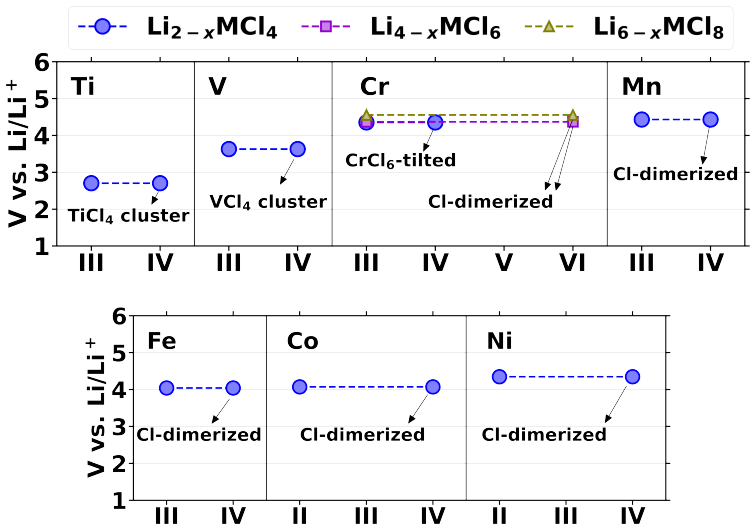
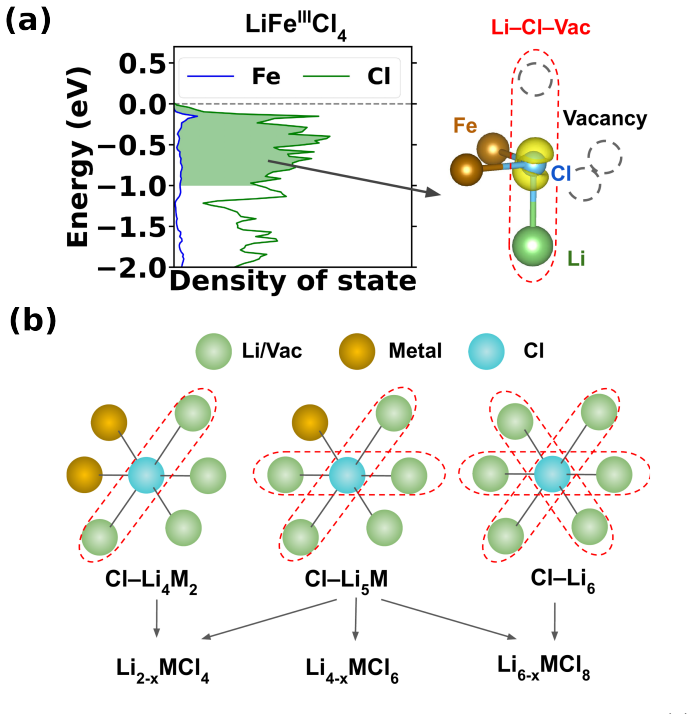
In Li-M-Cl ternary halides, the high ionicity of the metal-chloride bonds raises the redox potentials of the transition-metal cations above those typical of oxide cathodes, but simultaneously favors oxidation of the chloride anions and formation of Cl-Cl dimers at high voltages, thereby limiting the electrochemical stability window of these materials.
What carries the argument
First-principles calculations that map phase stability across varying metal-to-Cl ratios, transition-metal species, and oxidation states while computing separate cation and anion redox potentials.
If this is right
- Fluorine substitution tunes both cation and anion redox potentials and stands out as a route to extend the reversible voltage window.
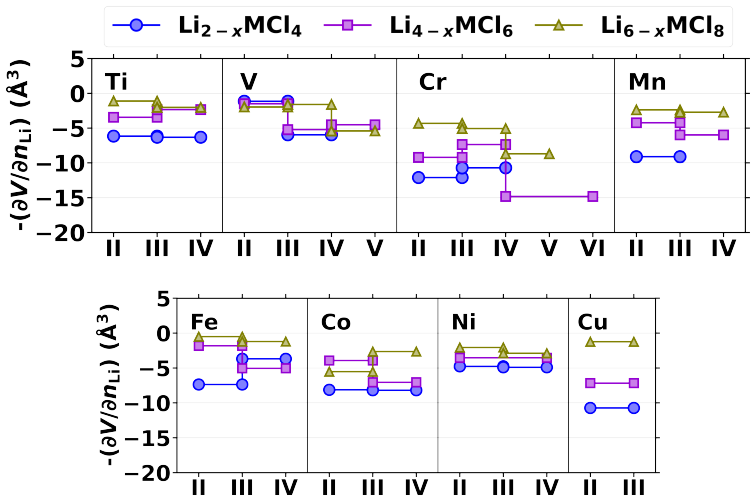
- The materials exhibit flat voltage profiles that may limit electrochemical compatibility with active materials operating at different voltages or over wider ranges.
- When used as redox-active catholytes, these compounds could increase energy density in solid-state batteries provided anion redox is controlled.
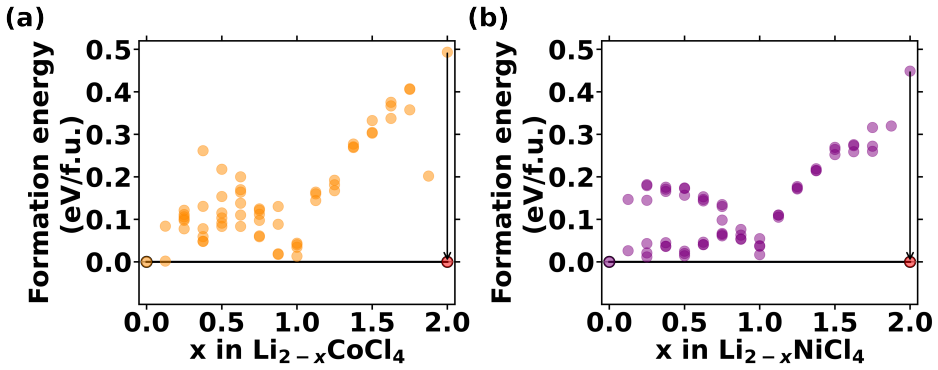
- Phase stability depends on metal-to-Cl ratio and anion framework, guiding selection of compositions that avoid decomposition at high voltage.
Where Pith is reading between the lines
- Mixed-anion frameworks beyond simple F substitution could further decouple cation and anion redox onsets.
- The combination of high Li-ion conductivity and redox activity points toward direct use as catholytes rather than only as solid cathodes.
- Experimental cycling of candidate compositions at voltages just below the predicted Cl-oxidation threshold would clarify practical limits.
Load-bearing premise
Standard first-principles methods without specified functionals or direct experimental benchmarks can reliably forecast both the elevation of cation redox potentials and the onset of Cl oxidation or dimerization.
What would settle it
Direct measurement during charging of the voltage at which Cl2 evolution or spectroscopic signatures of Cl-Cl dimers appear in a specific Li-M-Cl cathode would test the predicted stability limit.
Figures
read the original abstract
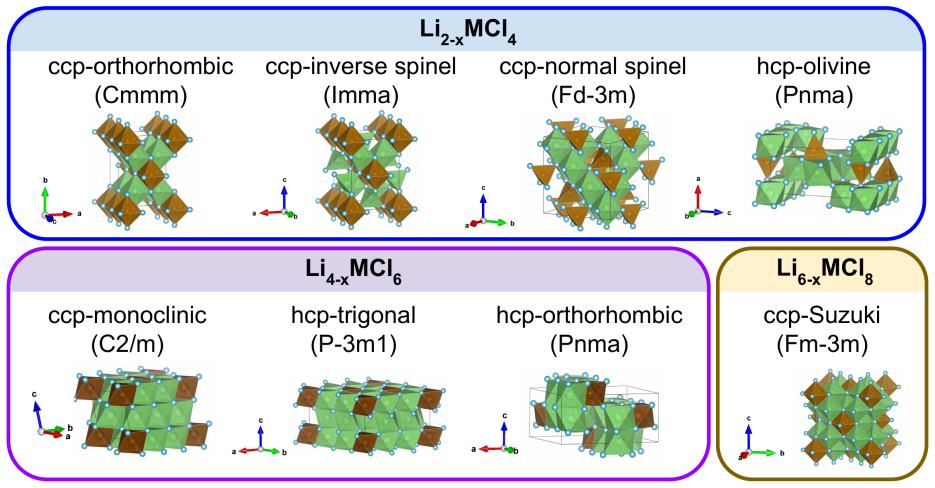
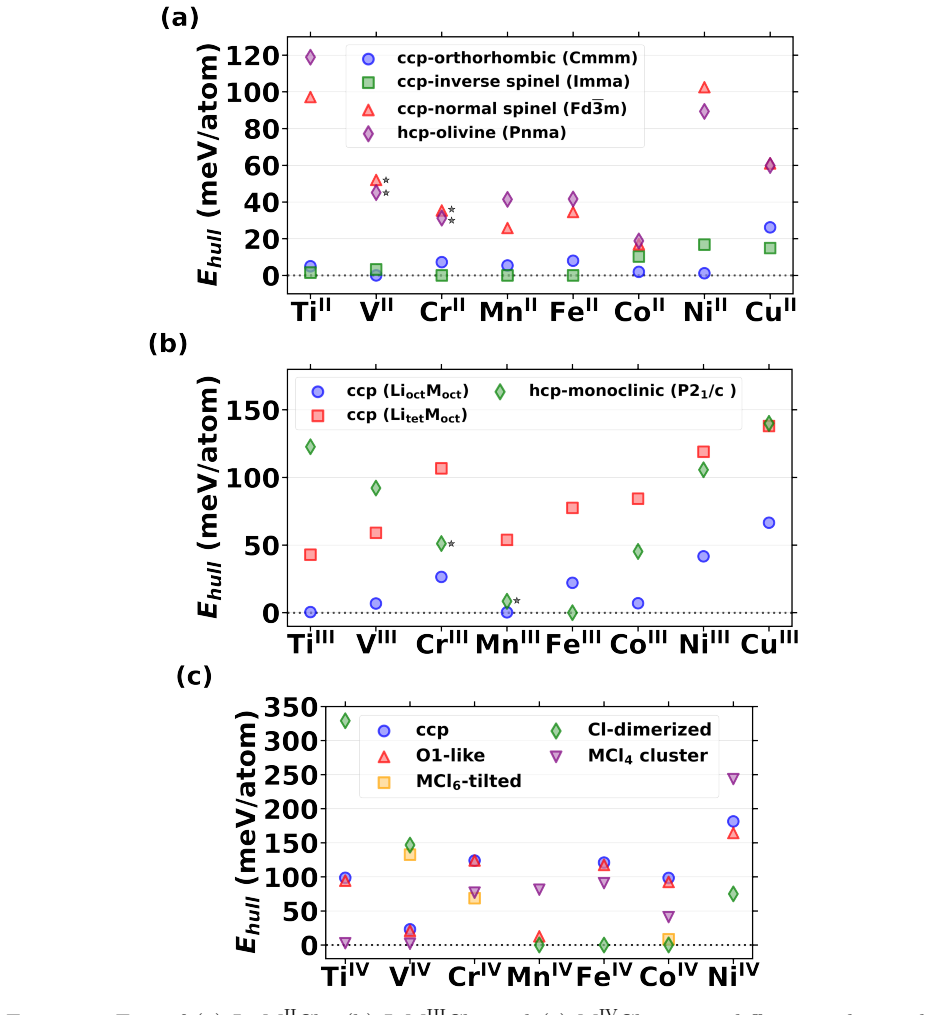
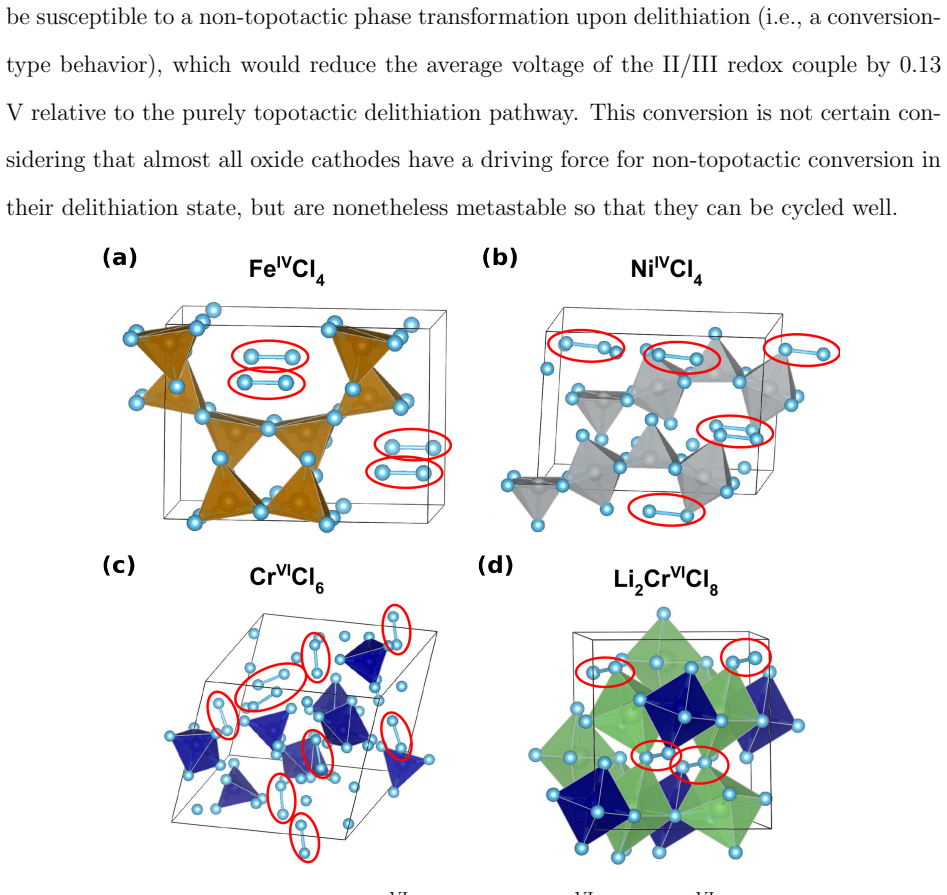
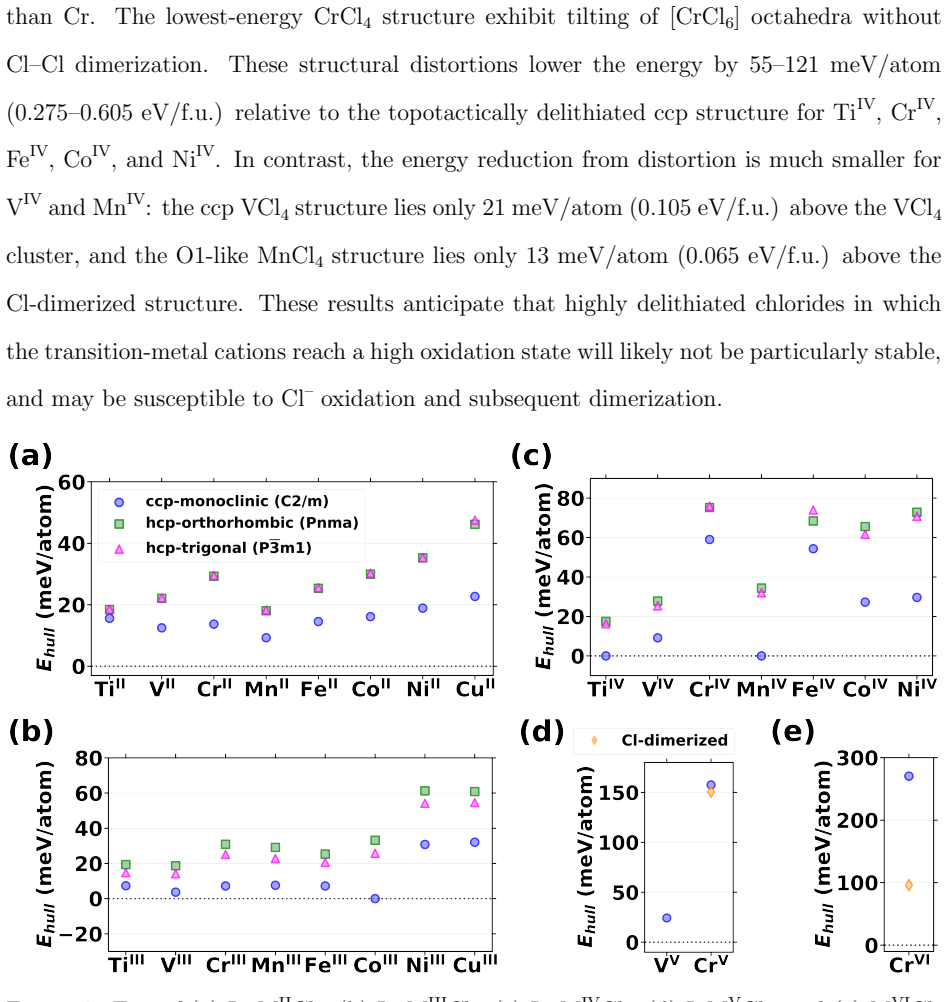
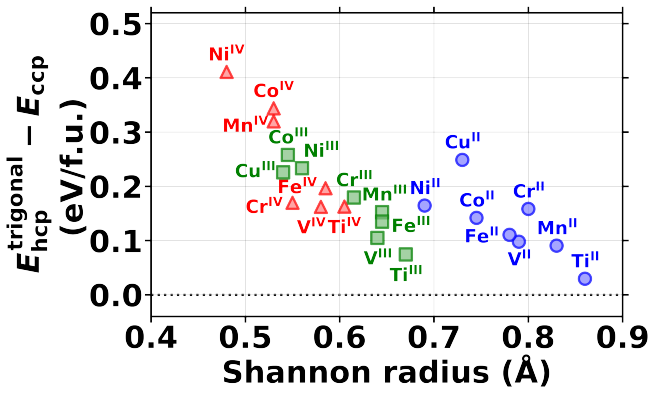
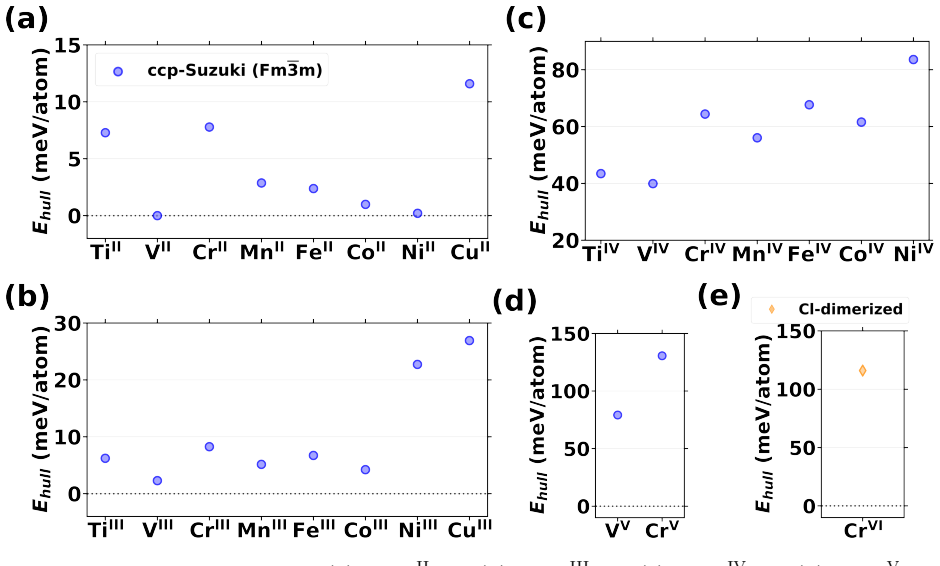
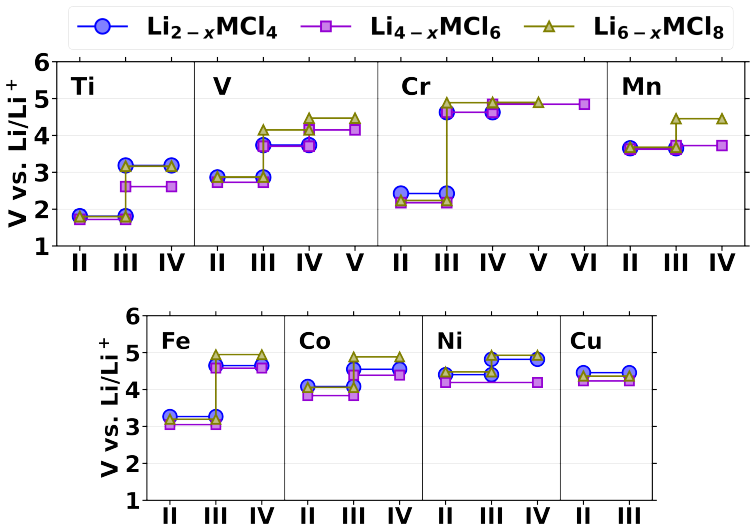
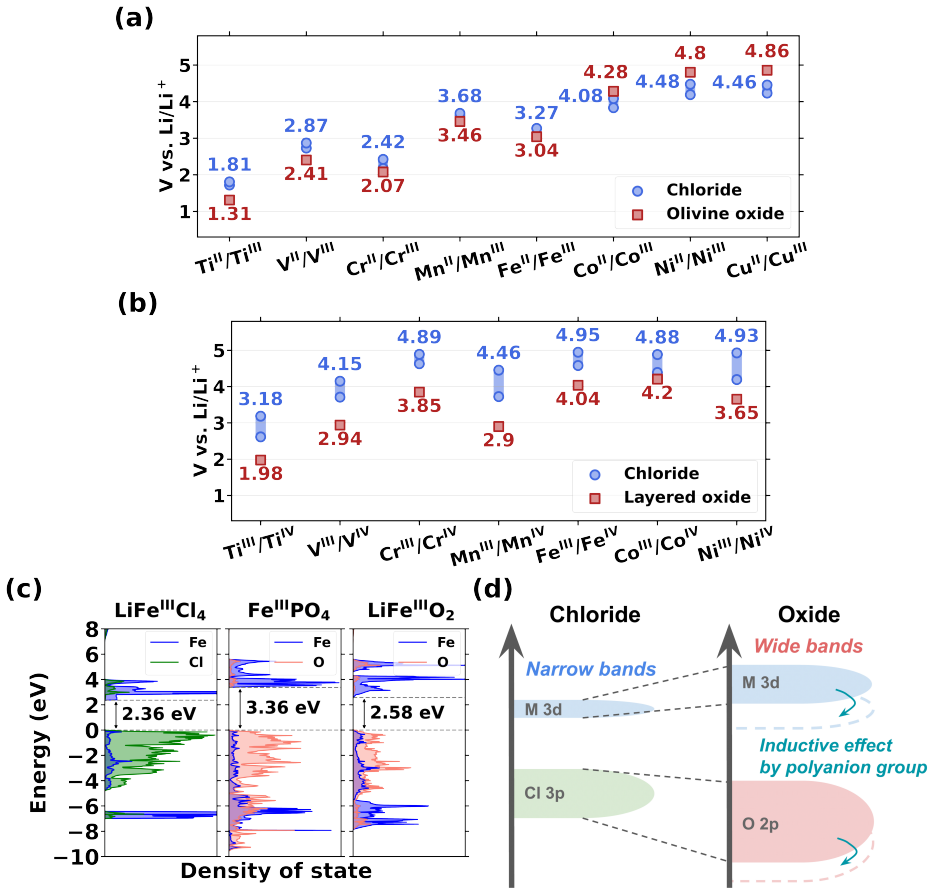
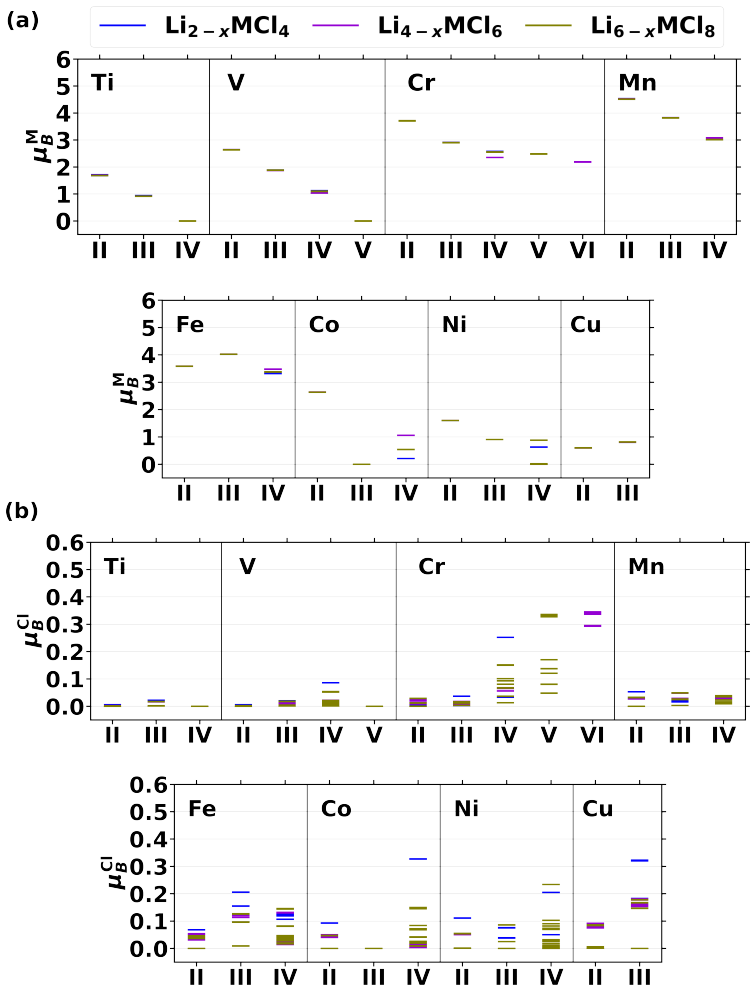
Electrochemically redox-active halide (eREAL) materials are an emerging class of materials that combine high Li-ion conductivity with transition-metal redox activity, making them promising candidates for cathode or catholyte applications. As a redox-active catholyte, they could significantly increase the energy density of solid-state batteries. In this work, we perform first-principles calculations on Li-M-Cl (M = 3d transition metals) ternaries to establish such a theoretical foundation for their stability and electrochemical activity. We map the phase stability of eREAL structures with varying metal-to-Cl ratio, transition-metal species, oxidation states, and anion frameworks, and compute cation and anion redox potentials. We find that the high ionicity of metal-Cl bonds elevates cation redox potentials above those of conventional oxide cathodes, but also will promote Cl oxidation and Cl-Cl dimerization at high voltages, which may limit the stability of these materials. Anion substitution effectively tunes both cation and anion redox potentials, with F substitution standing out as a viable route to extend the reversible voltage window. Beyond the anion redox issue, eREAL compounds generally exhibit flat voltage profiles, which potentially poses an electrochemical compatibility challenge when paired with active materials that operate at different voltage values or over wider voltage ranges. Collectively, our study provides a comprehensive analysis for redox behavior of eREAL materials, paving the way for their rational design and optimization in next-generation battery applications.
Editorial analysis
A structured set of objections, weighed in public.
Referee Report
Summary. The manuscript uses first-principles calculations to map phase stability and compute cation/anion redox potentials in Li-M-Cl (M = 3d transition metals) ternary compounds proposed as redox-active halide (eREAL) cathodes or catholytes. It concludes that high metal-Cl ionicity elevates cation redox potentials above those of conventional oxides while also promoting Cl oxidation and Cl-Cl dimerization at high voltages (limiting stability), that anion substitution (especially F) can tune the voltage window, and that the materials exhibit flat voltage profiles that may create electrochemical compatibility issues.
Significance. If the redox-potential ordering and stability limits hold under validated methodology, the work would supply a useful theoretical map for an emerging class of halide materials that combine Li-ion conductivity with transition-metal redox activity, potentially aiding design of higher-energy-density solid-state batteries. The identification of anion-redox limits and the anion-substitution tuning route are actionable insights.
major comments (2)
- [Abstract / Methods] Abstract and computational-methods description: the calculations are referred to only as 'first-principles calculations' with no specification of the exchange-correlation functional (PBE, SCAN, HSE, etc.), Hubbard U values, dispersion corrections, or convergence criteria. Because Cl oxidation energies and Cl-Cl dimerization are known to shift 0.5–1.5 V with functional choice owing to self-interaction error in ionic halides, this omission directly undermines the central claim that cation redox is elevated while Cl oxidation/Cl-Cl dimerization limits stability.
- [Redox-potential results] Redox-potential results section: the ordering of cation versus anion redox and the claimed stability limit are presented without reported error bars, without comparison to experimental voltage benchmarks for any Li-M-Cl compound, and without explicit tests of functional sensitivity. These omissions make the quantitative elevation of cation potentials and the predicted onset of Cl oxidation load-bearing but unverified.
minor comments (1)
- [Abstract] Notation for the eREAL acronym and the metal-to-Cl ratio variable should be defined at first use and used consistently in all figures and tables.
Simulated Author's Rebuttal
We thank the referee for the constructive comments on our manuscript. We agree that greater methodological transparency and validation are needed to support the central claims regarding redox ordering and stability limits. We address each major comment below and will revise the manuscript accordingly.
read point-by-point responses
-
Referee: [Abstract / Methods] Abstract and computational-methods description: the calculations are referred to only as 'first-principles calculations' with no specification of the exchange-correlation functional (PBE, SCAN, HSE, etc.), Hubbard U values, dispersion corrections, or convergence criteria. Because Cl oxidation energies and Cl-Cl dimerization are known to shift 0.5–1.5 V with functional choice owing to self-interaction error in ionic halides, this omission directly undermines the central claim that cation redox is elevated while Cl oxidation/Cl-Cl dimerization limits stability.
Authors: We agree that the specific DFT settings were not detailed in the abstract or methods, which is a valid concern for anion-redox predictions. In the revised version we will explicitly state that all calculations employed the PBE functional with Hubbard U corrections (listing the U values applied to each 3d metal), Grimme D3 dispersion corrections, and the convergence criteria used (energy cutoff, k-point density, force tolerance). We will also add a short paragraph discussing the known limitations of PBE for Cl oxidation and the rationale for our functional choice. revision: yes
-
Referee: [Redox-potential results] Redox-potential results section: the ordering of cation versus anion redox and the claimed stability limit are presented without reported error bars, without comparison to experimental voltage benchmarks for any Li-M-Cl compound, and without explicit tests of functional sensitivity. These omissions make the quantitative elevation of cation potentials and the predicted onset of Cl oxidation load-bearing but unverified.
Authors: We accept that the results section lacks these elements. The revised manuscript will report numerical error bars derived from convergence tests. We will include direct comparisons to the limited experimental voltage data available for Li-M-Cl phases (e.g., LiFeCl3). In addition, we will add a functional-sensitivity analysis (PBE+U versus SCAN) for representative compositions, placed either in the main text or as supplementary information, to quantify how the cation/anion redox ordering and Cl-dimerization onset shift with functional choice. revision: yes
Circularity Check
No significant circularity; derivation is self-contained first-principles computation
full rationale
The paper performs first-principles calculations on Li-M-Cl ternaries to map phase stability and compute cation/anion redox potentials, directly yielding the claims about metal-Cl ionicity elevating potentials and promoting Cl oxidation/dimerization. No equations or results reduce by construction to their own inputs, no parameters are fitted to a subset then renamed as predictions, and no load-bearing self-citations or uniqueness theorems are invoked. The work is externally falsifiable via independent DFT runs or experiments and does not rely on ansatzes or renamings of known results from within the paper.
Axiom & Free-Parameter Ledger
axioms (1)
- standard math Standard first-principles electronic structure methods can predict phase stability and redox potentials in Li-M-Cl ternaries
Reference graph
Works this paper leans on
-
[1]
(1) Kovalenko, M. V. Navigating the Catholyte Landscape in All- Solid-State Batteries. ACS Energy 2025, 11, 172–179. (2) Ko, S.; Ue, M.; Yamada, A. A critical outlook for large-scale all-solid-state batteries. Joule 2026, 10, 102269. (3) Shearing, P. R.; Electrochem, J.; Soc, A.; Robinson, J. B.; Xi, K.; Vasant, R. Multi Length Scale Microstructural Inves...
2025
-
[2]
Low-cost iron trichloride cathode for all-solid-state lithium-ion batteries
(9) Liu, Z.; Liu, J.; Zhao, S.; Xun, S.; Byaruhanga, P.; Chen, S.; Tang, Y.; Zhu, T.; Chen, H. Low-cost iron trichloride cathode for all-solid-state lithium-ion batteries. Na- ture Sustainability 2024, 7, 1492–1500. (10) Fu, J. et al. A cost-effective all-in-one halide material for all-solid-state batteries.Nature 2025, 643, 111–118. (11) Li, X.; Liang, J...
2024
-
[3]
Designing lithium halide solid electrolytes
(20) Wang, Q.; Zhou, Y.; Wang, X.; Guo, H.; Gong, S.; Yao, Z.; Wu, F.; Wang, J.; Ganap- athy, S.; Bai, X.; Li, B.; Zhao, C.; Janek, J. Designing lithium halide solid electrolytes. Nature Communications 2024, 15,
2024
-
[4]
R.; Holzapfel, M.; Nova, P.; Johnson, C
40 (21) Ni, L.; Mn, L.; Armstrong, A. R.; Holzapfel, M.; Nova, P.; Johnson, C. S. Demonstrat- ing Oxygen Loss and Associated Structural Reorganization in the Lithium Battery Cathode. Journal of American Chemical Society 2006, 8694–8698. (22) Seo, D. H.; Lee, J.; Urban, A.; Malik, R.; Kang, S.; Ceder, G. The structural and chemical origin of the oxygen red...
2006
-
[5]
(24) Assat, G.; Tarascon, J. M. Fundamental understanding and practical challenges of anionic redox activity in Li-ion batteries. Nature Energy 2018, 3, 373–386. (25) House, R. A.; Marie, J.-j.; P´ erez-osorio, M. A.; Rees, G. J.; Boivin, E.; Bruce, P. G. The role of O2 in O-redox cathodes for Li-ion batteries. Nature Energy 2021, 6, 781–789. (26) Aydinol...
2018
-
[6]
Redox-Level Design for High-Energy-Density Chloride Electrodes
(30) Tanibata, N.; Aizu, S.; Sasadaira, T.; Takeda, H.; Nakayama, M. Redox-Level Design for High-Energy-Density Chloride Electrodes. Advanced Energy Materials 2025, 04110, 1–8. (31) Manthiram, A.; Goodenough, J. B. Lithium insertion into Fe2(SO4)3 frameworks.Jour- nal of Power Sources 1989, 26, 403–408. (32) Hautier, G.; Jain, A.; Ong, S. P.; Kang, B.; Mo...
2025
-
[7]
Fun- damental interplay between anionic/cationic redox governing the kinetics and thermo- dynamics of lithium-rich cathodes
(41) Assat, G.; Foix, D.; Delacourt, C.; Iadecola, A.; Dedryv` ere, R.; Tarascon, J.-m. Fun- damental interplay between anionic/cationic redox governing the kinetics and thermo- dynamics of lithium-rich cathodes. Nature Communications 2017, 8,
2017
-
[8]
A.; Maitra, U.; P´ erez-osorio, M
(42) House, R. A.; Maitra, U.; P´ erez-osorio, M. A.; Lozano, J. G.; Jin, L.; Somerville, J. W.; Duda, L. C.; Nag, A.; Walters, A.; Zhou, K.-j.; Roberts, M. R.; Bruce, P. G. Su- perstructure control of first-cycle voltage hysteresis in oxygen-redox cathodes. Nature 2020, 577,
2020
-
[9]
A.; Rees, G
(43) House, R. A.; Rees, G. J.; P´ erez-osorio, M. A.; Marie, J.-j.; Boivin, E.; Robert- son, A. W.; Nag, A.; Garcia-fernandez, M.; Zhou, K.-j.; Bruce, P. G. First-cycle voltage hysteresis in Li-rich 3d cathodes associated with molecular O2 trapped in the bulk. Na- ture Energy 2020, 5, 777–785. (44) Luo, K.; Roberts, M. R.; Guerrini, N.; Tapia-Ruiz, N.; H...
2020
-
[10]
Design principles for zero-strain Li-ion cathodes Design principles for zero-strain Li-ion cathodes
(47) Zhao, X.; Tian, Y.; Lun, Z.; Cai, Z.; Chen, T.; Ouyang, B.; Ceder, G. Design principles for zero-strain Li-ion cathodes Design principles for zero-strain Li-ion cathodes. Joule 2022, c, 1–18. (48) Manthiram, A.; Cui, Z. Chemical factors controlling the behaviour of oxide cathodes in batteries. Nature Energy 2025, (49) Abdellahi, A.; Urban, A.; Dacek,...
2022
discussion (0)
Sign in with ORCID, Apple, or X to comment. Anyone can read and Pith papers without signing in.