DP4SQL: Differentially Private SQL with Flexible Privacy Policies
Pith reviewed 2026-06-27 21:22 UTC · model grok-4.3
The pith
DP4SQL lets data curators specify flexible privacy policies for relational databases instead of using rigid one-size-fits-all rules.
A machine-rendered reading of the paper's core claim, the machinery that carries it, and where it could break.
Core claim
DP4SQL is a differentially private SQL system that allows data curators to customize the plausible deniability requirements for their relational databases by supporting flexible policies on which pieces of information about an entity, spread across multiple relations, need protection. It handles partially public data and varying per-part protection levels without requiring manual updates to privacy accountants or proofs of correctness.
What carries the argument
A flexible privacy accounting mechanism that tracks stability and noise requirements across mixed public/private columns and varying per-part protection levels.
If this is right
- Curators can protect existence of records in some tables while protecting only contents in others without rewriting the accountant.
- Queries involving partially public columns receive noise calibrated to the actual sensitivity rather than a worst-case assumption.
- Different parts of the same record can receive different protection levels while preserving end-to-end privacy accounting.
- Small policy changes no longer force full re-verification of the privacy mechanism.
Where Pith is reading between the lines
- The same accounting approach could extend to other query languages or data models that mix public and private attributes.
- Database schema design might incorporate explicit privacy-level annotations as first-class metadata.
- Testing could focus on whether mixed-policy queries produce statistically distinguishable outputs under the claimed bounds.
Load-bearing premise
A single flexible privacy accounting mechanism can correctly track stability and noise requirements across mixed public/private columns and varying per-part protection levels without introducing new derivation gaps or post-hoc adjustments.
What would settle it
A concrete query and policy combination where the system's noise calculation or stability bound differs from what a manual per-policy analysis would require, violating the claimed privacy guarantee.
Figures

read the original abstract
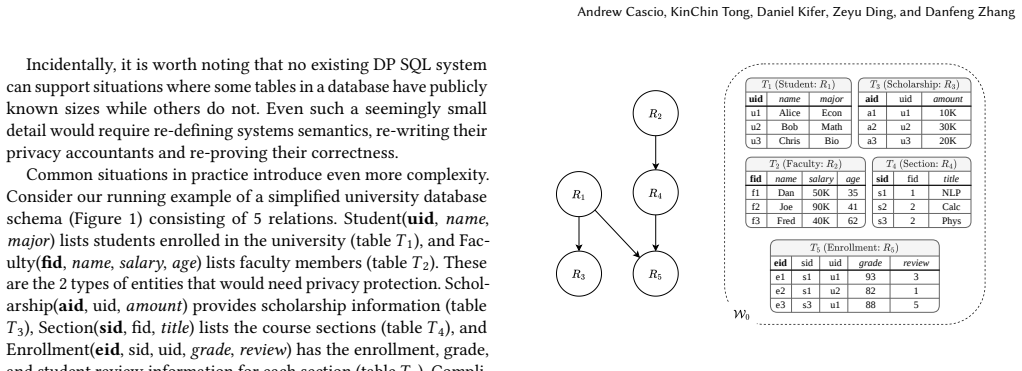
The plausible deniability model of differential privacy for single-table datasets is well-understood. However, applying differential privacy to relational databases is much trickier: each application needs flexibility in specifying the pieces of information about an entity, spread across multiple relations, that require plausible deniability guarantees. Existing differentially private SQL systems only support rigid privacy policies. Even seemingly small changes, such as specifying that some tables need to protect the existence of records while others only need to protect the record contents, require significant manual effort in updating their privacy accountants and proving their correctness. One example of a challenge is the presence of partially public data. Public columns in a table (e.g., faculty names in a university dataset and partial course enrollment information) can cause some queries to require more noise (compared to fully private data), while others require less noise. This kind of reasoning is not supported in existing systems. Another example is when different parts of records (e.g., demographics, financial data) require different levels of privacy protection. Again, existing differentially private SQL systems need to rewrite their rules for calculating query stability in order to support such a feature. This paper presents DP4SQL, a differentially private SQL system that allows data curators to better customize the plausible deniability requirements for their relational databases. This avoids the drawbacks of the "one-size-fits-all" systems that would either underprotect the data or inject too much noise into query answers.
Editorial analysis
A structured set of objections, weighed in public.
Referee Report
Summary. The paper presents DP4SQL, a differentially private SQL system for relational databases that supports flexible privacy policies. It allows data curators to customize plausible deniability requirements across multiple relations, including cases with partially public columns (which can increase or decrease required noise depending on the query) and heterogeneous protection levels for different parts of records (e.g., demographics vs. financial data). The system is claimed to avoid the manual rewrites and new proofs needed in existing rigid DP SQL systems when such policies change.
Significance. If the flexible accounting mechanism correctly handles stability and noise calibration across mixed public/private columns and per-part policies without derivation gaps, the work would advance practical DP deployment for relational data by enabling tailored protection levels that reduce unnecessary noise while maintaining end-to-end guarantees.
major comments (2)
- [Abstract] Abstract: the central claim that a single accountant correctly tracks stability and noise for queries over partially public columns and records with heterogeneous protection levels is presented without any stability definitions, case analysis, or composition rules; this is load-bearing for the flexibility claim and cannot be assessed from the given text.
- [Abstract] Abstract: no machine-checked proofs, parameter-free derivations, or detailed accountant description are referenced, leaving open the risk that new stability rules for public-column sensitivity or per-part policies introduce hidden assumptions that would invalidate the end-to-end guarantees.
minor comments (1)
- The abstract would benefit from a high-level outline of the key technical components (e.g., how the accountant is extended) to allow readers to gauge the scope of the contribution.
Simulated Author's Rebuttal
We thank the referee for their careful reading and comments on the abstract. The abstract summarizes the high-level contributions; the formal stability definitions, case analyses, composition rules, and accountant details appear in the body of the paper (Sections 3–5 and the appendix). We address each point below.
read point-by-point responses
-
Referee: [Abstract] Abstract: the central claim that a single accountant correctly tracks stability and noise for queries over partially public columns and records with heterogeneous protection levels is presented without any stability definitions, case analysis, or composition rules; this is load-bearing for the flexibility claim and cannot be assessed from the given text.
Authors: The abstract is a concise overview and does not contain the full formal development. Section 3 defines stability under partially public columns and per-part heterogeneous policies; Section 4.2 provides the case analysis for how public columns can increase or decrease required noise; Section 5 presents the single accountant together with the composition rules that track both stability and noise calibration end-to-end. These sections supply the load-bearing material for the flexibility claim. revision: no
-
Referee: [Abstract] Abstract: no machine-checked proofs, parameter-free derivations, or detailed accountant description are referenced, leaving open the risk that new stability rules for public-column sensitivity or per-part policies introduce hidden assumptions that would invalidate the end-to-end guarantees.
Authors: Section 5 contains a detailed description of the accountant, including the parameter-free derivations for the new stability rules and the explicit statement of all assumptions (e.g., independence of public-column values from private data and the per-part privacy parameters). The proofs are manual but fully spelled out in the appendix; we do not claim machine-checked proofs. The end-to-end guarantees follow directly from the composition theorem stated in Section 5 once the per-query stabilities are computed under the policy. revision: no
Circularity Check
No circularity: DP4SQL presents independent system design for flexible privacy policies
full rationale
The paper introduces DP4SQL as a new differentially private SQL system supporting customizable policies for mixed public/private columns and heterogeneous per-part protections. The abstract and description frame this as addressing gaps in existing rigid systems via new accountant mechanisms, without any quoted equations, fitted parameters renamed as predictions, or load-bearing self-citations that reduce the central claims to prior inputs by construction. No self-definitional loops, ansatz smuggling, or renaming of known results appear in the provided text. The derivation chain for stability tracking and noise calibration is presented as novel engineering work rather than a mathematical reduction to the paper's own assumptions, making the result self-contained.
Axiom & Free-Parameter Ledger
Reference graph
Works this paper leans on
-
[1]
John M. Abowd, Robert Ashmead, Ryan Cumings-Menon, Simson Garfinkel, Micah Heineck, Christine Heiss, Robert Johns, Daniel Kifer, Philip Leclerc, Ash- win Machanavajjhala, Brett Moran, William Sexton, Matthew Spence, and Pavel Zhuravlev. forthcoming. Preprint https://www.census.gov/library/working- papers/2022/adrm/CED-WP-2022-002.html. The 2020 Census Dis...
2022
-
[2]
Skye Berghel, Philip Bohannon, Damien Desfontaines, Charles Estes, Sam Haney, Luke Hartman, Michael Hay, Ashwin Machanavajjhala, Tom Magerlein, Gerome Miklau, Amritha Pai, William Sexton, and Ruchit Shrestha. 2022. Tumult Ana- lytics: a robust, easy-to-use, scalable, and expressive framework for differential privacy.arXiv preprint arXiv:2212.04133(2022)
arXiv 2022
-
[3]
Mark Bun and Thomas Steinke. 2016. Concentrated Differential Privacy: Sim- plifications, Extensions, and Lower Bounds. InProceedings, Part I, of the 14th International Conference on Theory of Cryptography - Volume 9985
2016
-
[4]
Lei Cao, Dongqing Xiao, Yizhou Yan, Samuel Madden, and Guoliang Li. 2021. ATLANTIC: making database differentially private and faster with accuracy guarantee. InProceedings of the VLDB Endowment
2021
-
[5]
T.P.P. Council. 2014. TPC Benchmark H. https://www.tpc.org/tpc_documents_ current_versions/pdf/tpc-h_v2.17.1.pdf
2014
-
[6]
Bolin Ding, Janardhan Kulkarni, and Sergey Yekhanin. 2017. Collecting Telemetry Data Privately. InProceedings of the 31st International Conference on Neural Information Processing Systems(Long Beach, California, USA)(NIPS’17). Curran Associates Inc., USA, 3574–3583. http://dl.acm.org/citation.cfm?id=3294996. 3295115
2017
-
[7]
Jinshuo Dong, Aaron Roth, and Weijie J. Su. 2022. Gaussian differential privacy. Journal of the Royal Statistical Society: Series B (Statistical Methodology)84, 1 (2022), 3–37. arXiv:https://rss.onlinelibrary.wiley.com/doi/pdf/10.1111/rssb.12454 doi:10.1111/rssb.12454
-
[8]
Wei Dong, Juanru Fang, Ke Yi, Yuchao Tao, and Ashwin Machanavajjhala. 2022. R2t: Instance-optimal truncation for differentially private query evaluation with foreign keys. InProceedings of the 2022 International Conference on Management of Data. 759–772
2022
-
[9]
Cynthia Dwork, Frank McSherry, Kobbi Nissim, and Adam Smith. 2006. Cali- brating noise to sensitivity in private data analysis. InProceedings of the Third Conference on Theory of Cryptography(New York, NY)(TCC’06). Springer-Verlag, Berlin, Heidelberg, 265–284. doi:10.1007/11681878_14
-
[10]
Cynthia Dwork and Aaron Roth. 2014. The algorithmic foundations of differential privacy.Theoretical Computer Science9, 3–4 (2014), 211–407
2014
-
[11]
Úlfar Erlingsson, Vasyl Pihur, and Aleksandra Korolova. 2014. RAPPOR: Ran- domized Aggregatable Privacy-Preserving Ordinal Response. InProceedings of the 2014 ACM SIGSAC Conference on Computer and Communications Security (Scottsdale, Arizona, USA)(CCS ’14). ACM, New York, NY, USA, 1054–1067
2014
-
[12]
Google. [n. d.]. Tensorflow Privacy Github. https://github.com/tensorflow/ privacy
-
[13]
Noah Johnson, Joseph P. Near, and Dawn Song. 2018. Towards practical differ- ential privacy for SQL queries.Proc. VLDB Endow.11, 5 (Jan. 2018), 526–539. doi:10.1145/3187009.3177733
-
[14]
Noah M. Johnson, Joseph P. Near, Joseph M. Hellerstein, and Dawn Song. 2018. Chorus: Differential Privacy via Query Rewriting.CoRRabs/1809.07750 (2018). arXiv:1809.07750 http://arxiv.org/abs/1809.07750
arXiv 2018
-
[15]
Ios Kotsogiannis, Yuchao Tao, Xi He, Maryam Fanaeepour, Ashwin Machanava- jjhala, Michael Hay, and Gerome Miklau. 2019. PrivateSQL: a differentially private SQL query engine.Proc. VLDB Endow.12, 11 (July 2019), 1371–1384. doi:10.14778/3342263.3342274
-
[16]
2022.Tumult Analytics
Tumult Labs. 2022.Tumult Analytics. https://tmlt.dev
2022
-
[17]
Ashwin Machanavajjhala, Daniel Kifer, John Abowd, Johannes Gehrke, and Lars Vilhuber. 2008. Privacy: Theory meets Practice on the Map. In2008 IEEE 24th International Conference on Data Engineering. 277–286. doi:10.1109/ICDE.2008. 4497436
-
[18]
Frank D. McSherry. 2009. Privacy integrated queries: an extensible platform for privacy-preserving data analysis. InProceedings of the 2009 ACM SIGMOD International Conference on Management of Data(Providence, Rhode Island, USA) (SIGMOD ’09). Association for Computing Machinery, New York, NY, USA, 19–30. doi:10.1145/1559845.1559850
-
[19]
Solomon Messing, Bogdan State, Chaya Nayak, Gary King, and Nate Persily
-
[20]
URLs Dataset for RFP.pdf. InFacebook URL Shares. Harvard Dataverse. doi:10.7910/DVN/EIAACS/PMQG9X
-
[21]
Ilya Mironov. 2017. Rényi Differential Privacy. In30th IEEE Computer Security Foundations Symposium, CSF 2017, Santa Barbara, CA, USA, August 21-25, 2017. 263–275
2017
-
[22]
Prashanth Mohan, Abhradeep Thakurta, Elaine Shi, Dawn Song, and David Culler
-
[23]
InProceedings of the 2012 ACM SIGMOD International Conference on Management of Data(Scottsdale, Arizona, USA)(SIGMOD ’12)
GUPT: Privacy Preserving Data Analysis Made Easy. InProceedings of the 2012 ACM SIGMOD International Conference on Management of Data(Scottsdale, Arizona, USA)(SIGMOD ’12). ACM, New York, NY, USA, 349–360
2012
-
[24]
Shangfu Peng, Yin Yang, Zhenjie Zhang, Marianne Winslett, and Yong Yu. 2013. Query optimization for differentially private data management systems. In2013 IEEE 29th International Conference on Data Engineering (ICDE). 1093–1104. doi:10. 1109/ICDE.2013.6544900
arXiv 2013
-
[25]
Davide Proserpio, Sharon Goldberg, and Frank McSherry. 2014. Calibrating Data to Sensitivity in Private Data Analysis: A Platform for Differentially-private Analysis of Weighted Datasets.Proc. VLDB Endow.7, 8 (April 2014), 637–648. doi:10.14778/2732296.2732300
-
[26]
Indrajit Roy, Srinath T. V. Setty, Ann Kilzer, Vitaly Shmatikov, and Emmett Witchel. 2010. Airavat: Security and Privacy for MapReduce. InProceedings of the 7th USENIX Conference on Networked Systems Design and Implementation (San Jose, California)(NSDI’10). USENIX Association, Berkeley, CA, USA, 20–20
2010
-
[27]
Apple Differential Privacy Team. 2017. Learning with Privacy at Scale.Apple Machine Learning Journal1, 8 (2017)
2017
-
[28]
The OpenDP Team. 2020. The OpenDP White Paper. https://projects.iq.harvard. edu/files/opendp/files/opendp_white_paper_11may2020.pdf
2020
-
[29]
Michael Carl Tschantz, Shayak Sen, and Anupam Datta. 2020. SoK: Differential privacy as a causal property. In2020 IEEE Symposium on Security and Privacy (SP). IEEE, 354–371
2020
-
[30]
Larry Wasserman and Shuheng Zhou. 2010. A statistical framework for differen- tial privacy.J. Amer. Statist. Assoc.105, 489 (2010), 375–389
2010
-
[31]
Royce J. Wilson, Celia Yuxin Zhang, William Lam, Damien Desfontaines, Daniel Simmons-Marengo, and Bryant Gipson. 2019. Differentially Private SQL with Bounded User Contribution.CoRRabs/1909.01917 (2019). arXiv:1909.01917 http://arxiv.org/abs/1909.01917
arXiv 2019
-
[32]
Jianzhe Yu, Wei Dong, Juanru Fang, Dajun Sun, and Ke Yi. 2024. DOP-SQL: A General-Purpose, High-Utility, and Extensible Private SQL System.Proc. VLDB Endow.17, 12 (Aug. 2024), 4385–4388. doi:10.14778/3685800.3685881 14 DP4SQL: Differentially Private SQL with Flexible Privacy Policies mmf(𝜎 𝜑 (𝑆).𝐴)=mmf(𝑆 .𝐴) mmf(𝜋 A (𝑆).𝐴)=mmf(𝑆 .𝐴) mmf(𝛾 A (𝑆).𝐴)=mmf(𝑆 ....
discussion (0)
Sign in with ORCID, Apple, or X to comment. Anyone can read and Pith papers without signing in.