Bayesian Global Fr\'echet Regression via Weak Conditional Expectations
Pith reviewed 2026-06-27 19:42 UTC · model grok-4.3
The pith
A Bayesian Fréchet regression framework reduces object-valued problems to scalar regressions via a novel Bayes rule that remains valid under moment conditions.
A machine-rendered reading of the paper's core claim, the machinery that carries it, and where it could break.
Core claim
Targeting a novel Fréchet Bayes rule reduces the object-valued regression problem to a collection of tractable scalar regression tasks. This rule supports a controlled interpolation between the prior and the data-driven frequentist estimate, enabling shrinkage toward informed values. The framework stays valid under model misspecification provided only moment conditions hold, because weak conditional expectations suffice for the key identities.
What carries the argument
The Fréchet Bayes rule, which converts metric-space regression into scalar tasks, together with weak conditional expectations that secure validity from moment conditions alone.
If this is right
- Prior information from auxiliary samples can be incorporated into global Fréchet regression for small target studies.
- Shrinkage toward informed values becomes available for object-valued responses.
- The reduction to scalar tasks makes the method computationally tractable for nonlinear global regression.
- Robustness under misspecification broadens applicability beyond correctly specified Gaussian models.
Where Pith is reading between the lines
- Existing Bayesian software for scalar regression could be reused directly after the reduction step.
- The same moment-based argument might apply to other Fréchet-type problems outside regression.
- Performance gains from auxiliary priors could be tested in additional domains such as shape or network data.
Load-bearing premise
Weak conditional expectations based on moment conditions are sufficient to keep the Bayes rule valid even when the model is misspecified.
What would settle it
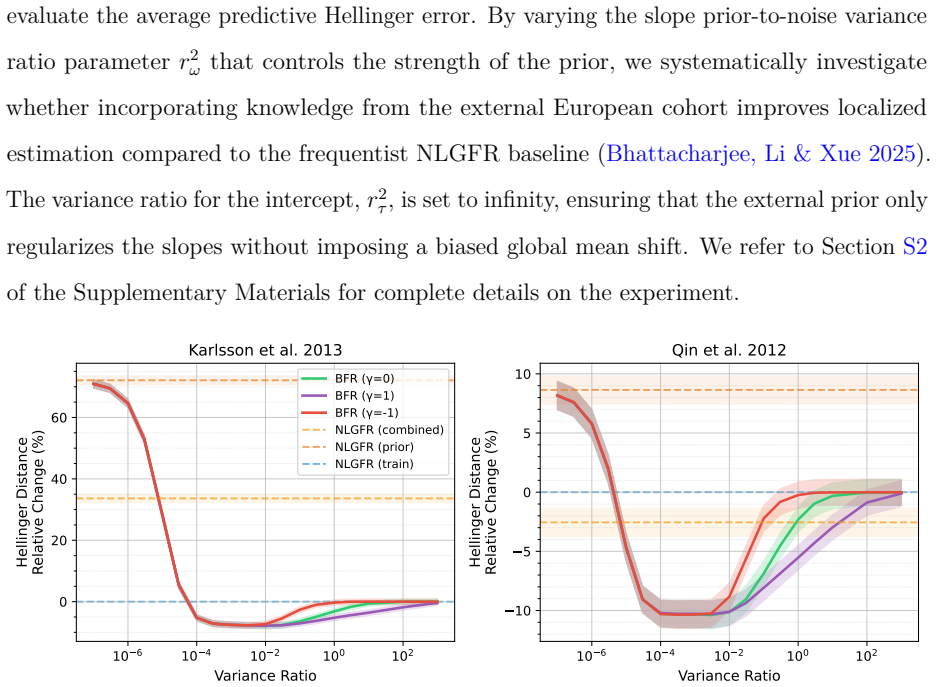
In the microbiome application, predictive performance on the target cohort would fail to improve when the auxiliary-cohort prior is used compared with the frequentist estimate alone.
Figures
read the original abstract
Fr\'echet regression provides a versatile framework for modeling responses in metric spaces with Euclidean predictors, yet current methodologies rely almost exclusively on frequentist approaches. We propose a Bayesian framework for Fr\'echet regression that offers a principled way of incorporating prior information into nonlinear global Fr\'echet regression. By targeting a novel Fr\'echet Bayes rule, we reduce the object-valued regression problem to a collection of tractable scalar regression tasks. Our approach allows for a controlled interpolation between the prior and the data-driven frequentist estimate, facilitating effective shrinkage toward informed values. While initially derived under Gaussian assumptions, we demonstrate that our framework is robust to model misspecification by establishing its validity under moment conditions via weak conditional expectations. The numerical properties of the proposed methodology are demonstrated in simulation studies and an application to microbiome compositional data, where we show that leveraging an auxiliary cohort to inform the prior significantly enhances predictive performance in a targeted, small-scale study
Editorial analysis
A structured set of objections, weighed in public.
Referee Report
Summary. The paper proposes a Bayesian framework for global Fréchet regression of metric-space responses on Euclidean predictors. It introduces a Fréchet Bayes rule that reduces the object-valued problem to a collection of scalar regression tasks, permitting controlled shrinkage between a prior and the frequentist Fréchet estimator. The method is first derived under Gaussian assumptions and then extended to validity under model misspecification by replacing ordinary conditional expectations with weak conditional expectations defined via moment conditions alone. Numerical performance is illustrated in simulations and a microbiome compositional-data application that uses an auxiliary cohort to inform the prior.
Significance. If the reduction to scalar tasks and the misspecification robustness both hold, the work would supply the first principled Bayesian procedure for global Fréchet regression, with practical value for small-sample prediction problems that can borrow strength from auxiliary data. The explicit interpolation between prior and data-driven estimates is a clear methodological contribution over existing frequentist Fréchet methods.
major comments (2)
- [§3.2] §3.2 (Weak conditional expectations and the Fréchet Bayes rule): The argument that the Fréchet mean defined by the weak conditional expectation coincides with the argmin of the integrated squared-distance functional rests on moment conditions alone. In a general metric space the squared-distance map need not be continuous or convex with respect to weak convergence; the manuscript does not supply the additional topological or convexity hypotheses that would justify interchanging the weak limit and the variational definition. Without this step the claimed validity under misspecification does not follow.
- [Theorem 3.1] Theorem 3.1 and the subsequent reduction to scalar regressions: The passage from the object-valued posterior Fréchet mean to a collection of independent scalar regressions is asserted after the weak-conditional-expectation construction. The proof sketch does not verify that the metric-space geometry is preserved once the full conditional law is replaced by its weak version; a counter-example in a non-Hilbert metric space would falsify the reduction.
minor comments (2)
- The notation for the weak conditional expectation operator is introduced without an explicit comparison to the ordinary conditional expectation; a short remark clarifying when the two coincide would aid readability.
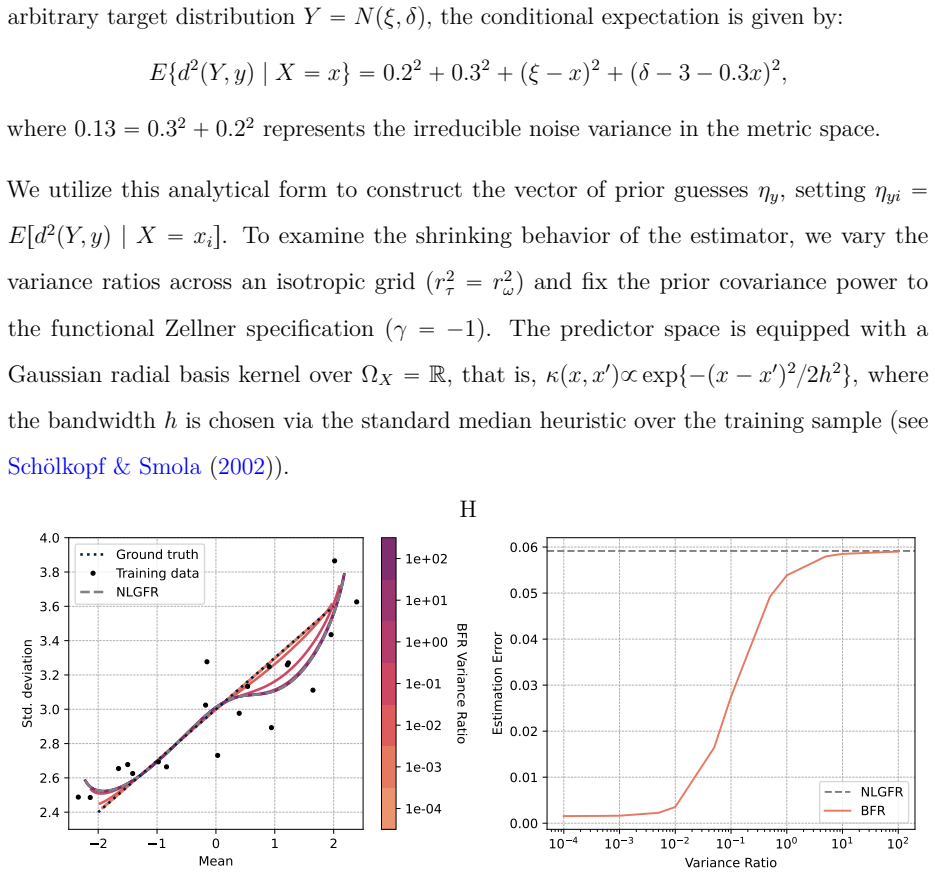
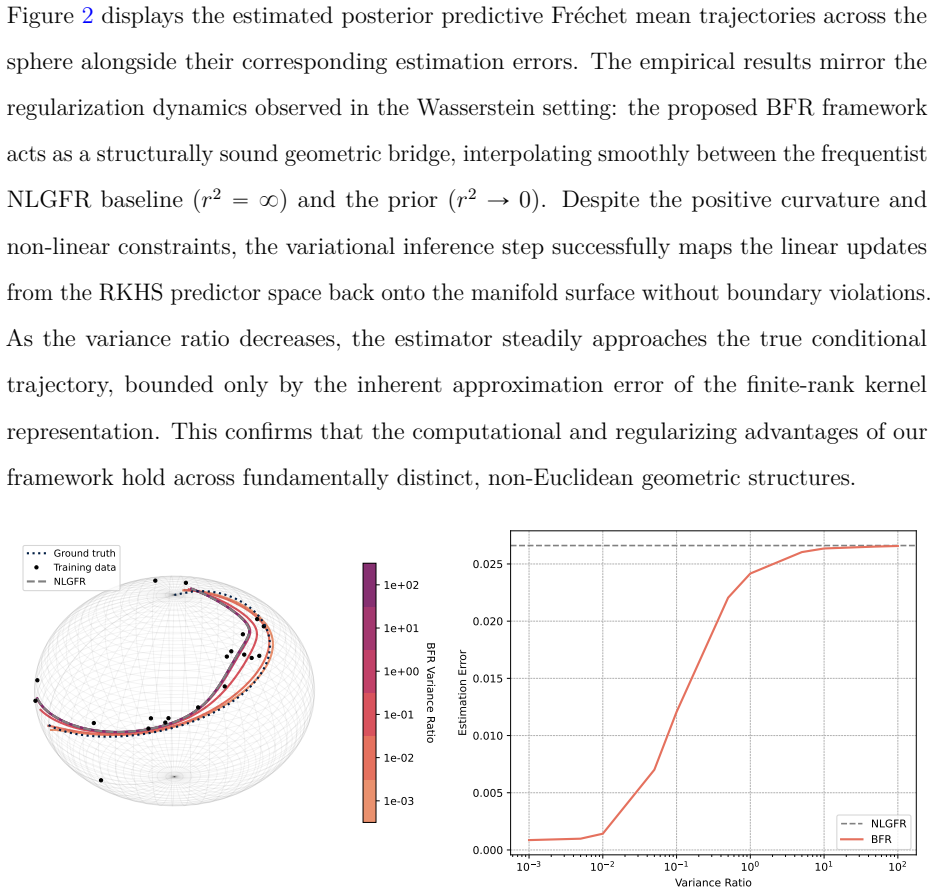
- Figure 2 (simulation results) reports point estimates but omits variability bands for the Bayesian versus frequentist estimators; adding these would strengthen the visual comparison.
Simulated Author's Rebuttal
We thank the referee for their constructive comments on our manuscript. We provide point-by-point responses to the major comments below, and we plan to incorporate clarifications in a revised version.
read point-by-point responses
-
Referee: [§3.2] §3.2 (Weak conditional expectations and the Fréchet Bayes rule): The argument that the Fréchet mean defined by the weak conditional expectation coincides with the argmin of the integrated squared-distance functional rests on moment conditions alone. In a general metric space the squared-distance map need not be continuous or convex with respect to weak convergence; the manuscript does not supply the additional topological or convexity hypotheses that would justify interchanging the weak limit and the variational definition. Without this step the claimed validity under misspecification does not follow.
Authors: We appreciate the referee pointing out this technical detail. Our construction of the weak conditional expectation is based on moment conditions, and the Fréchet mean is defined as the minimizer of the expected squared distance. In the paper, we implicitly rely on the properties of the metric space that ensure the necessary continuity for the interchange, as is common in Fréchet regression literature. However, to make this explicit, we will add a remark in Section 3.2 specifying the conditions (e.g., lower semi-continuity of the squared distance functional under weak convergence) under which the result holds. This will strengthen the justification for validity under misspecification. revision: partial
-
Referee: [Theorem 3.1] Theorem 3.1 and the subsequent reduction to scalar regressions: The passage from the object-valued posterior Fréchet mean to a collection of independent scalar regressions is asserted after the weak-conditional-expectation construction. The proof sketch does not verify that the metric-space geometry is preserved once the full conditional law is replaced by its weak version; a counter-example in a non-Hilbert metric space would falsify the reduction.
Authors: Regarding the reduction to scalar regressions in Theorem 3.1, the weak conditional expectation is designed such that the Fréchet Bayes rule decomposes the problem into scalar tasks while preserving the essential geometry through the moment conditions. The proof sketch in the manuscript outlines this decomposition. We disagree that a counter-example in a non-Hilbert space would necessarily falsify the reduction, as our framework is developed for general metric spaces where the Fréchet mean exists and the weak version maintains the variational property. Nevertheless, we will expand the proof in the revision to include a verification step showing that the geometry is preserved under the stated assumptions. revision: partial
Circularity Check
No circularity: derivation reduces object regression to scalar tasks via independent weak conditional expectation construction.
full rationale
The abstract and reader's summary indicate the Fréchet Bayes rule is a novel targeting construction that converts the metric-space problem into scalar regressions, with robustness shown under moment conditions. No quoted equation or self-citation chain reduces the central claim to a fitted input or prior self-result by definition. The reduction and misspecification validity are presented as derived results rather than tautological renamings or load-bearing self-citations. This is the expected non-finding for a paper whose core steps remain externally verifiable.
Axiom & Free-Parameter Ledger
axioms (1)
- domain assumption Validity of the Fréchet Bayes rule under moment conditions via weak conditional expectations
Reference graph
Works this paper leans on
-
[1]
arXiv preprint arXiv:2506.22754 , year=
Doubly robust estimation of causal effects for random object outcomes with continuous treatments , author=. arXiv preprint arXiv:2506.22754 , year=
-
[2]
Journal of Multivariate Analysis , volume=
Nonlinear sufficient dimension reduction for distribution-on-distribution regression , author=. Journal of Multivariate Analysis , volume=. 2024 , publisher=
2024
-
[3]
arXiv.org , author =
Variable. arXiv.org , author =
-
[4]
Reproducing kernel
Berlinet, Alain and Thomas-Agnan, Christine , year =. Reproducing kernel
-
[5]
Fréchet sufficient dimension reduction for random objects , volume =
Ying, Chao and Yu, Zhou , year =. Fréchet sufficient dimension reduction for random objects , volume =. Biometrika , publisher =
-
[6]
Causal inference on distribution functions , volume =
Lin, Zhenhua and Kong, Dehan and Wang, Linbo , year =. Causal inference on distribution functions , volume =. Journal of the Royal Statistical Society Series B , publisher =
-
[7]
Nonlinear sufficient dimension reduction for distribution-on-distribution regression , volume =
Zhang, Qi and Li, Bing and Xue, Lingzhou , year =. Nonlinear sufficient dimension reduction for distribution-on-distribution regression , volume =. Journal of Multivariate Analysis , publisher =
-
[8]
Doubly robust estimation of causal effects for random object outcomes with continuous treatments , journal =
Bhattacharjee, Satarupa and Li, Bing and Wu, Xiao and Xue, Lingzhou , year =. Doubly robust estimation of causal effects for random object outcomes with continuous treatments , journal =
-
[9]
Practical
Snoek, Jasper and Larochelle, Hugo and Adams, Ryan P , year =. Practical. Advances in
-
[10]
Automatic relevance determination for neural networks , journal =
MacKay, David JC and Neal, Radford M , year =. Automatic relevance determination for neural networks , journal =
-
[11]
Villani, Paolo and Unger, Jörg and Weiser, Martin , month = apr, year =. Adaptive. doi:10.48550/arXiv.2404.19459 , abstract =
-
[12]
Journal of Statistical Planning and Inference , author =
Bayesian variable selection using an adaptive powered correlation prior , volume =. Journal of Statistical Planning and Inference , author =. 2009 , keywords =
2009
-
[13]
Mulder, Joris , month = jan, year =. Bayesian. The American Statistician , publisher =. doi:10.1080/00031305.2022.2028675 , abstract =
work page internal anchor Pith review Pith/arXiv arXiv doi:10.1080/00031305.2022.2028675 2022
-
[14]
On assessing prior distributions and
Zellner, Arnold , year =. On assessing prior distributions and. Bayesian Inference and Decision Techniques , publisher =
-
[15]
, year =
ZELLNER, A. , year =. On assessing prior distributions and. Bayesian Inference and Decision techniques , publisher =
-
[16]
Zellner, Arnold , month = nov, year =. Optimal. The American Statistician , publisher =. doi:10.1080/00031305.1988.10475585 , abstract =
work page internal anchor Pith review Pith/arXiv arXiv doi:10.1080/00031305.1988.10475585 1988
-
[17]
Fong, C. H. E. , year =. The predictive view of
-
[18]
Dellaporta, Charita and Knoblauch, Jeremias and Damoulas, Theodoros and Briol, Francois-Xavier , month = may, year =. Robust. Proceedings of
-
[19]
Bayesian fractional posteriors , volume =
Bhattacharya, Anirban and Pati, Debdeep and Yang, Yun , month = feb, year =. Bayesian fractional posteriors , volume =. The Annals of Statistics , publisher =. doi:10.1214/18-AOS1712 , abstract =
-
[20]
Journal of the Royal Statistical Society Series B , author =
Martingale posterior distributions , volume =. Journal of the Royal Statistical Society Series B , author =. 2023 , pages =. doi:10.1093/jrsssb/qkad005 , abstract =
-
[22]
On the marginal likelihood and cross-validation , volume =. Biometrika , author =. 2020 , pages =. doi:10.1093/biomet/asz077 , abstract =
-
[23]
Assigning a value to a power likelihood in a general. Biometrika , author =. 2017 , pages =. doi:10.1093/biomet/asx010 , abstract =
-
[24]
Journal of the Royal Statistical Society Series B , author =
Robust. Journal of the Royal Statistical Society Series B , author =. 2022 , pages =. doi:10.1111/rssb.12500 , abstract =
-
[25]
Journal of the Royal Statistical Society Series A: Statistics in Society , author =
Beyond. Journal of the Royal Statistical Society Series A: Statistics in Society , author =. 2017 , pages =. doi:10.1111/rssa.12276 , abstract =
-
[26]
Grünwald, Peter and Ommen, Thijs van , month = dec, year =. Inconsistency of. Bayesian Analysis , publisher =. doi:10.1214/17-BA1085 , abstract =
-
[28]
Journal of Machine Learning Research , author =
On the properties of variational approximations of. Journal of Machine Learning Research , author =. 2016 , pages =
2016
-
[29]
Journal of Machine Learning Research , author =
The. Journal of Machine Learning Research , author =. 2023 , pages =
2023
-
[30]
Journal of Machine Learning Research , author =
An. Journal of Machine Learning Research , author =. 2022 , pages =
2022
-
[31]
and Drovandi, Christopher and Frazier, David T
Nott, David J. and Drovandi, Christopher and Frazier, David T. , month = apr, year =. Bayesian. Annual Review of Statistics and Its Application , publisher =. doi:10.1146/annurev-statistics-040522-015915 , abstract =
-
[33]
Farquhar, Greg and Baumli, Kate and Marinho, Zita and Filos, Angelos and Hessel, Matteo and van Hasselt, Hado P and Silver, David , year =. Self-. Advances in
-
[34]
Self-consistency: a fundamental concept in statistics , volume =
Flury, Bernard and Tarpey, Thaddeus , month = sep, year =. Self-consistency: a fundamental concept in statistics , volume =. Statistical Science , publisher =. doi:10.1214/ss/1032280215 , abstract =
-
[35]
Single. Statistical. 2019 , note =. doi:10.1002/9781119482260.ch4 , abstract =
-
[36]
Models for. Statistical. 2019 , note =. doi:10.1002/9781119482260.ch12 , abstract =
-
[37]
Bayes and. Statistical. 2019 , note =. doi:10.1002/9781119482260.ch10 , abstract =
-
[38]
Maximum. Statistical. 2019 , note =. doi:10.1002/9781119482260.ch8 , abstract =
-
[39]
Large-. Statistical. 2019 , note =. doi:10.1002/9781119482260.ch9 , abstract =
-
[40]
Maximum likelihood estimation via the. Biometrika , author =. 1993 , pages =. doi:10.1093/biomet/80.2.267 , abstract =
-
[41]
A view of the
Neal, Radford M and Hinton, Geoffrey E , year =. A view of the. Learning in graphical models , publisher =
-
[42]
The Annals of Statistics , author =
Nonlinear global. The Annals of Statistics , author =. 2025 , keywords =. doi:10.1214/24-AOS2457 , number =
-
[43]
Comprehensive database for food-gut microbiota-disease interactions (. Food Bioscience , author =. 2024 , keywords =. doi:10.1016/j.fbio.2024.104091 , urldate =
-
[44]
Metagenomic analysis of faecal microbiome as a tool towards targeted non-invasive biomarkers for colorectal cancer , volume =. Gut , author =. 2017 , keywords =. doi:10.1136/gutjnl-2015-309800 , language =
-
[45]
The Annals of Statistics , author =
Conformal inference for random objects , volume =. The Annals of Statistics , author =. 2025 , keywords =. doi:10.1214/25-AOS2495 , number =
-
[46]
Journal of Computational and Graphical Statistics , author =
Kernel. Journal of Computational and Graphical Statistics , author =. 2005 , keywords =. doi:10.1198/106186005X25619 , number =
-
[47]
Importance
Xu, Liyuan and Chen, Yutian and Doucet, Arnaud and Gretton, Arthur , month = jun, year =. Importance. Proceedings of the 39th
-
[48]
Dimension Reduction for. Journal of the American Statistical Association , author =. 2024 , keywords =. doi:10.1080/01621459.2023.2277406 , number =
-
[49]
, year =
Yi, Grace Y. , year =. Composite. Wiley
-
[50]
Xu, Haoshu and Li, Hongzhe , month = apr, year =. Wasserstein. doi:10.48550/arXiv.2404.03878 , urldate =
-
[51]
Nucleic Acids Research , author =. 2021 , pages =. doi:10.1093/nar/gkaa851 , number =
-
[52]
World Journal of Methodology , author =
Update on the gut microbiome in health and diseases , volume =. World Journal of Methodology , author =. 2024 , pages =. doi:10.5662/wjm.v14.i1.89196 , number =
-
[53]
Steinwart, Ingo , month = mar, year =. When does a. doi:10.48550/arXiv.2407.11898 , urldate =
-
[54]
Statistical science : a review journal of the Institute of Mathematical Statistics , author =
Variable. Statistical science : a review journal of the Institute of Mathematical Statistics , author =. 2011 , pages =. doi:10.1214/11-STS354 , number =
-
[55]
The Journal of Experimental Medicine , author =
Squamous cell carcinoma subverts adjacent histologically normal epithelium to promote lateral invasion , volume =. The Journal of Experimental Medicine , author =. 2021 , keywords =. doi:10.1084/jem.20200944 , language =
-
[56]
Information theoretic generalized. Bioinformatics , author =. 2020 , pages =. doi:10.1093/bioinformatics/btaa614 , number =
-
[57]
Wahba, Grace and Gu, Chong and Wang, Yuedong and Chappell, Richard , year =. Soft. The
-
[58]
Conditional
Sugiyama, Masashi and Takeuchi, Ichiro and Suzuki, Taiji and Kanamori, Takafumi and Hachiya, Hirotaka and Okanohara, Daisuke , month = mar, year =. Conditional. Proceedings of the
-
[59]
Annals of the Institute of Statistical Mathematics , author =
Direct importance estimation for covariate shift adaptation , volume =. Annals of the Institute of Statistical Mathematics , author =. 2008 , pages =. doi:10.1007/s10463-008-0197-x , language =
-
[60]
Annals of the Institute of Statistical Mathematics , author =
Density-ratio matching under the. Annals of the Institute of Statistical Mathematics , author =. 2012 , pages =. doi:10.1007/s10463-011-0343-8 , language =
-
[61]
Song, Le and Huang, Jonathan and Smola, Alex and Fukumizu, Kenji , month = jun, year =. Hilbert space embeddings of conditional distributions with applications to dynamical systems , isbn =. Proceedings of the 26th. doi:10.1145/1553374.1553497 , urldate =
-
[62]
IEEE Signal Processing Magazine , author =
Kernel. IEEE Signal Processing Magazine , author =. 2013 , keywords =. doi:10.1109/MSP.2013.2252713 , number =
-
[63]
Shimizu, Eiki and Fukumizu, Kenji and Sejdinovic, Dino , month = mar, year =. Neural-. doi:10.48550/arXiv.2403.10859 , urldate =
-
[64]
Hypothesis testing using pairwise distances and associated kernels (with Appendix)
Sejdinovic, Dino and Gretton, Arthur and Sriperumbudur, Bharath and Fukumizu, Kenji , month = may, year =. Hypothesis testing using pairwise distances and associated kernels (with. doi:10.48550/arXiv.1205.0411 , urldate =
work page internal anchor Pith review Pith/arXiv arXiv doi:10.48550/arxiv.1205.0411
-
[65]
Can’t. Technometrics , author =. 2021 , keywords =. doi:10.1080/00401706.2020.1791254 , number =
-
[66]
Proceedings of the IEEE , author =
Taking the. Proceedings of the IEEE , author =. 2016 , keywords =. doi:10.1109/JPROC.2015.2494218 , number =
-
[67]
International Journal of Neural Systems , author =
Gaussian processes for machine learning , volume =. International Journal of Neural Systems , author =. 2004 , keywords =. doi:10.1142/S0129065704001899 , number =
-
[68]
Rossi, Simone and Heinonen, Markus and Bonilla, Edwin and Shen, Zheyang and Filippone, Maurizio , month = mar, year =. Sparse. Proceedings of
-
[69]
Variational
Titsias, Michalis , month = apr, year =. Variational. Proceedings of the
-
[70]
Communications in Statistics - Theory and Methods , author =
Fiducial and. Communications in Statistics - Theory and Methods , author =. 2015 , keywords =. doi:10.1080/03610926.2013.823207 , number =
-
[71]
Ventura, Laura and Racugno, Walter , editor =. Pseudo-. Topics on. 2016 , keywords =. doi:10.1007/978-3-319-44093-4_19 , language =
-
[72]
Statistica Sinica , author =
An. Statistica Sinica , author =. 2011 , pages =
2011
-
[73]
Journal of Machine Learning for Modeling and Computing , author =
A. Journal of Machine Learning for Modeling and Computing , author =. 2020 , keywords =. doi:10.1615/JMachLearnModelComput.2020035155 , number =
-
[74]
and Fan, Yanan and Beaumont, Mark , month = sep, year =
Sisson, Scott A. and Fan, Yanan and Beaumont, Mark , month = sep, year =. Handbook of
-
[75]
Tony and Guo, Zijian and Ma, Rong , month = apr, year =
Variable Selection for Global. Journal of the American Statistical Association , author =. 2023 , keywords =. doi:10.1080/01621459.2021.1969240 , number =
-
[76]
Journal of Microbiology , author =
Machine learning methods for microbiome studies , volume =. Journal of Microbiology , author =. 2020 , keywords =. doi:10.1007/s12275-020-0066-8 , language =
-
[77]
Human microbiome research:. PLOS Biology , author =. 2023 , keywords =. doi:10.1371/journal.pbio.3002053 , language =
-
[78]
Nature Communications , author =
Microbiome differential abundance methods produce different results across 38 datasets , volume =. Nature Communications , author =. 2022 , keywords =. doi:10.1038/s41467-022-28034-z , language =
-
[79]
Identifying biases and their potential solutions in human microbiome studies , volume =. Microbiome , author =. 2021 , keywords =. doi:10.1186/s40168-021-01059-0 , number =
-
[80]
Accessible, curated metagenomic data through. Nature Methods , author =. 2017 , pages =. doi:10.1038/nmeth.4468 , language =
-
[81]
A metagenome-wide association study of gut microbiota in type 2 diabetes , volume =. Nature , author =. 2012 , keywords =. doi:10.1038/nature11450 , language =
-
[82]
Scandinavian Journal of Statistics , author =
Bayesian. Scandinavian Journal of Statistics , author =. 2003 , keywords =. doi:10.1111/1467-9469.00349 , language =
-
[83]
Journal of the Royal Statistical Society Series B , author =
A Note on Least-Squares Approximation in the Bayesian Analysis of Regression Models , volume =. Journal of the Royal Statistical Society Series B , author =. 1984 , pages =. doi:10.1111/j.2517-6161.1984.tb01285.x , number =
discussion (0)
Sign in with ORCID, Apple, or X to comment. Anyone can read and Pith papers without signing in.