Effective Bayesian ranking of low order monomial potentials in low temperature warm inflation
Pith reviewed 2026-06-27 19:43 UTC · model grok-4.3
The pith
Quartic monomial potential is preferred over quadratic and cubic in Bayesian evidence ranking for low-temperature warm inflation.
A machine-rendered reading of the paper's core claim, the machinery that carries it, and where it could break.
Core claim
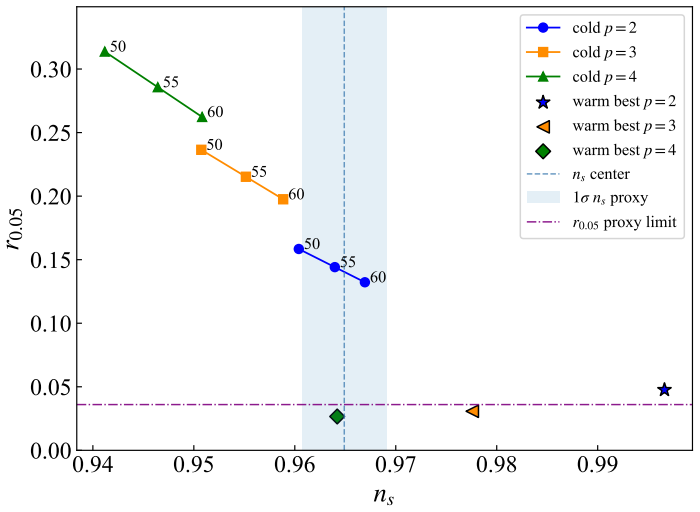
Within the low-temperature warm inflation class with the dissipative coefficient fixed as Υ = C_φ T³/φ², the quartic monomial V_4(φ) = λ_4 φ^4/4 yields the largest effective evidence Z_eff when the broadened compressed likelihood for (A_s, n_s, r_0.05) is integrated over structure-conditioned priors covering viable warm branches; the quadratic and cubic branches are disfavored by Δln Z_eff(p=2) = -32.18 and Δln Z_eff(p=3) = -6.99, establishing the stable hierarchy p=4 > p=3 ≫ p=2.
What carries the argument
Effective evidence Z_eff obtained by integrating the broadened compressed likelihood for (A_s, n_s, r_0.05) over the prior volume after solving the warm background equations that include radiation backreaction.
If this is right
- The quartic branch is favored once A_s, n_s, r_0.05 and viable parameter volume are considered simultaneously.
- The evidence hierarchy p=4 > p=3 ≫ p=2 remains unchanged under shifts in N_*, prior ranges, random seeds, and r bound treatment.
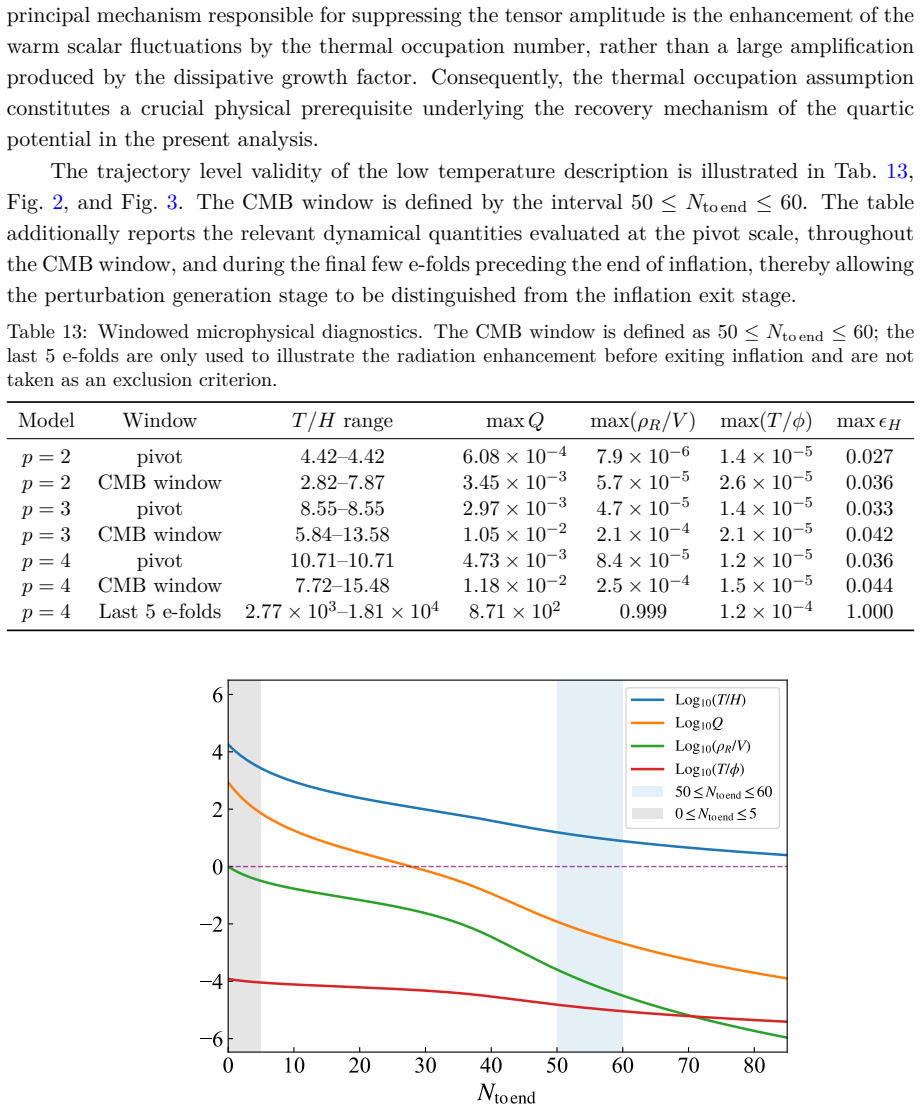
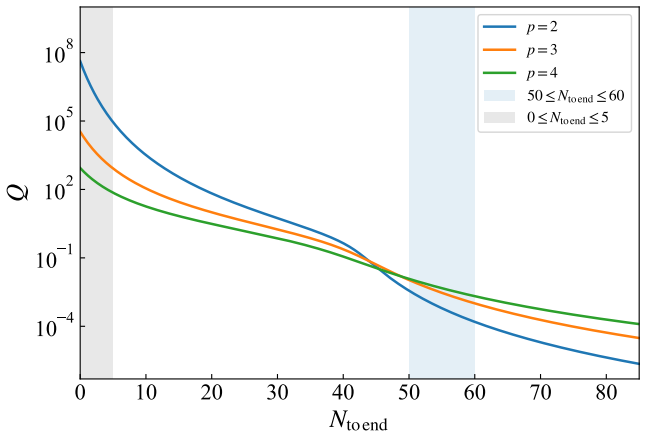
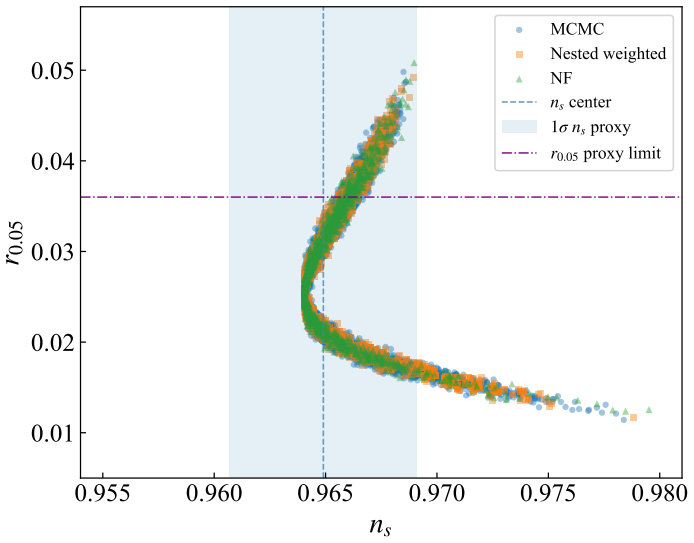
- Representative quartic trajectories achieve n_s=0.96420, r_0.05=0.02663, Q_*=4.68 imes10^{-3}, T_*/H_*=10.67 inside a weakly dissipative but thermally occupied window.
- The quartic preference is driven mainly by Bose-Einstein occupation enhancement for T_*/H_*>1 rather than by strong dissipative friction.
Where Pith is reading between the lines
- Testing other explicit forms of the dissipative coefficient could change which monomial is ranked highest.
- The structure-conditioned prior approach used here could be applied to rank other classes of inflationary models.
- Future tightening of the r upper bound would provide an independent check on the stability of the p=4 preference.
- The finding that thermal effects rather than friction drive the ranking suggests examining the same potentials in the strong-dissipation regime.
Load-bearing premise
The dissipative coefficient is fixed exactly as Υ = C_φ T³/φ² and the priors are restricted to structure-conditioned viable warm branches.
What would settle it
A recomputation with a different functional form for the dissipative coefficient that reverses or erases the evidence hierarchy among p=2,3,4 would falsify the reported ranking.
Figures
read the original abstract
An effective Bayesian evidence ranking is performed for the monomial potentials \(V_p(\phi)=\lambda_p\phi^p/p\), with \(p=2,3,4\), in low temperature warm inflation with the dissipative coefficient fixed as \(\Upsilon=C_\phi T^3/\phi^2\). In cold single field slow roll inflation, these branches are strongly constrained by the observational upper bound on the tensor to scalar ratio \(r=\mathcal P_T/\mathcal P_{\mathcal R}\), whereas warm inflation can reduce this tension by enhancing the scalar spectrum. The relevant question is therefore which monomial power is favored once \(A_s\), \(n_s\), \(r_{0.05}\), and the viable parameter volume are considered simultaneously. For each branch, the warm background equations including radiation backreaction are solved, and a broadened compressed likelihood for \((A_s,n_s,r_{0.05})\) is integrated over the prior volume to obtain \(Z_{\rm eff}^{(A_s,n_s,r)}\). For \(N_*=55\), \(\sigma_r=0.005\), and structure conditioned priors covering viable warm branches, the quadratic and cubic potentials are disfavored relative to the quartic branch: $\Delta\ln Z_{\rm eff}(p=2)=-32.18,~ \Delta\ln Z_{\rm eff}(p=3)=-6.99.$ This hierarchy is stable under changes in \(N_*\), prior ranges, random seeds, and the $r$ bound treatment. A representative quartic trajectory gives \(n_s=0.96420\), \(r_{0.05}=0.02663\), \(Q_*=4.68\times10^{-3}\), and \(T_*/H_*=10.67\), corresponding to a weakly dissipative but thermally occupied CMB window. Decomposing the primordial spectrum shows that the quartic preference is driven mainly by Bose Einstein occupation enhancement for \(T_*/H_*>1\), not by strong dissipative friction. Within the low temperature dissipative effective class and compressed likelihood adopted here, the evidence hierarchy is \(p=4>p=3\gg p=2.\)
Editorial analysis
A structured set of objections, weighed in public.
Referee Report
Summary. The paper performs an effective Bayesian evidence ranking for monomial potentials V_p(φ)=λ_p φ^p / p with p=2,3,4 in low-temperature warm inflation, fixing the dissipative coefficient as Υ=C_φ T^3/φ². Background equations including radiation backreaction are solved numerically for each branch; a broadened compressed likelihood for (A_s, n_s, r_0.05) is integrated over structure-conditioned priors on viable warm trajectories to obtain Z_eff. For N_*=55 and σ_r=0.005 the results are Δln Z_eff(p=2)=-32.18 and Δln Z_eff(p=3)=-6.99, establishing the hierarchy p=4 > p=3 ≫ p=2. The preference is attributed primarily to Bose-Einstein occupation enhancement for T_*/H_*>1 rather than strong dissipation.
Significance. If the numerical results hold, the work supplies a concrete, volume-weighted evidence comparison among the simplest monomial potentials inside the low-temperature warm-inflation class, incorporating both CMB constraints and the measure of viable trajectories. The explicit decomposition of the spectrum into thermal versus dissipative contributions is a useful diagnostic. The adoption of structure-conditioned priors that restrict the integration to physically viable warm branches is a methodological strength that avoids inflating the prior volume with unphysical regions.
major comments (2)
- [Abstract] Abstract (model definition): the dissipative coefficient is fixed exactly as Υ=C_φ T³/φ² and no alternative functional forms (e.g., Υ∝T or Υ∝φ T) are examined. Because the background evolution, the values of Q_* and T_*/H_*, the radiation back-reaction, and therefore the mapping from (C_φ, λ_p) to the observables (A_s, n_s, r) all depend on the precise Υ(φ,T) dependence, the reported Δln Z_eff values and the resulting hierarchy are conditional on this single choice; a different form would alter both the likelihood integrand and the volume of viable trajectories.
- [Evidence calculation section] Evidence calculation section: the manuscript states that the hierarchy is stable under changes in N_*, prior ranges, random seeds and r-bound treatment, yet provides no quantitative diagnostics (step-size convergence, integrator tolerances, Monte-Carlo sampling convergence, or explicit validation of the broadened compressed likelihood) for the numerical integration of the background equations or the evidence integral. Given that the central quantitative claims are the specific large Δln Z_eff differences obtained from these integrations, such tests are required to establish that the reported numbers are not sensitive to numerical artifacts.
minor comments (1)
- [Methods] The notation Z_eff^{(A_s,n_s,r)} is introduced without an explicit equation defining the broadened compressed likelihood; a short equation or reference to the precise form of the compression would improve clarity.
Simulated Author's Rebuttal
We thank the referee for the thorough review and valuable feedback on our manuscript. We address each major comment below and will make the necessary revisions to strengthen the paper.
read point-by-point responses
-
Referee: [Abstract] Abstract (model definition): the dissipative coefficient is fixed exactly as Υ=C_φ T³/φ² and no alternative functional forms (e.g., Υ∝T or Υ∝φ T) are examined. Because the background evolution, the values of Q_* and T_*/H_*, the radiation back-reaction, and therefore the mapping from (C_φ, λ_p) to the observables (A_s, n_s, r) all depend on the precise Υ(φ,T) dependence, the reported Δln Z_eff values and the resulting hierarchy are conditional on this single choice; a different form would alter both the likelihood integrand and the volume of viable trajectories.
Authors: We agree with the referee that our results are conditional on the specific form of the dissipative coefficient Υ = C_φ T³/φ². This choice is standard for the low-temperature warm inflation regime considered in the literature. In the revised manuscript, we will modify the abstract and add a statement in the introduction to explicitly note that the evidence ranking applies to this functional form and that other dependencies may lead to different hierarchies. We view this as a clarification rather than a change in scope. revision: yes
-
Referee: [Evidence calculation section] Evidence calculation section: the manuscript states that the hierarchy is stable under changes in N_*, prior ranges, random seeds and r-bound treatment, yet provides no quantitative diagnostics (step-size convergence, integrator tolerances, Monte-Carlo sampling convergence, or explicit validation of the broadened compressed likelihood) for the numerical integration of the background equations or the evidence integral. Given that the central quantitative claims are the specific large Δln Z_eff differences obtained from these integrations, such tests are required to establish that the reported numbers are not sensitive to numerical artifacts.
Authors: The referee correctly identifies that while we reported stability under variations in N_*, priors, seeds, and r treatment, we did not provide detailed quantitative diagnostics for the numerical methods. We will add these in the revised version, including tests for step-size convergence in the background solver, integrator tolerance settings, Monte Carlo convergence metrics such as effective sample sizes for the evidence integral, and validation of the broadened compressed likelihood implementation. These additions will be placed in a new appendix or subsection to confirm the robustness of the Δln Z_eff values. revision: yes
Circularity Check
No circularity; Z_eff computed from external CMB likelihood over model priors
full rationale
The paper solves the warm inflation background equations for each monomial branch under the fixed Υ form, then integrates an external compressed likelihood for (A_s, n_s, r_0.05) over the prior volume to obtain Z_eff. This is standard Bayesian evidence calculation against independent observational constraints; the resulting Δln Z_eff values follow directly from the data mapping rather than any self-definitional reduction, fitted input renamed as prediction, or load-bearing self-citation. The Υ choice is an explicit assumption whose sensitivity is noted but does not render the derivation circular by construction.
Axiom & Free-Parameter Ledger
free parameters (2)
- C_φ
- structure-conditioned prior ranges
axioms (2)
- domain assumption The dissipative coefficient takes the exact form Υ = C_φ T³/φ² throughout the evolution.
- domain assumption The broadened compressed likelihood for (A_s, n_s, r_0.05) faithfully represents current observational constraints.
Reference graph
Works this paper leans on
-
[1]
The Inflationary Universe: A Possible Solution to the Horizon and Flatness Problems,
A. H. Guth,“The Inflationary Universe: A Possible Solution to the Horizon and Flatness Problems,” Phys. Rev. D 23, 347-356 (1981)
1981
-
[2]
A New Inflationary Universe Scenario: A Possible Solution of the Horizon, Flatness, Homogeneity, Isotropy and Primordial Monopole Problems,
A. D. Linde,“A New Inflationary Universe Scenario: A Possible Solution of the Horizon, Flatness, Homogeneity, Isotropy and Primordial Monopole Problems,” Phys. Lett. B 108, 389-393 (1982)
1982
-
[3]
Cosmology for Grand Unified Theories with Radiatively Induced Symmetry Breaking,
A. Albrecht and P. J. Steinhardt,“Cosmology for Grand Unified Theories with Radiatively Induced Symmetry Breaking,” Phys. Rev. Lett. 48, 1220-1223 (1982)
1982
-
[4]
Particle physics models of inflation and the cosmological density perturbation,
D. H. Lyth and A. Riotto,“Particle physics models of inflation and the cosmological density perturbation,” Phys. Rept. 314, 1-146 (1999)
1999
-
[5]
D. Baumann,“Inflation,” arXiv:0907.5424
work page internal anchor Pith review Pith/arXiv arXiv
-
[6]
An analytic approach to non-slow-roll inflation,
G. Tasinato,“An analytic approach to non-slow-roll inflation,” Phys. Rev. D 103, no.2, 023535 (2021)
2021
-
[7]
Power-counting during single-field slow-roll inflation,
P. Adshead, C. P. Burgess, R. Holman and S. Shandera,“Power-counting during single-field slow-roll inflation,” JCAP 02, 016 (2018)
2018
-
[8]
Single field slow-roll inflation with step uplift to $n_s=1$
H. S. Yuan, Z. Y. Peng and Y. S. Piao,“Single field slow-roll inflation with step uplift to ns = 1,” arXiv:2604.02823 [astro-ph.CO]
work page internal anchor Pith review Pith/arXiv arXiv
-
[9]
Gravitational Wave Spectrum Induced by Primordial Scalar Perturbations,
D. Baumann, P. J. Steinhardt, K. Takahashi and K. Ichiki,“Gravitational Wave Spectrum Induced by Primordial Scalar Perturbations,” Phys. Rev. D 76, 084019 (2007)
2007
-
[10]
Planck 2018 results. X. Constraints on inflation,
Y. Akrami et al. [Planck],“Planck 2018 results. X. Constraints on inflation,” Astron. As- trophys. 641, A10 (2020)
2018
-
[11]
Improved Constraints on Primordial Gravitational Waves using Planck, WMAP, and BICEP/Keck Observations through the 2018 Observing Season,
P. A. R. Ade et al. [BICEP and Keck],“Improved Constraints on Primordial Gravitational Waves using Planck, WMAP, and BICEP/Keck Observations through the 2018 Observing Season,” Phys. Rev. Lett. 127, no.15, 151301 (2021)
2018
-
[12]
Planck 2018 results. I. Overview and the cosmological legacy of Planck,
N. Aghanim et al. [Planck],“Planck 2018 results. I. Overview and the cosmological legacy of Planck,” Astron. Astrophys. 641, A1 (2020)
2018
-
[13]
Constraining chameleon field driven warm inflation with Planck 2018 data,
H. Sheikhahmadi, A. Mohammadi, A. Aghamohammadi, T. Harko, R. Herrera, C. Corda, A. Abebe and K. Saaidi,“Constraining chameleon field driven warm inflation with Planck 2018 data,” Eur. Phys. J. C 79, no.12, 1038 (2019)
2018
-
[14]
Chaotic Inflation,
A. D. Linde,“Chaotic Inflation,” Phys. Lett. B 129, 177-181 (1983)
1983
-
[15]
Dynamical fractional chaotic infla- tion,
K. Harigaya, M. Ibe, K. Schmitz and T. T. Yanagida,“Dynamical fractional chaotic infla- tion,” Phys. Rev. D 90, no.12, 123524 (2014)
2014
-
[16]
Power-law and intermediate inflationary models in f(T)-gravity,
K. Rezazadeh, A. Abdolmaleki and K. Karami,“Power-law and intermediate inflationary models in f(T)-gravity,” JHEP 01, 131 (2016)
2016
-
[17]
Preinflationary dynamics in loop quantum cosmology: Power-law potentials,
M. Shahalam, M. Sharma, Q. Wu and A. Wang,“Preinflationary dynamics in loop quantum cosmology: Power-law potentials,” Phys. Rev. D 96, no.12, 123533 (2017) . 31
2017
-
[18]
Radiative plateau inflation,
G. Ballesteros and C. Tamarit,“Radiative plateau inflation,” JHEP 02, 153 (2016)
2016
-
[19]
The importance of being warm (during inflation),
S. Bartrum, M. Bastero-Gil, A. Berera, R. Cerezo, R. O. Ramos and J. G. Rosa,“The importance of being warm (during inflation),” Phys. Lett. B 732, 116-121 (2014)
2014
-
[20]
Warm Inflation and its Microphysical Basis,
A. Berera, I. G. Moss and R. O. Ramos,“Warm Inflation and its Microphysical Basis,” Rept. Prog. Phys. 72, 026901 (2009)
2009
-
[21]
The Warm Inflation Story,
A. Berera,“The Warm Inflation Story,” Universe 9, no.6, 272 (2023)
2023
-
[22]
Recent Developments in Warm Inflation,
V. Kamali, M. Motaharfar and R. O. Ramos,“Recent Developments in Warm Inflation,” Universe 9, no.3, 124 (2023)
2023
-
[23]
Scalar perturbation spectra from warm inflation,
L. M. H. Hall, I. G. Moss and A. Berera,“Scalar perturbation spectra from warm inflation,” Phys. Rev. D 69, 083525 (2004)
2004
-
[24]
Density fluctuations from warm inflation,
C. Graham and I. G. Moss,“Density fluctuations from warm inflation,” JCAP 07, 013 (2009)
2009
-
[25]
Power spectrum for inflation models with quantum and thermal noises,
R. O. Ramos and L. A. da Silva,“Power spectrum for inflation models with quantum and thermal noises,” JCAP 03, 032 (2013)
2013
-
[26]
WarmSPy: a numerical study of cosmological perturbations in warm inflation,
G. Montefalcone, V. Aragam, L. Visinelli and K. Freese,“WarmSPy: a numerical study of cosmological perturbations in warm inflation,” JCAP 01, 032 (2024)
2024
-
[27]
Nonminimally-coupled warm Higgs inflation: Metric vs. Palatini formulations,
T. Eadkhong, P. Dam-O, P. Channuie and D. Momeni,“Nonminimally-coupled warm Higgs inflation: Metric vs. Palatini formulations,” Nucl. Phys. B 994, 116289 (2023)
2023
-
[28]
Minimal warm Higgs inflation in Palatini R2 gravity,
J. Yuennan, R. Myrzakulov, P. K. Sahoo, F. Atamurotov and P. Channuie,“Minimal warm Higgs inflation in Palatini R2 gravity,” Eur. Phys. J. C 85, no.9, 972 (2025)
2025
-
[29]
Exploring the impact of the dissipation coefficient in warm Higgs inflation,
W. Cheng, X. W. Chen, R. Zhou, J. J. Jiang, X. R. Dai, Z. H. Zhang and T. Qin,“Exploring the impact of the dissipation coefficient in warm Higgs inflation,” Phys. Rev. D 109, no.8, 083509 (2024)
2024
-
[30]
Dissipation coefficients for supersymmetric inflatonary models
I. G. Moss and C. Xiong,“Dissipation coefficients for supersymmetric inflatonary models,” arXiv:hep-ph/0603266
work page internal anchor Pith review Pith/arXiv arXiv
-
[31]
Warm inflation dynamics in the low temperature regime,
M. Bastero-Gil and A. Berera,“Warm inflation dynamics in the low temperature regime,” Phys. Rev. D 76, 043515 (2007)
2007
-
[32]
Warm inflation model building,
M. Bastero-Gil and A. Berera,“Warm inflation model building,” Int. J. Mod. Phys. A 24, 2207-2240 (2009)
2009
-
[33]
General dissipation coefficient in low-temperature warm inflation,
M. Bastero-Gil, A. Berera, R. O. Ramos and J. G. Rosa,“General dissipation coefficient in low-temperature warm inflation,” JCAP 01, 016 (2013)
2013
-
[34]
Warm Little Inflaton,
M. Bastero-Gil, A. Berera, R. O. Ramos and J. G. Rosa,“Warm Little Inflaton,” Phys. Rev. Lett. 117, no.15, 151301 (2016)
2016
-
[35]
Warm inflation within a supersymmetric distributed mass model,
M. Bastero-Gil, A. Berera, R. Hernández-Jiménez and J. G. Rosa,“Warm inflation within a supersymmetric distributed mass model,” Phys. Rev. D 99, no.10, 103520 (2019) . 32
2019
-
[36]
Minimal Warm Inflation,
K. V. Berghaus, P. W. Graham and D. E. Kaplan,“Minimal Warm Inflation,” JCAP 03, 034 (2020)
2020
-
[37]
Warm Inflation with the Standard Model,
K. V. Berghaus, M. Drewes and S. Zell,“Warm Inflation with the Standard Model,” Phys. Rev. Lett. 135, no.17, 171002 (2025)
2025
-
[38]
Warming up for Planck,
S. Bartrum, A. Berera and J. G. Rosa,“Warming up for Planck,” JCAP 06, 025 (2013)
2013
-
[39]
Warm inflation dissipative effects: predictions and constraints from the Planck data,
M. Benetti and R. O. Ramos,“Warm inflation dissipative effects: predictions and constraints from the Planck data,” Phys. Rev. D 95, no.2, 023517 (2017)
2017
-
[40]
Constraining Warm Inflation with CMB data,
M. Bastero-Gil, S. Bhattacharya, K. Dutta and M. R. Gangopadhyay,“Constraining Warm Inflation with CMB data,” JCAP 02, 054 (2018)
2018
-
[41]
Revisiting CMB con- straints on warm inflation,
R. Arya, A. Dasgupta, G. Goswami, J. Prasad and R. Rangarajan,“Revisiting CMB con- straints on warm inflation,” JCAP 02, 043 (2018)
2018
-
[42]
Warm Inflation With A General Form Of The Dissipative Coefficient,
Y. Zhang,“Warm Inflation With A General Form Of The Dissipative Coefficient,” JCAP 03, 023 (2009)
2009
-
[43]
A comparative analysis of dissipation coefficients in warm inflation,
F. B. M. d. Santos, R. de Souza and J. S. Alcaniz,“A comparative analysis of dissipation coefficients in warm inflation,” JCAP 10, 071 (2024)
2024
-
[44]
Comparison of Effective Dissipation Channels in Warm Higgs Inflation from Warm Background Evolution
W. Cheng, X. Peng, J. w. Zhang, R. Zhou and Y. Pan,“Comparison of Effective Dissipation Channels in Warm Higgs Inflation from Warm Background Evolution,” arXiv:2604.17467
work page internal anchor Pith review Pith/arXiv arXiv
-
[45]
Observational Constraints on Monomial Warm Inflation,
L. Visinelli,“Observational Constraints on Monomial Warm Inflation,” JCAP 07, 054 (2016)
2016
-
[46]
Monomial warm inflation revisited,
G. Ballesteros, A. Perez Rodriguez and M. Pierre,“Monomial warm inflation revisited,” JCAP 03, 003 (2024)
2024
-
[47]
Evolution of coupled scalar perturbations through smooth reheating. Part II. Thermal fluctuation regime,
M. Laine, S. Procacci and A. Rogelj,“Evolution of coupled scalar perturbations through smooth reheating. Part II. Thermal fluctuation regime,” JCAP 12, 058 (2025)
2025
-
[48]
Warm multi-natural inflation,
A. Ito and R. O. Ramos,“Warm multi-natural inflation,” JCAP 08, 076 (2025)
2025
-
[49]
Warm β- exponential inflation and the swampland conjectures,
F. B. M. d. Santos, R. Silva, S. S. da Costa, M. Benetti and J. S. Alcaniz,“Warm β- exponential inflation and the swampland conjectures,” Eur. Phys. J. C 83, no.2, 178 (2023)
2023
-
[50]
Data compression in cosmology: A compressed likelihood for Planck data,
H. Prince and J. Dunkley,“Data compression in cosmology: A compressed likelihood for Planck data,” Phys. Rev. D 100, no.8, 083502 (2019)
2019
-
[51]
L. Balkenhol,“Compressed ’CMB-lite’ Likelihoods Using Automatic Differentiation,” arXiv:2412.00826
-
[52]
Cosmic Inflation at the crossroads,
J. Martin, C. Ringeval and V. Vennin,“Cosmic Inflation at the crossroads,” JCAP 07, 087 (2024)
2024
-
[53]
Bayesian Analysis of Inflation II: Model Selection and Con- straints on Reheating,
R. Easther and H. V. Peiris,“Bayesian Analysis of Inflation II: Model Selection and Con- straints on Reheating,” Phys. Rev. D 85, 103533 (2012) . 33
2012
-
[54]
Three channel dissipative warm Higgs inflation with global inference via genetic algorithms,
W. Cheng,“Three channel dissipative warm Higgs inflation with global inference via genetic algorithms,” arXiv:2512.23423
-
[55]
Genetic algorithm demystified for cosmological parameter estimation,
R. C. Bernardo and Y. Chen,“Genetic algorithm demystified for cosmological parameter estimation,” Astron. Comput. 55, 101041 (2026)
2026
-
[56]
Comparison of sampling techniques for Bayesian parameter estimation,
R. Allison and J. Dunkley,“Comparison of sampling techniques for Bayesian parameter estimation,” Mon. Not. Roy. Astron. Soc. 437, no.4, 3918-3928 (2014)
2014
-
[57]
emcee: The MCMC Hammer,
D. Foreman-Mackey, D. W. Hogg, D. Lang and J. Goodman,“emcee: The MCMC Hammer,” Publ. Astron. Soc. Pac. 125, 306-312 (2013) . 34
2013
discussion (0)
Sign in with ORCID, Apple, or X to comment. Anyone can read and Pith papers without signing in.