DC conductivity of tilted Dirac Fermions across the Lifshitz Transition: short- versus long-range impurities
Pith reviewed 2026-06-27 19:34 UTC · model grok-4.3
The pith
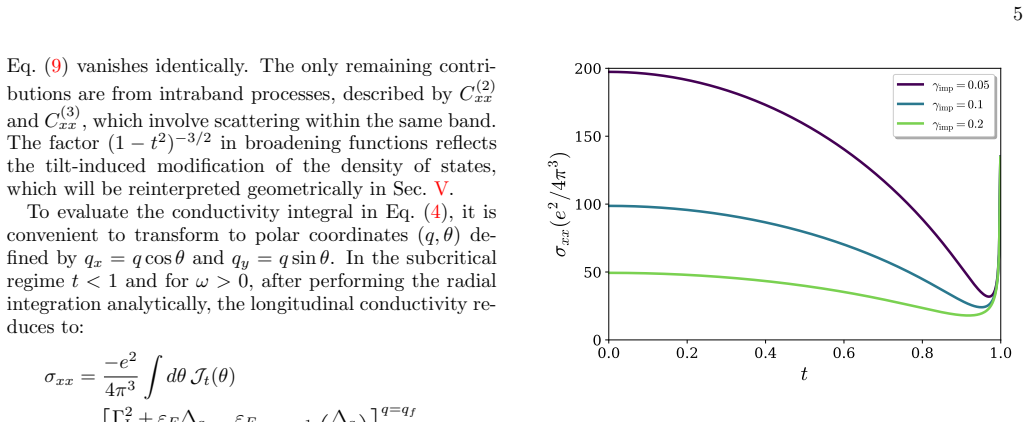
At the Lifshitz transition in tilted Dirac systems, short-range impurities produce a conductivity dip while Coulomb impurities produce a peak due to the van Hove singularity.
A machine-rendered reading of the paper's core claim, the machinery that carries it, and where it could break.
Core claim
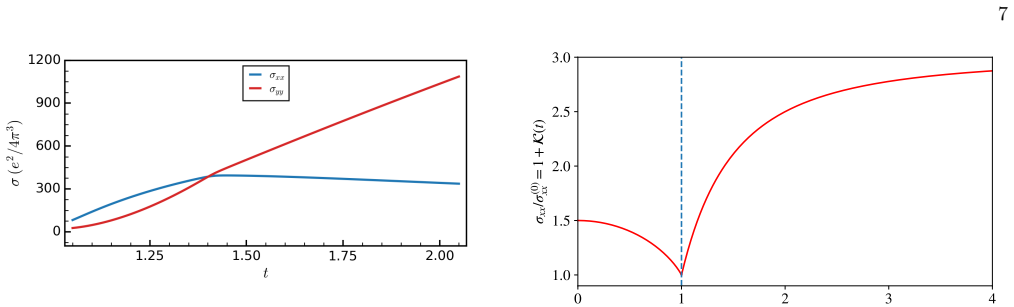
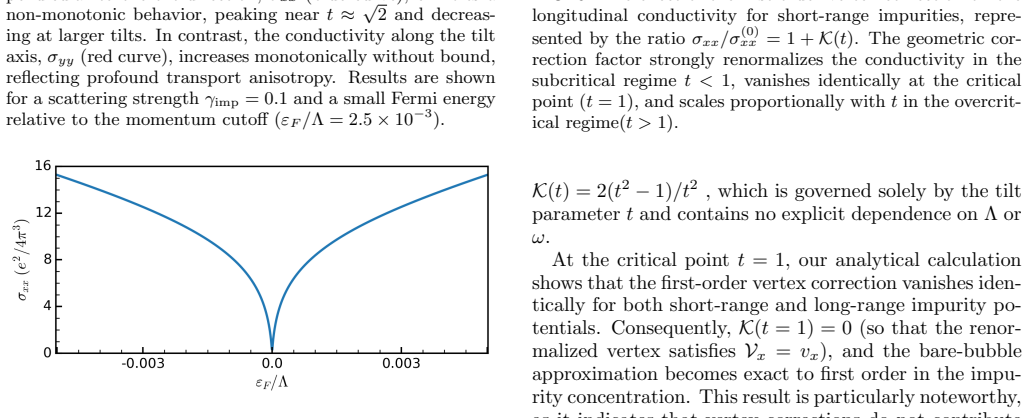
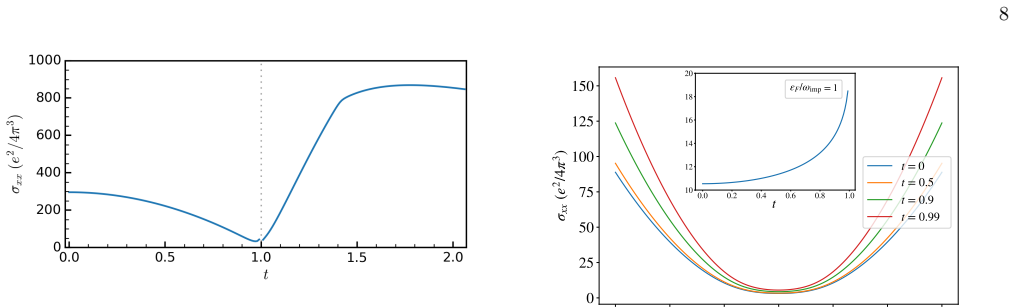
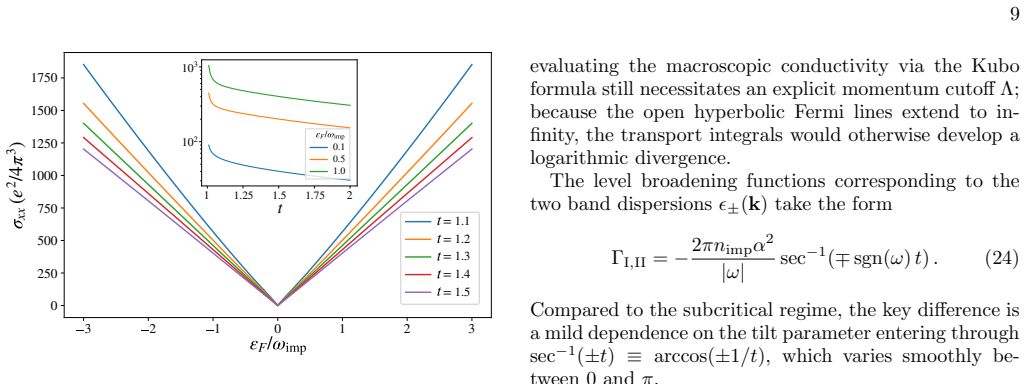
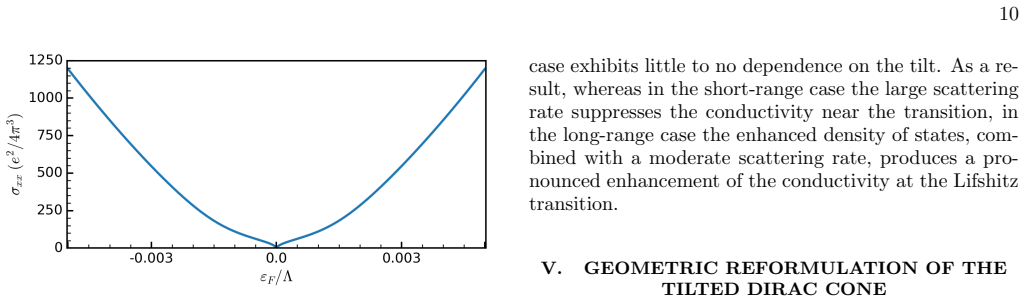
The paper claims that the van Hove singularity at the Lifshitz transition (t=1) induces a localized conductivity dip for short-range disorder but a pronounced macroscopic peak for Coulomb impurities. Vertex corrections vanish identically at this point for both impurity types. In the overcritical regime, short-range defects lead to a cutoff-dependent non-monotonic peak in perpendicular conductivity near t=sqrt(2), while long-range scattering decays monotonically, and parallel conductivity increases without bound revealing extreme anisotropy. The energy dependence of conductivity becomes nearly quadratic for Type I and linear for Type II under long-range scattering.
What carries the argument
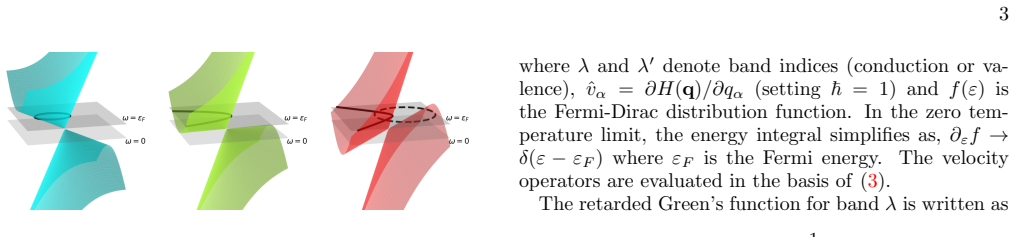
Kubo-formalism calculation of the conductivity tensor for tilted Dirac cones, distinguishing short-range delta-function scattering from long-range Coulomb scattering, with the dimensionless tilt parameter t driving the Lifshitz transition between closed and open Fermi surfaces.
If this is right
- Conductivity perpendicular to the tilt direction exhibits a cutoff-dependent non-monotonic peak near t=sqrt(2) only for short-range defects.
- Conductivity parallel to the tilt axis increases without bound in the overcritical regime for both impurity types, producing extreme anisotropy.
- The energy dependence of conductivity is quadratic in the subcritical regime and linear in the overcritical regime when scattering is Coulomb.
- Vertex corrections vanish exactly at the Lifshitz transition independent of impurity range.
- The tilt parameter controls macroscopic transport anisotropy across all regimes.
Where Pith is reading between the lines
- The opposite conductivity responses at t=1 imply that impurity screening could be used to switch between suppressed and enhanced transport exactly at the transition.
- The requirement of a cutoff in the overcritical regime indicates that lattice-scale effects will ultimately limit the predicted divergence of parallel conductivity.
- Vanishing vertex corrections at the transition simplify diagrammatic calculations and may allow analytic expressions for conductivity in related tilted systems.
Load-bearing premise
An ultraviolet momentum cutoff is required to regularize the open Fermi surface when tilt exceeds the critical value.
What would settle it
A measurement that finds a conductivity dip at t=1 for short-range impurities but a peak for Coulomb impurities in the same tilted Dirac sample would confirm the claimed divergence of transport signatures.
Figures
read the original abstract
We theoretically investigate the DC conductivity of two-dimensional tilted Dirac systems subject to short- and long-range impurity scattering. Using the Kubo formalism, we systematically study transport across the subcritical (Type I), critical, and overcritical (Type II) tilt regimes. In the subcritical phase, short-range impurities yield a frequency-independent conductivity that decreases monotonically with tilt. Conversely, long-range Coulomb scattering results in a strongly energy-dependent conductivity governed by a tilt-independent scattering rate. At the Lifshitz transition ($t = 1$), the transport signatures of these impurities diverge fundamentally: the van Hove singularity in the density of states induces a localized conductivity dip for short-range disorder, but a pronounced macroscopic peak for Coulomb impurities. In the overcritical regime, an ultraviolet momentum cutoff is required to regularize the open Fermi surface, leading to distinct behaviors for each impurity type. Notably, the conductivity perpendicular to the tilt direction ($\sigma_{xx}$) exhibits a cutoff-dependent, non-monotonic peak near $t = \sqrt{2}$ for short-range defects, while it decays monotonically with increasing tilt for long-range scattering. For both potentials, the conductivity along the tilt axis ($\sigma_{yy}$) increases without bound, revealing extreme transport anisotropy. For long-range impurities, the energy dependence of the conductivity becomes nearly quadratic and linear for Type I and II, respectively. Furthermore, vertex corrections vanish identically at the Lifshitz transition for both impurity types. Finally, we provide a unified geometric framework for these phenomena, establishing the tilt parameter as a powerful knob for engineering macroscopic transport in Dirac materials.
Editorial analysis
A structured set of objections, weighed in public.
Referee Report
Summary. The manuscript investigates DC conductivity of 2D tilted Dirac fermions using the Kubo formalism for short-range and long-range (Coulomb) impurities across subcritical (Type I, t<1), Lifshitz critical (t=1), and overcritical (Type II, t>1) regimes. It reports a monotonic decrease in conductivity with tilt for short-range impurities in the subcritical phase, energy-dependent conductivity for Coulomb scattering, a localized dip for short-range and macroscopic peak for Coulomb at t=1 due to the van Hove singularity in the DOS, cutoff-dependent non-monotonic σ_xx near t=√2 for short-range impurities in the overcritical regime (with diverging σ_yy), vanishing vertex corrections at t=1 for both impurity types, and a unified geometric framework positioning the tilt parameter as a control for macroscopic transport anisotropy.
Significance. If the central results hold after addressing regularization, the work provides a clear contrast between impurity scattering responses to the van Hove singularity at the Lifshitz transition and demonstrates extreme transport anisotropy in the overcritical phase. The unified geometric framework is a positive contribution for understanding tilt-tuned transport in Dirac materials.
major comments (2)
- [overcritical regime section] Overcritical regime section: An explicit ultraviolet momentum cutoff is introduced to regularize the open Fermi surface for t>1, producing cutoff-dependent non-monotonic σ_xx near t=√2 for short-range impurities (while σ_yy diverges). Because the same Kubo + Born approximation framework is used on both sides of t=1, the physical choice of cutoff (or lack of lattice regularization) creates ambiguity that could affect the robustness of the reported signatures and vanishing vertex corrections at the Lifshitz transition.
- [Lifshitz transition discussion] Lifshitz transition (t=1) analysis: The claim that vertex corrections vanish identically at t=1 for both short-range and Coulomb impurities is load-bearing for the central contrast in conductivity responses, yet the abstract and available description do not detail the explicit cancellation mechanism within the Kubo formalism or its independence from cutoff choices.
minor comments (1)
- The abstract mentions 'frequency-independent conductivity' for short-range impurities in the subcritical phase but does not specify the energy or frequency window over which this holds.
Simulated Author's Rebuttal
We thank the referee for their careful review and constructive comments on our manuscript. We address each major comment below, indicating planned revisions where appropriate to improve clarity and robustness.
read point-by-point responses
-
Referee: Overcritical regime section: An explicit ultraviolet momentum cutoff is introduced to regularize the open Fermi surface for t>1, producing cutoff-dependent non-monotonic σ_xx near t=√2 for short-range impurities (while σ_yy diverges). Because the same Kubo + Born approximation framework is used on both sides of t=1, the physical choice of cutoff (or lack of lattice regularization) creates ambiguity that could affect the robustness of the reported signatures and vanishing vertex corrections at the Lifshitz transition.
Authors: We acknowledge that the explicit UV cutoff for t>1 is a model-dependent regularization in the continuum limit, as the open Fermi surface in Type-II Dirac cones requires it to avoid divergences. Within our Kubo-Born framework, we have verified that the non-monotonic feature in σ_xx near t=√2 for short-range impurities and the divergence of σ_yy remain qualitatively robust across a range of cutoff values (e.g., Λ = 10-100 in units of the Dirac velocity scale). The vanishing vertex corrections at t=1 are computed independently at the critical point (closed Fermi surface) and do not depend on the overcritical cutoff choice. We will add a dedicated paragraph in the overcritical section discussing cutoff sensitivity and its implications for the reported signatures. revision: partial
-
Referee: Lifshitz transition (t=1) analysis: The claim that vertex corrections vanish identically at t=1 for both short-range and Coulomb impurities is load-bearing for the central contrast in conductivity responses, yet the abstract and available description do not detail the explicit cancellation mechanism within the Kubo formalism or its independence from cutoff choices.
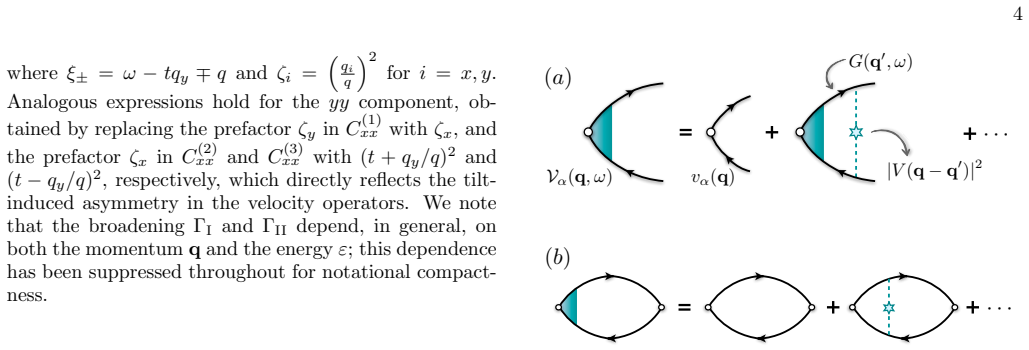
Authors: The vanishing of vertex corrections at t=1 follows from an exact cancellation in the ladder summation of the Kubo formula: at the Lifshitz point, the tilt parameter t=1 causes the renormalized velocity components to align such that the current vertex correction term integrates to zero against the product of retarded and advanced Green's functions for both impurity types. This holds within the Born approximation and is independent of cutoff because the calculation is performed exactly at t=1 with a closed Fermi surface (no UV regularization needed). The mechanism is derived in the main text following Eq. (12) and the associated diagrams. We will revise the abstract to briefly note this cancellation and expand the Lifshitz section with an explicit outline of the algebra showing cutoff independence. revision: yes
Circularity Check
No circularity; Kubo derivation uses external tilt parameter and standard regularization
full rationale
The paper applies the Kubo formalism to compute DC conductivity as a function of the external tilt parameter t across regimes, with the Lifshitz point at t=1 treated as an input control variable. The UV momentum cutoff is introduced explicitly as a regularization for the open Fermi surface when t>1 and produces cutoff-dependent results there, but this does not reduce the t=1 signatures (dip/peak, vanishing vertex corrections) to fitted quantities or self-citations by construction. No self-citations, ansatzes smuggled via prior work, or predictions that are statistically forced appear in the provided text. The central claims remain independent of the paper's own inputs.
Axiom & Free-Parameter Ledger
axioms (2)
- standard math Validity of the Kubo formalism for DC conductivity in the presence of impurities
- domain assumption Existence of a well-defined ultraviolet momentum cutoff for open Fermi surfaces
Reference graph
Works this paper leans on
-
[1]
V, map- ping the tilted Dirac cone to an isotropic one
Analytical Evaluation in the Subcritical Regime (t <1) To evaluate the integral forKanalytically, we leverage the geometric transformation introduced in Sec. V, map- ping the tilted Dirac cone to an isotropic one. We define the new momentum variables px py E = 1 0 0 0 √g t√g 0 0 1 qx qy ω ,(A7) with metric determinantg= 1−t 2, Jacob...
-
[2]
Analytical Evaluation in the Overcritical Regime (t >1) In the overcritical regime, the tilt parameter exceeds the effective Fermi velocity (t >1), leading to a Lif- shitz transition where the Fermi surface topology changes from a closed ellipse to an open hyperbola. To capture this geometry, we define the positive metric determinant g=t 2 −1>0 and introd...
-
[3]
This can be explicitly seen from both expressions (A14) and (A25), ast→1 and thusg→0
V anishing vertex corrections at the Lifshitz T ransition (t→1) The geometric formalism offers a direct proof for the vanishing of the vertex correction at the critical point t= 1. This can be explicitly seen from both expressions (A14) and (A25), ast→1 and thusg→0. From a phys- ical perspective, the effective Fermi surface stretches into two parallel lin...
-
[4]
Both these features are clearly seen in the numerical results shown in Fig
For large tiltingt≫1 the conductivity asymptot- ically vanishes asσ xx ∼1/t. Both these features are clearly seen in the numerical results shown in Fig. 4. For σyy, the same analysis gives σyy ∝ Z Λx −Λx dqx t t2 −1 v2 y = 2Λ(t2 −1) 3/2 t2 .(C7) 16 Its derivative is positive for allt >1, soσ yy increases monotonically. Therefore, in the overcritical regim...
-
[5]
K. S. Novoselov, A. K. Geim, S. V. Morozov, D. Jiang, M. Katsnelson, I. Grigorieva, S. Dubonos, and A. Firsov, Two-dimensional gas of massless dirac fermions in graphene, Nature438, 197 (2005)
2005
-
[6]
Castro Neto, F
A. Castro Neto, F. Guinea, N. Peres, K. Novoselov, and A. Geim, The electronic properties of graphene, Reviews of Modern Physics81, 109 (2009)
2009
-
[7]
Armitage, E
N. Armitage, E. Mele, and A. Vishwanath, Weyl and dirac semimetals in three-dimensional solids, Reviews of Modern Physics90, 015001 (2018)
2018
-
[8]
Yan and C
B. Yan and C. Felser, Topological materials: Weyl semimetals, Annual Review of Condensed Matter Physics 8, 337 (2017)
2017
-
[9]
B. Q. Lv, T. Qian, and H. Ding, Experimental perspec- tive on three-dimensional topological semimetals, Rev. Mod. Phys.93, 025002 (2021)
2021
-
[10]
T. Ando, Y. Zheng, and H. Suzuura, Dynamical con- ductivity and zero-mode anomaly in honeycomb lattices, Journal of the Physical Society of Japan71, 1318 (2002)
2002
-
[11]
Nomura and A
K. Nomura and A. H. MacDonald, Quantum transport in massless dirac fermions: Effect of coulomb scattering, Physical Review Letters98, 076602 (2007)
2007
-
[12]
Das Sarma, S
S. Das Sarma, S. Adam, E. H. Hwang, and E. Rossi, Electronic transport in two-dimensional graphene, Rev. Mod. Phys.83, 407 (2011)
2011
-
[13]
X. Wan, A. M. Turner, A. Vishwanath, and S. Y. Savrasov, Topological semimetal and fermi-arc surface states in the electronic structure of pyrochlore iridates, Phys. Rev. B83, 205101 (2011)
2011
-
[14]
A. A. Burkov, Chiral anomaly and transport in weyl met- als, Journal of Physics: Condensed Matter27, 113201 (2015)
2015
-
[15]
A. A. Burkov, Negative longitudinal magnetoresistance in dirac and weyl metals, Phys. Rev. B91, 245157 (2015)
2015
-
[16]
M. Z. Hasan, S.-Y. Xu, I. Belopolski, and S.-M. Huang, Discovery of weyl fermion semimetals and topological fermi arc states, Annual Review of Condensed Matter Physics8, 289 (2017)
2017
-
[17]
Sharma, P
G. Sharma, P. Goswami, and S. Tewari, Chiral anomaly and longitudinal magnetotransport in type-ii weyl semimetals, Phys. Rev. B96, 045112 (2017)
2017
-
[18]
A. A. Burkov, Giant planar hall effect in topological met- als, Phys. Rev. B96, 041110(R) (2017)
2017
-
[19]
Nissinen, Emergent spacetime and gravitational nieh- yan anomaly in chiralp+ipweyl superfluids and super- conductors, Phys
J. Nissinen, Emergent spacetime and gravitational nieh- yan anomaly in chiralp+ipweyl superfluids and super- conductors, Phys. Rev. Lett.124, 117002 (2020)
2020
-
[20]
Ong and S
N. Ong and S. Liang, Experimental signatures of the chi- ral anomaly in dirac–weyl semimetals, Nature Reviews Physics3, 394 (2021)
2021
-
[21]
Rostamzadeh, S
S. Rostamzadeh, S. Tasdemir, M. Sarisaman, S. A. Jafari, and M.-O. Goerbig, Tilt-induced vortical response and mixed anomaly in inhomogeneous weyl matter (2023)
2023
-
[22]
Katayama, A
S. Katayama, A. Kobayashi, and Y. Suzumura, Pressure- Induced Zero-Gap Semiconducting State in Organic Con- ductorα−(BEDT-TTF) 2I3 Salt, Journal of the Physical Society of Japan75, 054705 (2006)
2006
-
[23]
M. O. Goerbig, J.-N. Fuchs, G. Montambaux, and F. Pi´ echon, Tilted anisotropic dirac cones in quinoid- type graphene andα−(BEDT-TTF) 2i3, Phys. Rev. B78, 045415 (2008)
2008
-
[24]
A. A. Soluyanov, D. Gresch, Z. Wang, Q. Wu, M. Troyer, X. Dai, and B. A. Bernevig, Type-II Weyl semimetals, Nature527, 495 (2015)
2015
-
[25]
Volovik and K
G. Volovik and K. Zhang, Lifshitz transitions, type-ii dirac and weyl fermions, event horizon and all that, Jour- nal of Low Temperature Physics189, 276 (2017)
2017
-
[26]
Z. Wang, D. Gresch, A. A. Soluyanov, W. Xie, S. Kush- waha, X. Dai, M. Troyer, R. J. Cava, and B. A. Bernevig, mote2: A type-ii weyl topological metal, Phys. Rev. Lett. 117, 056805 (2016)
2016
-
[27]
S.-Y. Xu, N. Alidoust, G. Chang, H. Lu, B. Singh, I. Be- lopolski, D. S. Sanchez, X. Zhang, G. Bian, H. Zheng, et al., Discovery of lorentz-violating type ii weyl fermions in laalge, Science advances3, e1603266 (2017)
2017
-
[28]
V. A. Kosteleck´ y, R. Lehnert, N. McGinnis, M. Schreck, and B. Seradjeh, Lorentz violation in dirac and weyl semimetals, Phys. Rev. Res.4, 023106 (2022)
2022
-
[29]
Ferreiros, A
Y. Ferreiros, A. A. Zyuzin, and J. H. Bardarson, Anoma- lous nernst and thermal hall effects in tilted weyl semimetals, Phys. Rev. B96, 115202 (2017)
2017
-
[30]
Trescher, B
M. Trescher, B. Sbierski, P. W. Brouwer, and E. J. Bergholtz, Tilted disordered weyl semimetals, Phys. Rev. B95, 045139 (2017)
2017
-
[31]
Kundu, Z
A. Kundu, Z. B. Siu, H. Yang, and M. B. A. Jalil, Mag- netotransport of weyl semimetals with tilted dirac cones, New Journal of Physics22, 083081 (2020)
2020
-
[32]
Das and A
K. Das and A. Agarwal, Linear magnetochiral transport in tilted type-i and type-ii weyl semimetals, Phys. Rev. B99, 085405 (2019)
2019
-
[33]
Mizoguchi, H
T. Mizoguchi, H. Matsuura, and M. Ogata, Thermoelec- tric transport of type-i, ii, and iii massless dirac fermions in a two-dimensional lattice model, Phys. Rev. B105, 205203 (2022)
2022
-
[34]
Rostamzadeh, i
S. Rostamzadeh, i. d. I. m. c. Adagideli, and M. O. Goer- big, Large enhancement of conductivity in weyl semimet- als with tilted cones: Pseudorelativity and linear re- sponse, Phys. Rev. B100, 075438 (2019)
2019
-
[35]
Mohajerani, Z
A. Mohajerani, Z. Faraei, and S. A. Jafari, Fast nuclear spin relaxation rates in tilted cone weyl semimetals: red- shift factors from korringa relation, Journal of Physics: Condensed Matter33, 215603 (2021)
2021
-
[36]
Transport scaling and critical tilt effects in disordered two-dimensional Dirac fermions
S. Nanda and P. Hosur, Transport scaling and critical tilt effects in disordered 2d dirac fermions, arXiv preprint arXiv:2512.09133 10.48550/arXiv.2512.09133 (2025)
work page internal anchor Pith review Pith/arXiv arXiv doi:10.48550/arxiv.2512.09133 2025
-
[37]
Trescher, B
M. Trescher, B. Sbierski, P. W. Brouwer, and E. J. Bergholtz, Quantum transport in dirac materials: Sig- natures of tilted and anisotropic dirac and weyl cones, Physical Review B91, 115135 (2015)
2015
-
[38]
J. P. Carbotte, Dirac cone tilt on interband optical back- ground of type-i and type-ii weyl semimetals, Phys. Rev. B94, 165111 (2016)
2016
-
[39]
S. P. Mukherjee and J. P. Carbotte, Doping and tilting 17 on optics in noncentrosymmetric multi-weyl semimetals, Physical Review B99, 045150 (2019)
2019
-
[40]
G. E. Volovik, Black hole and hawking radiation by type- ii weyl fermions, JETP Lett.104, 645 (2016)
2016
-
[41]
G. E. Volovik,The universe in a helium droplet, Vol. 117 (Oxford University Press, Oxford, 2003)
2003
-
[42]
Kedem, E
Y. Kedem, E. J. Bergholtz, and F. Wilczek, Black and white holes at material junctions, Phys. Rev. Research2, 043285 (2020)
2020
-
[43]
S. M. Davis and M. S. Foster, Geodesic geometry of 2+1- D Dirac materials subject to artificial, quenched gravita- tional singularities, SciPost Phys.12, 204 (2022)
2022
-
[44]
Guan, Z.-M
S. Guan, Z.-M. Yu, Y. Liu, G.-B. Liu, L. Dong, Y. Lu, Y. Yao, and S. A. Yang, Artificial gravity field, astro- physical analogues, and topological phase transitions in strained topological semimetals, npj Quantum Mater.2, 1 (2017)
2017
-
[45]
Huang, K.-H
H. Huang, K.-H. Jin, and F. Liu, Black-hole horizon in the dirac semimetal zn 2in2s5, Phys. Rev. B98, 121110 (2018)
2018
-
[46]
Jalali-Mola and S
Z. Jalali-Mola and S. A. Jafari, Polarization tensor for tilted dirac fermion materials: Covariance in deformed minkowski spacetime, Phys. Rev. B100, 075113 (2019)
2019
-
[47]
Faraei and S
Z. Faraei and S. A. Jafari, Perpendicular andreev reflec- tion: Solid-state signature of black-hole horizon, Phys. Rev. B100, 245436 (2019)
2019
-
[48]
Liang and T
L. Liang and T. Ojanen, Curved spacetime theory of inhomogeneous weyl materials, Phys. Rev. Research1, 032006 (2019)
2019
-
[49]
Morice, A
C. Morice, A. G. Moghaddam, D. Chernyavsky, J. van Wezel, and J. van den Brink, Synthetic gravitational horizons in low-dimensional quantum matter, Phys. Rev. Res.3, L022022 (2021)
2021
-
[50]
A. G. Moghaddam, D. Chernyavsky, C. Morice, J. van Wezel, and J. van den Brink, Engineering spectral prop- erties of non-interacting lattice Hamiltonians, SciPost Phys.11, 109 (2021)
2021
-
[51]
Sabsovich, P
D. Sabsovich, P. Wunderlich, V. Fleurov, D. I. Pikulin, R. Ilan, and T. Meng, Hawking fragmentation and Hawk- ing attenuation in Weyl semimetals, Phys. Rev. Res.4, 013055 (2022)
2022
-
[52]
K¨ onye, C
V. K¨ onye, C. Morice, D. Chernyavsky, A. G. Moghad- dam, J. van den Brink, and J. van Wezel, Horizon physics of quasi-one-dimensional tilted weyl cones on a lattice, Phys. Rev. Res.4, 033237 (2022)
2022
-
[53]
K¨ onye, L
V. K¨ onye, L. Mertens, C. Morice, D. Chernyavsky, A. G. Moghaddam, J. van Wezel, and J. van den Brink, Anisotropic optics and gravitational lensing of tilted weyl fermions, Phys. Rev. B107, L201406 (2023)
2023
-
[54]
I. S. Chowdhury, H. N. Dhungana, S. Haque, H. Adawi, and E. Howard, Dirac-line criticality and emergent horizons in weyl lifshitz transitions, arXiv preprint arXiv:2605.27453 (2026)
Pith/arXiv arXiv 2026
-
[56]
Sharma, P
A. Sharma, P. Goswami, and S. Tewari, Weyl semimet- als with short-range interactions, Physical Review B96, 045112 (2017)
2017
-
[57]
S. Adam, E. Hwang, V. M. Galitski, and S. Das Sarma, A self-consistent theory for graphene transport, Proceed- ings of the National Academy of Sciences(PNAS)104, 18392 (2007)
2007
-
[58]
Bruus and K
H. Bruus and K. Flensberg,Many-Body Quantum Theory in Condensed Matter Physics: An Introduction, Oxford Graduate Texts (Oxford University Press, Oxford, 2004)
2004
-
[59]
A. A. Burkov, M. D. Hook, and L. Balents, Topological nodal semimetals, Phys. Rev. B84, 235126 (2011)
2011
-
[60]
Murakami, Absence of vertex correction for the spin hall effect inp-type semiconductors, Phys
S. Murakami, Absence of vertex correction for the spin hall effect inp-type semiconductors, Phys. Rev. B69, 241202 (2004)
2004
-
[61]
E. H. Hwang, S. Adam, and S. D. Sarma, Carrier trans- port in two-dimensional graphene layers, Phys. Rev. Lett. 98, 186806 (2007)
2007
-
[62]
Adam and S
S. Adam and S. Das Sarma, Boltzmann transport and residual conductivity in bilayer graphene, Phys. Rev. B 77, 115436 (2008)
2008
-
[63]
T. Ando, Theory of electronic states and transport in car- bon nanotubes, Journal of the Physical Society of Japan 74, 777 (2005), https://doi.org/10.1143/JPSJ.74.777
-
[64]
P. M. Ostrovsky, I. V. Gornyi, and A. D. Mirlin, Elec- tron transport in disordered graphene, Phys. Rev. B74, 235443 (2006)
2006
discussion (0)
Sign in with ORCID, Apple, or X to comment. Anyone can read and Pith papers without signing in.