REVIEW 1 major objections 1 minor 28 references
Reduced-order phasor-domain models for grid-forming converters remain trustworthy for stability analysis only when a structured singular-value certificate confirms that neglected electromagnetic-transient dynamics introduce no destabilizing
Reviewed by Pith at T0; open to challenge. T0 means a machine referee read the full paper against a public rubric. the ladder, T0–T4 →
A structured singular-value certificate is proposed to validate when ideal inner-loop tracking phasor models can be trusted against electromagnetic-transient uncertainties in grid-forming converter microgrids.
T0 review reviewed 2026-06-27 challenge →
load-bearing objection The paper casts EMT mismatch in GFM phasor models as structured uncertainty around the IILT loop and uses mu-analysis for a sufficient certificate on when the reduced model stays trustworthy, plus a measurement route for the weights. the 1 major comments →
When Can Phasor-Domain Device Models Be Trusted for Electromechanical Stability Analysis of Grid-Forming Converter-Dominated Microgrids?
The pith
A machine-rendered reading of the paper's core claim, the machinery that carries it, and where it could break.
The reading
Core claim
The EMT-induced model mismatch between the reduced-order converter model and the actual converter model can be represented as a structured uncertainty embedded around the IILT feedback loop, yielding a frequency-resolved interaction index and a structured singular-value sufficient certificate for determining when the stability conclusion of the IILT model can be certified with respect to a prescribed EMT uncertainty weight.
What carries the argument
Structured uncertainty placed around the ideal inner-loop tracking (IILT) feedback loop, whose weight is obtained from electromagnetic-transient mismatch, enabling structured singular-value analysis to certify when the reduced-order stability conclusion remains valid.
Load-bearing premise
The difference between the ideal inner-loop tracking model and the full electromagnetic-transient converter dynamics can be captured by a structured uncertainty whose weight is obtained without introducing destabilizing effects outside the certificate.
What would settle it
A detailed electromagnetic-transient simulation of the microgrid that becomes unstable when the structured singular-value certificate declares the IILT model stable, or remains stable when the certificate declares the model untrustworthy.
If this is right
- The certificate directly indicates the frequency ranges and operating conditions under which the phasor-domain stability conclusion can be trusted.
- Measurement-derived uncertainty weights match model-derived weights closely enough to allow certification without access to internal converter models.
- When the structured singular value exceeds one at any frequency, the IILT stability result cannot be certified and full electromagnetic-transient analysis is required.
- The same uncertainty-embedding approach applies to any prescribed electromagnetic-transient weight, whether derived from simulation or hardware measurement.
Where Pith is reading between the lines
- The same embedding technique could be applied to other timescale-separated power-system models to produce quantitative validity certificates.
- Terminal-only measurements open the possibility of on-line model-trust monitoring in operating microgrids without proprietary converter data.
- The frequency-resolved index supplies a concrete diagnostic for which converter parameters most strongly affect model trustworthiness.
Editorial analysis
A structured set of objections, weighed in public.
Referee Report
Summary. The paper claims that EMT-induced mismatches between full converter dynamics and reduced-order phasor-domain models assuming ideal inner-loop tracking (IILT) can be represented as a structured uncertainty Δ(s) embedded around the IILT feedback loop; μ-analysis then yields a frequency-resolved interaction index and a sufficient certificate for when the IILT stability conclusion remains valid with respect to a prescribed EMT uncertainty weight W(s), which can be obtained from either detailed EMT models or terminal measurements. Case studies are said to confirm the certificate's ability to identify loss of model trustworthiness.
Significance. If the central certificate is sound, the work supplies a practical, measurement-compatible tool for cross-timescale validation of electromechanical models in converter-dominated microgrids, directly addressing a common modeling assumption whose violation can produce false stability conclusions. The reported agreement between model-derived and measurement-derived weights is a concrete strength that supports deployability without inner-loop access.
major comments (1)
- [Abstract and uncertainty-embedding formulation] The embedding of all EMT-induced mismatch effects as a structured uncertainty around the IILT loop (abstract and the robust-stability formulation) assumes that any direct feedthrough or cross-coupling from inner voltage/current states to outer power-angle dynamics can be absorbed into the chosen block structure of Δ(s). The skeptic concern is load-bearing: if the actual EMT dynamics produce phase/gain effects outside this structure, the μ-condition can certify stability when the true system is unstable. The case studies must explicitly demonstrate that the selected Δ structure bounds all relevant cross terms for the tested operating points and network configurations; otherwise the sufficient certificate does not fully support the central claim.
minor comments (1)
- Ensure that the definition of the interaction index and the precise block diagram of the uncertainty embedding are accompanied by numbered equations so that the μ-condition can be reproduced without ambiguity.
Simulated Author's Rebuttal
We thank the referee for the detailed and constructive comment on the uncertainty-embedding formulation. The point is well taken and directly relevant to the strength of the sufficient certificate. We respond point-by-point below.
read point-by-point responses
-
Referee: [Abstract and uncertainty-embedding formulation] The embedding of all EMT-induced mismatch effects as a structured uncertainty around the IILT loop (abstract and the robust-stability formulation) assumes that any direct feedthrough or cross-coupling from inner voltage/current states to outer power-angle dynamics can be absorbed into the chosen block structure of Δ(s). The skeptic concern is load-bearing: if the actual EMT dynamics produce phase/gain effects outside this structure, the μ-condition can certify stability when the true system is unstable. The case studies must explicitly demonstrate that the selected Δ structure bounds all relevant cross terms for the tested operating points and network configurations; otherwise the sufficient certificate does not fully support the central claim.
Authors: We agree that the validity of the μ-certificate hinges on the chosen block structure of Δ(s) being rich enough to contain the actual EMT-induced mismatch operator. In the manuscript the uncertainty block is obtained by subtracting the IILT model from the full EMT model at the converter terminals; this difference operator therefore already encodes every direct feedthrough, cross-coupling, and phase/gain effect that exists between the inner-loop states and the outer power-angle variables. The block-diagonal structure subsequently imposed on Δ(s) is chosen to match the natural partitioning of the terminal voltage and current channels (i.e., the same input-output ports used to define the IILT loop), which is the standard practice for preserving the physical interconnection when applying structured singular-value analysis. Nevertheless, the referee correctly notes that an explicit verification that no significant residual lies outside this structure is currently only implicit in the case-study results. We will therefore revise the case-study section to add a quantitative check: for each operating point and network configuration we will compute the H∞ norm of the difference between the full mismatch operator and its projection onto the assumed block structure, and we will report that this residual remains below a small threshold (e.g., 5 % of the weight W(s)) for all tested cases. If any configuration violates the threshold we will enlarge the structure accordingly and recompute the interaction index. This addition will make the supporting evidence for the central claim fully explicit. revision: yes
Circularity Check
No significant circularity; standard μ-analysis on external uncertainty weight
full rationale
The derivation formulates model validity as a robust-stability problem by embedding EMT mismatch as structured uncertainty Δ(s) around the IILT loop and applying the structured singular value μ-condition with weight W(s) obtained from EMT models or measurements. This is a direct application of existing μ-analysis tools to an externally supplied uncertainty description; no equation reduces by construction to a fitted parameter or self-citation, and the certificate is not self-definitional. The paper remains self-contained against external benchmarks from robust control theory.
Axiom & Free-Parameter Ledger
free parameters (1)
- EMT uncertainty weight
axioms (1)
- standard math Standard assumptions of structured singular value (μ) analysis and robust stability theory apply to the embedded uncertainty around the IILT loop.
Cite this review
Pith. "Pith review of When Can Phasor-Domain Device Models Be Trusted for Electromechanical Stability Analysis of Grid-Forming Converter-Dominated Microgrids?." pith.science (2026). https://pith.science/paper/RS6OZMT4
@misc{pith2026260608082,
  author       = {Pith},
  title        = {Pith review of: When Can Phasor-Domain Device Models Be Trusted for Electromechanical Stability Analysis of Grid-Forming Converter-Dominated Microgrids?},
  year         = {2026},
  howpublished = {\url{https://pith.science/paper/RS6OZMT4}},
  note         = {Machine review of arXiv:2606.08082}
}
read the original abstract
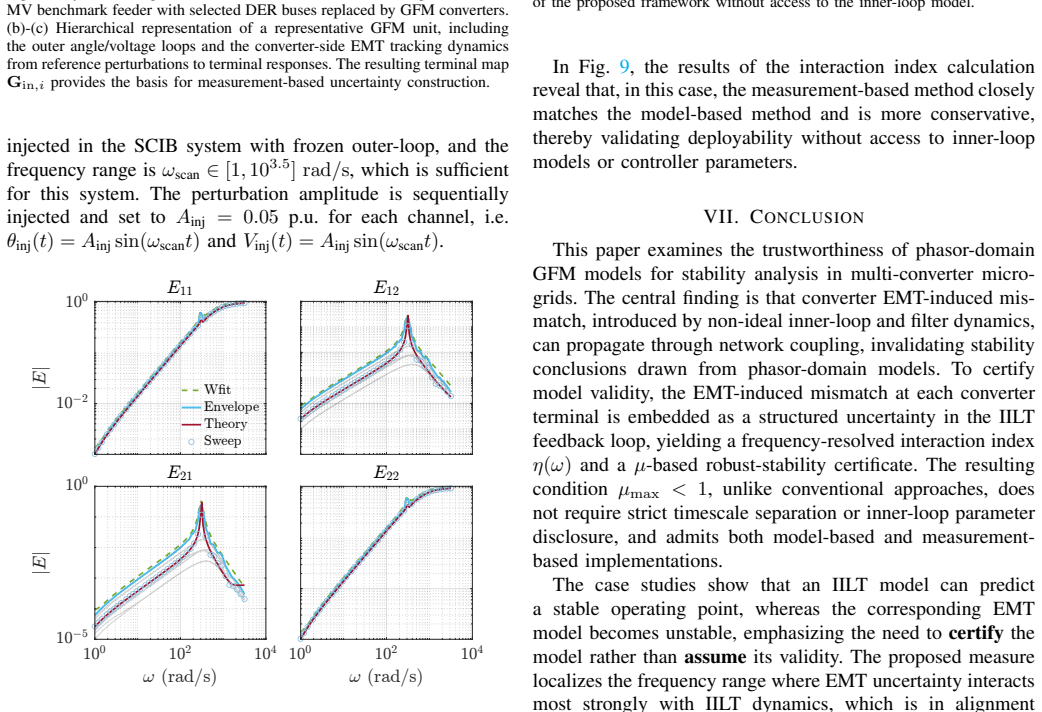
Grid-forming (GFM) converter-dominated microgrids are often analyzed using reduced-order phasor-domain electromechanical GFM models, but the validity of these models is often taken for granted. Assuming ideal inner-loop tracking (IILT) of terminal-voltage references, these models neglect the inner-loop and filter dynamics at the electromagnetic-transient (EMT) timescale to simplify stability analysis. This paper argues that such neglected dynamics can destabilize the system, invalidating the stability conclusions drawn from the IILT model. To address this cross-timescale stability issue, we formulate the validity of the IILT stability conclusion as a robust-stability certification problem. The EMT-induced model mismatch between the reduced-order converter model and the actual converter model is represented as a structured uncertainty embedded around the IILT feedback loop. This yields a frequency-resolved interaction index and a structured singular-value sufficient certificate for determining when the stability conclusion of the IILT model can be certified with respect to a prescribed EMT uncertainty weight. The uncertainty weight can be obtained from detailed EMT models or terminal reference-response measurements. Case studies confirm that the proposed certificate correctly certifies model validity and identifies the loss of trustworthiness. We also demonstrate that the measurement-based uncertainty weights closely match the model-based ones, which enables deployment without accessing inner-loop models.
Figures


Reference graph
Works this paper leans on
-
[1]
A survey on modeling of microgrids—from fundamental physics to phasors and voltage sources,
J. Schiffer, D. Zonetti, R. Ortega, A. M. Stankovi ´c, T. Sezi, and J. Raisch, “A survey on modeling of microgrids—from fundamental physics to phasors and voltage sources,”Automatica, vol. 74, pp. 135–150, 2016
2016
-
[2]
P/q-ω/v admittance modeling and oscillation analysis for multi-vsg grid-connected system,
S. Fu, Y . Sun, J. Lin, S. Chen, and M. Su, “P/q-ω/v admittance modeling and oscillation analysis for multi-vsg grid-connected system,”IEEE Trans. Power Syst., vol. 38, no. 6, pp. 5849–5859, 2023
2023
-
[3]
Compositional grid codes with guarantee on both stability and dynamic performance,
X. Peng, C. Fu, Z. Li, X. Ru, Z. Wang, and F. Liu, “Compositional grid codes with guarantee on both stability and dynamic performance,”IEEE Trans. Power Syst., vol. 41, no. 3, pp. 2398–2401, 2026
2026
-
[4]
Passivity and decentralized stability conditions for grid-forming converters,
X. He and F. D ¨orfler, “Passivity and decentralized stability conditions for grid-forming converters,”IEEE Trans. Power Syst., vol. 39, no. 3, pp. 5447–5450, 2024
2024
-
[5]
Microgrid modeling for stability analysis,
D. Esp ´ın-Sarzosaet al., “Microgrid modeling for stability analysis,” IEEE Trans. Smart Grid, vol. 15, no. 3, pp. 2459–2479, 2024
2024
-
[6]
Closed-Form Solutions for Grid-Forming Converters: A Design-Oriented Study,
F. Zhao, T. Zhu, L. Harnefors, B. Fan, H. Wu, Z. Zhou, Y . Sun, and X. Wang, “Closed-Form Solutions for Grid-Forming Converters: A Design-Oriented Study,”IEEE Open J. Power Electron., vol. 5, pp. 186–200, 2024
2024
-
[7]
Impact of V oltage-Loop Feedforward Terms on the Stability of Grid- Forming Inverters and Remedial Actions,
M. H. Ravanji, D. B. Rathnayake, M. Z. Mansour, and B. Bahrani, “Impact of V oltage-Loop Feedforward Terms on the Stability of Grid- Forming Inverters and Remedial Actions,”IEEE Trans. Energy Convers., vol. 38, no. 3, pp. 1554–1565, 2023
2023
-
[8]
Low-Frequency Resonances in Grid-Forming Converters: Causes and Damping Control,
F. Zhao, T. Zhu, Z. Li, and X. Wang, “Low-Frequency Resonances in Grid-Forming Converters: Causes and Damping Control,”IEEE Trans. Power Electron., vol. 39, no. 11, pp. 14 430–14 447, 2024
2024
-
[9]
Impact of angle- voltage coupling on small-signal stability of power systems: A damping perspective,
X. Peng, C. Fu, P. Yang, X. Ru, and F. Liu, “Impact of angle- voltage coupling on small-signal stability of power systems: A damping perspective,”IEEE Trans. Circuits Syst. I, Reg. Papers, vol. 73, no. 1, pp. 707–720, 2026
2026
-
[10]
Power Dynamic Decoupling Control of Grid-Forming Converter in Stiff Grid,
F. Zhao, X. Wang, and T. Zhu, “Power Dynamic Decoupling Control of Grid-Forming Converter in Stiff Grid,”IEEE Trans. Power Electron., vol. 37, no. 8, pp. 9073–9088, 2022
2022
-
[11]
Impedance Circuit Model of Grid-Forming Inverter: Visualizing Con- trol Algorithms as Circuit Elements,
Y . Li, Y . Gu, Y . Zhu, A. Junyent-Ferre, X. Xiang, and T. C. Green, “Impedance Circuit Model of Grid-Forming Inverter: Visualizing Con- trol Algorithms as Circuit Elements,”IEEE Trans. Power Electron., vol. 36, no. 3, pp. 3377–3395, 2021
2021
-
[12]
Exploring damping effect of inner control loops for grid-forming vscs,
L. Zhao, X. Wang, and Z. Jin, “Exploring damping effect of inner control loops for grid-forming vscs,”IEEE Open J. Power Electron., vol. 6, pp. 1595–1608, 2025
2025
-
[13]
Singular perturbations and input-to-state stability,
P. Christofides and A. Teel, “Singular perturbations and input-to-state stability,”IEEE Trans. Automat. Contr., vol. 41, no. 11, pp. 1645–1650, 1996
1996
-
[14]
Singular Perturbation-Based Large-Signal Order Reduction of Microgrids for Stability and Accuracy Synthesis With Control,
Z. Ma, Z. Wang, Y . Yuan, and T. Hong, “Singular Perturbation-Based Large-Signal Order Reduction of Microgrids for Stability and Accuracy Synthesis With Control,”IEEE Trans. Smart Grid, vol. 15, no. 4, pp. 3361–3374, 2024
2024
-
[15]
Model reduction for grid-forming hybrid renewable energy microgrid clusters based on multi-timescale characterization,
Z. Zhao, X. Luo, J. Wu, J. Xie, S. Gong, Q. Ni, C. S. Lai, and L. L. Lai, “Model reduction for grid-forming hybrid renewable energy microgrid clusters based on multi-timescale characterization,”IEEE Trans. Smart Grid, vol. 15, no. 2, pp. 1227–1242, 2024
2024
-
[16]
Reduced-order small-signal model of microgrid systems,
M. Rasheduzzaman, J. A. Mueller, and J. W. Kimball, “Reduced-order small-signal model of microgrid systems,”IEEE Trans. Sustain. Energy, vol. 6, no. 4, pp. 1292–1305, 2015
2015
-
[17]
Model Reduction and Dynamic Aggregation of Grid-Forming Inverter Networks,
O. Ajala, N. Baeckeland, B. Johnson, S. Dhople, and A. Dom ´ınguez- Garc´ıa, “Model Reduction and Dynamic Aggregation of Grid-Forming Inverter Networks,”IEEE Trans. Power Syst., vol. 38, no. 6, pp. 5475– 5490, 2023
2023
-
[18]
Impact of Inner Control Loops on Small- Signal Stability and Model-Order Reduction of Grid-Forming Convert- ers,
S. Eberlein and K. Rudion, “Impact of Inner Control Loops on Small- Signal Stability and Model-Order Reduction of Grid-Forming Convert- ers,”IEEE Trans. Smart Grid, vol. 14, no. 4, pp. 2812–2824, 2023
2023
-
[19]
K. Zhou, J. C. Doyle, K. Gloveret al.,Robust and optimal control. Prentice hall, 1996
1996
-
[20]
Robust stability investigation of the interactions among grid-forming and grid-following converters,
R. Rosso, S. Engelken, and M. Liserre, “Robust stability investigation of the interactions among grid-forming and grid-following converters,” IEEE Journal of Emerging and Selected Topics in Power Electronics, vol. 8, no. 2, pp. 991–1003, 2020
2020
-
[21]
µapproach-based robust stability analysis of weak-grid-connected voltage source converter,
X. Jin, N. Dai, and Y . Huang, “µapproach-based robust stability analysis of weak-grid-connected voltage source converter,” in2023 IEEE 2nd International Power Electronics and Application Symposium (PEAS), 2023, pp. 214–219
2023
-
[22]
Op- timal dynamic ancillary services provision based on local power grid perception,
V . H ¨aberle, X. He, L. Huang, E. Prieto-Araujo, and F. D ¨orfler, “Op- timal dynamic ancillary services provision based on local power grid perception,”IEEE Trans. Power Syst., vol. 40, no. 2, pp. 1816–1831, 2025
2025
-
[23]
Black-box impedance- based stability assessment of dynamic interactions between converters and grid,
N. Cifuentes, M. Sun, R. Gupta, and B. C. Pal, “Black-box impedance- based stability assessment of dynamic interactions between converters and grid,”IEEE Trans. Power Syst., vol. 37, no. 4, pp. 2976–2987, 2022
2022
-
[24]
Reduced-order model for inter-inverter oscillations in islanded droop- controlled microgrids,
I. P. Nikolakakos, H. H. Zeineldin, M. S. El-Moursi, and J. L. Kirtley, “Reduced-order model for inter-inverter oscillations in islanded droop- controlled microgrids,”IEEE Trans. Smart Grid, vol. 9, no. 5, pp. 4953– 4963, 2018
2018
-
[25]
High-fidelity model order reduction for microgrids stability assess- ment,
P. V orobev, P.-H. Huang, M. Al Hosani, J. L. Kirtley, and K. Turitsyn, “High-fidelity model order reduction for microgrids stability assess- ment,”IEEE Trans. Power Syst., vol. 33, no. 1, pp. 874–887, 2018
2018
-
[26]
J. C. Doyle, B. A. Francis, and A. R. Tannenbaum,Feedback control theory. New York: Macmillan, 1990
1990
-
[27]
Skogestad and I
S. Skogestad and I. Postlethwaite,Multivariable Feedback Control: Analysis and Design, 2nd ed. New York: Wiley, 2005
2005
-
[28]
Benchmark systems for network integration of renewable and distributed energy resources,
K. Strunz, E. Abbasi, R. Fletcher, R. Iravani, and G. Joos, “Benchmark systems for network integration of renewable and distributed energy resources,” CIGR´E, Paris, IDF, FR, Tech. Rep. 575, 2014
2014
This paper was first reviewed by grok-4.3 on June 27, 2026.
discussion (0)
Sign in with ORCID, Apple, or X to comment. Anyone can read and Pith papers without signing in.