Population synthesis of Galactic middle-aged pulsar wind nebulae II. Observational signatures of superefficiency
Pith reviewed 2026-06-27 19:34 UTC · model grok-4.3
The pith
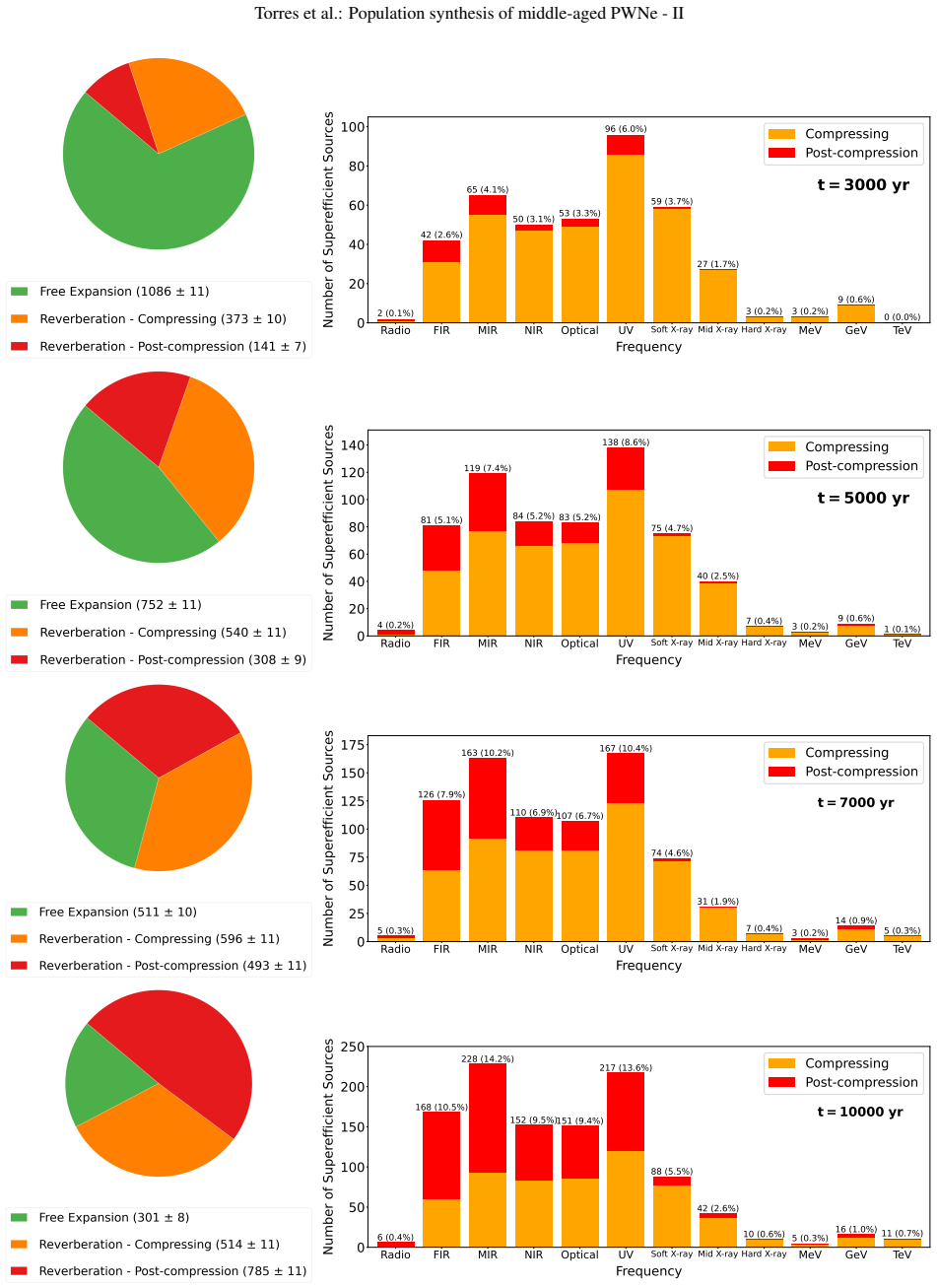
Modeling of middle-aged pulsar wind nebulae shows superefficiency occurs across frequencies more often than thin-shell models predict.
A machine-rendered reading of the paper's core claim, the machinery that carries it, and where it could break.
Core claim
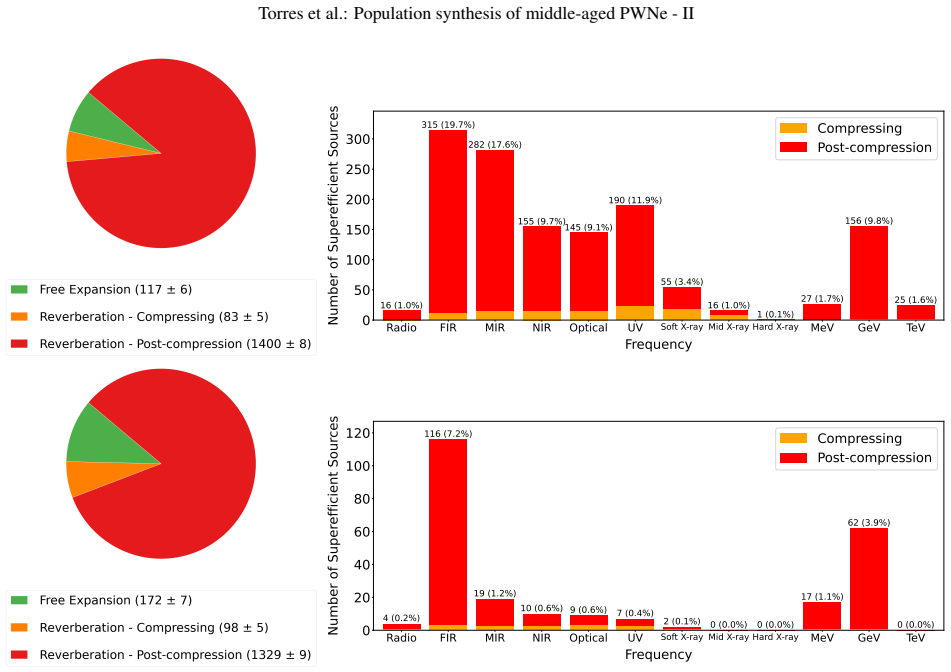
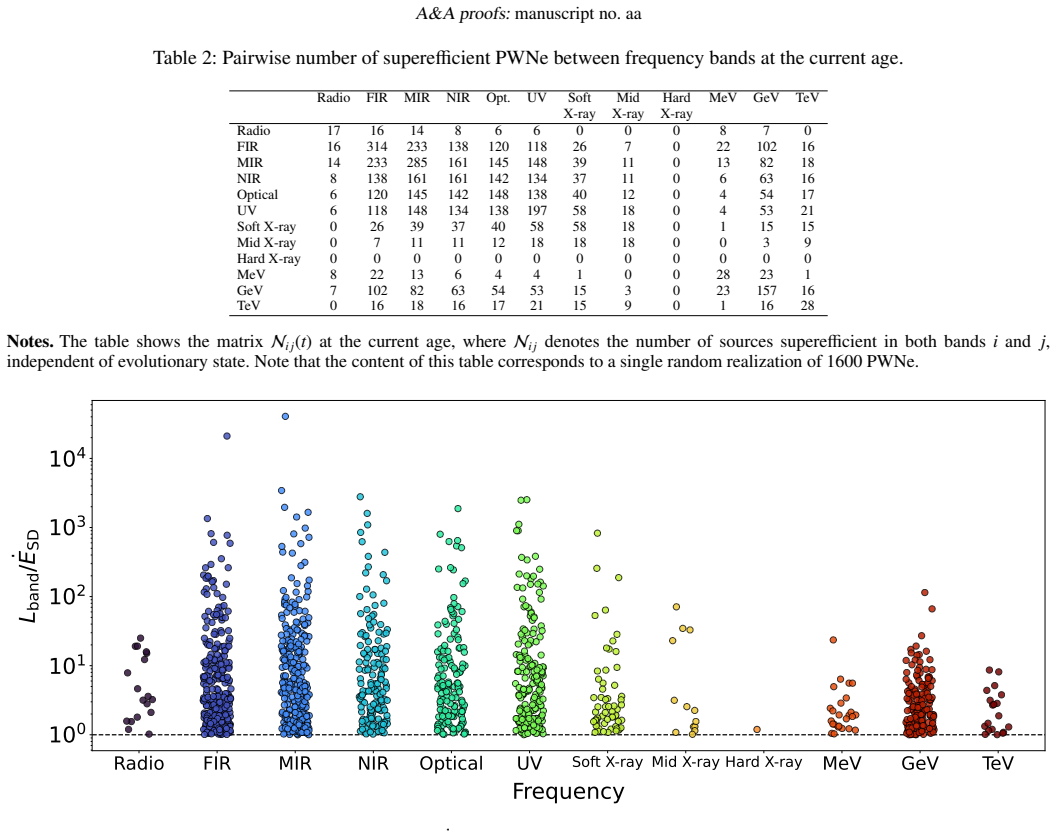
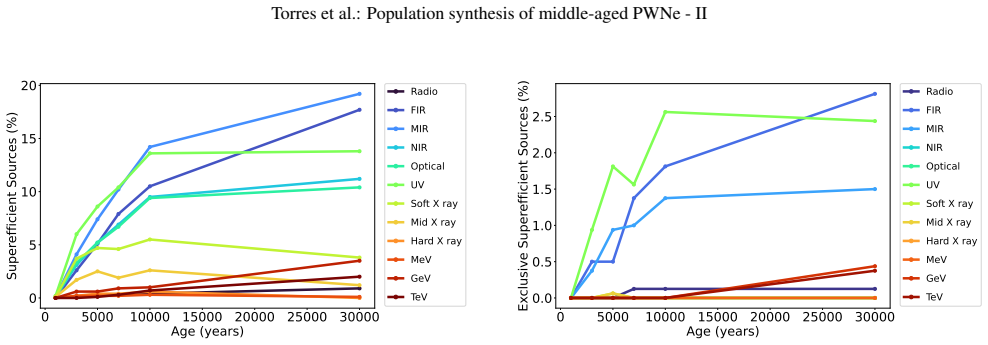
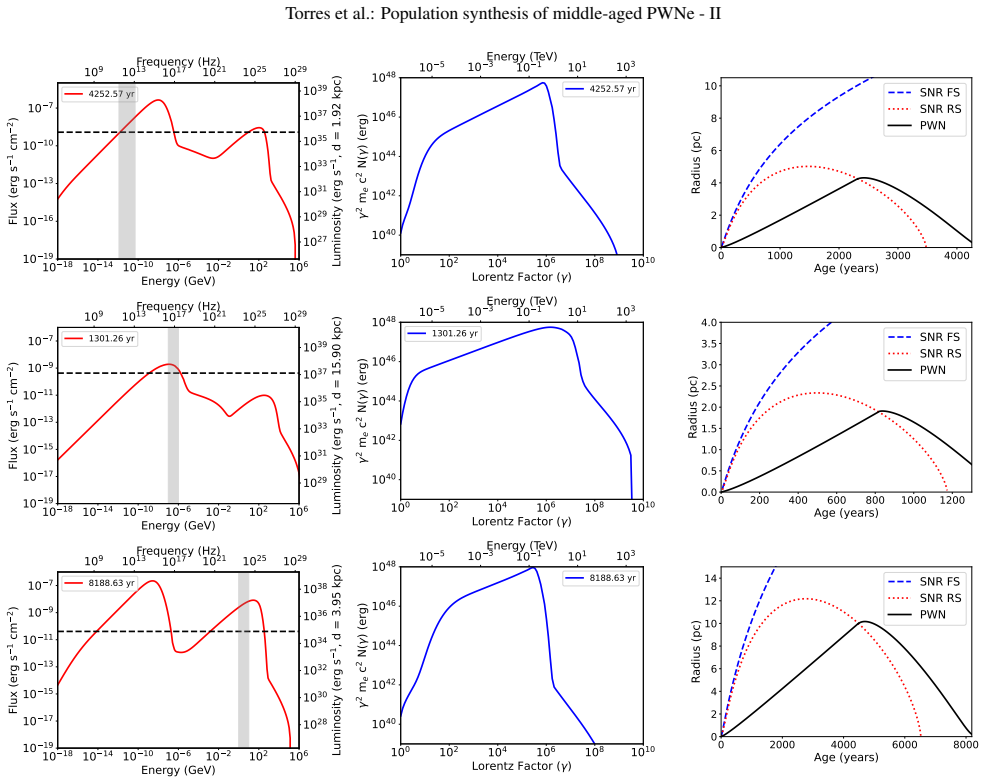
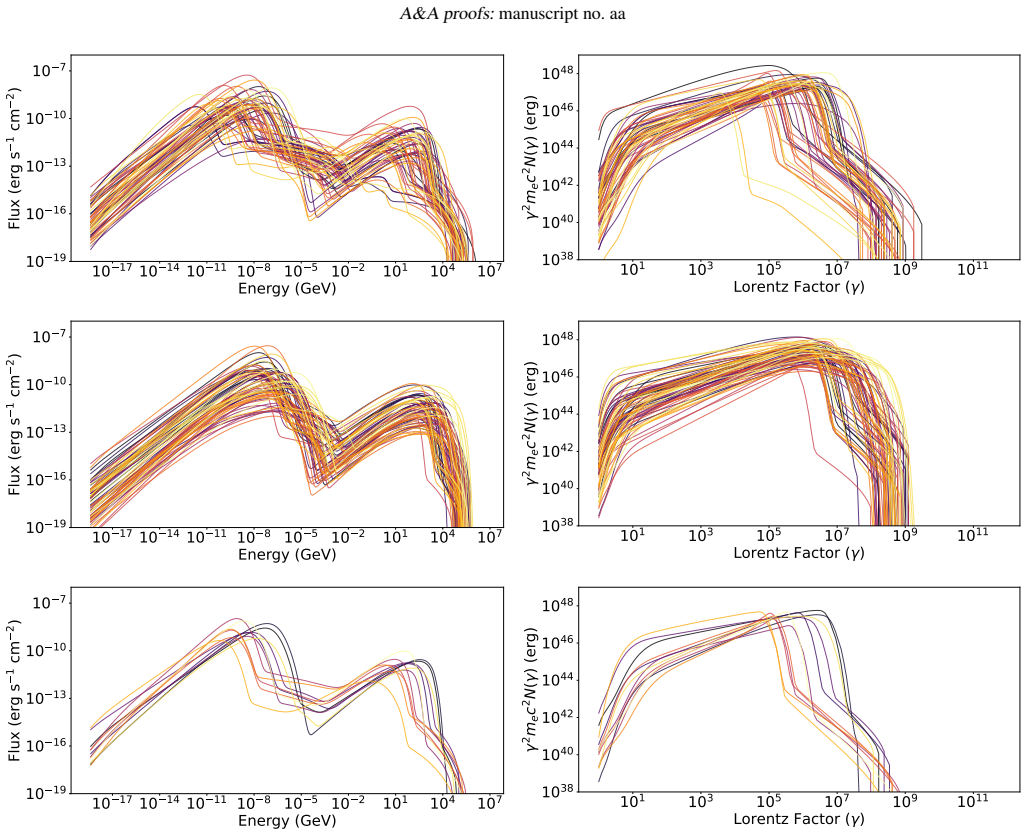
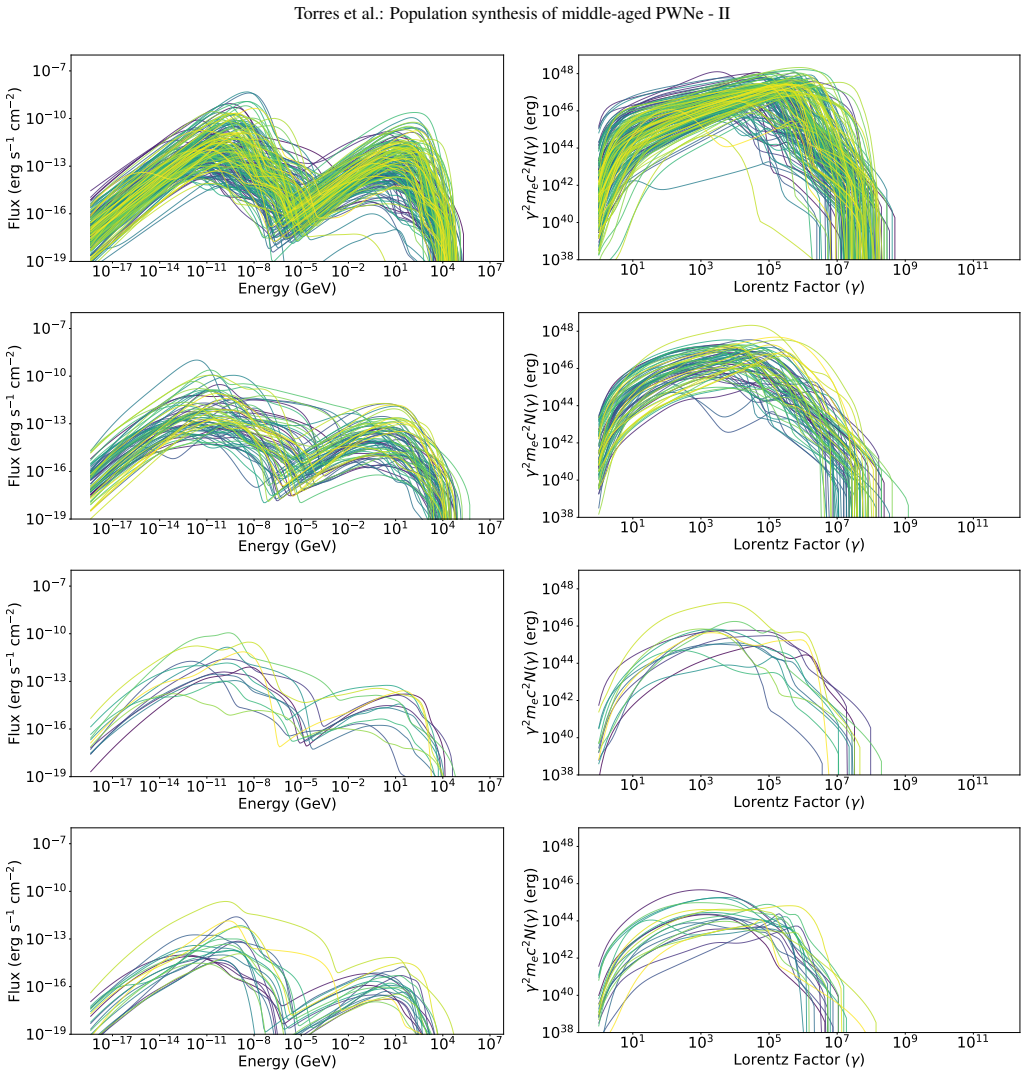
Using the hybrid TIDE+L framework, which self-consistently follows dynamical evolution, particle spectra, and emission from radio to PeV energies for PWNe in the reverberation phase, the population synthesis finds that superefficiency is prevalent across frequencies. It is enhanced where low-energy electrons radiate in magnetically amplified nebulae, and the model produces factors of a few more superefficient sources in FIR and GeV bands and more than an order of magnitude more in several optical/UV/X-ray bands than a purely thin-shell model.
What carries the argument
The hybrid TIDE+L framework that self-consistently tracks dynamical evolution, particle spectra, and multi-band emission for PWNe interacting with SNRs during reverberation.
If this is right
- Superefficiency occurs most commonly in the far-infrared but emerges across frequencies and evolutionary phases.
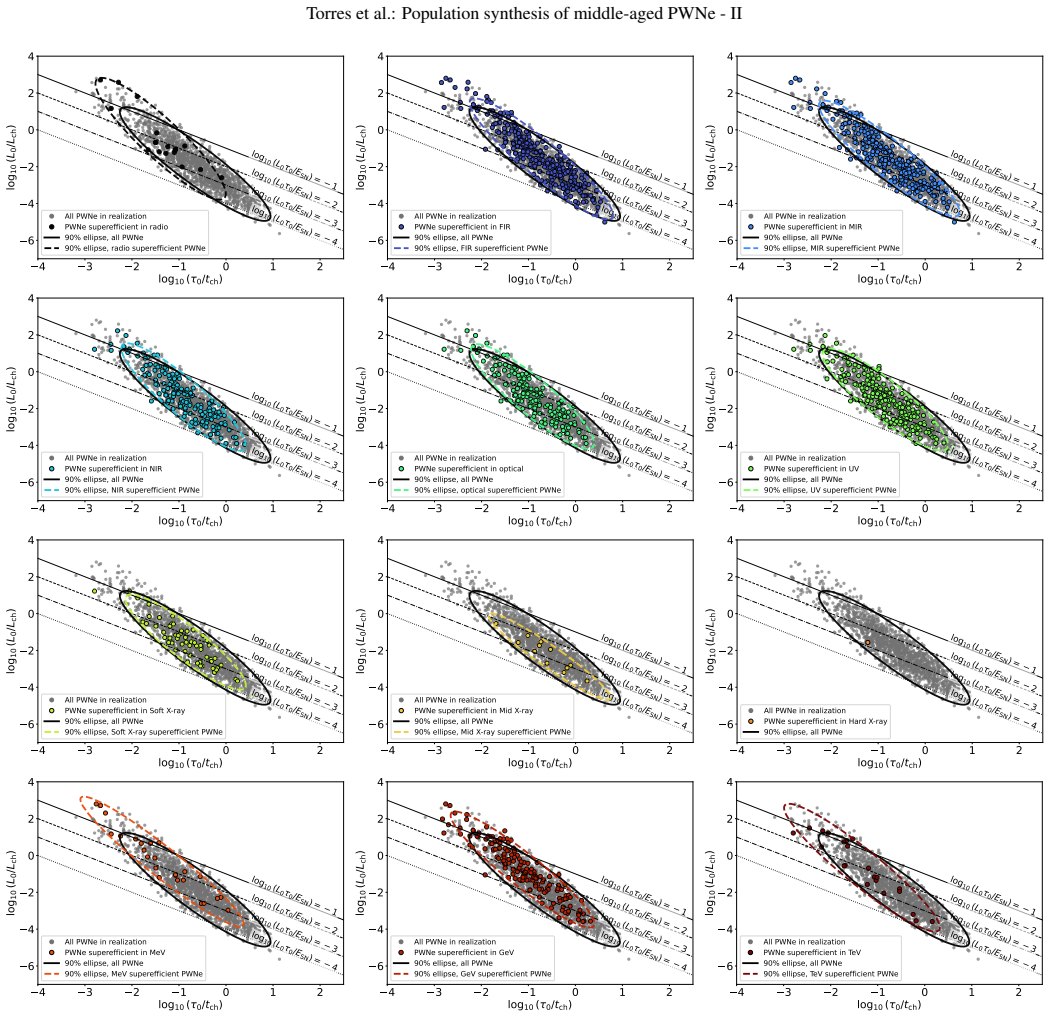
- Systems with accumulated low-energy electrons show stronger superefficiency when the nebula is magnetically amplified.
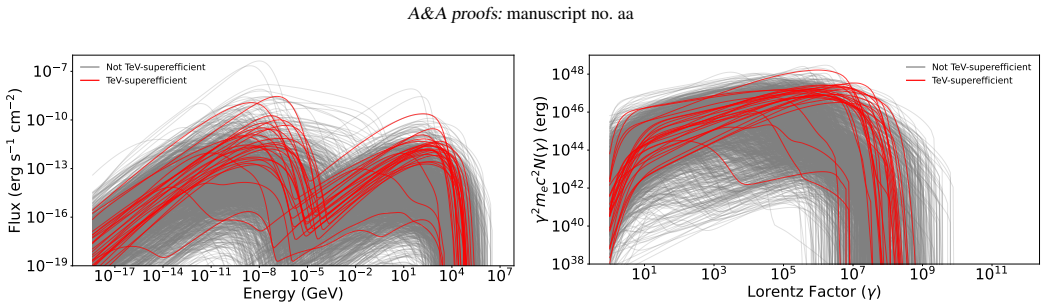
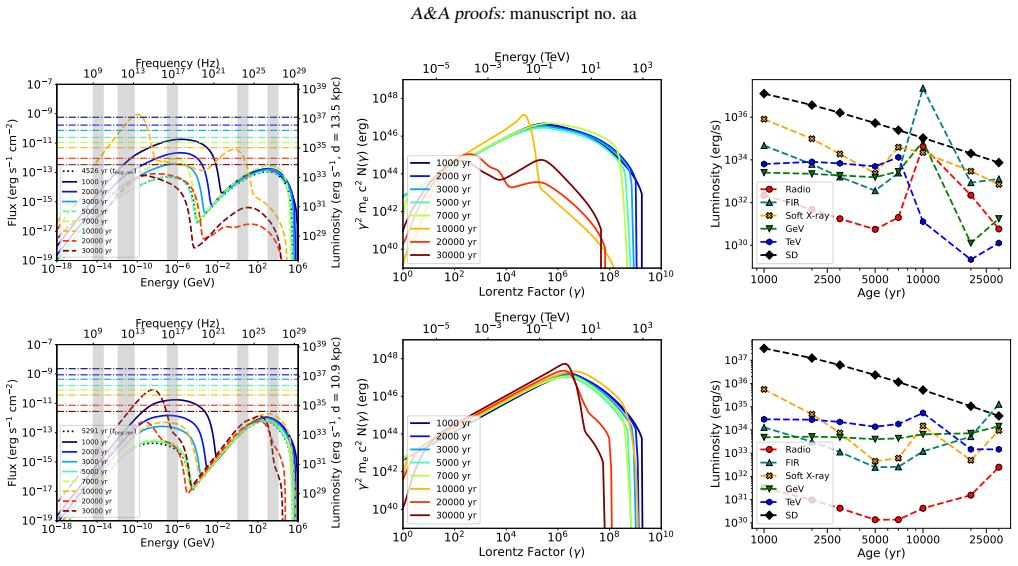
- Population spectral energy distributions reflect higher numbers of superefficient sources than thin-shell models allow.
- Differences between the hybrid model and thin-shell results reach more than an order of magnitude in optical, UV, and X-ray bands.
Where Pith is reading between the lines
- Accounting for the reverberation phase may alter estimates of the total radiative contribution from the Galactic pulsar population to background emission.
- Multi-wavelength surveys could identify more candidate PWNe by searching for signatures of temporary superefficiency rather than steady emission.
- Applying the same modeling approach to younger PWNe might show whether superefficiency is largely a middle-aged phenomenon.
Load-bearing premise
The hybrid framework accurately captures the effects of reverse-shock compression on magnetic fields and particle reprocessing without omitting key physical processes.
What would settle it
A complete multi-band survey of middle-aged Galactic PWNe that finds a number of superefficient sources in the X-ray band differing by more than an order of magnitude from the model's prediction would falsify the central claim.
Figures
read the original abstract
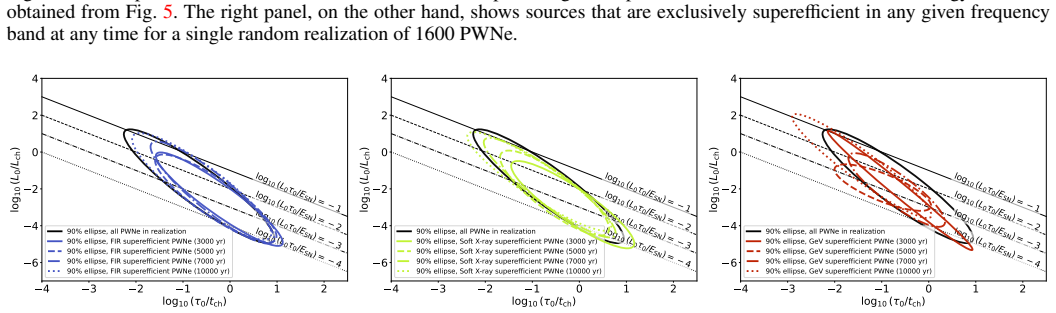
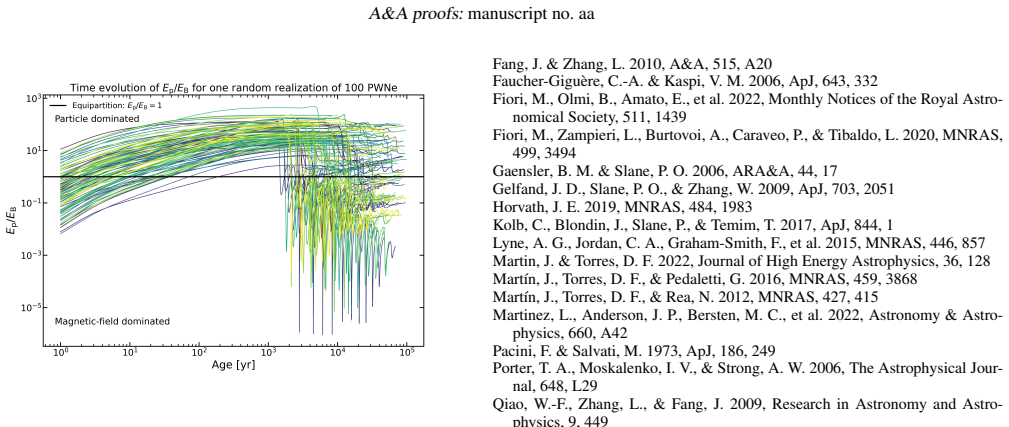
Pulsar wind nebulae (PWNe) interacting with the host supernova remnants (SNRs) can enter the reverberation phase in which reverse-shock-driven compression amplifies the magnetic field and rapidly reprocesses particles, sometimes producing "superefficiency", where the radiative output in a given frequency band exceeds the pulsar's instantaneous spin-down power. We investigate the prevalence of this phenomenon in the Galactic population by modeling PWNe with the hybrid TIDE+L framework, which self-consistently follows dynamical evolution, particle spectra, and emission from radio to PeV energies. We track superefficiency across frequency bands and evolutionary stages, analyzing both individual objects and ensemble properties, including compression-resolved samples and population spectral energy distributions. Superefficiency is most common in the far-infrared, but emerges across frequencies and evolutionary phases. It is enhanced in systems where accumulated low-energy electrons radiate in magnetically amplified nebulae. We predict substantially more superefficient sources than a purely thin-shell model would, with differences ranging from factors of a few in FIR and GeV bands to more than an order of magnitude in several optical/UV/X-ray bands.
Editorial analysis
A structured set of objections, weighed in public.
Referee Report
Summary. The paper performs a population synthesis of Galactic middle-aged pulsar wind nebulae (PWNe) using the hybrid TIDE+L framework to model their interaction with supernova remnants during the reverberation phase. It self-consistently evolves dynamics, particle spectra, and emission from radio to PeV energies, tracking the occurrence of superefficiency (radiative output exceeding instantaneous spin-down power) across frequency bands and evolutionary stages. The central result is that superefficiency is most common in the far-infrared but occurs across bands, with the model predicting substantially more superefficient sources than thin-shell approximations, by factors of a few in FIR/GeV to over an order of magnitude in optical/UV/X-ray bands.
Significance. If the results hold, the work demonstrates the impact of including reverberation-phase compression on PWN emission modeling, providing quantitative predictions for the prevalence of superefficient sources that can be tested against multi-wavelength surveys. The self-consistent TIDE+L treatment of dynamics, spectra, and broadband emission from radio to PeV is a clear strength, as is the comparison to thin-shell models and the analysis of both individual objects and ensemble properties including population SEDs.
minor comments (2)
- The abstract refers to 'compression-resolved samples' without defining the selection criteria or binning; this should be clarified in §3 or §4 with an explicit description of how compression phases are identified and sampled in the population synthesis.
- Figure captions and axis labels for the population SEDs and band-specific superefficiency fractions should explicitly note the assumed Galactic distribution and pulsar birth parameters to allow direct comparison with observations.
Simulated Author's Rebuttal
We thank the referee for the positive and constructive report, which accurately summarizes the scope and findings of our work on PWN population synthesis with the TIDE+L framework. The recommendation for minor revision is noted; we will prepare a revised manuscript accordingly.
Circularity Check
No significant circularity detected in derivation chain
full rationale
The paper's predictions of superefficiency prevalence and band-specific differences arise from running the hybrid TIDE+L framework on a population of PWNe, which is presented as self-consistently evolving dynamics, particle spectra, and multi-wavelength emission. No step reduces a claimed prediction to a fitted parameter by construction, renames a known result, or relies on a load-bearing self-citation whose content is itself unverified. The comparison to thin-shell models is external to the TIDE+L run and does not collapse the central claim. The derivation remains independent of its inputs.
Axiom & Free-Parameter Ledger
Reference graph
Works this paper leans on
-
[1]
Abe, S., Abhir, J., Abhishek, A., et al. 2024, J. Cosmology Astropart. Phys., 2024, 081
2024
-
[2]
Bandiera, R., Bucciantini, N., Martín, J., Olmi, B., & Torres, D. F. 2020, MN- RAS, 499, 2051
2020
-
[3]
Bandiera, R., Bucciantini, N., Martín, J., Olmi, B., & Torres, D. F. 2021, MN- RAS, 508, 3194
2021
-
[4]
Batzofin, R., Cristofari, P., Egberts, K., Steppa, C., & Meyer, D. M. A. 2024, Astronomy & Astrophysics, 687, A279
2024
-
[5]
M.-A., & Steppa, C
Batzofin, R., Egberts, K., Meyer, D. M.-A., & Steppa, C. 2025, A&A, 701, L4
2025
-
[6]
& Huang, H
Becker, W. & Huang, H. H. 2007, 363rd WE-Heraeus Seminar on Neutron Stars and Pulsars: 40 Years after the Discovery. Posters and Contributed Talks
2007
-
[7]
2011, MNRAS, 410, 381
Bucciantini, N., Arons, J., & Amato, E. 2011, MNRAS, 410, 381
2011
-
[8]
Cristofari, P., Gabici, S., Humensky, T. B., et al. 2017, MNRAS, 471, 201 De Sarkar, A., Torres, D. F., Olmi, B., Bucciantini, N., & Meyer, D. M.-A. 2026, arXiv e-prints, arXiv:2605.15359 De Sarkar, A., Zhang, W., Martín, J., et al. 2022, A&A, 668, A23
work page internal anchor Pith review Pith/arXiv arXiv 2017
-
[9]
1986, Non-Uniform Random Variate Generation(originally pub- lished with (Springer-Verlag) Ekström, S., Georgy, C., Eggenberger, P., et al
Devroye, L. 1986, Non-Uniform Random Variate Generation(originally pub- lished with (Springer-Verlag) Ekström, S., Georgy, C., Eggenberger, P., et al. 2012, Astronomy & Astro- physics, 537, A146
1986
-
[10]
& Zhang, L
Fang, J. & Zhang, L. 2010, A&A, 515, A20 Faucher-Giguère, C.-A. & Kaspi, V . M. 2006, ApJ, 643, 332
2010
-
[11]
2022, Monthly Notices of the Royal Astro- nomical Society, 511, 1439
Fiori, M., Olmi, B., Amato, E., et al. 2022, Monthly Notices of the Royal Astro- nomical Society, 511, 1439
2022
-
[12]
2020, MNRAS, 499, 3494
Fiori, M., Zampieri, L., Burtovoi, A., Caraveo, P., & Tibaldo, L. 2020, MNRAS, 499, 3494
2020
-
[13]
Gaensler, B. M. & Slane, P. O. 2006, ARA&A, 44, 17
2006
-
[14]
D., Slane, P
Gelfand, J. D., Slane, P. O., & Zhang, W. 2009, ApJ, 703, 2051
2009
-
[15]
Horvath, J. E. 2019, MNRAS, 484, 1983
2019
-
[16]
2017, ApJ, 844, 1
Kolb, C., Blondin, J., Slane, P., & Temim, T. 2017, ApJ, 844, 1
2017
-
[17]
G., Jordan, C
Lyne, A. G., Jordan, C. A., Graham-Smith, F., et al. 2015, MNRAS, 446, 857
2015
-
[18]
& Torres, D
Martin, J. & Torres, D. F. 2022, Journal of High Energy Astrophysics, 36, 128 Martín, J., Torres, D. F., & Pedaletti, G. 2016, MNRAS, 459, 3868 Martín, J., Torres, D. F., & Rea, N. 2012, MNRAS, 427, 415
2022
-
[19]
P., Bersten, M
Martinez, L., Anderson, J. P., Bersten, M. C., et al. 2022, Astronomy & Astro- physics, 660, A42
2022
-
[20]
& Salvati, M
Pacini, F. & Salvati, M. 1973, ApJ, 186, 249
1973
-
[21]
A., Moskalenko, I
Porter, T. A., Moskalenko, I. V ., & Strong, A. W. 2006, The Astrophysical Jour- nal, 648, L29
2006
-
[22]
2009, Research in Astronomy and Astro- physics, 9, 449
Qiao, W.-F., Zhang, L., & Fang, J. 2009, Research in Astronomy and Astro- physics, 9, 449
2009
-
[23]
Reynolds, S. P. & Chevalier, R. A. 1984, ApJ, 278, 630
1984
-
[24]
2021, New Astronomy, 83, 101498
Rozwadowska, K., Vissani, F., & Cappellaro, E. 2021, New Astronomy, 83, 101498
2021
-
[25]
Tanaka, S. J. & Takahara, F. 2010, The Astrophysical Journal, 715, 1248
2010
-
[26]
Tanaka, S. J. & Takahara, F. 2011, ApJ, 741, 40
2011
-
[27]
2015, ApJ, 808, 100
Temim, T., Slane, P., Kolb, C., et al. 2015, ApJ, 808, 100
2015
-
[28]
Torres, D. F. 2017, ApJ, 835, 54
2017
-
[29]
F., Cillis, A., Martín, J., & de Oña Wilhelmi, E
Torres, D. F., Cillis, A., Martín, J., & de Oña Wilhelmi, E. 2014, Journal of High Energy Astrophysics, 1, 31
2014
-
[30]
Torres, D. F. & Lin, T. 2018, ApJ, 864, L2
2018
-
[31]
F., Lin, T., & Coti Zelati, F
Torres, D. F., Lin, T., & Coti Zelati, F. 2019, MNRAS, 486, 1019
2019
-
[32]
F., Martín, J., de Oña Wilhelmi, E., & Cillis, A
Torres, D. F., Martín, J., de Oña Wilhelmi, E., & Cillis, A. 2013, MNRAS, 436, 3112 van Rensburg, C., Krüger, P. P., & Venter, C. 2018, MNRAS, 477, 3853 V orster, M. J., Tibolla, O., Ferreira, S. E. S., & Kaufmann, S. 2013, ApJ, 773, 139
2013
-
[33]
B., & Fang, J
Zhang, L., Chen, S. B., & Fang, J. 2008, ApJ, 676, 1210
2008
-
[34]
2018, A&A, 609, A110 Article number, page 16
Zhu, B.-T., Zhang, L., & Fang, J. 2018, A&A, 609, A110 Article number, page 16
2018
discussion (0)
Sign in with ORCID, Apple, or X to comment. Anyone can read and Pith papers without signing in.