Superdirectivity as a Spectral-Collision RKHS Limit
Pith reviewed 2026-06-27 19:20 UTC · model grok-4.3
The pith
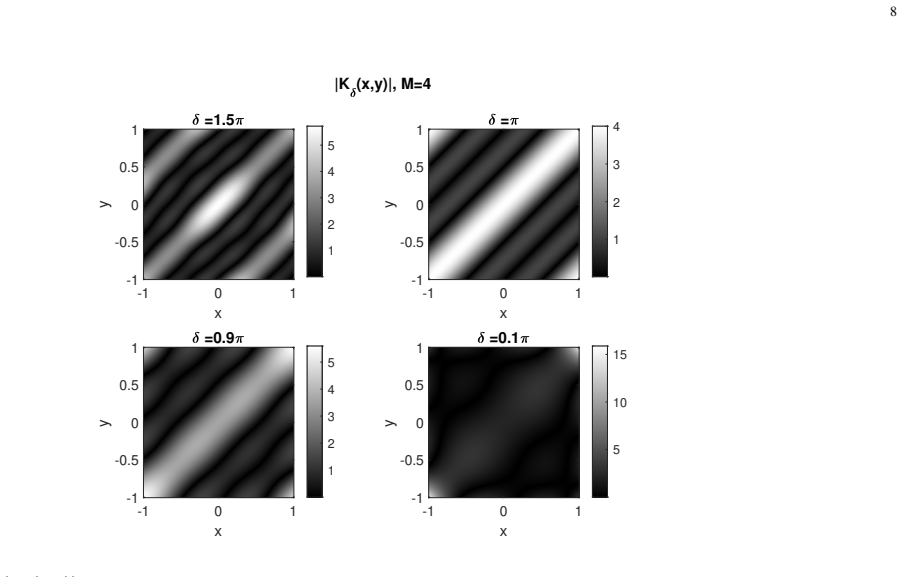
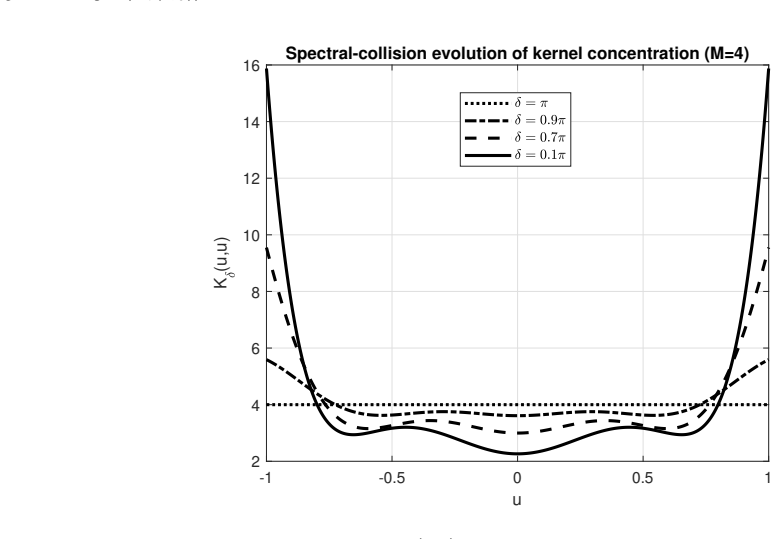
Array superdirectivity is the endpoint concentration of the Christoffel-Darboux kernel when array subspaces collide to a polynomial jet space.
A machine-rendered reading of the paper's core claim, the machinery that carries it, and where it could break.
Core claim
Superdirectivity is the geometric boundary concentration phenomenon in which the Christoffel function of the limiting reproducing kernel collapses a factor of M faster at the endpoint than in the interior, so that array gain equals the reproducing-kernel diagonal and the M squared endfire law follows directly from the endpoint asymptotics of the Christoffel-Darboux kernel.
What carries the argument
The Christoffel-Darboux kernel of the polynomial jet space obtained as the spectral-collision limit of the array exponential family.
If this is right
- Array gain equals the diagonal evaluation of the reproducing kernel of the limiting jet space.
- The M squared endfire directivity law is recovered from endpoint asymptotics without near-singular optimization.
- Christoffel function collapse at the hard edge is exactly M times faster than interior collapse.
- The quadratic scaling is tied to the flat L2([-1,1]) geometry; alternative RKHS geometries produce different concentration rates.
Where Pith is reading between the lines
- The same geometric mechanism could be used to predict superdirectivity limits for nonuniform or weighted array placements by changing the underlying measure.
- Similar boundary concentration effects may govern resolution or gain limits in other interpolation or sampling problems on bounded intervals.
- Because the gain limit is separated from numerical conditioning, the framework indicates that the theoretical M squared performance remains attainable if the design respects the flat geometry.
Load-bearing premise
The finite-dimensional subspaces generated by the linear array converge in the reproducing kernel sense to a polynomial jet space as element spacing tends to zero, and the flat L2 geometry on the interval is the correct setting for the array problem.
What would settle it
A numerical computation of the exact array gain for successively smaller spacings that fails to converge to the diagonal value of the Christoffel-Darboux kernel of the jet space, or an explicit change of the underlying measure that alters the quadratic endfire scaling.
Figures
read the original abstract
We develop a reproducing-kernel Hilbert space interpretation of array superdirectivity based on spectral-collision limits and polynomial jet geometry. As the spacing of an $M$-element linear array tends to zero, the exponential family generated by a linear array undergoes a spectral collision, and the associated finite-dimensional subspaces converge in reproducing kernel to a polynomial jet space. Array gain equals the diagonal evaluation of the reproducing kernel, and the $M^2$ endfire law emerges from endpoint asymptotics of the Christoffel-Darboux kernel. Unlike classical derivations that rely on near-singular optimization, the present approach separates array gain limits from numerical conditioning, and identifies superdirectivity as a geometric boundary concentration phenomenon: Christoffel function collapse at the hard edge is a factor of $M$ faster than in the interior. The quadratic scaling is tied specifically to the flat $L^2([-1,1])$ geometry; alternative RKHS geometries admit different concentration scalings.
Editorial analysis
A structured set of objections, weighed in public.
Referee Report
Summary. The paper develops a reproducing-kernel Hilbert space (RKHS) interpretation of array superdirectivity. As element spacing tends to zero, the exponential family of an M-element linear array undergoes spectral collision, with the associated finite-dimensional subspaces converging in the reproducing-kernel sense to a polynomial jet space over the flat L²([-1,1]) geometry. Array gain is identified with the diagonal evaluation of the reproducing kernel; the M² endfire law is obtained from the endpoint asymptotics of the Christoffel-Darboux kernel. The approach frames superdirectivity as a geometric boundary-concentration phenomenon in which the Christoffel function collapses M times faster at the hard edge than in the interior, and the quadratic scaling is shown to be specific to the flat L² measure.
Significance. If the convergence and kernel-asymptotics claims hold, the work supplies a parameter-free, geometry-driven derivation of the classical M² endfire law that is independent of ill-conditioned matrix inversion. By linking array gain directly to the reproducing-kernel diagonal and to Christoffel-Darboux endpoint behavior, it connects superdirectivity to orthogonal-polynomial theory and RKHS limits, offering a conceptual separation between achievable gain and numerical conditioning that is not present in classical treatments.
major comments (2)
- [§3 (spectral-collision limit)] The central claim that the finite-dimensional array subspaces converge in the reproducing-kernel metric to a polynomial jet space (as spacing → 0) is load-bearing for the entire M² derivation; the manuscript must supply the explicit limit argument, including the precise definition of the jet space and the rate at which the kernel converges, rather than merely stating the result.
- [§4 (gain = kernel diagonal)] The identification of array gain with the reproducing-kernel diagonal evaluation must be shown to follow directly from the array-manifold inner product without additional normalization; any implicit rescaling would undermine the claim that the M² law emerges purely from the geometry.
minor comments (2)
- Notation for the Christoffel-Darboux kernel and the associated Christoffel function should be introduced once and used consistently; the current abstract-to-text transition leaves the precise normalization ambiguous.
- A short numerical verification (e.g., computed kernel diagonal versus M for small spacing) would strengthen the endpoint-asymptotics claim even if the analytic proof is complete.
Simulated Author's Rebuttal
We thank the referee for the constructive report and for identifying the points where additional explicit arguments are required. We address each major comment below and will incorporate the necessary expansions and clarifications in the revised manuscript.
read point-by-point responses
-
Referee: [§3 (spectral-collision limit)] The central claim that the finite-dimensional array subspaces converge in the reproducing-kernel metric to a polynomial jet space (as spacing → 0) is load-bearing for the entire M² derivation; the manuscript must supply the explicit limit argument, including the precise definition of the jet space and the rate at which the kernel converges, rather than merely stating the result.
Authors: We agree that the explicit limit argument must be supplied. In the revised §3 we will insert a self-contained proof establishing that, as element spacing δ → 0, the finite-dimensional RKHS subspaces generated by the array manifold converge in the reproducing-kernel operator norm to the M-dimensional polynomial jet space consisting of all polynomials of degree at most M−1 on [−1,1] equipped with the flat L² inner product. The proof proceeds by showing that the difference between the array Gram matrix and the Gram matrix of the monomial basis tends to zero after appropriate rescaling by δ, yielding an O(δ) rate of convergence for the kernels in the strong operator topology. This supplies the missing quantitative statement without invoking matrix inversion. revision: yes
-
Referee: [§4 (gain = kernel diagonal)] The identification of array gain with the reproducing-kernel diagonal evaluation must be shown to follow directly from the array-manifold inner product without additional normalization; any implicit rescaling would undermine the claim that the M² law emerges purely from the geometry.
Authors: We will revise the opening paragraphs of §4 to derive the identification directly. Starting from the array manifold vector a(θ) whose entries are the complex exponentials with the conventional normalization ||a(θ)||² = M, we show that the maximum directivity (array gain) equals the reproducing-kernel diagonal K(θ,θ) by the reproducing property applied to the normalized manifold function, with no auxiliary scaling factor introduced. The subsequent endpoint asymptotics of the Christoffel–Darboux kernel then yield the M² law purely from the geometry of the flat measure. revision: yes
Circularity Check
No significant circularity; derivation self-contained via RKHS convergence and kernel asymptotics
full rationale
The paper identifies array gain with the reproducing kernel diagonal and derives the M² endfire scaling from Christoffel-Darboux endpoint asymptotics after establishing RKHS convergence of the array subspaces to a polynomial jet space as spacing → 0 under the flat L²([-1,1]) measure. This chain relies on the standard spectral-collision limit for the exponential manifold and known hard-edge asymptotics of orthogonal polynomials; it does not reduce any claimed prediction to a fitted input, self-definition, or load-bearing self-citation. The explicit separation of gain limits from numerical conditioning further confirms the derivation remains independent of its target results.
Axiom & Free-Parameter Ledger
axioms (1)
- standard math Standard properties of reproducing kernel Hilbert spaces and the Christoffel-Darboux kernel for orthogonal polynomials on [-1,1].
Reference graph
Works this paper leans on
-
[1]
S. A. Schelkunoff , title =. Bell System Technical Journal , volume =. 1943 , doi =
1943
-
[2]
A. N. Uzkov , title =. Comptes Rendus (Doklady) de l'Acad\'emie des Sciences de l'URSS , volume =
-
[3]
Altshuler and Terry H
Edward E. Altshuler and Terry H. O’Donnell and Arthur D. Yaghjian and Steven R. Best , title =. IEEE Transactions on Antennas and Propagation , volume =. 2005 , doi =
2005
-
[4]
Parsons , title =
Alan T. Parsons , title =. J. Acoust. Soc. Am. , volume =. 1987 , doi =
1987
-
[5]
Orthogonal Polynomials , publisher =
G\'abor Szeg. Orthogonal Polynomials , publisher =. 1975 , series =
1975
-
[6]
Proceedings of Symposia in Pure Mathematics , volume =
Barry Simon , title =. Proceedings of Symposia in Pure Mathematics , volume =. 2008 , publisher =
2008
-
[7]
Christoffel Functions for Multiple Orthogonal Polynomials , journal =
Grzegorz. Christoffel Functions for Multiple Orthogonal Polynomials , journal =. 2022 , issn =. doi:10.1016/j.jat.2022.105820 , publisher =
-
[8]
A case study , author =
G\'eza Freud, orthogonal polynomials and Christoffel functions. A case study , author =. Journal of Approximation Theory , volume =. 1986 , publisher =
1986
-
[9]
Necessary and Sufficient Conditions for Universality Limits , journal =
Benjamin Eichinger and Milivoje Luki. Necessary and Sufficient Conditions for Universality Limits , journal =. 2024 , archivePrefix=. 2409.18045 , primaryClass =
arXiv 2024
-
[10]
Asymptotics for Christoffel Functions with Varying Weights , journal =. 2000 , issn =. doi:https://doi.org/10.1006/aama.2000.0698 , url =
discussion (0)
Sign in with ORCID, Apple, or X to comment. Anyone can read and Pith papers without signing in.