MEC-Cox: Machine-Learning-Assisted Generalized Entropy Calibration for ATT Marginal Hazard-Ratio Estimation
Pith reviewed 2026-06-27 19:02 UTC · model grok-4.3
The pith
MEC-Cox applies Bregman calibration to source-propensity odds weights to improve efficiency of ATT marginal hazard ratio estimation via IPW Cox regression with external controls.
A machine-rendered reading of the paper's core claim, the machinery that carries it, and where it could break.
Core claim
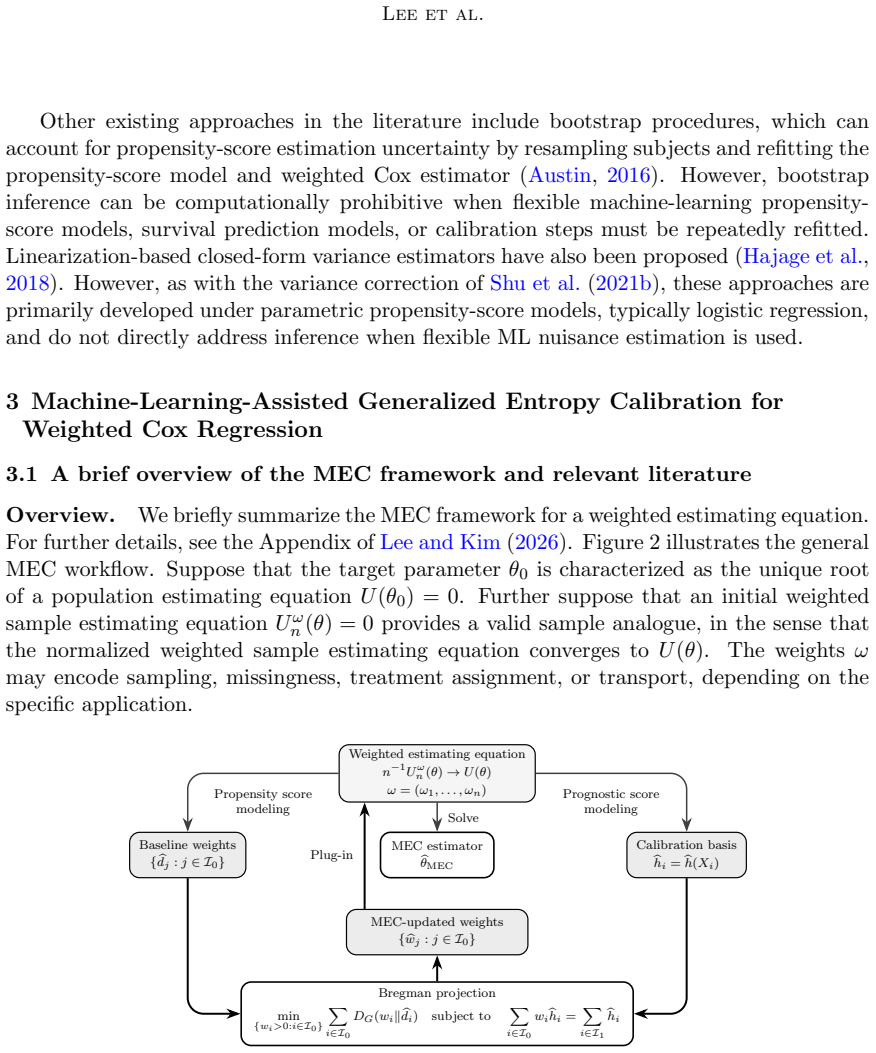
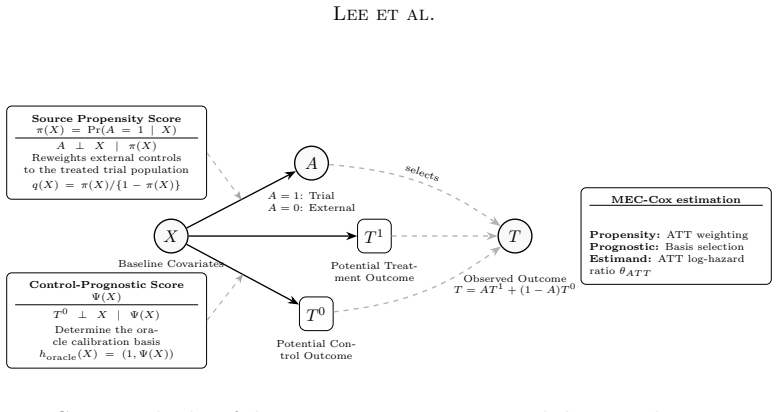
We propose MEC-Cox which begins with normalized source-propensity-score odds weights for external controls and applies Bregman calibration to balance cross-fitted prognostic summaries between external controls and treated trial patients. The updated weights serve dual roles as source-transport and prognostic-score balancing weights for ATT-weighted IPW Cox regression. We establish consistency, characterize a calibration-induced efficiency gain, and develop a stacked sandwich variance estimator.
What carries the argument
Bregman calibration applied to cross-fitted prognostic summaries (such as control-survival predictions or Cox linear predictors) on top of source-propensity-score odds weights.
If this is right
- The IPW Cox estimator with MEC weights is consistent for the ATT marginal hazard ratio.
- Calibration produces an efficiency gain compared to uncalibrated weights.
- The stacked sandwich variance estimator supports valid inference.
- Flexible machine learning nuisance estimation can be incorporated without direct incorporation difficulties in the Cox model.
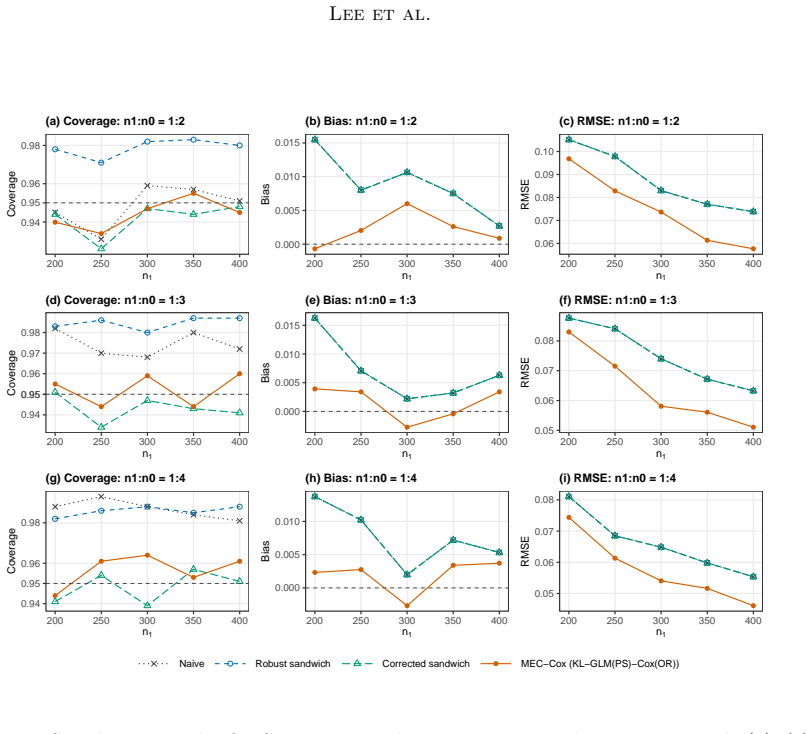
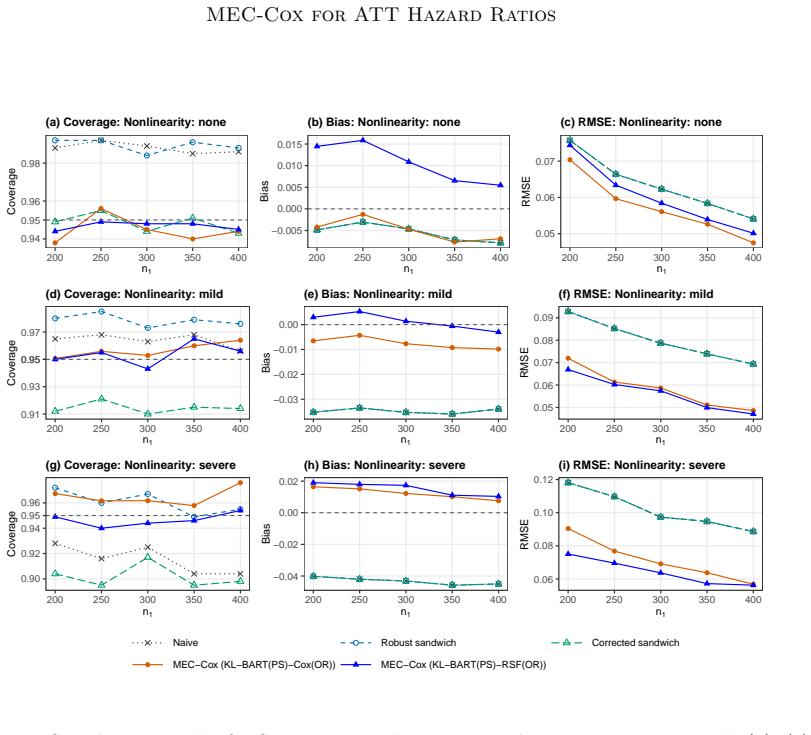
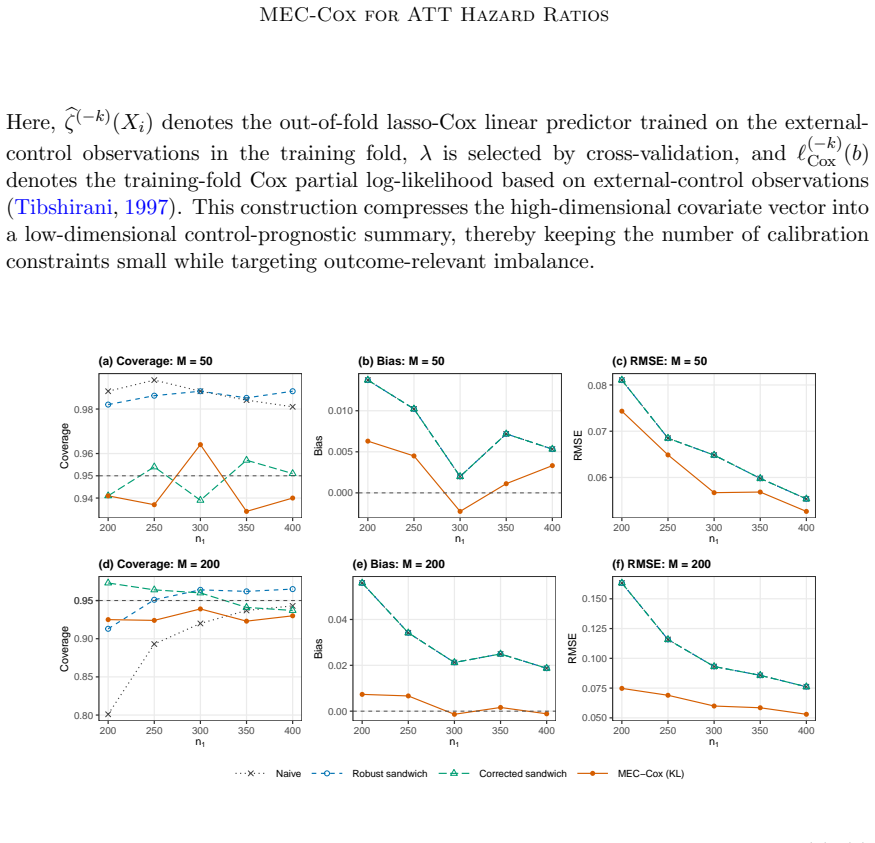
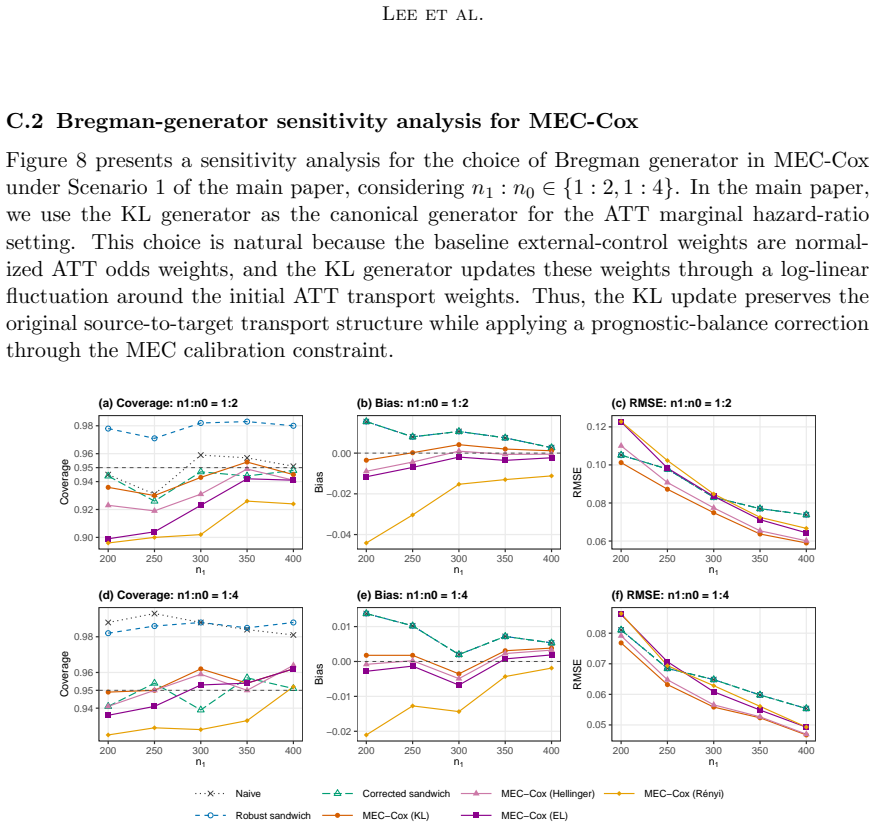
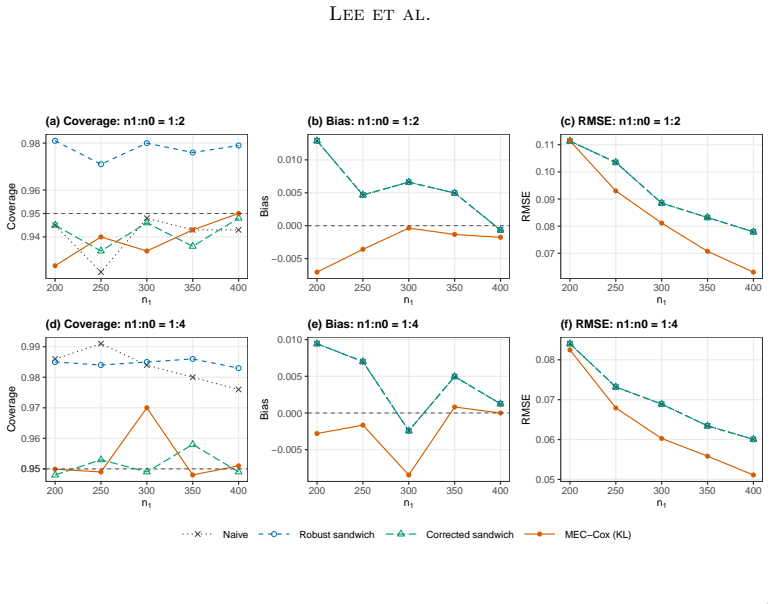
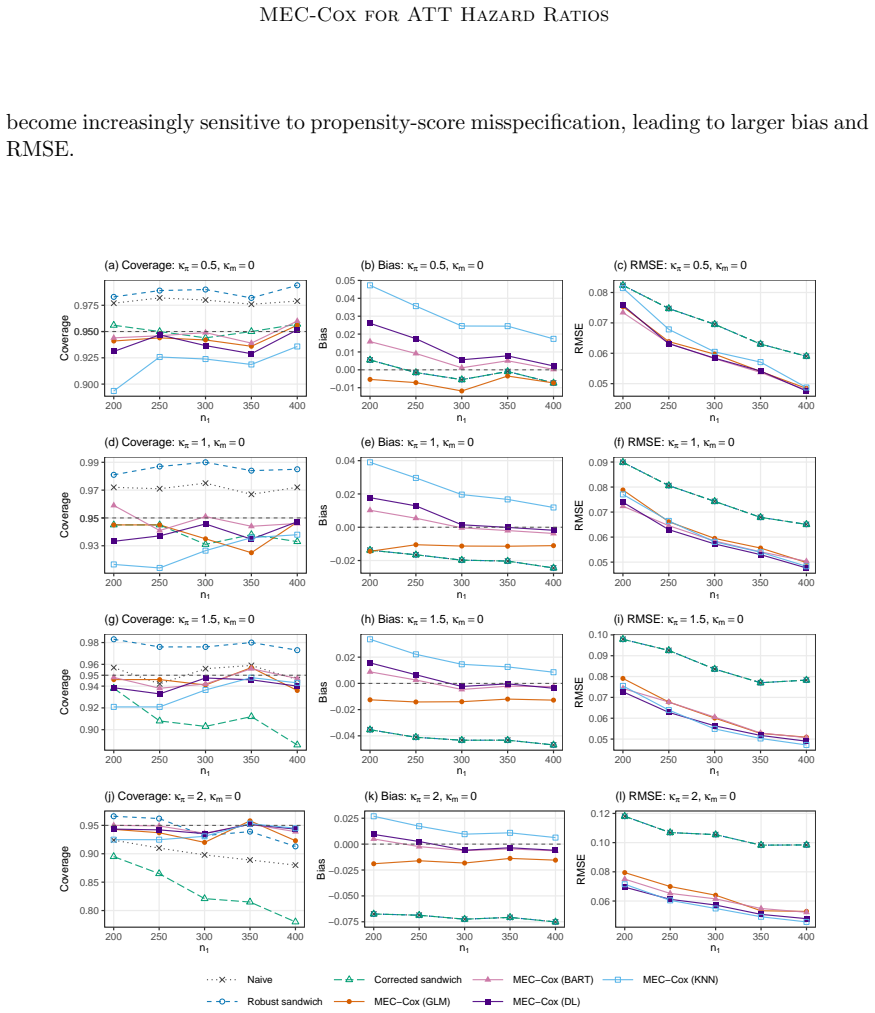
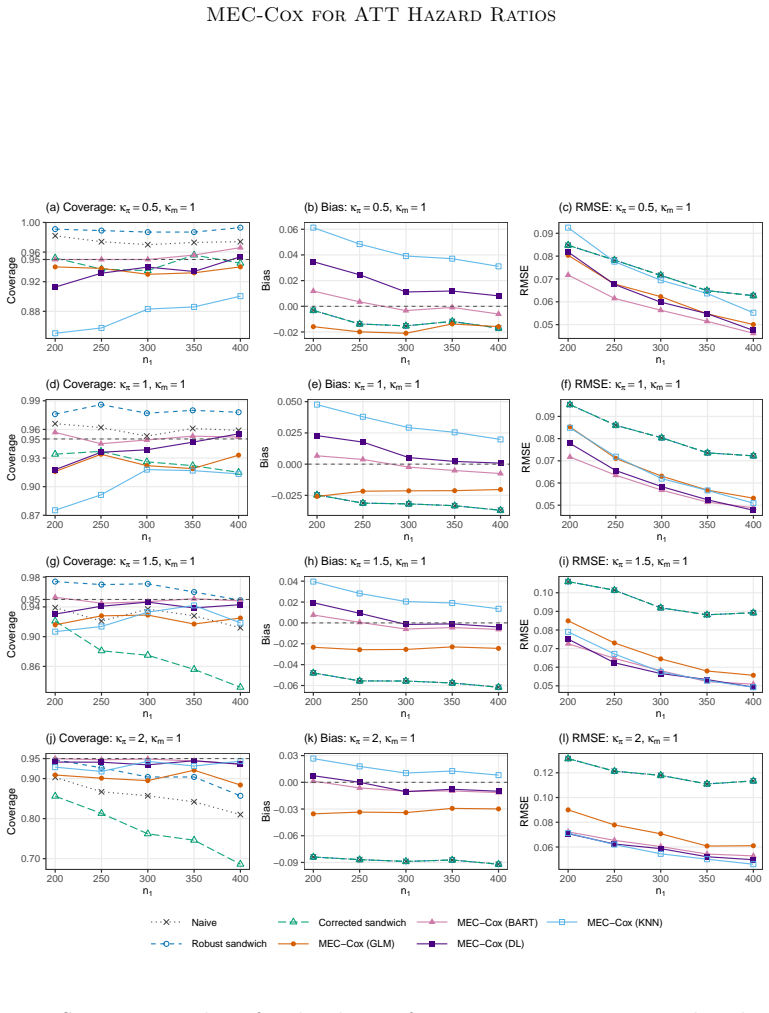
- Simulations indicate reduced bias, increased efficiency, and improved coverage.
Where Pith is reading between the lines
- This calibration strategy might generalize to other time-to-event models or estimands beyond Cox regression.
- Practitioners could use larger external datasets with less concern for population mismatch in prognostic factors.
- Further work could examine performance under different degrees of overlap between trial and external populations.
Load-bearing premise
Bregman calibration balances the prognostic summaries between groups without adding bias to the IPW Cox estimator.
What would settle it
A simulation where the true ATT hazard ratio is known but the calibrated IPW Cox estimates exhibit persistent bias or nominal coverage failure when the calibration basis is included would falsify the consistency and efficiency claims.
Figures
read the original abstract
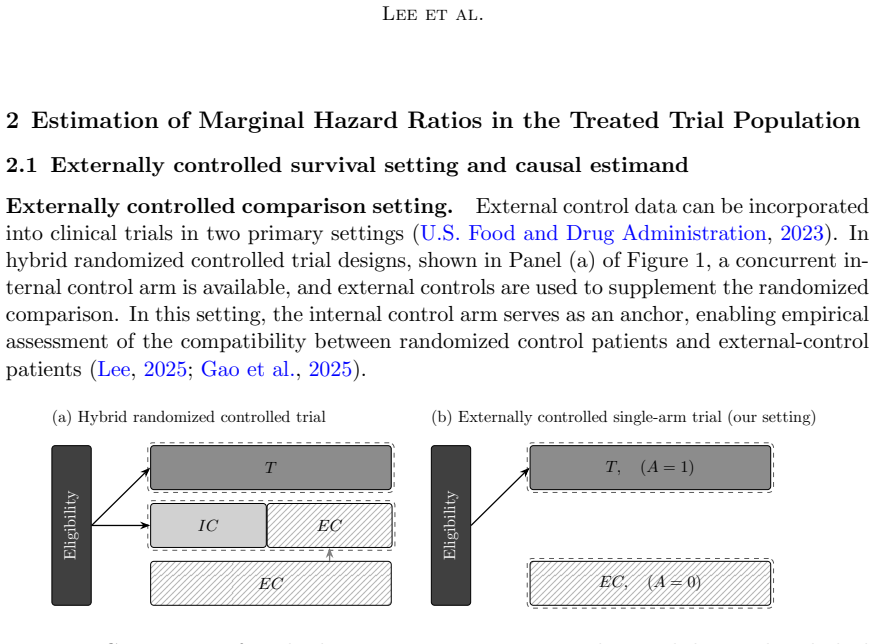
Externally controlled survival trials are increasingly used when concurrent randomized controls are infeasible, particularly in oncology and rare-disease settings with time-to-event endpoints. We target an average-treatment-effect-on-the-treated (ATT)-type marginal hazard-ratio estimand, comparing treatment with counterfactual control in the treated trial population, and estimate it using inverse-probability-weighted (IPW) Cox regression. Valid inference is challenging because IPW Cox regression depends on the weights through both event contributions and risk-set averages, making flexible machine-learning nuisance estimation difficult to incorporate directly. Building on machine-learning-assisted generalized entropy calibration (MEC) by Lee and Kim (2026), we propose MEC-Cox for ATT-weighted IPW Cox regression. The method begins with normalized source-propensity-score odds weights for external controls and then applies Bregman calibration to balance cross-fitted prognostic summaries between external controls and treated trial patients. The calibration basis may include control-survival predictions, Cox linear predictors, penalized-survival-model predictions, or other prognostic-score summaries. MEC-updated weights therefore play a dual role as source-transport and prognostic-score balancing weights. We establish consistency, characterize a calibration-induced efficiency gain, and develop a stacked sandwich variance estimator. Simulations show that MEC-Cox can reduce bias, increase efficiency, and improve coverage through flexible machine-learning-assisted adjustment.
Editorial analysis
A structured set of objections, weighed in public.
Referee Report
Summary. The paper proposes MEC-Cox, extending machine-learning-assisted generalized entropy calibration (MEC) from Lee and Kim (2026) to inverse-probability-weighted (IPW) Cox regression for estimating an ATT-type marginal hazard ratio in externally controlled survival trials. It starts with normalized source-propensity odds weights for external controls, applies Bregman calibration to balance cross-fitted prognostic summaries (e.g., control-survival predictions or Cox linear predictors), establishes consistency and a calibration-induced efficiency gain, develops a stacked sandwich variance estimator, and reports simulation results showing reduced bias, increased efficiency, and improved coverage.
Significance. If the consistency result holds under the stated conditions, MEC-Cox would offer a practical route to incorporating flexible ML nuisance estimators into IPW Cox models while preserving the ATT target, which is relevant for oncology and rare-disease settings. The dual role of the calibrated weights and the explicit variance estimator are potentially useful contributions, though the magnitude of any efficiency gain and its dependence on the prior MEC framework would need to be quantified independently.
major comments (2)
- [Abstract] Abstract: the consistency claim for the MEC-Cox estimator rests on the Bregman calibration step preserving the expectation of the IPW Cox estimating equation, but the text provides no indication of how the proof establishes orthogonality between the calibration constraints and the risk-set averages in the partial-likelihood score; without this, the calibrated weights may converge to a different functional than the target ATT hazard ratio.
- [Abstract] Abstract (and § on consistency): the efficiency-gain characterization and the stacked sandwich variance estimator are asserted to follow from the MEC framework, yet the dependence introduced by reusing the same weights for both transport and prognostic balancing is not shown to leave the original IPW moment condition intact; this is load-bearing for the central consistency claim.
minor comments (2)
- [Abstract] The abstract cites Lee and Kim (2026) for the core calibration technique; the manuscript should clarify which results are taken as given versus which are re-derived for the Cox case.
- Simulation details (bias, efficiency, coverage) are summarized but not linked to specific design choices (e.g., degree of overlap, strength of prognostic summaries); a table or section reference would improve reproducibility.
Simulated Author's Rebuttal
We thank the referee for the careful review and for identifying points where the exposition of the consistency argument requires greater clarity. We address each major comment below and will revise the manuscript to strengthen the presentation of the theoretical results.
read point-by-point responses
-
Referee: [Abstract] Abstract: the consistency claim for the MEC-Cox estimator rests on the Bregman calibration step preserving the expectation of the IPW Cox estimating equation, but the text provides no indication of how the proof establishes orthogonality between the calibration constraints and the risk-set averages in the partial-likelihood score; without this, the calibrated weights may converge to a different functional than the target ATT hazard ratio.
Authors: We agree that the abstract and main-text consistency section do not explicitly sketch the orthogonality argument. The full proof (Appendix A) shows that the Bregman calibration is performed on cross-fitted functions of covariates only; because these functions are measurable with respect to the covariate sigma-field, their calibration constraints are orthogonal to the risk-set indicators appearing in the partial-likelihood score. Consequently the calibrated weights retain the same expectation for the ATT-weighted Cox estimating equation as the original normalized source-propensity odds weights. In revision we will insert a short paragraph in Section 3.2 that states this orthogonality explicitly and references the relevant step in the appendix. revision: yes
-
Referee: [Abstract] Abstract (and § on consistency): the efficiency-gain characterization and the stacked sandwich variance estimator are asserted to follow from the MEC framework, yet the dependence introduced by reusing the same weights for both transport and prognostic balancing is not shown to leave the original IPW moment condition intact; this is load-bearing for the central consistency claim.
Authors: The manuscript extends the MEC framework precisely so that the additional prognostic-balancing constraints are imposed after the source-transport weights have already been normalized; the dual use therefore does not alter the original IPW moment condition. The stacked sandwich estimator accounts for the joint estimation of the propensity and calibration parameters. Nevertheless, we acknowledge that the dependence structure is not spelled out in the main text. Revision will add a short lemma (new Lemma 3) demonstrating that the calibration step leaves the expectation of the ATT IPW score unchanged, together with the corresponding influence-function derivation for the variance estimator. revision: yes
Circularity Check
MEC-Cox consistency and efficiency claims rest on self-cited MEC framework by overlapping authors
specific steps
-
self citation load bearing
[Abstract]
"Building on machine-learning-assisted generalized entropy calibration (MEC) by Lee and Kim (2026), we propose MEC-Cox for ATT-weighted IPW Cox regression. ... We establish consistency, characterize a calibration-induced efficiency gain, and develop a stacked sandwich variance estimator."
The consistency claim and efficiency characterization for the IPW Cox estimator after Bregman calibration are asserted as established, yet the foundational properties of the generalized entropy calibration (balancing prognostic summaries without altering the IPW moment condition) are justified solely by citation to the prior work sharing two authors; no independent derivation or external validation of those properties appears in the provided text.
full rationale
The paper's central derivation chain for consistency of the ATT marginal hazard-ratio estimator and the calibration-induced efficiency gain is built directly on the Bregman calibration properties imported from the 2026 MEC paper by two of the same authors (Lee and Kim). The abstract explicitly positions the work as an extension of that prior framework rather than deriving the key balancing and moment-preservation properties from first principles or external benchmarks within this manuscript. This constitutes self-citation load-bearing for the load-bearing calibration step.
Axiom & Free-Parameter Ledger
axioms (1)
- domain assumption Machine-learning nuisance estimators for propensity scores and prognostic summaries are consistent and cross-fitted.
Reference graph
Works this paper leans on
-
[1]
Statistics in Medicine , volume=
A proper statistical inference framework to compare clinical trial and real-world progression-free survival data , author=. Statistics in Medicine , volume=. 2022 , publisher=
2022
-
[2]
Robins, Andrea Rotnitzky, and Lue Ping Zhao
James M. Robins and Andrea Rotnitzky and Lue Ping Zhao , title =. Journal of the American Statistical Association , volume =. 1994 , publisher =. doi:10.1080/01621459.1994.10476818 , URL =
-
[3]
and Zubizarreta, Jos
Ben-Michael, Eli and Feller, Avi and Hirshberg, David A. and Zubizarreta, Jos. The Balancing Act in Causal Inference , journal=
-
[4]
2023 , publisher=
Handbook of matching and weighting adjustments for causal inference , author=. 2023 , publisher=
2023
-
[5]
2006 , publisher=
Semiparametric theory and missing data , author=. 2006 , publisher=
2006
-
[6]
American Economic Review , volume=
Double/debiased/neyman machine learning of treatment effects , author=. American Economic Review , volume=. 2017 , publisher=
2017
-
[7]
The Econometrics Journal , volume=
Debiased machine learning of conditional average treatment effects and other causal functions , author=. The Econometrics Journal , volume=. 2021 , publisher=
2021
-
[8]
Journal of Machine Learning Research , volume =
Time-to-Event Prediction with Neural Networks and Cox Regression , author =. Journal of Machine Learning Research , volume =
-
[9]
BMC Medical Research Methodology , volume =
External Validation of a Cox Prognostic Model: Principles and Methods , author =. BMC Medical Research Methodology , volume =. 2013 , doi =
2013
-
[10]
Proceedings of Machine Learning for Healthcare , series =
Deep Kernel Survival Analysis and Subject-Specific Survival Time Prediction Intervals , author =. Proceedings of Machine Learning for Healthcare , series =
-
[11]
Handbook of matching and weighting adjustments for causal inference , pages=
Balancing weights for causal inference , author=. Handbook of matching and weighting adjustments for causal inference , pages=. 2023 , publisher=
2023
-
[12]
and Wager, Stefan , title =
Hirshberg, David A. and Wager, Stefan , title =. The Annals of Statistics , year =
-
[13]
On the Implied Weights of Linear Regression for Causal Inference , journal =
Chattopadhyay, Ambarish and Zubizarreta, Jos. On the Implied Weights of Linear Regression for Causal Inference , journal =. 2023 , volume =
2023
-
[14]
and Ratkovic, M
Imai, K. and Ratkovic, M. , year =. Covariate balancing propensity score , volume =
-
[15]
Statistical Methods in Medical Research , pages=
Asymptotic validity of Schoenfeld’s sample size formula for the Cox proportional hazards model via the Wald test approach , author=. Statistical Methods in Medical Research , pages=. 2026 , publisher=
2026
-
[16]
Medical Decision Making , volume=
Modeling good research practices—overview: a report of the ISPOR-SMDM Modeling Good Research Practices Task Force--1 , author=. Medical Decision Making , volume=. 2012 , publisher=
2012
-
[17]
Value in health , volume=
Mifamurtide for high-grade, resectable, nonmetastatic osteosarcoma following surgical resection: a cost-effectiveness analysis , author=. Value in health , volume=. 2013 , publisher=
2013
-
[18]
Value in Health , volume=
Health technology assessment challenges in oncology: 20 years of value in health , author=. Value in Health , volume=. 2019 , publisher=
2019
-
[19]
The Lancet Regional Health--Europe , volume=
Strengthening health technology assessment for cancer treatments in Europe by integrating causal inference and target trial emulation , author=. The Lancet Regional Health--Europe , volume=. 2025 , publisher=
2025
-
[20]
2025 , organization =
NICE Health Technology Evaluations: The Manual (PMG36) , author =. 2025 , organization =
2025
-
[21]
Medical Decision Making , volume=
Survival analysis for economic evaluations alongside clinical trials—extrapolation with patient-level data: inconsistencies, limitations, and a practical guide , author=. Medical Decision Making , volume=. 2013 , publisher=
2013
-
[22]
2020 , month = dec, url =
Transparency Committee Doctrine: Principles of Medicinal Product Assessments and Appraisal for Reimbursement Purposes , author =. 2020 , month = dec, url =
2020
-
[23]
Journal of Medical Economics , volume=
Use of external data to inform overall survival extrapolation in NICE technology appraisals for oncology drugs , author=. Journal of Medical Economics , volume=. 2025 , publisher=
2025
-
[24]
FDA Grant Awards for Projects Supporting the Use of Real-World Data to Generate Real-World Evidence in Regulatory Decision Making , year =
-
[25]
Nature reviews Drug discovery , volume=
Bridging the efficacy--effectiveness gap: a regulator's perspective on addressing variability of drug response , author=. Nature reviews Drug discovery , volume=. 2011 , publisher=
2011
-
[26]
Biometrika , volume=
Inference and missing data , author=. Biometrika , volume=. 1976 , publisher=
1976
-
[27]
Pharmacoeconomics , volume=
Assessment-schedule matching in unanchored indirect treatment comparisons of progression-free survival in cancer studies , author=. Pharmacoeconomics , volume=. 2019 , publisher=
2019
-
[28]
Journal of Biopharmaceutical Statistics , volume=
A review of statistical issues with progression-free survival as an interval-censored time-to-event endpoint , author=. Journal of Biopharmaceutical Statistics , volume=. 2013 , publisher=
2013
-
[29]
Pharmaceutical Statistics , volume=
Progression-free survival in oncological clinical studies: Assessment time bias and methods for its correction , author=. Pharmaceutical Statistics , volume=. 2021 , publisher=
2021
-
[30]
Clinical Cancer Research , volume=
How to deal with interval-censored data practically while assessing the progression-free survival: a step-by-step guide using SAS and R software , author=. Clinical Cancer Research , volume=. 2016 , publisher=
2016
-
[31]
2016 , publisher=
Cancer clinical trials: current and controversial issues in design and analysis , author=. 2016 , publisher=
2016
-
[32]
New England Journal of Medicine , volume=
Human papillomavirus and survival of patients with oropharyngeal cancer , author=. New England Journal of Medicine , volume=. 2010 , publisher=
2010
-
[33]
New England Journal of Medicine , volume=
Apalutamide treatment and metastasis-free survival in prostate cancer , author=. New England Journal of Medicine , volume=. 2018 , publisher=
2018
-
[34]
NEJM ev`idence , volume=
Overall survival and response with nivolumab and relatlimab in advanced melanoma , author=. NEJM ev`idence , volume=. 2023 , publisher=
2023
-
[35]
Journal of the National Cancer Institute , volume=
When you look matters: the effect of assessment schedule on progression-free survival , author=. Journal of the National Cancer Institute , volume=. 2007 , publisher=
2007
-
[36]
Statistics in Medicine , volume=
Bias in progression-free survival analysis due to intermittent assessment of progression , author=. Statistics in Medicine , volume=. 2015 , publisher=
2015
-
[37]
2019 , publisher=
Statistical analysis with missing data , author=. 2019 , publisher=
2019
-
[38]
2014 , publisher=
Handbook of missing data methodology , author=. 2014 , publisher=
2014
-
[39]
Canadian Journal of Cardiology , volume=
Missing data in clinical research: a tutorial on multiple imputation , author=. Canadian Journal of Cardiology , volume=. 2021 , publisher=
2021
-
[40]
1997 , publisher=
Analysis of incomplete multivariate data , author=. 1997 , publisher=
1997
-
[41]
Statistics in Medicine , volume=
Multiple imputation for interval censored data with auxiliary variables , author=. Statistics in Medicine , volume=. 2007 , publisher=
2007
-
[42]
JCO Clinical Cancer Informatics , volume=
Comparing findings from a friends of cancer research exploratory analysis of real-world end points with the cancer analysis system in England , author=. JCO Clinical Cancer Informatics , volume=. 2021 , publisher=
2021
-
[43]
JCO clinical cancer informatics , volume=
Comparisons of real-world time-to-event end points in oncology research , author=. JCO clinical cancer informatics , volume=
-
[44]
Biometrika , volume=
Partial residuals for the proportional hazards regression model , author=. Biometrika , volume=. 1982 , publisher=
1982
-
[45]
Value in Health , volume=
Characterizing structural uncertainty in decision analytic models: a review and application of methods , author=. Value in Health , volume=. 2009 , publisher=
2009
-
[46]
Human Gene Therapy , volume=
Methods for Extrapolating Survival Analyses for the Economic Evaluation of Advanced Therapy Medicinal Products , author=. Human Gene Therapy , volume=. 2022 , publisher=
2022
-
[47]
Journal of the Royal Statistical Society Series A: Statistics in Society , volume=
Accounting for uncertainty in health economic decision models by using model averaging , author=. Journal of the Royal Statistical Society Series A: Statistics in Society , volume=. 2009 , publisher=
2009
-
[48]
Journal of the American Statistical Association , volume=
Bootstrap confidence intervals and bootstrap approximations , author=. Journal of the American Statistical Association , volume=. 1987 , publisher=
1987
-
[49]
Therapeutic Innovation & Regulatory Science , volume=
A Flexible Ensemble Learning Method for Survival Extrapolation , author=. Therapeutic Innovation & Regulatory Science , volume=. 2023 , publisher=
2023
-
[50]
Statistical science , volume=
Bootstrap confidence intervals , author=. Statistical science , volume=. 1996 , publisher=
1996
-
[51]
Journal of the American statistical association , volume=
More efficient bootstrap computations , author=. Journal of the American statistical association , volume=. 1990 , publisher=
1990
-
[52]
1994 , publisher=
An introduction to the bootstrap , author=. 1994 , publisher=
1994
-
[53]
Cambridge books , year=
Model selection and model averaging , author=. Cambridge books , year=
-
[54]
Journal of the American Statistical Association , volume=
Bayesian model averaging for linear regression models , author=. Journal of the American Statistical Association , volume=. 1997 , publisher=
1997
-
[55]
Journal of the American Statistical Association , volume=
Model selection and accounting for model uncertainty in graphical models using Occam's window , author=. Journal of the American Statistical Association , volume=. 1994 , publisher=
1994
-
[56]
The Annals of Statistics , volume=
Piecewise exponential models for survival data with covariates , author=. The Annals of Statistics , volume=. 1982 , publisher=
1982
-
[57]
JCO clinical cancer informatics , volume=
An exploratory analysis of real-world end points for assessing outcomes among immunotherapy-treated patients with advanced non--small-cell lung cancer , author=. JCO clinical cancer informatics , volume=. 2019 , publisher=
2019
-
[58]
2017 , publisher=
Benefit-risk assessment methods in medical product development: Bridging qualitative and quantitative assessments , author=. 2017 , publisher=
2017
-
[59]
The European Journal of Health Economics , volume=
Using health technology assessment to assess the value of new medicines: results of a systematic review and expert consultation across eight European countries , author=. The European Journal of Health Economics , volume=. 2018 , publisher=
2018
-
[60]
Statistics in Biopharmaceutical Research , number=
The current landscape of HTA framework and key challenges , author=. Statistics in Biopharmaceutical Research , number=. 2025 , publisher=
2025
-
[61]
Nature communications , volume=
Addressing challenges with real-world synthetic control arms to demonstrate the comparative effectiveness of Pralsetinib in non-small cell lung cancer , author=. Nature communications , volume=. 2022 , publisher=
2022
-
[62]
Annals of Oncology , volume=
External control arms in oncology: current use and future directions , author=. Annals of Oncology , volume=. 2022 , publisher=
2022
-
[63]
Clinical epidemiology , pages=
Synthetic and external controls in clinical trials--a primer for researchers , author=. Clinical epidemiology , pages=. 2020 , publisher=
2020
-
[64]
Real-World Data: Assessing Electronic Health Records and Medical Claims Data To Support Regulatory Decision-Making for Drug and Biological Products , year =
-
[65]
Report by the decision support unit , volume=
NICE DSU technical support document 14: survival analysis for economic evaluations alongside clinical trials-extrapolation with patient-level data , author=. Report by the decision support unit , volume=
-
[66]
Considerations for the Use of Real-World Data and Evidence To Support Regulatory Decision-Making for Drug and Biological Products , year =
-
[67]
Glossary: Structural uncertainty , year =
-
[68]
Guidelines for the Submission of Documentation for Single Technology Assessments (STAs) of Medical Devices and Diagnostic Interventions , author=
-
[69]
BMC Medical Research Methodology , volume=
Beyond hazard ratios: appropriate statistical methods for quantifying the clinical effectiveness of immune-oncology therapies--the example of the Netherlands , author=. BMC Medical Research Methodology , volume=. 2024 , publisher=
2024
-
[70]
Real’naya klinicheskaya praktika: dannyye i dokazatel’stva= Real-World Data & Evidence , volume=
Surrogate endpoints in cost-effectiveness analysis for use in medical technology assessment , author=. Real’naya klinicheskaya praktika: dannyye i dokazatel’stva= Real-World Data & Evidence , volume=
-
[71]
Value in Health , volume=
Measuring survival benefit in health technology assessment in the presence of nonproportional hazards , author=. Value in Health , volume=. 2019 , publisher=
2019
-
[72]
PharmacoEconomics-open , volume=
Similarities and differences in health technology assessment systems and implications for coverage decisions: evidence from 32 countries , author=. PharmacoEconomics-open , volume=. 2022 , publisher=
2022
-
[73]
Sociological methods & research , volume=
Multimodel inference: understanding AIC and BIC in model selection , author=. Sociological methods & research , volume=. 2004 , publisher=
2004
-
[74]
Decision Support Unit, ScHARR, University of Sheffield , volume=
NICE DSU technical support document 21: flexible methods for survival analysis , author=. Decision Support Unit, ScHARR, University of Sheffield , volume=
-
[75]
Value in Health , volume=
The (harsh) reality of real-world data external comparators for health technology assessment , author=. Value in Health , volume=. 2022 , publisher=
2022
-
[76]
Medical Decision Making , volume=
A systematic review of methods to incorporate external evidence into trial-based survival extrapolations for health technology assessment , author=. Medical Decision Making , volume=. 2023 , publisher=
2023
-
[77]
2019 , note =
ICH Steering Committee , title =. 2019 , note =
2019
-
[78]
Statistics in medicine , volume=
Flexible parametric proportional-hazards and proportional-odds models for censored survival data, with application to prognostic modelling and estimation of treatment effects , author=. Statistics in medicine , volume=. 2002 , publisher=
2002
-
[79]
Statistics in medicine , volume=
Extending inferences from a randomized trial to a new target population , author=. Statistics in medicine , volume=. 2020 , publisher=
2020
-
[80]
Statistics in medicine , volume=
Estimands in heath technology assessment: a causal inference perspective , author=. Statistics in medicine , volume=. 2022 , publisher=
2022
discussion (0)
Sign in with ORCID, Apple, or X to comment. Anyone can read and Pith papers without signing in.