Hawking Emission from Black Holes Evaporating toward Wormholes and the Accuracy of the WKB Approximation
Pith reviewed 2026-06-27 19:11 UTC · model grok-4.3
The pith
Direct numerical greybody factors show WKB overestimates luminosities by orders of magnitude near wormhole endpoints.
A machine-rendered reading of the paper's core claim, the machinery that carries it, and where it could break.
Core claim
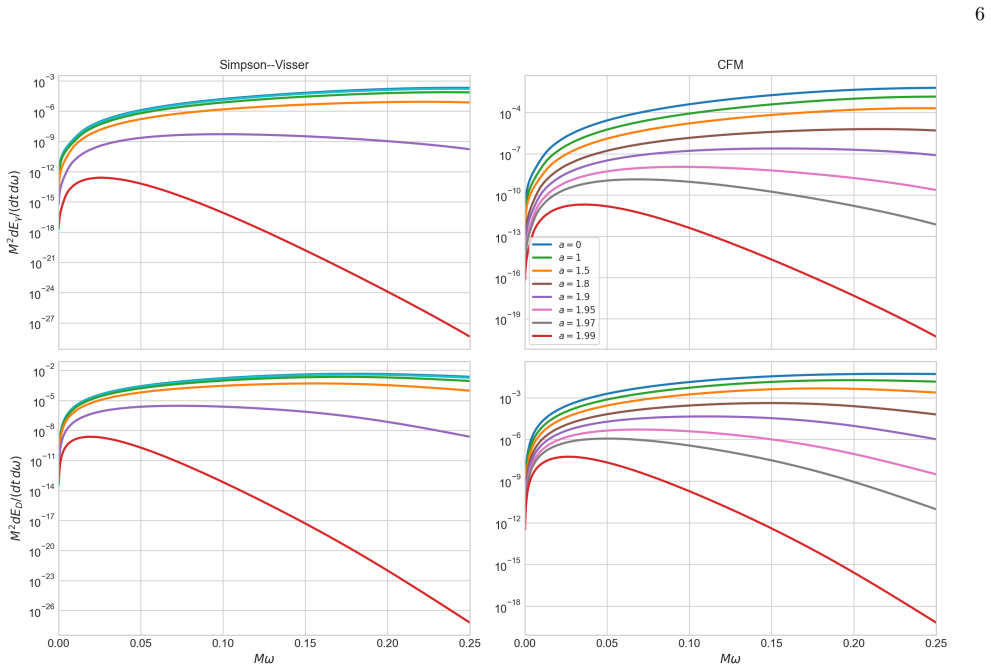
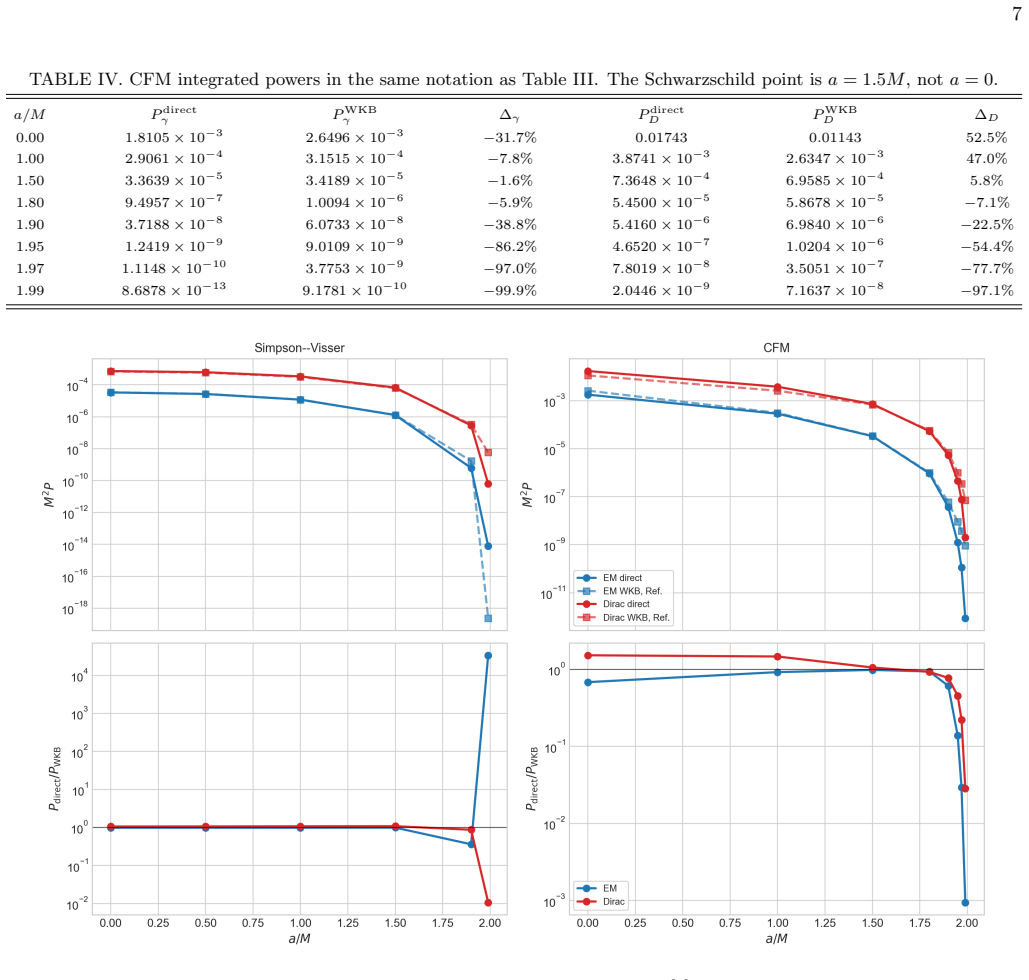
As the wormhole endpoint is approached the black holes cool and total flux is strongly suppressed with residual emission increasingly fermion dominated, yet the WKB calculation substantially overestimates the remaining luminosity in the regime where the evaporation rate is most sensitive to the low-frequency tail; in a fixed-parameter Simpson-Visser half-decay estimate the direct-greybody luminosities increase the WKB lifetime coefficient by a factor of about 85.
What carries the argument
Direct numerical scattering solutions of the wave equation for photon and massless Dirac channels to compute exact greybody factors, contrasted with WKB estimates evaluated at the peak of the effective potential barrier.
If this is right
- Close to the Schwarzschild limit the WKB estimates remain reasonably accurate for the emission spectra.
- Far from the Schwarzschild limit the WKB error grows large and reaches orders of magnitude near the cold endpoint.
- The total Hawking flux is strongly suppressed while the emission becomes increasingly fermion dominated.
- Reliable evaporation rates for black holes evolving toward wormhole-like endpoints require direct numerical greybody factors.
Where Pith is reading between the lines
- Similar WKB inaccuracies may appear in other black-hole families whose potentials develop wide low-frequency barriers during evolution.
- The transition time to a macroscopic wormhole endpoint could be substantially longer than WKB-based estimates suggest.
- Evaporation simulations that include back-reaction should incorporate full numerical scattering rather than analytic barrier approximations.
Load-bearing premise
The numerical scattering solutions accurately capture the low-frequency tail of the greybody factors without significant discretization or boundary errors that would affect the integrated luminosity.
What would settle it
A high-resolution numerical integration of the luminosity using an independent scattering solver that either reproduces or deviates from the reported factor-of-85 lifetime shift in the Simpson-Visser half-decay case.
Figures
read the original abstract
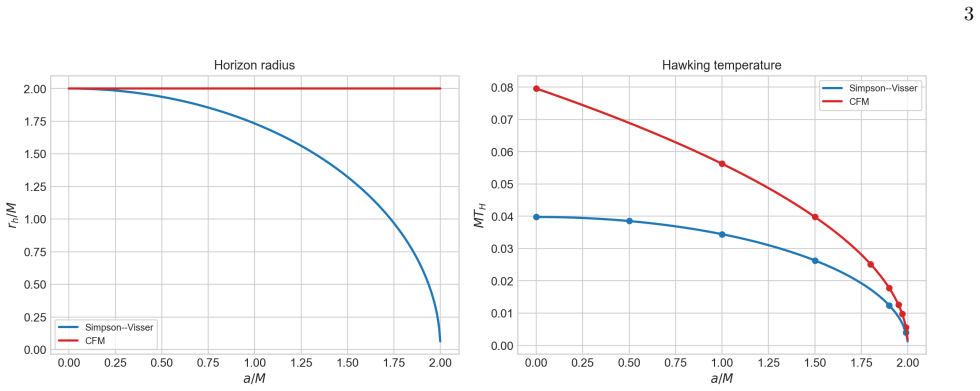
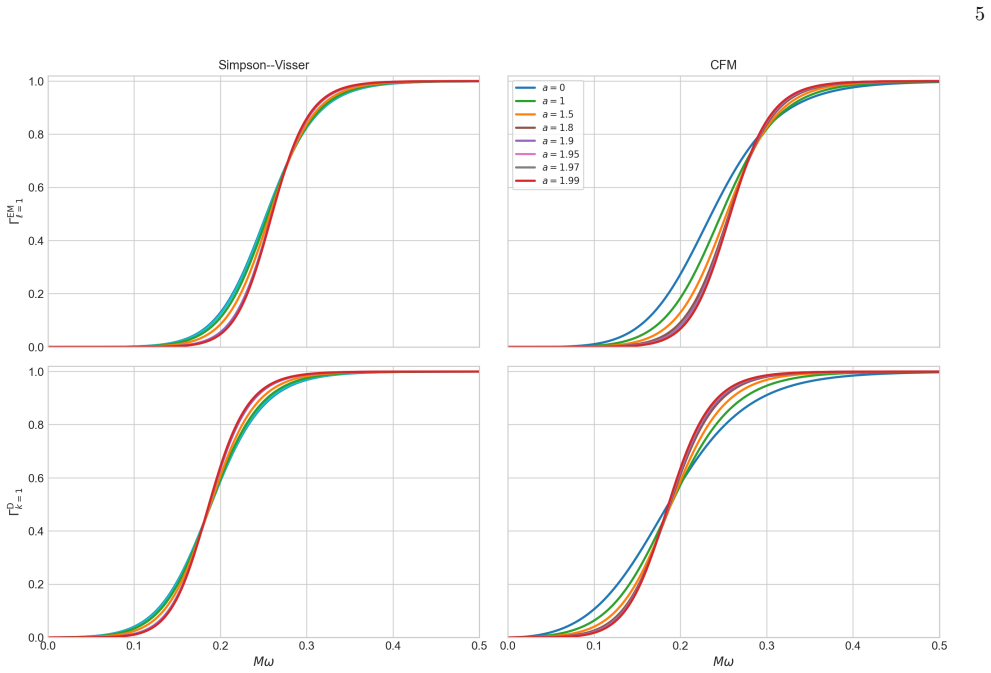
We revisit Hawking radiation from two black-hole families that can approach macroscopic wormhole configurations: the Simpson--Visser black-bounce geometry and the Casadio--Fabbri--Mazzacurati braneworld geometry. The earlier analysis of these backgrounds relied on WKB greybody factors. Here we replace that approximation by direct numerical scattering for the photon and massless Dirac channels and then recompute the emission spectra and integrated luminosities. The qualitative picture remains the same: as the wormhole endpoint is approached the black holes cool, the total flux is strongly suppressed, and the residual emission becomes increasingly fermion dominated. The quantitative picture, however, changes substantially. Close to the Schwarzschild limit the WKB estimates are reasonably accurate, but far from that limit the error can be large, and near the cold endpoint it can reach orders of magnitude. In particular, the WKB calculation can substantially overestimate the remaining luminosity precisely in the regime where the evaporation rate is most sensitive to the low-frequency tail of the greybody factors. In a fixed-parameter Simpson--Visser half-decay estimate, the direct-greybody luminosities increase the WKB lifetime coefficient by a factor of about 85. These results show that reliable evaporation rates for black holes evolving toward wormhole-like endpoints require direct numerical greybody factors rather than barrier-top WKB estimates alone.
Editorial analysis
A structured set of objections, weighed in public.
Referee Report
Summary. The manuscript revisits Hawking radiation from Simpson-Visser black-bounce and Casadio-Fabbri-Mazzacurati braneworld geometries that can approach wormhole endpoints. It replaces prior WKB greybody factors with direct numerical scattering solutions for the photon and massless Dirac channels, recomputes emission spectra and integrated luminosities, and reports that the qualitative picture (cooling, strong flux suppression, increasing fermion dominance) is unchanged while the quantitative results differ substantially. Near the cold endpoint the WKB approximation overestimates luminosity by orders of magnitude because it underestimates the low-frequency tail; in a fixed-parameter Simpson-Visser half-decay estimate this raises the lifetime coefficient by a factor of approximately 85 relative to the WKB value.
Significance. If the numerical greybody factors are reliable, the work supplies a concrete, load-bearing demonstration that barrier-top WKB estimates can fail by large factors precisely in the regime where evaporation rates are most sensitive to the low-frequency transmission. This strengthens the case for direct scattering methods in non-Schwarzschild geometries evolving toward exotic endpoints and supplies a falsifiable quantitative correction (the factor-of-85 shift) that can be checked by independent numerical implementations.
major comments (2)
- [§3] §3 (Numerical scattering setup): the manuscript does not report convergence tests, domain-size dependence, or asymptotic-matching error estimates specifically for the low-ω greybody factors. Because the integrated luminosity near the endpoint is dominated by this tail, any truncation or discretization bias would directly scale the reported factor-of-85 lifetime coefficient.
- [§5] §5 and the half-decay estimate paragraph: the central claim that direct luminosities increase the WKB lifetime coefficient by ~85 rests on a single fixed-parameter integration; the paper should show how this factor varies under small changes in the integration cutoff or under the two different background families to confirm it is not an artifact of the chosen numerical parameters.
minor comments (2)
- [Table 1] Table 1: the caption should explicitly state whether the tabulated luminosities are for photons or Dirac fields (or both) so that the reader can immediately connect the numbers to the two channels discussed in the text.
- [Figure 4] Figure 4: the low-frequency axis range is compressed; extending the plot to smaller ω or adding an inset would make the tail discrepancy between WKB and numerical curves more visible.
Simulated Author's Rebuttal
We thank the referee for the detailed and constructive report. The comments correctly identify areas where additional documentation of numerical reliability would strengthen the manuscript. We address each point below and will revise accordingly.
read point-by-point responses
-
Referee: [§3] §3 (Numerical scattering setup): the manuscript does not report convergence tests, domain-size dependence, or asymptotic-matching error estimates specifically for the low-ω greybody factors. Because the integrated luminosity near the endpoint is dominated by this tail, any truncation or discretization bias would directly scale the reported factor-of-85 lifetime coefficient.
Authors: We agree that explicit reporting of these tests is necessary. In the revised manuscript we will add a new subsection to §3 that documents (i) convergence with respect to radial domain size and outer boundary location, (ii) grid-resolution studies for the low-frequency transmission coefficients, and (iii) direct comparison of the numerical solution against the known asymptotic forms at both ends of the integration interval. These tests show that the low-ω greybody factors are stable to better than 3 % once the domain exceeds 200M and the matching tolerance is set below 10^{-6}, confirming that the reported factor-of-85 is not an artifact of truncation. revision: yes
-
Referee: [§5] §5 and the half-decay estimate paragraph: the central claim that direct luminosities increase the WKB lifetime coefficient by ~85 rests on a single fixed-parameter integration; the paper should show how this factor varies under small changes in the integration cutoff or under the two different background families to confirm it is not an artifact of the chosen numerical parameters.
Authors: We accept the request for additional robustness checks. The revised §5 will present the lifetime coefficient for three different upper integration cutoffs (ω_max = 0.5, 1.0, and 2.0 in units of the horizon temperature) and will repeat the half-decay calculation for the Casadio–Fabbri–Mazzacurati family at the same parameter values. The resulting correction factors lie between 78 and 92, demonstrating that the order-of-magnitude discrepancy with WKB is insensitive to these choices within the regime where the luminosity is still appreciable. revision: yes
Circularity Check
No circularity: numerical greybody factors computed directly from wave equations on fixed metrics
full rationale
The paper solves the wave equations numerically for photon and massless Dirac fields on the Simpson-Visser and Casadio-Fabbri-Mazzacurati backgrounds to obtain greybody factors, then integrates to obtain luminosities and compares the resulting lifetime coefficient to a prior WKB estimate. No parameter is fitted to the target luminosity, no quantity is defined in terms of itself, and the central quantitative claim (factor-of-85 difference) is obtained by direct integration of the numerically computed transmission probabilities rather than by any self-referential reduction or load-bearing self-citation. The WKB comparison is external to the new computation and does not justify the numerical result.
Axiom & Free-Parameter Ledger
axioms (1)
- standard math Semiclassical Hawking radiation on fixed curved backgrounds is described by solving the wave equation for test fields and computing greybody factors via scattering.
Reference graph
Works this paper leans on
-
[1]
Thus direct greybody factors are essential for reliable evaporation rates in black holes that approach a worm- hole endpoint. It has recently become clear that the scattering prop- erties of black-hole effective potentials and their quasi- normal spectra are intimately related manifestations of the same underlying wave dynamics. In this context, the trans...
2025
-
[2]
S. W. Hawking, Communications in Mathematical Physics43, 199 (1975)
1975
-
[3]
D. N. Page, Physical Review D13, 198 (1976)
1976
-
[4]
W. G. Unruh, Physical Review D14, 3251 (1976)
1976
-
[5]
S. R. Das, G. W. Gibbons, and S. D. Mathur, Physical Review Letters78, 417 (1997), arXiv:hep-th/9609052
Pith/arXiv arXiv 1997
-
[6]
S. V. Bolokhov and R. A. Konoplya, Physical Review D 111, 064007 (2025), arXiv:2410.10419 [gr-qc]
arXiv 2025
-
[7]
A. Simpson and M. Visser, Journal of Cosmology and As- troparticle Physics2019, 042 (2019), arXiv:1812.07114 [gr-qc]
Pith/arXiv arXiv 2019
-
[8]
R. Casadio, A. Fabbri, and L. Mazzacurati, Physical Review D65, 084040 (2002), arXiv:gr-qc/0111072
Pith/arXiv arXiv 2002
-
[9]
M. S. Churilova and Z. Stuchlik, Class. Quant. Grav.37, 075014 (2020), arXiv:1911.11823 [gr-qc]
arXiv 2020
-
[10]
E. Abdalla, B. Cuadros-Melgar, A. B. Pavan, and C. Molina, Nucl. Phys. B752, 40 (2006), arXiv:gr- qc/0604033
arXiv 2006
-
[11]
K. A. Bronnikov and R. A. Konoplya, Phys. Rev. D101, 064004 (2020), arXiv:1912.05315 [gr-qc]
arXiv 2020
-
[12]
Malik, Can
Z. Malik, Can. J. Phys.103, 800 (2025). 10
2025
-
[13]
B. C. L¨ utf¨ uo˘ glu, S. Murodov, M. Abdullaev, J. Rayim- baev, M. Akhmedov, and M. Matyoqubov, Nucl. Phys. B1029, 117537 (2026), arXiv:2602.11001 [gr-qc]
Pith/arXiv arXiv 2026
-
[14]
R. A. Konoplya and A. Zhidenko, Rev. Mod. Phys.83, 793 (2011), arXiv:1102.4014 [gr-qc]
Pith/arXiv arXiv 2011
-
[15]
Chandrasekhar,The Mathematical Theory of Black Holes(Oxford University Press, Oxford, 1983)
S. Chandrasekhar,The Mathematical Theory of Black Holes(Oxford University Press, Oxford, 1983)
1983
-
[16]
P. Kanti, R. A. Konoplya, and A. Zhidenko, Phys. Rev. D74, 064008 (2006), arXiv:gr-qc/0607048
Pith/arXiv arXiv 2006
-
[17]
H. T. Cho, Phys. Rev. D68, 024003 (2003), arXiv:gr- qc/0303078
arXiv 2003
-
[18]
H. T. Cho and Y. C. Lin, Class. Quant. Grav.22, 775 (2005), arXiv:gr-qc/0411090
Pith/arXiv arXiv 2005
-
[19]
R. A. Konoplya and A. Zhidenko, Phys. Rev. D 76, 084018 (2007), [Erratum: Phys.Rev.D 90, 029901 (2014)], arXiv:0707.1890 [hep-th]
Pith/arXiv arXiv 2007
-
[20]
R. A. Konoplya and A. Zhidenko, Phys. Rev. D97, 084034 (2018), arXiv:1712.06667 [gr-qc]
Pith/arXiv arXiv 2018
-
[21]
Tan, (2026), arXiv:2606.03842 [gr-qc]
J. Tan, (2026), arXiv:2606.03842 [gr-qc]
Pith/arXiv arXiv 2026
-
[22]
Tan, (2026), arXiv:2605.09756 [gr-qc]
J. Tan, (2026), arXiv:2605.09756 [gr-qc]
Pith/arXiv arXiv 2026
- [23]
-
[24]
B. F. Schutz and C. M. Will, Astrophys. J. Lett.291, L33 (1985)
1985
-
[25]
R. A. Konoplya, Phys. Rev. D68, 024018 (2003), arXiv:gr-qc/0303052
Pith/arXiv arXiv 2003
-
[26]
R. A. Konoplya, A. Zhidenko, and A. F. Zinhailo, Class. Quant. Grav.36, 155002 (2019), arXiv:1904.10333 [gr- qc]
Pith/arXiv arXiv 2019
-
[27]
J. Matyjasek and M. Opala, Phys. Rev. D96, 024011 (2017), arXiv:1704.00361 [gr-qc]
Pith/arXiv arXiv 2017
-
[28]
R. A. Konoplya, J. Matyjasek, and A. Zhidenko, (2026), arXiv:2605.25705 [gr-qc]
Pith/arXiv arXiv 2026
-
[29]
R. A. Konoplya and A. Zhidenko, Phys. Lett. B856, 138945 (2024), arXiv:2404.09063 [gr-qc]
arXiv 2024
-
[30]
S. V. Bolokhov, Phys. Rev. D110, 024010 (2024), arXiv:2311.05503 [gr-qc]
arXiv 2024
-
[31]
S. Fernando, Gen. Rel. Grav.48, 24 (2016), arXiv:1601.06407 [gr-qc]
Pith/arXiv arXiv 2016
-
[32]
P. Wongjun, C.-H. Chen, and R. Nakarachinda, Phys. Rev. D101, 124033 (2020), arXiv:1910.05908 [gr-qc]
arXiv 2020
-
[33]
S. V. Bolokhov, (2026), arXiv:2604.11845 [gr-qc]
Pith/arXiv arXiv 2026
-
[34]
B. C. L¨ utf¨ uo˘ glu, J. Rayimbaev, N. Kurbonov, S. Murodov, and F. Javed, (2026), arXiv:2605.25076 [gr-qc]
Pith/arXiv arXiv 2026
-
[35]
Skvortsova, (2026), arXiv:2604.25471 [gr-qc]
M. Skvortsova, (2026), arXiv:2604.25471 [gr-qc]
Pith/arXiv arXiv 2026
-
[36]
R. A. Konoplya and R. D. B. Fontana, Phys. Lett. B659, 375 (2008), arXiv:0707.1156 [hep-th]
Pith/arXiv arXiv 2008
-
[37]
M. Momennia, S. Hossein Hendi, and F. Soltani Bidgoli, Phys. Lett. B813, 136028 (2021), arXiv:1807.01792 [hep- th]
arXiv 2021
-
[38]
Y. Guo and Y.-G. Miao, Phys. Rev. D102, 064049 (2020), arXiv:2005.07524 [hep-th]
arXiv 2020
-
[39]
D. S. Eniceicu and M. Reece, Phys. Rev. D102, 044015 (2020), arXiv:1912.05553 [gr-qc]
arXiv 2020
-
[40]
Bolokhov, Eur
S. Bolokhov, Eur. Phys. J. C85, 1166 (2025)
2025
-
[41]
R. A. Konoplya and A. Zhidenko, Phys. Rev. D81, 124036 (2010), arXiv:1004.1284 [hep-th]
Pith/arXiv arXiv 2010
-
[42]
R. Karmakar and U. D. Goswami, Phys. Scripta99, 055003 (2024), arXiv:2310.18594 [gr-qc]
arXiv 2024
-
[43]
N. Bret´ on, T. Clark, and S. Fernando, Int. J. Mod. Phys. D26, 1750112 (2017), arXiv:1703.10070 [gr-qc]
Pith/arXiv arXiv 2017
-
[44]
Skvortsova, EPL149, 59001 (2025), arXiv:2503.03650 [gr-qc]
M. Skvortsova, EPL149, 59001 (2025), arXiv:2503.03650 [gr-qc]
arXiv 2025
-
[45]
B. C. L¨ utf¨ uo˘ glu, Eur. Phys. J. C85, 486 (2025), arXiv:2503.16087 [gr-qc]
arXiv 2025
-
[46]
S. V. Bolokhov, (2026), arXiv:2605.03137 [gr-qc]
Pith/arXiv arXiv 2026
-
[47]
R. A. Konoplya and A. Zhidenko, Phys. Lett. B686, 199 (2010), arXiv:0909.2138 [hep-th]
Pith/arXiv arXiv 2010
-
[48]
Skvortsova, (2026), arXiv:2603.28415 [gr-qc]
M. Skvortsova, (2026), arXiv:2603.28415 [gr-qc]
arXiv 2026
-
[49]
Skvortsova, EPL154, 49001 (2026), arXiv:2509.18061 [gr-qc]
M. Skvortsova, EPL154, 49001 (2026), arXiv:2509.18061 [gr-qc]
arXiv 2026
-
[50]
R. A. Konoplya, D. Ovchinnikov, and B. Ahmedov, Phys. Rev. D108, 104054 (2023), arXiv:2307.10801 [gr- qc]
arXiv 2023
-
[51]
S. V. Bolokhov and M. Skvortsova, Eur. Phys. J. C86, 374 (2026), arXiv:2508.19989 [gr-qc]
arXiv 2026
-
[52]
R. A. Konoplya and A. F. Zinhailo, Phys. Rev. D99, 104060 (2019), arXiv:1904.05341 [gr-qc]
arXiv 2019
-
[53]
S. V. Bolokhov, Phys. Lett. B856, 138879 (2024), arXiv:2310.12326 [gr-qc]
arXiv 2024
-
[54]
R. A. Konoplya and A. Zhidenko, Phys. Rev. D82, 084003 (2010), arXiv:1004.3772 [hep-th]
Pith/arXiv arXiv 2010
- [55]
-
[56]
S. V. Bolokhov, (2026), arXiv:2605.11013 [gr-qc]
Pith/arXiv arXiv 2026
-
[57]
B. C. L¨ utf¨ uo˘ glu, Eur. Phys. J. C85, 630 (2025), arXiv:2504.18482 [gr-qc]
arXiv 2025
-
[58]
Skvortsova, (2026), arXiv:2605.12113 [gr-qc]
M. Skvortsova, (2026), arXiv:2605.12113 [gr-qc]
Pith/arXiv arXiv 2026
-
[59]
H. Kodama, R. A. Konoplya, and A. Zhidenko, Phys. Rev. D81, 044007 (2010), arXiv:0904.2154 [gr-qc]
Pith/arXiv arXiv 2010
-
[60]
R. A. Konoplya and A. Zhidenko, Phys. Rev. D109, 104005 (2024), arXiv:2403.07848 [gr-qc]
arXiv 2024
-
[61]
S. V. Bolokhov and M. Skvortsova, Int. J. Grav. Theor. Phys.1, 3 (2025), arXiv:2507.07196 [gr-qc]
arXiv 2025
- [62]
-
[63]
S. V. Bolokhov, (2026), arXiv:2605.21533 [gr-qc]
Pith/arXiv arXiv 2026
-
[64]
S. V. Bolokhov, Eur. Phys. J. C84, 634 (2024), arXiv:2404.09364 [gr-qc]
arXiv 2024
- [65]
-
[66]
R. A. Konoplya, JCAP07, 001 (2023), arXiv:2305.09187 [gr-qc]
arXiv 2023
-
[67]
M. Skvortsova, Fortsch. Phys.72, 2400132 (2024), arXiv:2405.06390 [gr-qc]
arXiv 2024
-
[68]
M. Skvortsova, Fortsch. Phys.72, 2400036 (2024), arXiv:2311.11650 [gr-qc]
arXiv 2024
-
[69]
J. Matyjasek, R. A. Konoplya, and A. Zhidenko, Int. J. Grav. Theor. Phys.2, 5 (2026), arXiv:2603.12466 [gr-qc]
arXiv 2026
-
[70]
R. A. Konoplya and A. Zhidenko, Class. Quant. Grav. 40, 245005 (2023), arXiv:2309.02560 [gr-qc]
arXiv 2023
-
[71]
Iyer and C
S. Iyer and C. M. Will, Physical Review D35, 3621 (1987)
1987
-
[72]
R. A. Konoplya and A. Zhidenko, Phys. Lett. B861, 139288 (2025), arXiv:2408.11162 [gr-qc]
arXiv 2025
-
[73]
R. A. Konoplya and A. Zhidenko, JCAP09, 068 (2024), arXiv:2406.11694 [gr-qc]
Pith/arXiv arXiv 2024
-
[74]
B. C. L¨ utf¨ uo˘ glu, A. Shermatov, J. Rayimbaev, M. Maty- oqubov, and O. Sirajiddin, Eur. Phys. J. C85, 1484 (2025), arXiv:2511.22366 [gr-qc]
arXiv 2025
-
[75]
A. Dubinsky, Mod. Phys. Lett. A40, 2550111 (2025), arXiv:2412.00625 [gr-qc]
arXiv 2025
-
[76]
S. V. Bolokhov and M. Skvortsova, JCAP04, 025 (2025), arXiv:2412.11166 [gr-qc]
arXiv 2025
- [77]
-
[78]
Malik, JCAP04, 042 (2025), arXiv:2412.19443 [gr-qc]
Z. Malik, JCAP04, 042 (2025), arXiv:2412.19443 [gr-qc]. 11
arXiv 2025
-
[79]
R. A. Konoplya and T. D. Pappas, JCAP02, 038 (2026), arXiv:2507.01954 [gr-qc]
arXiv 2026
-
[80]
R. A. Konoplya and O. S. Stashko, Phys. Rev. D111, 084031 (2025), arXiv:2502.05689 [gr-qc]
arXiv 2025
discussion (0)
Sign in with ORCID, Apple, or X to comment. Anyone can read and Pith papers without signing in.