Comparing Controller-Free Pointing Techniques Across Depth for 2D Selection in Augmented Reality
Pith reviewed 2026-06-27 18:11 UTC · model grok-4.3
The pith
Head-based pointing is the most accurate and consistent controller-free method for 2D AR selection across depths.
A machine-rendered reading of the paper's core claim, the machinery that carries it, and where it could break.
Core claim
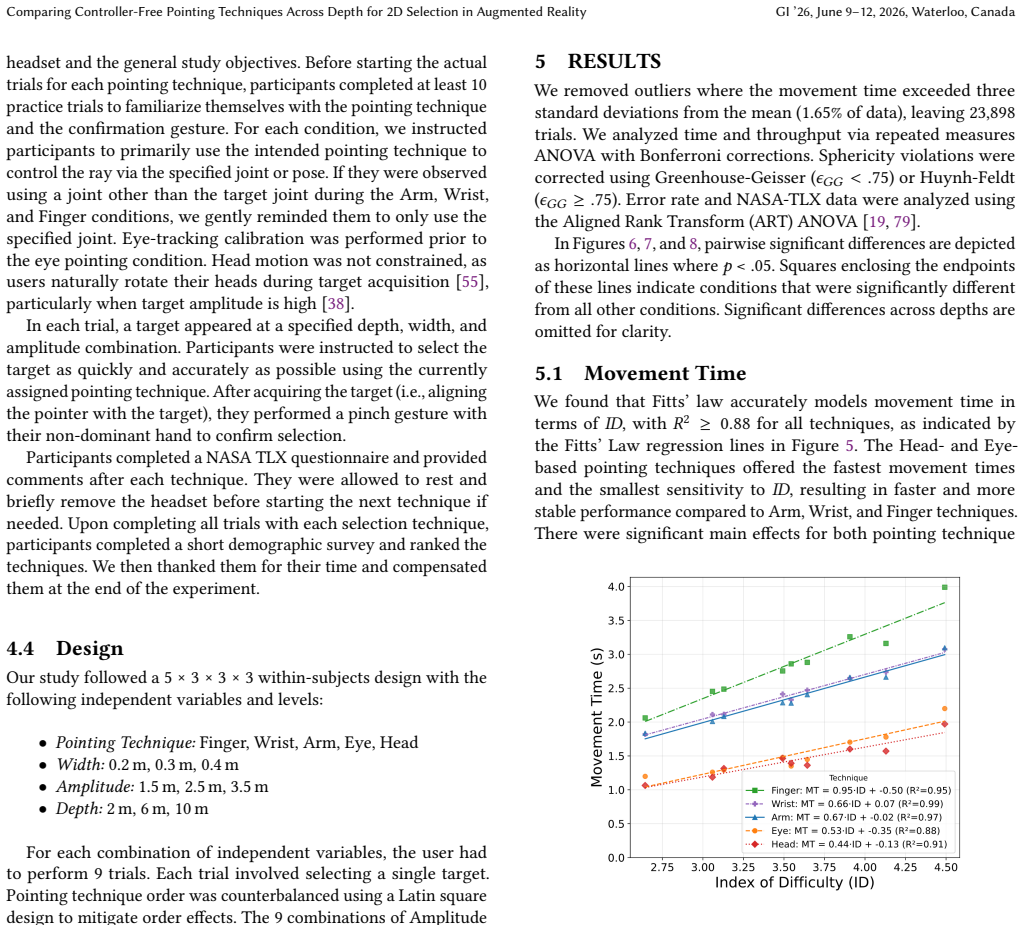
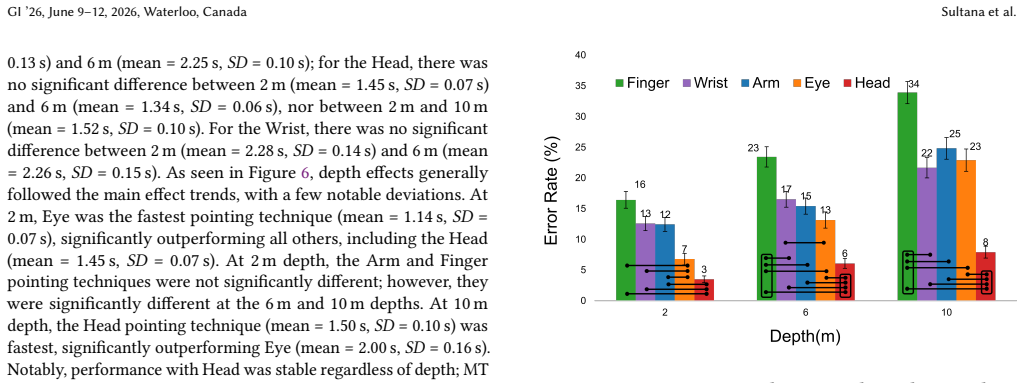
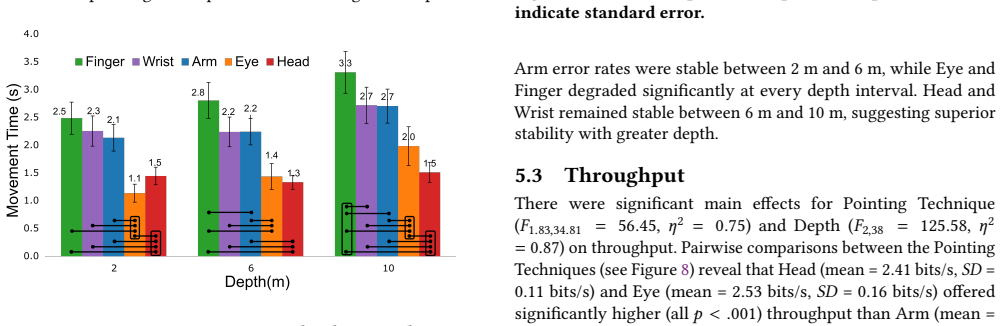
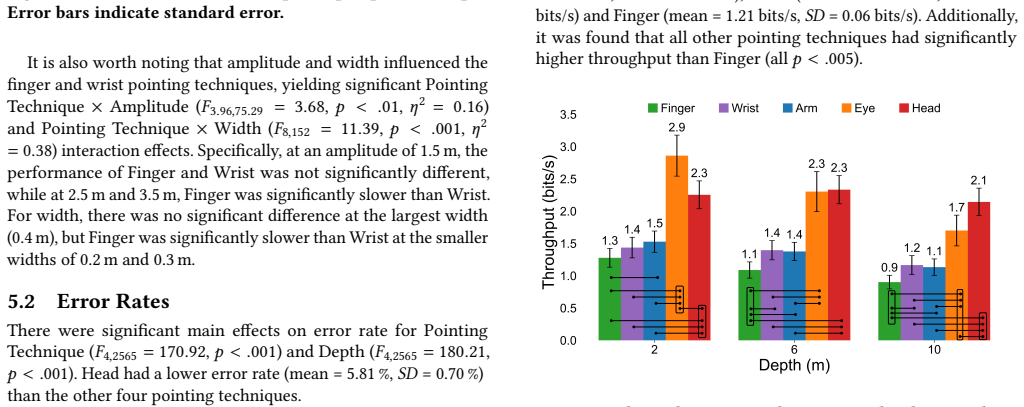
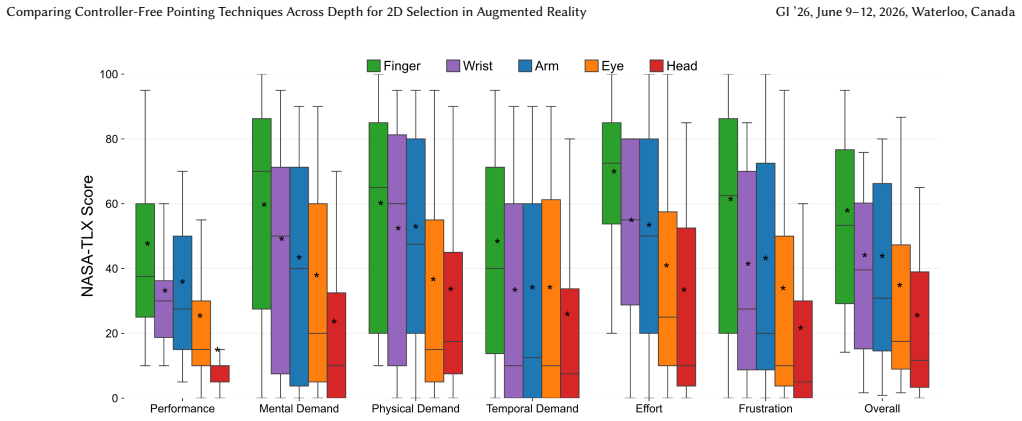
Head- and eye-based pointing significantly outperformed the hand-based methods in movement time, accuracy, throughput, and workload. Head input was the most accurate and remained the most consistent across depth. Depth significantly impacted performance, with complex interactions with target size and distance.
What carries the argument
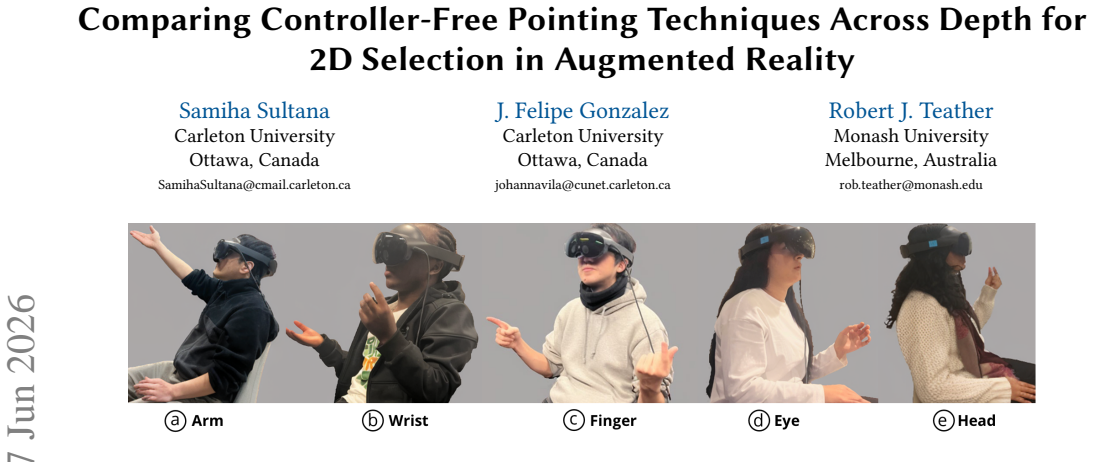
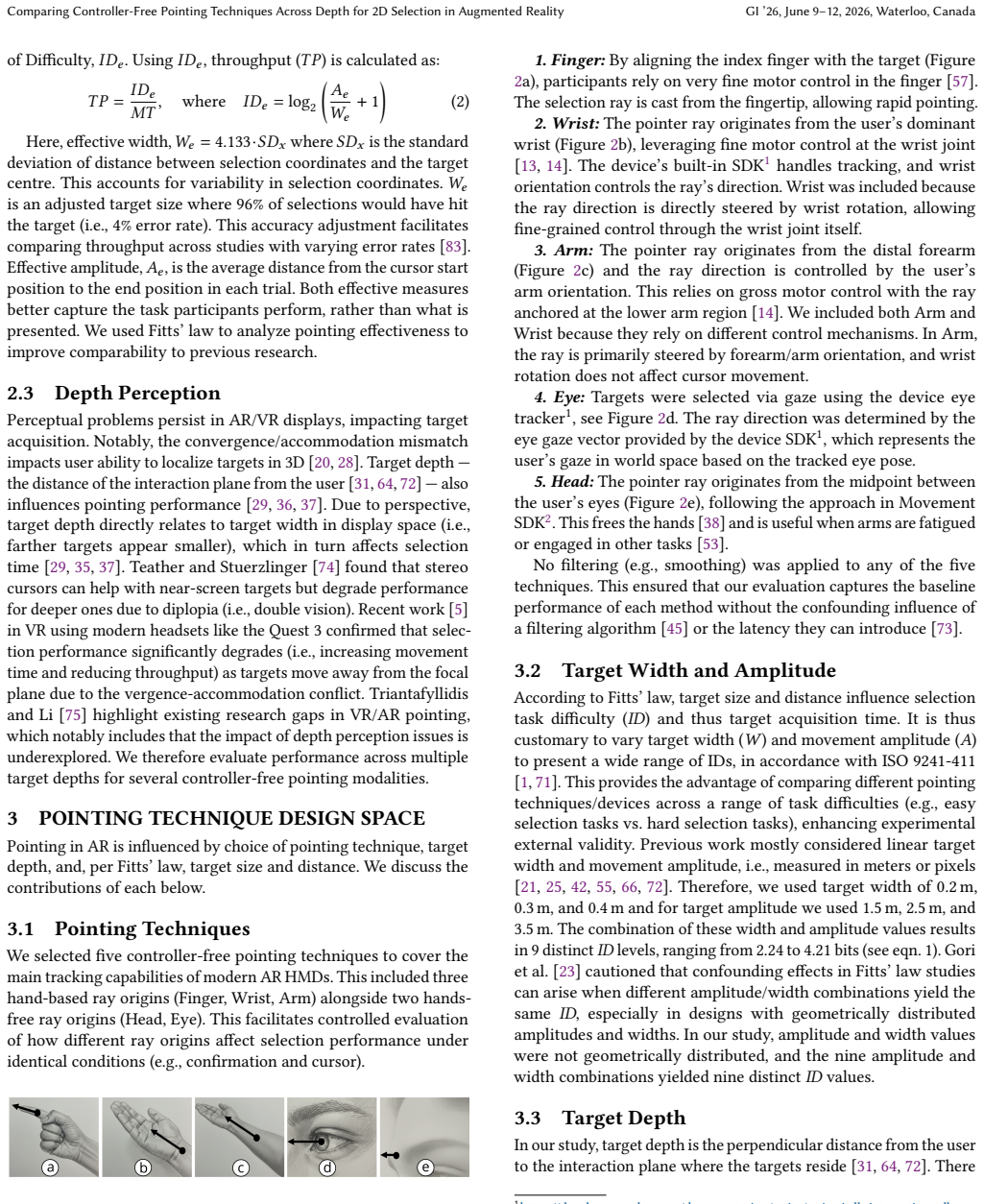
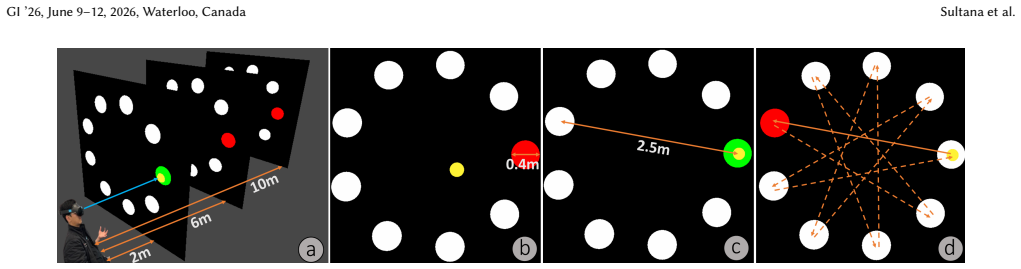
ISO 9241-411 evaluation of five controller-free techniques (Head, Eye, Finger, Wrist, Arm) across three fixed depths.
If this is right
- Head input can be prioritized for AR tasks that span multiple depths.
- Hand-based methods become less competitive as target distance increases.
- Eye input offers strong performance but is less stable than head input across depths.
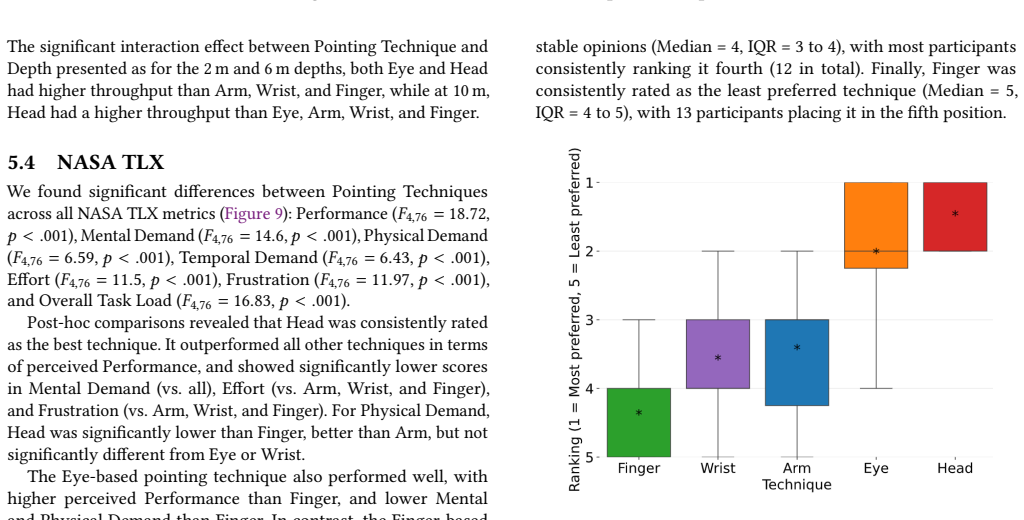
- Workload ratings favor head and eye methods over finger, wrist, or arm gestures.
Where Pith is reading between the lines
- AR interface designers may default to head tracking for distant or variable-depth targets.
- Testing the same techniques while users walk or turn could reveal additional depth-related costs.
- Hybrid inputs that switch between head and eye based on depth might reduce overall errors.
Load-bearing premise
The ISO 9241-411 protocol together with the five chosen techniques and three depths adequately represents performance differences in actual AR use.
What would settle it
Finding that any hand-based technique matches or exceeds head input in accuracy or throughput at 10 m depth under the same protocol would undermine the main result.
Figures
read the original abstract
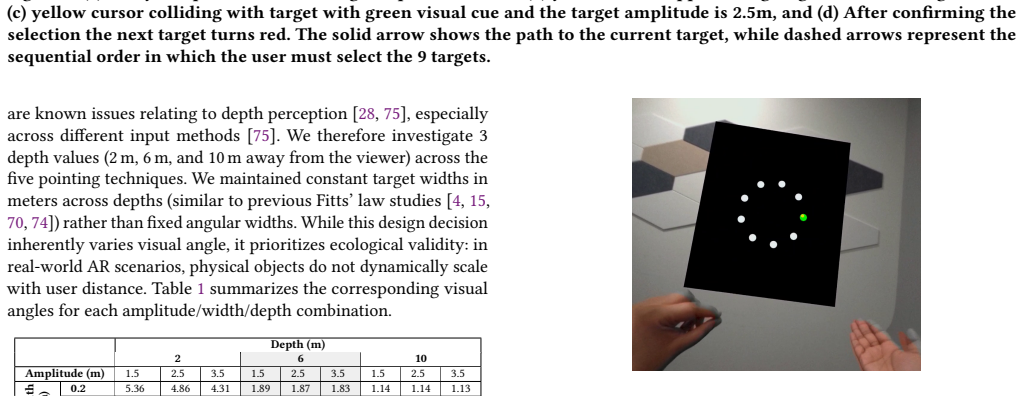
This paper presents a systematic evaluation of five controller-free pointing techniques for 2D target selection in AR, using ISO 9241-411. We compared them across multiple depths (2 m, 6 m, 10 m) in terms of movement time, accuracy, throughput, and workload (NASA TLX). Head- and eye-based pointing significantly outperformed the hand-based methods (Finger, Wrist, and Arm); Head input was the most accurate and remained the most consistent across depth. Depth significantly impacted performance, with complex interactions with target size and distance. Our results offer a comprehensive empirical basis for selecting appropriate controller-free techniques in depth-varying AR tasks.
Editorial analysis
A structured set of objections, weighed in public.
Referee Report
Summary. This paper presents a systematic empirical evaluation of five controller-free pointing techniques (Head, Eye, Finger, Wrist, Arm) for 2D target selection in augmented reality. Using the ISO 9241-411 protocol, it compares the techniques across three fixed depths (2 m, 6 m, 10 m) on movement time, accuracy, throughput, and NASA TLX workload. The central claims are that head- and eye-based methods significantly outperform the hand-based methods, that head input is the most accurate and remains most consistent across depth, and that depth has significant effects with complex interactions involving target size and distance.
Significance. If the empirical ordering and depth-interaction results hold with adequate statistical support, the work supplies a practical, protocol-based comparison that can inform technique selection for depth-varying AR tasks. The use of a standard ISO metric set and direct multi-depth testing is a clear strength for reproducibility and applicability.
major comments (2)
- [Abstract] Abstract: the claims of 'significant outperformance' by head- and eye-based methods and of 'depth significantly impacted performance' are stated without any accompanying sample size, statistical test results, error bars, or exclusion criteria. These details are required to evaluate whether the reported ordering is load-bearing or could be explained by sampling variability.
- [Abstract / Methods] The manuscript relies on the assumption that the five chosen techniques plus the three fixed depths and ISO 9241-411 protocol adequately capture performance differences relevant to real AR use; however, no sensitivity analysis or comparison to alternative protocols is provided to test this assumption.
minor comments (1)
- [Abstract] The abstract would benefit from a brief parenthetical note on participant count and key statistical outcomes to make the summary self-contained.
Simulated Author's Rebuttal
We thank the referee for their constructive comments on our manuscript. We provide point-by-point responses below, indicating where we agree and will revise the manuscript.
read point-by-point responses
-
Referee: [Abstract] Abstract: the claims of 'significant outperformance' by head- and eye-based methods and of 'depth significantly impacted performance' are stated without any accompanying sample size, statistical test results, error bars, or exclusion criteria. These details are required to evaluate whether the reported ordering is load-bearing or could be explained by sampling variability.
Authors: We agree that the abstract would benefit from additional statistical context. The full manuscript reports the study details including sample size, repeated-measures ANOVA results, and exclusion criteria in the Methods section, along with error bars in the figures. We will revise the abstract to concisely reference the participant count, note the statistical tests confirming the significant effects for technique and depth, and indicate the error bar conventions used. This will improve transparency without substantially lengthening the abstract. revision: yes
-
Referee: [Abstract / Methods] The manuscript relies on the assumption that the five chosen techniques plus the three fixed depths and ISO 9241-411 protocol adequately capture performance differences relevant to real AR use; however, no sensitivity analysis or comparison to alternative protocols is provided to test this assumption.
Authors: We respectfully maintain that the selected techniques, depths, and ISO 9241-411 protocol are appropriate and justified for the study's goals, as explained in the Introduction and Methods: the techniques cover common controller-free approaches in AR, the protocol is a standard for 2D pointing evaluation, and the depths span typical AR ranges. A sensitivity analysis or direct comparison to alternative protocols falls outside the scope of this controlled empirical comparison. However, we will partially revise by expanding the Methods and Limitations sections to more explicitly justify these choices and discuss generalizability constraints. revision: partial
Circularity Check
No significant circularity: purely empirical comparison study
full rationale
This is a standard user study paper that applies the ISO 9241-411 protocol to compare five controller-free pointing techniques at three fixed depths. The central claims (head pointing most accurate and depth-consistent) are direct empirical outcomes from measured movement time, error rate, throughput, and NASA TLX scores. No equations, fitted parameters, derivations, or predictions appear in the text. No self-citations are used to justify uniqueness or load-bearing premises. The protocol and metrics are external standards, making the study self-contained against external benchmarks with no reduction of results to inputs by construction.
Axiom & Free-Parameter Ledger
Reference graph
Works this paper leans on
-
[1]
ISO/TS 9241-411:2012 Ergonomics of human-system interaction Part 411: Evaluation methods for the design of physical input devices
2012. ISO/TS 9241-411:2012 Ergonomics of human-system interaction Part 411: Evaluation methods for the design of physical input devices. https://www.iso. org/standard/54106.html https://www.iso.org/standard/54106.html
2012
-
[2]
Mohammadreza Amini, Wolfgang Stuerzlinger, Robert J Teather, and Anil Ufuk Batmaz. 2025. A Systematic Review of Fitts’ Law in 3D Extended Reality. In Proceedings of the 2025 CHI Conference on Human Factors in Computing Systems (CHI ’25). Association for Computing Machinery, New York, NY, USA, 1–25. https://doi.org/10.1145/3706598.3713623
-
[3]
Ferran Argelaguet and Carlos Andujar. 2009. Efficient 3D Pointing Selection in Cluttered Virtual Environments.IEEE Computer Graphics and Applications29, 6 (Nov. 2009), 34–43. https://doi.org/10.1109/MCG.2009.117 Conference Name: IEEE Computer Graphics and Applications
-
[4]
Mayra Donaji Barrera Machuca and Wolfgang Stuerzlinger. 2019. The Effect of Stereo Display Deficiencies on Virtual Hand Pointing. InProceedings of the 2019 CHI Conference on Human Factors in Computing Systems (CHI ’19). Association for Computing Machinery, New York, NY, USA, 1–14. https://doi.org/10.1145/ 3290605.3300437
arXiv 2019
-
[5]
Mohammad Raihanul Bashar, Mayra Donaji Barrera Machuca, Wolfgang Stuerzlinger, and Anil Ufuk Batmaz. 2025. The effect of visual depth on the vergence–accommodation conflict on 3D selection performance within virtual reality headsets: MR Bashar et al.The Visual Computer41, 12 (2025), 9645–9661. https://doi.org/10.1007/s00371-025-03990-x
-
[6]
Anil Ufuk Batmaz, Mayra Donaji Barrera Machuca, Duc Minh Pham, and Wolfgang Stuerzlinger. 2019. Do Head-Mounted Display Stereo Deficiencies Affect 3D Pointing Tasks in AR and VR?. In2019 IEEE Conference on Virtual Reality and 3D User Interfaces (VR). 585–592. https://doi.org/10.1109/VR.2019.8797975 ISSN: 2642-5254
-
[7]
Bernardos, Gómez , David, , and José R
Ana M. Bernardos, Gómez , David, , and José R. Casar. 2016. A Comparison of Head Pose and Deictic Pointing Interaction Methods for Smart Environments. International Journal of Human–Computer Interaction32, 4 (April 2016), 325–351. https://doi.org/10.1080/10447318.2016.1142054 Publisher: Taylor & Francis
-
[8]
Jonas Blattgerste, Patrick Renner, and Thies Pfeiffer. 2018. Advantages of eye- gaze over head-gaze-based selection in virtual and augmented reality under varying field of views. InProceedings of the Workshop on Communication by Gaze Interaction (COGAIN ’18). Association for Computing Machinery, New York, NY, USA, 1–9. https://doi.org/10.1145/3206343.3206349
-
[9]
Doug Bowman, Vinh Ly, Joshua Campbell, and Virginia Tech. 2001. Pinch keyboard: Natural text input for immersive virtual environments. (Jan. 2001). http://hdl.handle.net/10919/20010
2001
-
[10]
Doug A. Bowman, Donald B. Johnson, and Larry F. Hodges. 1999. Testbed evaluation of virtual environment interaction techniques. InProceedings of the ACM symposium on Virtual reality software and technology (VRST ’99). Association for Computing Machinery, New York, NY, USA, 26–33. https://doi.org/10.1145/ 323663.323667
arXiv 1999
-
[11]
Gavin Buckingham. 2021. Hand Tracking for Immersive Virtual Reality: Opportunities and Challenges.Frontiers in Virtual Reality2 (Oct. 2021). https: //doi.org/10.3389/frvir.2021.728461 Publisher: Frontiers
-
[12]
Lizhou Cao, Huadong Zhang, Chao Peng, and Jeffrey T. Hansberger. 2023. Real- time multimodal interaction in virtual reality - a case study with a large virtual interface.Multimedia Tools Appl.82, 16 (Feb. 2023), 25427–25448. https://doi. org/10.1007/s11042-023-14381-6
-
[13]
Sohan Chowdhury, William Delamare, Pourang Irani, and Khalad Hasan. 2023. PAWS: Personalized Arm and Wrist Movements With Sensitivity Mappings for Controller-Free Locomotion in Virtual Reality.Proc. ACM Hum.-Comput. Interact. 7, MHCI (Sept. 2023), 217:1–217:21. https://doi.org/10.1145/3604264
-
[14]
Sohan Chowdhury, A K M Amanat Ullah, Nathan Bruce Pelmore, Pourang Irani, and Khalad Hasan. 2022. WriArm: Leveraging Wrist Movement to Design Wrist+Arm Based Teleportation in VR. In2022 IEEE International Symposium on Mixed and Augmented Reality (ISMAR). 317–325. https://doi.org/10.1109/ ISMAR55827.2022.00047 ISSN: 1554-7868
arXiv 2022
-
[15]
Logan D. Clark, Aakash B. Bhagat, and Sara L. Riggs. 2020. Extending Fitts’ law in three-dimensional virtual environments with current low-cost virtual reality technology.International Journal of Human-Computer Studies139 (July 2020), 102413. https://doi.org/10.1016/j.ijhcs.2020.102413
-
[16]
Nathan Cournia, John D. Smith, and Andrew T. Duchowski. 2003. Gaze- vs. hand-based pointing in virtual environments. InCHI ’03 extended abstracts on Human factors in computing systems - CHI ’03. ACM Press, Ft. Lauderdale, Florida, USA, 772. https://doi.org/10.1145/765891.765982
-
[17]
Crossman
E.R.F.W. Crossman. 1957. The speed and accuracy of hand movements. The Nature and Acquisition of Industrial Skill
1957
-
[18]
Czerwinski, Greg Smith, Tim Regan, B
M. Czerwinski, Greg Smith, Tim Regan, B. Meyers, G. Robertson, and G. Starkweather. 2003. Toward Characterizing the Productivity Benefits of Very Large Displays. https://www.semanticscholar.org/ paper/Toward-Characterizing-the-Productivity-Benefits-of-Czerwinski- Smith/d3076f1e3c19bcf2a46922294aa67ddb1d36b34b
2003
-
[19]
Lisa A. Elkin, Matthew Kay, James J. Higgins, and Jacob O. Wobbrock. 2021. An Aligned Rank Transform Procedure for Multifactor Contrast Tests. InThe 34th Annual ACM Symposium on User Interface Software and Technology (UIST ’21). Association for Computing Machinery, New York, NY, USA, 754–768. https: //doi.org/10.1145/3472749.3474784
-
[20]
Ajoy S. Fernandes, Murdison , T. Scott, , and Michael J. Proulx. 2025. Looking in Depth: Targeting by Eye and Controller Input for Multi-Depth Target Placement. International Journal of Human–Computer Interaction41, 13 (July 2025). https: //doi.org/10.1080/10447318.2024.2401657 Publisher: Taylor & Francis, pages = 7952–7967,
-
[21]
Paul M. Fitts. 1954. The information capacity of the human motor system in controlling the amplitude of movement.Journal of Experimental Psychology47, 6 (1954), 381–391. https://doi.org/10.1037/h0055392 Place: US Publisher: American Psychological Association
-
[22]
Anton Franzluebbers and Kyle Johnsen. 2023. Versatile Mixed-method Locomotion under Free-hand and Controller-based Virtual Reality Interfaces. In Proceedings of the 29th ACM Symposium on Virtual Reality Software and Technology (VRST ’23). Association for Computing Machinery, New York, NY, USA, 1–10. https://doi.org/10.1145/3611659.3615701
-
[23]
Julien Gori, Olivier Rioul, Yves Guiard, and Michel Beaudouin-Lafon. 2018. The perils of confounding factors: how Fitts’ law experiments can lead to false conclusions. InProceedings of the 2018 CHI Conference on Human Factors in Computing Systems. 1–10. https://doi.org/10.1145/3173574.3173770
-
[24]
Scott MacKenzie, and Per Bækgaard
John Paulin Hansen, Vijay Rajanna, I. Scott MacKenzie, and Per Bækgaard. 2018. A Fitts’ law study of click and dwell interaction by gaze, head and mouse with a head-mounted display. InProceedings of the Workshop on Communication by Gaze Interaction (COGAIN ’18). Association for Computing Machinery, New York, NY, USA, 1–5. https://doi.org/10.1145/3206343.3206344
-
[25]
Faizan Haque, Mathieu Nancel, and Daniel Vogel. 2015. Myopoint: Pointing and Clicking Using Forearm Mounted Electromyography and Inertial Motion Sensors. InProceedings of the 33rd Annual ACM Conference on Human Factors in Computing Systems (CHI ’15). Association for Computing Machinery, New York, NY, USA, 3653–3656. https://doi.org/10.1145/2702123.2702133
-
[26]
Sandra G. Hart. 2006. Nasa-Task Load Index (NASA-TLX); 20 Years Later. Proceedings of the Human Factors and Ergonomics Society Annual Meeting50, 9 (Oct. 2006), 904–908. https://doi.org/10.1177/154193120605000909 Publisher: SAGE Publications Inc
-
[27]
Juan David Hincapié-Ramos, Xiang Guo, Paymahn Moghadasian, and Pourang Irani. 2014. Consumed endurance: a metric to quantify arm fatigue of mid- air interactions. InProceedings of the SIGCHI Conference on Human Factors in Computing Systems (CHI ’14). Association for Computing Machinery, New York, NY, USA, 1063–1072. https://doi.org/10.1145/2556288.2557130
-
[28]
David M. Hoffman, Ahna R. Girshick, Kurt Akeley, and Martin S. Banks. 2008. Vergence–accommodation conflicts hinder visual performance and cause visual fatigue.Journal of Vision8, 3 (March 2008), 33. https://doi.org/10.1167/8.3.33
-
[29]
Juan Pablo Hourcade and Natasha Bullock-Rest. 2012. How small can you go? analyzing the effect of visual angle in pointing tasks. InProceedings of the SIGCHI Conference on Human Factors in Computing Systems (CHI ’12). Association for Computing Machinery, New York, NY, USA, 213–216. https://doi.org/10.1145/ 2207676.2207706
arXiv 2012
-
[30]
Rachel Huang, Carisa Harris-adamson, Dan Odell, and David Rempel. 2019. Design of finger gestures for locomotion in virtual reality.Virtual Reality & Intelligent Hardware1, 1 (Feb. 2019), 1–9. https://doi.org/10.3724/SP.J.2096- 5796.2018.0007
-
[31]
Izabelle Janzen, Vasanth K. Rajendran, and Kellogg S. Booth. 2016. Modeling the Impact of Depth on Pointing Performance. InProceedings of the 2016 CHI Conference on Human Factors in Computing Systems (CHI ’16). Association for Computing Machinery, New York, NY, USA, 188–199. https://doi.org/10.1145/ 2858036.2858244
arXiv 2016
-
[32]
Adam Jones, J
J. Adam Jones, J. Edward Swan, Gurjot Singh, Eric Kolstad, and Stephen R. Ellis
-
[33]
InProceedings of the 5th symposium on Applied perception in graphics and visualization (APGV ’08)
The effects of virtual reality, augmented reality, and motion parallax on egocentric depth perception. InProceedings of the 5th symposium on Applied perception in graphics and visualization (APGV ’08). Association for Computing Machinery, New York, NY, USA, 9–14. https://doi.org/10.1145/1394281.1394283
-
[34]
Chaowanan Khundam. 2015. First person movement control with palm normal and hand gesture interaction in virtual reality. In2015 12th International Joint Conference on Computer Science and Software Engineering (JCSSE). 325–330. https: //doi.org/10.1109/JCSSE.2015.7219818
-
[35]
Daehwa Kim, Keunwoo Park, and Geehyuk Lee. 2021. AtaTouch: Robust Finger Pinch Detection for a VR Controller Using RF Return Loss. InProceedings of the 2021 CHI Conference on Human Factors in Computing Systems (CHI ’21). Association for Computing Machinery, New York, NY, USA, 1–9. https://doi. org/10.1145/3411764.3445442
-
[36]
Haejun Kim, Yuhwa Hong, Jihae Yu, Shuping Xiong, and Woojoo Kim. 2025. The Effect of Target Depth on Performance of Multi-directional Tapping Task in Virtual Reality. InProceedings of the Extended Abstracts of the CHI Conference on Human Factors in Computing Systems (CHI EA ’25). Association for Computing Machinery, New York, NY, USA, 1–8. https://doi.org...
-
[37]
Heliyon9(4), 14534 (2023) https://doi.org/10.1016/j
Regis Kopper, Doug A. Bowman, Mara G. Silva, and Ryan P. McMahan. 2010. A human motor behavior model for distal pointing tasks.International Journal of Human-Computer Studies68, 10 (Oct. 2010), 603–615. https://doi.org/10.1016/j. ijhcs.2010.05.001
work page doi:10.1016/j 2010
-
[38]
A. J. Kovacs, J. J. Buchanan, and C. H. Shea. 2008. Perceptual influences on Fitts’ law.Experimental Brain Research190, 1 (Sept. 2008), 99–103. https://doi.org/10. 1007/s00221-008-1497-3
2008
-
[39]
Mikko Kytö, Barrett Ens, Thammathip Piumsomboon, Gun A. Lee, and Mark Billinghurst. 2018. Pinpointing: Precise Head- and Eye-Based Target Selection for Augmented Reality. InProceedings of the 2018 CHI Conference on Human Factors in Computing Systems (CHI ’18). Association for Computing Machinery, New York, NY, USA, 1–14. https://doi.org/10.1145/3173574.3173655
-
[40]
LaViola, Ernst Kruijff, Ryan P
Joseph J. LaViola, Ernst Kruijff, Ryan P. McMahan, Doug A. Bowman, and Ivan Poupyrev. 2017.3D user interfaces: theory and practice(second edition ed.). Addison-Wesley
2017
-
[41]
Jihyeon Lee, Jinwook Kim, and Jeongmi Lee. 2023. Comparison of Virtual Reality Teleportation Targeting Method Performance depending on the Teleport Distance. In2023 IEEE International Symposium on Mixed and Augmented Reality Adjunct (ISMAR-Adjunct). 742–745. https://doi.org/10.1109/ISMAR-Adjunct60411.2023. 00160 ISSN: 2771-1110
-
[42]
Chiuhsiang Joe Lin, Sui-Hua Ho, and Yan-Jyun Chen. 2015. An investigation of pointing postures in a 3D stereoscopic environment.Applied Ergonomics48 (May 2015), 154–163. https://doi.org/10.1016/j.apergo.2014.12.001
-
[43]
Lars Lischke, Valentin Schwind, Kai Friedrich, Albrecht Schmidt, and Niels Henze
-
[44]
MAGIC-Pointing on Large High-Resolution Displays. InProceedings of the 2016 CHI Conference Extended Abstracts on Human Factors in Computing Systems (CHI EA ’16). Association for Computing Machinery, New York, NY, USA, 1706–1712. https://doi.org/10.1145/2851581.2892479
-
[45]
Lystbæk, Peter Rosenberg, Ken Pfeuffer, Jens Emil Grønbæk, and Hans Gellersen
Mathias N. Lystbæk, Peter Rosenberg, Ken Pfeuffer, Jens Emil Grønbæk, and Hans Gellersen. 2022. Gaze-Hand Alignment: Combining Eye Gaze and Mid-Air Pointing for Interacting with Menus in Augmented Reality.Proc. ACM Hum.- Comput. Interact.6, ETRA (May 2022), 145:1–145:18. https://doi.org/10.1145/ 3530886
2022
-
[46]
I. Scott MacKenzie. 1992. Fitts’ Law as a Research and Design Tool in Human- Computer Interaction.Human–Computer Interaction7, 1 (March 1992), 91–139. https://doi.org/10.1207/s15327051hci0701_3 Publisher: Taylor & Francis
-
[47]
Pavel Manakhov, Ludwig Sidenmark, Ken Pfeuffer, and Hans Gellersen. 2024. Filtering on the Go: Effect of Filters on Gaze Pointing Accuracy During Physical Locomotion in Extended Reality.IEEE Transactions on Visualization and Computer Graphics30, 11 (Nov. 2024), 7234–7244. https://doi.org/10.1109/TVCG.2024. 3456153
-
[48]
Madhur Mangalam, Sanjay Oruganti, Gavin Buckingham, and Christoph W. Borst
-
[49]
Enhancing hand-object interactions in virtual reality for precision manual tasks.Virtual Reality28, 4 (Nov. 2024), 166. https://doi.org/10.1007/s10055-024- 01055-3
-
[50]
Meta. 2025. Meta Quest MR, VR Headsets & Accessories. https://www.meta. com/ca/quest
2025
-
[51]
Mifsud, Adam S
Domenick M. Mifsud, Adam S. Williams, Francisco Ortega, and Robert J. Teather
-
[52]
In2022 IEEE Conference on Virtual Reality and 3D User Interfaces Abstracts and Workshops (VRW)
Augmented Reality Fitts’ Law Input Comparison Between Touchpad, Pointing Gesture, and Raycast. In2022 IEEE Conference on Virtual Reality and 3D User Interfaces Abstracts and Workshops (VRW). 590–591. https://doi.org/10.1109/ VRW55335.2022.00146
arXiv 2022
-
[53]
Scott MacKenzie, Per Bækgaard, and Vijay Rajanna
Katsumi Minakata, John Paulin Hansen, I. Scott MacKenzie, Per Bækgaard, and Vijay Rajanna. 2019. Pointing by gaze, head, and foot in a head-mounted display. InProceedings of the 11th ACM Symposium on Eye Tracking Research & Applications (ETRA ’19). Association for Computing Machinery, New York, NY, USA, 1–9. https://doi.org/10.1145/3317956.3318150
-
[54]
Mark R. Mine. 1995.Virtual Environment Interaction Techniques. Technical Report. University of North Carolina at Chapel Hill, USA. https://www.cs.unc. edu/techreports/95-018.pdf
1995
-
[55]
Pedro Monteiro, Guilherme Gonçalves, Bruno Peixoto, Miguel Melo, and Maximino Bessa. 2023. Evaluation of Hands-Free VR Interaction Methods During a Fitts’ Task: Efficiency and Effectiveness.IEEE Access11 (2023), 70898–70911. https://doi.org/10.1109/ACCESS.2023.3293057 Conference Name: IEEE Access
-
[56]
Aunnoy K Mutasim, Anil Ufuk Batmaz, and Wolfgang Stuerzlinger. 2021. Pinch, Click, or Dwell: Comparing Different Selection Techniques for Eye-Gaze-Based Pointing in Virtual Reality. InACM Symposium on Eye Tracking Research and Applications (ETRA ’21 Short Papers). Association for Computing Machinery, New York, NY, USA, 1–7. https://doi.org/10.1145/3448018.3457998
-
[57]
Myers, Rishi Bhatnagar, Jeffrey Nichols, Choon Hong Peck, Dave Kong, Robert Miller, and A
Brad A. Myers, Rishi Bhatnagar, Jeffrey Nichols, Choon Hong Peck, Dave Kong, Robert Miller, and A. Chris Long. 2002. Interacting at a distance: measuring the performance of laser pointers and other devices. InProceedings of the SIGCHI Conference on Human Factors in Computing Systems (CHI ’02). Association for Computing Machinery, New York, NY, USA, 33–40....
arXiv 2002
-
[58]
Djallil Naceri, Ryad Chellali, Fabien Dionnet, and Simone Toma. 2010. Depth Perception Within Virtual Environments: Comparison Between two Display Technologies.International Journal on Advances in Intelligent Systems3 (Jan. 2010), 51–64. https://www.researchgate.net/publication/242330470
arXiv 2010
-
[59]
Irani, and Michel Beaudouin-Lafon
Mathieu Nancel, Olivier Chapuis, Emmanuel Pietriga, Xing-Dong Yang, Pourang P. Irani, and Michel Beaudouin-Lafon. 2013. High-precision pointing on large wall displays using small handheld devices. InProceedings of the SIGCHI Conference on Human Factors in Computing Systems (CHI ’13). Association for Computing Machinery, New York, NY, USA, 831–840. https:/...
arXiv 2013
-
[60]
Bakdauren Narbayev, A K M Amanat Ullah, Jaisie Sin, Patricia Lasserre, and Khalad Hasan. 2025. Exploring Pointing and Confirmation Techniques for Teleportation Across Varying Elevations in Virtual Reality . In2025 IEEE International Symposium on Mixed and Augmented Reality (ISMAR). IEEE Computer Society, Los Alamitos, CA, USA, 1671–1681. https://doi.org/1...
arXiv 2025
-
[61]
Ian Oakley, John Sunwoo, and Il-Yeon Cho. 2008. Pointing with fingers, hands and arms for wearable computing. InCHI ’08 Extended Abstracts on Human Factors in Computing Systems (CHI EA ’08). Association for Computing Machinery, New York, NY, USA, 3255–3260. https://doi.org/10.1145/1358628.1358840
-
[62]
Natalia Ocampo, J Felipe Gonzalez, and Robert J Teather. 2025. Comparing Hand and Controller Avatars with Hand Tracking and Controller-Based Interaction. In2025 IEEE International Symposium on Mixed and Augmented Reality (ISMAR). IEEE, 164–174. https://doi.org/10.1109/ISMAR67309.2025.00029
-
[63]
Ken Pfeuffer, Benedikt Mayer, Diako Mardanbegi, and Hans Gellersen. 2017. Gaze + pinch interaction in virtual reality. InProceedings of the 5th Symposium on Spatial User Interaction (SUI ’17). Association for Computing Machinery, New York, NY, USA, 99–108. https://doi.org/10.1145/3131277.3132180
-
[64]
Aniruddha Prithul, Jiwan Bhandari, Walker Spurgeon, and Eelke Folmer. 2022. Evaluation of Hands-free Teleportation in VR. InProceedings of the 2022 ACM Symposium on Spatial User Interaction (SUI ’22). Association for Computing Machinery, New York, NY, USA, 1–6. https://doi.org/10.1145/3565970.3567683
-
[65]
Yuan Yuan Qian and Robert J. Teather. 2017. The eyes don’t have it: an empirical comparison of head-based and eye-based selection in virtual reality. InProceedings of the 5th Symposium on Spatial User Interaction (SUI ’17). Association for Computing Machinery, New York, NY, USA, 91–98. https://doi.org/10.1145/ 3131277.3132182
arXiv 2017
-
[66]
Alexander Schäfer, Gerd Reis, and Didier Stricker. 2021. Controlling Teleportation- Based Locomotion in Virtual Reality with Hand Gestures: A Comparative Evaluation of Two-Handed and One-Handed Techniques.Electronics10, 6 (Jan. 2021), 715. https://doi.org/10.3390/electronics10060715 Number: 6 Publisher: Multidisciplinary Digital Publishing Institute
-
[67]
Alexander Schäfer, Gerd Reis, and Didier Stricker. 2022. Controlling Continuous Locomotion in Virtual Reality with Bare Hands Using Hand Gestures. InVirtual Reality and Mixed Reality, Gabriel Zachmann, Mariano Alcañiz Raya, Patrick Bourdot, Maud Marchal, Jeanine Stefanucci, and Xubo Yang (Eds.). Springer International Publishing, Cham, 191–205. https://do...
-
[68]
Mengdi Shi, Tao Hu, and Jiawen Yu. 2022. Pointing Cursor Interaction in Virtual Reality from the Perspective of Distance Perception | IIETA. https://doi.org/10. 18280/ts.390209
2022
-
[69]
Garth Shoemaker, Takayuki Tsukitani, Yoshifumi Kitamura, and Kellogg S. Booth
- [70]
-
[71]
Shaishav Siddhpuria, Sylvain Malacria, Mathieu Nancel, and Edward Lank. 2018. Pointing at a Distance with Everyday Smart Devices. InProceedings of the 2018 CHI Conference on Human Factors in Computing Systems (CHI ’18). Association for Computing Machinery, New York, NY, USA, 1–11. https://doi.org/10.1145/ 3173574.3173747
arXiv 2018
-
[72]
Ludwig Sidenmark and Hans Gellersen. 2019. Eye, Head and Torso Coordination During Gaze Shifts in Virtual Reality.ACM Trans. Comput.-Hum. Interact.27, 1 (2019), 4:1–4:40. https://doi.org/10.1145/3361218
-
[73]
Ludwig Sidenmark and Hans Gellersen. 2019. Eye&Head: Synergetic Eye and Head Movement for Gaze Pointing and Selection. InProceedings of the 32nd Annual ACM Symposium on User Interface Software and Technology (UIST ’19). Association for Computing Machinery, New York, NY, USA, 1161–1174. https: //doi.org/10.1145/3332165.3347921
-
[74]
Ludwig Sidenmark, Franziska Prummer, Joshua Newn, and Hans Gellersen. 2023. Comparing Gaze, Head and Controller Selection of Dynamically Revealed Targets in Head-Mounted Displays.IEEE Transactions on Visualization and Computer Graphics29, 11 (Nov. 2023), 4740–4750. https://doi.org/10.1109/TVCG.2023. 3320235
-
[75]
Siddhanth Raja Sindhupathiraja, A K M Amanat Ullah, William Delamare, and Khalad Hasan. 2024. Exploring Bi-Manual Teleportation in Virtual Reality. In 2024 IEEE Conference Virtual Reality and 3D User Interfaces (VR). 754–764. https: //doi.org/10.1109/VR58804.2024.00095 ISSN: 2642-5254
-
[76]
R. William Soukoreff and I. Scott MacKenzie. 2004. Towards a standard for pointing device evaluation, perspectives on 27 years of Fitts’ law research in HCI.International Journal of Human-Computer Studies61, 6 (Dec. 2004), 751–789. https://doi.org/10.1016/j.ijhcs.2004.09.001 Comparing Controller-Free Pointing Techniques Across Depth for 2D Selection in Au...
-
[77]
Da Tao, Xiaofeng Diao, Tieyan Wang, Jingya Guo, and Xingda Qu. 2021. Freehand interaction with large displays: Effects of body posture, interaction distance and target size on task performance, perceived usability and workload.Applied Ergonomics93 (May 2021), 103370. https://doi.org/10.1016/j.apergo.2021.103370
-
[78]
Teather, Andriy Pavlovych, Wolfgang Stuerzlinger, and I
Robert J. Teather, Andriy Pavlovych, Wolfgang Stuerzlinger, and I. Scott MacKenzie. 2009. Effects of tracking technology, latency, and spatial jitter on object movement. In2009 IEEE Symposium on 3D User Interfaces. 43–50. https://doi.org/10.1109/3DUI.2009.4811204
-
[79]
Teather and Wolfgang Stuerzlinger
Robert J. Teather and Wolfgang Stuerzlinger. 2013. Pointing at 3d target projections with one-eyed and stereo cursors. InProceedings of the SIGCHI Conference on Human Factors in Computing Systems (CHI ’13). Association for Computing Machinery, New York, NY, USA, 159–168. https://doi.org/10.1145/ 2470654.2470677
arXiv 2013
-
[80]
Eleftherios Triantafyllidis and Zhibin Li. 2021. The Challenges in Modeling Human Performance in 3D Space with Fitts’ Law. InExtended Abstracts of the 2021 CHI Conference on Human Factors in Computing Systems (CHI EA ’21). Association for Computing Machinery, New York, NY, USA, 1–9. https://doi.org/10.1145/ 3411763.3443442
arXiv 2021
discussion (0)
Sign in with ORCID, Apple, or X to comment. Anyone can read and Pith papers without signing in.