Multiscale Fourier Neural Operator for Inverse Wave Scattering in Highly Oscillatory Media
Pith reviewed 2026-06-27 18:12 UTC · model grok-4.3
The pith
Multiscale Fourier neural operator maps highly oscillatory media to scattered wavefields for inverse Helmholtz problems.
A machine-rendered reading of the paper's core claim, the machinery that carries it, and where it could break.
Core claim
The MscaleFNO provides a neural surrogate model with reduced spectral bias for the Helmholtz equations, mapping highly oscillatory medium profiles to scattered wavefields. A plug-and-play inversion using elucidated diffusion model is introduced to regularize the inverse solver based on least squares of data misfits. Numerical results for partial aperture inversion of oscillatory two-dimensional media demonstrate the advantage and effectiveness of MscaleFNO for accurate reconstruction of highly oscillatory medium properties.
What carries the argument
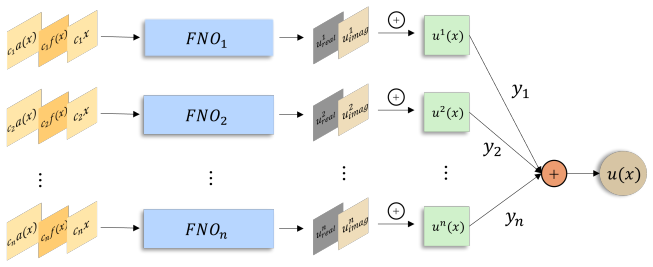
The multiscale Fourier neural operator (MscaleFNO), which processes inputs at multiple scales to overcome spectral bias in learning operators for highly oscillatory wave equations.
If this is right
- Improved accuracy in reconstructing highly oscillatory medium properties from partial wave scattering data.
- Effective regularization of inverse problems through integration with diffusion models.
- Applicability to Helmholtz inverse scattering without requiring problem-specific retraining.
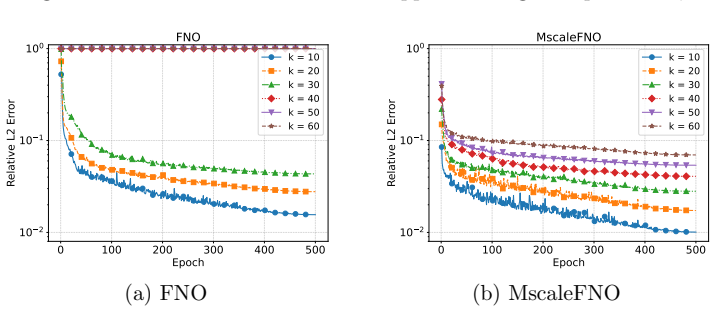
- Advantage over standard FNOs in handling high-frequency oscillations in 2D media.
Where Pith is reading between the lines
- Potential extension to three-dimensional or time-dependent wave problems if the multiscale structure generalizes.
- Could enable faster surrogate-based inversions in applications like seismic imaging where oscillatory media are common.
- Training on simulated data may need validation against noisy real-world measurements to confirm robustness.
Load-bearing premise
The multiscale architecture allows the neural operator to generalize across different highly oscillatory media without retraining or suffering from spectral bias.
What would settle it
If on a new set of highly oscillatory media the prediction error of MscaleFNO for the wavefields is not lower than that of a standard FNO, or if the inversion fails to reconstruct the media accurately.
Figures
read the original abstract
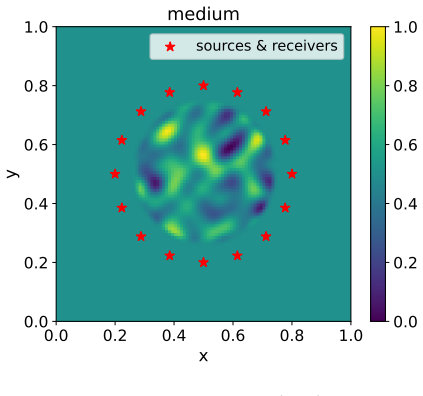
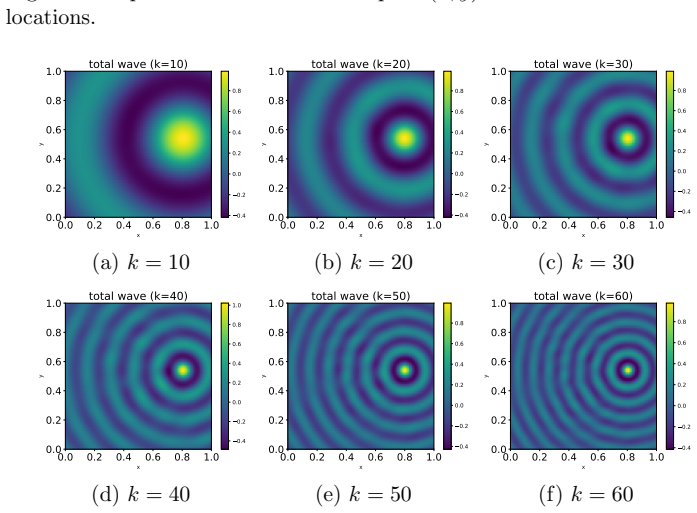
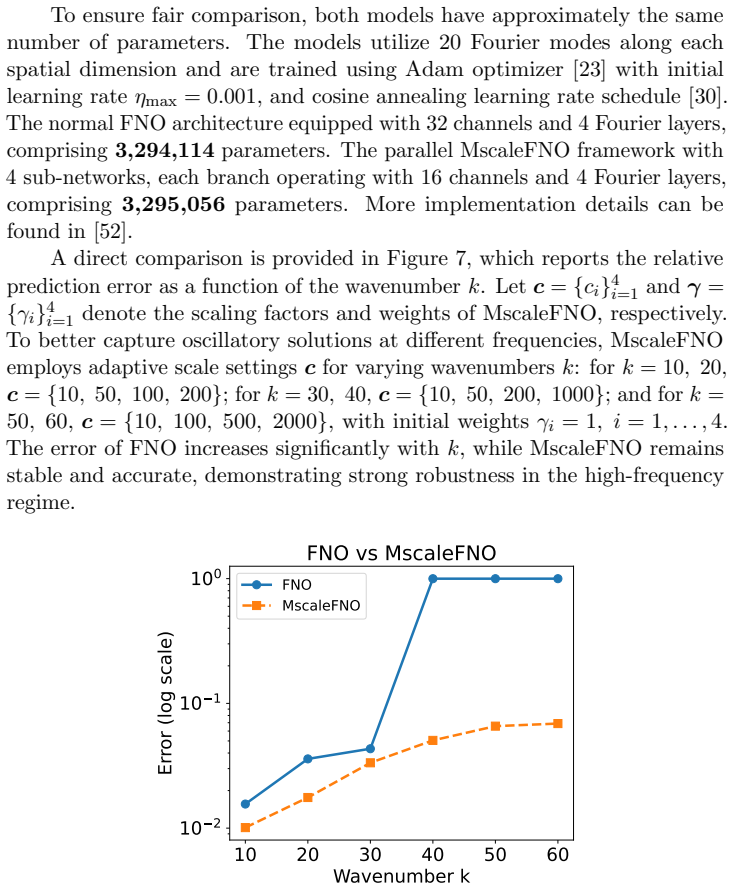
In this paper, we propose an operator learning method based on the multiscale Fourier neural operator (MscaleFNO) for inverse medium problems of Helmholtz equations. The MscaleFNO provides a neural surrogate model with reduced spectral bias for the Helmholtz equations, mapping highly oscillatory medium profiles to scattered wavefields. A plug-and-play inversion using elucidated diffusion model is introduced to regularize the inverse solver based on least squares of data misfits. Numerical results for partial aperture inversion of oscillatory two-dimensional media demonstrate the advantage and effectiveness of MscaleFNO for accurate reconstruction of highly oscillatory medium properties.
Editorial analysis
A structured set of objections, weighed in public.
Referee Report
Summary. The manuscript proposes the multiscale Fourier neural operator (MscaleFNO) as a neural surrogate for the forward Helmholtz map in inverse medium scattering, mapping highly oscillatory medium profiles to scattered wavefields with reduced spectral bias relative to standard FNOs. This surrogate is embedded in a plug-and-play least-squares inversion regularized by an elucidated diffusion model. Numerical results are presented for partial-aperture reconstruction of 2D oscillatory media, with the claim that these demonstrate the method's advantage and effectiveness.
Significance. If the MscaleFNO architecture demonstrably reduces spectral bias and generalizes to oscillation frequencies outside the training distribution, the work would supply a practical data-driven forward model for inverse scattering problems where conventional discretizations become prohibitive. The diffusion-regularized inversion framework is a modular contribution. The significance is currently limited by the lack of explicit scaling or ablation evidence tying performance to oscillation frequency.
major comments (2)
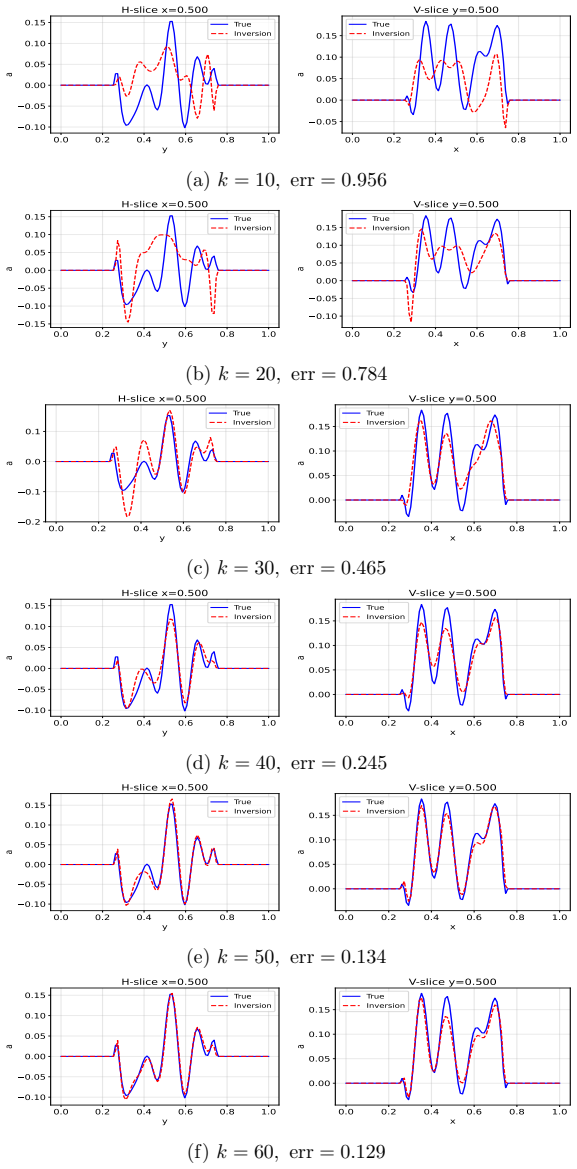
- [Numerical experiments] Numerical experiments section: no ablation study or scaling analysis is reported that measures reconstruction or forward-map error as a function of oscillation frequency relative to the training distribution. This verification is load-bearing for the central claim that MscaleFNO mitigates spectral bias sufficiently to enable reliable inversion in highly oscillatory regimes beyond the reported 2D cases.
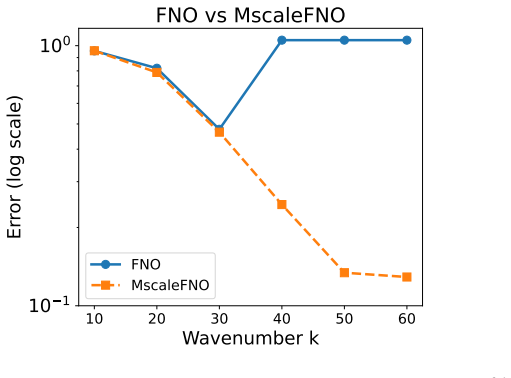
- [Abstract] Abstract: the statement that 'numerical results ... demonstrate the advantage and effectiveness' is not supported by any quantitative metrics, baseline comparisons against standard FNO, error bars, or specification of the training frequency band; without these the strength of the evidence for reduced spectral bias cannot be assessed.
minor comments (1)
- [Method] The description of the multiscale Fourier layers would benefit from an explicit diagram or equation block showing how the scale-specific kernels are combined, to improve reproducibility.
Simulated Author's Rebuttal
We thank the referee for the constructive feedback, which highlights opportunities to strengthen the evidence supporting the reduced spectral bias of MscaleFNO. We address each major comment below and will incorporate revisions to improve clarity and rigor.
read point-by-point responses
-
Referee: [Numerical experiments] Numerical experiments section: no ablation study or scaling analysis is reported that measures reconstruction or forward-map error as a function of oscillation frequency relative to the training distribution. This verification is load-bearing for the central claim that MscaleFNO mitigates spectral bias sufficiently to enable reliable inversion in highly oscillatory regimes beyond the reported 2D cases.
Authors: We agree that an explicit scaling analysis with respect to oscillation frequency would provide stronger verification of the central claim. In the revised manuscript, we will add an ablation study in the Numerical experiments section that reports forward-map and reconstruction errors as functions of oscillation frequency, explicitly including cases both within and outside the training distribution. This will directly address the load-bearing aspect of the claim regarding mitigation of spectral bias in highly oscillatory regimes. revision: yes
-
Referee: [Abstract] Abstract: the statement that 'numerical results ... demonstrate the advantage and effectiveness' is not supported by any quantitative metrics, baseline comparisons against standard FNO, error bars, or specification of the training frequency band; without these the strength of the evidence for reduced spectral bias cannot be assessed.
Authors: We acknowledge that the abstract phrasing is general and would benefit from more specific support. The numerical experiments section contains quantitative metrics and baseline comparisons, but we will revise the abstract to explicitly reference the key quantitative improvements (including error reductions relative to standard FNO), note the presence of error bars, and specify the training frequency band. This revision will make the evidence for reduced spectral bias more assessable while remaining faithful to the reported results. revision: yes
Circularity Check
No circularity: standard supervised operator learning with no self-referential reductions
full rationale
The paper proposes MscaleFNO as a neural surrogate for the Helmholtz forward map and a diffusion-regularized least-squares inversion. No derivation chain, equations, or fitted parameters are shown that reduce a claimed prediction to its own inputs by construction. The approach follows standard supervised operator learning on simulated data without load-bearing self-citations, uniqueness theorems imported from the authors, or ansatzes smuggled via prior work. The central claims rest on empirical performance in 2D cases rather than any self-definitional or fitted-input structure.
Axiom & Free-Parameter Ledger
Reference graph
Works this paper leans on
-
[1]
L. Amundsen, A. Reitan, H. Helgesen, et al.,Data-driven inver- sion/depth imaging derived from approximation to one-dimensional in- verse acoustic scattering, Inverse Problems,21:1823-1850, 2005. https: //iopscience.iop.org/article/10.1088/0266-5611/21/6/002
-
[2]
G. Bao, H. Zhang,Sensitive analysis of an inverse problem for the wave equation with caustics, J. Am. Math. Soc.,27:953-981, 2014. https: //doi.org/10.1090/S0894-0347-2014-00787-6
-
[3]
Boull´ e, A
N. Boull´ e, A. Townsend,A mathematical guide to operator learning, Handbook Numer. Anal.,25:83-125, 2024. https://doi.org/10.1016/ bs.hna.2024.05.003
2024
-
[4]
S. K. Boya, D. N. Subramani,PINTO: Physics-informed transformer neural operator for learning generalized solutions of partial differential equations, Comput. Phys. Commun.,315:109702, 2025. https://doi. org/10.1016/j.cpc.2025.109702
-
[5]
X. Cao, Q. Ding, X. Zhang, et al.,Diff-ANO: Towards Fast High-Resolution Ultrasound Computed Tomography via Conditional Consistency Models and Adjoint Neural Operators, arXiv preprint, arXiv:2507.16344, 2025. https://doi.org/10.48550/arXiv.2507. 16344
work page internal anchor Pith review Pith/arXiv arXiv doi:10.48550/arxiv.2507 2025
-
[6]
T. Chen, H. Chen,Universal approximation to nonlinear operators, IEEE Trans. Neural Netw.,6(4):911-917, 1995. https://doi.org/10. 1109/72.392253
1995
-
[7]
Diffusion Posterior Sampling for General Noisy Inverse Problems
H. Chung, J. Kim, M. T. McCann, et al.,Diffusion posterior sampling for general noisy inverse problems, in ICLR, 2023. https://doi.org/ 10.48550/arXiv.2209.14687
work page internal anchor Pith review Pith/arXiv arXiv doi:10.48550/arxiv.2209.14687 2023
-
[8]
Colton, J
D. Colton, J. Coyle, P. Monk,Recent developments in inverse acoustic scattering theory, SIAM Rev.,42:369-414, 2000. https://doi.org/10. 1137/S0036144500367337. 29
2000
-
[9]
D. Courjon, C. Bainier,Near field microscopy and near field optics, Rep. Prog. Phys.,57:989, 1994. https://doi.org/10.1088/0034-4885/57/ 10/002
-
[10]
C. Deng, S. Feng, H. Wang, et al.,OpenFWI: Large-scale multi- structural benchmark datasets for full waveform inversion, in NeurIPS,
-
[11]
https://proceedings.neurips.cc/paper_files/paper/2022/ file/27d3ef263c7cb8d542c4f9815a49b69b-Paper-Datasets_and_ Benchmarks.pdf
2022
-
[12]
O. Dorn, E. Miller, C. Rappaport,A shape reconstruction method for electromagnetic tomography using adjoint fields and level sets, In- verse Problems,16(5):1119-1156, 2000. https://iopscience.iop.org/ article/10.1088/0266-5611/16/5/303
-
[13]
H. W. Engl, M. Hanke, A. Neubauer,Regularization of inverse problems, Springer, Dordrecht, 2000
2000
-
[14]
P. H¨ ahner, T. Hohage,New stability estimates for the inverse acoustic inhomogeneous medium problem and applications, SIAM J. Math. Anal., 33(3):670-685, 2001. https://doi.org/10.1137/S0036141001383564
-
[15]
X. Liu, B. Xu, S. Cao, et al.,Mitigating spectral bias for the multiscale operator learning, J. Comput. Phys.,506:112944, 2024. https://doi. org/10.1016/j.jcp.2024.112944
-
[16]
J. Ho, A. Jain, P. Abbeel,Denoising diffusion probabilistic mod- els, in NeurIPS, 2020. https://dl.acm.org/doi/10.5555/3495724. 3496298
-
[17]
F. Ihlenburg, I. Babuˇ ska,Finite element solution of the Helmholtz equation with high wave number, SIAM J. Numer. Anal.,34(1):315-358, 1997.https://doi.org/10.1137/S0036142994272337
-
[18]
Y. Ji, J. Liang, and Z. Xu,Machine-Learning Interatomic Potentials for Long-Range Systems, Phys. Rev. Lett.135, 178001, 2025. https: //doi.org/10.1103/ssp9-7s81
-
[19]
P. Jin, Y. Feng, S. Feng, et al.,An empirical study of large-scale data- driven full waveform inversion, Sci. Rep.,14:20034, 2024. https://doi. org/10.1038/s41598-024-68573-7
-
[20]
P. Jin, X. Zhang, Y. Chen, et al.,Unsupervised learning of full-waveform inversion, in ICLR, 2022. https://doi.org/10.48550/arXiv.2110. 07584
-
[21]
Elucidating the Design Space of Diffusion-Based Generative Models
T. Karras, M. Aittala, T. Aila, S. Laine,Elucidating the design space of diffusion-based generative models, in NeurIPS, 2022. https://doi.org/ 10.48550/arXiv.2206.00364. 30
work page internal anchor Pith review Pith/arXiv arXiv doi:10.48550/arxiv.2206.00364 2022
-
[22]
B. Kawar, M. Elad, S. Ermon, J. Song,Denoising diffusion restoration models, in NeurIPS, 2022. https://doi.org/10.48550/arXiv.2201. 11793
-
[23]
Y. Khoo, L. Ying,SwitchNet: a neural network model for forward and inverse scattering problems, SIAM J. Sci. Comput.,41:A3182-A3201, 2018.https://doi.org/10.1137/18M1222399
-
[24]
D. P. Kingma, J. Ba,Adam: A Method for Stochastic Optimization, in ICLR, 2015.https://doi.org/10.48550/arXiv.1412.6980
work page internal anchor Pith review Pith/arXiv arXiv doi:10.48550/arxiv.1412.6980 2015
-
[25]
Kovachki, Z
N. Kovachki, Z. Li, B. Liu, et al.,Neural operator: Learning maps between function spaces, J. Mach. Learn. Res.,24(89):1-97, 2023. http: //jmlr.org/papers/v24/21-1524.html
2023
-
[27]
Z. Li, N. Kovachki, K. Azizzadenesheli, et al.,Neural operator: Graph kernel network for PDEs, arXiv preprint, arXiv: 2003.03485, 2020. https://arxiv.org/abs/2003.03485
Pith/arXiv arXiv 2003
-
[28]
Z. Li, H. Zheng, N. Kovachki, et al.,Physics-Informed neural operator for learning partial differential equations, ACM/IMS J. Data Sci.,1(3):9, 2024.https://doi.org/10.1145/3648506
-
[29]
Z. Liu, F. Chen, J. Chen, et al.,Neumann series-based neural operator for solving 2D inverse medium problem, J. Comput. Phys.,534:114025, 2025.https://doi.org/10.1016/j.jcp.2025.114025
-
[30]
D. Long, Z. Xu, Q. Yuan, et al.,Invertible Fourier neural operators, arXiv preprint, arXiv:2402.11722, 2024. https://arxiv.org/abs/2402. 11722
arXiv 2024
-
[32]
L. Lu, P. Jin, G. Pang, et al.,Learning nonlinear operators via DeepONet, Nat. Mach. Intell.,3(3):218-229, 2021. https://doi.org/10.1038/ s42256-021-00302-5
2021
-
[33]
R. Molinaro, Y. Yang, B. Engquist, et al.,Neural inverse operators for solving PDE inverse problems, arXiv preprint, arXiv:2301.11167, 2023. https://arxiv.org/abs/2301.11167. 31
arXiv 2023
-
[34]
J.-C. N´ ed´ elec,Acoustic and Electromagnetic Equations: Integral Repre- sentations for Harmonic Problems, Springer, New York, 2001. https: //doi.org/10.1007/978-1-4757-4393-7
-
[35]
The Nobel Prize in Chemistry 2014, Nobel Foundation
2014
- [36]
-
[37]
R.-E. Plessix,A review of the adjoint-state method for computing the gradient of a functional with geophysical applications, Geophys. J. Int., 167(2):495-503, 2006. https://doi.org/10.1111/j.1365-246X.2006. 02978.x
-
[39]
Rahaman, A
N. Rahaman, A. Baratin, D. Arpit, et al.,On the spectral bias of neural networks, in ICML, 2019. https://proceedings.mlr.press/ v97/rahaman19a.html
2019
-
[40]
M. A. Rahman, M. A. Fl´ orez, A. Anandkumar, et al.,Generative adversarial neural operators, Trans. Mach. Learn. Res., 2022. https: //openreview.net/forum?id=X1VzbBU6xZ
2022
-
[41]
Y. Romano, M. Elad, P. Milanfar,The little engine that could: Regu- larization by denoising, SIAM J. Imaging Sci.,10(4):1804-1844, 2017. https://doi.org/10.1137/16M1102884
-
[42]
R. Rombach, A. Blattmann, D. Lorenz, et al.,High-resolution image synthesis with latent diffusion models, in CVPR, 2022. https://doi. org/10.1109/CVPR52688.2022.01042
-
[43]
S. Shan, M. Zhu, Y. Lin, et al.,Regularization by denoising diffusion models for inverse PDEs, Commun. Phys., 2026. https://doi.org/10. 1038/s42005-026-02677-6
2026
-
[44]
Score-Based Generative Modeling through Stochastic Differential Equations
Y. Song et al.,Score-based generative modeling through stochastic dif- ferential equations, in ICLR, 2021. https://doi.org/10.48550/arXiv. 2011.13456
work page internal anchor Pith review Pith/arXiv arXiv doi:10.48550/arxiv 2021
-
[45]
J. Song, C. Meng, S. Ermon,Denoising diffusion implicit models, in ICLR, 2021.https://openreview.net/forum?id=St1giarCHLP. 32
2021
-
[46]
Tarantola,Inversion of seismic reflection data in the acoustic ap- proximation, Geophysics,49(8):1259-1266, 1984
A. Tarantola,Inversion of seismic reflection data in the acoustic ap- proximation, Geophysics,49(8):1259-1266, 1984. https://doi.org/10. 1190/1.1441754
1984
-
[47]
T. Tripura, S. Chakraborty,Wavelet neural operator, Comput. Methods Appl. Mech. Eng.,404:115783, 2023. https://doi.org/10.1016/j. cma.2022.115783
work page doi:10.1016/j 2023
-
[48]
S. V. Venkatakrishnan, C. A. Bouman, B. Wohlberg,Plug-and-play priors for model based reconstruction, in IEEE GlobalSIP, 2013:945-948. https://doi.org/10.1109/GlobalSIP.2013.6737048
-
[49]
J. Virieux, S. Operto,An overview of full-waveform inversion, Geo- physics,76(4):WCC1-WCC26, 2009. https://doi.org/10.1190/1. 3238367
work page doi:10.1190/1 2009
-
[50]
Y. Wu, Y. Lin,InversionNet: An efficient data-driven full waveform inversion, IEEE Trans. Comput. Imaging,6:419-433, 2020. https:// doi.org/10.1109/TCI.2019.2956866
-
[51]
Z. Q. J. Xu, L. Zhang, W. Cai,On understanding spectral biases of deep neural networks, J. Comput. Phys.,530:113905, 2025. https: //doi.org/10.1016/j.jcp.2025.113905
-
[52]
Z.-Q. J. Xu, Y. Zhang, and T. Luo,Overview frequency principle/spectral bias in deep learning, Commun. Appl. Math. Comput.,7:827–864, 2025. https://doi.org/10.1007/s42967-024-00398-7
-
[53]
Z. You, Z. Xu, W. Cai,MscaleFNO: Multi-scale Fourier neural opera- tor learning for oscillatory functions and wave scattering problems, J. Comput. Phys.,547:114530, 2026. https://doi.org/10.1016/j.jcp. 2025.114530
-
[54]
Y. Zang, P.-S. Koutsourelakis,DGenNO: A physics-aware neural op- erator for solving forward and inverse PDE problems based on deep generative probabilistic modeling, J. Comput. Phys.,538:114137, 2025. https://doi.org/10.1016/j.jcp.2025.114137
-
[55]
Z. Zhang, Y. Wu, Z. Zhou, et al.,VelocityGAN: Subsurface velocity image estimation using conditional adversarial networks, in WACV, 2019:705-714.https://doi.org/10.1109/WACV.2019.00080
-
[56]
Y. Zhu, K. Zhang, J. Liang, et al.,Denoising diffusion models for plug-and-play image restoration, in CVPRW, 2023:1219-1229. https: //doi.org/10.1109/CVPRW59228.2023.00129. 33
discussion (0)
Sign in with ORCID, Apple, or X to comment. Anyone can read and Pith papers without signing in.