A Dual Metastable-State Encoding Architecture for Quantum Processing with ¹⁷¹Yb Atom Arrays
Pith reviewed 2026-06-27 18:39 UTC · model grok-4.3
The pith
171Yb atoms can encode long-lived storage qubits and fast-operation qubits in two different metastable manifolds connected by coherent shelving.
A machine-rendered reading of the paper's core claim, the machinery that carries it, and where it could break.
Core claim
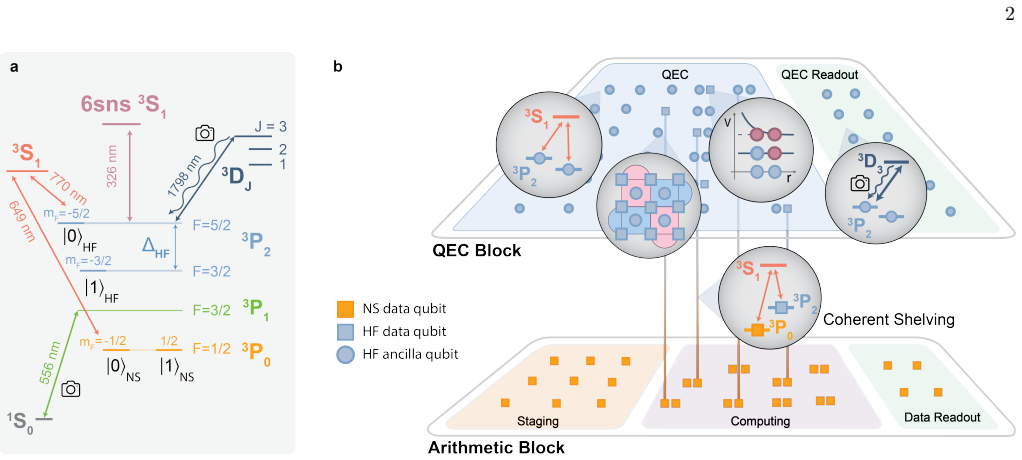
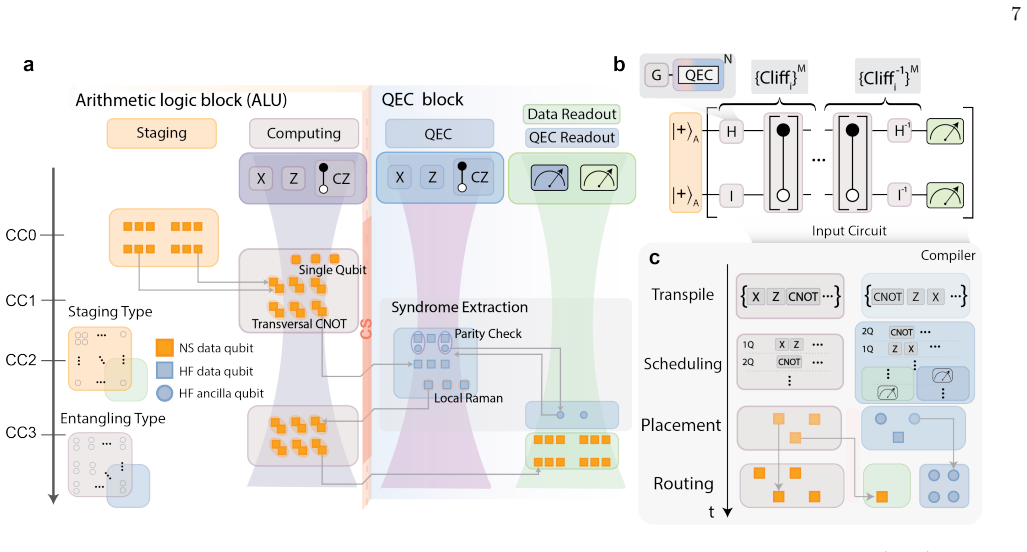
A dual metastable-state qubit encoding for 171Yb atoms that utilizes two independent qubit subspaces in the (6s6p) ³P₀ and (6s6p) ³P₂ manifolds. The ³P₀ manifold provides a long-coherence nuclear-spin qubit suitable for storage and arithmetic operations, while the ³P₂ manifold provides a hyperfine-spin qubit that enables fast Raman operations and direct state-selective imaging. Coherent shelving between the two metastable manifolds connects the qubit subspaces, allowing operations to be assigned to spectrally distinct processor zones.
What carries the argument
Dual metastable-state encoding with coherent shelving between the ³P₀ nuclear-spin qubit subspace and the ³P₂ hyperfine-spin qubit subspace.
If this is right
- Fast qubit operations and mid-circuit measurements can be performed on ancilla qubits without disturbing nearby data qubits.
- The single-species platform integrates all required functions for fault-tolerant quantum computing without additional atomic species.
- Simulated single-qubit and two-qubit gate fidelities in the ³P₂ manifold support high-fidelity operations.
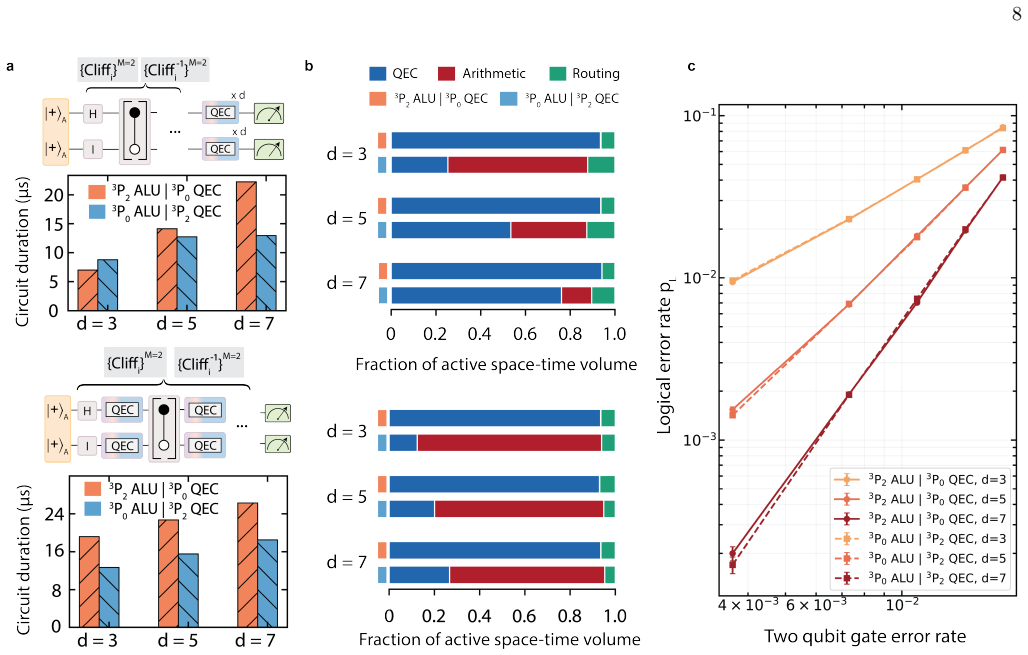
- Architectural resource estimation shows the approach is viable for logical-level simulations of quantum algorithms.
Where Pith is reading between the lines
- Similar dual-encoding schemes could be explored in other atoms with multiple metastable states to simplify neutral-atom architectures.
- Experimental validation of shelving fidelity would directly test the practicality for scaling to larger qubit arrays.
- This might allow dynamic reassignment of qubit roles during computation by shelving between manifolds.
Load-bearing premise
Coherent shelving between the ³P₀ nuclear-spin and ³P₂ hyperfine-spin manifolds can be performed at high fidelity with negligible crosstalk or decoherence.
What would settle it
Measurement showing that the coherent shelving operation introduces errors or decoherence rates too high for the threshold of fault-tolerant quantum error correction.
Figures
read the original abstract
Neutral-atom arrays combine scalable qubit registers, long coherence times, flexible optical control, and strong Rydberg-mediated entangling interactions, making them a promising platform for quantum information processing. However, physical error rates remain a challenge, and fault-tolerant quantum error correction (QEC) requires repeated mid-circuit measurement and reset of ancilla qubits without disturbing nearby data qubits. This requirement introduces significant control and architectural overhead, making qubit encoding an important architectural decision. Here, we propose a dual metastable-state qubit encoding for $^{171}\mathrm{Yb}$ atoms that utilizes two independent qubit subspaces in the $(6s6p)\,{}^3\mathrm{P}_0$ and $(6s6p)\,{}^3\mathrm{P}_2$ manifolds. The ${}^3\mathrm{P}_0$ manifold provides a long-coherence nuclear-spin (NS) qubit suitable for storage and arithmetic operations, while the ${}^3\mathrm{P}_2$ manifold provides a hyperfine-spin (HF) qubit, with $\Delta_{\mathrm{HF}} = 2\pi \times 6.7~\mathrm{GHz}$, that enables fast Raman operations and direct state-selective imaging. Coherent shelving between the two metastable manifolds connects the qubit subspaces, allowing operations to be assigned to spectrally distinct processor zones. We simulate single-qubit and two-qubit gate fidelities in ${}^3\mathrm{P}_2$, as well as coherent shelving between the HF and NS qubit subspaces. We incorporate these physical-level estimates into an architectural resource estimation and logical-level simulation. Our approach integrates mid-circuit measurements and fast qubit operations within a single-species platform, providing a versatile framework for future fault-tolerant quantum computing with neutral-atom qubits.
Editorial analysis
A structured set of objections, weighed in public.
Referee Report
Summary. The paper proposes a dual metastable-state qubit encoding for ¹⁷¹Yb neutral-atom arrays that uses the long-coherence nuclear-spin qubit in the ³P₀ manifold for data storage and arithmetic while employing the hyperfine-spin qubit in the ³P₂ manifold (Δ_HF = 2π × 6.7 GHz) for fast Raman gates and state-selective imaging. Coherent shelving between the manifolds is used to assign operations to spectrally distinct zones within a single species. The work reports simulations of single- and two-qubit gate fidelities in ³P₂ together with shelving, which are then fed into an architectural resource estimation and logical-level simulation for fault-tolerant QEC.
Significance. If the shelving operation can be realized with high fidelity and negligible crosstalk to neighboring qubits, the architecture would allow mid-circuit measurement and reset of ancillae without dual-species hardware or additional control overhead, offering a concrete single-species route to repeated QEC cycles in neutral-atom platforms.
major comments (2)
- [Abstract] Abstract: the central claim that coherent shelving between the ³P₀ NS and ³P₂ HF manifolds enables spectrally distinct zones with negligible crosstalk is load-bearing for the single-species advantage, yet the manuscript states only that simulations were performed without reporting quantitative fidelity values, error budgets, or modeled decoherence channels (off-resonant scattering, Rydberg-mediated crosstalk).
- [Architectural resource estimation] Architectural resource estimation and logical-level simulation (implied in the final paragraph): physical-level estimates are used as inputs, but no baseline comparison to dual-species or extra-hardware schemes is provided, nor is a threshold fidelity for shelving derived that would be required to maintain advantage over repeated QEC cycles.
minor comments (1)
- [Abstract] The abstract mentions incorporation of physical-level estimates into logical-level simulation but does not specify the error model or code distance used; a brief methods paragraph would improve clarity.
Simulated Author's Rebuttal
We thank the referee for their careful reading and constructive comments on our manuscript. We address the major comments point by point below.
read point-by-point responses
-
Referee: [Abstract] Abstract: the central claim that coherent shelving between the ³P₀ NS and ³P₂ HF manifolds enables spectrally distinct zones with negligible crosstalk is load-bearing for the single-species advantage, yet the manuscript states only that simulations were performed without reporting quantitative fidelity values, error budgets, or modeled decoherence channels (off-resonant scattering, Rydberg-mediated crosstalk).
Authors: We agree that the abstract would benefit from reporting the key quantitative results. The full manuscript contains simulations of single- and two-qubit gates in ³P₂ as well as shelving fidelities, including consideration of decoherence channels. In the revision we will update the abstract to include the simulated fidelity values and add explicit discussion of the error budgets (off-resonant scattering, Rydberg-mediated effects) in the simulation sections to make these details more prominent. revision: yes
-
Referee: [Architectural resource estimation] Architectural resource estimation and logical-level simulation (implied in the final paragraph): physical-level estimates are used as inputs, but no baseline comparison to dual-species or extra-hardware schemes is provided, nor is a threshold fidelity for shelving derived that would be required to maintain advantage over repeated QEC cycles.
Authors: We agree that deriving a shelving-fidelity threshold from the logical simulations would strengthen the claims. In revision we will add this analysis based on our existing resource-estimation and logical-level results. A full quantitative baseline comparison to dual-species architectures would require separate modeling of those platforms at the same level of detail, which lies outside the scope of the present work; we will instead expand the discussion to qualitatively contrast the single-species approach and flag the comparison as future work. revision: partial
Circularity Check
Physical-level estimates used as inputs; no derivation reduces to self-definition or fitted prediction.
full rationale
The paper proposes a dual-manifold encoding, reports simulations of shelving and gates as physical inputs, then feeds those estimates into resource and logical simulations. No equation equates an output advantage to an input parameter by construction, and no load-bearing self-citation chain is invoked to justify the architecture. The central shelving-fidelity assumption is stated as a prerequisite rather than derived from the scheme itself, consistent with a non-circular use of external physical modeling.
Axiom & Free-Parameter Ledger
free parameters (1)
- simulated single- and two-qubit gate fidelities in ³P₂
axioms (1)
- domain assumption Coherent shelving between ³P₀ and ³P₂ manifolds is feasible at high fidelity without disturbing data qubits
Reference graph
Works this paper leans on
-
[1]
We propose an optical Raman scheme that utilizes the 3S1 manifold as the intermedi- ate transition between|1⟩ HF and|0⟩ HF
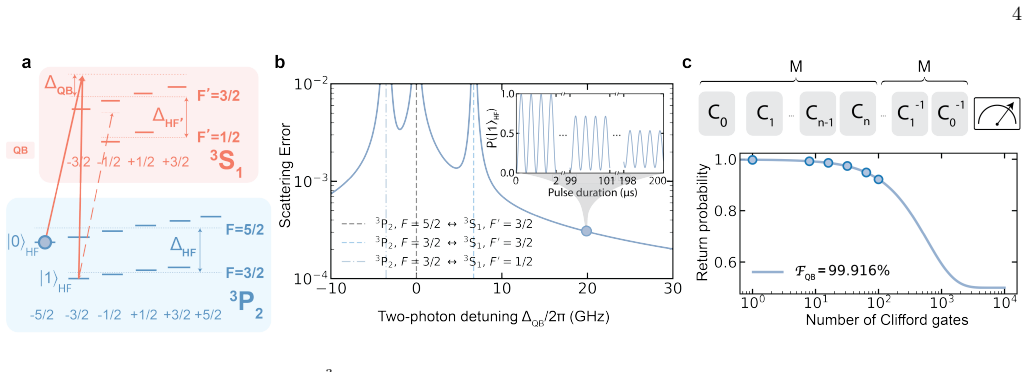
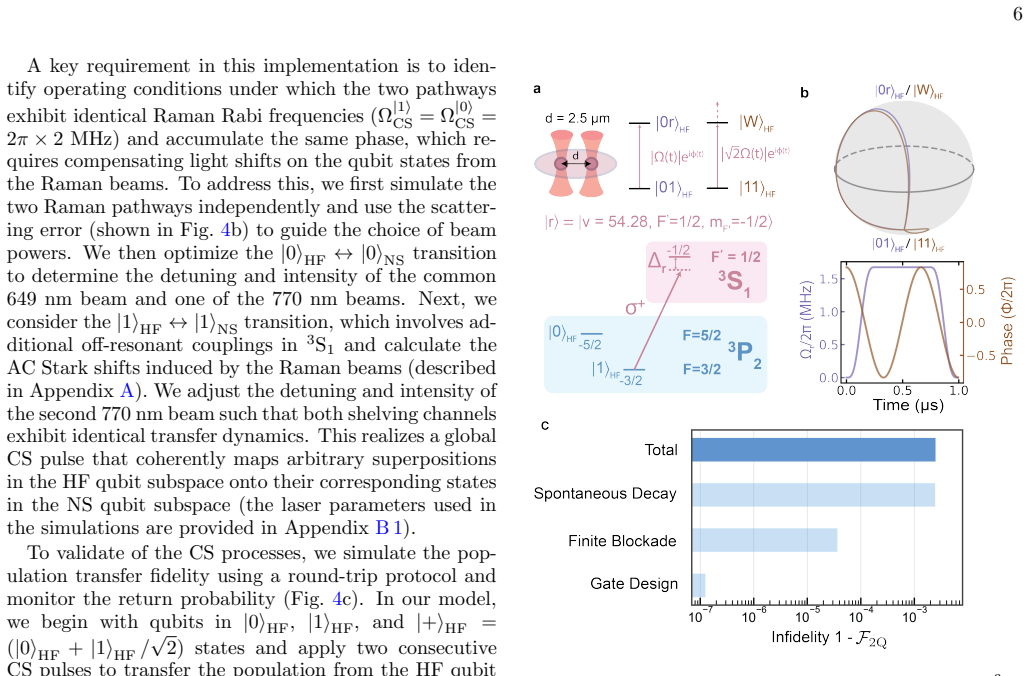
Single-qubit Operations The large hyperfine splitting of the3P2 manifold makes the HF qubit a natural platform for fast local opera- tions in our architecture. We propose an optical Raman scheme that utilizes the 3S1 manifold as the intermedi- ate transition between|1⟩ HF and|0⟩ HF. We model this operation with a pair of 770 nm beams and include a B= 10 G...
-
[2]
Our CS scheme utilizes an optical Raman process that transfers atomic population between the 3P2 and 3P0 manifolds via the 3S1 intermediate state
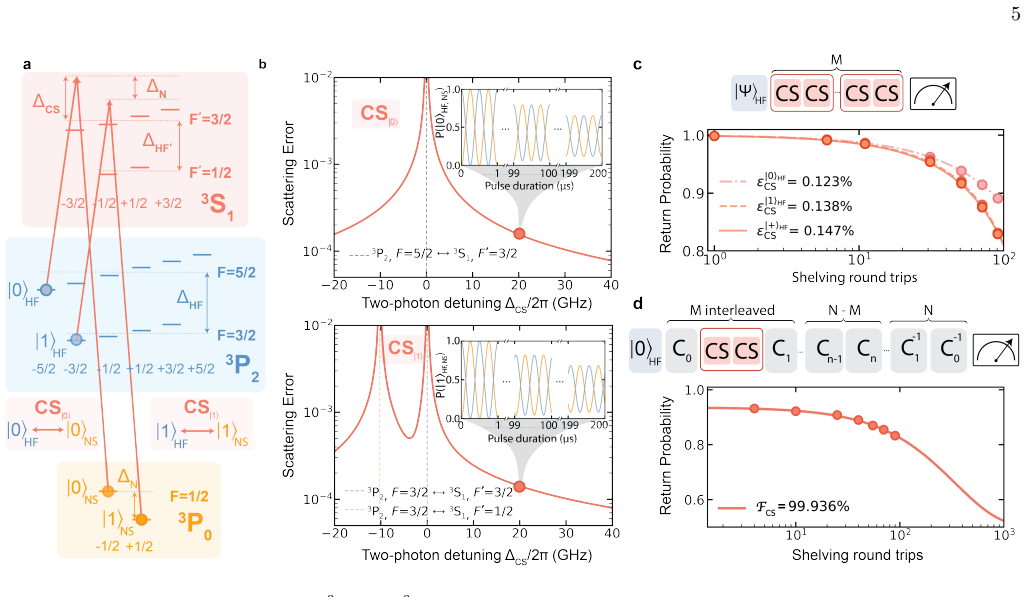
Coherent Shelving Our architecture requires coherent shelving (CS) of ar- bitrary qubit states between the HF and NS qubit sub- spaces to realize mid-circuit QEC protocols. Our CS scheme utilizes an optical Raman process that transfers atomic population between the 3P2 and 3P0 manifolds via the 3S1 intermediate state. This scheme uses the same 770 nm Rama...
-
[3]
states and apply two consecutive CS pulses to transfer the population from the HF qubit subspace to the NS qubit subspace and back. We then fit the return probability for each initial state and ex- tract the following operation errors:ε |0⟩HF CS = 0.123%, ε |1⟩HF CS = 0.138%, andε |+⟩HF CS = 0.147% (for details see Appendix B 2). This is consistent with t...
-
[4]
To model two-qubit operations in the 3P2 manifold, we simu- late a controlled-phase (CZ) gate protocol following FIG
Rydberg-mediated Two-qubit Gates Metastable states in alkaline-earth atoms support fast, high-fidelity two-qubit gates through single-photon cou- pling to the Rydberg manifold [11, 43]. To model two-qubit operations in the 3P2 manifold, we simu- late a controlled-phase (CZ) gate protocol following FIG. 5.ImplementingCZgate in the 3P2 manifold. a.We select...
-
[5]
We use this model primarily to estimate the fidelity of single- qubit operations and the coherent shelving process
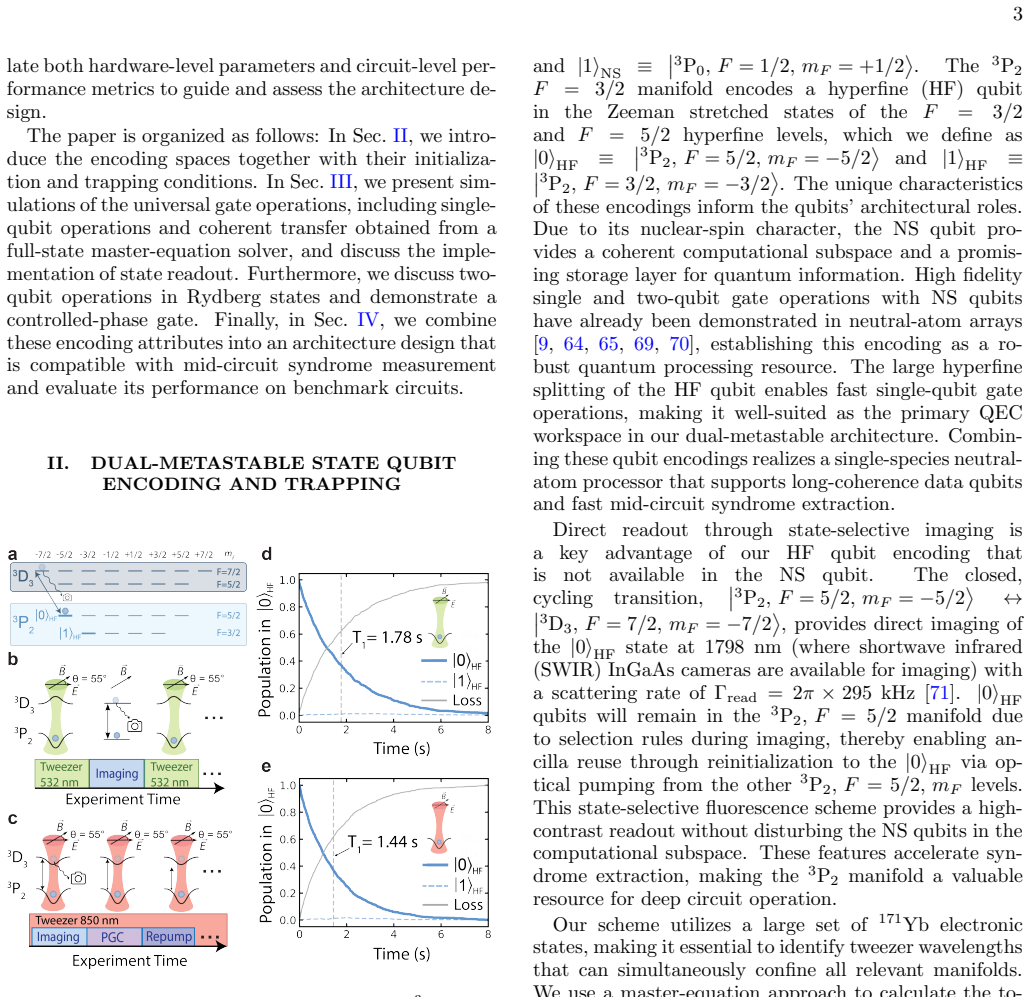
Hyperfine Atomic Master Equation To describe the complex coupling between hyperfine manifolds, particularly for states with larger total angu- lar momentum (e.g., 3P2, and 3D3), we develop a more general numerical model of the internal dynamics. We use this model primarily to estimate the fidelity of single- qubit operations and the coherent shelving proc...
-
[6]
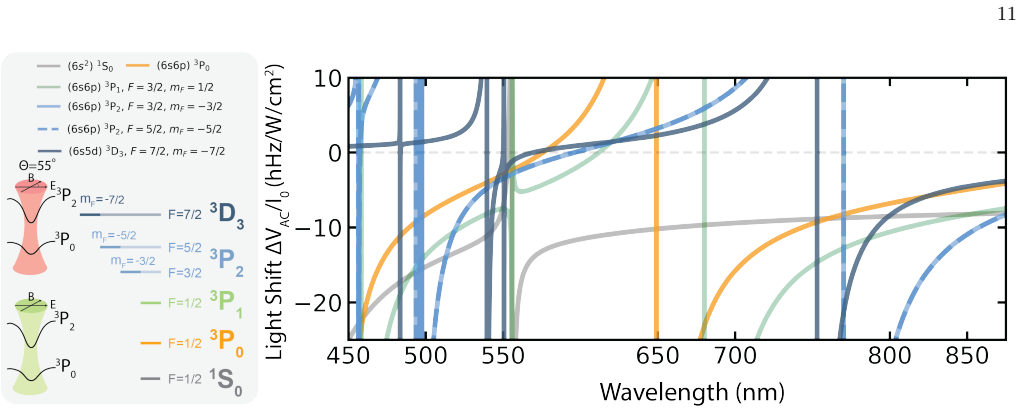
AC Stark Shift and Atomic Polarizability To identify tweezers wavelengths that can trap all necessary atomic states, we calculate the polarizabil- ity of each state. The polarizability follows Kramers– Heisenberg polarizability tensor [118], αµν(β, ω) = X β′ 2ωβ′β ℏ ⟨β|dµ|β′⟩⟨β′|dν|β⟩ ω2 β′β −ω 2 .(A5) Here, atomic statesβare labeled by their term symbols...
-
[7]
The procedure is modeled using the master-equation solver described in Appendix
Optical Pumping Simulation Here we describe the numerical simulations of the proposed optical pumping process. The procedure is modeled using the master-equation solver described in Appendix. A 1. To initialize atoms to|0⟩ HF after loading them into tweezer array, the popula- tion is first prepared in 1S0, F= 1/2, m F =−1/2 by depleting 1S0, F= 1/2, m F =...
-
[8]
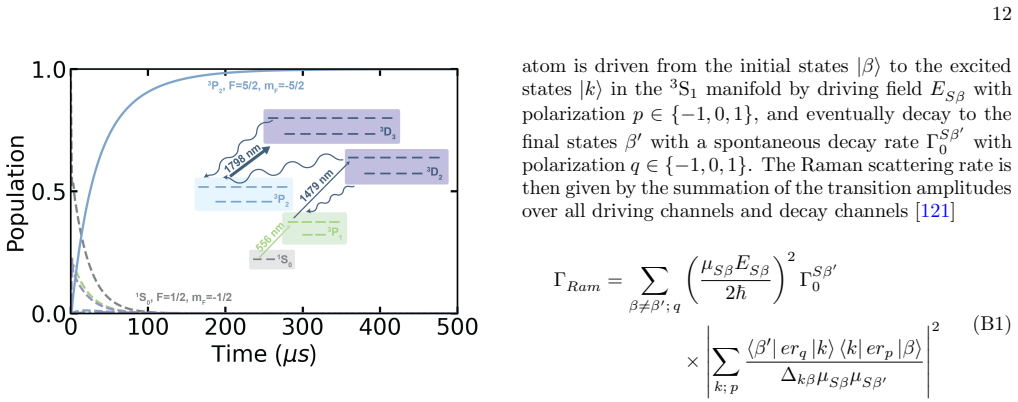
Scattering Error The scattering contributions are evaluated analytically from the Raman transition amplitudes. Assuming the atom is driven from the initial states|β⟩to the excited states|k⟩in the 3S1 manifold by driving fieldE Sβ with polarizationp∈ {−1,0,1}, and eventually decay to the final statesβ ′ with a spontaneous decay rate Γ Sβ ′ 0 with polarizat...
-
[9]
Both cases can be converted into erasure errors by applying a repump- ing pulse
Qubit Operation Benchmarking Under the conditions mentioned in the main text Sec.(III), for a single R X(π) gate, we estimate that ap- proximately 55% of the leaked population eventually de- cays to 1S0, while about 21% ends in 3P0. Both cases can be converted into erasure errors by applying a repump- ing pulse. The remaining∼24% remains within nearby mag...
-
[10]
Schlosser, G
N. Schlosser, G. Reymond, I. Protsenko, and P. Grang- ier, Sub-poissonian loading of single atoms in a micro- scopic dipole trap, Nature411, 1024 (2001)
2001
-
[11]
Bernien, S
H. Bernien, S. Schwartz, A. Keesling, H. Levine, A. Om- ran, H. Pichler, S. Choi, A. S. Zibrov, M. Endres, M. Greiner, V. Vuleti´ c, and M. D. Lukin, Probing many- body dynamics on a 51-atom quantum simulator, Na- ture551, 579 (2017)
2017
-
[12]
H. J. Manetsch, G. Nomura, E. Bataille, X. Lv, K. H. Leung, and M. Endres, A tweezer array with 6,100 highly coherent atomic qubits, Nature647, 60 (2025)
2025
-
[13]
Holman, Y
A. Holman, Y. Xu, X. Sun, J. Wu, M. Wang, Z. Zhu, B. Seo, N. Yu, and S. Will, Trapping of single atoms in metasurface optical tweezer arrays, Nature649, 859– (2026)
2026
-
[14]
Schymik, S
K.-N. Schymik, S. Pancaldi, F. Nogrette, D. Barredo, J. Paris, A. Browaeys, and T. Lahaye, Single atoms with 6000-second trapping lifetimes in optical-tweezer arrays at cryogenic temperatures, Phys. Rev. Appl.16, 034013 (2021)
2021
-
[15]
N.-C. Chiu, E. C. Trapp, J. Guo, M. H. Abobeih, L. M. Stewart, S. Hollerith, P. L. Stroganov, M. Kalinowski, A. A. Geim, S. J. Evered, S. H. Li, X. Lyu, L. M. Peters, D. Bluvstein, T. T. Wang, M. Greiner, V. Vuleti´ c, and M. D. Lukin, Continuous operation of a coherent 3,000- qubit system, Nature646, 1075 (2025)
2025
-
[16]
Y. Li, Y. Bao, M. Peper, C. Li, and J. D. Thompson, Fast, continuous and coherent atom replacement in a neutral atom qubit array, arXiv:2506.15633 (2025)
arXiv 2025
-
[17]
Sales Rodriguez, J
P. Sales Rodriguez, J. M. Robinson, P. N. Jepsen, Z. He, C. Duckering, C. Zhao, K.-H. Wu, J. Campo, K. Bag- nall, M. Kwon,et al., Experimental demonstration of logical magic state distillation, Nature645, 620 (2025)
2025
-
[18]
S. Ma, A. P. Burgers, G. Liu, J. Wilson, B. Zhang, and J. D. Thompson, Universal gate operations on nuclear spin qubits in an optical tweezer array of 171Yb atoms, Phys. Rev. X12, 021028 (2022)
2022
-
[19]
S. J. Evered, D. Bluvstein, M. Kalinowski, S. Ebadi, T. Manovitz, H. Zhou, S. H. Li, A. A. Geim, T. T. Wang, N. Maskara, H. Levine, G. Semeghini, M. Greiner, V. Vuleti´ c, and M. D. Lukin, High-fidelity parallel entangling gates on a neutral-atom quantum computer, Nature622, 268 (2023)
2023
-
[20]
R. B.-S. Tsai, X. Sun, A. L. Shaw, R. Finkelstein, and M. Endres, Benchmarking and fidelity response theory of high-fidelity rydberg entangling gates, PRX Quantum 6, 010331 (2025)
2025
-
[21]
A. Y. Kitaev, Quantum computations: algorithms and error correction, Russ. Math. Surv.52, 1191 (1997)
1997
-
[22]
Endres, H
M. Endres, H. Bernien, A. Keesling, H. Levine, E. R. Anschuetz, A. Krajenbrink, C. Senko, V. Vuletic, M. Greiner, and M. D. Lukin, Atom-by-atom assembly of defect-free one-dimensional cold atom arrays, Science 354, 1024 (2016)
2016
-
[23]
Barredo, S
D. Barredo, S. de L´ es´ eleuc, V. Lienhard, T. Lahaye, and A. Browaeys, An atom-by-atom assembler of defect-free arbitrary two-dimensional atomic arrays, Science354, 1021 (2016)
2016
-
[24]
Levine, A
H. Levine, A. Keesling, G. Semeghini, A. Omran, T. T. Wang, S. Ebadi, H. Bernien, M. Greiner, V. Vuleti´ c, H. Pichler, and M. D. Lukin, Parallel implementation of high-fidelity multiqubit gates with neutral atoms, Phys. Rev. Lett.123, 170503 (2019)
2019
-
[25]
Bluvstein, H
D. Bluvstein, H. Levine, G. Semeghini, T. T. Wang, S. Ebadi, M. Kalinowski, A. Keesling, N. Maskara, H. Pichler, M. Greiner, V. Vuletic, and M. D. Lukin, A quantum processor based on coherent transport of entangled atom arrays, Nature604, 451 (2022)
2022
-
[26]
Matsukevich, T
D. Matsukevich, T. Chaneliere, M. Bhattacharya, S.-Y. Lan, S. Jenkins, T. Kennedy, and A. Kuzmich, Entan- glement of a photon and a collective atomic excitation, Phys. Rev. Lett.95, 040405 (2005)
2005
-
[27]
Luan, J.-B
X. Luan, J.-B. B´ eguin, A. P. Burgers, Z. Qin, S.-P. Yu, and H. J. Kimble, The integration of photonic crystal waveguides with atom arrays in optical tweezers, Adv. Quantum Technol.3, 2000008 (2020)
2020
-
[28]
S. G. Menon, N. Glachman, M. Pompili, A. Dibos, and H. Bernien, An integrated atom array-nanophotonic chip platform with background-free imaging, Nat. Com- mun.15, 6156 (2024)
2024
-
[29]
Li and J
Y. Li and J. D. Thompson, High-rate and high-fidelity modular interconnects between neutral atom quantum 16 processors, PRX Quantum5, 020363 (2024)
2024
-
[30]
L. Li, X. Hu, Z. Jia, W. Huie, W. K. C. Sun, Aakash, Y. Dong, N. Hiri-O-Tuppa, and J. P. Covey, Paral- lelized telecom quantum networking with an ytterbium- 171 atom array, Nat. Phys.21, 1826 (2025)
2025
-
[31]
Sinclair, J
J. Sinclair, J. Ramette, B. Grinkemeyer, D. Bluvstein, M. D. Lukin, and V. Vuleti´ c, Fault-tolerant optical in- terconnects for neutral-atom arrays, Phys. Rev. Res.7, 013313 (2025)
2025
-
[32]
Sunami, S
S. Sunami, S. Tamiya, R. Inoue, H. Yamasaki, and A. Goban, Scalable networking of neutral-atom qubits: Nanofiber-based approach for multiprocessor fault- tolerant quantum computers, PRX Quantum6, 010101 (2025)
2025
-
[33]
Bluvstein, S
D. Bluvstein, S. J. Evered, A. A. Geim, S. H. Li, H. Zhou, T. Manovitz, S. Ebadi, M. Cain, M. Kali- nowski, D. Hangleiter,et al., Logical quantum proces- sor based on reconfigurable atom arrays, Nature626, 58 (2024)
2024
-
[34]
Bluvstein, A
D. Bluvstein, A. A. Geim, S. H. Li, S. J. Evered, J. P. Bonilla Ataides, G. Baranes, A. Gu, T. Manovitz, M. Xu, M. Kalinowski,et al., A fault-tolerant neutral- atom architecture for universal quantum computation, Nature649, 39 (2026)
2026
-
[35]
M. P. Jones, J. Beugnon, A. Ga¨ etan, J. Zhang, G. Messin, A. Browaeys, and P. Grangier, Fast quantum state control of a single trapped neutral atom, Phys. Rev. A75, 040301 (2007)
2007
-
[36]
Saffman, T
M. Saffman, T. G. Walker, and K. Mølmer, Quantum information with rydberg atoms, Rev. Mod. Phys.82, 2313 (2010)
2010
-
[37]
Z.-H. Wang, G. Li, Y.-L. Tian, and T.-C. Zhang, Quan- tum state manipulation of single-cesium-atom qubit in a micro-optical trap, Front. Phys.9, 634 (2014)
2014
-
[38]
Noguchi, Y
A. Noguchi, Y. Eto, M. Ueda, and M. Kozuma, Quantum-state tomography of a single nuclear spin qubit of an optically manipulated ytterbium atom, Phys. Rev. A84, 030301 (2011)
2011
-
[39]
A. D. Ludlow, M. M. Boyd, J. Ye, E. Peik, and P. O. Schmidt, Optical atomic clocks, Rev. Mod. Phys.87, 637 (2015)
2015
-
[40]
Cooper, J
A. Cooper, J. P. Covey, I. S. Madjarov, S. G. Porsev, M. S. Safronova, and M. Endres, Alkaline-earth atoms in optical tweezers, Phys. Rev. X8, 041055 (2018)
2018
-
[41]
Saskin, J
S. Saskin, J. T. Wilson, B. Grinkemeyer, and J. D. Thompson, Narrow-line cooling and imaging of ytter- bium atoms in an optical tweezer array, Phys. Rev. Lett. 122, 143002 (2019)
2019
-
[42]
J. W. Lis, A. Senoo, W. F. McGrew, F. R¨ onchen, A. Jenkins, and A. M. Kaufman, Midcircuit operations using the omg architecture in neutral atom arrays, Phys. Rev. X13, 041035 (2023)
2023
-
[43]
I. S. Madjarov, J. P. Covey, A. L. Shaw, J. Choi, A. Kale, A. Cooper, H. Pichler, V. Schkolnik, J. R. Williams, and M. Endres, High-fidelity entanglement and detection of alkaline-earth rydberg atoms, Nat. Phys.16, 857 (2020)
2020
-
[44]
A. W. Young, W. J. Eckner, W. R. Milner, D. Kedar, M. A. Norcia, E. Oelker, N. Schine, J. Ye, and A. M. Kaufman, Half-minute-scale atomic coherence and high relative stability in a tweezer clock, Nature588, 408 (2020)
2020
-
[45]
D. T. C. Allcock, W. C. Campbell, J. Chiaverini, I. L. Chuang, E. R. Hudson, I. D. Moore, A. Ransford, C. Ro- man, J. M. Sage, and D. J. Wineland, omg blueprint for trapped ion quantum computing with metastable states, Appl. Phys. Lett.119, 214002 (2021)
2021
-
[46]
Pucher, V
S. Pucher, V. Kl¨ usener, F. Spriestersbach, J. Geiger, A. Schindewolf, I. Bloch, and S. Blatt, Fine-structure qubit encoded in metastable strontium trapped in an optical lattice, Phys. Rev. Lett.132, 150605 (2024)
2024
-
[47]
Unnikrishnan, P
G. Unnikrishnan, P. Ilzh¨ ofer, A. Scholz, C. H¨ olzl, A. G¨ otzelmann, R. K. Gupta, J. Zhao, J. Krauter, S. Weber, N. Makki,et al., Coherent control of the fine- structure qubit in a single alkaline-earth atom, Phys. Rev. Lett.132, 150606 (2024)
2024
-
[48]
A. L. Shaw, P. Scholl, R. Finkelstein, R. B.-S. Tsai, J. Choi, and M. Endres, Erasure cooling, control, and hyperentanglement of motion in optical tweezers, Sci- ence388, 845 (2025)
2025
-
[49]
Z. Li, R. De, R. Sivakumar, W. Huie, H.-T. Wei, J. D. Piel, C. H. Greene, K. R. A. Hazzard, Z. Z. Yan, and J. P. Covey, Quantum science with arrays of metastable helium-3 atoms, arXiv:2601.06763 (2026)
arXiv 2026
-
[50]
S. J. Evered, M. Xu, S. H. Li, A. A. Geim, J. Ataides, M. Kalinowski, D. Bluvstein, N. Maskara, C. Kokail, M. Greiner,et al., High-fidelity entangling gates and nonlocal circuits with neutral atoms, arXiv:2604.25987 (2026)
Pith/arXiv arXiv 2026
-
[51]
Radnaev, W
A. Radnaev, W. Chung, D. Cole, D. Mason, T. Bal- lance, M. Bedalov, D. Belknap, M. Berman, M. Blakely, I. Bloomfield,et al., Universal neutral-atom quantum computer with individual optical addressing and non- destructive readout, PRX Quantum6, 030334 (2025)
2025
-
[52]
B. Zhang, G. Liu, G. Bornet, S. P. Horvath, P. Peng, S. Ma, S. Huang, S. Puri, and J. D. Thompson, Lever- aging erasure errors in logical qubits with metastable 171Yb atoms, arXiv:2506.13724 (2025)
Pith/arXiv arXiv 2025
-
[53]
Preskill, Quantum Computing in the NISQ era and beyond, Quantum2, 79 (2018)
J. Preskill, Quantum Computing in the NISQ era and beyond, Quantum2, 79 (2018)
2018
-
[54]
Preskill, Beyond nisq: The megaquop machine, ACM Trans
J. Preskill, Beyond nisq: The megaquop machine, ACM Trans. Quant. Comp.6, 1 (2025)
2025
-
[55]
T. G. Draper, S. A. Kutin, E. M. Rains, and K. M. Svore, A logarithmic-depth quantum carry-lookahead adder, arXiv: quant-ph/0406142 (2004)
Pith/arXiv arXiv 2004
-
[56]
Sahay, J
K. Sahay, J. Jin, J. Claes, J. D. Thompson, and S. Puri, High-threshold codes for neutral-atom qubits with bi- ased erasure errors, Phys. Rev. X13, 041013 (2023)
2023
-
[57]
A. M. Steane, Error correcting codes in quantum theory, Phys. Rev. Lett.77, 793 (1996)
1996
-
[58]
Gottesman,Stabilizer codes and quantum error cor- rection(California Institute of Technology, 1997)
D. Gottesman,Stabilizer codes and quantum error cor- rection(California Institute of Technology, 1997)
1997
-
[59]
A. G. Fowler, M. Mariantoni, J. M. Martinis, and A. N. Cleland, Surface codes: Towards practical large-scale quantum computation, Phys. Rev. A86, 032324 (2012)
2012
-
[60]
Kjaergaard, M
M. Kjaergaard, M. E. Schwartz, J. Braum¨ uller, P. Krantz, J. I.-J. Wang, S. Gustavsson, and W. D. Oliver, Superconducting qubits: Current state of play, Annu. Rev. Condens. Matter Phys.11, 369–395 (2020)
2020
-
[61]
Deist, Y.-H
E. Deist, Y.-H. Lu, J. Ho, M. K. Pasha, J. Zeiher, Z. Yan, and D. M. Stamper-Kurn, Mid-circuit cavity measurement in a neutral atom array, Phys. Rev. Lett. 129, 203602 (2022)
2022
-
[62]
Norcia, W
M. Norcia, W. Cairncross, K. Barnes, P. Battaglino, A. Brown, M. Brown, K. Cassella, C.-A. Chen, R. Coxe, D. Crow,et al., Midcircuit qubit measurement and re- arrangement in a 171Yb atomic array, Phys. Rev. X13, 041034 (2023). 17
2023
-
[63]
Anand, C
S. Anand, C. E. Bradley, R. White, V. Ramesh, K. Singh, and H. Bernien, A dual-species rydberg ar- ray, Nat. Phys.20, 1744 (2024)
2024
-
[64]
Petrosyan, S
D. Petrosyan, S. Norrell, C. Poole, and M. Saffman, Fast measurements and multiqubit gates in dual-species atomic arrays, Phys. Rev. A110, 042404 (2024)
2024
- [65]
- [66]
-
[67]
Y. Zeng, P. Xu, X. He, Y. Liu, M. Liu, J. Wang, D. Pa- poular, G. Shlyapnikov, and M. Zhan, Entangling two individual atoms of different isotopes via rydberg block- ade, Phys. Rev. Lett.119, 160502 (2017)
2017
-
[68]
Nakamura, T
Y. Nakamura, T. Kusano, R. Yokoyama, K. Saito, K. Higashi, N. Ozawa, T. Takano, Y. Takasu, and Y. Takahashi, Hybrid atom tweezer array of nuclear spin and optical clock qubits, Phys. Rev. X14, 041062 (2024)
2024
-
[69]
Yang, J.-Y
H.-X. Yang, J.-Y. Ma, Y.-K. Wu, Y. Wang, M.-M. Cao, W.-X. Guo, Y.-Y. Huang, L. Feng, Z.-C. Zhou, and L.-M. Duan, Realizing coherently convertible dual-type qubits with the same ion species, Nat. Phys.18, 1058 (2022)
2022
-
[70]
Y. Wu, S. Kolkowitz, S. Puri, and J. D. Thompson, Era- sure conversion for fault-tolerant quantum computing in alkaline earth rydberg atom arrays, Nat. Commun.13, 4657 (2022)
2022
-
[71]
Singh, C
K. Singh, C. E. Bradley, S. Anand, V. Ramesh, R. White, and H. Bernien, Mid-circuit correction of cor- related phase errors using an array of spectator qubits, Science380, 1265 (2023)
2023
-
[72]
T. M. Graham, L. Phuttitarn, R. Chinnarasu, Y. Song, C. Poole, K. Jooya, J. Scott, A. Scott, P. Eichler, and M. Saffman, Midcircuit measurements on a single- species neutral alkali atom quantum processor, Phys. Rev. X13, 041051 (2023)
2023
-
[73]
S. Ma, G. Liu, P. Peng, B. Zhang, S. Jandura, J. Claes, A. P. Burgers, G. Pupillo, S. Puri, and J. D. Thompson, High-fidelity gates and mid-circuit erasure conversion in an atomic qubit, Nature622, 279 (2023)
2023
-
[74]
Jenkins, J
A. Jenkins, J. W. Lis, A. Senoo, W. F. McGrew, and A. M. Kaufman, Ytterbium nuclear-spin qubits in an optical tweezer array, Phys. Rev. X12, 021027 (2022)
2022
-
[75]
R. Tao, O. Lib, F. Gyger, H. Timme, M. Ammenwerth, I. Bloch, and J. Zeiher, Universal gates for a metastable qubit in strontium-88, arXiv:2506.10714 (2025)
Pith/arXiv arXiv 2025
-
[76]
Scholl, A
P. Scholl, A. L. Shaw, R. B.-S. Tsai, R. Finkelstein, J. Choi, and M. Endres, Erasure conversion in a high- fidelity rydberg quantum simulator, Nature622, 273 (2023)
2023
-
[77]
Knill, D
E. Knill, D. Leibfried, R. Reichle, J. Britton, R. B. Blakestad, J. D. Jost, C. Langer, R. Ozeri, S. Sei- delin, and D. J. Wineland, Randomized benchmarking of quantum gates, Phys. Rev. A77, 012307 (2008)
2008
-
[78]
Peper, Y
M. Peper, Y. Li, D. Y. Knapp, M. Bileska, S. Ma, G. Liu, P. Peng, B. Zhang, S. P. Horvath, A. P. Burg- ers, and J. D. Thompson, Spectroscopy and modeling of 171Yb rydberg states for high-fidelity two-qubit gates, Phys. Rev. X15, 011009 (2025)
2025
- [79]
-
[80]
S. G. Porsev, Y. G. Rakhlina, and M. G. Kozlov, Electric-dipole amplitudes, lifetimes, and polarizabili- ties of the low-lying levels of atomic ytterbium, Phys. Rev. A60, 2781 (1999)
1999
discussion (0)
Sign in with ORCID, Apple, or X to comment. Anyone can read and Pith papers without signing in.