Testing the Black Box: Structural Barriers to Independent Evaluation of Consumer-Facing Health LLMs
Pith reviewed 2026-06-27 18:40 UTC · model grok-4.3
The pith
No reliable independent evaluation framework yet exists for examining how consumer-facing health LLMs behave in ordinary use.
A machine-rendered reading of the paper's core claim, the machinery that carries it, and where it could break.
Core claim
Attempts to evaluate response variation and sycophancy in consumer-facing health LLMs under ordinary-use conditions encountered five linked barriers. Factual prompts produced stable answers that masked sycophancy emerging over multi-turn conversation. Browser interfaces did not disclose which signals influenced outputs and could not be reset to a clean baseline. Large-scale testing was blocked by terms of service, rate limits, and bot detection. Accuracy-based criteria missed tone, framing, and omission while LLM-as-judge methods risked shared alignment bias. Models changed without traceable version identifiers, preventing replication. No reliable independent evaluation framework therefore e
What carries the argument
The five linked barriers encountered when testing simulated user profiles with adapted multi-turn prompts from validated scales such as the Vaccination Attitudes Examination scale.
If this is right
- Oversight requires disclosure of which personalization signals affect outputs.
- Stable version identifiers are needed so evaluations can be replicated.
- Researcher safe-harbor programs would be required to conduct testing at scale.
- Post-deployment monitoring of health-related outputs becomes necessary once access barriers are addressed.
- Accuracy-based criteria alone cannot capture the clinically relevant variation in tone and framing.
Where Pith is reading between the lines
- The same access and measurement barriers would likely appear when trying to audit consumer LLMs in other high-stakes domains such as legal or financial advice.
- Without version control and signal disclosure, companies retain sole ability to know whether their models treat users differently based on unobservable context.
- Patients using these models may receive systematically different health framing depending on their browsing history or expressed beliefs, yet neither they nor regulators can verify it.
Load-bearing premise
The five barriers are general structural features of current consumer LLM interfaces and policies rather than artifacts of the specific models, prompts, or research setup chosen.
What would settle it
A researcher successfully running repeatable, large-scale tests of sycophancy and response variation across multiple consumer health LLMs while avoiding all five barriers would falsify the claim.
Figures
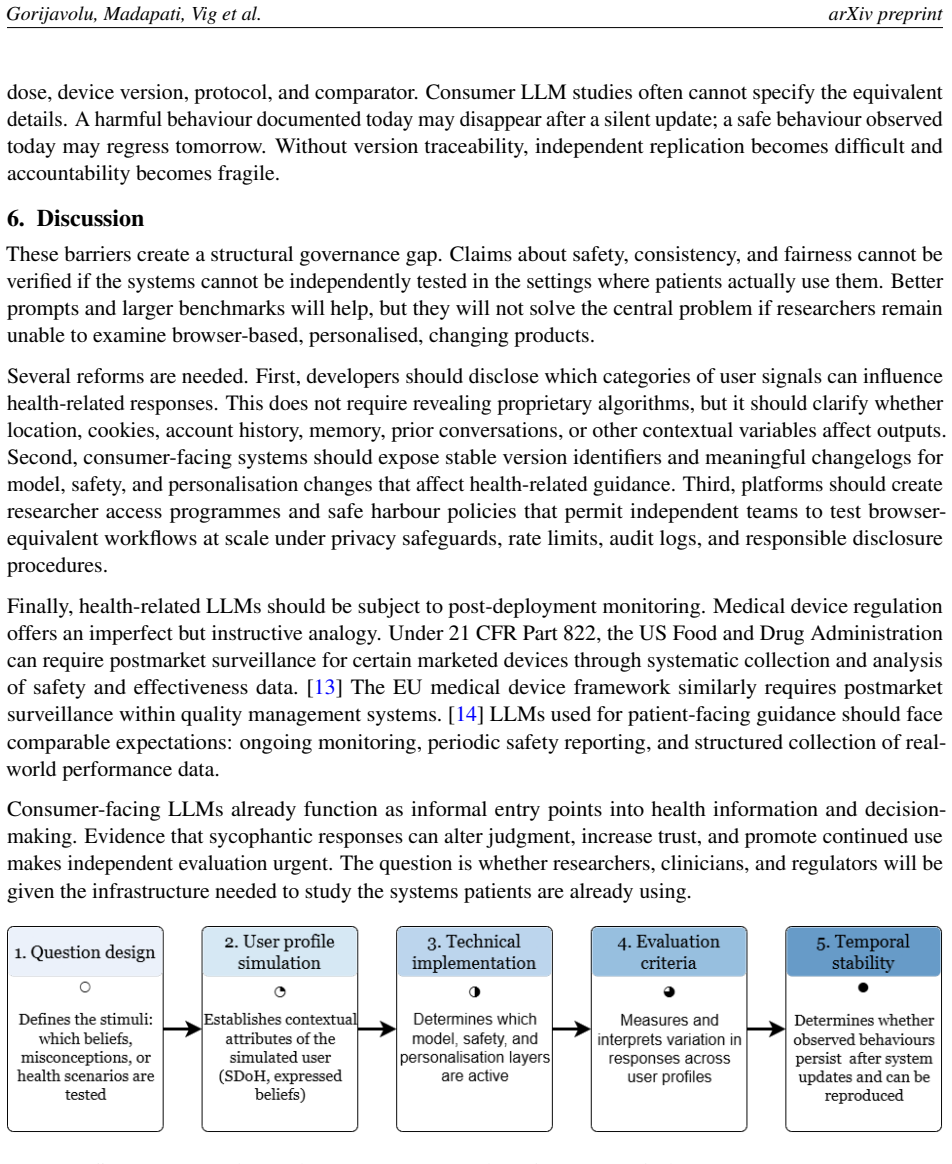
read the original abstract
Background: Consumer-facing large language models are now a common source of health information, and they interpret and personalize responses rather than retrieve them. Whether their responses vary across users is a clinical, equity, and governance question, sharpened by evidence that sycophantic responses can alter judgment and increase trust. Objective: To evaluate response variation and sycophancy in consumer-facing health LLMs under conditions resembling ordinary patient use. Methods: We constructed simulated user profiles differing in geography, browsing context, expressed beliefs, and social determinants of health, drawing on literature linking social context to health attitudes. We adapted validated instruments, including the Vaccination Attitudes Examination scale and reproductive attitudes scales, into multi-turn prompts designed to elicit clinically meaningful variation across users. Results: The evaluation encountered five linked barriers. Factual prompts produced stable responses that masked sycophancy emerging over multi-turn conversation. Browser-based interfaces did not disclose which signals influence outputs and could not be reset to a clean baseline. Large-scale testing was restricted by terms of service, rate limits, and bot detection. Accuracy-based criteria could not capture tone, framing, or omission, and LLM-as-judge methods risked shared alignment bias. Models changed without traceable version identifiers, preventing reliable replication. Conclusions: No reliable independent evaluation framework yet exists for examining how consumer-facing health LLMs behave in ordinary use. Oversight requires disclosure of personalization signals, stable version identifiers, researcher safe harbor programs, and post-deployment monitoring of health-related outputs.
Editorial analysis
A structured set of objections, weighed in public.
Referee Report
Summary. The paper reports an observational study in which the authors constructed simulated user profiles (differing in geography, browsing context, beliefs, and social determinants) and adapted validated instruments such as the Vaccination Attitudes Examination scale into multi-turn prompts to test response variation and sycophancy in consumer-facing health LLMs. Their evaluation attempts encountered five barriers—stable factual responses masking multi-turn sycophancy, undisclosed browser signals, ToS/rate-limit restrictions, inadequacy of accuracy metrics for tone/omission, and untraceable model versions—leading to the conclusion that no reliable independent evaluation framework exists for ordinary-use behavior and that oversight requires specific disclosures and safe-harbor programs.
Significance. If the five barriers are shown to be structural rather than setup-dependent, the work would usefully document concrete obstacles to post-deployment auditing of health LLMs and would motivate concrete policy recommendations (disclosure of personalization signals, version identifiers, researcher safe harbors). The observational character of the report, however, limits its immediate evidentiary weight.
major comments (3)
- [Methods] Methods: the section is described only at high level with no quantitative data, error bars, replication details, or enumeration of the exact models, prompts, or number of trials performed. This leaves open whether the reported barriers are reproducible or specific to the chosen simulated profiles and browser-based access method.
- [Results] Results: the five barriers are presented as linked and general, yet no evidence is supplied that alternative access methods (API endpoints where available, single-turn designs, different user agents, or non-browser interfaces) would encounter identical restrictions. The universality assumption is therefore load-bearing for the claim that 'no reliable independent evaluation framework yet exists.'
- [Conclusions] Conclusions: the strong claim that oversight 'requires disclosure of personalization signals, stable version identifiers, researcher safe harbor programs, and post-deployment monitoring' follows directly from the five barriers, but the manuscript provides no demonstration that these barriers cannot be circumvented within current interfaces or that the barriers are inherent rather than artifacts of the authors' particular testing setup.
minor comments (2)
- [Abstract] The abstract states that 'LLM-as-judge methods risked shared alignment bias' without citing prior work on LLM-as-judge reliability or alignment bias; a brief reference would clarify the point.
- [Background] The phrase 'ordinary patient use' is used repeatedly but never operationalized beyond the simulated-profile construction; a short clarification of the intended scope would improve precision.
Simulated Author's Rebuttal
We thank the referee for the constructive comments. Our study is observational, documenting barriers encountered in attempting to evaluate consumer-facing health LLMs under ordinary-use conditions. We address each major comment below and indicate where revisions will be made.
read point-by-point responses
-
Referee: [Methods] Methods: the section is described only at high level with no quantitative data, error bars, replication details, or enumeration of the exact models, prompts, or number of trials performed. This leaves open whether the reported barriers are reproducible or specific to the chosen simulated profiles and browser-based access method.
Authors: The study is observational, reporting barriers encountered during evaluation attempts rather than an experimental design requiring statistical metrics. We will revise the Methods section to enumerate the specific consumer-facing models tested, the number and construction of simulated profiles (geography, browsing context, beliefs, social determinants), the adaptation of validated instruments such as the VAX scale into multi-turn prompts, and the approximate number of interactions performed. This will clarify the setup while preserving the observational character. revision: yes
-
Referee: [Results] Results: the five barriers are presented as linked and general, yet no evidence is supplied that alternative access methods (API endpoints where available, single-turn designs, different user agents, or non-browser interfaces) would encounter identical restrictions. The universality assumption is therefore load-bearing for the claim that 'no reliable independent evaluation framework yet exists.'
Authors: We will revise the Results and add a Discussion subsection to explicitly limit claims to standard browser-based consumer interfaces, which are the primary access method for ordinary users. We note that APIs are not universally available, often require payment or different terms, and may not replicate the personalization signals present in consumer versions. Single-turn designs would miss the multi-turn sycophancy observed. The barriers are presented as linked because they arise from common design features (non-disclosure, ToS, lack of versioning). We will temper the language to 'no reliable independent evaluation framework for ordinary-use behavior in current consumer interfaces' rather than a universal claim. revision: partial
-
Referee: [Conclusions] Conclusions: the strong claim that oversight 'requires disclosure of personalization signals, stable version identifiers, researcher safe harbor programs, and post-deployment monitoring' follows directly from the five barriers, but the manuscript provides no demonstration that these barriers cannot be circumvented within current interfaces or that the barriers are inherent rather than artifacts of the authors' particular testing setup.
Authors: The recommendations are policy implications drawn from the observed linked barriers, which appear structural given their origin in interface design and terms that apply broadly. We acknowledge the observational design does not exhaustively rule out all circumventions. We will revise the Conclusions to frame the items as motivated suggestions for enabling oversight rather than strict requirements, and add a limitations paragraph noting the need for further work on alternative methods. revision: yes
Circularity Check
No significant circularity in observational report
full rationale
The paper is an observational account of five barriers encountered while testing consumer-facing health LLMs with simulated profiles and adapted scales. No mathematical derivations, fitted parameters, predictions, or self-citation chains exist that reduce any claim to its inputs by construction. The central conclusion follows directly from the reported testing experiences without self-definitional steps, renamed results, or load-bearing self-citations. This is a standard non-circular empirical report.
Axiom & Free-Parameter Ledger
axioms (1)
- domain assumption Simulated user profiles differing in geography, browsing context, expressed beliefs, and social determinants produce response patterns representative of real patient use.
Reference graph
Works this paper leans on
-
[1]
Sycophancy in GPT-4o: What happened and what we’re doing about it
OpenAI. Sycophancy in GPT-4o: What happened and what we’re doing about it. https://openai. com/index/sycophancy-in-gpt-4o/, 2025. Accessed: 2026-05-02
2025
-
[2]
Arora, Jason Wei, R
Rajan K. Arora, Jason Wei, R. S. Hicks, P. Bowman, Joaquin Quiñonero-Candela, Fotis Tsimpourlas, et al. HealthBench: Evaluating large language models towards improved human health, 2025
2025
-
[3]
Sycophantic AI decreases prosocial intentions and promotes dependence
Myra Cheng, Cinoo Lee, Pranav Khadpe, Shirley Yu, Daniyar Han, and Dan Jurafsky. Sycophantic AI decreases prosocial intentions and promotes dependence.Science, 391(6792):eaec8352, 2026. doi: 10.1126/science.aec8352
-
[4]
Liesbet R. Martin and Keith J. Petrie. Understanding the dimensions of anti-vaccination attitudes: The vaccination attitudes examination (V AX) scale.Annals of Behavioral Medicine, 51(5):652–660, 2017. doi: 10.1007/s12160-017-9888-y
-
[5]
M. M. Alam, L. K. B. Melhim, M. T. Ahmad, and M. Jemmali. Public attitude towards COVID-19 vaccination: Validation of COVID-Vaccination Attitude Scale (C-V AS).Journal of Multidisciplinary Healthcare, 15:941–954, 2022. doi: 10.2147/JMDH.S353594
-
[6]
M. G. Taylor and G. I. Whitehead. The measurement of attitudes toward abor- tion. Available from https : / / www . semanticscholar . org / paper / The - measurement - of - attitudes - toward - abortion - Taylor - Whitehead / 66f252c083b1974ec522e210f091870aaeddcd4f, 2014. Accessed: 2026-05-02
2014
-
[7]
A. Bompelli, Y . Wang, R. Wan, E. Singh, Y . Zhou, L. Xu, et al. Social and behavioral determinants of health in the era of artificial intelligence with electronic health records: A scoping review.Health Data Science, page 9759016, 2021. doi: 10.34133/2021/9759016
-
[8]
B. G. Patra, M. M. Sharma, V . Vekaria, P. Adekkanattu, O. V . Patterson, B. Glicksberg, et al. Extracting social determinants of health from electronic health records using natural language processing: a systematic review.Journal of the American Medical Informatics Association, 28(12):2716–2727, 2021. doi: 10.1093/jamia/ocab170
-
[9]
Rawan Abulibdeh, K. Tu, and E. Sejdi ´c. Natural language processing methods for assessing social determinants of health in the electronic health records: A narrative review.Expert Systems with Applications, 284:127928, 2025. doi: 10.1016/j.eswa.2025.127928
-
[10]
Brown, A
Michael A. Brown, A. Gruen, G. Maldoff, S. Messing, Z. Sanderson, and M. Zimmer. Web scraping for research: Legal, ethical, institutional, and scientific considerations, 2024
2024
-
[11]
J. Gu, X. Jiang, Z. Shi, H. Tan, X. Zhai, C. Xu, et al. A survey on LLM-as-a-Judge, 2025
2025
-
[12]
System card: Claude Sonnet 4.5 [September 2025]
Anthropic. System card: Claude Sonnet 4.5 [September 2025]. https://www-cdn.anthropic. com/963373e433e489a87a10c823c52a0a013e9172dd.pdf , 2025. Accessed: 2026-05- 02
2025
-
[13]
21 CFR part 822 — postmarket surveillance
US Food and Drug Administration. 21 CFR part 822 — postmarket surveillance. https://www. ecfr.gov/current/title-21/part-822. Accessed: 2026-05-02
2026
-
[14]
MDR chapter 7: Post-market surveillance, vigilance and market surveil- lance
European Commission. MDR chapter 7: Post-market surveillance, vigilance and market surveil- lance. Medical Device Regulation. https : / / www . medical - device - regulation . eu/category/mdr- chapter- 7- post- market- surveillance- vigilance- and- market-surveillance/. Accessed: 2026-05-02. 5 Gorijavolu, Madapati, Vig et al. arXiv preprint Acknowledgemen...
2026
discussion (0)
Sign in with ORCID, Apple, or X to comment. Anyone can read and Pith papers without signing in.