Back on Track: Aligning Rewards and States for Reasoning in Diffusion Large Language Models
Pith reviewed 2026-06-27 18:29 UTC · model grok-4.3
The pith
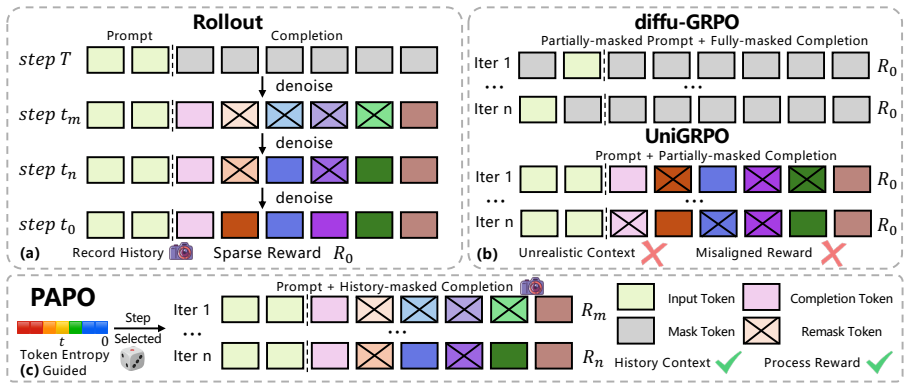
PAPO aligns RL updates to diffusion LLM generative trajectories using step-wise rewards and historical re-enactment.
A machine-rendered reading of the paper's core claim, the machinery that carries it, and where it could break.
Core claim
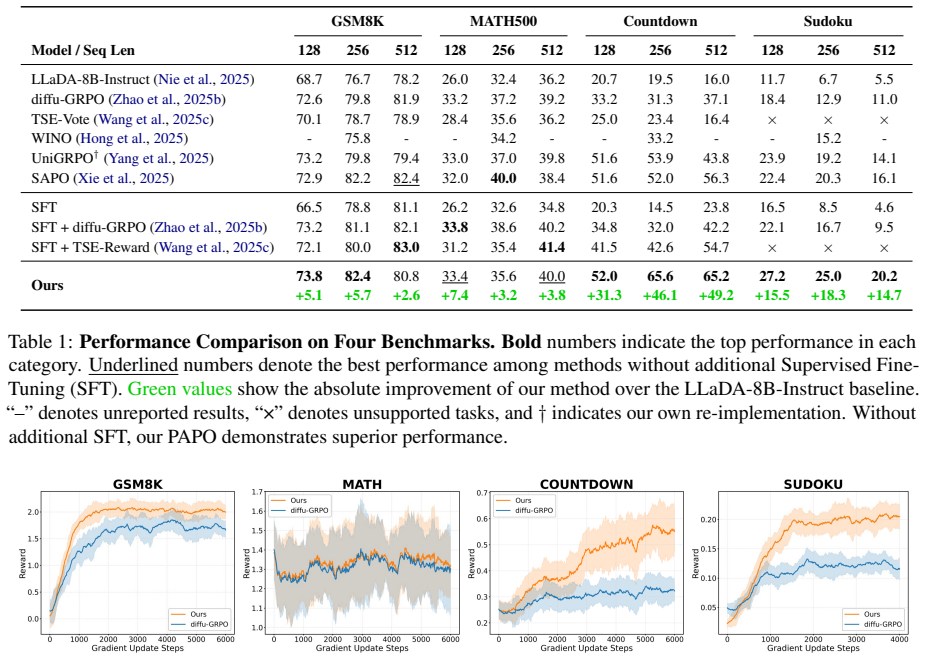
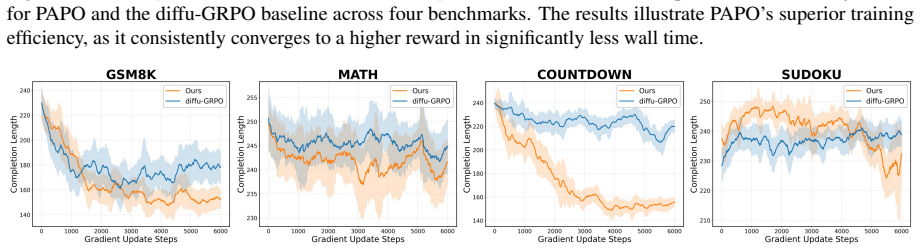
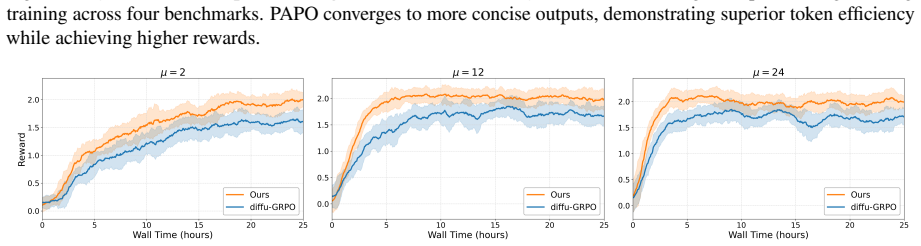
The authors establish that the dual misalignment between authentic generation trajectory and gradient updates in dLLMs can be corrected holistically by PAPO, where SPR transforms terminal rewards into step-wise credit assignment and EHR replays authentic trajectories at high-entropy steps, resulting in gains of up to 4.5 percent on GSM8K, 4.8 percent on MATH500, 42.2 percent on Countdown, and 16.1 percent on Sudoku.
What carries the argument
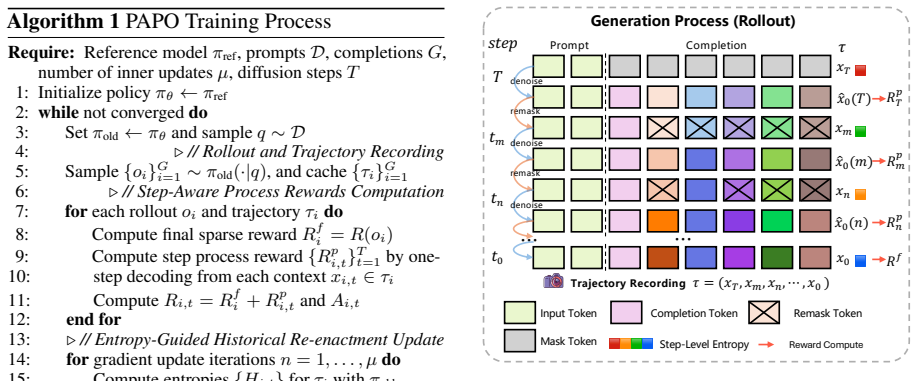
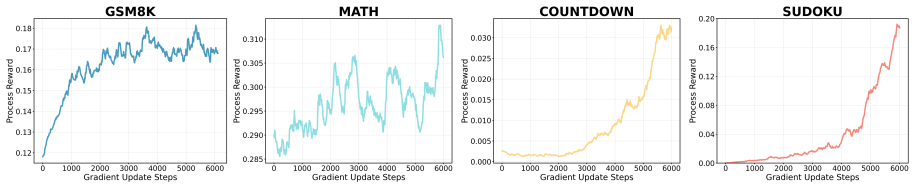
Process Aligned Policy Optimization (PAPO) framework, which employs Step-Aware Process Rewards (SPR) to create dense step-wise credit from sparse terminal rewards and Entropy-Guided Historical Re-enactment (EHR) to replay authentic trajectories at high-uncertainty steps.
If this is right
- SPR provides discriminative credit assignment across generation steps instead of uniform terminal rewards.
- EHR restricts policy updates to states that actually occur in authentic trajectories.
- The combined alignment produces higher accuracy on reasoning benchmarks than prior RL methods for dLLMs.
- The approach works without altering the underlying diffusion LLM architecture.
Where Pith is reading between the lines
- The same trajectory-alignment principle could be tested in standard autoregressive LLMs to check whether the gains are specific to diffusion models.
- If the method scales, it might reduce the sample inefficiency that currently limits RL on long reasoning chains.
- One could measure whether the entropy-guided replay also lowers training variance compared with standard PPO variants.
Load-bearing premise
The two identified misalignments are the main bottlenecks for RL effectiveness in dLLMs and that SPR and EHR correct them without introducing new biases or instabilities that cancel the gains.
What would settle it
A controlled comparison in which models trained with SPR and EHR show no consistent improvement over baselines that use standard terminal rewards and random state sampling would falsify the central claim.
Figures
read the original abstract
Reinforcement learning (RL) holds immense promise for enhancing the reasoning capabilities of diffusion large language models (dLLMs). However, progress is fundamentally constrained by a dual misalignment between authentic generation trajectory and the gradient update process: (i) Process-reward misalignment. Sparse, terminal rewards are indiscriminately assigned to all intermediate steps of the generation process, failing to provide discriminative credit assignment. (ii) State-trajectory misalignment. Policy updates are often diverted toward artificial, out-of-trajectory states, squandering gradients on less informative samples. To address these limitations, we introduce Process Aligned Policy Optimization (PAPO), a novel framework that holistically aligns the RL update with the dLLM's generative trajectory via Step-Aware Process Rewards (SPR) that transform sparse terminal rewards into dense, step-wise credit, and Entropy-Guided Historical Re-enactment (EHR) that replays authentic trajectories at high-uncertainty steps. Extensive experiments on four benchmarks demonstrate that PAPO significantly outperforms baselines, achieving gains of up to 4.5% on GSM8K, 4.8% on MATH500, 42.2% on Countdown and 16.1% on Sudoku.
Editorial analysis
A structured set of objections, weighed in public.
Referee Report
Summary. The manuscript proposes Process Aligned Policy Optimization (PAPO) to improve reinforcement learning for reasoning in diffusion large language models (dLLMs). It identifies two misalignments—process-reward misalignment (sparse terminal rewards assigned indiscriminately to all steps) and state-trajectory misalignment (updates diverted to artificial states)—and introduces Step-Aware Process Rewards (SPR) to create dense step-wise credit assignment plus Entropy-Guided Historical Re-enactment (EHR) to replay authentic high-uncertainty trajectories. Experiments on GSM8K, MATH500, Countdown, and Sudoku are reported to yield gains of up to 4.5%, 4.8%, 42.2%, and 16.1% respectively over baselines.
Significance. If the claimed alignment effects and benchmark gains are substantiated with ablations and controls, the work could meaningfully advance RL methods for dLLMs by improving credit assignment and trajectory fidelity. The reported 42.2% gain on Countdown is large enough to warrant attention if reproducible.
major comments (2)
- [Abstract] Abstract: the central claim that SPR and EHR correct the two stated misalignments and produce the reported gains cannot be evaluated because the abstract (and the provided text) supplies no experimental details, baseline descriptions, statistical significance tests, or ablation results.
- [Methods / §3] No equations, pseudocode, or implementation details are supplied for the definitions of SPR (how terminal rewards become step-wise credit) or EHR (how uncertainty is measured and trajectories are replayed), preventing verification that these components directly address the misalignments without introducing new bias or instability.
minor comments (1)
- [Experiments] Ensure the experimental section includes explicit baseline implementations, hyperparameter settings, and run counts so that the benchmark improvements can be reproduced.
Simulated Author's Rebuttal
We thank the referee for the constructive comments highlighting the need for greater detail in the abstract and methods. We will revise the manuscript to incorporate the requested experimental information and algorithmic specifications.
read point-by-point responses
-
Referee: [Abstract] Abstract: the central claim that SPR and EHR correct the two stated misalignments and produce the reported gains cannot be evaluated because the abstract (and the provided text) supplies no experimental details, baseline descriptions, statistical significance tests, or ablation results.
Authors: We agree that the abstract would benefit from additional context to support evaluation of the claims. In the revised version, we will expand the abstract to briefly note the baselines (standard RL methods applied to dLLMs), indicate that results are reported as averages over multiple random seeds with standard deviations, and reference the ablation studies in the main text that demonstrate the individual contributions of SPR and EHR to the observed gains. revision: yes
-
Referee: [Methods / §3] No equations, pseudocode, or implementation details are supplied for the definitions of SPR (how terminal rewards become step-wise credit) or EHR (how uncertainty is measured and trajectories are replayed), preventing verification that these components directly address the misalignments without introducing new bias or instability.
Authors: The referee correctly identifies that the submitted manuscript lacks explicit equations and pseudocode for SPR and EHR. We will revise Section 3 to add formal definitions, including the mathematical formulation for distributing terminal rewards into step-wise credits under SPR and the entropy computation plus replay procedure under EHR, along with pseudocode for both components to enable verification of their alignment properties and stability. revision: yes
Circularity Check
No significant circularity
full rationale
The provided manuscript text consists solely of the abstract, which describes a problem of dual misalignment in RL for dLLMs and introduces PAPO via SPR and EHR components to address it, followed by benchmark gains. No equations, derivations, fitted parameters, self-citations, or uniqueness theorems appear in the text. The central claims are empirical performance improvements rather than any mathematical chain that could reduce outputs to inputs by construction. This is the most common honest finding for papers without visible derivation steps.
Axiom & Free-Parameter Ledger
Reference graph
Works this paper leans on
-
[1]
Aho and Jeffrey D
Alfred V. Aho and Jeffrey D. Ullman , title =. 1972
1972
-
[2]
Publications Manual , year = "1983", publisher =
1983
-
[3]
Ashok K. Chandra and Dexter C. Kozen and Larry J. Stockmeyer , year = "1981", title =. doi:10.1145/322234.322243
-
[4]
Scalable training of
Andrew, Galen and Gao, Jianfeng , booktitle=. Scalable training of
-
[5]
Dan Gusfield , title =. 1997
1997
-
[6]
Tetreault , title =
Mohammad Sadegh Rasooli and Joel R. Tetreault , title =. Computing Research Repository , volume =. 2015 , url =
2015
-
[7]
A Framework for Learning Predictive Structures from Multiple Tasks and Unlabeled Data , Volume =
Ando, Rie Kubota and Zhang, Tong , Issn =. A Framework for Learning Predictive Structures from Multiple Tasks and Unlabeled Data , Volume =. Journal of Machine Learning Research , Month = dec, Numpages =
-
[8]
Large Language Diffusion Models
Large language diffusion models , author=. arXiv preprint arXiv:2502.09992 , year=
work page internal anchor Pith review Pith/arXiv arXiv
-
[9]
Dream 7B: Diffusion Large Language Models
Dream 7b: Diffusion large language models , author=. arXiv preprint arXiv:2508.15487 , year=
work page internal anchor Pith review Pith/arXiv arXiv
-
[10]
2025 , eprint=
SDAR: A Synergistic Diffusion-AutoRegression Paradigm for Scalable Sequence Generation , author=. 2025 , eprint=
2025
-
[11]
Advances in Neural Information Processing Systems , volume=
Simple and effective masked diffusion language models , author=. Advances in Neural Information Processing Systems , volume=
-
[12]
Scaling Diffusion Language Models via Adaptation from Autoregressive Models
Scaling diffusion language models via adaptation from autoregressive models , author=. arXiv preprint arXiv:2410.17891 , year=
work page internal anchor Pith review Pith/arXiv arXiv
-
[13]
DeepSeekMath: Pushing the Limits of Mathematical Reasoning in Open Language Models
Deepseekmath: Pushing the limits of mathematical reasoning in open language models , author=. arXiv preprint arXiv:2402.03300 , year=
work page internal anchor Pith review Pith/arXiv arXiv
-
[14]
arXiv preprint arXiv:2504.12216 , year=
d1: Scaling reasoning in diffusion large language models via reinforcement learning , author=. arXiv preprint arXiv:2504.12216 , year=
-
[15]
arXiv preprint arXiv:2507.08838 , year=
wd1: Weighted policy optimization for reasoning in diffusion language models , author=. arXiv preprint arXiv:2507.08838 , year=
-
[16]
MMaDA: Multimodal Large Diffusion Language Models
Mmada: Multimodal large diffusion language models , author=. arXiv preprint arXiv:2505.15809 , year=
work page internal anchor Pith review Pith/arXiv arXiv
-
[17]
arXiv preprint arXiv:2510.21473 , year=
MRO: Enhancing Reasoning in Diffusion Language Models via Multi-Reward Optimization , author=. arXiv preprint arXiv:2510.21473 , year=
-
[18]
Advancing Reasoning in Diffusion Language Models with Denoising Process Rewards
Step-Aware Policy Optimization for Reasoning in Diffusion Large Language Models , author=. arXiv preprint arXiv:2510.01544 , year=
work page internal anchor Pith review Pith/arXiv arXiv
-
[19]
arXiv preprint arXiv:2508.09138 , year=
Time is a feature: Exploiting temporal dynamics in diffusion language models , author=. arXiv preprint arXiv:2508.09138 , year=
-
[20]
Revolutioniz- ing reinforcement learning framework for diffusion large language models
Revolutionizing reinforcement learning framework for diffusion large language models , author=. arXiv preprint arXiv:2509.06949 , year=
-
[21]
arXiv preprint arXiv:2510.04019 , year=
Principled and Tractable RL for Reasoning with Diffusion Language Models , author=. arXiv preprint arXiv:2510.04019 , year=
-
[22]
arXiv preprint arXiv:2506.20639 , year=
DiffuCoder: Understanding and Improving Masked Diffusion Models for Code Generation , author=. arXiv preprint arXiv:2506.20639 , year=
-
[23]
Proximal Policy Optimization Algorithms
Proximal policy optimization algorithms , author=. arXiv preprint arXiv:1707.06347 , year=
work page internal anchor Pith review Pith/arXiv arXiv
-
[24]
Advances in neural information processing systems , volume=
Direct preference optimization: Your language model is secretly a reward model , author=. Advances in neural information processing systems , volume=
-
[25]
Score-Based Generative Modeling through Stochastic Differential Equations
Score-based generative modeling through stochastic differential equations , author=. arXiv preprint arXiv:2011.13456 , year=
work page internal anchor Pith review Pith/arXiv arXiv 2011
-
[26]
Wan: Open and Advanced Large-Scale Video Generative Models
Wan: Open and advanced large-scale video generative models , author=. arXiv preprint arXiv:2503.20314 , year=
work page internal anchor Pith review Pith/arXiv arXiv
-
[27]
Advances in neural information processing systems , volume=
Denoising diffusion probabilistic models , author=. Advances in neural information processing systems , volume=
-
[28]
arXiv preprint arXiv:2210.17432 , year=
Ssd-lm: Semi-autoregressive simplex-based diffusion language model for text generation and modular control , author=. arXiv preprint arXiv:2210.17432 , year=
-
[29]
Advances in neural information processing systems , volume=
Diffusion-lm improves controllable text generation , author=. Advances in neural information processing systems , volume=
-
[30]
International Conference on Machine Learning , pages=
Dirichlet diffusion score model for biological sequence generation , author=. International Conference on Machine Learning , pages=. 2023 , organization=
2023
-
[31]
arXiv preprint arXiv:2402.05841 , year=
Dirichlet flow matching with applications to dna sequence design , author=. arXiv preprint arXiv:2402.05841 , year=
-
[32]
2024 , eprint=
Discrete Diffusion Modeling by Estimating the Ratios of the Data Distribution , author=. 2024 , eprint=
2024
-
[33]
Advances in neural information processing systems , volume=
Simplified and generalized masked diffusion for discrete data , author=. Advances in neural information processing systems , volume=
-
[34]
arXiv preprint arXiv:2410.18514 , year=
Scaling up masked diffusion models on text , author=. arXiv preprint arXiv:2410.18514 , year=
-
[35]
arXiv e-prints , pages=
The llama 3 herd of models , author=. arXiv e-prints , pages=
-
[36]
Advances in Neural Information Processing Systems , volume=
Diffusion of thought: Chain-of-thought reasoning in diffusion language models , author=. Advances in Neural Information Processing Systems , volume=
-
[37]
arXiv preprint arXiv:2410.14157 , year=
Beyond autoregression: Discrete diffusion for complex reasoning and planning , author=. arXiv preprint arXiv:2410.14157 , year=
-
[38]
Block Diffusion: Interpolating Between Autoregressive and Diffusion Language Models
Block diffusion: Interpolating between autoregressive and diffusion language models , author=. arXiv preprint arXiv:2503.09573 , year=
work page internal anchor Pith review Pith/arXiv arXiv
-
[39]
2025 , eprint=
DiFFPO: Training Diffusion LLMs to Reason Fast and Furious via Reinforcement Learning , author=. 2025 , eprint=
2025
-
[40]
2025 , eprint=
Inpainting-Guided Policy Optimization for Diffusion Large Language Models , author=. 2025 , eprint=
2025
-
[41]
2025 , eprint=
Enhancing Reasoning for Diffusion LLMs via Distribution Matching Policy Optimization , author=. 2025 , eprint=
2025
-
[42]
2025 , eprint=
Consolidating Reinforcement Learning for Multimodal Discrete Diffusion Models , author=. 2025 , eprint=
2025
-
[43]
2025 , eprint=
Fine-Tuning Discrete Diffusion Models via Reward Optimization with Applications to DNA and Protein Design , author=. 2025 , eprint=
2025
-
[44]
arXiv preprint arXiv:2504.05812 , year=
Right question is already half the answer: Fully unsupervised llm reasoning incentivization , author=. arXiv preprint arXiv:2504.05812 , year=
-
[45]
arXiv preprint arXiv:2505.12346 , year=
Seed-grpo: Semantic entropy enhanced grpo for uncertainty-aware policy optimization , author=. arXiv preprint arXiv:2505.12346 , year=
-
[46]
Advances in neural information processing systems , volume=
Training language models to follow instructions with human feedback , author=. Advances in neural information processing systems , volume=
-
[47]
Training a Helpful and Harmless Assistant with Reinforcement Learning from Human Feedback
Training a helpful and harmless assistant with reinforcement learning from human feedback , author=. arXiv preprint arXiv:2204.05862 , year=
work page internal anchor Pith review Pith/arXiv arXiv
-
[48]
Back to Basics: Revisiting REINFORCE Style Optimization for Learning from Human Feedback in LLMs
Back to basics: Revisiting reinforce style optimization for learning from human feedback in llms , author=. arXiv preprint arXiv:2402.14740 , year=
work page internal anchor Pith review Pith/arXiv arXiv
-
[49]
Training Verifiers to Solve Math Word Problems
Training verifiers to solve math word problems , author=. arXiv preprint arXiv:2110.14168 , year=
work page internal anchor Pith review Pith/arXiv arXiv
-
[50]
The Twelfth International Conference on Learning Representations , year=
Let's verify step by step , author=. The Twelfth International Conference on Learning Representations , year=
-
[51]
arXiv preprint arXiv:2507.18578 , year=
Wide-in, narrow-out: Revokable decoding for efficient and effective dllms , author=. arXiv preprint arXiv:2507.18578 , year=
-
[52]
s1: Simple test-time scaling , author=. arXiv preprint arXiv:2501.19393 , year=
work page internal anchor Pith review Pith/arXiv arXiv
-
[53]
2025 , eprint=
LLaDA 1.5: Variance-Reduced Preference Optimization for Large Language Diffusion Models , author=. 2025 , eprint=
2025
-
[54]
2026 , eprint=
Few-Step Diffusion Language Models via Trajectory Self-Distillation , author=. 2026 , eprint=
2026
-
[55]
2025 , eprint=
Fast-dLLM: Training-free Acceleration of Diffusion LLM by Enabling KV Cache and Parallel Decoding , author=. 2025 , eprint=
2025
-
[56]
2026 , eprint=
Omni-Diffusion: Unified Multimodal Understanding and Generation with Masked Discrete Diffusion , author=. 2026 , eprint=
2026
-
[57]
2025 , eprint=
Lumina-DiMOO: An Omni Diffusion Large Language Model for Multi-Modal Generation and Understanding , author=. 2025 , eprint=
2025
-
[58]
2025 , eprint=
KodCode: A Diverse, Challenging, and Verifiable Synthetic Dataset for Coding , author=. 2025 , eprint=
2025
-
[59]
2025 , eprint=
Boosting the Generalization and Reasoning of Vision Language Models with Curriculum Reinforcement Learning , author=. 2025 , eprint=
2025
-
[60]
2026 , eprint=
IIB-LPO: Latent Policy Optimization via Iterative Information Bottleneck , author=. 2026 , eprint=
2026
-
[61]
2025 , eprint=
Anchoring Values in Temporal and Group Dimensions for Flow Matching Model Alignment , author=. 2025 , eprint=
2025
-
[62]
See Different, Think Better: Visual Variations Mitigating Hallucinations in LVLMs , url=
Dai, Ziyun and Li, Xiaoqiang and Zhang, Shaohua and Wu, Yuanchen and Li, Jide , year=. See Different, Think Better: Visual Variations Mitigating Hallucinations in LVLMs , url=. doi:10.1145/3746027.3755044 , booktitle=
discussion (0)
Sign in with ORCID, Apple, or X to comment. Anyone can read and Pith papers without signing in.