Acoustic disguising: a unified framework for cloaking and holography
Pith reviewed 2026-06-27 17:38 UTC · model grok-4.3
The pith
Cloaking and holography are two limits of acoustic disguising realized by driving a closed surface with Green's functions.
A machine-rendered reading of the paper's core claim, the machinery that carries it, and where it could break.
Core claim
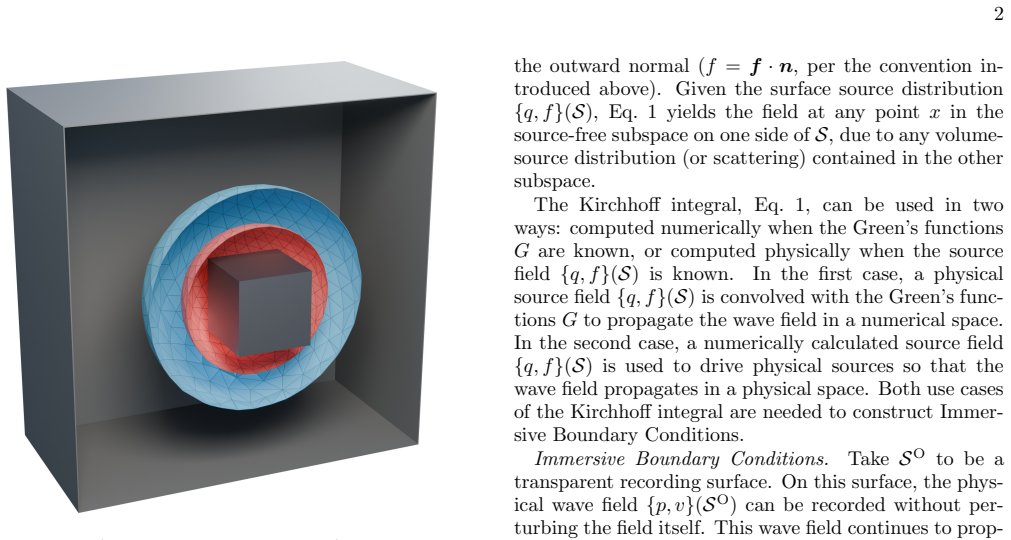
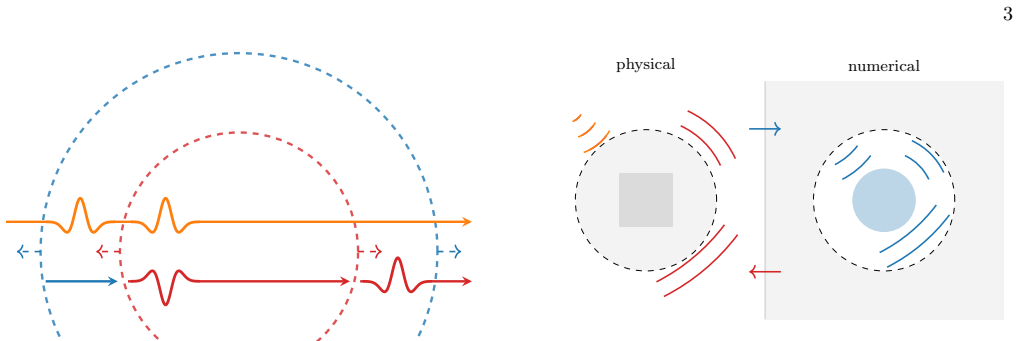
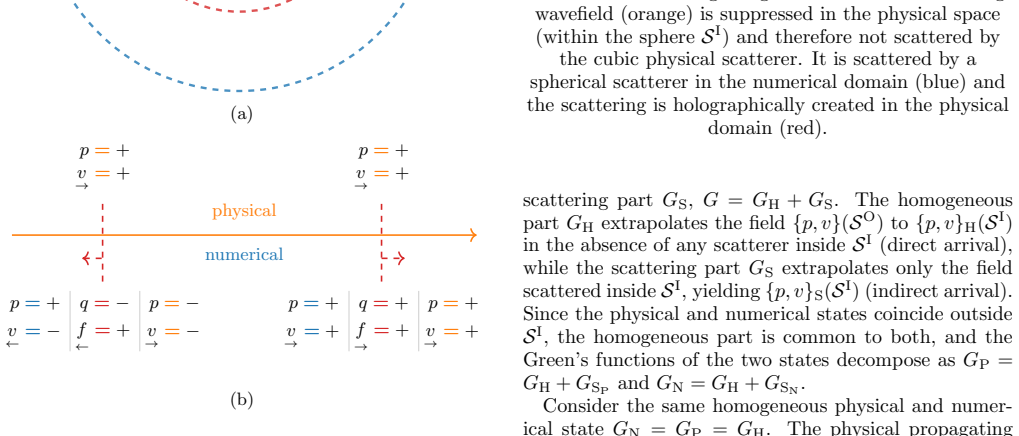
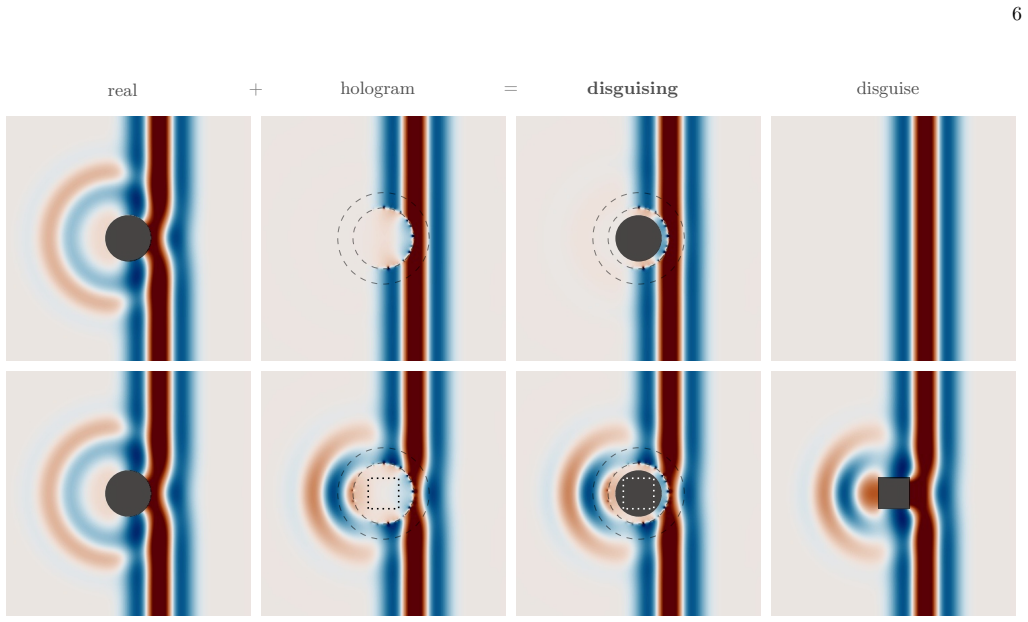
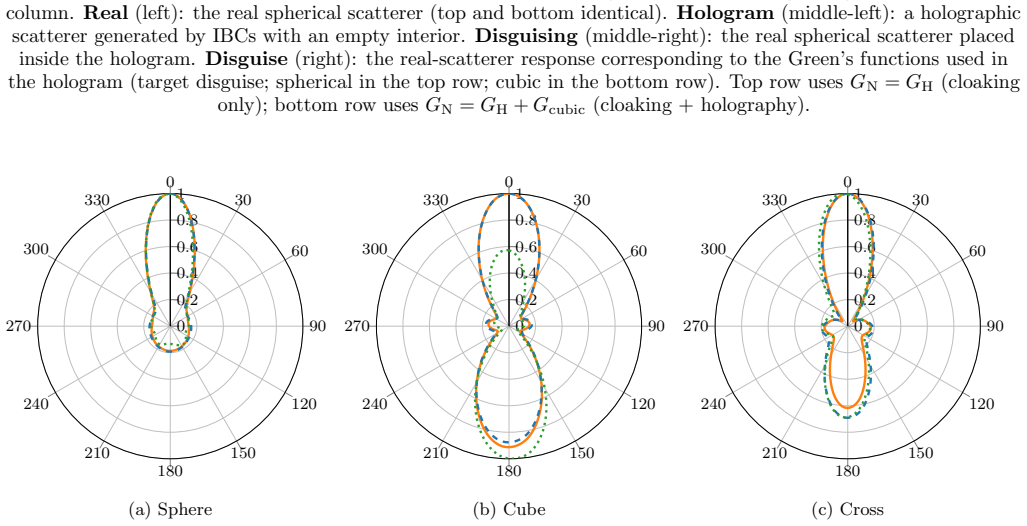
Driving the boundary with homogeneous Green's functions suppresses any incident field inside the enclosed volume and cloaks unknown objects broadband; driving it with scattering Green's functions synthesizes a holographic scatterer indistinguishable from a target for arbitrary illuminations. Combining the two, using heterogeneous Green's functions, replaces the scattering signature of one object with that of another, transforming its acoustic identity. The framework is shown in three-dimensional FDTD simulations driven by impulsive Green's functions, complemented by data-driven Green's-function retrieval.
What carries the argument
Immersive boundary conditions on a closed surface driven by homogeneous, scattering, or heterogeneous Green's functions.
If this is right
- Unknown objects inside the volume are cloaked from broadband incident fields.
- Holographic scatterers can be synthesized that match a target object for arbitrary illuminations.
- The scattering signature of one object can be replaced with that of another.
- Real-time three-dimensional acoustic cloaking, holography, cloning, and disguising become feasible.
- Data-driven retrieval of Green's functions supports practical implementation.
Where Pith is reading between the lines
- The same boundary-driving approach could extend to electromagnetic or elastic waves.
- Sensor arrays approximating the closed surface might enable adaptive disguising in changing environments.
- The unification points to possible new designs for acoustic privacy systems or virtual sound fields.
Load-bearing premise
Immersive boundary conditions on a closed surface can be physically realized and driven with the required Green's functions without artifacts.
What would settle it
A measurement inside the enclosed volume showing that an incident broadband field remains unsuppressed after the boundary is driven with homogeneous Green's functions.
Figures
read the original abstract
Cloaking and holography -- usually treated as distinct problems -- are two limits of a single operation that we call acoustic disguising, realized here using immersive boundary conditions on a closed surface. Driving the boundary with homogeneous Green's functions suppresses any incident field inside the enclosed volume and cloaks unknown objects broadband; driving it with scattering Green's functions synthesizes a holographic scatterer indistinguishable from a target for arbitrary illuminations. Combining the two, using heterogeneous Green's functions, replaces the scattering signature of one object with that of another, transforming its acoustic identity. We demonstrate the framework in three-dimensional FDTD simulations driven by impulsive Green's functions, complemented by data-driven Green's-function retrieval, establishing a direct route to real-time 3D acoustic cloaking, holography, cloning, and disguising.
Editorial analysis
A structured set of objections, weighed in public.
Referee Report
Summary. The paper proposes 'acoustic disguising' as a unified framework treating cloaking and holography as limits of the same operation realized via immersive boundary conditions on a closed surface. Driving the boundary with homogeneous Green's functions is claimed to suppress arbitrary incident fields inside the volume for broadband cloaking of unknown objects; scattering Green's functions synthesize a target scatterer for arbitrary illuminations; and heterogeneous Green's functions transform one object's scattering signature into another's. The framework is demonstrated in 3D FDTD simulations using impulsive Green's functions, with data-driven retrieval suggested for real-time applications.
Significance. If the central claims hold, the work offers a mathematically unified approach to acoustic cloaking, holography, and identity transformation with a direct path to experimental implementation via data-driven Green's function retrieval. Strengths include the conceptual unification and the emphasis on broadband, illumination-independent performance, which would be a notable advance if supported by rigorous derivations and non-idealized validation.
major comments (2)
- [Abstract and simulation description] The central claims require that homogeneous Green's functions exactly cancel arbitrary incident fields inside the surface (cloaking) and that scattering/heterogeneous versions exactly reproduce or swap signatures for any illumination. However, the FDTD demonstrations rely on impulsive Green's functions under perfect conditions and do not test for phase/amplitude errors from data-driven retrieval or actuator dynamics, which directly undermines the load-bearing assumption of realizable exact driving for broadband/unknown incidents.
- [Abstract] No equations, derivations, or error analysis are supplied to show how the Green's functions achieve exact suppression or synthesis; without these, it is impossible to verify whether the framework is parameter-free or internally consistent as stated.
minor comments (1)
- [Abstract] Clarify the precise definition and computation of 'heterogeneous Green's functions' versus the homogeneous and scattering cases to avoid ambiguity in the framework description.
Simulated Author's Rebuttal
We thank the referee for the constructive feedback. We address each major comment below and will revise the manuscript accordingly to strengthen the presentation of the framework.
read point-by-point responses
-
Referee: [Abstract and simulation description] The central claims require that homogeneous Green's functions exactly cancel arbitrary incident fields inside the surface (cloaking) and that scattering/heterogeneous versions exactly reproduce or swap signatures for any illumination. However, the FDTD demonstrations rely on impulsive Green's functions under perfect conditions and do not test for phase/amplitude errors from data-driven retrieval or actuator dynamics, which directly undermines the load-bearing assumption of realizable exact driving for broadband/unknown incidents.
Authors: The simulations demonstrate the ideal case of the mathematical framework using impulsive Green's functions to establish the unification principle for cloaking, holography, and identity transformation. The manuscript positions data-driven retrieval as a suggested route to implementation rather than claiming that the presented simulations already incorporate non-ideal effects. We agree that an analysis of phase/amplitude errors and actuator dynamics would better support the path to broadband, illumination-independent performance. We will add a subsection discussing these practical considerations, their potential impact, and mitigation approaches. revision: yes
-
Referee: [Abstract] No equations, derivations, or error analysis are supplied to show how the Green's functions achieve exact suppression or synthesis; without these, it is impossible to verify whether the framework is parameter-free or internally consistent as stated.
Authors: The abstract summarizes the approach, while the body of the manuscript describes the roles of homogeneous, scattering, and heterogeneous Green's functions. To make the claims more verifiable as requested, we will insert explicit equations and derivations showing how these functions produce the suppression and synthesis effects, together with a concise error analysis confirming consistency under the stated conditions. revision: yes
Circularity Check
No circularity: claims rest on standard Green's function application and FDTD validation
full rationale
The paper presents acoustic disguising as a unification of cloaking and holography via driving a closed surface with homogeneous, scattering, or heterogeneous Green's functions. The abstract and description indicate this is demonstrated through three-dimensional FDTD simulations using impulsive Green's functions plus data-driven retrieval. No load-bearing steps reduce any prediction to a fitted input by construction, no self-definitional relations appear, and no self-citations are invoked as uniqueness theorems or ansatzes that would force the result. The derivation chain is self-contained against external acoustic theory and numerical benchmarks.
Axiom & Free-Parameter Ledger
axioms (1)
- domain assumption Immersive boundary conditions on a closed surface can be driven to control internal and scattered acoustic fields using Green's functions.
invented entities (2)
-
acoustic disguising
no independent evidence
-
heterogeneous Green's functions
no independent evidence
Reference graph
Works this paper leans on
-
[1]
Fleury, F
R. Fleury, F. Monticone, and A. Al` u, Invisibility and Cloaking: Origins, Present, and Future Perspectives, Physical Review Applied4, 037001 (2015)
2015
-
[2]
P. A. Nelson, S. J. Elliott, and P. A. Nelson,Active Con- trol of Sound, paperback ed., 4. print., [nachdr.] ed. (Aca- demic Press, San Diego, 2000)
2000
-
[3]
A. N. Norris, Acoustic cloaking theory, Proceedings of the Royal Society A: Mathematical, Physical and Engineer- ing Sciences464, 2411 (2008), arXiv:0805.0080 [cond- mat]
Pith/arXiv arXiv 2008
-
[4]
A. N. Norris, Acoustic cloaking, Acoustics Today (2015)
2015
-
[5]
X. Song, T. Chen, J. Zhu, Y. He, and Z. Liu, Broadband acoustic cloaking and disguising with full-rangle incident angles based on reconfigurable metasurface, International Journal of Modern Physics B33, 1950273 (2019)
2019
-
[6]
Chen and C
H. Chen and C. T. Chan, Acoustic cloaking and transfor- mation acoustics, Journal of Physics D: Applied Physics 43, 113001 (2010)
2010
-
[7]
Zigoneanu, B.-I
L. Zigoneanu, B.-I. Popa, and S. A. Cummer, Three- dimensional broadband omnidirectional acoustic ground cloak, Nature Materials13, 352 (2014)
2014
-
[8]
S. A. Cummer, J. Christensen, and A. Al` u, Controlling sound with acoustic metamaterials, Nature Reviews Ma- terials1, 1 (2016)
2016
-
[9]
Friot and C
E. Friot and C. Bordier, Real-time active suppression of scattered acoustic radiation, Journal of Sound and Vi- bration278, 563 (2004)
2004
-
[10]
Guevara Vasquez, G
F. Guevara Vasquez, G. W. Milton, and D. Onofrei, Ex- terior cloaking with active sources in two dimensional acoustics, Wave Motion48, 515 (2011)
2011
-
[11]
B.-I. Popa, D. Shinde, A. Konneker, and S. A. Cummer, Active acoustic metamaterials reconfigurable in real time, Physical Review B91, 220303 (2015)
2015
-
[12]
G. Ma, X. Fan, P. Sheng, and M. Fink, Shaping reverber- ating sound fields with an actively tunable metasurface, Proceedings of the National Academy of Sciences115, 6638 (2018)
2018
-
[13]
Lasri and L
O. Lasri and L. Sirota, Active control approach to tem- poral acoustic cloaking, Applied Physics Letters123, 032201 (2023)
2023
-
[14]
D. A. B. Miller, On perfect cloaking, Optics Express14, 12457 (2006)
2006
-
[15]
van Manen, J
D.-J. van Manen, J. O. A. Robertsson, and A. Curtis, Exact wave field simulation for finite-volume scattering problems, The Journal of the Acoustical Society of Amer- ica122, EL115 (2007)
2007
-
[16]
Vasmel, J
M. Vasmel, J. O. A. Robertsson, D.-J. van Manen, and A. Curtis, Immersive experimentation in a wave propa- gation laboratory, The Journal of the Acoustical Society of America134, EL492 (2013)
2013
-
[17]
van Manen, M
D.-J. van Manen, M. Vasmel, S. Greenhalgh, and J. O. A. Robertsson, Broadband cloaking and holography with ex- act boundary conditions, The Journal of the Acoustical Society of America137, EL415 (2015)
2015
-
[18]
T. S. Becker, D.-J. van Manen, C. M. Donahue, C. B¨ arlocher, N. B¨ orsing, F. Broggini, T. Haag, J. O. A. Robertsson, D. R. Schmidt, S. A. Greenhalgh, and T. E. Blum, Immersive Wave Propagation Experimentation: Physical Implementation and One-Dimensional Acoustic Results, Physical Review X8, 031011 (2018)
2018
-
[19]
B¨ orsing, T
N. B¨ orsing, T. S. Becker, A. Curtis, D.-J. van Manen, T. Haag, and J. O. Robertsson, Cloaking and Hologra- phy Experiments Using Immersive Boundary Conditions, Physical Review Applied12, 024011 (2019)
2019
-
[20]
Broggini, M
F. Broggini, M. Vasmel, J. O. A. Robertsson, and D.- J. van Manen, Immersive boundary conditions: Theory, implementation, and examples, GEOPHYSICS82, T97 (2017)
2017
-
[21]
T. S. Becker, D.-J. Van Manen, T. Haag, C. B¨ arlocher, X. Li, N. B¨ orsing, A. Curtis, M. Serra-Garcia, and J. O. A. Robertsson, Broadband acoustic invisibility and illusions, Science Advances7, eabi9627 (2021)
2021
-
[22]
M¨ uller, T
J. M¨ uller, T. S. Becker, X. Li, J. Aichele, M. Serra- Garcia, J. O. Robertsson, and D.-J. Van Manen, Acoustic cloning, Physical Review Applied20, 064014 (2023)
2023
-
[23]
G. Barton,Elements of Green’s Functions and Propaga- tion: Potentials, Diffusion, and Waves, Oxford Science Publications (Clarendon Press ; Oxford University Press, Oxford : New York, 1989)
1989
-
[24]
J. T. Fokkema and P. M. van den Berg,Seismic Appli- cations of Acoustic Reciprocity(Elsevier, Amsterdam ; New York, 1993)
1993
-
[25]
A. T. de Hoop,Handbook of Radiation and Scattering of Waves: Acoustic Waves in Fluid, Elastic Waves in Solids, Electromagnetic Waves(Acad. Press, London, 1995)
1995
-
[26]
Amundsen, Elimination of free-surface related multi- ples without need of the source wavelet, GEOPHYSICS 66, 327 (2001)
L. Amundsen, Elimination of free-surface related multi- ples without need of the source wavelet, GEOPHYSICS 66, 327 (2001)
2001
-
[27]
Wapenaar, J
K. Wapenaar, J. van der Neut, E. Ruigrok, D. Draganov, J. Hunziker, E. Slob, J. Thorbecke, and R. Snieder, Seismic interferometry by crosscorrelation and by mul- tidimensional deconvolution: A systematic compari- son: Seismic interferometry, Geophysical Journal Inter- national185, 1335 (2011)
2011
-
[28]
X. Li, T. Becker, M. Ravasi, J. Robertsson, and D.-J. van Manen, Closed-aperture unbounded acoustics exper- imentation using multidimensional deconvolution, The Journal of the Acoustical Society of America149, 1813 (2021)
2021
-
[29]
J. G. Tolan and J. B. Schneider, Locally conformal method for acoustic finite-difference time-domain mod- eling of rigid surfaces, The Journal of the Acoustical So- ciety of America114, 2575 (2003)
2003
-
[30]
Gonz´ alez, Measurement of Areas on a Sphere Using Fibonacci and Latitude–Longitude Lattices, Mathemati- cal Geosciences42, 49 (2010)
´A. Gonz´ alez, Measurement of Areas on a Sphere Using Fibonacci and Latitude–Longitude Lattices, Mathemati- cal Geosciences42, 49 (2010)
2010
-
[31]
Marques, C
R. Marques, C. Bouville, M. Ribardi` ere, L. P. Santos, and K. Bouatouch, Spherical Fibonacci Point Sets for Il- lumination Integrals, Computer Graphics Forum32, 134 8 (2013)
2013
-
[32]
A. J. Berkhout and C. P. A. Wapenaar, One-way versions of the Kirchhoff integral, Geophysics54, 460 (1989)
1989
-
[33]
Wapenaar, Reciprocity and Representation Theo- rems for Flux- and Field-Normalised Decomposed Wave Fields, Advances in Mathematical Physics2020, 1 (2020)
K. Wapenaar, Reciprocity and Representation Theo- rems for Flux- and Field-Normalised Decomposed Wave Fields, Advances in Mathematical Physics2020, 1 (2020)
2020
-
[34]
J. B. Schneider,Understanding the Finite-Difference Time-Domain Method(Washington State University)
-
[35]
Botteldooren, Finite-difference time-domain simula- tion of low-frequency room acoustic problems, The Jour- nal of the Acoustical Society of America98, 3302 (1995)
D. Botteldooren, Finite-difference time-domain simula- tion of low-frequency room acoustic problems, The Jour- nal of the Acoustical Society of America98, 3302 (1995)
1995
-
[36]
Sheaffer, M
J. Sheaffer, M. V. Walstijn, and B. Fazenda, A Physically-Constrained Source Model for FDTD Acous- tic Simulation, inProc. of the 15th International Con- ference on Digital Audio Effects (DAFx-12)(York, UK, 2012)
2012
-
[37]
Ravasi and I
M. Ravasi and I. Vasconcelos, PyLops—A linear-operator Python library for scalable algebra and optimization, SoftwareX11, 100361 (2020)
2020
-
[38]
Roberts, The Unreasonable Effectiveness of Quasir- andom Sequences (2018)
M. Roberts, The Unreasonable Effectiveness of Quasir- andom Sequences (2018)
2018
-
[39]
Roberts, Evenly distributing points on a sphere (2018)
M. Roberts, Evenly distributing points on a sphere (2018)
2018
-
[40]
Crameri, Scientific colour maps, Zenodo (2023)
F. Crameri, Scientific colour maps, Zenodo (2023). 9 FIG. S1: Pressure recorded on the discretised recording surfaceS O — a Fibonacci-sampled sphere triangulated via its convex hull — at two timestamps for a single illumination source (see Fig. S2).Left:just after the wavefront’s first arrival.Right:deep in the reverberant tail. The triangulated mesh is G...
2023
-
[41]
In 3D, the closed integration path of the 2D formulation is replaced by a closed surface that fully encloses the scatterer
MDD Multidimensional deconvolution (MDD) in three dimensions is similar to the two-dimensional approach [22, 28]. In 3D, the closed integration path of the 2D formulation is replaced by a closed surface that fully encloses the scatterer. The multidimensional convolution formalism (MDC) remains applicable, and the volumetric Green’s functions are retrieved...
-
[42]
2, admits two evaluation schemes
Boundary-extrapolation write count The discrete Kirchhoff convolution that extrapolates the recorded outer-surface field to the inner emitting surface, Eq. 2, admits two evaluation schemes. Ascatterforward-extrapolates each recorded boundary sample into theKfuture output times reached by its kernel, performing a read–modify–write per kernel tap:O(K) write...
-
[43]
The scattered-intensity renderings (Figs
Additional Results All pressure-field visualizations in this work use the perceptually-uniform Cramerivikdiverging colormap [40], mapped to a fixed symmetric range centered on zero that is shared across all panels of a figure—and across comparable figures—so panels can be compared directly. The scattered-intensity renderings (Figs. S19–S21) instead use th...
discussion (0)
Sign in with ORCID, Apple, or X to comment. Anyone can read and Pith papers without signing in.