Dimensionality-Driven Charge Stabilization of Group-IV Color Centers in Diamond Ultrathin Films
Pith reviewed 2026-06-27 18:19 UTC · model grok-4.3
The pith
Dimensional confinement in diamane stabilizes the neutral charge state of group-IV vacancy centers without doping.
A machine-rendered reading of the paper's core claim, the machinery that carries it, and where it could break.
Core claim
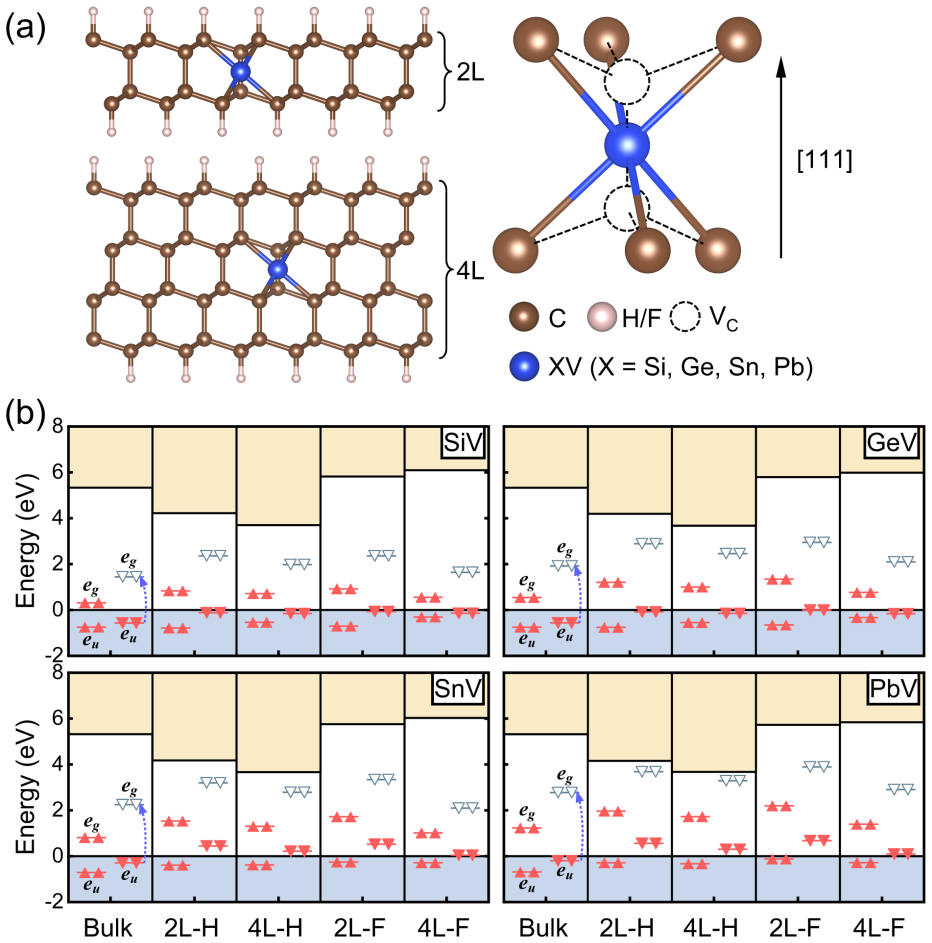
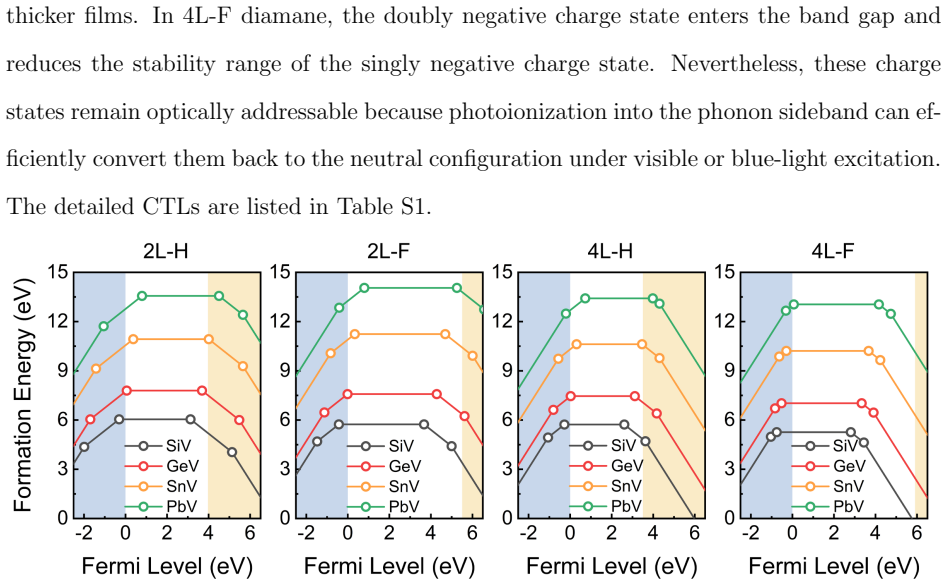
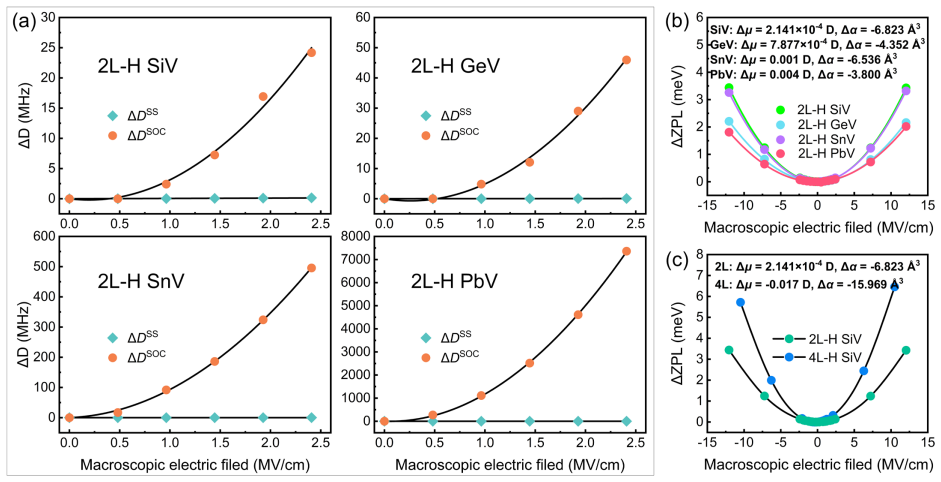
Neutral group-IV vacancy centers in diamond are promising spin-photon interfaces but require stringent Fermi-level engineering in boron-doped material to remain neutral. Dimensional confinement in diamane supplies an alternative: quantum confinement and surface termination cooperatively tune the host band gap and shift the occupied defect states upward from the valence-band edge, thereby enlarging the thermodynamic stability window of the neutral charge state and suppressing valence-band assisted excitation pathways. Thickness and surface termination further enable systematic tuning of zero-field splitting and spin-orbit coupling while largely preserving optical transition energies, with hyd
What carries the argument
quantum confinement and surface termination in diamane, which shift occupied defect states relative to the valence-band edge and enlarge the neutral charge stability window
If this is right
- Reducing diamane thickness increases the thermodynamic stability window of the neutral charge state.
- Different surface terminations allow additional tuning of the electronic structure and defect levels.
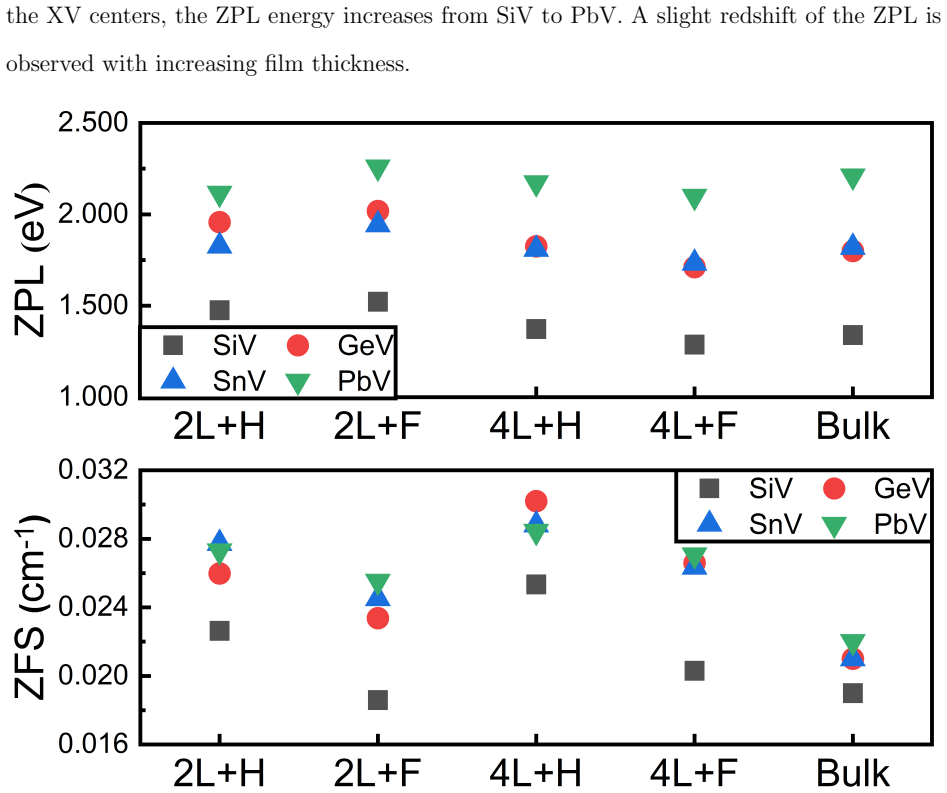
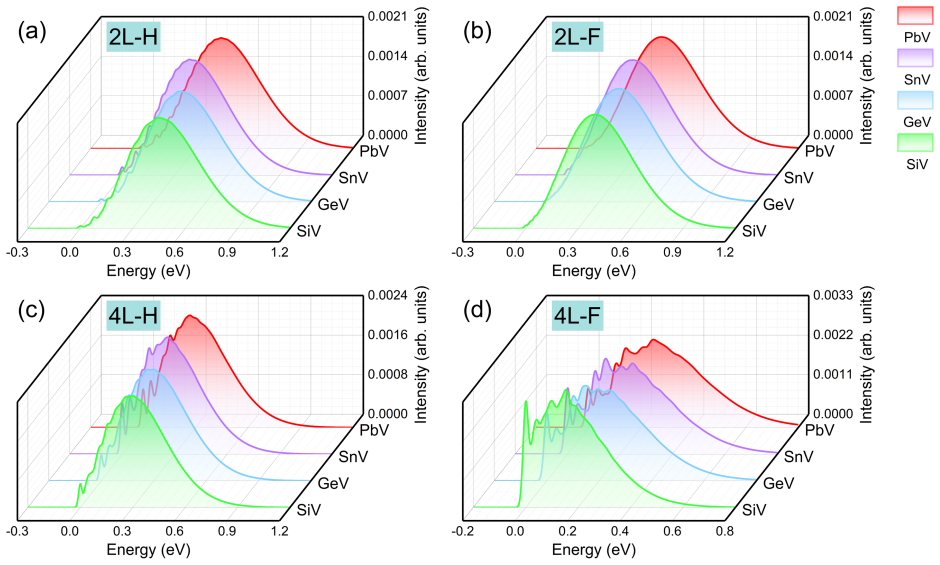
- Optical transition energies of the XV centers remain largely unchanged across thicknesses and terminations.
- Zero-field splitting and spin-orbit coupling become tunable with film thickness while optical properties stay intact.
- Hydrogenated surfaces provide the best overall balance of charge stability and magneto-optical performance.
Where Pith is reading between the lines
- The same confinement mechanism could be tested in other two-dimensional hosts to stabilize charge states of different quantum defects.
- Embedding XV centers in diamane layers might enable hybrid devices that combine diamond spin properties with two-dimensional electronics or van der Waals stacks.
- Preservation of optical energies suggests these centers could be integrated into existing diamond quantum platforms but in a thinner, more tunable form.
Load-bearing premise
First-principles calculations accurately predict the positions of defect states and charge transition levels relative to the valence band in real ultrathin films with chosen surface terminations.
What would settle it
Fabricating diamane films containing group-IV vacancy centers and measuring their charge transition levels to find no enlargement of the neutral stability window compared with bulk diamond.
Figures
read the original abstract
Neutral group-IV vacancy (XV, X = Si, Ge, Sn, and Pb) centers in diamond are emerging solid-state spin-photon interfaces because of their favorable spin coherence and inversion symmetry-protected optical transitions. However, stabilizing their neutral charge state typically requires stringent Fermi-level engineering in high purity boron-doped diamond, which poses significant materials-growth challenges. Here, we demonstrate that dimensional confinement in diamane provides an alternative route to charge-state stabilization without intentional doping. Using first-principles calculations, we show that quantum confinement and surface termination cooperatively tune the host band gap and shift the occupied defect states upward from the valence-band edge, thereby enlarging the thermodynamic stability window of the neutral charge state and suppressing valence-band assisted excitation pathways. We further reveal that the thickness and surface termination of diamane enable systematic tuning of the electronic structure, zero-field splitting, and spin-orbit coupling of XV centers while largely preserving their optical transition energies. Among the structures considered, hydrogenated diamane offers the most favorable balance between charge-state stability and magneto-optical performance. More broadly, our findings establish dimensional confinement as a general strategy for engineering the charge, optical, and spin properties of solid-state quantum defects.
Editorial analysis
A structured set of objections, weighed in public.
Referee Report
Summary. The manuscript claims that dimensional confinement in ultrathin diamond films (diamane) stabilizes the neutral charge state of group-IV vacancy centers (XV, X=Si,Ge,Sn,Pb) without intentional doping. First-principles calculations show that quantum confinement and surface termination shift occupied defect states upward from the valence-band edge, enlarging the thermodynamic stability window of the neutral charge state while suppressing valence-band-assisted excitations. Thickness and termination further enable tuning of electronic structure, zero-field splitting, and spin-orbit coupling, largely preserving optical transition energies, with hydrogenated diamane identified as optimal.
Significance. If the computational predictions are reliable, the work would be significant for quantum defect engineering: it establishes dimensional confinement as a doping-free route to charge-state control and property tuning in solid-state spin-photon interfaces, potentially simplifying growth of high-purity diamond hosts for group-IV centers.
major comments (2)
- [Methods] §Methods (computational details): the exchange-correlation functional, supercell sizes, k-point sampling, vacuum thickness, and electrostatic alignment procedure for slab models are not specified or benchmarked, yet these directly determine the accuracy of defect formation energies versus Fermi level and the reported shifts of occupied states relative to the VBM that underpin the central stability-window claim.
- [Results] Results on charge transition levels: no validation against known experimental or higher-level (e.g., GW) charge transition levels for XV centers in bulk diamond is provided, nor are error estimates or functional-sensitivity tests reported; without these, the quantitative enlargement of the neutral XV stability window and suppression of valence-band pathways cannot be assessed as load-bearing evidence.
minor comments (2)
- A summary table comparing stability windows, ZFS, and optical energies across all thicknesses and terminations (including hydrogenated vs. others) would clarify the claim that hydrogenated diamane offers the best balance.
- Figure captions and axis labels for band alignments and formation-energy plots should explicitly note the reference level (VBM) and any dipole corrections applied.
Simulated Author's Rebuttal
We thank the referee for their thorough review and valuable feedback on our manuscript. We address each of the major comments below and will update the manuscript to improve clarity and robustness.
read point-by-point responses
-
Referee: [Methods] §Methods (computational details): the exchange-correlation functional, supercell sizes, k-point sampling, vacuum thickness, and electrostatic alignment procedure for slab models are not specified or benchmarked, yet these directly determine the accuracy of defect formation energies versus Fermi level and the reported shifts of occupied states relative to the VBM that underpin the central stability-window claim.
Authors: We agree that the Methods section lacks sufficient detail on these aspects. In the revised manuscript, we will provide complete specifications: the PBE functional, supercell sizes (e.g., 5x5xN for N-layer films), 2x2x1 k-point sampling, 20 Å vacuum thickness, and the potential alignment method using the vacuum region average. We will also add relevant convergence benchmarks to support the accuracy of the formation energies and state shifts. revision: yes
-
Referee: [Results] Results on charge transition levels: no validation against known experimental or higher-level (e.g., GW) charge transition levels for XV centers in bulk diamond is provided, nor are error estimates or functional-sensitivity tests reported; without these, the quantitative enlargement of the neutral XV stability window and suppression of valence-band pathways cannot be assessed as load-bearing evidence.
Authors: The referee correctly notes the absence of such validation. While our primary focus is on the relative effects of dimensional confinement, we will revise the manuscript to include comparisons with available experimental and theoretical (including GW) data for bulk diamond XV centers from the literature. We will also discuss expected DFT errors and include functional sensitivity tests for key quantities where computationally feasible. New high-level calculations for the films would require substantial additional resources and are planned for future work. revision: partial
Circularity Check
No significant circularity in first-principles computational claims
full rationale
The paper's central claims rest on direct first-principles DFT computations of formation energies, band gaps, and defect levels in diamane slabs with varying thickness and terminations. No equations, fitted parameters, or self-citations reduce any reported prediction to its own inputs by construction; the results are outputs of standard electronic-structure methods applied to the modeled systems. The derivation chain is therefore self-contained against external benchmarks and receives the default non-circularity finding.
Axiom & Free-Parameter Ledger
axioms (1)
- standard math Standard assumptions of density functional theory for electronic structure and defect thermodynamics
Reference graph
Works this paper leans on
-
[1]
Nature Reviews Materials , volume=
Quantum guidelines for solid-state spin defects , author=. Nature Reviews Materials , volume=. 2021 , publisher=
2021
-
[2]
Science , volume=
Materials challenges and opportunities for quantum computing hardware , author=. Science , volume=. 2021 , publisher=
2021
-
[3]
Nitrogen-vacancy centers in diamond: nanoscale sensors for physics and biology , author=. Annu. Rev. Phys. Chem. , volume=. 2014 , publisher=
2014
-
[4]
MRS Bull
Nanoscale magnetometry with NV centers in diamond , author=. MRS Bull. , volume=. 2013 , publisher=
2013
-
[5]
Strain Coupling of a Nitrogen-Vacancy Center Spin to a Diamond Mechanical Oscillator , author =. Phys. Rev. Lett. , volume =. 2014 , month =. doi:10.1103/PhysRevLett.113.020503 , url =
-
[6]
Nature , volume=
Nanometre-scale thermometry in a living cell , author=. Nature , volume=. 2013 , publisher=
2013
-
[7]
Electric-field sensing using single diamond spins , author=. Nat. Phys. , volume=. 2011 , publisher=
2011
-
[8]
Nature , volume=
Nanoscale magnetic sensing with an individual electronic spin in diamond , author=. Nature , volume=. 2008 , publisher=
2008
-
[9]
Investigation of the stark effect on a centrosymmetric quantum emitter in diamond , author=. Phys. Rev. Lett. , volume=. 2021 , publisher=
2021
-
[10]
Quantum nanophotonics with group IV defects in diamond , author=. Nat. Commun. , volume=. 2019 , publisher=
2019
-
[11]
Multiple intrinsically identical single-photon emitters in the solid state , author=. Nat. Commun. , volume=. 2014 , publisher=
2014
-
[12]
Science , volume=
Robust multi-qubit quantum network node with integrated error detection , author=. Science , volume=. 2022 , publisher=
2022
-
[13]
Nature , volume=
Entanglement-assisted non-local optical interferometry in a quantum network , author=. Nature , volume=. 2026 , publisher=
2026
-
[14]
Silicon-vacancy spin qubit in diamond: a quantum memory exceeding 10 ms with single-shot state readout , author=. Phys. Rev. Lett. , volume=. 2017 , publisher=
2017
-
[15]
Neutral silicon-vacancy center in diamond: spin polarization and lifetimes , author=. Phys. Rev. Lett. , volume=. 2017 , publisher=
2017
-
[16]
Microwave-based quantum control and coherence protection of tin-vacancy spin qubits in a strain-tuned diamond-membrane heterostructure , author=. Phys. Rev. X , volume=. 2023 , publisher=
2023
-
[17]
Laser activation of single group-IV colour centres in diamond , author=. Nat. Commun. , volume=. 2025 , publisher=
2025
-
[18]
Tin-vacancy quantum emitters in diamond , author=. Phys. Rev. Lett. , volume=. 2017 , publisher=
2017
-
[19]
Mitigating the Transition of SiV ^
Rieger, Manuel and Poudel, Rubek and Waldmann, Tobias and Todenhagen, Lina M and Kresta, Stefan and Leal, Nori N Chavira and Villafa. Mitigating the Transition of SiV ^. arXiv preprint arXiv:2512.06389 , year=
-
[20]
Fast optoelectronic charge state conversion of silicon vacancies in diamond , author=. Sci. Adv. , volume=. 2024 , publisher=
2024
-
[21]
Science , volume=
Observation of an environmentally insensitive solid-state spin defect in diamond , author=. Science , volume=. 2018 , publisher=
2018
-
[22]
Neutral silicon vacancy centers in undoped diamond via surface control , author=. Phys. Rev. Lett. , volume=. 2023 , publisher=
2023
-
[23]
Improving surface and defect center chemistry of fluorescent nanodiamonds for imaging purposes—a review , author=. Anal. Bioanal. Chem. , volume=. 2015 , publisher=
2015
-
[24]
MRS Bull
Materials challenges for quantum technologies based on color centers in diamond , author=. MRS Bull. , volume=. 2021 , publisher=
2021
-
[25]
Chemically induced transformation of chemical vapour deposition grown bilayer graphene into fluorinated single-layer diamond , author=. Nat. Nanotechnol. , volume=. 2020 , publisher=
2020
-
[26]
npj Comput
The properties, thermodynamics and application prospects of diamanes , author=. npj Comput. Mater. , year=
-
[27]
Nano letters , volume=
Phase diagram of quasi-two-dimensional carbon, from graphene to diamond , author=. Nano letters , volume=. 2014 , publisher=
2014
-
[28]
Carbon , volume=
Low temperature, pressureless sp2 to sp3 transformation of ultrathin, crystalline carbon films , author=. Carbon , volume=. 2019 , publisher=
2019
-
[29]
Interlayer Carbon Bond Formation Induced by Hydrogen Adsorption in Few-Layer Supported Graphene , author=. Phys. Rev. Lett. , volume=. 2013 , publisher=
2013
-
[30]
Nano letters , volume=
Tailoring single-and double-sided fluorination of bilayer graphene via substrate interactions , author=. Nano letters , volume=. 2020 , publisher=
2020
-
[31]
Roles of nitrogen substitution and surface reconstruction in stabilizing nonpassivated single-layer diamond , author=. Phys. Rev. B , volume=. 2020 , publisher=
2020
-
[32]
Diamond surface engineering for molecular sensing with nitrogen-acancy centers , author=. J. Mater. Chem. C , volume=. 2022 , publisher=
2022
-
[33]
Nano Lett
Proper surface termination for luminescent near-surface NV centers in diamond , author=. Nano Lett. , volume=. 2014 , publisher=
2014
-
[34]
Applied Physics Letters , volume=
Work function and electron affinity of the fluorine-terminated (100) diamond surface , author=. Applied Physics Letters , volume=. 2013 , publisher=
2013
-
[35]
npj Comput
The ( e_g e_u ) E_g product Jahn--Teller effect in the neutral group-IV vacancy quantum bits in diamond , author=. npj Comput. Mater. , volume=. 2019 , publisher=
2019
-
[36]
Ab initio magneto-optical spectrum of group-IV vacancy color centers in diamond , author=. Phys. Rev. X , volume=. 2018 , publisher=
2018
-
[37]
Electrical tuning of tin-vacancy centers in diamond , author=. Phys. Rev. Appl. , volume=. 2021 , publisher=
2021
-
[38]
Stark shift control of single optical centers in diamond , author=. Phys. Rev. Lett. , volume=. 2006 , publisher=
2006
-
[39]
Nature , pages=
Bottom-Up Synthesis of Molecular Nanodiamond from Nanographene , author=. Nature , pages=. 2026 , publisher=
2026
-
[40]
ACS Appl
Impact of surface functionalization on the quantum coherence of nitrogen-vacancy centers in nanodiamonds , author=. ACS Appl. Mater. Interfaces , volume=. 2018 , publisher=
2018
-
[41]
Non-invasive bioinert room-temperature quantum sensor from silicon carbide qubits , author=. Nat. Mater. , pages=. 2025 , publisher=
2025
-
[42]
Origin of structure and zero-phonon-line anomalies of XV centers in diamond (X= Si, Ge, Sn, Pb) , author=. Phys. Rev. B , volume=. 2023 , publisher=
2023
-
[43]
Efficiency of ab-initio total energy calculations for metals and semiconductors using a plane-wave basis set , author=. Comput. Mater. Sci. , volume=. 1996 , publisher=
1996
-
[44]
Efficient iterative schemes for ab initio total-energy calculations using a plane-wave basis set , author=. Phys. Rev. B , volume=. 1996 , publisher=
1996
-
[45]
Projector augmented-wave method , author=. Phys. Rev. B , volume=. 1994 , publisher=
1994
-
[46]
From ultrasoft pseudopotentials to the projector augmented-wave method , author=. Phys. Rev. B , volume=. 1999 , publisher=
1999
-
[47]
Hybrid functionals based on a screened Coulomb potential , author=. J. Chem. Phys. , volume=. 2003 , publisher=
2003
-
[48]
Generalized dipole correction for charged surfaces in the repeated-slab approach , author=. Phys. Rev. B , volume=. 2020 , publisher=
2020
-
[49]
Nanophotonics , volume=
Recent advances in the ab initio theory of solid-state defect qubits , author=. Nanophotonics , volume=. 2023 , publisher=
2023
-
[50]
Newton , volume=
Computation-aided design of color centers for quantum information processing , author=. Newton , volume=. 2026 , publisher=
2026
-
[51]
Optik , volume=
Optical properties of Janus and non-Janus diamanes monolayers using ab-initio calculations , author=. Optik , volume=. 2021 , publisher=
2021
-
[52]
Ultralong spin coherence time in isotopically engineered diamond , author=. Nat. Mater. , volume=. 2009 , publisher=
2009
-
[53]
MRS Bull
Diamond NV centers for quantum computing and quantum networks , author=. MRS Bull. , volume=. 2013 , publisher=
2013
-
[54]
Optical properties of the neutral silicon split-vacancy center in diamond , author =. Phys. Rev. B , volume =. 2011 , month =. doi:10.1103/PhysRevB.84.245208 , url =
-
[55]
Spin-orbit driven electrical manipulation of the zero-field splitting in high-spin centers in solids , author =. Phys. Rev. Res. , volume =. 2020 , month =. doi:10.1103/PhysRevResearch.2.023071 , url =
-
[56]
Optimizing the depth-dependent nitrogen vacancy center quantum sensor in diamane , author =. Phys. Rev. B , volume =. 2025 , month =. doi:10.1103/sfz1-zvdb , url =
-
[57]
Pressure and temperature dependence of the zero-field splitting in the ground state of NV centers in diamond: A first-principles study , author =. Phys. Rev. B , volume =. 2014 , month =. doi:10.1103/PhysRevB.90.235205 , url =
-
[58]
Vacancy-related color centers in two-dimensional silicon carbide monolayers , author =. Phys. Rev. Mater. , volume =. 2024 , month =. doi:10.1103/PhysRevMaterials.8.056201 , url =
-
[59]
Gatteschi, Dante and Sessoli, Roberta , title =. Angew. Chem. Int. Ed. , volume =. doi:https://doi.org/10.1002/anie.200390099 , url =. https://onlinelibrary.wiley.com/doi/pdf/10.1002/anie.200390099 , abstract =
-
[60]
Li, Song and Gali, Adam , title =. J. Phys. Chem. Lett. , volume =. 2022 , doi =
2022
discussion (0)
Sign in with ORCID, Apple, or X to comment. Anyone can read and Pith papers without signing in.