Dissipative Channels Determine Open Electromagnetic Quantization
Pith reviewed 2026-06-27 18:45 UTC · model grok-4.3
The pith
Factoring the imaginary part of the Maxwell operator identifies reservoirs directly from dissipation geometry and supplies a quantization for open electromagnetic systems with arbitrary passive boundaries.
A machine-rendered reading of the paper's core claim, the machinery that carries it, and where it could break.
Core claim
Factoring the imaginary part of the Maxwell operator gives a bosonic realization of the electromagnetic field operator and partitions the fluctuation channels into medium-assisted reservoirs from material absorption and boundary-assisted reservoirs from exchange through the open boundary. Depending on the boundary condition the latter become free-space radiation modes, impedance-load channels, guided port modes or more general boundary channels. Green-function input-output relations then follow, yielding frequency-dependent scattering and noise kernels without Markov or single-mode assumptions.
What carries the argument
Factoring the imaginary part of the Maxwell operator, which supplies the bosonic field realization and separates medium-assisted from boundary-assisted fluctuation channels.
If this is right
- Green-function input-output relations hold for arbitrary passive boundary conditions.
- Scattering and noise kernels are obtained at each frequency without Markov or single-mode assumptions.
- Mixed impedance and outgoing boundaries receive a consistent treatment in lossy structures.
- Waveguide-port boundaries in photonic integrated circuits are quantized by the same procedure.
Where Pith is reading between the lines
- The separation of channels suggests a route to compute non-Markovian correlations in time-dependent open systems once the kernels are known.
- The method may connect to device-level noise modeling in integrated photonics by treating radiation and absorption loss on equal footing.
- Direct comparison of predicted versus measured noise spectra in a single-mode waveguide with known port boundaries would provide a concrete test.
Load-bearing premise
The boundary conditions are passive, so that the dissipation geometry of the Maxwell operator directly identifies the reservoirs without further phenomenological input.
What would settle it
Computing the frequency-dependent noise kernel for a concrete lossy structure that has specified mixed impedance and outgoing boundaries, then measuring that kernel experimentally and finding a mismatch, would falsify the claim.
Figures
read the original abstract
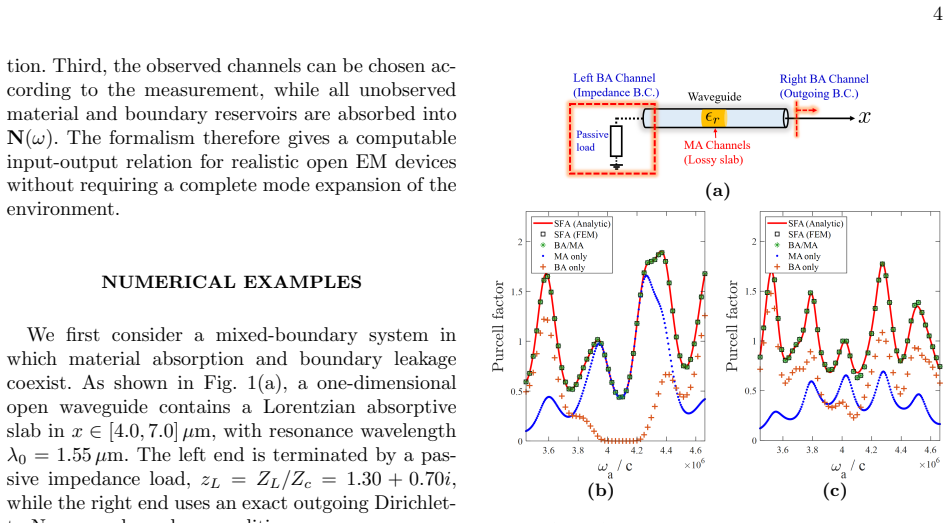
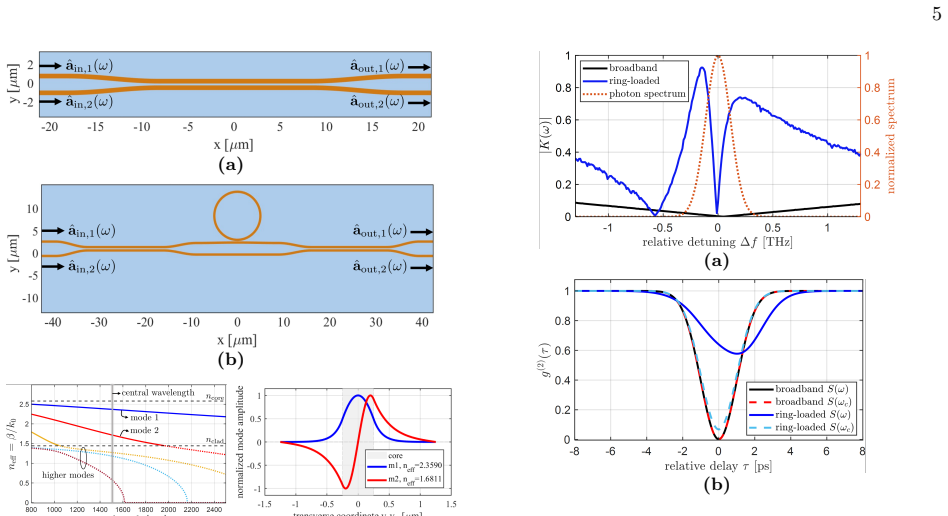
We formulate a quantization scheme for open electromagnetic systems with arbitrary passive boundary conditions. Rather than specifying reservoirs phenomenologically, the method identifies them from the dissipation geometry of the Maxwell operator. Factoring the imaginary part of the Maxwell operator gives a bosonic realization of the field operator and separates the fluctuation channels into medium-assisted reservoirs from material absorption and boundary-assisted reservoirs from exchange through the open boundary. Depending on the boundary condition, the latter become free-space radiation modes, impedance-load channels, guided port modes, or more general boundary channels. Green-function input-output relations then follow as an application, yielding frequency-dependent scattering and noise kernels without Markov or single-mode assumptions. To illustrate the practical application, we consider a lossy structure with mixed impedance and outgoing boundaries, and photonic integrated circuit configurations with waveguide port boundaries.
Editorial analysis
A structured set of objections, weighed in public.
Referee Report
Summary. The manuscript proposes a quantization scheme for open electromagnetic systems subject to arbitrary passive boundary conditions. Rather than introducing reservoirs phenomenologically, the method identifies them from the dissipation geometry of the Maxwell operator: factoring its imaginary part is claimed to furnish a bosonic realization of the field operator while cleanly separating fluctuation channels into medium-assisted reservoirs (arising from material absorption) and boundary-assisted reservoirs (arising from exchange through the open boundary). The latter may correspond to free-space radiation modes, impedance-load channels, guided port modes, or more general boundary channels depending on the chosen boundary condition. Green-function input-output relations are then derived, producing frequency-dependent scattering and noise kernels without Markov or single-mode restrictions. The construction is illustrated by a lossy structure with mixed impedance and outgoing boundaries together with photonic-integrated-circuit examples employing waveguide-port boundaries.
Significance. If the central construction is valid, the result supplies a systematic, operator-based route to the bosonic field realization and reservoir separation that is grounded directly in the dissipation geometry of the Maxwell operator. This removes the need for ad-hoc reservoir modeling and yields input-output relations that remain valid for arbitrary passive boundaries and retain full frequency dependence. The explicit treatment of mixed boundary conditions in the illustrative example is a concrete strength, as is the avoidance of Markov or single-mode approximations. These features would make the framework useful for quantization of nanophotonic and quantum-optical structures with realistic open boundaries.
minor comments (2)
- The abstract states that 'factoring the imaginary part of the Maxwell operator' yields the bosonic realization, but the main text should supply the explicit operator definition and the algebraic steps of the factorization (including any domain or inner-product considerations) so that the separation into medium-assisted versus boundary-assisted channels can be verified directly.
- In the illustrative example with mixed impedance and outgoing boundaries, the paper should state the precise form of the boundary operators employed and confirm that they satisfy the passivity condition used in the general argument.
Simulated Author's Rebuttal
We thank the referee for the detailed and positive summary of our manuscript, the assessment of its significance, and the recommendation for minor revision. No major comments were raised.
Circularity Check
No significant circularity detected
full rationale
The paper's derivation begins with the Maxwell operator for open systems under passive boundary conditions and factors its imaginary part to obtain a bosonic field realization while separating medium-assisted and boundary-assisted fluctuation channels. Green-function input-output relations are presented as a direct application yielding scattering and noise kernels. No quoted step reduces by construction to a fitted input, self-citation chain, or ansatz smuggled from prior work by the same authors; the construction is framed as following from the operator's dissipation geometry without phenomenological reservoirs. The passive-boundary assumption is stated explicitly and does not embed the target result. This is a self-contained derivation against the stated inputs.
Axiom & Free-Parameter Ledger
axioms (2)
- domain assumption The Maxwell operator for the electromagnetic system has an imaginary part whose factorization yields a bosonic field realization.
- domain assumption Boundary conditions are passive.
Reference graph
Works this paper leans on
-
[1]
Breuer and F
H.-P. Breuer and F. Petruccione,The Theory of Open Quantum Systems(Oxford University Press, 2007)
2007
-
[2]
Campaioli, J
F. Campaioli, J. H. Cole, and H. Hapuarachchi, Quantum master equations: Tips and tricks for quantum optics, quantum computing, and beyond, PRX Quantum5, 020202 (2024)
2024
-
[3]
H. M. Wiseman and G. J. Milburn,Quantum mea- surement and control(Cambridge University Press, 2010)
2010
-
[4]
Alexander, A
K. Alexander, A. Benyamini, D. Black,et al., A manufacturable platform for photonic quantum computing, Nature641, 876 (2025)
2025
-
[5]
Jahani, S
S. Jahani, S. Kim, J. Atkinson, J. C. Wirth, F. Kalhor, A. A. Noman, W. D. Newman, P. Shekhar, K. Han, V. Van, R. G. DeCorby, L. Chrostowski, M. Qi, and Z. Jacob, Controlling evanescent waves using silicon photonic all-dielectric metamaterials for dense integration, Nature Com- munications9, 1893 (2018)
2018
-
[6]
D. T. Spencer, J. F. Bauters, M. J. R. Heck, and J. E. Bowers, Integrated waveguide coupled si3n4 resonators in the ultrahigh-q regime, Optica1, 153 (2014)
2014
-
[7]
Delga, J
A. Delga, J. Feist, J. Bravo-Abad, and F. J. Garcia- Vidal, Quantum emitters near a metal nanoparti- cle: Strong coupling and quenching, Phys. Rev. Lett. 112, 253601 (2014)
2014
-
[8]
M. S. Tame, K. R. McEnery, S ¸. K.¨Ozdemir, J. Lee, S. A. Maier, and M. S. Kim, Quantum plasmonics, Nature Physics9, 329 (2013)
2013
-
[9]
A. S. Sheremet, M. I. Petrov, I. V. Iorsh, A. V. Poshakinskiy, and A. N. Poddubny, Waveguide quantum electrodynamics: Collective radiance and photon-photon correlations, Rev. Mod. Phys.95, 015002 (2023)
2023
-
[10]
Melati, F
D. Melati, F. Morichetti, and A. Melloni, A unified approach for radiative losses and backscattering in optical waveguides, J. Opt.16, 055502 (2014)
2014
-
[11]
Magnard, S
P. Magnard, S. Storz, P. Kurpiers, J. Sch¨ ar, F. Marxer, J. L¨ utolf, T. Walter, J.-C. Besse, M. Gabureac, K. Reuer, A. Akin, B. Royer, A. Blais, and A. Wallraff, Microwave quantum link between superconducting circuits housed in spatially sep- arated cryogenic systems, Phys. Rev. Lett.125, 260502 (2020)
2020
-
[12]
Kurpiers, P
P. Kurpiers, P. Magnard, T. Walter, B. Royer, M. Pechal, J. Heinsoo, Y. Salath´ e, A. Akin, S. Storz, J.-C. Besse, S. Gasparinetti, A. Blais, and A. Wall- raff, Deterministic quantum state transfer and re- mote entanglement using microwave photons, Na- ture558, 264 (2018)
2018
-
[13]
Blais, A
A. Blais, A. L. Grimsmo, S. M. Girvin, and A. Wall- raff, Circuit quantum electrodynamics, Rev. Mod. Phys.93, 025005 (2021)
2021
-
[14]
Reiserer and G
A. Reiserer and G. Rempe, Cavity-based quantum networks with single atoms and optical photons, Rev. Mod. Phys.87, 1379 (2015)
2015
-
[15]
M. K. Bhaskaret al., Experimental demonstration of memory-enhanced quantum communication, Na- ture580, 60 (2020)
2020
-
[16]
N. Lauk, N. Sinclair, S. Barzanjeh, J. P. Covey, M. Saffman, M. Spiropulu, and C. Simon, Perspec- tives on quantum transduction, Quantum Science and Technology5, 020501 (2020)
2020
-
[17]
Mirhosseini, A
M. Mirhosseini, A. Sipahigil, M. Kalaee, and O. Painter, Superconducting qubit to optical pho- ton transduction, Nature588, 599 (2020)
2020
-
[18]
Scheel and S
S. Scheel and S. Y. Buhmann, Macroscopic quantum electrodynamics – concepts and applications, Acta Physica Slovaca58, 675 (2008)
2008
-
[19]
H. T. Dung, L. Kn¨ oll, and D.-G. Welsch, Sponta- neous decay in the presence of dispersing and ab- sorbing bodies: General theory and application to a spherical cavity, Phys. Rev. A62, 053804 (2000)
2000
-
[20]
Gruner and D.-G
T. Gruner and D.-G. Welsch, Green-function ap- proach to the radiation-field quantization for ho- mogeneous and inhomogeneous kramers-kronig di- electrics, Phys. Rev. A53, 1818 (1996)
1996
-
[21]
Ciattoni, Quantum electrodynamics of lossy magnetodielectric samples in vacuum: Modified langevin noise formalism, Phys
A. Ciattoni, Quantum electrodynamics of lossy magnetodielectric samples in vacuum: Modified langevin noise formalism, Phys. Rev. A110, 013707 (2024)
2024
-
[22]
D.-Y. Na, T. E. Roth, J. Zhu, W. C. Chew, and C. J. Ryu, Numerical framework for modeling quantum electromagnetic systems involving finite-sized lossy dielectric objects in free space, Phys. Rev. A107, 063702 (2023)
2023
-
[23]
A. Ciattoni, Direct derivation of the modified langevin noise formalism from the canonical quan- tization of macroscopic electromagnetism (2026), arXiv:2603.04336 [quant-ph]
Pith/arXiv arXiv 2026
-
[24]
H. Choi, T. E. Roth, W. C. Chew, and D.-Y. Na, Non-markovian analysis of atom-field interactions in dissipative electromagnetic environments, Phys. Rev. Appl.24, 044056 (2025)
2025
-
[25]
H. Choi, J. Seo, W. C. Chew, and D.-Y. Na, Atom- field non-markovian dynamics in open and dissipa- tive systems: An efficient memory-kernel approach linked to dyadic greens function and cem treatments (2025), arXiv:2511.03561 [quant-ph]
arXiv 2025
-
[26]
H. Choi, W. C. Chew, and D.-Y. Na, Computa- tional framework for non-markovian multi-emitter dynamics beyond the single-excitation limit (2026), arXiv:2604.02741 [quant-ph]
Pith/arXiv arXiv 2026
-
[27]
Miano, L
G. Miano, L. M. Cangemi, and C. Forestiere, Spec- tral densities of a dispersive dielectric sphere in the modified langevin noise formalism, Phys. Rev. A 112, 033712 (2025)
2025
-
[28]
Miano, L
G. Miano, L. M. Cangemi, and C. Forestiere, Quan- tum emitter interacting with a dispersive dielectric object: a model based on the modified langevin noise formalism, Nanophotonics14, 4019 (2025)
2025
-
[29]
Ciattoni, Quantum-optical scattering by macro- scopic lossy objects: A general approach, Phys
A. Ciattoni, Quantum-optical scattering by macro- scopic lossy objects: A general approach, Phys. Rev. A112, 013704 (2025)
2025
-
[30]
A. Ciattoni, Quantum interference effects in two- photon scattering by a macroscopic lossy sphere 7 (2025), arXiv:2510.27612 [quant-ph]
arXiv 2025
-
[31]
Huang, H
C. Huang, H. Ge, Y. Cheng, Z. He, F. Liu, and W. E. I. Sha, Modeling of far-field quantum coher- ence by dielectric bodies based on the volume in- tegral equation method, IEEE Transactions on An- tennas and Propagation , 1 (2026)
2026
-
[32]
Moon, D.-Y
S. Moon, D.-Y. Na, and T. E. Roth, Analytical quantum full-wave solutions for a 3-d circuit quan- tum electrodynamics system, IEEE Transactions on Antennas and Propagation72, 6702 (2024)
2024
-
[33]
I. V. Lindell and A. H. Sihvola, Electromagnetic boundary conditions defined in terms of normal field components, IEEE Transactions on Antennas and Propagation58, 1128 (2010)
2010
-
[34]
C. C. Gerry and P. L. Knight,Introductory quantum optics(Cambridge university press, 2023)
2023
-
[35]
Gruner and D.-G
T. Gruner and D.-G. Welsch, Quantum-optical input-output relations for dispersive and lossy mul- tilayer dielectric plates, Phys. Rev. A54, 1661 (1996)
1996
-
[36]
Kn¨ oll, S
L. Kn¨ oll, S. Scheel, E. Schmidt, D.-G. Welsch, and A. V. Chizhov, Quantum-state transformation by dispersive and absorbing four-port devices, Phys. Rev. A59, 4716 (1999)
1999
-
[37]
A. H. Kiilerich and K. Mølmer, Input-output theory with quantum pulses, Phys. Rev. Lett.123, 123604 (2019)
2019
-
[38]
S. Moon and T. E. Roth, Analytical quan- tum full-wave analysis of few-photon transport through a superconducting cavity qubit (2026), arXiv:2603.03015 [quant-ph]
arXiv 2026
-
[39]
C. K. Hong, Z. Y. Ou, and L. Mandel, Measure- ment of subpicosecond time intervals between two photons by interference, Phys. Rev. Lett.59, 2044 (1987)
2044
-
[40]
T. G. Philbin, Canonical quantization of macro- scopic electromagnetism, New Journal of Physics 12, 123008 (2010)
2010
-
[41]
W. C. Chew, D.-Y. Na, P. Bermel, T. E. Roth, C. J. Ryu, and E. Kudeki, Quantum maxwell’s equations made simple: Employing scalar and vector poten- tial formulation, IEEE Antennas and Propagation Magazine63, 14 (2021)
2021
-
[42]
Franke, S
S. Franke, S. Hughes, M. K. Dezfouli, P. T. Kris- tensen, K. Busch, A. Knorr, and M. Richter, Quan- tization of quasinormal modes for open cavities and plasmonic cavity quantum electrodynamics, Phys. Rev. Lett.122, 213901 (2019)
2019
-
[43]
Fuchs, J
R. Fuchs, J. Ren, S. Franke, S. Hughes, and M. Richter, Quantization of optical quasinormal modes for spatially separated cavity systems with finite retardation, Phys. Rev. A110, 043718 (2024)
2024
-
[44]
Franke, J
S. Franke, J. Ren, and S. Hughes, Quantized quasinormal-mode theory of coupled lossy and am- plifying resonators, Phys. Rev. A105, 023702 (2022)
2022
-
[46]
T. G. Philbin, New Journal of Physics12, 123008 (2010), URLhttps://doi.org/10.1088/1367-2630/12/12/123008
-
[47]
Scheel and S
S. Scheel and S. Y. Buhmann, Acta Physica Slovaca58, 675 (2008)
2008
-
[48]
S. Franke, S. Hughes, M. K. Dezfouli, P. T. Kristensen, K. Busch, A. Knorr, and M. Richter, Phys. Rev. Lett.122, 213901 (2019), URLhttps://link.aps.org/doi/10.1103/PhysRevLett.122.213901
-
[49]
R. Fuchs, J. Ren, S. Franke, S. Hughes, and M. Richter, Phys. Rev. A110, 043718 (2024), URLhttps://link.aps.org/ doi/10.1103/PhysRevA.110.043718
-
[50]
Good quantum error-correcting codes exist
S. Franke, J. Ren, and S. Hughes, Phys. Rev. A105, 023702 (2022), URLhttps://link.aps.org/doi/10.1103/PhysRevA. 105.023702
- [51]
discussion (0)
Sign in with ORCID, Apple, or X to comment. Anyone can read and Pith papers without signing in.