A five-qubit 1-resistant graph state and stabilizer marginal certificates
Pith reviewed 2026-06-27 18:42 UTC · model grok-4.3
The pith
The five-qubit 1-resistant stabilizer states are exactly the local Clifford class of the five-cycle graph state.
A machine-rendered reading of the paper's core claim, the machinery that carries it, and where it could break.
Core claim
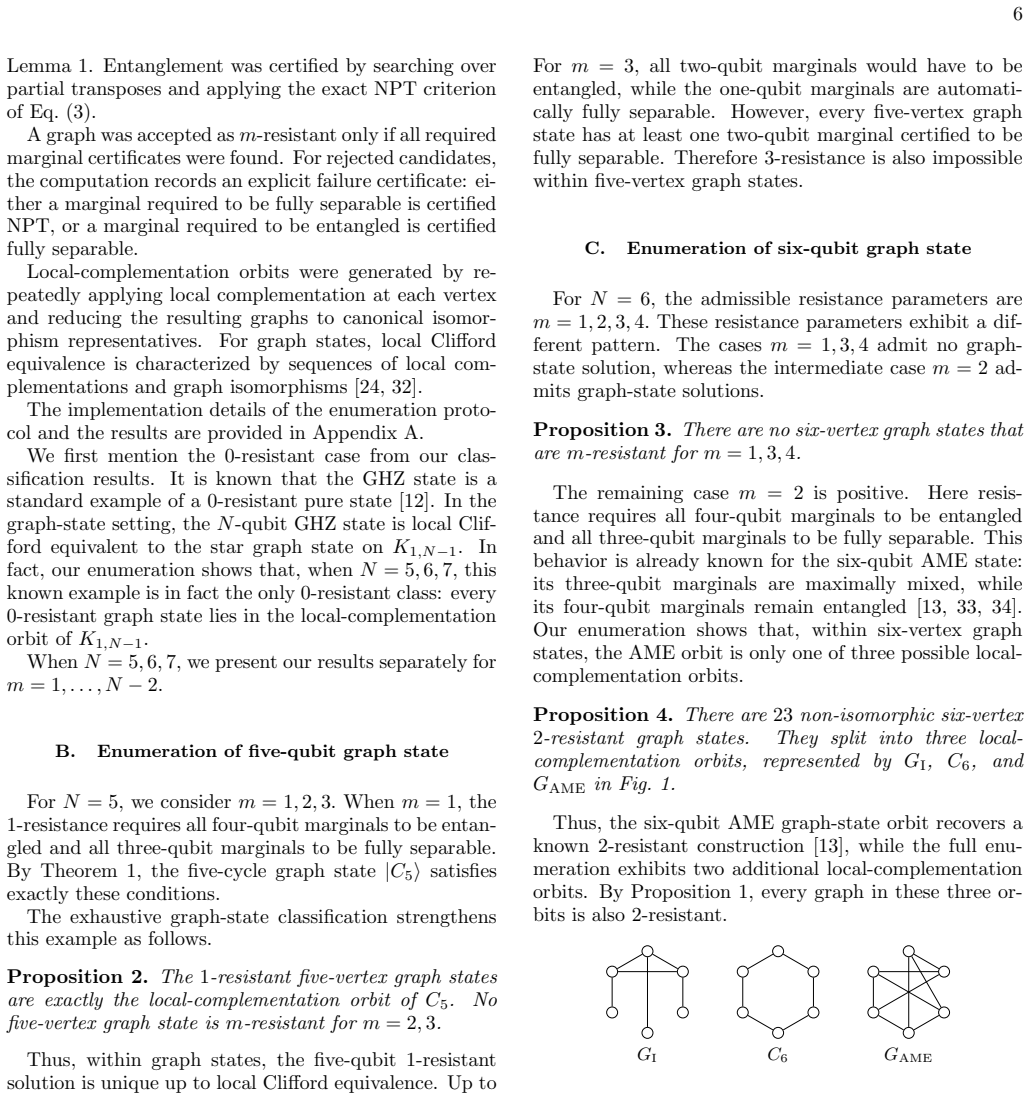
The five-qubit 1-resistant stabilizer states are exactly the local Clifford class of C5. Six-qubit 2-resistant stabilizer states exist in three distinct local Clifford classes, whereas no seven-qubit stabilizer state is m-resistant for any nonzero admissible m. The cycle graph states ket C_N with N greater than or equal to 7 are not m-resistant for any 0 less than or equal to m less than or equal to N-2.
What carries the argument
Stabilizer-subgroup method that certifies full separability after m+1 losses via local stabilizers and entanglement after m losses via exact negative partial transpose witnesses.
If this is right
- The five-qubit 1-resistant stabilizer states are exactly the local Clifford class of C5.
- Six-qubit 2-resistant stabilizer states exist in three distinct local Clifford classes.
- No seven-qubit stabilizer state is m-resistant for any nonzero admissible m.
- Cycle graph states C_N with N greater than or equal to 7 are not m-resistant for any 0 less than or equal to m less than or equal to N-2.
Where Pith is reading between the lines
- The verification approach may scale to search for resistant states in systems larger than seven qubits.
- The identified states could serve as building blocks for quantum protocols that tolerate qubit loss during transmission.
- The complete absence of such states at seven qubits may point to a size threshold beyond which stabilizer states lose this form of robustness.
- The same local-stabilizer and witness technique could be tested on non-graph stabilizer states to check whether the classification pattern holds more broadly.
Load-bearing premise
The stabilizer-subgroup method using local stabilizers to certify separability and exact NPT witnesses to certify entanglement correctly identifies m-resistance for all graph states on five to seven qubits without false negatives or positives.
What would settle it
Discovery of a five-qubit stabilizer state that remains entangled after any single qubit loss yet is not locally Clifford equivalent to C5, or a case where the method misclassifies the resistance level of a known graph state.
Figures
read the original abstract
We study particle-loss resistant entanglement within the framework of stabilizer and graph states. A pure state is \(m\)-resistant if it remains entangled after the loss of any \(m\) particles and becomes fully separable after the loss of any \(m+1\) particles. The smallest previously unresolved qubit case was the existence of a five-qubit \(1\)-resistant pure state, which is resolved here by the five-cycle graph state \(\ket{C_5}\). A stabilizer-subgroup method is also developed for verifying \(m\)-resistance in graph states, using local stabilizers to certify full separability and exact negative partial transpose~(NPT) witnesses to certify entanglement. Applying this to all graph states associated with non-isomorphic graphs on five, six, and seven vertices, we obtain a graph state classification up to local Clifford equivalence, which also classifies stabilizer states up to local Clifford equivalence. Thus, the five-qubit \(1\)-resistant stabilizer states are exactly the local Clifford class of \(C_5\). Six-qubit \(2\)-resistant stabilizer states exist in three distinct local Clifford classes, whereas no seven-qubit stabilizer state is \(m\)-resistant for any nonzero admissible \(m\). Finally, we prove that the cycle graph states \(\ket{C_N}\) with \(N\ge 7\) are not \(m\)-resistant for any \(0\le m\le N-2\).
Editorial analysis
A structured set of objections, weighed in public.
Referee Report
Summary. The manuscript introduces m-resistant pure states (entangled after any m particle losses but fully separable after m+1) in the stabilizer/graph-state setting. It resolves the open five-qubit case by exhibiting the five-cycle graph state |C5> as 1-resistant, develops a stabilizer-subgroup certification method that uses local stabilizers to certify full separability and exact NPT witnesses to certify entanglement, and applies the method exhaustively to all non-isomorphic graphs on five, six and seven vertices. This yields a local-Clifford classification of m-resistant stabilizer states, with the concrete results that five-qubit 1-resistant states are exactly the LC class of C5, six-qubit 2-resistant states fall into three LC classes, no seven-qubit stabilizer state is m-resistant for admissible m, and cycle states |CN> with N≥7 are never m-resistant for 0≤m≤N-2.
Significance. If the certification method is sound, the work supplies the first explicit five-qubit 1-resistant example, a complete small-n classification up to local Clifford equivalence, and a reusable verification technique for particle-loss resistance. The exhaustive enumeration on five-to-seven vertices and the explicit non-resistance proof for larger cycles are concrete, falsifiable contributions that advance the study of robust multipartite entanglement.
major comments (1)
- [stabilizer-subgroup method section] The section describing the stabilizer-subgroup method (abstract and the paragraph introducing the developed method): the claim that local-stabilizer separability certificates plus exact NPT entanglement witnesses correctly identify m-resistance for every reduced state on three-to-four qubits is load-bearing for the central “exactly the LC class of C5” statement. No independent cross-check against known 3- and 4-qubit entanglement measures or explicit completeness argument for the NPT witnesses on these reductions is supplied beyond the method’s internal development; a single false negative or positive would invalidate the exhaustive classification.
Simulated Author's Rebuttal
We thank the referee for their careful reading and for highlighting the importance of validating the stabilizer-subgroup certification method. We address the concern below and commit to strengthening the manuscript accordingly.
read point-by-point responses
-
Referee: [stabilizer-subgroup method section] The section describing the stabilizer-subgroup method (abstract and the paragraph introducing the developed method): the claim that local-stabilizer separability certificates plus exact NPT entanglement witnesses correctly identify m-resistance for every reduced state on three-to-four qubits is load-bearing for the central “exactly the LC class of C5” statement. No independent cross-check against known 3- and 4-qubit entanglement measures or explicit completeness argument for the NPT witnesses on these reductions is supplied beyond the method’s internal development; a single false negative or positive would invalidate the exhaustive classification.
Authors: We agree that the absence of an explicit cross-check against independent 3- and 4-qubit entanglement criteria is a gap in the current presentation. The method combines (i) local-stabilizer conditions that rigorously certify full separability when a product-form stabilizer exists and (ii) direct computation of the partial transpose to detect negativity. While these are standard and exact for the states considered, we acknowledge that PPT-entangled states exist in 3- and 4-qubit systems and that a completeness argument specific to graph-state reductions was not supplied. In the revised manuscript we will add a dedicated subsection that (a) recalls the known limitations of the PPT criterion for 3- and 4-qubit systems, (b) verifies that none of the reduced states arising from the enumerated 5-, 6- and 7-qubit graph states are PPT-entangled (by explicit computation of the eigenvalues of the partial transpose for representative cases), and (c) cross-checks a subset of the separability/entanglement decisions against the three-tangle and concurrence for 3-qubit reductions and against the PPT and realignment criteria for 4-qubit reductions. This addition will make the load-bearing claim fully substantiated without altering the classification results. revision: yes
Circularity Check
No circularity; derivation applies developed method to exhaustive enumeration
full rationale
The paper develops a stabilizer-subgroup method (local stabilizers for separability certification + exact NPT witnesses for entanglement) and applies it exhaustively to all non-isomorphic graphs on 5-7 vertices plus their reductions. This produces the classification that five-qubit 1-resistant stabilizer states are exactly the LC class of C5. The method is constructed from standard stabilizer formalism and NPT criteria (external to the classification result), with no equations reducing the m-resistance property to a fitted parameter, self-definition, or self-citation chain. The cycle-graph non-resistance proof for N>=7 is likewise independent. The derivation is self-contained against the enumerated graphs and does not reduce by construction to its inputs.
Axiom & Free-Parameter Ledger
axioms (1)
- standard math Standard properties of stabilizer states, graph states, and the negative partial transpose criterion for entanglement
Reference graph
Works this paper leans on
-
[1]
for everyJ⊆[N]with|J|=m, the reduced state ρ ¯J is entangled
-
[2]
Throughout this paper,m-resistance refers to the above notion unless otherwise specified
for everyJ⊆[N]with|J|=m+ 1, the reduced stateρ ¯J is fully separable. Throughout this paper,m-resistance refers to the above notion unless otherwise specified. ForN= 5 andm= 1, the definition requires that every four-qubit marginal is entangled, whereas every three-qubit marginal is fully separable. This is the crite- rion used below to verify the 1-resis...
-
[3]
(1) gives ρA = 2−|A| X u∈Fs 2 g(u)
Thus Eq. (1) gives ρA = 2−|A| X u∈Fs 2 g(u). LetR⊆Abe one side of a bipartitionR|(A\R). We denote by Γ R the partial-transpose map acting on the qubits inR, with respect to the computational ba- sis. Thus, for an operatorMon the subsystemA,M ΓR is obtained by transposing the tensor factors inRand leaving those inA\Runchanged. Under ΓR, a Pauli string chan...
-
[4]
IfS A(G) satisfies the local stabilizer sepa- rability criterion of Lemma 1, thenρ A is certified fully separable
For each subsetAwith|A|=N−m−1, compute SA(G). IfS A(G) satisfies the local stabilizer sepa- rability criterion of Lemma 1, thenρ A is certified fully separable. In particular, dimF2 SA(G) = dimF2 LA ≤1 is sufficient. Here, we identify subsets inL A as binary vectors, and treatL A as a linear subspace ofF N 2 , since the mappingU7→Odd G(U) is linear overF 2
-
[5]
For each subsetAwith|A|=N−m, compute SA(G) and search over bipartitionsR|(A\R). If Eq. (3) gives λx(R)<0,for somex∈F s 2 thenρ A is entangled by the NPT criterion. Thus the graph-state verification is certificate-based: full separability is proved by a local stabilizer certificate forS A(G), while entanglement is proved by an exact NPT certificate compute...
-
[6]
Horodecki, P
R. Horodecki, P. Horodecki, M. Horodecki, and K. Horodecki, Reviews of Modern Physics81, 865 (2009)
2009
-
[7]
G¨ uhne and G
O. G¨ uhne and G. T´ oth, Physics Reports474, 1 (2009)
2009
-
[8]
Steane, Reports on Progress in Physics61, 117 (1998)
A. Steane, Reports on Progress in Physics61, 117 (1998)
1998
-
[9]
Vidal and R
G. Vidal and R. Tarrach, Physical Review A59, 141 (1999)
1999
-
[10]
D¨ ur, Physical Review A63, 020303 (2001)
W. D¨ ur, Physical Review A63, 020303 (2001)
2001
-
[11]
H. J. Briegel and R. Raussendorf, Physical Review Let- ters86, 910 (2001)
2001
-
[12]
A. K. Rajagopal and R. W. Rendell, Physical Review A 65, 032328 (2002)
2002
-
[13]
Sugita, Borromean entanglement revisited (2007), arXiv:0704.1712 [quant-ph]
A. Sugita, Borromean entanglement revisited (2007), arXiv:0704.1712 [quant-ph]
Pith/arXiv arXiv 2007
-
[14]
Brunner and T
N. Brunner and T. V´ ertesi, Physical Review A86, 042113 (2012)
2012
-
[15]
G. M. Quinta and R. Andr´ e, Physical Review A97, 042307 (2018)
2018
-
[16]
Neven, J
A. Neven, J. Martin, and T. Bastin, Physical Review A 98, 062335 (2018)
2018
-
[17]
G. M. Quinta, R. Andr´ e, A. Burchardt, and K. ˙Zyczkowski, Physical Review A100, 062329 (2019)
2019
-
[18]
Zhang, Z
W. Zhang, Z. Han, F. Shi, and X. Zhang, Physical Review A112, 022408 (2025)
2025
-
[19]
M. A. Nielsen and I. L. Chuang,Quantum Computation and Quantum Information, 10th ed. (Cambridge Univer- sity Press, 2010)
2010
-
[20]
Balasubramanian, J
V. Balasubramanian, J. R. Fliss, R. G. Leigh, and O. Par- rikar, Journal of High Energy Physics2017, 061 (2017)
2017
-
[21]
Luo and S.-M
M.-X. Luo and S.-M. Fei, Physical Review Research3, 043120 (2021)
2021
-
[22]
G¨ uhne and M
O. G¨ uhne and M. Seevinck, New Journal of Physics12, 053002 (2010)
2010
-
[23]
R. H. Dicke, Physical Review93, 99 (1954)
1954
-
[24]
Gottesman,Stabilizer Codes and Quantum Error Cor- rection, Ph.D
D. Gottesman,Stabilizer Codes and Quantum Error Cor- rection, Ph.D. thesis, California Institute of Technology (1997), arXiv:quant-ph/9705052
Pith/arXiv arXiv 1997
-
[25]
M. Hein, J. Eisert, and H. J. Briegel, Physical Review A 69, 062311 (2004)
2004
-
[26]
M. Hein, W. D¨ ur, J. Eisert, R. Raussendorf, M. Van den Nest, and H. J. Briegel, arXiv preprint quant-ph/0602096 (2006), arXiv:quant-ph/0602096
Pith/arXiv arXiv 2006
-
[27]
Peres, Physical Review Letters77, 1413 (1996)
A. Peres, Physical Review Letters77, 1413 (1996)
1996
-
[28]
Horodecki, P
M. Horodecki, P. Horodecki, and R. Horodecki, Physics Letters A223, 1 (1996)
1996
-
[29]
Van den Nest, J
M. Van den Nest, J. Dehaene, and B. De Moor, Physical Review A69, 022316 (2004)
2004
-
[30]
D. M. Greenberger, M. A. Horne, and A. Zeilinger, in Bell’s Theorem, Quantum Theory and Conceptions of the Universe, edited by M. Kafatos (Kluwer Academic, Dor- drecht, 1989) pp. 69–72
1989
-
[31]
G¨ uhne, Physics Letters A375, 406 (2011)
O. G¨ uhne, Physics Letters A375, 406 (2011)
2011
-
[32]
D. Fattal, T. S. Cubitt, Y. Yamamoto, S. Bravyi, and I. L. Chuang, arXiv preprint quant-ph/0406168 (2004), arXiv:quant-ph/0406168
Pith/arXiv arXiv 2004
-
[33]
K. M. R. Audenaert and M. B. Plenio, New Journal of Physics7, 170 (2005), arXiv:quant-ph/0505036
Pith/arXiv arXiv 2005
-
[34]
T´ oth and O
G. T´ oth and O. G¨ uhne, Physical Review A72, 022340 (2005)
2005
-
[35]
Kay, Journal of Physics A: Mathematical and Theo- retical43, 495301 (2010), arXiv:1008.2316
A. Kay, Journal of Physics A: Mathematical and Theo- retical43, 495301 (2010), arXiv:1008.2316
Pith/arXiv arXiv 2010
-
[36]
Kay, Physical Review A83, 020303 (2011)
A. Kay, Physical Review A83, 020303 (2011)
2011
-
[37]
Van den Nest, J
M. Van den Nest, J. Dehaene, and B. De Moor, Physical Review A70, 034302 (2004)
2004
-
[38]
Helwig, W
W. Helwig, W. Cui, A. Riera, J. I. Latorre, and H.-K. Lo, Physical Review A86, 052335 (2012)
2012
-
[39]
Helwig, arXiv preprint arXiv:1306.2879 (2013), arXiv:1306.2879
W. Helwig, arXiv preprint arXiv:1306.2879 (2013), arXiv:1306.2879
Pith/arXiv arXiv 2013
-
[40]
A. A. Hagberg, D. A. Schult, and P. J. Swart, inProceed- ings of the 7th Python in Science Conference(2008) pp. 11–15
2008
discussion (0)
Sign in with ORCID, Apple, or X to comment. Anyone can read and Pith papers without signing in.