Nonperturbative isotope effect on light-matter interaction in boron arsenide
Pith reviewed 2026-06-27 18:01 UTC · model grok-4.3
The pith
Coherently mixed boron isotope vibrations reshape the dielectric function in boron arsenide and enable twofold tuning of radiative heat flux.
A machine-rendered reading of the paper's core claim, the machinery that carries it, and where it could break.
Core claim
In the nonperturbative regime the coherently mixed vibrations between the two boron isotopes reshape the dielectric function of boron arsenide. The resulting dielectric response determines the properties of coupled surface phonon polaritons and the magnitude of near-field radiative heat transfer. Isotope engineering then modulates the polariton resonance to achieve a twofold tuning of the radiative heat flux. A single theoretical framework is constructed that recovers the perturbative limit at weak disorder and remains valid at strong disorder.
What carries the argument
Nonperturbative treatment of coherently mixed vibrations between the two boron isotopes that directly enters the dielectric function.
If this is right
- Nonperturbative isotope interactions set the dispersion and coupling strength of surface phonon polaritons.
- Near-field radiative heat transfer is quantitatively controlled by the same nonperturbative mixing.
- Isotope ratio variation produces a twofold change in radiative heat flux.
- The same framework recovers ordinary perturbative results at low disorder and remains valid at high disorder.
Where Pith is reading between the lines
- The approach may apply to other compound semiconductors that combine light and heavy isotopes of the same element.
- Isotope engineering could be used to design thermal emitters whose resonance frequency is set by the mixing rather than by composition alone.
- Thin-film or nanostructured samples would allow direct comparison of the predicted polariton shifts with far-field or near-field spectroscopy.
- The framework supplies a route to parameter-free modeling of disorder effects that could be tested against existing heat-transfer data on isotopically mixed samples.
Load-bearing premise
Perturbation theory fails for the large boron isotope mass difference, so a new nonperturbative description is required to capture the coherent mixing and its consequences for the dielectric function and heat transfer.
What would settle it
Experimental spectra of the dielectric function or measured near-field heat flux in boron arsenide samples prepared with controlled boron isotope ratios that deviate from perturbative predictions once the isotope disorder enters the nonperturbative regime.
Figures
read the original abstract
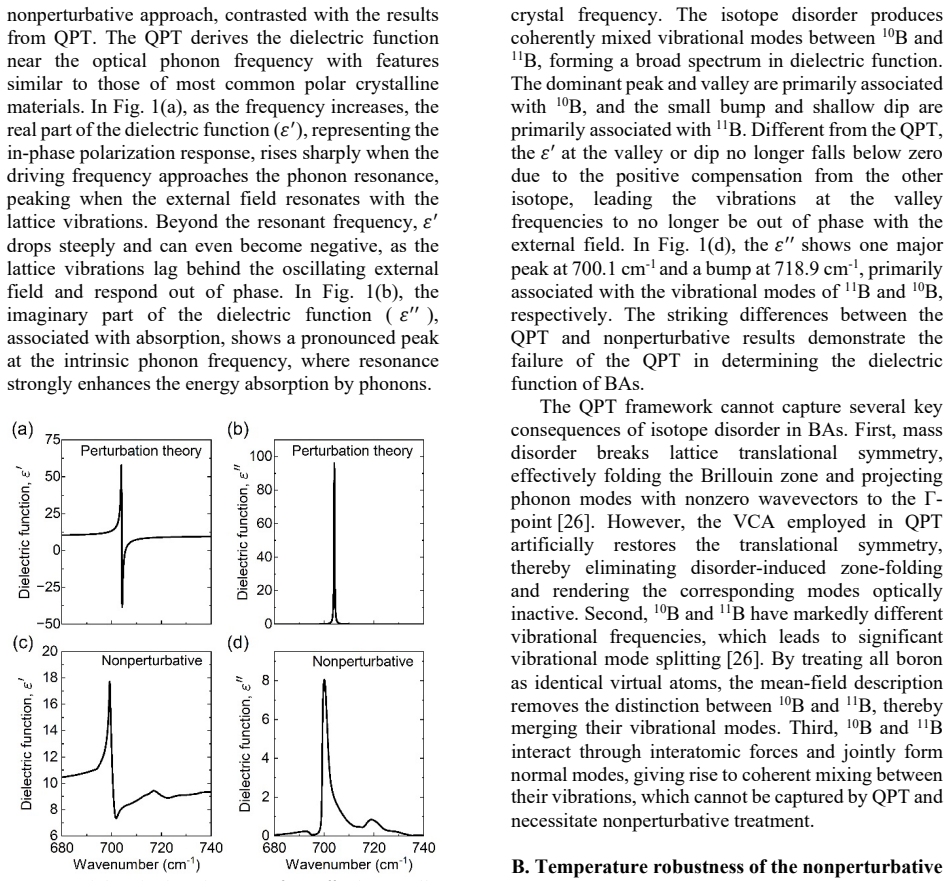
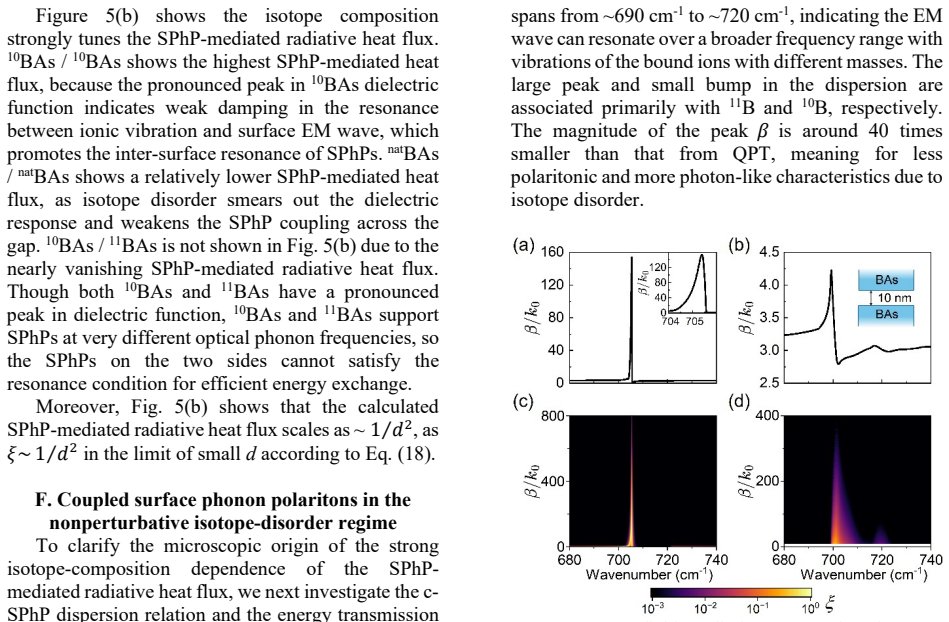
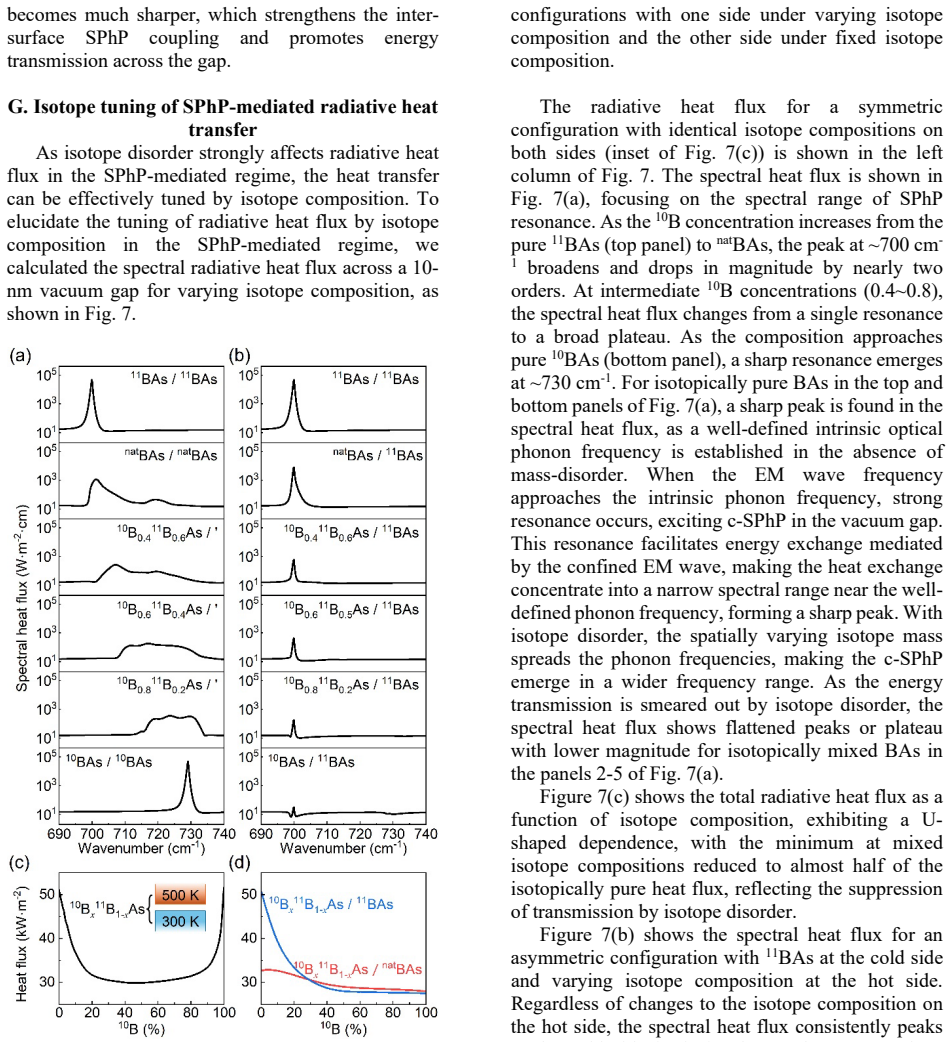
The interaction of light and matter under strong isotope disorder gives rise to unconventional physics that goes beyond the quantum perturbation theory. In boron arsenide, the large mass difference between the two stable boron isotopes presents a paradigmatic case where perturbation theory fails, yet a unified theoretical framework across the perturbative and nonperturbative regime has remained elusive. Here, we develop a nonperturbative approach to capture isotope-disorder effect in boron arsenide, which fundamentally alters light-matter interactions. We reveal that coherently mixed vibrations between two boron isotopes reshape the dielectric function in the nonperturbative regime. The nonperturbative isotope interactions dictate the properties of coupled surface phonon polaritons and near-field radiative heat transfer. Two-fold tuning of radiative heat flux is achieved by modulating the surface phonon polariton resonance via isotope engineering. This work establishes a unified framework connecting the perturbative and nonperturbative limits, enabling quantitative predictions across weak to strong disorder regime.
Editorial analysis
A structured set of objections, weighed in public.
Referee Report
Summary. The manuscript develops a nonperturbative theoretical framework to treat isotope disorder in boron arsenide (BAs), asserting that the ~10% mass difference between 10B and 11B causes perturbation theory to fail. It claims that coherent vibrational mixing between the isotopes reshapes the dielectric function, controls coupled surface phonon polaritons, and enables two-fold tuning of near-field radiative heat flux through isotope engineering, while providing a unified description spanning weak to strong disorder regimes.
Significance. If the nonperturbative method and its predictions are rigorously validated, the work would supply a practical framework for quantitative modeling of light-matter coupling under strong isotopic disorder, with direct relevance to phonon-polariton engineering and radiative heat transfer in BAs and related materials.
major comments (2)
- [Abstract and §1] Abstract and §1: The central assertion that standard perturbation theory fails for the boron isotope mass difference is presented without a quantitative breakdown (e.g., explicit comparison of second- and higher-order corrections to first-order frequency shifts at the studied isotope concentrations). This demonstration is required to establish the necessity of the new framework.
- [Theoretical development (likely §2–3)] Theoretical development (likely §2–3): The nonperturbative treatment of coherent isotope mixing and its effect on the dielectric function is introduced, but the manuscript does not show an explicit reduction to the perturbative limit at low disorder or provide error bounds on the predicted reshaping of the dielectric function and polariton dispersion.
minor comments (2)
- Figure captions and axis labels should explicitly state the isotope concentrations and temperature ranges used for the heat-flux calculations.
- A brief comparison table of perturbative vs. nonperturbative results at low disorder would improve clarity.
Simulated Author's Rebuttal
We thank the referee for the detailed and constructive report. We agree that additional quantitative demonstrations are needed to strengthen the motivation and validation of the nonperturbative framework. We will revise the manuscript accordingly.
read point-by-point responses
-
Referee: [Abstract and §1] Abstract and §1: The central assertion that standard perturbation theory fails for the boron isotope mass difference is presented without a quantitative breakdown (e.g., explicit comparison of second- and higher-order corrections to first-order frequency shifts at the studied isotope concentrations). This demonstration is required to establish the necessity of the new framework.
Authors: We agree that an explicit quantitative comparison is required to rigorously establish the breakdown of perturbation theory. In the revised manuscript we will add a new figure and accompanying text in §1 that directly compares the first-order frequency shifts against second- and higher-order corrections (computed via the perturbative expansion of the dynamical matrix) for the isotope concentrations examined in the study. This will quantify the regime where higher-order terms become comparable to or exceed the first-order shift, thereby justifying the nonperturbative treatment. revision: yes
-
Referee: [Theoretical development (likely §2–3)] Theoretical development (likely §2–3): The nonperturbative treatment of coherent isotope mixing and its effect on the dielectric function is introduced, but the manuscript does not show an explicit reduction to the perturbative limit at low disorder or provide error bounds on the predicted reshaping of the dielectric function and polariton dispersion.
Authors: We acknowledge that an explicit reduction to the perturbative limit and associated error bounds were not provided. In the revised version we will insert a dedicated subsection (likely in §3) that analytically recovers the perturbative result in the low-disorder limit and numerically demonstrates convergence of the nonperturbative dielectric function to the perturbative one as the isotope concentration approaches the dilute limit. We will also report quantitative error bounds (e.g., relative deviation in the real and imaginary parts of the dielectric function and in the polariton dispersion) across the full range of disorder strengths considered. revision: yes
Circularity Check
No circularity: derivation chain not reducible to inputs by construction
full rationale
The provided abstract and context describe development of a nonperturbative framework for isotope effects, asserting failure of perturbation theory due to boron mass difference, but contain no equations, fitting procedures, self-citations, or ansatzes that reduce predictions to inputs by definition. No load-bearing steps match the enumerated circularity patterns; the central claim rests on an external physical assumption rather than self-referential construction. The derivation is treated as self-contained pending full text inspection.
Axiom & Free-Parameter Ledger
Reference graph
Works this paper leans on
-
[1]
J. J. Sakurai, Modern Quantum Mechanics (Addison-Wesley Publishing Company, 1994)
1994
-
[2]
G. D. Mahan, Many‐Particle Physics (Kluwer, 2000)
2000
-
[3]
J. S. Kang, H. Wu, M. Li, and Y. Hu, Intrinsic low thermal conductivity and phonon renormalization due to strong anharmonicity of single -crystal tin selenide, Nano Lett. 19 , 4941 (2019)
2019
-
[4]
Errea, B
I. Errea, B. Rousseau, and A. Bergara, Anharmonic stabilization of the high-pressure simple cubic phase of calcium, Phys. Rev. Lett. 106, 165501 (2011)
2011
-
[5]
Zacharias and F
M. Zacharias and F. Giustino, Theory of the special displacement method for electronic structure calculations at finite temperature, Phys. Rev. Res. 2, 13357 (2020)
2020
-
[6]
B. L. Altshuler, Y. Gefen, A. Kamenev, and L. S. Levitov, Quasiparticle lifetime in a finite system: A nonperturbative approach, Phys. Rev. Lett. 78, 2803 (1997)
1997
-
[7]
Paschen and Q
S. Paschen and Q. Si, Quantum phases driven by strong correlations, Nat . Rev. Phys. 3, 9 (2021)
2021
-
[8]
S. S. Lee, Recent developments in non -Fermi liquid theory, Annu. Rev. Condens. Matter Phys. 9, 227 (2018)
2018
-
[9]
Frisk Kockum, A
A. Frisk Kockum, A. Miranowicz, S. De Liberato, S. Savasta, and F. Nori, Ultrastrong coupling between light and matter, Nat . Rev. Phys. 1, 19 (2019)
2019
-
[10]
Forn-Díaz, L
P. Forn-Díaz, L. Lamata, E. Rico, J. Kono, and E. Solano, Ultrastrong coupling regimes of light-matter interaction, Rev. Mod. Phys. 91, 25005 (2019)
2019
-
[11]
Bazavov et al., Nonperturbative QCD simulations with 2+1 flavors of improved staggered quarks, Rev
A. Bazavov et al., Nonperturbative QCD simulations with 2+1 flavors of improved staggered quarks, Rev. Mod. Phys. 82, 1349 (2010)
2010
-
[12]
Z. M. Zhang, Nano/Microscale Heat Transfer (McGraw-Hill, 2007). 11
2007
-
[13]
J. S. Kang, M. Li, H. Wu, H. Nguyen, and Y. Hu, Experimental observation of high thermal conductivity in boron arsenide, Science 361, 575 (2018)
2018
-
[14]
Tian et al., Unusual high thermal conductivity in boron arsenide bulk crystals, Science 361, 582 (2018)
F. Tian et al., Unusual high thermal conductivity in boron arsenide bulk crystals, Science 361, 582 (2018)
2018
-
[15]
S. Li, Q. Zheng, Y. Lv, X. Liu, X. Wang, P. Y. Huang, D. G. Cahill, and B. Lv, High thermal conductivity in cubic boron arsenide crystals, Science 361, 579 (2018)
2018
-
[16]
Dames, Ultrahigh thermal conductivity confirmed in boron arsenide, Science 361, 549 (2018)
C. Dames, Ultrahigh thermal conductivity confirmed in boron arsenide, Science 361, 549 (2018)
2018
-
[17]
Shin et al., High ambipolar mobility in cubic boron arsenide, Science 377, 437 (2022)
J. Shin et al., High ambipolar mobility in cubic boron arsenide, Science 377, 437 (2022)
2022
-
[18]
Yue et al., High ambipolar mobility in cubic boron arsenide revealed by transient reflectivity microscopy, Science 377 , 433 (2022)
S. Yue et al., High ambipolar mobility in cubic boron arsenide revealed by transient reflectivity microscopy, Science 377 , 433 (2022)
2022
-
[19]
J. S. Kang, M. Li, H. Wu, H. Nguyen, T. Aoki, and Y. Hu, Integration of boron arsenide cooling substrates into gallium nitride devices, Nat. Electron. 4, 416 (2021)
2021
-
[20]
Lindsay, D
L. Lindsay, D. A. Broido, and T. L. Reinecke, First-principles determination of ultrahigh thermal conductivity of boron arsenide: A competitor for diamond?, Phys. Rev. Lett. 111, 025901 (2013)
2013
-
[21]
T. Feng, L. Lindsay, and X. Ruan, Four - phonon scattering significantly reduces intrinsic thermal conductivity of solids, Phys. Rev. B 96, 161201(R) (2017)
2017
-
[22]
A. B. Niyikiza, Z. Xiang, F. Zhang, F. Pan, C. Li, M. Delmont, D. Broido, Y. Peng, B. Liao, and Z. Ren, Thermal conductivity of boron arsenide above 2100 W per meter per Kelvin at room temperature, Mater . Today 90, 11 (2025)
2025
-
[23]
Zhong et al., Thermal Conductivity above 2,000 W/m·K in Boron Arsenide by Nanosecond Transducer -Less Time -Domain Thermoreflectance, Research 8, 0971 (2026)
H. Zhong et al., Thermal Conductivity above 2,000 W/m·K in Boron Arsenide by Nanosecond Transducer -Less Time -Domain Thermoreflectance, Research 8, 0971 (2026)
2026
-
[24]
V. G. Hadjiev, M. N. Iliev, B. Lv, Z. F. Ren, and C. W. Chu, Anomalous vibrational properties of cubic boron arsenide, Phys. Rev. B 89, 024308 (2014)
2014
-
[25]
A. Rai, S. Li, H. Wu, B. Lv, and D. G. Cahill, Effect of isotope disorder on the Raman spectra of cubic boron arsenide, Phys. Rev. Mater. 5, 013603 (2021)
2021
-
[26]
H. Wu, Z. Qin, S. Li, L. Lindsay, and Y. Hu, Nonperturbative determination of isotope - induced anomalous vibrational physics, Phys. Rev. B 108, L140302 (2023)
2023
-
[27]
Hayes and R
W. Hayes and R. Loudon, Scattering of Light by Crystals (John Wiley and Sons, 1978)
1978
-
[28]
D. Feng, X. Yang, Z. Han, and X. Ruan, Near- field radiation in BAs and BSb dominated by four-phonon scattering, Phys. Rev. B 109, L081409 (2024)
2024
-
[29]
X. Meng, A. Singh, R. Juneja, Y. Zhang, F. Tian, Z. Ren, A. K. Singh, L. Shi, J. F. Lin, and Y. Wang, Pressure -Dependent Behavior of Defect-Modulated Band Structure in Boron Arsenide, Adv. Mater. 32, 2001942 (2020)
2020
-
[30]
J. S. Kang, M. Li, H. Wu, H. Nguyen, and Y. Hu, Basic physical properties of cubic boron arsenide, Appl. Phys. Lett. 115 , 122103 (2019)
2019
-
[31]
S. Li, Z. Qin, H. Wu, M. Li, M. Kunz, A. Alatas, A. Kavner, and Y. Hu, Anomalous thermal transport under high pressure in boron arsenide, Nature 612, 459 (2022)
2022
-
[32]
Oganesyan and D
V. Oganesyan and D. A. Huse, Localization of interacting fermions at high temperature, Phys. Rev. B 75, 155111 (2007)
2007
-
[33]
Pal and D
A. Pal and D. A. Huse, Many -body localization phase transition, Phys. Rev. B 82, 174411 (2010)
2010
-
[34]
See Supplemental Material [url] for the convergence test and error analysis
-
[35]
Tadano, Y
T. Tadano, Y. Gohda, and S. Tsuneyuki, Anharmonic force constants extracted from first-principles molecular dynamics: applications to heat transfer simulations, J . Phys. Condens. Matter 26, 225402 (2014)
2014
-
[36]
Hohenberg and W
P. Hohenberg and W. Kohn, Inhomogeneous electron gas, Phys. Rev. 136, B864 (1964)
1964
-
[37]
Kohn and L
W. Kohn and L. J. Sham, Self- consistent equations including exchange and correlation effects, Phys. Rev. 140, A1133 (1965)
1965
-
[38]
Giannozzi et al., QUANTUM ESPRESSO: a modular and open- source software project for quantum simulations of materials, J
P. Giannozzi et al., QUANTUM ESPRESSO: a modular and open- source software project for quantum simulations of materials, J. Phys. Condens. Matter 21, 395502 (2009)
2009
-
[39]
Giannozzi et al., Advanced capabilities for materials modelling with Quantum ESPRESSO, J
P. Giannozzi et al., Advanced capabilities for materials modelling with Quantum ESPRESSO, J . Phys. Condens. Matter 29, 465901 (2017)
2017
-
[40]
We used the pseudopotentials B.pbe -n- kjpaw_psl.1.0.0.UPF and As.pbe -n- kjpaw_psl.1.0.0.UPF from the Quantum ESPRESSO pseudopotential data base: http://www.quantum- espresso.org/pseudopotentials
-
[41]
V. R. Cooper, Van der Waals density functional: An appropriate exchange functional, Phys. Rev. B 81, 161104 (2010)
2010
-
[42]
Tamura, Isotope scattering of dispersive phonons in Ge, Phys
S. Tamura, Isotope scattering of dispersive phonons in Ge, Phys. Rev. B 27, 858 (1983). 12
1983
-
[43]
We used the pseudopotentials Ga.pz -dn- kjpaw_psl.0.2.UPF, As.pz -n- kjpaw_psl.0.2.UPF, Si.pz -n- kjpaw_psl.0.1.UPF, and C.pz -n- kjpaw_psl.0.1.UPF from the Quantum ESPRESSO pseudopotential data base: http://www.quantum- espresso.org/pseudopotentials
-
[44]
X. Yang, T. Feng, J. S. Kang, Y. Hu, J. Li, and X. Ruan, Observation of strong higher -order lattice anharmonicity in Raman and infrared spectra, Phys. Rev. B 101, 161202(R) (2020)
2020
-
[45]
G. A. Samara, Temperature and pressure dependences of the dielectric constants of semiconductors, Phys. Rev. B 27, 3494 (1983)
1983
-
[46]
Olego and M
D. Olego and M. Cardona, Temperature dependence of the optical phonons and transverse effective charge in 3C -SiC, Phys. Rev. B 25, 3889 (1982)
1982
-
[47]
Fujiwara, Spectroscopic Ellipsometry: Principles and Applications (John Wiley & Sons, 2007)
H. Fujiwara, Spectroscopic Ellipsometry: Principles and Applications (John Wiley & Sons, 2007)
2007
-
[48]
J. P. Mulet, K. Joulain, R. Carminati, and J. J. Greffet, Enhanced radiative heat transfer at nanometric distances, Microscale Thermophysical Engineering 6, 209 (2002)
2002
-
[49]
Joulain, J
K. Joulain, J. -P. Mulet, F. Marquier, R. Carminati, and J. -J. Greffet, Surface electromagnetic waves thermally excited: Radiative heat transfer, coherence properties and Casimir forces revisited in the near field, Surf. Sci. Rep. 57, 59 (2005)
2005
-
[50]
S. Shen, A. Narayanaswamy, and G. Chen, Surface Phonon Polaritons Mediated Energy Transfer between Nanoscale Gaps, Nano Lett. 9, 2909 (2009)
2009
-
[51]
F. Yang, J. R. Sambles, and G. W. Bradberry, Long-range surface modes supported by thin films, Phys. Rev. B 44, 5855 (1991)
1991
-
[52]
Kittel, W
A. Kittel, W. Müller -Hirsch, J. Parisi, S. -A. Biehs, D. Reddig, and M. Holthaus, Near-field heat transfer in a scanning thermal microscope, Phys. Rev. Lett. 95, 224301 (2005)
2005
-
[53]
Rousseau, A
E. Rousseau, A. Siria, G. Jourdan, S. Volz, F. Comin, J. Chevrier, and J. J. Greffet, Radiative heat transfer at the nanoscale, Nat. Photonics 3, 514 (2009)
2009
-
[54]
R. S. Ottens, V. Quetschke, S. Wise, A. A. Alemi, R. Lundock, G. Mueller, D. H. Reitze, D. B. Tanner, and B. F. Whiting, Near- field radiative heat transfer between macroscopic planar surfaces, Phys. Rev. Lett. 107 , 14301 (2011)
2011
-
[55]
Kim et al., Radiative heat transfer in the extreme near field, Nature 528, 387 (2015)
K. Kim et al., Radiative heat transfer in the extreme near field, Nature 528, 387 (2015)
2015
-
[56]
St-Gelais, L
R. St-Gelais, L. Zhu, S. Fan, and M. Lipson, Near-field radiative heat transfer between parallel structures in the deep subwavelength regime, Nat. Nanotechnol. 11, 515 (2016)
2016
-
[57]
B. Song, D. Thompson, A. Fiorino, Y. Ganjeh, P. Reddy, and E. Meyhofer, Radiative heat conductances between dielectric and metallic parallel plates with nanoscale gaps, Nat. Nanotechnol. 11, 509 (2016)
2016
-
[58]
B. Song, A. Fiorino, E. Meyhofer, and P. Reddy, Near-field radiative thermal transport: From theory to experiment, AIP Adv. 5, 053503 (2015)
2015
-
[59]
H. Wu, Nonperturbative isotope effect on light-matter interaction in boron arsenide [Data set], Zenodo (2025 ), https://doi.org/10.5281/zenodo.17514764
discussion (0)
Sign in with ORCID, Apple, or X to comment. Anyone can read and Pith papers without signing in.