Coexistence of High Temperature Superconductivity and Antiferromagnetic Order in a Cuprate with Multiple Hole Fermi Pockets
Pith reviewed 2026-06-27 17:49 UTC · model grok-4.3
The pith
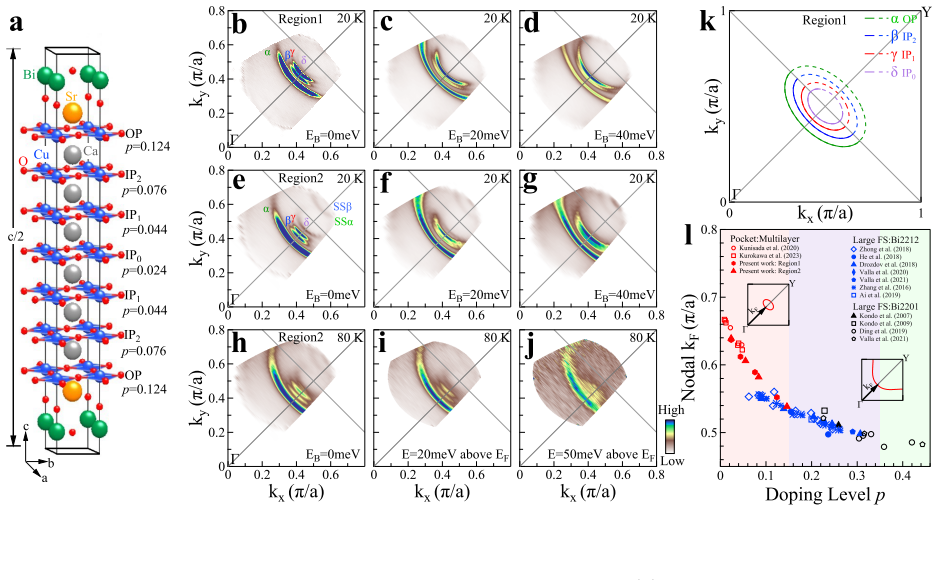
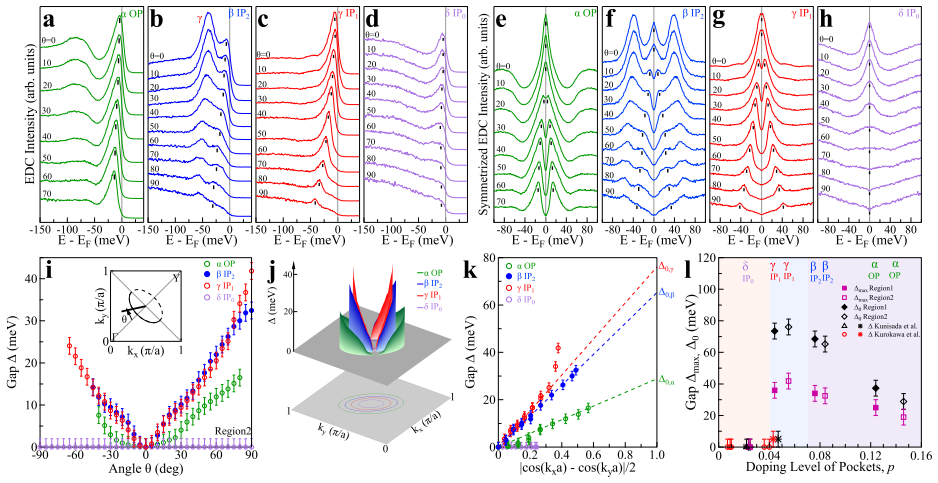
A cuprate with multiple hole Fermi pockets exhibits 75 K superconductivity coexisting with strong antiferromagnetic order, including 42 meV pairing gaps in lightly doped planes.
A machine-rendered reading of the paper's core claim, the machinery that carries it, and where it could break.
Core claim
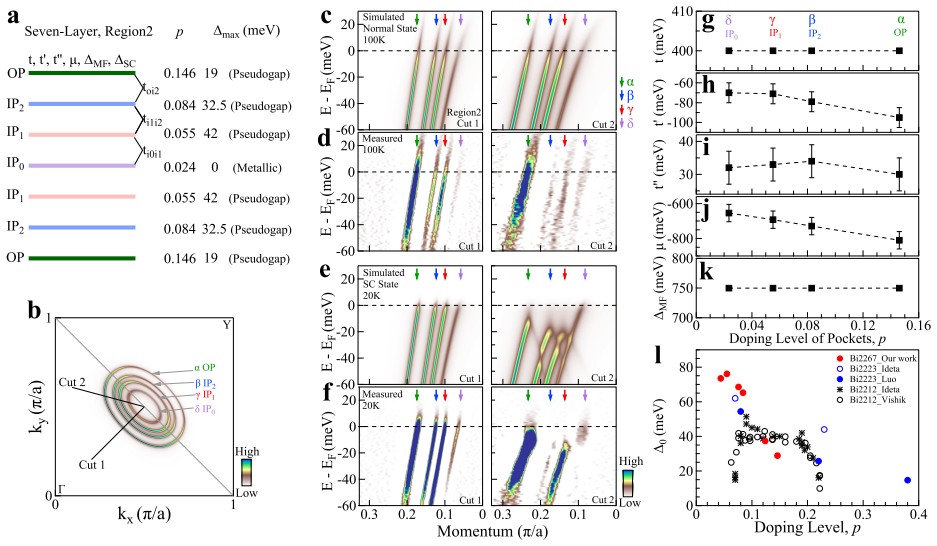
In Bi2267, high-resolution ARPES identifies multiple hole Fermi pockets that carry substantial electron pairing, manifested as energy gaps up to 42 meV even in lightly doped planes with p approximately 0.05; this pairing supports superconductivity at approximately 75 K while strong antiferromagnetic order and correlations remain present, showing that the two orders can coexist in a multi-pocket cuprate.
What carries the argument
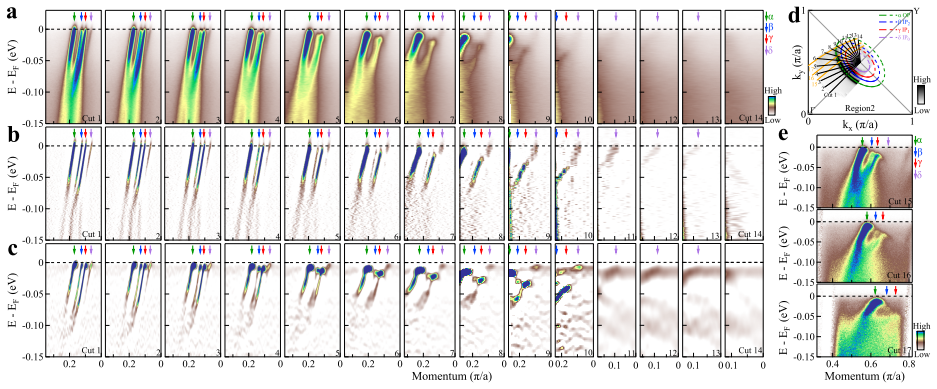
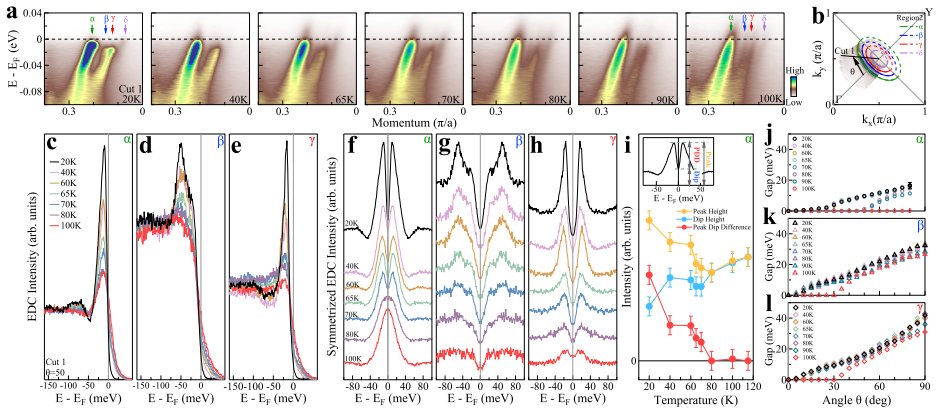
multiple hole Fermi pockets observed by spatially resolved laser ARPES, each exhibiting distinct momentum-, temperature-, and surface-dependent energy gaps that persist alongside antiferromagnetic order.
If this is right
- Superconductivity in this system arises from states distributed across multiple Fermi pockets rather than being restricted to nodal regions.
- Antiferromagnetic order does not suppress high-Tc superconductivity when multiple hole pockets are present.
- Large pairing gaps can form in underdoped CuO2 planes provided the system supports multiple pockets.
- The conventional separation of nodal and antinodal roles in driving cuprate superconductivity requires revision for multi-pocket compounds.
Where Pith is reading between the lines
- The coexistence may point to a pairing mechanism that tolerates or even benefits from antiferromagnetic fluctuations across several pockets.
- Similar multi-pocket structures could be searched for in other multilayer cuprates to test whether high-Tc superconductivity routinely survives strong antiferromagnetism.
- The doping level at which the largest gaps appear suggests that optimal pairing may shift when the Fermi surface reconstructs into multiple pockets.
Load-bearing premise
The energy gaps measured on the Fermi pockets are superconducting pairing gaps rather than other competing orders or experimental artifacts.
What would settle it
If the same momentum-dependent gaps remain unchanged when temperature is raised above Tc or when the sample is driven out of the superconducting state by other means, the interpretation of the gaps as pairing gaps would be falsified.
Figures
read the original abstract
The intricate relationship between high temperature superconductivity and antiferromagnetic order in cuprates, and the fundamental origin of electron pairing remain open questions. By utilizing high-resolution laser-based spatially-resolved angle-resolved photoemission spectroscopy, we investigate the seven-layer $Bi_{2}Sr_{2}Ca_{6}Cu_{7}O_{18+\delta}$ (Bi2267) and identify a cuprate system that consists of multiple hole Fermi pockets. The observed Fermi pockets exhibit pronounced momentum-, temperature- and Fermi surface-dependent energy gaps. Crucially, high temperature superconductivity with a critical temperature ($T_{\mathrm{c}}$) of $\sim$75 K emerges in a system with multiple Fermi pockets and the presence of strong antiferromagnetic order and correlations. In particular, substantial electron pairing is observed along the Fermi pocket with an energy gap up to $\sim$42 meV in lightly-doped CuO$_{2}$ planes ($p\sim$0.05). These findings challenge the conventional understanding of the roles of the nodal and antinodal electronic states in driving high-temperature superconductivity. They show that superconductivity and antiferromagnetism can coexist in a cuprate with multiple Fermi pockets, offering further insights into the pairing mechanism in cuprate superconductors.
Editorial analysis
A structured set of objections, weighed in public.
Referee Report
Summary. The manuscript reports high-resolution laser-based ARPES measurements on the seven-layer cuprate Bi_{2}Sr_{2}Ca_{6}Cu_{7}O_{18+δ} (Bi2267), identifying multiple hole Fermi pockets. It claims that high-Tc superconductivity (Tc ≈ 75 K) coexists with strong antiferromagnetic order and correlations at low doping (p ≈ 0.05), with momentum-, temperature-, and Fermi-surface-dependent energy gaps reaching up to ≈ 42 meV on one pocket; this is presented as evidence that superconductivity and antiferromagnetism can coexist in a multi-pocket system, challenging conventional views on the roles of nodal versus antinodal states in cuprate pairing.
Significance. If the observed gaps are unambiguously superconducting pairing gaps that close at the reported Tc and the antiferromagnetic correlations are independently confirmed to be strong, the result would be significant: it would furnish a concrete multi-pocket cuprate platform in which high-Tc superconductivity persists alongside AF order at p ≈ 0.05, thereby constraining models that tie pairing exclusively to antinodal states or require AF suppression for superconductivity.
major comments (2)
- [Abstract] Abstract: the central claim that the momentum- and temperature-dependent gaps (up to 42 meV) constitute 'substantial electron pairing' and establish Tc ≈ 75 K superconductivity rests on an interpretive assignment that is not accompanied by explicit distinguishing criteria (gap closure temperature matching transport Tc, particle-hole symmetry of the gap, or comparison to pseudogap signatures). In the underdoped regime such gaps are routinely associated with pseudogap or AF order; without these diagnostics the assignment is load-bearing for the coexistence conclusion.
- [Abstract] Abstract: the statement that 'strong antiferromagnetic order and correlations' coexist with superconductivity lacks quantitative support in the provided text (e.g., no reported magnetic Bragg peak intensity, spin correlation length, or doping-dependent AF transition temperature), which is required to substantiate the claim that AF order is not merely residual but coexists without suppressing the reported Tc.
Simulated Author's Rebuttal
We thank the referee for their careful reading of the manuscript and for identifying points that require clarification. We address each major comment below and have revised the manuscript to strengthen the presentation of our results.
read point-by-point responses
-
Referee: [Abstract] Abstract: the central claim that the momentum- and temperature-dependent gaps (up to 42 meV) constitute 'substantial electron pairing' and establish Tc ≈ 75 K superconductivity rests on an interpretive assignment that is not accompanied by explicit distinguishing criteria (gap closure temperature matching transport Tc, particle-hole symmetry of the gap, or comparison to pseudogap signatures). In the underdoped regime such gaps are routinely associated with pseudogap or AF order; without these diagnostics the assignment is load-bearing for the coexistence conclusion.
Authors: We agree that the abstract is brief and does not explicitly list the distinguishing criteria. The main text presents temperature-dependent ARPES data (Figs. 3 and 4) in which the gap on the inner Fermi pocket closes at approximately 75 K, matching the transport Tc, together with particle-hole symmetric dispersion around the Fermi level. The momentum dependence further distinguishes these gaps from typical pseudogap behavior. We have revised the abstract to reference the temperature closure at Tc and the Fermi-surface selectivity of the gaps, thereby making the assignment to superconducting pairing explicit. revision: yes
-
Referee: [Abstract] Abstract: the statement that 'strong antiferromagnetic order and correlations' coexist with superconductivity lacks quantitative support in the provided text (e.g., no reported magnetic Bragg peak intensity, spin correlation length, or doping-dependent AF transition temperature), which is required to substantiate the claim that AF order is not merely residual but coexists without suppressing the reported Tc.
Authors: The referee is correct that direct quantitative measures such as magnetic Bragg peak intensity or spin correlation length are not reported, as these require neutron scattering. Our claim of strong AF correlations rests on ARPES signatures of band folding and shadow bands that persist in the lightly doped planes (p ≈ 0.05) and remain visible up to temperatures well above Tc. We have revised the abstract and main text to describe these as 'pronounced antiferromagnetic correlations' supported by the observed folding, added citations to prior work on multilayer cuprates, and noted that complementary neutron data would be valuable for full quantification. The coexistence conclusion is therefore based on the simultaneous observation of the folded bands and the closing superconducting gap. revision: partial
Circularity Check
No circularity: purely observational ARPES report with no derivations or model reductions
full rationale
The manuscript is an experimental study reporting ARPES measurements of Fermi surface pockets, momentum-dependent gaps, and their temperature dependence in Bi2267. No equations, ansatzes, fitted parameters, or predictive models appear in the provided text; claims rest on direct observation of gaps up to 42 meV and Tc ~75 K rather than any reduction of outputs to inputs. No self-citation chains or uniqueness theorems are invoked to support a derivation. The work is therefore self-contained as an observational report.
Axiom & Free-Parameter Ledger
Reference graph
Works this paper leans on
-
[1]
P. A. Lee, N. Nagaosa and X. G. Wen. Doping a Mott insulator: physics of high-temperature superconductivity.Review of Modern Physics78, 17 (2006)
2006
-
[2]
Keimer, S
B. Keimer, S. A. Kivelson, M. R. Norman, S. Uchida and J. Zaanen. From quantum matter to high-temperature superconductivity in copper oxides.Nature518, 179 (2015)
2015
-
[3]
Vaknin, S
D. Vaknin, S. K. Sinha, D. E. Moncton, D. C. Johnston, J. M. Newsam, C. R. Safinya and H. E. King, Jr. Antiferromagnetism inLa 2CuO 4−y.Physical Review Letters58, 2802 (1987)
1987
-
[4]
J. M. Tranquada, A. H. Moudden, A. I. Goldman, P. Zolliker, D. E. Cox, and G. Shirane, S. K. Sinha, D. Vaknin, D. C. Johnston, M. S. Alvarez, A. J. Jacobson, J. T. Lewandowski, and J. M. Newsam. Antiferromagnetism inY Ba 2Cu3O6+x .Physical Review B38, 2477 (1988)
1988
-
[5]
Manousakis
E. Manousakis. The spin- 1 2 Heisenberg antiferromagnet on a square lattice and its application to the cuprous oxides.Review of Modern Physics63, 1 (1991)
1991
-
[6]
Eskes and J
H. Eskes and J. H. Jefferson. Superexchange in the cuprates.Physical Review B48, 9788 (1993). 14
1993
-
[7]
C. W. Chu, L. Z. Deng and B. Lv. Hole-doped cuprate high temperature superconductors. Physica C514, 290 (2015)
2015
-
[8]
P. C. Dai, H. A. Mook, S. M. Hayden, G. Aeppli, T. G. Perring, R. D. Hunt and F. Do˘gan. The magnetic excitation spectrum and thermodynamics of high-T C superconductors.Science 284, 1344 (1999)
1999
-
[9]
Coldea, S
R. Coldea, S. M. Hayden, G. Aeppli, T. G. Perring, C. D. Frost, T. E. Mason, S.-W. Cheong and Z. Fisk. Spin waves and electronic interactions inLa 2CuO 4.Physical Review Letters86, 5377 (2001)
2001
-
[10]
H. A. Mook, P. C. Dai and F. Do˘gan. Charge and Spin Structure inY Ba 2Cu3O6.35.Physical Review Letters88, 097004 (2002)
2002
-
[11]
S. M. Hayden, H. A. Mook, P. C. Dai, T. G. Perring and F. Do˘gan. The structure of the high-energy spin excitations in a high-transition-temperature superconductor.Nature429, 531 (2004)
2004
-
[12]
Wakimoto, H
S. Wakimoto, H. Zhang, K. Yamada, I. Swainson, H. Kim and R. J. Birgeneau. Direct relation between the low-energy spin excitations and superconductivity of overdoped high-T C superconductors.Physical Review Letters92, 217004 (2004)
2004
-
[13]
Vignolle, S
B. Vignolle, S. M. Hayden, D. F. McMorrow, H. M. Ronnow, B. Lake, C. D. Frost and T. G. Perring. Two energy scales in the spin excitations of the high-temperature superconductor La2−xSrxCuO 4.Nature Physics3, 163 (2007)
2007
-
[14]
J. M. Tranquada. Neutron scattering studies of antiferromagnetic correlations in cuprates. inHandbook of High-Temperature Superconductivity: Theory and Experimentedited by J. R. Schrieffer (Springer, New York, 2007)
2007
-
[15]
D. J. Scalapino, E. Loh, Jr. and J. E. Hirsch. d-wave pairing near a spin-density-wave insta- bility.Physical Review B34, 8190 (1986)
1986
-
[16]
Monthoux, A
P. Monthoux, A. V. Balatsky and D. Pines. Toward a theory of high-temperature supercon- ductivity in the antiferromagnetically correlated cuprate oxides.Physical Review Letters67, 3448 (1991)
1991
-
[17]
D. J. Scalapino. The case ford x2−y2 pairing in the cuprate superconductors.Physics Reports 250, 329 (1995)
1995
-
[18]
Moriya and K
T. Moriya and K. Ueda. Spin fluctuations and high temperature superconductivity.Advances in Physics49, 555 (2000). 15
2000
-
[19]
Abanov, A
Ar. Abanov, A. V. Chubukov and M. R. Norman. Gap anisotropy and universal pairing scale in a spin-fluctuation model of cuprate superconductors.Physical Review B78, 220507 (2008)
2008
-
[20]
D. J. Scalapino. A common thread: The pairing interaction for unconventional superconduc- tors.Reviews of Modern Physics84, 1383 (2012)
2012
-
[21]
Damascelli, Z
A. Damascelli, Z. Hussain and Z. X. Shen. Angle-resolved photoemission studies of the cuprate superconductors.Reviews of Modern Physics75, 473 (2003)
2003
-
[22]
Yoshida, X
T. Yoshida, X. J. Zhou, T. Sasagawa, W. L. Yang, P. V. Bogdanov, A. Lanzara, Z. Hussain, T. Mizokawa, A. Fujimori, H. Eisaki, Z.-X. Shen, T. Kakeshita and S. Uchida. Metallic behavior of lightly dopedLa 2−xSrxCuO 4 with a Fermi surface forming an arc.Physical Review Letters 91, 027001 (2003)
2003
-
[23]
K. M. Shen, F. Ronning, D. H. Lu, W. S. Lee, N. J. C. Ingle, W. Meevasana, F. Baumberger, A. Damascelli, N. P. Armitage, L. L. Miller, Y. Kohsaka, M. Azuma, M. Takano, H. Takagi and Z. X. Shen. Missing quasiparticles and the chemical potential puzzle in the doping evolution of the cuprate superconductors.Physical Review Letters93, 267002 (2004)
2004
-
[24]
K. M. Shen, F. Ronning, D. H. Lu, F. Baumberger, N. J. C. Ingle, W. S. Lee, W. Meevasana, Y. Kohsaka, M. Azuma, M. Takano, H. Takagi and Z.-X. Shen. Nodal quasiparticles and antinodal charge ordering inCa 2−xN axCuO 2Cl2.Science307, 901 (2005)
2005
-
[25]
Yoshida, X
T. Yoshida, X. J. Zhou, K. Tanaka, W. L. Yang, Z. Hussain, Z.-X. Shen, A. Fujimori, S. Sahrakorpi, M. Lindroos, R. S. Markiewicz, A. Bansil, S. Komiya, Y. Ando, H. Eisaki, T. Kakeshita and S. Uchida. Systematic doping evolution of the underlying Fermi surface of La2−xSrxCuO 4.Physical Review B74, 224510 (2006)
2006
-
[26]
Hashimoto, T
M. Hashimoto, T. Yoshida, H. Yagi, M. Takizawa, A. Fujimori, M. Kubota, K. Ono, K. Tanaka, D. H. Lu, Z.-X. Shen, S. Ono and Y. Ando. Doping evolution of the electronic structure in the single-layer cuprateBi 2Sr2−xLaxCuO 6+δ: Comparison with other single-layer cuprates. Physical Review B77, 094516 (2008)
2008
-
[27]
Y. Y. Peng, J. Q. Meng, D. X. Mou, J. F. He, L. Zhao, Y. Wu, G. D. Liu, X. L. Dong, S. L. He, J. Zhang, X. Y. Wang, Q. J. Peng, Z. M. Wang, S. J. Zhang, F. Yang, C. T. Chen, Z. Y. Xu, T. K. Lee and X. J. Zhou. Disappearance of nodal gap across the insulator-superconductor transition in a copper-oxide superconductor.Nature Communications4, 2459 (2013)
2013
-
[28]
Q. Gao, L. Zhao, C. Hu, H. T. Yan, H. Chen, Y. Q. Cai, C. Li, P. Ai, J. Liu, J. W. Huang, H. T. Rong, C. Y. Song, C. H. Yin, Q. Y. Wang, Y. Huang, G. D. Liu, Z. Y. Xu and X. J. Zhou. 16 Electronic evolution from the parent Mott insulator to a superconductor in lightly hole-doped Bi2Sr2CaCu 2O8+δ.Chinese Physics Letters37, 087402 (2020)
2020
-
[29]
J. C. Campuzano, H. Ding, M. R. Norman, H. M. Fretwell, M. Randeria, A. Kaminski, J. Mesot, T. Takeuchi, T. Sato, T. Yokoya, T. Takahashi, T. Mochiku, K. Kadowaki, P. Guptasarma, D. G. Hinks, Z. Konstantinovic, Z. Z. Li and H. Raffy. Electronic spectra and their relation to the (π, π) collective mode in high-T C superconductors.Physical Review Letters83, ...
1999
-
[30]
Tanaka, W
K. Tanaka, W. S. Lee, D. H. Lu, A. Fujimori, T. Fujii, Risdiana, I. Terasaki, D. J. Scalapino, T. P. Devereaux, Z. Hussain and Z.-X. Shen. Distinct Fermi-momentum-dependent energy gaps in deeply underdoped Bi2212.Science314, 1910 (2006)
1910
-
[31]
D. L. Feng, D. H. Lu, K. M. Shen, C. Kim, H. Eisaki, A. Damascelli, R. Yoshizaki, J.- i. Shimoyama, K. Kishio, G. D. Gu, S. Oh, A. Andrus, J. O ′Donnell, J. N. Eckstein and Z. X. Shen. Signature of superfluid density in the single-particle excitation spectrum of Bi2Sr2CaCu 2O8+δ.Science289, 434 (2000)
2000
-
[32]
H. Ding, J. R. Engelbrecht, Z. Wang, J. C. Campuzano, S. C. Wang, H. B. Yang, R. Rogan, T. Takahashi, K. Kadowaki and D. G. Hinks. Coherent quasiparticle weight and its connection to high-TC superconductivity from angle-resolved photoemission.Physical Review Letters87, 227001 (2001)
2001
-
[33]
X. J. Zhou, T. Yoshida, D.H. Lee, W. L. Yang, V. Brouet, F. Zhou, W. X. Ti, J. W. Xiong, Z. X. Zhao, T. Sasagawa, T. Kakeshita, H. Eisaki, S. Uchida, A. Fujimori, Z. Hussain and Z. X. Shen. Dichotomy between nodal and antinodal quasiparticles in underdoped (La2−xSrx)CuO 4 superconductors.Physical Review Letters92, 187001 (2004)
2004
-
[34]
T. Dahm, V. Hinkov, S. V. Borisenko, A. A. Kordyuk, V. B. Zabolotnyy, J. Fink, B. Buechner, D. J. Scalapino, W. Hanke and B. Keimer. Strength of the spin-fluctuation-mediated pairing interaction in a high-temperature superconductor.Nature Physics5, 217 (2009)
2009
-
[35]
Z. C. Wang, C. W. Zou, C. T. Lin, X. Y. Luo, H. T. Yan, C. H. Yin, Y. Xu, X. J. Zhou, Y. Y. Wang and J. Zhu. Correlating the charge-transfer gap to the maximum transition temperature inBi 2Sr2Can−1CunO2n+4+δ.Science381, 227 (2023)
2023
-
[36]
Kunisada, S
S. Kunisada, S. Isono, Y. Kohama, S. Sakai, C. Bareille, S. Sakuragi, R. Noguchi, K. Kurokawa, K. Kuroda, Y. Ishida, S. Adachi, R. Sekine, T. K. Kim, C. Cacho, S Shin, T. Tohyama, K. Tokiwa and T. Kondo. Observation of small Fermi pockets protected by cleanCuO 2 sheets 17 of a high-T C superconductor.Science369, 833 (2020)
2020
-
[37]
Kurokawa, S
K. Kurokawa, S. Isono, Y. Kohama, S. Kunisada, S. Sakai, R. Sekine, M. Okubo, M. D. Watson, T. K. Kim, C. Cacho, S. Shin, T. Tohyama, K. Tokiwa and T. Kondo. Unveiling phase diagram of the lightly doped high-T C cuprate superconductors with disorder removed. Nature Communications14, 4064 (2023)
2023
-
[38]
Kondo, T
T. Kondo, T. Takeuchi, A. Kaminski, S. Tsuda and S. Shin. Evidence for two energy scales in the superconducting state of optimally doped (Bi, P b) 2(Sr, La)2CuO 6+δ.Physical Review Letters98, 267004 (2007)
2007
-
[39]
Kondo, R
T. Kondo, R. Khasanov, T. Takeuchi, J. Schmalian and A. Kaminski. Competition between the pseudogap and superconductivity in the high-T C copper oxides.Nature457, 296 (2009)
2009
-
[40]
Y. X. Zhang, C. Hu, Y. Hu, L. Zhao, Y. Ding, X. Sun, A. J. Liang, Y. Zhang, S. L. He, D. F. Liu, L. Yu, G. D. Liu, X. L. Dong, G. D. Gu, C. T. Chen, Z. Y. Xu and X. J. Zhou. In situ carrier tuning in high temperature superconductorBi 2Sr2CaCu 2O8+δ by potassium deposition.Science Bulletin61, 1037 (2016)
2016
-
[41]
I. K. Drozdov, I. Pletikosi´c, C.-K. Kim, K. Fujita, G. D. Gu, J. C. S´eamus Davis, P. D. Johnson, I. Bo˘zovi´cand T. Valla. Phase diagram ofBi 2Sr2CaCu 2O8+δ revisited.Nature Communications9, 5210 (2018)
2018
-
[42]
Y. He, M. Hashimoto, D. Song, S.-D. Chen, J. He, I. M. Vishik, B. Moritz, D.-H. Lee, N. Nagaosa, J. Zaanen, T. P. Devereaux, Y. Yoshida, H. Eisaki, D. H. Lu and Z.-X. Shen. Rapid change of superconductivity and electron-phonon coupling through critical doping in Bi-2212. Science362, 62 (2018)
2018
-
[43]
Y. G. Zhong, Y. M. Chen, J. Y. Guan, J. Zhao, Z. C. Rao, C. Y. Tang, H. J. Liu, Y. J. Sun and H. Ding. Extraction of tight binding parameters from in-situ ARPES on the continuously doped surface of cuprates.Science China-Physics, Mechanics and Astronomy.61, 127403 (2018)
2018
-
[44]
Y. Ding, L. Zhao, H. T. Yan, Q. Gao, J. Liu, C. Hu, J. W. Huang, C. Li, Y. Xu, Y. Q. Cai, H. T. Rong, D. S. Wu, C. Y. Song, H. X. Zhou, X. L. Dong, G. D. Liu, Q. Y. Wang, S. J. Zhang, Z. M. Wang, F. F. Zhang, F. Yang, Q. J. Peng, Z. Y. Xu, C. T. Chen and X. J. Zhou. Disappearance of superconductivity and a concomitant Lifshitz transition in heavily overdo...
2019
-
[45]
P. Ai, Q. Gao, J. Liu, Y. X. Zhang, C. Li, J. W. Huang, C. Y. Song, H. T. Yan, L. Zhao, G. D. Liu, G. D. Gu, F. F. Zhang, F. Yang, Q. J. Peng, Z. Y. Xu, and X. J. Zhou. Distinct supercon- ducting gap on two bilayer-split Fermi surface sheets inBi 2Sr2CaCu 2O8+δ superconductor. Chinese Physics Letters36, 067402 (2019)
2019
-
[46]
Valla, I
T. Valla, I. K. Drozdov and G.D. Gu. Disappearance of superconductivity due to vanishing coupling in the overdopedBi 2Sr2CaCu 2O8+δ.Nature Communications11, 569 (2020)
2020
-
[47]
Valla, P
T. Valla, P. Pervan, I. Pletikosi´c, I. K. Drozdov, A. K. Kundu, Z. Wu and G. D. Gu. Hole- like Fermi surface in the overdoped non-superconductingBi 1.8P b0.4Sr2CuO 6+δ.Europhysics Letters134, 17002 (2021)
2021
-
[48]
R. S. Markiewicz, S. Sahrakorpi, M. Lindroos, H. Lin and A. Bansil. One-band tight-binding model parametrization of the high-T c cuprates including the effect ofk z dispersion.Physical Review B72, 054519 (2005)
2005
-
[49]
Mukuda, S
H. Mukuda, S. Shimizu, A. Iyo, and Y. Kitaoka. High-T C superconductivity and antiferro- magnetism in multilayered copper oxides -a new paradigm of superconducting mechanism. Journal of the Physical Society of Japan81, 011008 (2012)
2012
-
[50]
M. Mori, T. Tohyama and S. Maekawa. Charge imbalance effects on interlayer hopping and Fermi surfaces in multilayered high-TC cuprates.Journal of the Physical Society of Japan75, 034708 (2006)
2006
-
[51]
H. Chen, J. M. Shi, Y. H. Li, X. Y. Luo, Y. W. Chen, C. H. Yin, Y. J. Shu, J. X. Zhang, T. M. Miao, B. Liang, W. P. Zhu, N. Cai, X. L. Ren, C. T. Lin, S. J. Zhang, Z. M. Wang, F. F. Zhang, F. Yang, Q. J. Peng, Z. Y. Xu, G. D. Liu, H. Q. Mao, X. T. Li, T. Xiang, L. Zhao and X. J. Zhou. Persistent Fermi pockets and robust electron pairing in lightly doped C...
Pith/arXiv arXiv 2026
-
[52]
Kunisada, S
S. Kunisada, S. Adachi, S. Sakai, N. Sasaki, M. Nakayama, S. Akebi, K. Kuroda, T. Sasagawa, T. Watanabe, S. Shin, and T. Kondo. Observation of Bogoliubov band hybridization in the optimally doped trilayerBi 2Sr2Ca2Cu3O10+δ.Physical Review Letters119, 217001 (2017)
2017
-
[53]
Ideta, S
S. Ideta, S. Johnston, T. Yoshida, K. Tanaka, M. Mori, H. Anzai, A. Ino, M. Arita, H. Na- matame, M. Taniguchi, S. Ishida, K. Takashima, K. M. Kojima, T. P. Devereaux, S. Uchida, and A. Fujimori. Hybridization of Bogoliubov quasiparticles between adjacent CuO 2 lay- ers in the triple-layer cuprateBi 2Sr2Ca2Cu3O10+δ studied by angle-resolved photoemission ...
2021
-
[54]
X. Y. Luo, H. Chen, Y. H. Li, Q. Gao, C. H. Yin, H. T. Yan, T. M. Miao, H. L. Luo, Y. J. Shu, Y. W. Chen, C. T. Lin, S. J. Zhang, Z. M. Wang, F. F. Zhang, F. Yang, Q. J. Peng, G. D. Liu, L. Zhao, Z. Y. Xu, T. Xiang and X. J. Zhou. Electronic origin of high superconducting critical temperature in trilayer cuprates.Nature Physics19, 1841 (2023)
2023
-
[55]
Hashimoto, I
M. Hashimoto, I. M. Vishik, R. H. He, T. P. Devereaux and Z. X. Shen. Energy gaps in high-transition-temperature cuprate superconductors.Nature Physics10, 483 (2014)
2014
-
[56]
Ideta, K
S. Ideta, K. Takashima, M. Hashimoto, T. Yoshida, A. Fujimori, H. Anzai, T. Fujita, Y. Nakashima, A. Ino, M. Arita, H. Namatame, M. Taniguchi, K. Ono, M. Kubota, D. H. Lu, Z.-X. Shen, K. M. Kojima, and S. Uchida. Enhanced superconducting gaps in the trilayer high-temperatureBi 2Sr2Ca2Cu3O10+δ cuprate superconductor.Physical Review Letters104, 227001 (2010)
2010
-
[57]
Y. Xu, H. T. Rong, Q. Y. Wang, D. S. Wu, Y. Hu, Y. Q. Cai, Q. Gao, H. T. Yan, C. Li, C. H. Yin, H. Chen, J. W. Huang, Z. H. Zhu, Y. Huang, G. D. Liu, Z. Y. Xu, L. Zhao and X. J. Zhou. Spectroscopic evidence of superconductivity pairing at 83 K in single-layer FeSe/SrTiO3 films.Nature Communications12, 2840 (2021)
2021
-
[58]
S. D. Chen, M. Hashimoto, Y. He, D. Song, J. F. He, Y. F. Li, S. Ishida, H. Eisaki, J. Zaanen, T. P. Devereaux, D. H. Lee, D. H. Lu and Z. X. Shen. Unconventional spectral signature of TC in a pure d-wave superconductor.Nature601, 562 (2022)
2022
-
[59]
Narita, T
H. Narita, T. Hatano and K. Nakamura. Synthesis and characterization of Bi2Sr2Can−1CunOy (n= 1-7) thin films grown by off-axis, three target magnetron sputtering.Journal of Applied Physics72, 5778 (1992)
1992
-
[60]
Matsui, K
H. Matsui, K. Terashima, T. Sato, T. Takahashi, S.-C. Wang, H.-B. Yang, H. Ding, T. Uefuji and K. Yamada. Angle-Resolved Photoemission Spectroscopy of the Antiferromagnetic Super- conductorN d 1.87Ce0.13CuO 4: Anisotropic spin-correlation gap, pseudogap, and the induced quasiparticle mass enhancement.Physical Review Letters94, 047005 (2005)
2005
-
[61]
J. He, C. R. Rotundu, M. S. Scheurer, Y. He, M. Hashimoto, K.-J. Xu, Y. Wang, E. W. Huang, T. Jia, S. Chen, B. Moritz, D. Lu, Y. S. Lee, T. P. Devereaux and Z.-X. Shen, Fermi surface reconstruction in electron-doped cuprates without antiferromagnetic long-range order. Proceedings of the National Academy of Sciences116, 3449 (2019)
2019
-
[62]
J. R. Schrieffer, X. G. Wen and S. C. Zhang. Dynamic spin fluctuations and the bag mechanism of high-TC superconductivity.Physical Review B39, 11663 (1989). 20
1989
-
[63]
A. V. Chubukov and D. M. Frenkel. Renormalized perturbation theory of magnetic instabilities in the two-dimensional Hubbard model at small doping.Physical Review B46, 11884 (1992)
1992
-
[64]
Bulut, D
N. Bulut, D. J. Scalapino and S. R. White. Electronic properties of the insulating half-filled hubbard model.Physical Review Letters73, 748 (1994)
1994
-
[65]
Xiang and J
T. Xiang and J. M. Wheatley. Quasiparticle energy dispersion in doped two-dimensional quantum antiferromagnets.Physical Review B54, R12653 (1996)
1996
-
[66]
Kusko, R
C. Kusko, R. S. Markiewicz, M. Lindroos and A. Bansil. Fermi surface evolution and collapse of the Mott pseudogap inN d 2−xCexCuO 4±δ.Physical Review B66, 140513 (2002)
2002
-
[67]
V. J. Emery and S. A. Kivelson. Importance of phase fluctuations in superconductors with small superfluid density.Nature374, 434 (1995)
1995
-
[68]
Chatterjee, M
U. Chatterjee, M. Shi, D. Ai, J. Zhao, A. Kanigel, S. Rosenkranz, H. Raffy, Z. Z. Li, K. Kadowaki, D. G. Hinks, Z. J. Xu, J. S.Wen, G. Gu, C. T. Lin, H. Claus, M. R. Norman, M. Randeria and J. C. Campuzano. Observation of a d-wave nodal liquid in highly underdoped Bi2Sr2CaCu 2O8+δ.Nature Physics6, 99 (2010)
2010
-
[69]
I. M. Vishik, M. Hashimoto, R. H. He, W. S. Lee,b, F. Schmitt, D. H. Lu, R. G. Moore, C. Zhang, W. Meevasana, T. Sasagawa, S. Uchida, K. Fujita, S. Ishida, M. Ishikado, Y. Yoshida, H. Eisaki, Z. Hussain, T. P. Devereaux and Z. X. Shen. Phase competition in trisected superconducting dome.Proceedings of the National Academy of Sciences of the United States ...
2012
-
[70]
Liang, C
B. Liang, C. T. Lin, P. Shang and G. Yang. Single crystals of triple-layered cuprates Bi2Sr2Ca2Cu3O10+δ: growth, annealing and characterization.Physica C383, 75 (2002)
2002
-
[71]
C. T. Lin and B. Liang. Growth of a hard-grown single crystal-Bi 2Sr2Ca2Cu3O10+δ. in New Trends in Superconductivityedited by J.F. Annett and S. Kruchinin (Kluwer Academic Publishers, The Netherlands, 2002)
2002
-
[72]
G. D. Liu, G. L. Wang, Y. Zhu, H. B. Zhang, G. C. Zhang, X. Y. Wang, Y. Zhou, W. T. Zhang, H. Y. Liu, L. Zhao, J. Q. Meng, X. L. Dong, C. T. Chen, Z. Y. Xu, and X. J. Zhou. Development of a vacuum ultraviolet laser-based angle-resolved photoemission system with a superhigh energy resolution better than 1meV.Review of Scientific Instruments79, 023105 (2008)
2008
-
[73]
X. J. Zhou, S. L. He, G. D. Liu, L. Zhao, L. Yu, and W. T. Zhang. New developments in laser-based photoemission spectroscopy and its scientific applications: a key issues review. 21 Reports on Progress in Physics81, 062101 (2018). Acknowledgements This work is supported by the National Natural Science Foundation of China (Grant Nos. 12488201 by X.J.Z., 12...
2018
discussion (0)
Sign in with ORCID, Apple, or X to comment. Anyone can read and Pith papers without signing in.