Information Entropy Based Crystal Structure Prediction of Chemically Disordered Alloys via Graph Convolutional Neural Networks
Pith reviewed 2026-06-27 17:54 UTC · model grok-4.3
The pith
An information entropy metric from alchemical Monte Carlo trajectories on a graph convolutional neural network potential predicts stable phases in chemically disordered alloys.
A machine-rendered reading of the paper's core claim, the machinery that carries it, and where it could break.
Core claim
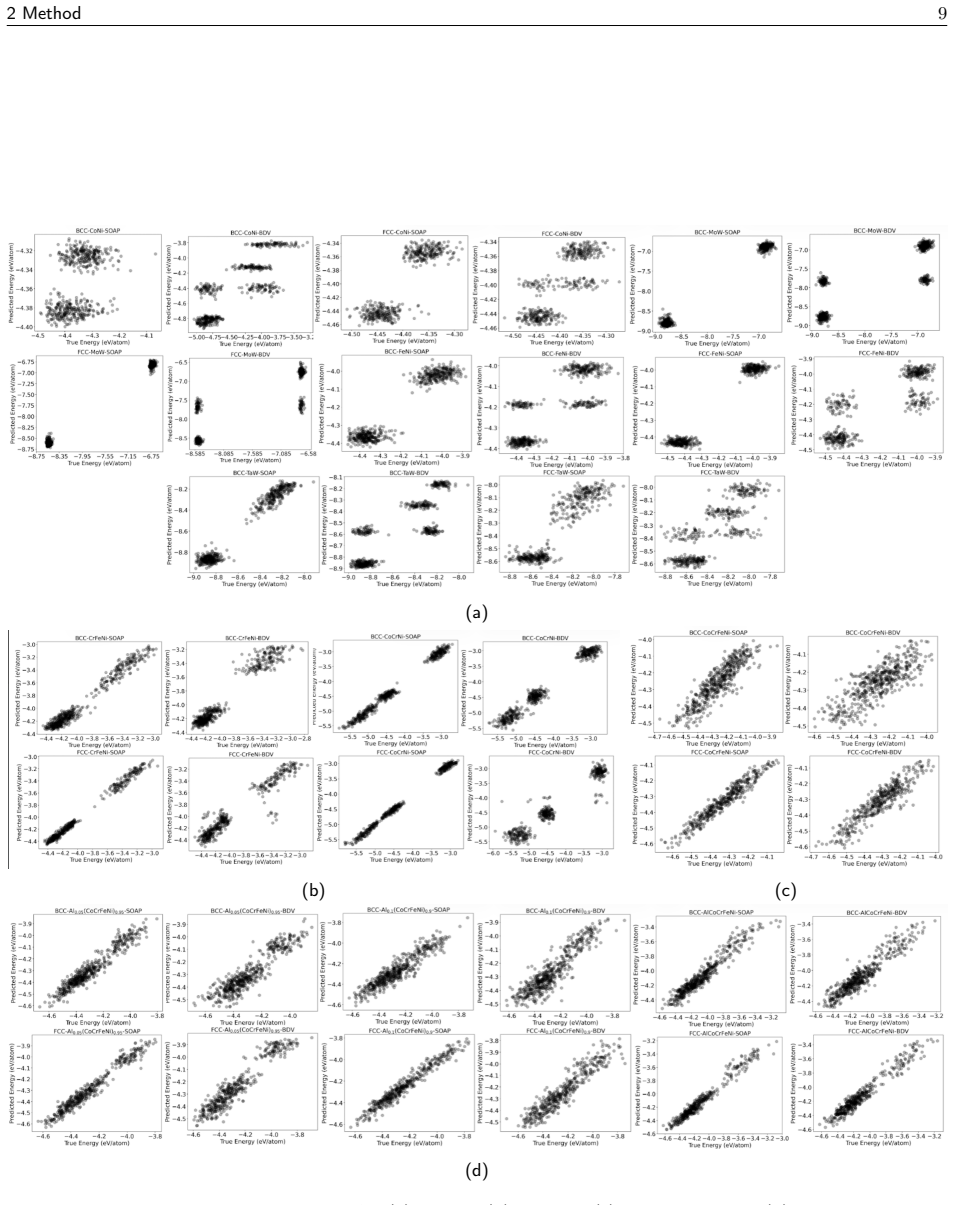
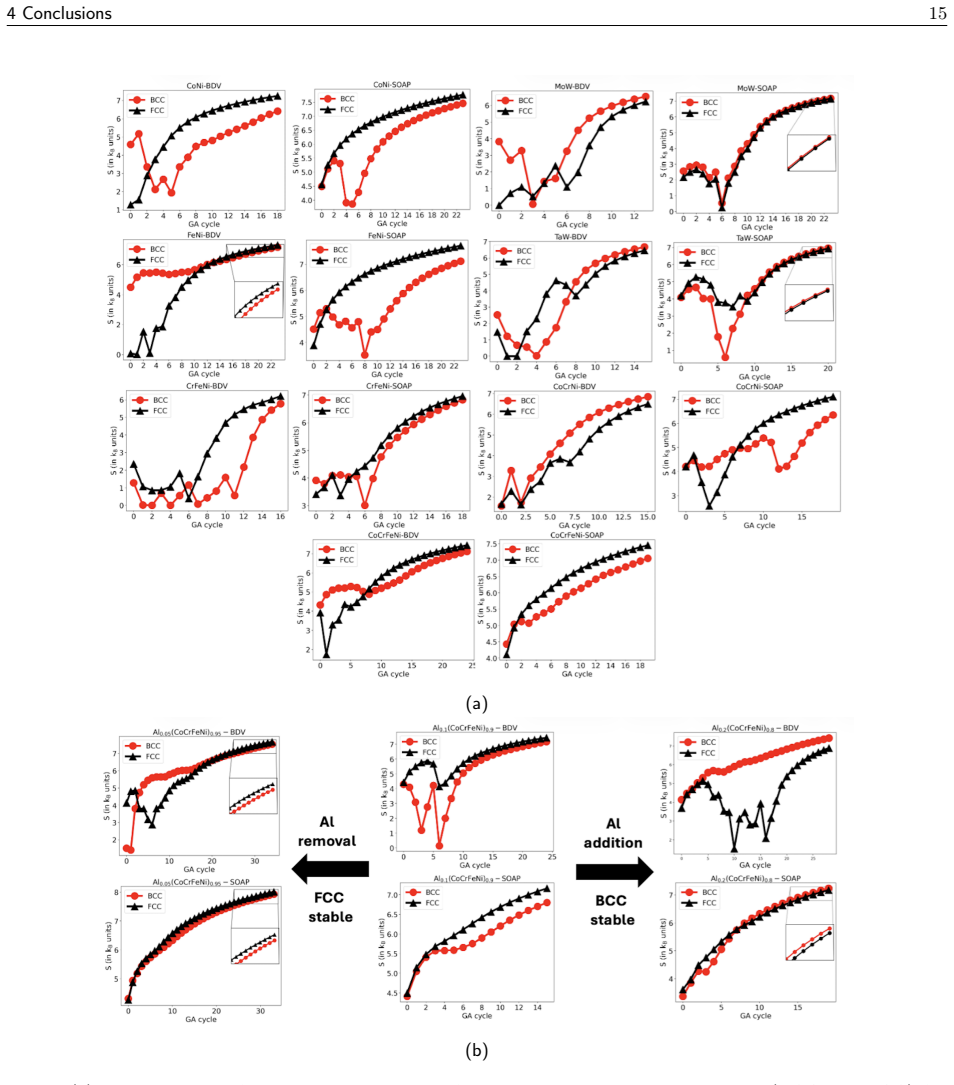
The central claim is that the information entropy of alchemical Monte Carlo trajectories generated with a graph convolutional neural network model serves as a reliable indicator of convergence to the thermodynamically stable crystal structure for binary (CoNi, MoW, FeNi, TaW), ternary (CoCrNi, CrFeNi), quaternary (CoCrFeNi) and quinary (Al_x(CoCrFeNi)_{1-x}) chemically disordered alloys, offering a practical route when conventional enumeration or direct simulation becomes infeasible.
What carries the argument
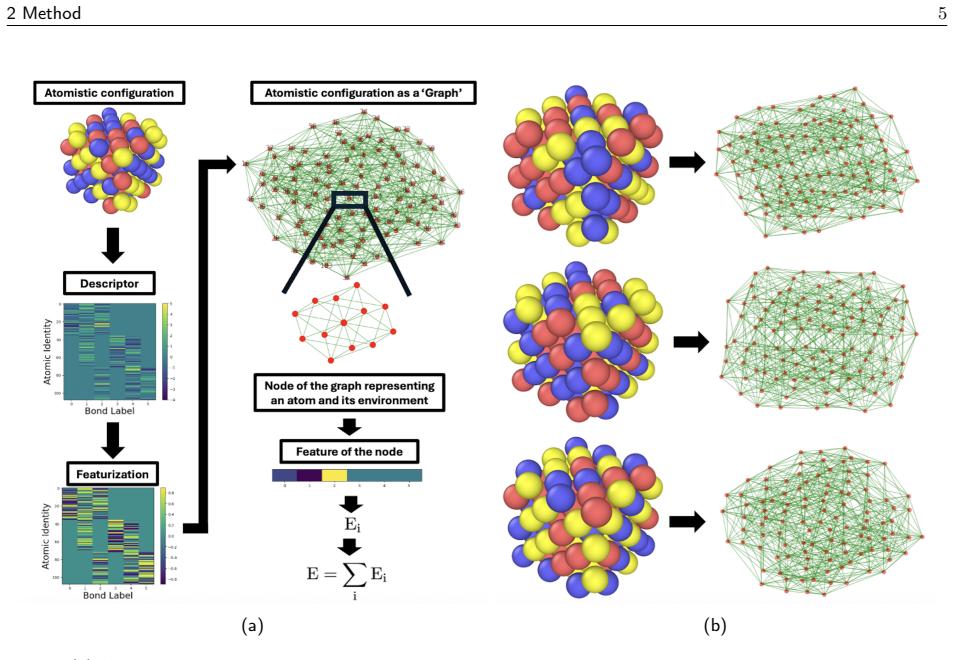
The information entropy metric extracted from alchemical Monte Carlo trajectories on the graph convolutional neural network approximation to the potential energy surface; it quantifies when further sampling no longer reveals new low-energy configurations and thereby signals the stable phase.
If this is right
- The entropy metric successfully distinguishes stable phases across binary through quinary alloy compositions.
- Alchemical Monte Carlo sampling guided by the trained graph convolutional network becomes feasible for systems whose combinatorial size defeats direct enumeration.
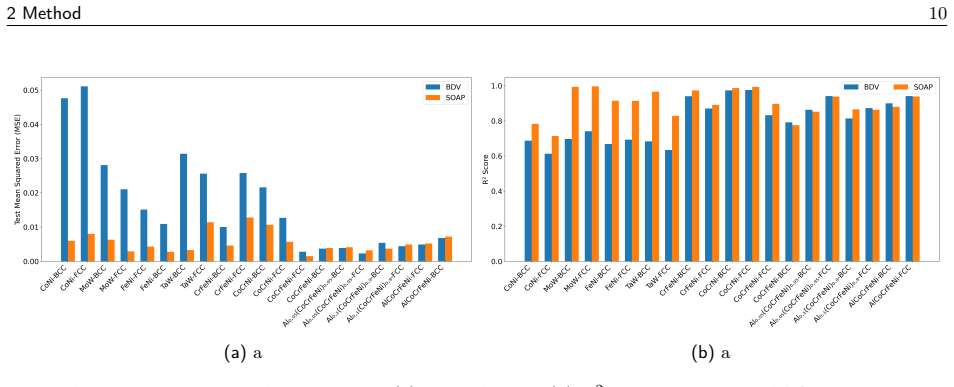
- The Bond Disproportion Vector descriptor offers a lower-cost alternative to SOAP for some but not all of the tested compositions.
- Information entropy supplies a quantitative measure of how thoroughly the potential energy landscape has been explored during sampling.
Where Pith is reading between the lines
- The same entropy signal could be monitored during sampling to decide when to stop and accept a predicted structure for new high-entropy alloy compositions not included in the training set.
- Transfer of the trained graph convolutional network to chemically similar but previously unseen alloy systems would allow rapid phase screening without retraining from scratch.
- If the entropy plateau occurs at different temperatures, the approach could map phase boundaries as a function of temperature for a given composition.
Load-bearing premise
The graph convolutional neural network, trained on limited data, approximates the true potential energy surface closely enough that entropy of the Monte Carlo trajectories correctly identifies the stable phase rather than an artifact of model error.
What would settle it
Experimental or high-accuracy density-functional-theory confirmation that the phase flagged by the entropy plateau for the quaternary CoCrFeNi alloy differs from the known stable structure.
Figures
read the original abstract
The phase prediction of chemically disordered alloys poses a significant computational challenge due to the combinatorial complexity of such materials. The high-throughput compositional exploration of chemically disordered alloys, including high-entropy alloys, requires an approach to efficiently explore the potential energy landscape of such complex materials. Additionally, a metric to quantify the potential energy landscape explored for phase prediction of the compositions needs to be defined. We propose an information-theoretic approach to phase prediction in chemically disordered alloys in the present work. We demonstrate the applicability of alchemical Monte Carlo sampling using an efficient Graph Convolutional Neural Network-Based machine learning model. We additionally demonstrate the applicability and limitations of the Bond Disproportion Vector (BDV) as a low-computational-cost descriptor and benchmark it against the state-of-the-art Smooth Overlap of Atomic Positions (SOAP) descriptor. We show the applicability of an information entropy-based metric for the phase prediction of binary (CoNi, MoW, FeNi and TaW), ternary (CoCrNi, CrFeNi), quaternary (CoCrFeNi) and quinary ($\mathrm{Al_x(CoCrFeNi)_{1-x}}$) alloys. Information entropy-based phase prediction can be applicable in challenging cases where conventional approaches are not feasible.
Editorial analysis
A structured set of objections, weighed in public.
Referee Report
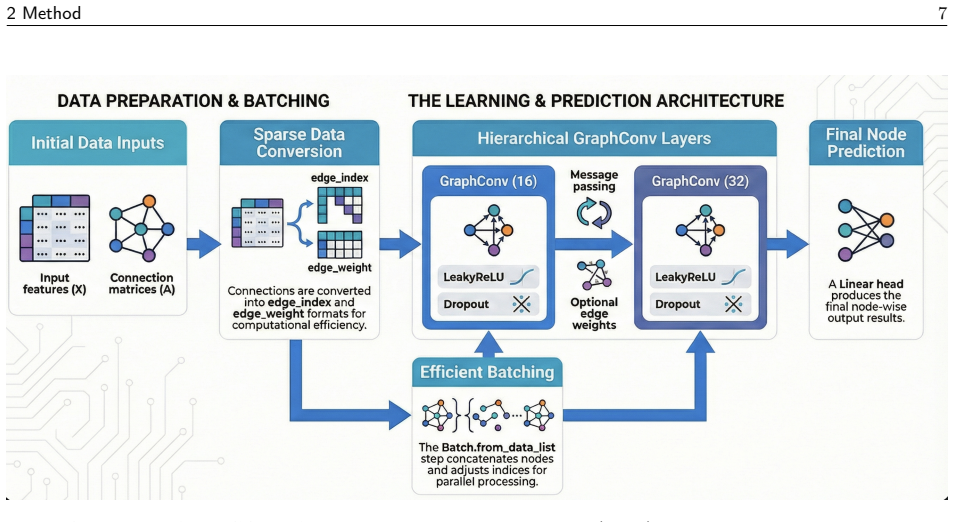
Summary. The manuscript proposes an information-theoretic approach to phase prediction for chemically disordered alloys, using alchemical Monte Carlo sampling driven by a Graph Convolutional Neural Network (GCN) surrogate model together with an information entropy metric. It reports applicability of the method to binary (CoNi, MoW, FeNi, TaW), ternary (CoCrNi, CrFeNi), quaternary (CoCrFeNi), and quinary (Al_x(CoCrFeNi)_{1-x}) alloys, benchmarks the Bond Disproportion Vector descriptor against SOAP, and claims utility in regimes where conventional approaches are infeasible.
Significance. If the GCN surrogate produces sufficiently accurate relative energies, the entropy metric on alchemical MC trajectories could offer a scalable route to phase prediction in high-entropy alloys whose combinatorial complexity defeats direct enumeration or conventional sampling.
major comments (2)
- [Abstract] Abstract: the central claim that 'information entropy-based phase prediction can be applicable in challenging cases where conventional approaches are not feasible' is unsupported because no validation metrics (MAE on configuration energies, ranking preservation of low-energy structures, or transferability tests on the listed alloy compositions) are reported.
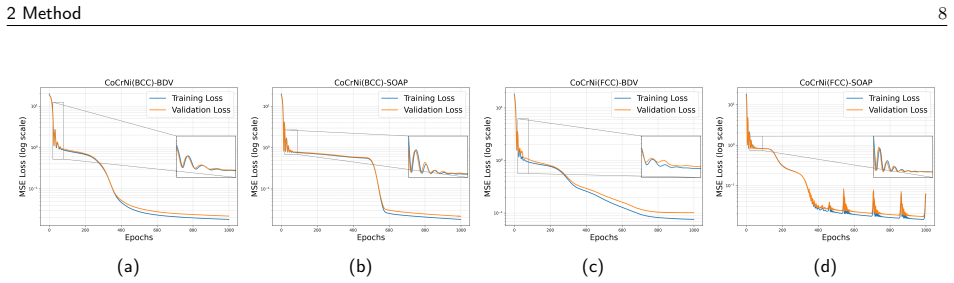
- [Abstract] Abstract: the reliability of the entropy signal as an indicator of convergence to the stable phase rests on the unverified assumption that the GCN, trained on limited data, produces relative energies accurate enough for the sampled distribution to reflect the true Boltzmann-weighted landscape; without reported error bars or cross-validation on the relevant energy window this assumption remains load-bearing and untested.
Simulated Author's Rebuttal
We thank the referee for their careful reading of the manuscript and for highlighting the need for clearer validation in the abstract. We address each major comment below and will revise the manuscript accordingly.
read point-by-point responses
-
Referee: [Abstract] Abstract: the central claim that 'information entropy-based phase prediction can be applicable in challenging cases where conventional approaches are not feasible' is unsupported because no validation metrics (MAE on configuration energies, ranking preservation of low-energy structures, or transferability tests on the listed alloy compositions) are reported.
Authors: We agree that the abstract does not explicitly cite numerical validation metrics such as MAE, ranking preservation, or transferability tests. The manuscript demonstrates applicability through explicit results on the listed binary (CoNi, MoW, FeNi, TaW), ternary (CoCrNi, CrFeNi), quaternary (CoCrFeNi), and quinary (Al_x(CoCrFeNi)_{1-x}) alloys, together with the BDV vs. SOAP benchmark. To address the concern directly, we will revise the abstract to reference the specific sections containing these demonstrations and qualify the central claim to reflect the scope of the presented evidence. revision: yes
-
Referee: [Abstract] Abstract: the reliability of the entropy signal as an indicator of convergence to the stable phase rests on the unverified assumption that the GCN, trained on limited data, produces relative energies accurate enough for the sampled distribution to reflect the true Boltzmann-weighted landscape; without reported error bars or cross-validation on the relevant energy window this assumption remains load-bearing and untested.
Authors: This observation correctly identifies a load-bearing assumption. While the GCN-driven alchemical MC sampling yields consistent phase predictions across the reported alloy systems, the manuscript does not include MAE values, error bars on relative energies, or cross-validation restricted to the relevant energy window. We will revise the manuscript to add a dedicated subsection reporting GCN validation metrics (including MAE on held-out configurations and transferability across the listed compositions) and will discuss the implications for the entropy metric. revision: yes
Circularity Check
No significant circularity; derivation relies on independent ML surrogate and external entropy metric
full rationale
The paper trains a GCN surrogate on configuration data, deploys it to generate alchemical MC trajectories, and computes an information-entropy metric on those trajectories to signal phase convergence. None of the load-bearing steps reduce by construction to the inputs: the GCN is a standard supervised model whose outputs are not tautologically identical to the entropy signal, the entropy definition is information-theoretic and independent of the fitted parameters, and no self-citation chain or uniqueness theorem is invoked to force the result. The method is therefore self-contained against external benchmarks (DFT validation of the surrogate would falsify it independently).
Axiom & Free-Parameter Ledger
Reference graph
Works this paper leans on
-
[1]
High entropy alloys for advanced electrocatalysis with computational insights and multidisciplinary design strategies.iScience, 28(10), 2025
Bowen Guo, Zikai Zhou, Wei Sun, and Xudong Hu. High entropy alloys for advanced electrocatalysis with computational insights and multidisciplinary design strategies.iScience, 28(10), 2025
2025
-
[2]
Christopher D Woodgate and Julie B Staunton. Compositional phase stability in medium-entropy and high- entropy cantor-wu alloys from an ab initio all-electron landau-type theory and atomistic modeling.Physical Review B, 105(11):115124, 2022
2022
-
[3]
Predictive screening of phase stability in high-entropy ceramics.Materials Advances, 6(15):5286–5294, 2025
Muhammad Waqas Qureshi, Shuguang Wei, Longfei Liu, Sudipta Paul, Jun Young Kim, Chuan Zhang, Xudong Wang, John H Perepezko, Dane Morgan, and Izabela Szlufarska. Predictive screening of phase stability in high-entropy ceramics.Materials Advances, 6(15):5286–5294, 2025
2025
-
[4]
Fast ab initio design of high-entropy magnetic materials.Physical Review Materials, 9(3):L031401, 2025
Dinesh Bista, Willie B Beeson, Turbasu Sengupta, Jerome Jackson, Shiv N Khanna, Kai Liu, and Gen Yin. Fast ab initio design of high-entropy magnetic materials.Physical Review Materials, 9(3):L031401, 2025. 6 Code Availability 17
2025
-
[5]
Effect of mo, ta, v and zr on a duplex bcc+ orthorhombic refractory complex concentrated alloy using diffusion couples.Intermetallics, 124:106836, 2020
Antoine Lacour-Gogny-Goubert, Zhao Huvelin, Mikael Perrut, Denis Boivin, Nicolas Horezan, Ivan Guillot, Ph Vermaut, and Jean-Philippe Couzinié. Effect of mo, ta, v and zr on a duplex bcc+ orthorhombic refractory complex concentrated alloy using diffusion couples.Intermetallics, 124:106836, 2020
2020
-
[6]
Comparing calphad predictions with high energy synchrotron radiation x-ray diffraction measurements during in situ annealing of al0
CR Reynolds, Z Herl, NA Ley, D Choudhuri, JT Lloyd, and ML Young. Comparing calphad predictions with high energy synchrotron radiation x-ray diffraction measurements during in situ annealing of al0. 3cocrfeni high entropy alloy.Materialia, 12:100784, 2020
2020
-
[7]
Ghada ALMisned, Ömer Güler, İskender Özkul, Duygu Sen Baykal, Hessa Alkarrani, G Kilic, A Mesbahi, and HO Tekin. Comprehensive computational assessment of al-based high-entropy superalloys: Thermodynamic, mechanical, and radiation shielding characterization for nuclear applications: Almisned, güler, özkul, baykal, alkarrani, kilic, and mesbahi.JOM, 77(10)...
2025
-
[8]
Linhan Yin, Xinpeng Guo, Yongquan Guo, Yuzheng Hui, and Shuo Lu. Valence electron structures and thermal and magnetic properties of rco5 (r= light rare earth) intermetallic compounds with medium-and high-entropy design at r site.Journal of Alloys and Compounds, 965:171357, 2023
2023
-
[9]
Transferable predictions of energetic and structural properties for refractory solid solution alloys across chemical compositions.Computational Materials Science, 257:113908, 2025
Massimiliano Lupo Pasini, Pei Zhang, Jong Youl Choi, German Samolyuk, Markus Eisenbach, and Ying Yang. Transferable predictions of energetic and structural properties for refractory solid solution alloys across chemical compositions.Computational Materials Science, 257:113908, 2025
2025
-
[10]
Nested crystal graph neural networks for modeling chemically complex materials.Acta Materialia, page 121725, 2025
Yiding Wang, Fengpei Zhang, Tianqing Li, Xiangdong Ding, Graeme J Ackland, Hongxiang Zong, Turab Look- man, and Jun Sun. Nested crystal graph neural networks for modeling chemically complex materials.Acta Materialia, page 121725, 2025
2025
-
[11]
Prediction and characterization of chemically complexσ- phase intermetallics with graph neural network.Acta Materialia, page 121427, 2025
Wenhao Zhang, Mariano Forti, Runan Xie, Céline Barreteau, Abe Taichi, Jean-Marc Joubert, Thomas Hammer- schmidt, and Jean-Claude Crivello. Prediction and characterization of chemically complexσ- phase intermetallics with graph neural network.Acta Materialia, page 121427, 2025
2025
-
[12]
Rapid and automated alloy design with graph neural network- powered large language model-driven multi-agent ai.MRS Bulletin, 50(11):1309–1324, 2025
Alireza Ghafarollahi and Markus J Buehler. Rapid and automated alloy design with graph neural network- powered large language model-driven multi-agent ai.MRS Bulletin, 50(11):1309–1324, 2025
2025
-
[13]
High-throughput design of bimetallic materials via multimodal machine learning and the accessibility index.Chemical Science, 16(42):19644–19657, 2025
Yuming Gu, Yating Gu, Maochen Yang, Shisi Tang, Jiawei Chen, Xinyi Liang, Dong Zheng, Zekun Li, Fengqi Song, Yang Gao, et al. High-throughput design of bimetallic materials via multimodal machine learning and the accessibility index.Chemical Science, 16(42):19644–19657, 2025
2025
-
[14]
Hydrogen storage metal-organic framework classification models based on crystal graph convolutional neural networks.Chemical Engineering Science, 259:117813, 2022
Xiuyang Lu, Zhizhong Xie, Xuanjun Wu, Mengmeng Li, and Weiquan Cai. Hydrogen storage metal-organic framework classification models based on crystal graph convolutional neural networks.Chemical Engineering Science, 259:117813, 2022
2022
-
[15]
Graph neural network guided evolutionary search of grain boundaries in 2d materials.ACS applied materials & interfaces, 15(16):20520–20530, 2023
Jianan Zhang, Aditya Koneru, Subramanian KRS Sankaranarayanan, and Carmen M Lilley. Graph neural network guided evolutionary search of grain boundaries in 2d materials.ACS applied materials & interfaces, 15(16):20520–20530, 2023. 6 Code Availability 18
2023
-
[16]
Graph neural networks for an accurate and interpretable prediction of the properties of polycrystalline materials.npj Computational Materials, 7(1):103, 2021
Minyi Dai, Mehmet F Demirel, Yingyu Liang, and Jia-Mian Hu. Graph neural networks for an accurate and interpretable prediction of the properties of polycrystalline materials.npj Computational Materials, 7(1):103, 2021
2021
-
[17]
Benchmarking graph neural networks for materials chemistry.npj Computational Materials, 7(1):84, 2021
Victor Fung, Jiaxin Zhang, Eric Juarez, and Bobby G Sumpter. Benchmarking graph neural networks for materials chemistry.npj Computational Materials, 7(1):84, 2021
2021
-
[18]
Graph convo- lutional neural networks with global attention for improved materials property prediction.Physical Chemistry Chemical Physics, 22(32):18141–18148, 2020
Steph-Yves Louis, Yong Zhao, Alireza Nasiri, Xiran Wang, Yuqi Song, Fei Liu, and Jianjun Hu. Graph convo- lutional neural networks with global attention for improved materials property prediction.Physical Chemistry Chemical Physics, 22(32):18141–18148, 2020
2020
-
[19]
A review on the applications of graph neural networks in materials science at the atomic scale.Materials Genome Engineering Advances, 2(2):e50, 2024
Xingyue Shi, Linming Zhou, Yuhui Huang, Yongjun Wu, and Zijian Hong. A review on the applications of graph neural networks in materials science at the atomic scale.Materials Genome Engineering Advances, 2(2):e50, 2024
2024
-
[20]
Scaling deep learning for materials discovery.Nature, 624(7990):80–85, 2023
AmilMerchant, SimonBatzner, SamuelSSchoenholz, MuratahanAykol, GowoonCheon, andEkinDogusCubuk. Scaling deep learning for materials discovery.Nature, 624(7990):80–85, 2023
2023
-
[21]
Md-gnn: A mechanism-data-driven graph neural network for molecular properties prediction and new material discovery.Journal of Molecular Graphics and Modelling, 123:108506, 2023
Saian Chen, Aziguli Wulamu, Qiping Zou, Han Zheng, Li Wen, Xi Guo, Han Chen, Taohong Zhang, and Ying Zhang. Md-gnn: A mechanism-data-driven graph neural network for molecular properties prediction and new material discovery.Journal of Molecular Graphics and Modelling, 123:108506, 2023
2023
-
[22]
On representing chemical environments.Physical Review B—Condensed Matter and Materials Physics, 87(18):184115, 2013
Albert P Bartók, Risi Kondor, and Gábor Csányi. On representing chemical environments.Physical Review B—Condensed Matter and Materials Physics, 87(18):184115, 2013
2013
-
[23]
Research on the tf–idf algorithm combined with semantics for automatic extraction of keywords from network news texts.Journal of Intelligent Systems, 33(1):20230300, 2024
Yan Wang. Research on the tf–idf algorithm combined with semantics for automatic extraction of keywords from network news texts.Journal of Intelligent Systems, 33(1):20230300, 2024
2024
-
[24]
Gaasp: Genetic algorithm-based atomistic sampling protocol for high-entropy materials.Materials and Manufacturing Processes, 38(16):2044–2050, 2023
G Anand. Gaasp: Genetic algorithm-based atomistic sampling protocol for high-entropy materials.Materials and Manufacturing Processes, 38(16):2044–2050, 2023
2044
-
[25]
A mathematicaltheory of communication.The Bell system technical journal, 27(3):379– 423, 1948
ClaudeElwoodShannon. A mathematicaltheory of communication.The Bell system technical journal, 27(3):379– 423, 1948
1948
-
[26]
Unraveling amazon tree community assembly using maximum information entropy: a quantitative analysis of tropical forest ecology.Scientific Reports, 13(1):2859, 2023
Edwin Pos, Luiz de Souza Coelho, Diogenes de Andrade Lima Filho, Rafael P Salomão, Iêda Leão Amaral, Francisca Dionízia de Almeida Matos, Carolina V Castilho, Oliver L Phillips, Juan Ernesto Guevara, Marcelo de Jesus Veiga Carim, et al. Unraveling amazon tree community assembly using maximum information entropy: a quantitative analysis of tropical forest ...
2023
-
[27]
Entropy removal of clinical features.Scientific Reports, 2025
KianDSamadian, EmmaChua, BoyuPeng, AdrianaColeska, AhmadHassan, PaulChong, BrianLocke, DavidM Liebovitz, Cory Rohlfsen, and Shuhan He. Entropy removal of clinical features.Scientific Reports, 2025
2025
-
[28]
Quantum-inspired information entropy in multifield turbulence.Physical Review Research, 7(2):023212, 2025
Go Yatomi and Motoki Nakata. Quantum-inspired information entropy in multifield turbulence.Physical Review Research, 7(2):023212, 2025
2025
-
[29]
Thermodynamics of information.Nature physics, 11(2):131–139, 2015
Juan MR Parrondo, Jordan M Horowitz, and Takahiro Sagawa. Thermodynamics of information.Nature physics, 11(2):131–139, 2015. 6 Code Availability 19
2015
-
[30]
Topological complexity of crystal structures: quantitative approach.Acta Crystallographica Section A: Foundations of Crystallography, 68(3):393–398, 2012
Sergey Krivovichev. Topological complexity of crystal structures: quantitative approach.Acta Crystallographica Section A: Foundations of Crystallography, 68(3):393–398, 2012
2012
-
[31]
Structural complexity and configurational entropy of crystals.Acta Crystallographica Section B: Structural Science, Crystal Engineering and Materials, 72(2):274–276, 2016
Sergey V Krivovichev. Structural complexity and configurational entropy of crystals.Acta Crystallographica Section B: Structural Science, Crystal Engineering and Materials, 72(2):274–276, 2016
2016
-
[32]
On an extension of krivovichev’s complexity measures.Acta Crystallographica Section A: Foundations and Advances, 76(4):534–548, 2020
Wolfgang Hornfeck. On an extension of krivovichev’s complexity measures.Acta Crystallographica Section A: Foundations and Advances, 76(4):534–548, 2020
2020
-
[33]
crystit: complexity and configurational entropy of crystal structures via information theory.Journal of Applied Crystallography, 54(1):306–316, 2021
Clemens Kaußler and Gregor Kieslich. crystit: complexity and configurational entropy of crystal structures via information theory.Journal of Applied Crystallography, 54(1):306–316, 2021
2021
-
[34]
Nucle- ation of molecular crystals driven by relative information entropy.Journal of chemical theory and computation, 14(2):959–972, 2018
Gianpaolo Gobbo, Michael A Bellucci, Gareth A Tribello, Giovanni Ciccotti, and Bernhardt L Trout. Nucle- ation of molecular crystals driven by relative information entropy.Journal of chemical theory and computation, 14(2):959–972, 2018
2018
-
[35]
Generating cocrystal polymorphs with information entropy driven by molecular dynamics-based enhanced sampling.The Journal of Physical Chemistry Letters, 11(22):9751–9758, 2020
Hongxing Song, Leslie Vogt-Maranto, Ren Wiscons, Adam J Matzger, and Mark E Tuckerman. Generating cocrystal polymorphs with information entropy driven by molecular dynamics-based enhanced sampling.The Journal of Physical Chemistry Letters, 11(22):9751–9758, 2020
2020
-
[36]
Sudoku-inspired high-shannon-entropy alloys.Acta Materialia, 225:117556, 2022
Houlong Zhuang. Sudoku-inspired high-shannon-entropy alloys.Acta Materialia, 225:117556, 2022
2022
-
[37]
The generalized boltzmann distribution is the only distribution in which the gibbs-shannon entropy equals the thermodynamic entropy.The Journal of chemical physics, 151(3), 2019
Xiang Gao, Emilio Gallicchio, and Adrian E Roitberg. The generalized boltzmann distribution is the only distribution in which the gibbs-shannon entropy equals the thermodynamic entropy.The Journal of chemical physics, 151(3), 2019
2019
-
[38]
In situ synchrotron x-ray diffraction revealing competition between a1 and b2 phases in alcocrfenix high-entropy alloys.Acta Materialia, page 122097, 2026
Shilei Liu, Victoria Kaban, Victor T Witusiewicz, and Ivan Kaban. In situ synchrotron x-ray diffraction revealing competition between a1 and b2 phases in alcocrfenix high-entropy alloys.Acta Materialia, page 122097, 2026
2026
-
[39]
Nabila Tabassum, Yamini Sudha Sistla, Ankit Gupta, and Ramesh Gupta Burela. Effect of temperature on microstructural, mechanical and thermodynamic properties of fcc phase-stabilized alcocrfeni high-entropy alloy: atomistic simulations.Journal of Thermal Analysis and Calorimetry, pages 1–26, 2025
2025
-
[40]
Studies on kinetics of bcc to fcc phase transfor- mation in alcocrfeni equiatomic high entropy alloy.Metallurgical and Materials Transactions A, 52(5):1679–1688, 2021
JP Panda, P Arya, K Guruvidyathri, Ravikirana, and BS Murty. Studies on kinetics of bcc to fcc phase transfor- mation in alcocrfeni equiatomic high entropy alloy.Metallurgical and Materials Transactions A, 52(5):1679–1688, 2021. Appendix Relation between comparative Shannon Entropy and Kullback-Leibler Divergence (KLD) The Shannon Entropy can be defined a...
2021
discussion (0)
Sign in with ORCID, Apple, or X to comment. Anyone can read and Pith papers without signing in.