REVIEW 2 major objections 2 minor 14 references
Evaluating Multimodal Steganalysis for Split-Payload Audiovisual Steganography
T0 review · 2 major / 2 minor · reviewed 2026-06-27 · grok-4.3
Pith's one-line read Splitting a secret message across audio and video makes single-modality steganalysis perform near random guessing.
desk verdict Split-payload steganography beats single-mode detectors but the multimodal edge is mostly video, and the methods lack enough detail to judge how general the finding is. read the letter →
The pith
A machine-rendered reading of the paper's core claim, the machinery that carries it, and where it could break.
The reading
What carries the argument
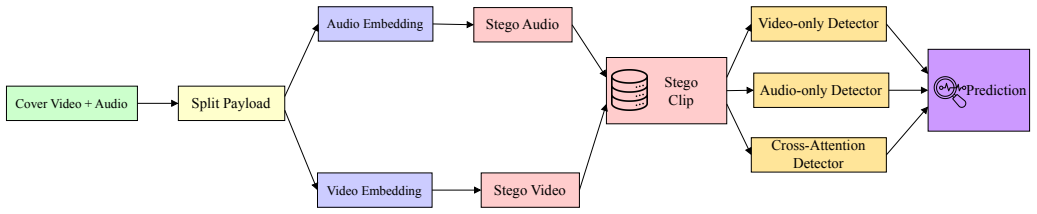
Split-payload embedding that divides the secret message between audio and video tracks to reduce the embedding burden on any single carrier.
What would settle it
A test showing that the multimodal detector's performance drops to near random when the video stream is replaced with clean video while keeping the audio embedding, but stays high when video has embedding and audio is clean, would indicate reliance on one modality.
Extended reading notes
Core claim
Audiovisual samples were created with the hidden message divided between audio and video tracks under synchronized and asynchronous embedding. Single mode detectors performed close to random guessing, demonstrating the benefit of this hiding mechanism. The multimodal model initially appeared more effective, but checks revealed this improvement mostly came from the video stream, not from a true combined audio-video signal.
Load-bearing premise
The audiovisual samples with divided payloads and the tested detectors represent general split-payload steganography scenarios, with performance differences reflecting true modality interactions rather than dataset artifacts.
Editorial extensions
If this is right
- Single-mode detectors become ineffective against split-payload steganography.
- Multimodal detectors can appear effective but may not be learning a combined signal.
- Careful evaluation of multimodal detectors is required to confirm they use intended signals.
- Payload splitting across modalities increases the challenge for detection methods.
Reading between the lines
- Future work could develop fusion methods that force multimodal models to use both streams equally.
- Similar splitting strategies might apply to other paired media like image-text.
- Testing on larger, more varied datasets could reveal if current findings hold beyond the created samples.
Editorial analysis
A structured set of objections, weighed in public.
Referee Report
Summary. The paper evaluates split-payload audiovisual steganography in which a secret message is divided between audio and video tracks under synchronized and asynchronous embedding. It reports that single-mode detectors perform close to random guessing on the resulting samples, while an initial multimodal detector appears stronger; further (unspecified) checks indicate that the multimodal gain derives mostly from the video stream rather than true cross-modal interaction. The central claim is that payload splitting can evade detection but that multimodal steganalyzers require careful validation to ensure they are not simply exploiting one modality.
Significance. If the experimental outcomes are reproducible, the work would usefully illustrate an evasion technique for audiovisual steganography and, more importantly, demonstrate the risk that multimodal detectors may latch onto single-modality artifacts. The abstract's cautious qualification that the multimodal improvement is largely video-driven is a positive feature that directly mitigates over-interpretation. No machine-checked proofs or parameter-free derivations are present, but the empirical framing itself is appropriately modest.
major comments (2)
- [Abstract] Abstract (and presumed Methods/Experimental sections): The manuscript states concrete performance outcomes (single-mode detectors near random guessing; multimodal gain attributable to video) yet supplies no information on sample generation procedure, detector architectures, training/validation splits, embedding algorithms, or statistical controls. This omission is load-bearing for the central claim, as the reported differences cannot be assessed for dataset artifacts versus genuine modality interaction without these details.
- [Abstract] Abstract: The statement that 'further checks show that this improvement mostly comes from the video stream' is presented without describing the checks themselves (e.g., modality ablation, feature attribution, or separate audio-only/video-only retraining). Without this information it is impossible to verify that cross-modal interaction has been ruled out, directly affecting the paper's cautionary conclusion.
minor comments (2)
- [Abstract] Abstract, sentence 5: 'The single mode detectors performs close to random guessing' contains a subject-verb agreement error ('detectors performs').
- [Abstract] Abstract: The phrase 'thus showing the benefit of this hiding mechanism' is slightly overstated given the later qualification that multimodal results are largely video-driven; a more neutral wording would better match the paper's own caution.
Simulated Author's Rebuttal
We thank the referee for their insightful comments, which help clarify the presentation of our experimental details. We address each major comment below and have revised the manuscript to incorporate additional information on our methods and validation procedures.
read point-by-point responses
-
Referee: [Abstract] Abstract (and presumed Methods/Experimental sections): The manuscript states concrete performance outcomes (single-mode detectors near random guessing; multimodal gain attributable to video) yet supplies no information on sample generation procedure, detector architectures, training/validation splits, embedding algorithms, or statistical controls. This omission is load-bearing for the central claim, as the reported differences cannot be assessed for dataset artifacts versus genuine modality interaction without these details.
Authors: We agree that methodological details are essential for reproducibility and assessing the validity of our claims. While the abstract is necessarily concise, the full manuscript contains sections describing the audiovisual sample generation (including payload splitting under synchronized and asynchronous settings), the embedding algorithms used, the architectures of the single-mode and multimodal detectors, the training/validation/test splits, and statistical controls such as repeated experiments. To make this more accessible, we have added a reference to these sections directly in the abstract and expanded the Methods section with a summary table of key parameters. This revision ensures readers can evaluate the results without ambiguity. revision: yes
-
Referee: [Abstract] Abstract: The statement that 'further checks show that this improvement mostly comes from the video stream' is presented without describing the checks themselves (e.g., modality ablation, feature attribution, or separate audio-only/video-only retraining). Without this information it is impossible to verify that cross-modal interaction has been ruled out, directly affecting the paper's cautionary conclusion.
Authors: The further checks consisted of modality ablation experiments, where we retrained and evaluated the multimodal detector using only audio features, only video features, and combined features, along with an analysis of feature contributions. These experiments are detailed in the Results section of the manuscript. We have revised the abstract to include a brief mention of 'through modality ablation studies' and added a new subsection explicitly describing the ablation setup, the performance drops when removing the video modality, and the conclusion that the gain is primarily video-driven rather than due to cross-modal interactions. revision: yes
Circularity Check
No significant circularity; purely empirical evaluation
full rationale
The paper is an empirical evaluation study that creates split-payload audiovisual samples and measures detector performance on them. No mathematical derivations, equations, fitted parameters, or predictions are present that could reduce to inputs by construction. Results are reported as direct experimental measurements rather than self-referential claims, and the abstract's own qualification about video-driven gains further indicates the work is self-contained against external benchmarks with no load-bearing self-citations or ansatzes.
Assumptions & free parameters
Cite this review
Pith. "Pith review of Evaluating Multimodal Steganalysis for Split-Payload Audiovisual Steganography." pith.science (2026). https://pith.science/paper/JS5NCYDG
@misc{pith2026260608726,
  author       = {Pith},
  title        = {Pith review of: Evaluating Multimodal Steganalysis for Split-Payload Audiovisual Steganography},
  year         = {2026},
  howpublished = {\url{https://pith.science/paper/JS5NCYDG}},
  note         = {Machine review of arXiv:2606.08726}
}
read the original abstract
The aim of steganography is to hide secret information inside ordinary media so that the existence of communication is hidden rather than encrypted. In audiovisual context, the availability of audio and video streams creates an opportunity to split a payload across these two modes thus, reducing the embedding burden on any single carrier. This paper evaluates whether such split-payload audiovisual steganography can help evade unimodal and multimodal steganalysis under synchronized and asynchronous embedding settings. We create audiovisual samples where the hidden message is divided between the audio and video tracks, and then test how well different detectors can identify them. The single mode detectors performs close to random guessing, thus showing the benefit of this hiding mechanism, while the multimodal model initially appears more effective. However, further checks show that this improvement mostly comes from the video stream, not from a true combined audio-video signal. Overall, the results suggest that splitting the payload across modalities can make detection harder, but multimodal detectors must be evaluated carefully to ensure they are learning the intended signal.
Figures

Reference graph
Works this paper leans on
-
[1]
A new approach for LSB based image steganography using secret key
SM Masud Karim, Md Saifur Rahman, and Md Is- mail Hossain. “A new approach for LSB based image steganography using secret key”. In:14th international conference on computer and information technology (ICCIT 2011). IEEE. 2011, pp. 286–291
2011
-
[2]
Edge-based image steganography
Saiful Islam, Mangat R Modi, and Phalguni Gupta. “Edge-based image steganography”. In:EURASIP Jour- nal on Information Security2014.1 (2014), p. 8
2014
-
[3]
Image steganography approaches and their detection strategies: A survey
Meike Helena Kombrink, Zeno Jean Marius Hubert Geradts, and Marcel Worring. “Image steganography approaches and their detection strategies: A survey”. In: ACM Computing Surveys57.2 (2024), pp. 1–40
2024
-
[4]
High-capacity convolutional video steganography with temporal residual modeling
Xinyu Weng et al. “High-capacity convolutional video steganography with temporal residual modeling”. In: Proceedings of the 2019 on international conference on multimedia retrieval. 2019, pp. 87–95
2019
-
[5]
Deep video steganography using temporal-attention-based frame selection and spatial sparse adversarial attack
Beijing Chen, Yuting Hong, and Yuxin Nie. “Deep video steganography using temporal-attention-based frame selection and spatial sparse adversarial attack”. In:Journal of Visual Communication and Image Rep- resentation104 (2024), p. 104311
2024
-
[6]
Universal distortion function for steganography in an arbitrary domain
V ojt ˇech Holub, Jessica Fridrich, and Tom ´aˇs Denemark. “Universal distortion function for steganography in an arbitrary domain”. In:EURASIP Journal on Information Security2014.1 (2014), p. 1
2014
-
[7]
Structural design of convolutional neural networks for steganalysis
Guanshuo Xu, Han-Zhou Wu, and Yun-Qing Shi. “Structural design of convolutional neural networks for steganalysis”. In:IEEE Signal Processing Letters23.5 (2016), pp. 708–712
2016
-
[8]
Deep Residual Network for Steganalysis of Digital Im- ages
Mehdi Boroumand, Mo Chen, and Jessica Fridrich. “Deep Residual Network for Steganalysis of Digital Im- ages”. In:IEEE Transactions on Information Forensics and Security14.5 (2019), pp. 1181–1196.DOI: 10.1109/ TIFS.2018.2871749
Show all 14 references
-
[9]
Steganalysis of V oIP streams with CNN-LSTM net- work
Hao Yang, Zhongliang Yang, and Yongfeng Huang. “Steganalysis of V oIP streams with CNN-LSTM net- work”. In:Proceedings of the ACM workshop on infor- mation hiding and multimedia security. 2019, pp. 204– 209
2019
-
[10]
StegaVideo: Robust High-Resolution Video Steganography with Temporal and Edge Guid- ance
Kun Hu et al. “StegaVideo: Robust High-Resolution Video Steganography with Temporal and Edge Guid- ance”. In: (2024)
2024
-
[11]
From covert hiding to visual editing: Robust generative video steganography
Xueying Mao et al. “From covert hiding to visual editing: Robust generative video steganography”. In: Proceedings of the 32nd ACM International Conference on Multimedia. 2024, pp. 2757–2765
2024
-
[12]
Learning audio-visual speech repre- sentation by masked multimodal cluster prediction
Bowen Shi et al. “Learning audio-visual speech repre- sentation by masked multimodal cluster prediction”. In: arXiv preprint arXiv:2201.02184(2022)
2022
-
[13]
A simple framework for con- trastive learning of visual representations
Ting Chen et al. “A simple framework for con- trastive learning of visual representations”. In:Interna- tional conference on machine learning. PmLR. 2020, pp. 1597–1607
2020
-
[14]
The Ryerson Audio-Visual Database of Emotional Speech and Song (RA VDESS): A dynamic, multimodal set of facial and vocal expressions in North American English
Steven R Livingstone and Frank A Russo. “The Ryerson Audio-Visual Database of Emotional Speech and Song (RA VDESS): A dynamic, multimodal set of facial and vocal expressions in North American English”. In:PloS one13.5 (2018), e0196391
2018
Reviewed June 27, 2026 · model on record in the stance chip above.
Discussion (0). Sign in to comment.