A Non-Overlapping Schwarz Hybrid Finite Element-Neural Operator Framework for Solid Mechanics on Irregular Domains
Pith reviewed 2026-06-27 17:25 UTC · model grok-4.3
The pith
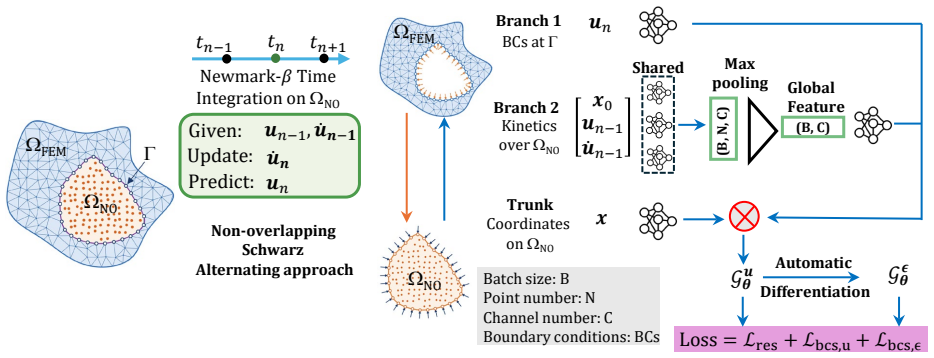
Non-overlapping Schwarz alternating method with Neumann-Dirichlet exchange couples finite-element solvers to Point-DeepONet on irregular domains while deriving strain and stress analytically from displacement.
A machine-rendered reading of the paper's core claim, the machinery that carries it, and where it could break.
Core claim
The framework establishes a non-overlapping FE-NO coupling that uses Neumann-Dirichlet interface exchange to eliminate overlap, Point-DeepONet to operate on unstructured point clouds for arbitrary subdomain shapes, and analytic kinematic derivation of strain and stress from the displacement operator, yielding a geometry-flexible, parameter-efficient, and convergence-stable hybrid solver for solid mechanics.
What carries the argument
Non-overlapping Schwarz alternating method with Neumann-Dirichlet traction-displacement exchange paired with Point-DeepONet on unstructured finite-element point clouds.
If this is right
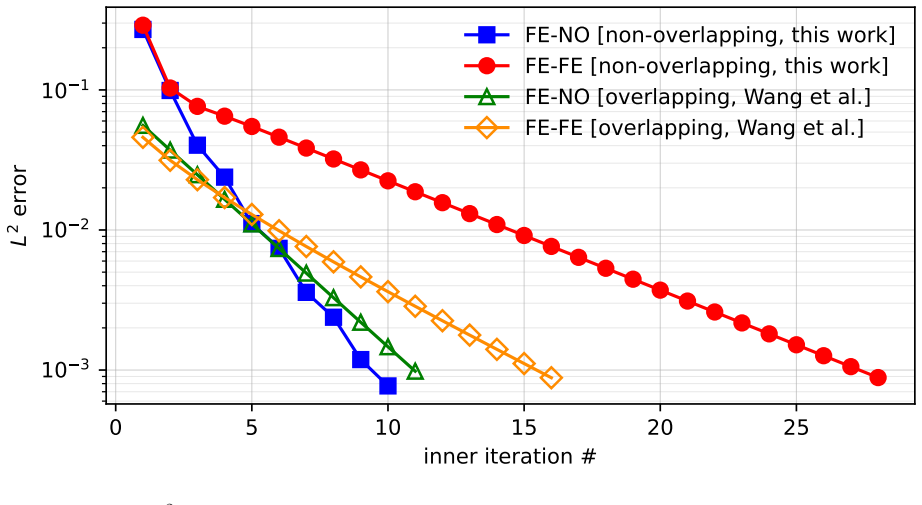
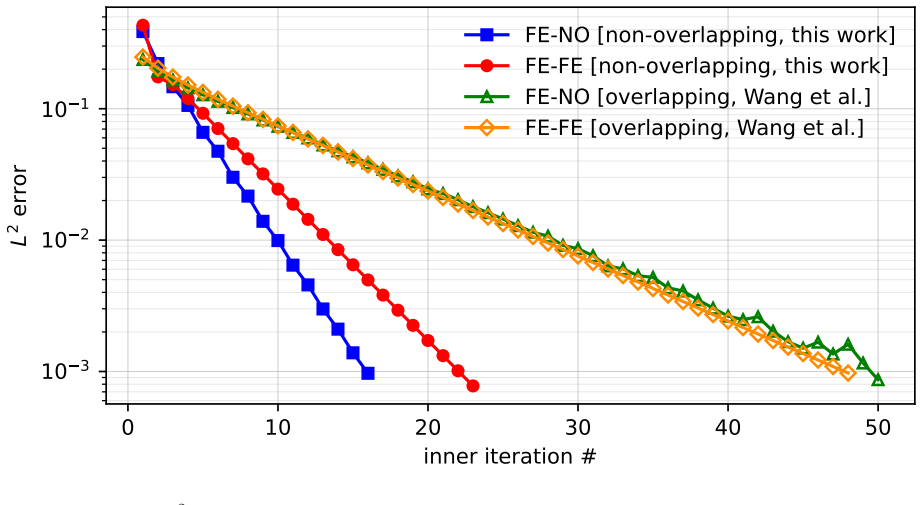
- Inner Schwarz iteration counts drop because the overlap layer and its redundant interface computations are removed.
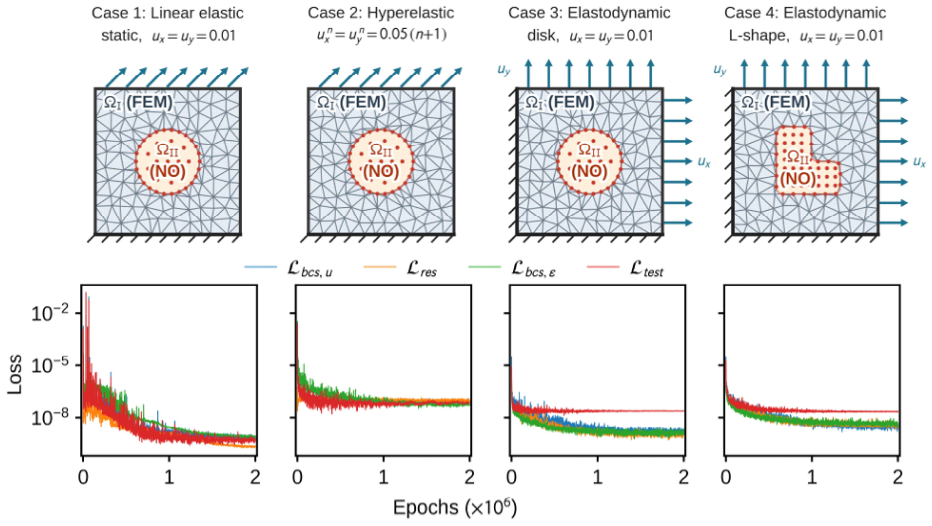
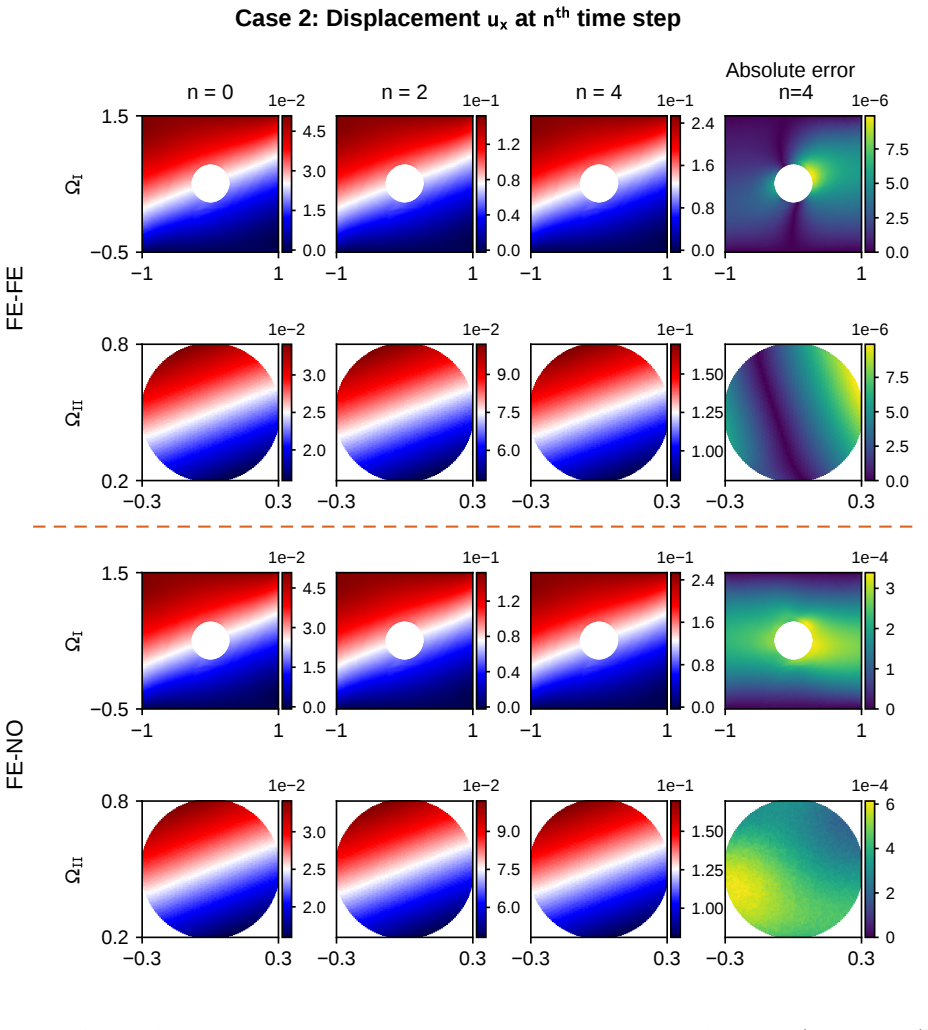
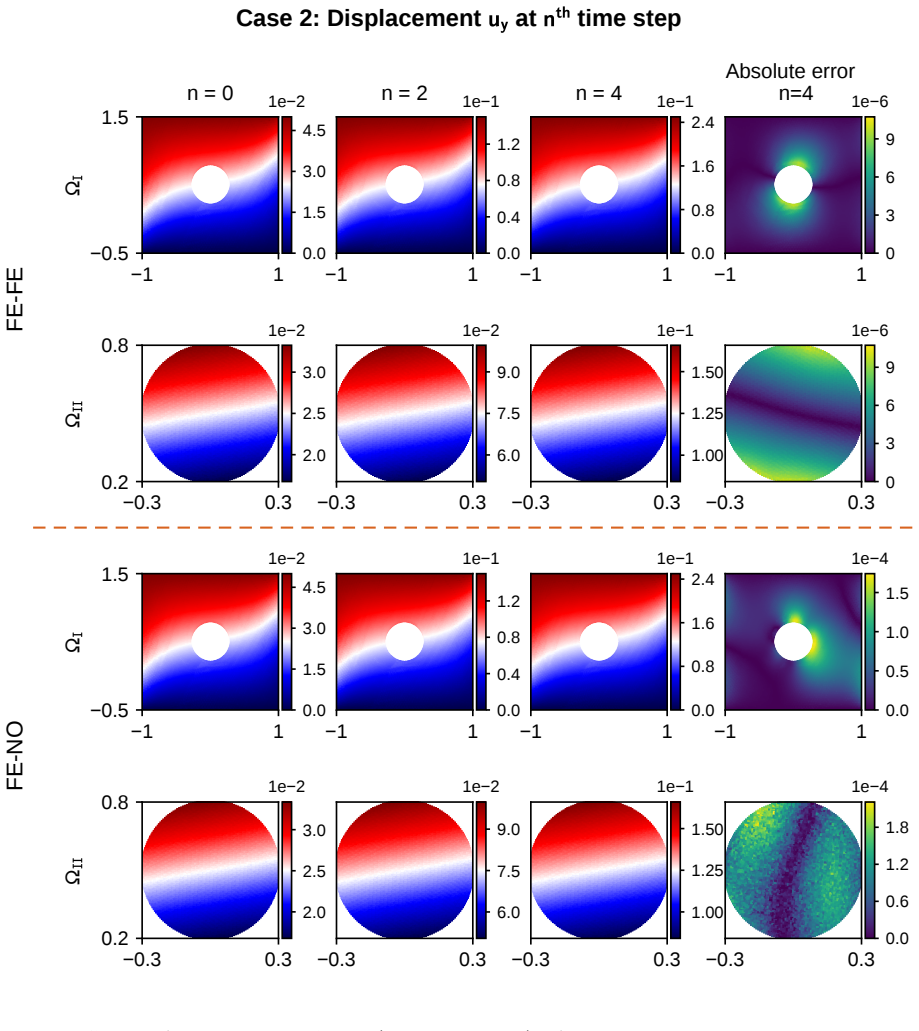
- Error remains bounded across all tested static, quasi-static, and dynamic time horizons.
- The neural-operator subdomain can occupy any non-convex or irregular geometry because the Point-DeepONet works directly on unstructured FE point clouds.
- Trainable parameter count decreases by deriving strain and stress operators analytically from the displacement operator instead of learning them separately.
- FE fidelity is retained outside the neural-operator subdomain while the hybrid still accelerates regions with localized nonlinearities.
Where Pith is reading between the lines
- The same non-overlapping exchange pattern could be applied to other operator-learning architectures to obtain similar iteration savings in multiphysics settings.
- Direct use of unstructured point clouds opens the possibility of coupling the framework to adaptive mesh-refinement schemes that change subdomain boundaries during a simulation.
- Because mechanical consistency is enforced by construction, the learned displacement field might be inserted into existing variational formulations without additional equilibrium penalties.
- Extension to three-dimensional problems with multiple neural-operator subdomains would test whether the bounded-error property scales when several interfaces interact.
Load-bearing premise
The Point-DeepONet accurately approximates the solution operator on unstructured point clouds for arbitrarily shaped subdomains and the Neumann-Dirichlet exchange keeps the iteration stable and error bounded without an overlap layer.
What would settle it
Unbounded error growth during long-time dynamic runs or divergence of the Point-DeepONet on highly irregular non-convex subdomains without any interpolation would falsify the central claim.
Figures
read the original abstract
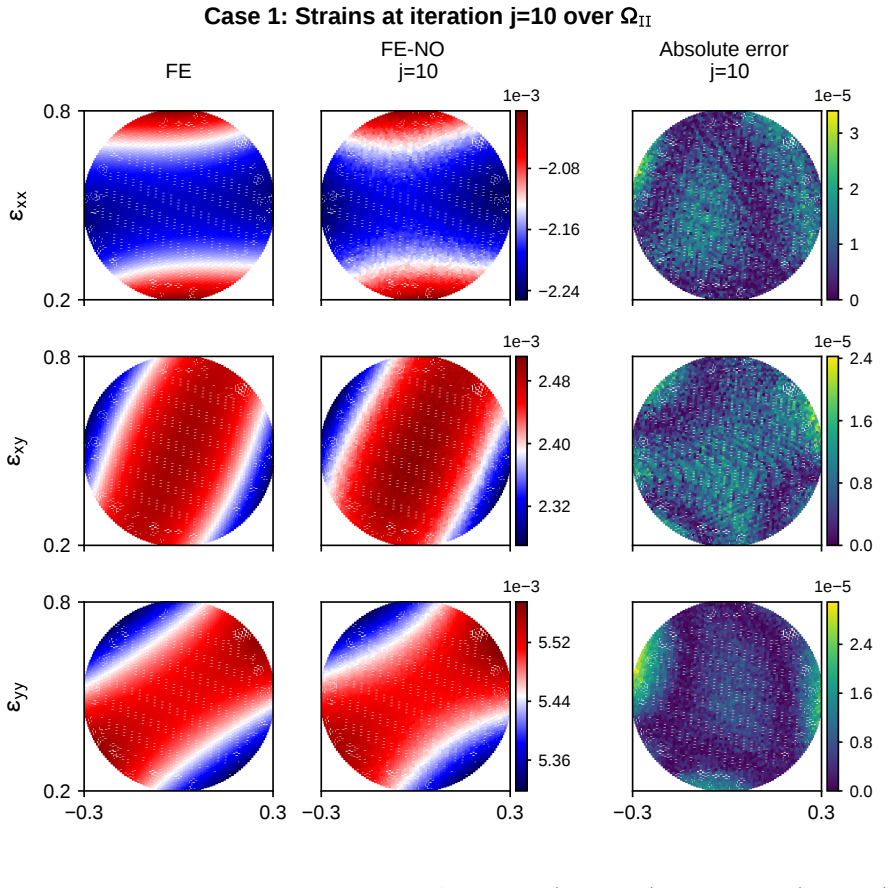
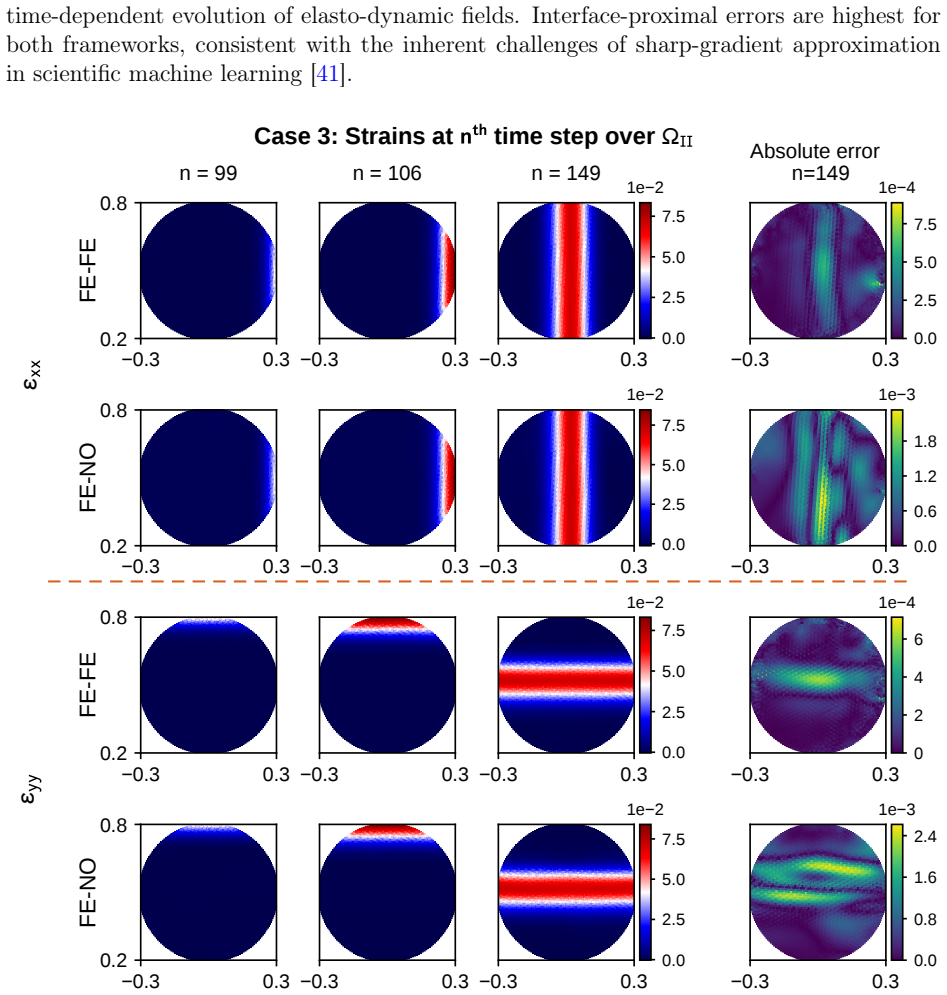
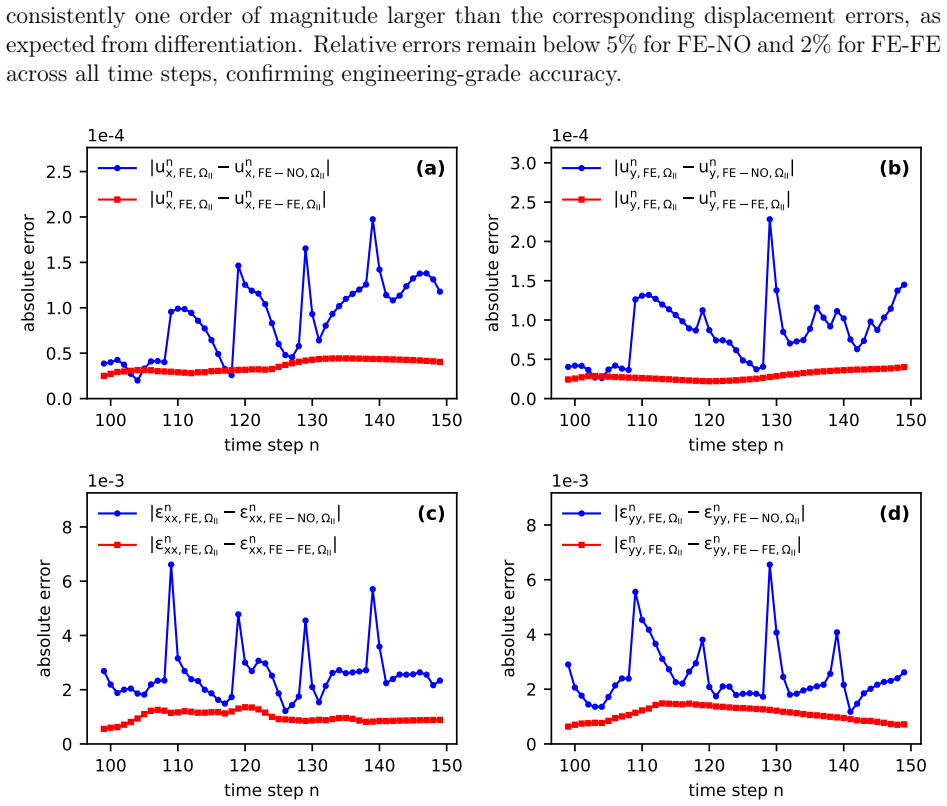
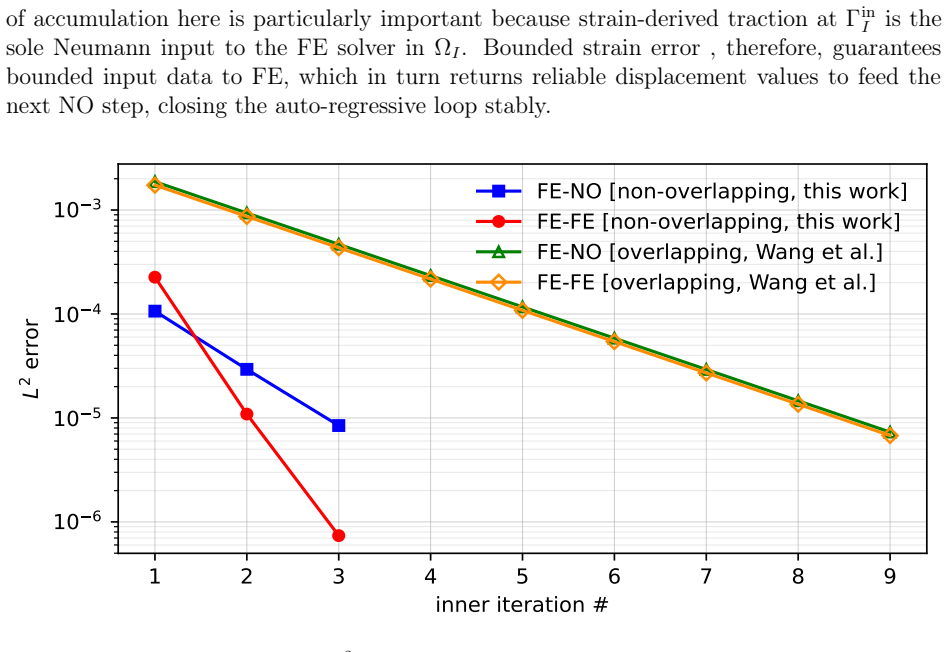
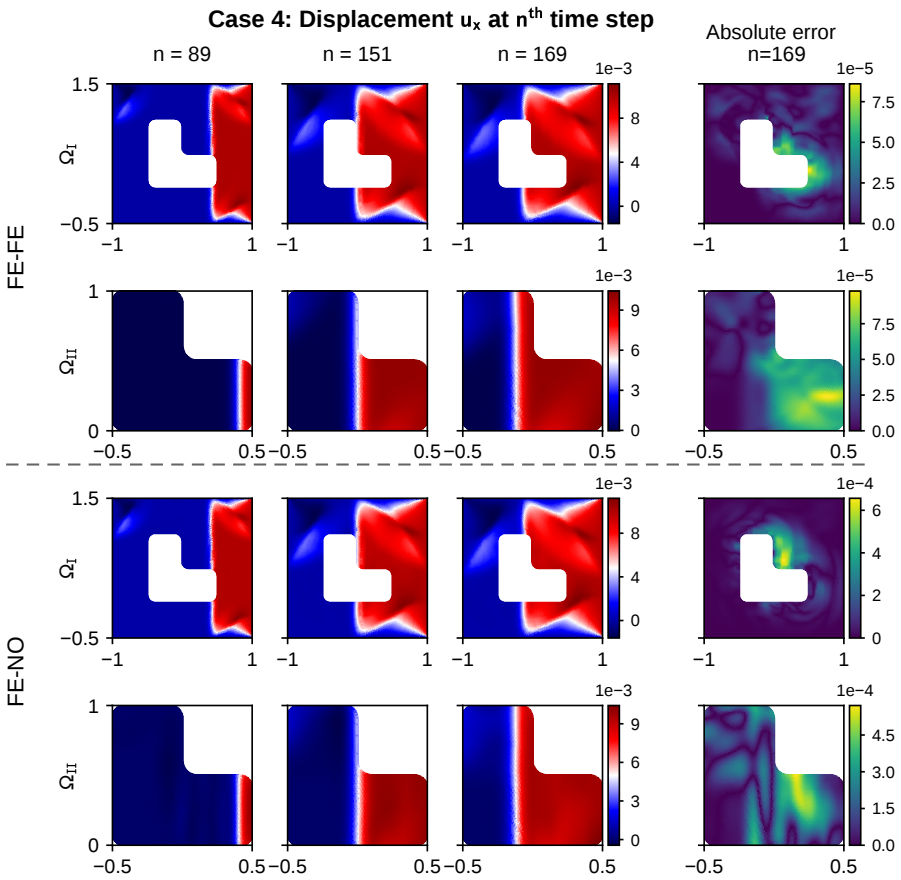
Finite element (FE) methods are the benchmark for solid mechanics simulations, yet their computational cost becomes prohibitive for problems with localised nonlinearities, fine-scale features, or long-time dynamic evolution. In our earlier FE-neural operator (FE-NO) hybrid framework [1], physics-informed deep operator networks were coupled with FE solvers through overlapping domain decomposition with Dirichlet-Dirichlet interface exchange, accelerating intensive subdomains while preserving FE fidelity elsewhere. Two limitations remained: the overlapping formulation required redundant interface computations that increased inner Schwarz iteration counts, and the convolutional feature extractor restricted the NO subdomain to structured grids, precluding irregular geometries. A non-overlapping Schwarz alternating method with Neumann-Dirichlet interface exchange replaces it, transmitting traction from the NO to FE rather than displacement. This eliminates the overlap layer and reduces inner Schwarz iterations while maintaining bounded error accumulation across all tested time horizons. For arbitrarily shaped subdomains, a Point-DeepONet operates on unstructured FE point clouds without interpolation, extending it to non-convex and irregular geometries. Strain and stress operators are derived analytically from the displacement operators via kinematic equations, rather than as independent networks, reducing trainable parameter sets while enforcing mechanical consistency by construction. The framework is validated on three benchmarks: static linear elasticity, quasi-static hyperelasticity, and elastodynamics with regular and irregular geometries. These results establish a non-overlapping FE-NO coupling paradigm that is geometry-flexible, parameter-efficient, and convergence-stable, providing a pathway for hybrid physics-based and operator-learning solvers in large-scale dynamic solid mechanics.
Editorial analysis
A structured set of objections, weighed in public.
Referee Report
Summary. The manuscript introduces a non-overlapping Schwarz alternating method with Neumann-Dirichlet interface exchange for coupling finite element solvers and Point-DeepONet neural operators in solid mechanics. This replaces an earlier overlapping Dirichlet-Dirichlet approach from [1], eliminates the overlap layer, reduces inner Schwarz iterations, and extends to irregular geometries via Point-DeepONet on unstructured point clouds. Strain and stress operators are derived analytically from displacement operators via kinematic equations to enforce mechanical consistency by construction. The framework is validated on three benchmarks: static linear elasticity, quasi-static hyperelasticity, and elastodynamics, with claims of bounded error accumulation across tested time horizons.
Significance. If the results hold, this work advances hybrid FE-NO solvers by improving geometry flexibility and iteration efficiency for dynamic solid mechanics on irregular domains. The analytical derivation of strain/stress operators from displacement operators is a clear strength, reducing trainable parameters while enforcing consistency by construction. Empirical validation across multiple benchmarks supports the potential for scalable simulations, though the long-time stability claims require further substantiation.
major comments (2)
- [Elastodynamics benchmark and methods sections] The central claim that the non-overlapping ND exchange maintains bounded error accumulation in elastodynamics without an overlap buffer (abstract) rests on the assumption that traction transmission preserves stability despite Point-DeepONet approximation mismatches on unstructured clouds. The manuscript reports bounded errors numerically but provides no dedicated analysis, theorem, or error-propagation study in the methods or elastodynamics results section demonstrating why secular growth is prevented, making this load-bearing for the dynamic case.
- [Point-DeepONet and validation sections] The Point-DeepONet performance on arbitrarily shaped subdomains without interpolation is asserted as enabling irregular geometries, but the validation lacks quantitative comparison (e.g., error tables or convergence rates) between unstructured point-cloud results and any structured-grid baseline, weakening the geometry-flexibility claim.
minor comments (2)
- A consolidated table summarizing error metrics (e.g., displacement, strain, stress L2 errors) across all three benchmarks and geometries would improve clarity and allow direct assessment of bounded accumulation.
- The description of the Neumann-Dirichlet exchange could include an explicit diagram or pseudocode in the methods to clarify the interface transmission steps.
Simulated Author's Rebuttal
We thank the referee for the constructive feedback on our manuscript. We address each major comment below with clarifications based on the numerical validations and design choices in the work. We are prepared to make targeted revisions where they strengthen the presentation without altering the core contributions.
read point-by-point responses
-
Referee: [Elastodynamics benchmark and methods sections] The central claim that the non-overlapping ND exchange maintains bounded error accumulation in elastodynamics without an overlap buffer (abstract) rests on the assumption that traction transmission preserves stability despite Point-DeepONet approximation mismatches on unstructured clouds. The manuscript reports bounded errors numerically but provides no dedicated analysis, theorem, or error-propagation study in the methods or elastodynamics results section demonstrating why secular growth is prevented, making this load-bearing for the dynamic case.
Authors: We appreciate the referee's emphasis on substantiating the stability claim. The manuscript reports numerical results from the elastodynamics benchmark demonstrating that errors remain bounded over the tested time horizons under the non-overlapping ND formulation. This behavior is observed consistently with the traction-based interface exchange and the analytical strain-stress operators derived from the displacement operator, which enforce consistency by construction and reduce parameter-induced mismatches. While the work does not include a formal theorem or dedicated error-propagation analysis (focusing instead on the hybrid framework's practical implementation and empirical performance across benchmarks), the absence of secular growth in the reported simulations supports the claim for the tested regimes. We can revise the elastodynamics results section to include an expanded discussion of the observed error trends and interface transmission effects. revision: partial
-
Referee: [Point-DeepONet and validation sections] The Point-DeepONet performance on arbitrarily shaped subdomains without interpolation is asserted as enabling irregular geometries, but the validation lacks quantitative comparison (e.g., error tables or convergence rates) between unstructured point-cloud results and any structured-grid baseline, weakening the geometry-flexibility claim.
Authors: We acknowledge that explicit quantitative comparisons to structured-grid baselines would provide additional context. However, structured-grid approaches (as in the prior overlapping Dirichlet-Dirichlet framework) are inherently limited to regular domains and cannot be directly applied to the irregular and non-convex geometries tested here without interpolation or remeshing, which defeats the purpose of the Point-DeepONet extension. For the regular-geometry cases in the benchmarks, the Point-DeepONet results are compared against FE reference solutions and align with prior hybrid performance. To strengthen the geometry-flexibility claim, we will add error tables and convergence metrics for the unstructured point-cloud cases against the FE ground truth in the validation sections. revision: yes
Circularity Check
No significant circularity; derivation chain is self-contained
full rationale
The paper's central contributions—the non-overlapping Schwarz method with Neumann-Dirichlet exchange, Point-DeepONet on unstructured point clouds, and analytical derivation of strain/stress operators from displacement via kinematics—are presented as independent extensions beyond the cited prior framework [1]. These elements are validated against external benchmarks (static elasticity, hyperelasticity, elastodynamics) rather than reducing to fitted inputs or self-citations by construction. The phrase 'enforcing mechanical consistency by construction' refers to standard kinematic relations, not a definitional loop. No load-bearing claim equates a prediction or uniqueness result to its own inputs.
Axiom & Free-Parameter Ledger
free parameters (1)
- Point-DeepONet network weights
axioms (2)
- domain assumption Non-overlapping Schwarz alternating method with Neumann-Dirichlet exchange converges with bounded error accumulation for the tested time horizons
- standard math Kinematic equations allow exact derivation of strain and stress from displacement without additional approximation error
Reference graph
Works this paper leans on
-
[1]
W. Wang, M. Hakimzadeh, H. Ruan, S. Goswami, Time-marching neural operator–fe coupling: Ai-accelerated physics modeling, Computer Methods in Applied Mechanics and Engineering 446 (2025) 118319
2025
-
[2]
Rabczuk, C
T. Rabczuk, C. Anitescu, S. Goswami, X. Zhuang, Y. Wang, Scientific Machine Learning with Engineering Applications (2026)
2026
-
[3]
L. Lu, P. Jin, G. Pang, Z. Zhang, G. E. Karniadakis, Learning nonlinear operators via deeponet based on the universal approximation theorem of operators, Nature machine intelligence 3 (3) (2021) 218–229
2021
-
[4]
Z. Li, N. Kovachki, K. Azizzadenesheli, B. Liu, K. Bhattacharya, A. Stuart, A. Anandkumar, Fourier Neural Operator for Parametric Partial Differential Equations (2021).arXiv:2010. 08895
2021
-
[5]
Tripura, S
T. Tripura, S. Chakraborty, Wavelet Neural Operator for solving parametric partial differential equations in computational mechanics problems, Computer Methods in Applied Mechanics and Engineering 404 (2023) 115783
2023
-
[6]
Raonic, R
B. Raonic, R. Molinaro, T. Rohner, S. Mishra, E. de Bezenac, Convolutional neural operators, in: ICLR 2023 Workshop on Physics for Machine Learning, 2023
2023
-
[7]
Q. Cao, S. Goswami, G. E. Karniadakis, Laplace neural operator for solving differential equa- tions, Nature Machine Intelligence 6 (6) (2024) 631–640. 35
2024
-
[8]
Pestourie, Y
R. Pestourie, Y. Mroueh, C. Rackauckas, P. Das, S. G. Johnson, Physics-enhanced deep surro- gates for partial differential equations, Nature Machine Intelligence 5 (12) (2023) 1458–1465
2023
-
[9]
Degen, D
D. Degen, D. Caviedes Voullième, S. Buiter, H.-J. Hendricks Franssen, H. Vereecken, A. González-Nicolás, F. Wellmann, Perspectives of physics-based machine learning strategies for geoscientific applications governed by partial differential equations, Geoscientific Model Development 16 (24) (2023) 7375–7409
2023
-
[10]
S. L. Brunton, J. N. Kutz, Promising directions of machine learning for partial differential equations, Nature Computational Science 4 (7) (2024) 483–494
2024
-
[11]
E. Koh, N. Kim, Recent progress in scientific machine learning for numerical solutions of partial differential equations, JMST Advances (2025) 1–9
2025
-
[12]
A.Agarwal, D.R.Sarkar, S.Goswami, Multimodalneuraloperatorsforreal-timebiomechanical modelling of traumatic brain injury, Computer Methods and Programs in Biomedicine (2026) 109398
2026
-
[13]
Goswami, A
S. Goswami, A. Bora, Y. Yu, G. E. Karniadakis, Physics-informed deep neural operator net- works, in: Machine learning in modeling and simulation: methods and applications, Springer, 2023, pp. 219–254
2023
-
[14]
D. S. Li, S. Goswami, Q. Cao, V. Oommen, R. Assi, J. D. Humphrey, G. E. Karniadakis, Importance of localized dilatation and distensibility in identifying determinants of thoracic aortic aneurysm with neural operators, PLOS Computational Biology 21 (10) (2025) e1013550
2025
-
[15]
Azizzadenesheli, N
K. Azizzadenesheli, N. Kovachki, Z. Li, M. Liu-Schiaffini, J. Kossaifi, A. Anandkumar, Neural operators for accelerating scientific simulations and design, Nature Reviews Physics 6 (5) (2024) 320–328
2024
- [16]
- [17]
-
[18]
Mandl, S
L. Mandl, S. Goswami, L. Lambers, T. Ricken, Separable physics-informed deeponet: Break- ing the curse of dimensionality in physics-informed machine learning, Computer Methods in Applied Mechanics and Engineering 434 (2025) 117586
2025
-
[19]
D. R. Sarkar, V. Kag, B. Pal, S. Goswami, Learning hidden physics and system parameters with deep operator networks, Computer Methods in Applied Mechanics and Engineering 456 (2026) 118926
2026
-
[20]
F. M. Amin, D. W. Abueidda, P. Pantidis, M. E. Mobasher, I-FENN with DeepONets: acceler- ating simulations in coupled multiphysics problems, Computer Methods in Applied Mechanics and Engineering 451 (2026) 118645. 36
2026
-
[21]
P. Pantidis, L. Svolos, D. Abueidda, M. E. Mobasher, Integrated finite element neural network (ifenn) for phase-field fracture with minimal input and generalized geometry-load handling, arXiv preprint arXiv:2505.19566 (2025)
-
[22]
Actor, N
J. Actor, N. A. Trask, A. Huang, Machine-Learned Finite Element Exterior Calculus for Lin- ear and Nonlinear Problems, Tech. rep., Sandia National Lab.(SNL-NM), Albuquerque, NM (United States) (2023)
2023
-
[23]
A. Mota, D. Koliesnikova, I. Tezaur, J. Hoy, A Fundamentally New Coupled Approach to Con- tact Mechanics via the Dirichlet-Neumann Schwarz Alternating Method, International Journal for Numerical Methods in Engineering 126 (9) (2025) e70039
2025
- [24]
-
[25]
Ouyang, Y
W. Ouyang, Y. Shin, S.-W. Liu, L. Lu, NOEM: efficient and scalable finite element method enabled by reusable neural operators, Nature Computational Science 6 (4) (2026) 417–429
2026
- [26]
- [27]
-
[28]
Mandl, D
L. Mandl, D. Nayak, T. Ricken, S. Goswami, Physics-informed time-integrated deeponet: Tem- poral tangent space operator learning for high-accuracy inference, Computer Methods in Ap- plied Mechanics and Engineering 455 (2026) 118917
2026
-
[29]
Lions, et al., On the Schwarz alternating method
P.-L. Lions, et al., On the Schwarz alternating method. I, in: First international symposium on domain decomposition methods for partial differential equations, Vol. 1, Paris, France, 1988, p. 42
1988
-
[30]
Haase, U
G. Haase, U. Langer, The non-overlapping domain decomposition multiplicative schwarz method, International Journal of Computer Mathematics 44 (1-4) (1992) 223–242
1992
-
[31]
C. R. Qi, H. Su, K. Mo, L. J. Guibas, Pointnet: Deep learning on point sets for 3d classification and segmentation, in: Proceedings of the IEEE conference on computer vision and pattern recognition, 2017, pp. 652–660
2017
- [32]
-
[33]
N. M. Newmark, A method of computation for structural dynamics, Journal of the engineering mechanics division 85 (3) (1959) 67–94
1959
-
[34]
Bradbury, R
J. Bradbury, R. Frostig, P. Hawkins, M. J. Johnson, C. Leary, D. Maclaurin, G. Necula, A. Paszke, J. VanderPlas, S. Wanderman-Milne, et al., JAX: composable transformations of Python+ NumPy programs (2018). 37
2018
-
[35]
I. A. Baratta, J. P. Dean, J. S. Dokken, M. Habera, J. HALE, C. N. Richardson, M. E. Rognes, M. W. Scroggs, N. Sime, G. N. Wells, DOLFINx: the next generation FEniCS problem solving environment (2023)
2023
-
[36]
Geuzaine, J.-F
C. Geuzaine, J.-F. Remacle, Gmsh: A 3-D finite element mesh generator with built-in pre-and post-processing facilities, International journal for numerical methods in engineering 79 (11) (2009) 1309–1331
2009
-
[37]
Balay, S
S. Balay, S. Abhyankar, M. F. Adams, S. Benson, J. Brown, P. Brune, K. Buschelman, E. M. Constantinescu, L. Dalcin, A. Dener, V. Eijkhout, J. Faibussowitsch, W. D. Gropp, V. Hapla, T. Isaac, P. Jolivet, D. Karpeev, D. Kaushik, M. G. Knepley, F. Kong, S. Kruger, D. A. May, L. C. McInnes, R. T. Mills, L. Mitchell, T. Munson, J. E. Roman, K. Rupp, P. Sanan, ...
2024
-
[38]
A. Mota, I. Tezaur, C. Alleman, The Schwarz alternating method in solid mechanics, Computer Methods in Applied Mechanics and Engineering 319 (2017) 19–51
2017
-
[39]
Destrade, G
M. Destrade, G. Zurlo, Deformations, in: Nonlinear Elasticity: A Concise Masterclass for Undergraduates, Springer, 2025, pp. 17–38
2025
-
[40]
D. P. Kingma, J. Ba, Adam: A Method for Stochastic Optimization, arXiv preprint arXiv:1412.6980 (2014)
work page internal anchor Pith review Pith/arXiv arXiv 2014
- [41]
-
[42]
Michałowska, S
K. Michałowska, S. Goswami, G. E. Karniadakis, S. Riemer-Sørensen, Neural operator learn- ing for long-time integration in dynamical systems with recurrent neural networks, in: 2024 International Joint Conference on Neural Networks (IJCNN), IEEE, 2024, pp. 1–8. 38 Appendix A. Data generation In all three solid mechanics examples, both the displacements an...
2024
discussion (0)
Sign in with ORCID, Apple, or X to comment. Anyone can read and Pith papers without signing in.