Chiral Surface Phonons
Pith reviewed 2026-06-27 17:49 UTC · model grok-4.3
The pith
All surfaces of crystalline materials host chiral surface phonons that generate sheets of in-plane magnetism.
A machine-rendered reading of the paper's core claim, the machinery that carries it, and where it could break.
Core claim
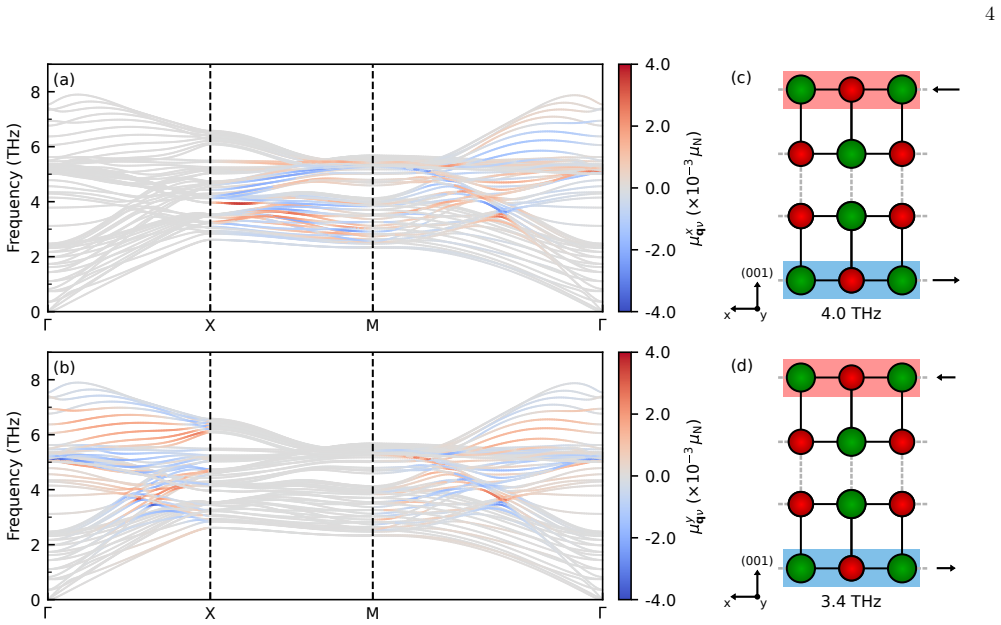
Symmetry arguments combined with density functional theory demonstrate that all surfaces of crystalline materials host surface phonons that are chiral; as model systems, slabs of highly symmetric AB rocksalt compounds exhibit surface-localized phonons whose atomic displacements show chiral motion, and these chiral surface phonons generate sheets of in-plane magnetism at the surface.
What carries the argument
Chiral surface phonons: surface-localized vibrational modes whose atoms execute circular displacements that break effective time-reversal symmetry and thereby induce in-plane magnetic moments.
If this is right
- Chiral phonons appear at every surface and interface in any crystal.
- These modes produce in-plane magnetic sheets without requiring magnetic atoms.
- Surface and interface magnetism can arise from lattice dynamics alone.
- Surface-sensitive probes will register magnetic effects traceable to chiral phonons.
Where Pith is reading between the lines
- Circularly polarized light or inelastic scattering could detect the chirality directly.
- Strain or surface termination may tune the strength of the induced magnetic sheets.
- The mechanism offers a route to phonon-driven spin effects at interfaces in devices.
Load-bearing premise
Symmetry arguments and DFT results obtained for highly symmetric AB rocksalt slabs generalize to all crystalline materials and all types of surfaces or interfaces.
What would settle it
Observation of circular atomic displacements in surface phonon modes or direct measurement of phonon-induced in-plane surface magnetization in a non-magnetic crystal.
Figures
read the original abstract
We use symmetry arguments combined with density functional theory to demonstrate that all surfaces of crystalline materials host surface phonons that are chiral. As model system, we study slabs of highly symmetric AB rocksalt compounds, and find surface-localized phonons whose atomic displacements exhibit chiral motion. We further show that these chiral surface phonons generate sheets of in-plane magnetism at the surface. Our results reveal that chiral phonons can emerge in all crystalline materials as a result of reduced symmetry at surfaces or interfaces. These findings establish surfaces as a previously overlooked source of chiral phonons and their associated magnetic moments, which could play a role in a broad range of surface-sensitive measurements.
Editorial analysis
A structured set of objections, weighed in public.
Referee Report
Summary. The paper claims that reduced symmetry at surfaces universally permits chiral surface phonons in all crystalline materials. Using symmetry arguments plus DFT calculations on slabs of highly symmetric AB rocksalt compounds, it reports surface-localized modes with chiral atomic displacements and shows that these modes produce sheets of in-plane surface magnetism. The central result is presented as a general consequence of surface symmetry breaking rather than a special property of the model systems.
Significance. If the generalization holds, the work would identify surfaces and interfaces as a ubiquitous source of chiral phonons and associated magnetic moments, with potential consequences for surface-sensitive spectroscopies and spintronics. The combination of symmetry analysis with explicit DFT on model slabs is a methodological strength; the absence of free parameters in the symmetry part and the use of standard DFT for the examples are also positive.
major comments (3)
- [Abstract, §1] Abstract and §1 (Introduction): the assertion that 'all surfaces of crystalline materials host surface phonons that are chiral' and that this 'can emerge in all crystalline materials' is not supported by the provided evidence. The DFT results are restricted to high-symmetry AB rocksalt slabs; no general point-group analysis is given showing that every possible surface termination (including those retaining mirror or glide planes) necessarily permits degenerate circularly polarized modes.
- [§3, §4] §3 (DFT results) and §4 (magnetism): the claim that the observed chiral displacements 'generate sheets of in-plane magnetism' assumes a material-independent angular-momentum transfer mechanism. It is unclear whether this is demonstrated by explicit spin-polarized DFT calculations on the same slabs or is an inference; if the latter, the coupling strength and its dependence on surface reconstruction or termination must be quantified to support the general statement.
- [§2] §2 (symmetry arguments): the symmetry-breaking argument is invoked to extend the rocksalt results to arbitrary lattices, yet many surfaces (e.g., reconstructed low-symmetry faces or those preserving C2 or mirror symmetry) can still enforce linearly polarized or non-degenerate modes. A counter-example survey or exhaustive enumeration of surface point groups that do versus do not allow chiral phonons is required for the universality claim.
minor comments (2)
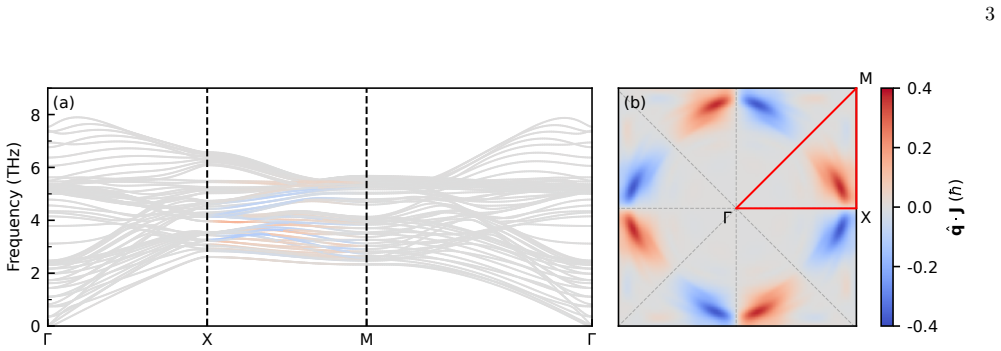
- [Figures 2-4] Figure captions and axis labels in the phonon dispersion plots should explicitly state the slab thickness and k-point sampling used to confirm surface localization.
- [References] The manuscript should cite prior work on surface phonon modes in rocksalt compounds and on chiral phonons in bulk systems to clarify the novelty of the surface-specific claim.
Simulated Author's Rebuttal
We thank the referee for the careful reading of our manuscript and the constructive comments. We address each major comment below, clarifying the scope of our symmetry arguments and the nature of the magnetism claim while noting where revisions will be made to improve precision.
read point-by-point responses
-
Referee: [Abstract, §1] Abstract and §1 (Introduction): the assertion that 'all surfaces of crystalline materials host surface phonons that are chiral' and that this 'can emerge in all crystalline materials' is not supported by the provided evidence. The DFT results are restricted to high-symmetry AB rocksalt slabs; no general point-group analysis is given showing that every possible surface termination (including those retaining mirror or glide planes) necessarily permits degenerate circularly polarized modes.
Authors: We appreciate this observation on the generality of the claim. Our symmetry analysis rests on the reduction of the bulk point group upon surface termination, which removes inversion and frequently mirror symmetries, thereby permitting chiral (circularly polarized) modes. The rocksalt (001) slabs serve as explicit examples where this occurs and is confirmed by DFT. We acknowledge that surfaces retaining mirror or glide planes may restrict modes to linear polarization. We will revise the abstract and §1 to qualify the statement accordingly and expand §2 with a short discussion of surface point-group conditions that allow versus forbid chiral phonons. revision: partial
-
Referee: [§3, §4] §3 (DFT results) and §4 (magnetism): the claim that the observed chiral displacements 'generate sheets of in-plane magnetism' assumes a material-independent angular-momentum transfer mechanism. It is unclear whether this is demonstrated by explicit spin-polarized DFT calculations on the same slabs or is an inference; if the latter, the coupling strength and its dependence on surface reconstruction or termination must be quantified to support the general statement.
Authors: The in-plane magnetism is inferred from the nonzero phonon angular momentum of the chiral surface modes, which can couple to electronic spins through established spin-phonon mechanisms. No spin-polarized DFT calculations were performed in this work, as the primary focus is the identification and symmetry properties of the phonons themselves. We will clarify the inferential nature of the magnetism statement in §4, reference the relevant angular-momentum literature, and note that quantitative coupling strengths for specific terminations lie beyond the present scope. revision: partial
-
Referee: [§2] §2 (symmetry arguments): the symmetry-breaking argument is invoked to extend the rocksalt results to arbitrary lattices, yet many surfaces (e.g., reconstructed low-symmetry faces or those preserving C2 or mirror symmetry) can still enforce linearly polarized or non-degenerate modes. A counter-example survey or exhaustive enumeration of surface point groups that do versus do not allow chiral phonons is required for the universality claim.
Authors: An exhaustive enumeration of all surface point groups would indeed strengthen the universality statement but constitutes a separate, substantial study. Our manuscript uses symmetry reduction as a general principle illustrated by the rocksalt cases. We will add a clarifying paragraph in §2 stating that surfaces preserving mirror or glide symmetry may not host chiral modes and that the phenomenon is expected wherever those symmetries are absent. revision: partial
Circularity Check
No circularity: symmetry arguments and DFT on model systems are independent of the target claim
full rationale
The paper's derivation begins with symmetry considerations applied to surface-reduced symmetry and explicit density functional theory calculations performed on AB rocksalt model slabs. These steps are presented as external inputs that support the existence of chiral surface phonons; the subsequent generalization to all crystalline surfaces is framed as a logical extension of the symmetry analysis rather than a redefinition or statistical fit of the computed quantities themselves. No equations reduce the claimed result to its own fitted parameters, no self-citations serve as the sole justification for uniqueness, and no ansatz is smuggled through prior work. The derivation chain therefore remains self-contained against external benchmarks.
Axiom & Free-Parameter Ledger
axioms (1)
- domain assumption Reduced symmetry at surfaces permits chiral phonon modes with net magnetic moments
Reference graph
Works this paper leans on
-
[1]
D. G. Cahill and R. O. Pohl, Lattice Vibrations and Heat Transport in Crystals and Glasses, Annu. Rev. Phys. Chem.39, 93 (1988)
1988
-
[2]
R. A. Cowley, Acoustic Phonon Instabilities and Struc- tural Phase Transitions, Phys. Rev. B13, 4877 (1976)
1976
-
[3]
Kampfrath, K
T. Kampfrath, K. Tanaka, and K. A. Nelson, Resonant and Nonresonant Control over Matter and Light by In- tense Terahertz Transients, Nat. Photon.7, 680 (2013)
2013
-
[4]
D. M. Juraschek, R. M. Geilhufe, H. Zhu, M. Basini, P. Baum, A. Baydin, S. Chaudhary, M. Fechner, B. Fle- bus, G. Grissonnanche, A. I. Kirilyuk, M. Lemeshko, S. F. Maehrlein, M. Mignolet, S. Murakami, Q. Niu, U. Nowak, C. P. Romao, H. Rostami, T. Satoh, N. A. Spaldin, H. Ueda, and L. Zhang, Chiral Phonons, Nat. Phys.21, 1532 (2025)
2025
-
[5]
Zhang and Q
L. Zhang and Q. Niu, Chiral Phonons at High-Symmetry Points in Monolayer Hexagonal Lattices, Phys. Rev. Lett. 115, 115502 (2015)
2015
-
[6]
H. Zhu, J. Yi, M.-Y. Li, J. Xiao, L. Zhang, C.-W. Yang, R. A. Kaindl, L.-J. Li, Y. Wang, and X. Zhang, Obser- vation of Chiral Phonons, Science359, 579 (2018)
2018
-
[7]
Coh, Classification of Materials with Phonon Angular Momentum and Microscopic Origin of Angular Momen- tum, Phys
S. Coh, Classification of Materials with Phonon Angular Momentum and Microscopic Origin of Angular Momen- tum, Phys. Rev. B108, 134307 (2023)
2023
-
[8]
Y. Yang, Z. Xiao, Y. Mao, Z. Li, Z. Wang, T. Deng, Y. Tang, Z.-D. Song, Y. Li, H. Yuan, M. Shi, and Y. Xu, Symmetry-Guided Catalogue of Chiral Phonon Materi- als, Nat. Phys.X, 1 (2026)
2026
-
[9]
D. M. Juraschek, M. Fechner, A. V. Balatsky, and N. A. Spaldin, Dynamical Multiferroicity, Phys. Rev. Mater.1, 014401 (2017)
2017
-
[10]
D. M. Juraschek and N. A. Spaldin, Orbital Magnetic Moments of Phonons, Phys. Rev. Mater.3, 064405 (2019)
2019
-
[11]
Cheng, T
B. Cheng, T. Schumann, Y. Wang, X. Zhang, D. Bar- balas, S. Stemmer, and N. P. Armitage, A Large Effective Phonon Magnetic Moment in a Dirac Semimetal, Nano Lett.20, 5991 (2020)
2020
-
[12]
Baydin, F
A. Baydin, F. G. G. Hernandez, M. Rodriguez-Vega, A. K. Okazaki, F. Tay, G. T. Noe, I. Katayama, J. Takeda, H. Nojiri, P. H. O. Rappl, E. Abramof, G. A. Fiete, and J. Kono, Magnetic Control of Soft Chiral Phonons in PbTe, Phys. Rev. Lett.128, 075901 (2022)
2022
-
[13]
Zhang and Q
L. Zhang and Q. Niu, Angular Momentum of Phonons and the Einstein–de Haas Effect, Phys. Rev. Lett.112, 085503 (2014)
2014
-
[14]
Dornes, Y
C. Dornes, Y. Acremann, M. Savoini, M. Kubli, M. J. Neugebauer, E. Abreu, L. Huber, G. Lantz, C. a. F. Vaz, H. Lemke, E. M. Bothschafter, M. Porer, V. Es- posito, L. Rettig, M. Buzzi, A. Alberca, Y. W. Windsor, P. Beaud, U. Staub, D. Zhu, S. Song, J. M. Glownia, and S. L. Johnson, The Ultrafast Einstein–de Haas Effect, Nature565, 209 (2019)
2019
-
[15]
Zhang, N
H. Zhang, N. Peshcherenko, F. Yang, T. Z. Ward, P. Raghuvanshi, L. Lindsay, C. Felser, Y. Zhang, J.-Q. Yan, and H. Miao, Measurement of Phonon Angular Mo- mentum, Nat. Phys.21, 1387 (2025)
2025
-
[16]
C. S. Davies, F. G. N. Fennema, A. Tsukamoto, I. Raz- dolski, A. V. Kimel, and A. Kirilyuk, Phononic Switching of Magnetization by the Ultrafast Barnett Effect, Nature 6 628, 540 (2024)
2024
-
[17]
Basini, M
M. Basini, M. Pancaldi, B. Wehinger, M. Udina, V. Unikandanunni, T. Tadano, M. C. Hoffmann, A. V. Balatsky, and S. Bonetti, Terahertz Electric-Field-Driven Dynamical Multiferroicity in SrTiO 3, Nature628, 534 (2024)
2024
-
[18]
S. F. Weber, A. Urru, S. Bhowal, C. Ederer, and N. A. Spaldin, Surface Magnetization in Antiferromag- nets: Classification, Example Materials, and Relation to Magnetoelectric Responses, Phys. Rev. X14, 021033 (2024)
2024
-
[19]
S. F. Weber, A. Urru, and N. A. Spaldin, Local Magneto- electric Effects as Predictors of Surface Magnetic Order, Phys. Rev. X15, 021094 (2025)
2025
-
[20]
Bhowal, A
S. Bhowal, A. Urru, S. F. Weber, and N. A. Spaldin, Emergent Surface Multiferroicity, Phys. Rev. Lett.134, 146703 (2025)
2025
-
[21]
T. S. Chen, G. P. Alldredge, F. W. De Wette, and R. E. Allen, Surface and Pseudosurface Modes in Ionic Crys- tals, Phys. Rev. Lett.26, 1543 (1971)
1971
-
[22]
R. E. Allen, G. P. Alldredge, and F. W. de Wette, Studies of Vibrational Surface Modes. I. General Formulation, Phys. Rev. B4, 1648 (1971)
1971
-
[23]
R. E. Allen, G. P. Alldredge, and F. W. de Wette, Studies of Vibrational Surface Modes. II. Monatomic Fcc Crys- tals, Phys. Rev. B4, 1661 (1971)
1971
-
[24]
T. S. Chen, F. W. de Wette, and G. P. Alldredge, Stud- ies of Vibrational Surface Modes in Ionic Crystals. I. De- tailed Shell-Model Studies for the Unrelaxed (001) Face of Seven Crystals Having the Rocksalt Structure, Phys. Rev. B15, 1167 (1977)
1977
-
[25]
R. F. Wallis, Surface Vibrational Properties, J. Vac. Sci. Technol. A3, 1422 (1985)
1985
-
[26]
Kress and F
W. Kress and F. W. De Wette,Surface Phonons, Springer Series in Surface Sciences, Vol. 21 (Springer Berlin Heidelberg, Berlin, Heidelberg, 1991)
1991
-
[27]
Kresse and J
G. Kresse and J. Hafner, Ab Initio Molecular- Dynamics Simulation of the Liquid-Metal–Amorphous- Semiconductor Transition in Germanium, Phys. Rev. B 49, 14251 (1994)
1994
-
[28]
Kresse and J
G. Kresse and J. Furthm¨ uller, Efficiency of Ab-Initio To- tal Energy Calculations for Metals and Semiconductors Using a Plane-Wave Basis Set, Comput. Mater. Sci.6, 15 (1996)
1996
-
[29]
Kresse and J
G. Kresse and J. Furthm¨ uller, Efficient Iterative Schemes for Ab Initio Total-Energy Calculations Using a Plane- Wave Basis Set, Phys. Rev. B54, 11169 (1996)
1996
-
[30]
Kresse and D
G. Kresse and D. Joubert, From Ultrasoft Pseudopoten- tials to the Projector Augmented-Wave Method, Phys. Rev. B59, 1758 (1999)
1999
-
[31]
J. P. Perdew, A. Ruzsinszky, G. I. Csonka, O. A. Vy- drov, G. E. Scuseria, L. A. Constantin, X. Zhou, and K. Burke, Restoring the Density-Gradient Expansion for Exchange in Solids and Surfaces, Phys. Rev. Lett.100, 136406 (2008)
2008
-
[32]
H. J. Monkhorst and J. D. Pack, Special Points for Brillouin-zone Integrations, Phys. Rev. B13, 5188 (1976)
1976
-
[33]
Togo, First-Principles Phonon Calculations with Phonopy and Phono3py, J
A. Togo, First-Principles Phonon Calculations with Phonopy and Phono3py, J. Phys. Soc. Jpn.92, 012001 (2023)
2023
-
[34]
A. Togo, L. Chaput, T. Tadano, and I. Tanaka, Im- plementation Strategies in Phonopy and Phono3py, J. Phys.: Condens. Matter35, 353001 (2023)
2023
-
[35]
Gonze, J.-C
X. Gonze, J.-C. Charlier, D. Allan, and M. Teter, Inter- atomic Force Constants from First Principles: The Case ofα-Quartz, Phys. Rev. B50, 13035 (1994)
1994
-
[36]
Gonze and C
X. Gonze and C. Lee, Dynamical Matrices, Born Effec- tive Charges, Dielectric Permittivity Tensors, and Inter- atomic Force Constants from Density-Functional Pertur- bation Theory, Phys. Rev. B55, 10355 (1997)
1997
-
[37]
D. M. Ceperley and B. J. Alder, Ground State of the Electron Gas by a Stochastic Method, Phys. Rev. Lett. 45, 566 (1980)
1980
-
[38]
J. P. Perdew, K. Burke, and M. Ernzerhof, Generalized Gradient Approximation Made Simple, Phys. Rev. Lett. 77, 3865 (1996)
1996
-
[39]
Straumanis and A
M. Straumanis and A. Ievi¸ nˇ s, Die Gitter konstanten des NaCl und des Steinsalzes, Z. Phys.102, 353 (1936)
1936
-
[40]
J. E. Nickels, M. A. Fineman, and W. E. Wallace, X-Ray Diffraction Studies of Sodium Chloride–Sodium Bromide Solid Solutions, J. Phys. Chem.53, 625 (1949)
1949
-
[41]
Raunio, Phonon Dispersion Relations in NaCl, Phys
G. Raunio, Phonon Dispersion Relations in NaCl, Phys. Rev.178, 1496 (1969)
1969
-
[42]
Schmunk and D
R. Schmunk and D. Winder, Lattice Dynamics of Sodium Chloride at Room Temperature, J. Phys. Chem. Solids 31, 131 (1970)
1970
-
[43]
N. E. Brese and M. O’Keeffe, Structures of RbD and CsD by Time-of-Flight Neutron Diffraction, Acta Cryst. C47, 1956 (1991)
1956
-
[44]
Zintl and A
E. Zintl and A. Harder, ¨Uber Alkalihydride, Z. Phys. Chem.14B, 265 (1931)
1931
-
[45]
V. M. Goldschmidt, Die Gesetze der Krystallochemie, Naturwissenschaften14, 477 (1926)
1926
-
[46]
H. Ueda, A. Nag, C. P. Romao, M. Garc´ ıa-Fern´ andez, K.- J. Zhou, and U. Staub, Chiral Phonons in Polar LiNbO3, Nat. Commun.17, 212 (2025)
2025
-
[47]
A full map of the phonon cycloidicity, i.e
We note that phonons along these high-symmetry lines can be cycloidal, with the ions tracing circular trajec- tories within a plane perpendicular to the propagation direction (ˆq⊥J). A full map of the phonon cycloidicity, i.e. ˆq×J, throughout the Brillouin zone is provided in SM Note 2
-
[48]
Park and B.-J
S. Park and B.-J. Yang, Phonon Angular Momentum Hall Effect, Nano Lett.20, 7694 (2020)
2020
-
[49]
D. A. B. Lopez, V. Brehm, and D. M. Juraschek, Atom- istic Theory of the Phonon Angular Momentum Hall Ef- fect (2026), 2604.01899 [cond-mat.mtrl-sci]. Supplemental Material: Chiral Surface Phonons Mike Pols 1,∗ and Nicola A. Spaldin 1,† 1Materials Theory, ETH Zurich, CH-8093 Z¨ urich, Switzerland (Dated: June 9, 2026) ∗ mike.pols@mat.ethz.ch † nicola.spal...
arXiv 2026
-
[50]
Computational methods S3 Exchange-correlation (XC) functionals S3 Convergence of slab thickness S4
-
[51]
Chiral phonons S5 Brillouin zone cross section S5 Handedness of surfaces S5 Localization of chirality S6 Cycloidicity of phonons S8
-
[52]
Surface magnetization S10 Magnetization of bottom surface S10 Total magnetization of surfaces S10
-
[53]
Other rocksalt-structure materials S12 Bulk phonons S12 Surface phonons S12 Chiral phonons S13 Surface magnetization S14 References S17 S2
-
[54]
Our analysis includes the LDA [1], PBE [2], and PBEsol [3] functionals
COMPUT A TIONAL METHODS Exchange-correlation (XC) functionals To determine the most suitable exchange-correlation (XC) functional for our phonon calculations, we evaluate how well they reproduce both experimental geometries and phonon frequencies. Our analysis includes the LDA [1], PBE [2], and PBEsol [3] functionals. For each functional, we optimize the ...
-
[55]
This approach, which follows the method described in Ref
CHIRAL PHONONS Brillouin zone cross section To calculate the constant-frequency cross section of the Brillouin zone, we average the phonon chirality over the phonon bands by weighting the contribution of each band with a Gaussian distribution centered around a target frequencyf 0. This approach, which follows the method described in Ref. [11], enables the...
-
[56]
S6 the phonon magnetic moments of the bottom surface of the rocksalt slab are shown
SURF ACE MAGNETIZA TION Magnetization of bottom surface In Fig. S6 the phonon magnetic moments of the bottom surface of the rocksalt slab are shown. Compared to the top layer of the slab, shown in Fig. 5, the bottom layer of the slab exhibits a phonon magnetic moment antiparallel to it: a positivex-component in the top surface layers corresponds to a nega...
-
[57]
OTHER ROCKSAL T-STRUCTURE MA TERIALS Bulk phonons Figure S8 shows the phonon dispersion of three different compounds with a rocksalt structure: NaCl, RbF, and CsH. We see that the dispersion of the three materials are similar, with the most notable difference stemming from the mass difference between the A+ cations and B − anions; the larger the mass rati...
-
[58]
D. M. Ceperley and B. J. Alder, Phys. Rev. Lett.45, 566 (1980)
1980
-
[59]
J. P. Perdew, K. Burke, and M. Ernzerhof, Phys. Rev. Lett.77, 3865 (1996)
1996
-
[60]
J. P. Perdew, A. Ruzsinszky, G. I. Csonka, O. A. Vydrov, G. E. Scuseria, L. A. Constantin, X. Zhou, and K. Burke, Phys. Rev. Lett.100, 136406 (2008)
2008
-
[61]
Straumanis and A
M. Straumanis and A. Ievi¸ nˇ s, Z. Phys.102, 353 (1936)
1936
-
[62]
J. E. Nickels, M. A. Fineman, and W. E. Wallace, J. Phys. Chem.53, 625 (1949)
1949
-
[63]
Raunio, Phys
G. Raunio, Phys. Rev.178, 1496 (1969)
1969
-
[64]
Schmunk and D
R. Schmunk and D. Winder, J. Phys. Chem. Solids31, 131 (1970)
1970
-
[65]
N. E. Brese and M. O’Keeffe, Acta Cryst. C47, 1956 (1991)
1956
-
[66]
Zintl and A
E. Zintl and A. Harder, Z. Phys. Chem.14B, 265 (1931)
1931
-
[67]
V. M. Goldschmidt, Naturwissenschaften14, 477 (1926)
1926
-
[68]
H. Ueda, A. Nag, C. P. Romao, M. Garc´ ıa-Fern´ andez, K.-J. Zhou, and U. Staub, Nat. Com- mun.17, 212 (2025). S17
2025
discussion (0)
Sign in with ORCID, Apple, or X to comment. Anyone can read and Pith papers without signing in.