Flexible Coupler Antenna Enhanced Wireless Communication: Modeling and Coupler Position Optimization
Pith reviewed 2026-06-27 17:33 UTC · model grok-4.3
The pith
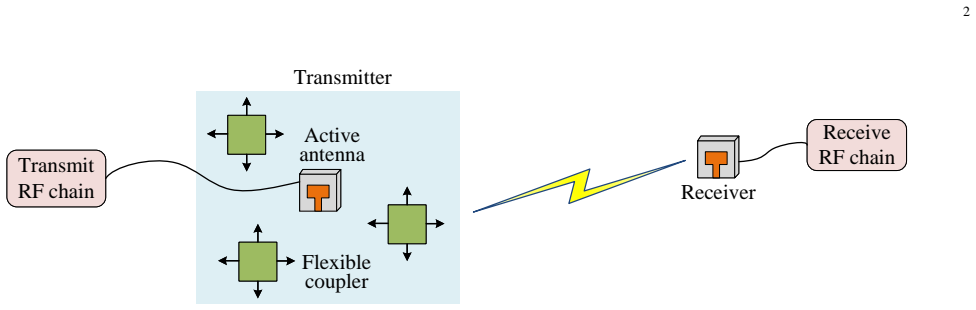
Repositioning passive couplers around one fixed active antenna enables beamforming that raises achievable rates while cutting active antennas and RF chains.
A machine-rendered reading of the paper's core claim, the machinery that carries it, and where it could break.
Core claim
By deriving mechanical beamforming weights as explicit functions of passive coupler positions and optimizing those positions with a block-coordinate conditional gradient method, the flexible coupler antenna achieves higher achievable rates than conventional schemes in both LoS and multipath settings while requiring only a single active antenna and fewer RF chains.
What carries the argument
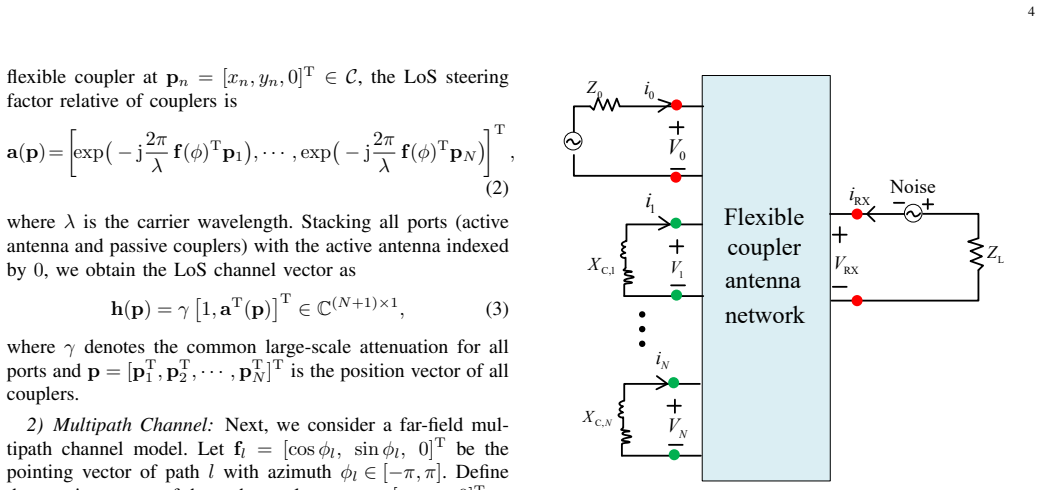
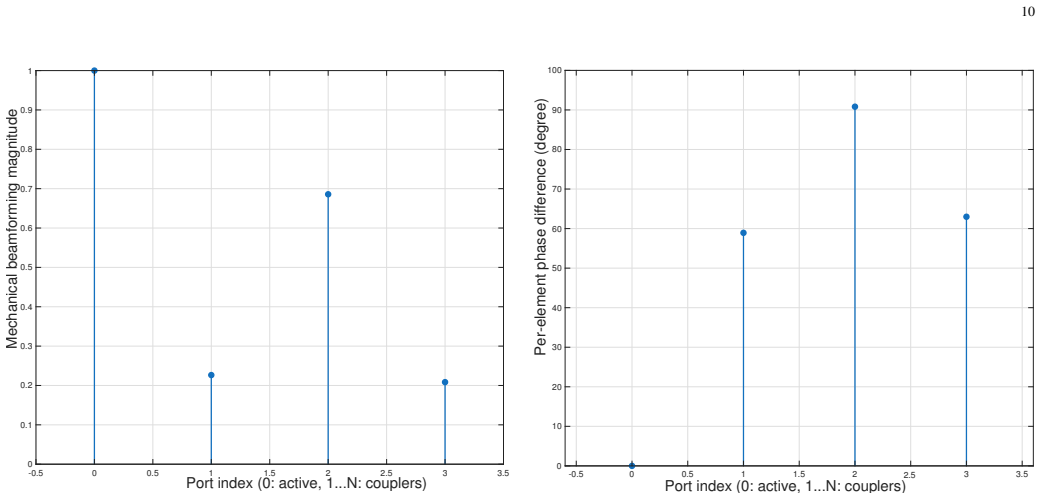
Mechanical beamforming weights expressed as functions of coupler positions, obtained from multi-port circuit theory channel models, that reshape induced currents on the passive elements without moving the active antenna.
If this is right
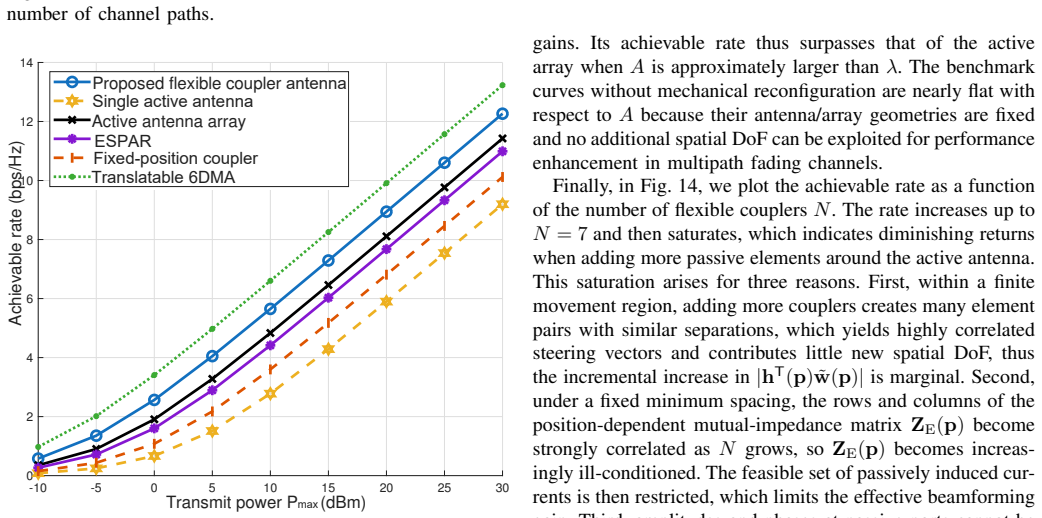
- The optimized coupler positions produce higher achievable rates than benchmark schemes that use more active antennas.
- Only one active antenna and a reduced number of RF chains are needed to reach the reported performance.
- Mechanical movement of passive elements alone suffices for the beamforming gain under the stated movement and power constraints.
- The same position-optimization approach applies to both line-of-sight and multipath channel models.
Where Pith is reading between the lines
- The approach could reduce total system power draw in battery-limited transmitters by lowering the count of active RF chains.
- Extending the single-transmitter setup to coordinated movement across multiple flexible coupler antennas might support multi-user scenarios.
- The sequential optimization routine may serve as a starting point for real-time tracking when the receiver or environment changes slowly.
Load-bearing premise
The multi-port circuit theory models correctly capture how electromagnetic interactions between the fixed active antenna and the movable passive couplers change with position.
What would settle it
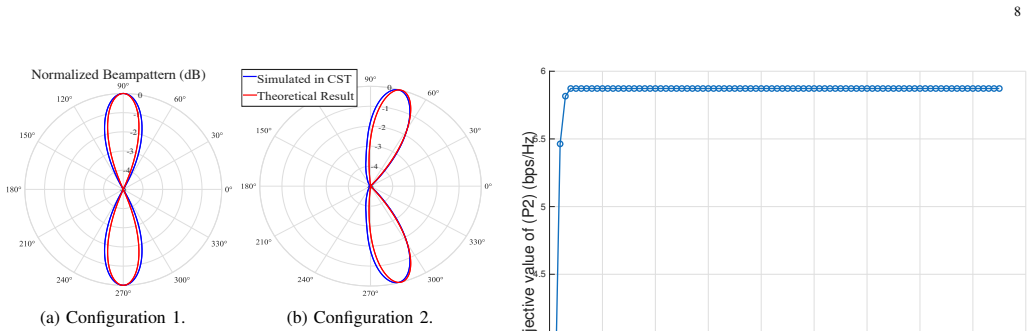
Experimental measurements of radiation patterns or achievable rate that deviate markedly from the model's predictions at the computed optimal coupler positions would show the modeling step does not hold.
Figures
read the original abstract
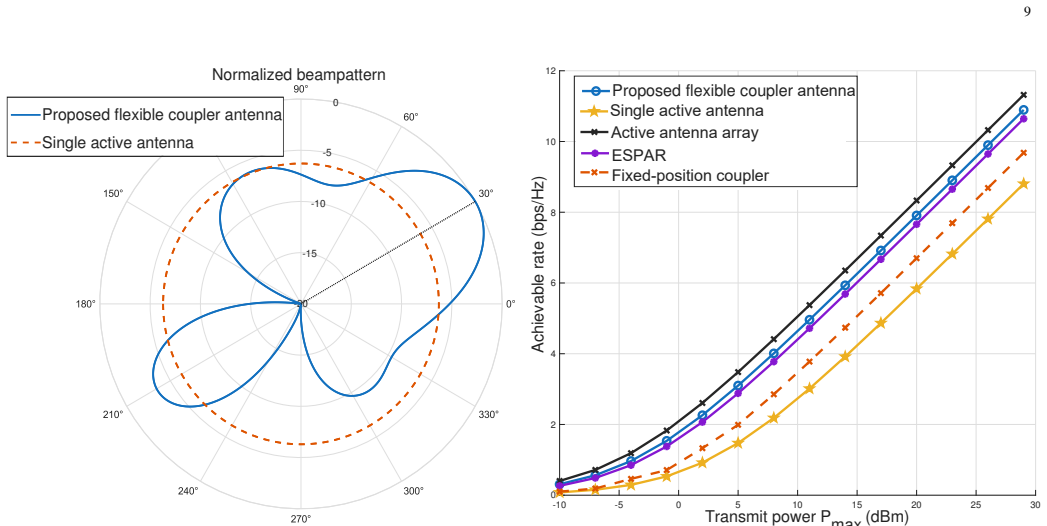
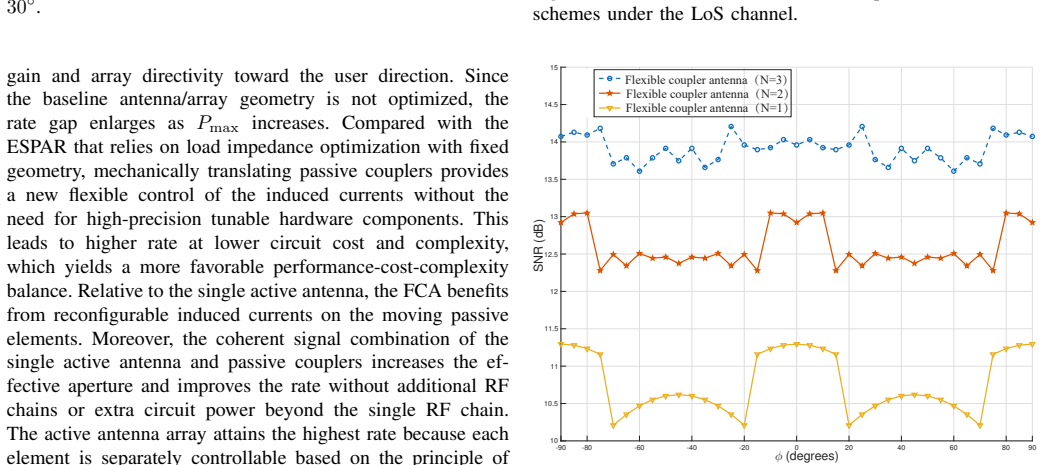
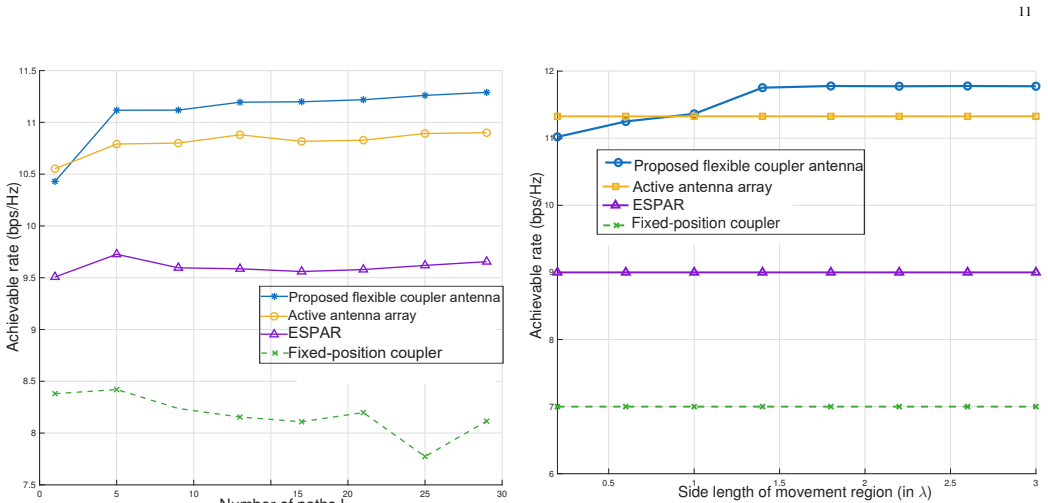
This paper proposes a novel flexible coupler antenna (FCA) that translates passive coupling elements around a fixed-position active antenna to reshape the induced currents on the passive elements for radiation. A new form of mechanical beamforming is achieved by moving only the passive coupling elements while keeping the active antenna stationary. The proposed design significantly reduces the antenna and radio-frequency (RF) chain costs of conventional active array beamforming with low mechanical control complexity and energy consumption. For the purpose of exposition, we consider a point-to-point communication system with one FCA at the transmitter and one fixed antenna at the receiver. Specifically, based on multi-port circuit theory, we establish both the line-of-sight (LoS) and multipath channel models and derive the mechanical beamforming weights of the passive couplers as functions of their positions. Then, we formulate a new problem to maximize the received signal-to-noise ratio (SNR) by optimizing the positions of passive couplers at the transmitter, subject to coupler movement and transmit power constraints. Solving the resulting problem is inherently difficult because coupled channel and mechanical beamforming create non-linearity in the objective function.To tackle this problem, we propose an efficient block-coordinate conditional gradient method to search for the best positions of all passive couplers by sequentially optimizing the position of each coupler with those of the other couplers fixed in an iterative manner.Simulation results demonstrate that the proposed system significantly outperforms benchmark schemes in terms of achievable rate, but with significantly reduced active antennas and RF chains.
Editorial analysis
A structured set of objections, weighed in public.
Referee Report
Summary. The manuscript proposes a flexible coupler antenna (FCA) in which passive coupling elements are mechanically repositioned around a fixed active antenna to reshape induced currents and achieve mechanical beamforming. Using multi-port circuit theory, the authors derive both line-of-sight and multipath channel models, express the mechanical beamforming weights explicitly as functions of coupler positions, formulate an SNR-maximization problem subject to movement and transmit-power constraints, and solve it via a block-coordinate conditional gradient algorithm that sequentially optimizes each coupler position. Simulation results are reported to show higher achievable rates than benchmark schemes while employing substantially fewer active antennas and RF chains.
Significance. If the multi-port circuit models remain faithful to the underlying electromagnetics under the stated movement constraints, the work offers a concrete route to hardware reduction in beamforming systems: performance gains are obtained by moving only passive elements rather than scaling active RF chains. The explicit position-dependent weight derivation and the iterative solver for the resulting non-linear objective constitute the main technical contributions.
major comments (1)
- [Channel modeling and mechanical beamforming weight derivation (sections describing the multi-port circuit models)] The central performance claims (rate gains with reduced active elements) are obtained exclusively from simulations driven by the multi-port circuit-theory channel models (both LoS and multipath). No comparison to full-wave electromagnetic solvers or measured data is presented to verify that the induced currents, mutual coupling, and radiation efficiency remain accurate when the passive couplers are displaced under the movement constraints. This modeling step is load-bearing because the mechanical beamforming weights, the SNR objective, and all benchmark comparisons are computed directly from these models; any systematic discrepancy in near-field or movement-induced effects would invalidate the reported gains.
Simulated Author's Rebuttal
We thank the referee for the detailed and constructive review. The significance assessment is appreciated. We respond to the single major comment below.
read point-by-point responses
-
Referee: [Channel modeling and mechanical beamforming weight derivation (sections describing the multi-port circuit models)] The central performance claims (rate gains with reduced active elements) are obtained exclusively from simulations driven by the multi-port circuit-theory channel models (both LoS and multipath). No comparison to full-wave electromagnetic solvers or measured data is presented to verify that the induced currents, mutual coupling, and radiation efficiency remain accurate when the passive couplers are displaced under the movement constraints. This modeling step is load-bearing because the mechanical beamforming weights, the SNR objective, and all benchmark comparisons are computed directly from these models; any systematic discrepancy in near-field or movement-induced effects would invalidate the reported gains.
Authors: We agree that the multi-port circuit models are central and that direct verification against full-wave solvers for displaced positions would increase confidence. The models follow directly from standard multi-port network theory, in which the impedance matrix Z( heta) is parameterized by coupler positions heta; this is an established approach for mutual-coupling analysis in the antenna literature and yields exact port relations under the lumped-element assumption. The movement constraints in the optimization problem are chosen to remain within the regime where this quasi-static network model is applicable. Nevertheless, the absence of explicit cross-validation in the submitted manuscript is a valid observation. In the revised manuscript we will add a dedicated validation subsection (or appendix) that compares the circuit-model predictions of induced currents and far-field patterns against full-wave electromagnetic simulations for representative positions and displacements within the allowed movement range. This addition will not change the derived weights, the optimization algorithm, or the reported rate gains, but will explicitly confirm the modeling fidelity under the stated constraints. revision: partial
Circularity Check
No significant circularity detected
full rationale
The derivation begins from multi-port circuit theory to establish LoS and multipath channel models, then expresses mechanical beamforming weights explicitly as functions of coupler positions before formulating an SNR maximization problem under movement and power constraints. These steps invoke an external modeling framework rather than defining quantities in terms of the target performance metric or renaming fitted parameters as predictions. The subsequent block-coordinate optimization and simulation comparisons operate on the resulting non-linear objective; no equation reduces by construction to an input parameter or self-citation chain. The paper therefore remains self-contained against external circuit-theory benchmarks.
Axiom & Free-Parameter Ledger
axioms (1)
- domain assumption Multi-port circuit theory accurately models the electromagnetic coupling between the fixed active antenna and the movable passive couplers for both LoS and multipath propagation.
invented entities (1)
-
Flexible Coupler Antenna (FCA)
no independent evidence
Reference graph
Works this paper leans on
-
[1]
An overview of signal processing techniques for millimeter wave MIMO systems,
R. W. Heath, N. Gonz ´alez-Prelcic, S. Rangan, W. Roh, and A. M. Sayeed, “An overview of signal processing techniques for millimeter wave MIMO systems,”IEEE J. Sel. Top. Signal Process., vol. 10, no. 3, pp. 436–453, Apr. 2016
2016
-
[2]
On the road to 6G: Visions, requirements, key technologies, and testbeds,
C.-X. Wanget al., “On the road to 6G: Visions, requirements, key technologies, and testbeds,”IEEE Commun. Surv. Tutor ., vol. 25, no. 2, pp. 905–974, Secondquart. 2023
2023
-
[3]
Massive MIMO for next generation wireless systems,
E. G. Larsson, O. Edfors, F. Tufvesson, and T. L. Marzetta, “Massive MIMO for next generation wireless systems,”IEEE Commun. Mag., vol. 52, no. 2, pp. 186–195, Feb. 2014
2014
-
[4]
A tutorial on extremely large-scale MIMO for 6G: Fundamentals, signal processing, and applications,
Z. Wanget al., “A tutorial on extremely large-scale MIMO for 6G: Fundamentals, signal processing, and applications,”IEEE Commun. Surv. Tutorials., vol. 26, no. 3, pp. 1560–1605, thirdquart. 2024
2024
-
[5]
Smart radio environments empowered by reconfigurable intelligent surfaces: How it works, state of research, and the road ahead,
M. Di Renzo, A. Zappone, M. Debbah, M.-S. Alouini, C. Yuen, J. de Rosny, and S. Tretyakov, “Smart radio environments empowered by reconfigurable intelligent surfaces: How it works, state of research, and the road ahead,”IEEE J. Sel. Areas Commun., vol. 38, no. 11, pp. 2450–2525, Nov. 2020
2020
-
[6]
Target sensing with intelligent reflecting surface: Architecture and performance,
X. Shao, C. You, W. Ma, X. Chen, and R. Zhang, “Target sensing with intelligent reflecting surface: Architecture and performance,”IEEE J. Sel. Areas Commun., vol. 40, no. 7, pp. 2070–2084, Jul. 2022
2070
-
[7]
Intelligent surfaces empowered wireless network: Recent advances and the road to 6G,
Q. Wuet al., “Intelligent surfaces empowered wireless network: Recent advances and the road to 6G,”Proc. IEEE, vol. 112, no. 7, pp. 724–763, Jul. 2024
2024
-
[8]
IRS aided millimeter-wave sensing and communication: Beam scanning, beam splitting, and performance analysis,
R. Liet al., “IRS aided millimeter-wave sensing and communication: Beam scanning, beam splitting, and performance analysis,”IEEE Trans. Wireless Commun., vol. 23, no. 12, pp. 19 713–19 727, Dec. 2024
2024
-
[9]
Massive MIMO is a reality-what is next?: Five promising research directions for antenna arrays,
E. Bj ¨ornson, L. Sanguinetti, H. Wymeersch, J. Hoydis, and T. L. Marzetta, “Massive MIMO is a reality-what is next?: Five promising research directions for antenna arrays,”Digit. Signal Process., vol. 94, pp. 3–20, 2019
2019
-
[10]
Near-field MIMO communications for 6G: Fundamentals, challenges, potentials, and future directions,
M. Cui, Z. Wu, Y . Lu, X. Wei, and L. Dai, “Near-field MIMO communications for 6G: Fundamentals, challenges, potentials, and future directions,”IEEE Commun. Mag., vol. 61, no. 1, pp. 40–46, Jan. 2023
2023
-
[11]
Radio channel measurements and modeling: Incorporating reconfigurable antennas into wireless propagation channels,
C.-X. Wang, C. Gu, J. Li, J. Huang, Y . Liu, and Y . Chen, “Radio channel measurements and modeling: Incorporating reconfigurable antennas into wireless propagation channels,”IEEE Wireless Commun., vol. 33, no. 1, pp. 207–215, Feb. 2026
2026
-
[12]
6D movable antenna based on user distribution: Modeling and optimization,
X. Shao, Q. Jiang, and R. Zhang, “6D movable antenna based on user distribution: Modeling and optimization,”IEEE Trans. Wireless Commun., vol. 24, no. 1, pp. 355–370, Jan. 2025
2025
-
[13]
6D movable antenna enhanced wireless network via discrete position and rotation optimiza- tion,
X. Shao, R. Zhang, Q. Jiang, and R. Schober, “6D movable antenna enhanced wireless network via discrete position and rotation optimiza- tion,”IEEE J. Sel. Areas Commun., vol. 43, no. 3, pp. 674–687, Mar. 2025
2025
-
[14]
6DMA enhanced wireless network with flexible antenna position and rotation: Opportunities and challenges,
X. Shao and R. Zhang, “6DMA enhanced wireless network with flexible antenna position and rotation: Opportunities and challenges,”IEEE Commun. Mag., vol. 63, no. 4, pp. 121–128, Apr. 2025
2025
-
[15]
Statistical channel-based low-complexity rotation and position optimization for 6d movable antennas enabled wireless com- munication,
Q. Jianget al., “Statistical channel-based low-complexity rotation and position optimization for 6d movable antennas enabled wireless com- munication,”IEEE Trans. Wireless Commun., vol. 25, pp. 8874–8889, 2026
2026
-
[16]
A tutorial on six-dimensional movable antenna for 6G networks: Synergizing positionable and rotatable antennas,
X. Shaoet al., “A tutorial on six-dimensional movable antenna for 6G networks: Synergizing positionable and rotatable antennas,”IEEE Commun. Surv. Tutor ., 2025, early access
2025
-
[17]
UA V-enabled passive 6D movable antennas: Joint deployment and beamforming optimization,
C. Liu, W. Mei, P. Wang, Y . Meng, Z. Chen, and B. Ning, “UA V-enabled passive 6D movable antennas: Joint deployment and beamforming optimization,”IEEE Trans. Wireless Commun., vol. 25, pp. 9765–9781, 2026
2026
-
[18]
Distributed channel estimation and optimization for 6D movable antenna: Unveiling directional sparsity,
X. Shao, R. Zhang, Q. Jiang, J. Park, T. Q. S. Quek, and R. Schober, “Distributed channel estimation and optimization for 6D movable antenna: Unveiling directional sparsity,”IEEE J. Sel. Topics Signal Process., vol. 19, no. 2, pp. 349–365, Mar. 2025
2025
-
[19]
Y . Liet al., “AI signal processing paradigm for movable antenna: From spatial position optimization to electromagnetic reconfigurability,”arXiv preprint arXiv:2510.19209, 2025
-
[20]
Mutual coupling analysis of 6G ultra-massive MIMO channel measurements and models,
R. Feng, C.-X. Wang, J. Huang, Y . Zheng, F. Lai, and W. Zhou, “Mutual coupling analysis of 6G ultra-massive MIMO channel measurements and models,” inIEEE Int. Conf. Commun., May 2022, pp. 956–961
2022
-
[21]
Characteristics and channel capacity studies of a novel 6G non-stationary massive MIMO channel model considering mutual coupling,
Y . Yang, C.-X. Wang, J. Huang, and J. Thompson, “Characteristics and channel capacity studies of a novel 6G non-stationary massive MIMO channel model considering mutual coupling,”IEEE J. Sel. Areas Commun., vol. 42, no. 6, pp. 1519–1533, Jun. 2024
2024
-
[22]
Modeling, capacity studies, antenna and system designs for 6G/B6G 3-D continuous-space radio channels enabled by electromagnetic information theory,
C.-X. Wanget al., “Modeling, capacity studies, antenna and system designs for 6G/B6G 3-D continuous-space radio channels enabled by electromagnetic information theory,”IEEE Commun. Surv. Tutor ., vol. 28, pp. 1–63, 2026
2026
-
[23]
X. Shao, C. Shan, W. Zhuang, and X. Shen, “Coupler position optimiza- tion and channel estimation for flexible coupler antenna aided multiuser communication,”arXiv preprint arXiv:2602.11319, 2026
-
[24]
Reconfigurable Coupler Antenna for Wireless Networks
——, “Reconfigurable coupler antenna for wireless networks,”arXiv preprint arXiv:2605.20560, 2026
work page internal anchor Pith review Pith/arXiv arXiv 2026
-
[25]
Rotatable Coupler Antenna Enhanced Wireless Network: Modeling and Coupler Rotation Optimization
——, “Rotatable coupler antenna enhanced wireless network: Modeling and coupler rotation optimization,”arXiv preprint arXiv:2605.20535, 2026
work page internal anchor Pith review Pith/arXiv arXiv 2026
-
[26]
Flexible coupler antenna enhanced low- altitude wireless communication,
X. Shao, Y . Du, and R. Zhang, “Flexible coupler antenna enhanced low- altitude wireless communication,”IEEE J. Sel. Top. Signal Process., 2026, early access
2026
-
[27]
C. A. Balanis,Modern antenna handbook. John Wiley & Sons, 2011
2011
-
[28]
Low-profile ESPAR an- tenna for RSS-based DoA estimation in IoT applications,
M. Burtowy, M. Rzymowski, and L. Kulas, “Low-profile ESPAR an- tenna for RSS-based DoA estimation in IoT applications,”IEEE Access, vol. 7, pp. 17 403–17 411, Jan. 2019
2019
-
[29]
Electrically steerable passive array radiator (ESPAR) antennas,
H. Kawakami and T. Ohira, “Electrically steerable passive array radiator (ESPAR) antennas,”IEEE Antennas Propag. Mag., vol. 47, no. 2, pp. 43–50, Apr. 2005
2005
-
[30]
Ambient backscatter communication systems: Detection and performance analysis,
G. Wang, F. Gao, R. Fan, and C. Tellambura, “Ambient backscatter communication systems: Detection and performance analysis,”IEEE Trans. Commun., vol. 64, no. 11, pp. 4836–4846, Nov. 2016
2016
-
[31]
C. A. Balanis,Antenna theory: analysis and design. John wiley & sons, 2016. 13
2016
-
[32]
D. M. Pozar,Microwave engineering: theory and techniques. John wiley & sons, 2021
2021
-
[33]
Toward a circuit theory of communi- cation,
M. T. Ivrla ˇc and J. A. Nossek, “Toward a circuit theory of communi- cation,”IEEE Trans. Circuits Syst. I, Reg. Papers, vol. 57, no. 7, pp. 1663–1683, Jul. 2010
2010
-
[34]
Nonlinear programming,
D. P. Bertsekas, “Nonlinear programming,”J. Oper . Res. Soc., vol. 48, no. 3, pp. 334–334, 1997
1997
-
[35]
On efficiency of nonmonotone Armijo- type line searches,
M. Ahookhosh and S. Ghaderi, “On efficiency of nonmonotone Armijo- type line searches,”Appl. Math. Model., vol. 43, pp. 170–190, 2017
2017
-
[36]
The complex-step derivative approximation,
J. R. Martins, P. Sturdza, and J. J. Alonso, “The complex-step derivative approximation,”ACM Trans. Math. Softw., vol. 29, no. 3, pp. 245–262, 2003
2003
-
[37]
Flexible coupler array with reconfigurable pattern: Mechanical beamforming and digital agent,
X. Shao, Y . Zhang, N. Cheng, W. Zhuang, and X. Shen, “Flexible coupler array with reconfigurable pattern: Mechanical beamforming and digital agent,”arXiv preprint arXiv:2602.17710, 2026
-
[38]
Analysis of dense array massive MIMO with practical constraints,
N. V . Deshpande, S. R. Khosravirad, J. Du, H. Viswanathan, M. R. Castellanos, and R. W. Heath, “Analysis of dense array massive MIMO with practical constraints,” in26th Int. ITG Workshop Smart Antennas and 13th Conference on Systems, Communications, and Coding. VDE, Feb. 2023, pp. 1–6
2023
-
[39]
Polarforming antenna enhanced sensing and communication: Modeling and optimization,
X. Shao, R. Zhang, H. Zhou, Q. Jiang, C. Zhou, W. Zhuang, and X. Shen, “Polarforming antenna enhanced sensing and communication: Modeling and optimization,”IEEE J. Sel. Areas Commun., vol. 44, pp. 416–431, Mar. 2026
2026
-
[40]
Hybrid near-far field 6D movable antenna design exploiting directional sparsity and deep learning,
X. Shaoet al., “Hybrid near-far field 6D movable antenna design exploiting directional sparsity and deep learning,”IEEE Trans. Wireless Commun., vol. 25, pp. 3736–3749, Sep. 2025
2025
-
[41]
Multi-Cell 6DMA: Cooperative Interference Management and Antenna Rotation Optimization
Q. Jianget al., “Multi-cell 6dma: Cooperative interference management and antenna rotation optimization,”arXiv preprint arXiv:2605.22288, 2026
work page internal anchor Pith review Pith/arXiv arXiv 2026
discussion (0)
Sign in with ORCID, Apple, or X to comment. Anyone can read and Pith papers without signing in.