Local electronic structure and dynamics of hydrogen in CeO₂
Pith reviewed 2026-06-27 16:17 UTC · model grok-4.3
The pith
Muon spin rotation reveals a polaron state in CeO2 where implanted muons bond to oxygen and localize a 4f electron on a nearby cerium site below 10 K.
A machine-rendered reading of the paper's core claim, the machinery that carries it, and where it could break.
Core claim
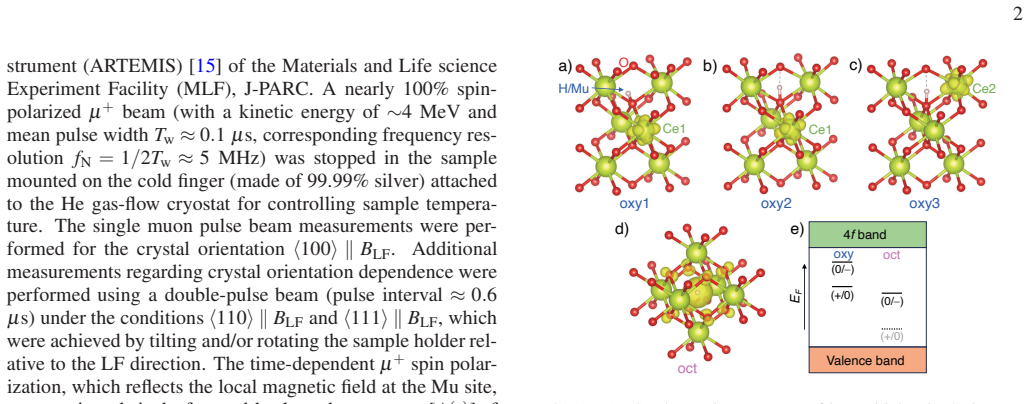
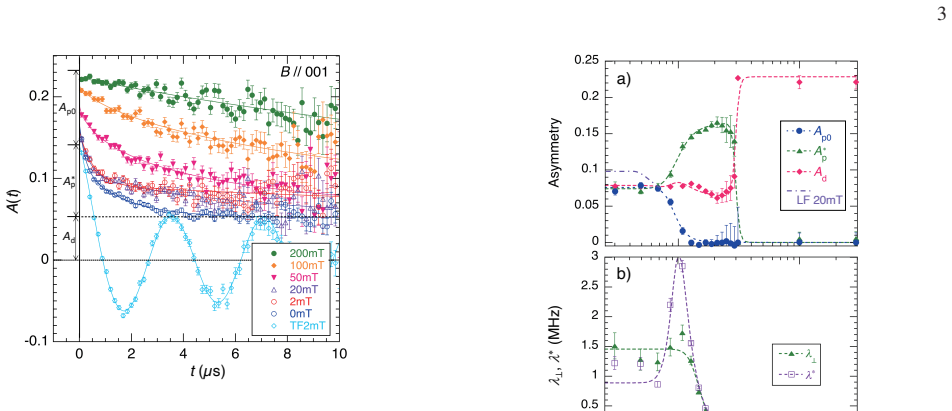
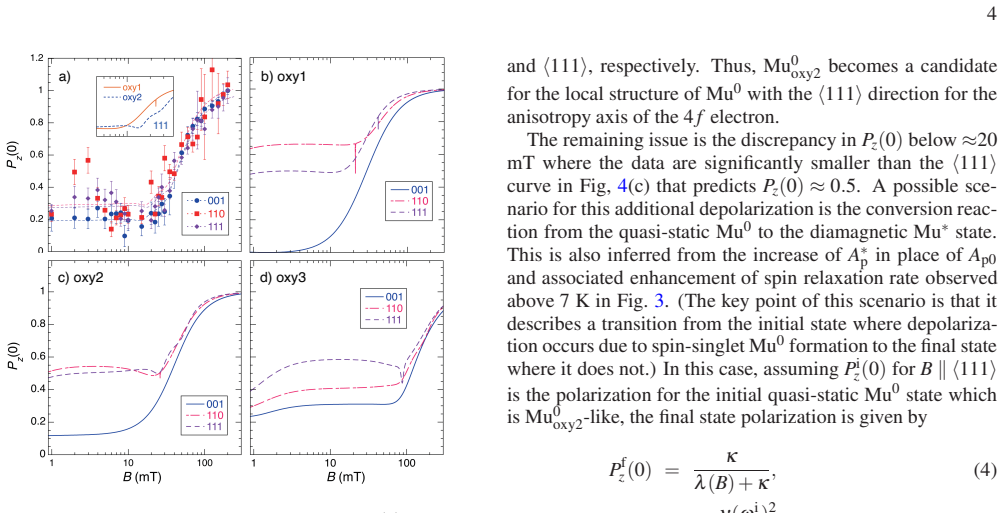
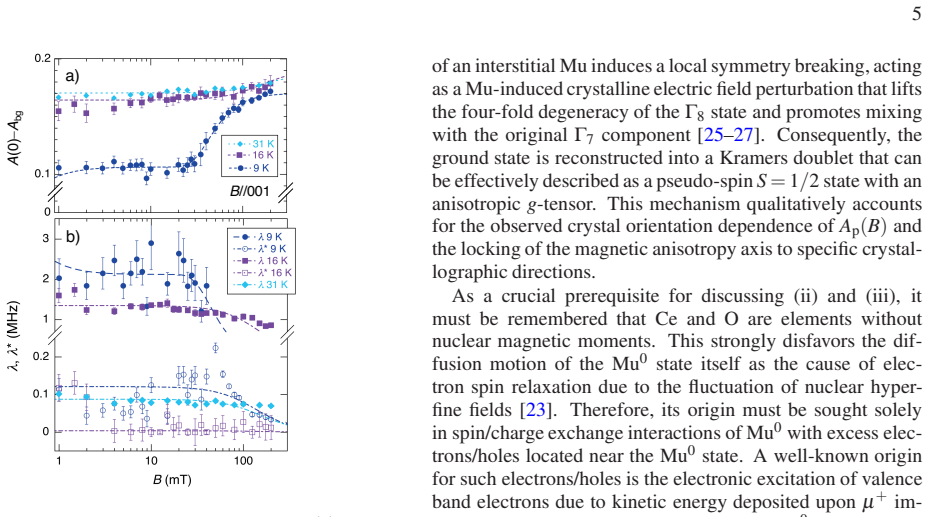
Upon positive muon implantation into CeO2, both paramagnetic Mu0 and diamagnetic Mu* states are observed below approximately 10 K. Magnetic field dependence of the Mu0 signals combined with DFT results provides evidence for the formation of a polaron state consisting of Mu bonded to a ligand oxygen and a 4f electron localized on a nearby Ce site. The crystal-orientation dependence of the Mu0 signal suggests strong anisotropy of the 4f electron due to spin-orbit coupling with lifted degeneracy. The Mu0 state exhibits transition to the Mu* state at temperatures above approximately 10 K before disappearing above approximately 30 K, suggesting rapid diffusive motion of the 4f electrons and/or Mu
What carries the argument
The polaron state consisting of Mu bonded to ligand oxygen with a 4f electron localized on a nearby Ce site, identified by magnetic-field dependence of μSR signals together with DFT calculations.
If this is right
- The 4f electron in the polaron exhibits strong anisotropy due to spin-orbit coupling with lifted degeneracy.
- The polaron state transitions to a second Mu0 configuration above 10 K that shows a diamagnetic response from fast spin or charge fluctuations.
- The state disappears above 30 K, consistent with rapid diffusive motion of the 4f electrons or the muon.
- The same diffusive behavior is expected for hydrogen itself at elevated temperatures.
Where Pith is reading between the lines
- If the polaron assignment holds, low-temperature hydrogen incorporation in ceria would involve localized 4f states that could alter local charge transport.
- The observed transition temperature sets an upper bound on the stability range of such polaron configurations in undoped ceria.
- Similar μSR signatures might appear in other fluorite-structured oxides containing 4f electrons if the same bonding geometry occurs.
Load-bearing premise
The observed μSR signals and their magnetic-field and orientation dependence can be unambiguously assigned to a static polaron configuration rather than other possible muon sites or dynamic effects, with DFT accurately reproducing the localization without adjustable parameters tuned to the data.
What would settle it
A measured hyperfine coupling or anisotropy that deviates significantly from the values predicted by DFT for the proposed Mu-O-Ce polaron geometry would falsify the assignment.
Figures
read the original abstract
The local electronic states of muon (Mu) as an isotope of hydrogen (H) in high-quality single-crystalline ceria (CeO$_2$) are investigated using muon spin rotation/relaxation ($\mu\text{SR}$) and first-principles density functional theory (DFT) calculations. Upon positive muon implantation, both paramagnetic (Mu$^0$) and diamagnetic (Mu$^*$) states are observed below $\approx$10 K. Magnetic field dependence of the Mu$^0$ signals combined with DFT results provides evidence for the formation of a polaron state, consisting of Mu bonded to a ligand oxygen and a $4f$ electron localized on a nearby Ce site. The crystal-orientation dependence of the Mu$^0$ signal suggests strong anisotropy of the $4f$ electron due to the spin-orbit coupling with lifted degeneracy. Furthermore, the Mu$^0$ state exhibits transition to the Mu$^*$ state that corresponds to another Mu$^0$ state (exhibiting a diamagnetic response due to fast spin/charge fluctuations) at temperatures above $\approx$10 K, before disappearing above $\approx$30 K. These findings suggest rapid diffusive motion of the $4f$ electrons and/or Mu (as well as H) at higher temperatures.
Editorial analysis
A structured set of objections, weighed in public.
Referee Report
Summary. The manuscript uses μSR on single-crystal CeO₂ to identify paramagnetic Mu⁰ and diamagnetic Mu* states below ~10 K. Magnetic-field and orientation dependence of the Mu⁰ signals, together with DFT calculations, are presented as evidence for a static polaron configuration in which Mu is bonded to a ligand oxygen while a 4f electron is localized on a nearby Ce site. Temperature-dependent transitions above ~10 K are interpreted as conversion to a fluctuating Mu⁰ state that disappears above ~30 K, suggesting rapid diffusion of the 4f electron or Mu/H.
Significance. If the polaron assignment and its parameter independence can be established, the work would supply direct experimental-computational evidence for hydrogen-induced small-polaron formation in ceria, a system central to catalysis and ionic conduction. The μSR–DFT combination and the reported anisotropy arising from spin-orbit coupling are potentially valuable strengths.
major comments (2)
- [DFT calculations] DFT section: the localization of the Ce 4f electron that defines the claimed polaron requires a Hubbard U correction. The manuscript does not state the U value employed, nor does it report a sensitivity test showing that the hyperfine tensor, site geometry, or agreement with the observed μSR anisotropy remains stable for U values in the conventional 4–6 eV range. Because standard GGA functionals delocalize 4f states, the robustness of the polaron assignment (and therefore the claim that field dependence plus DFT unambiguously identifies the state) cannot be evaluated without this information.
- [μSR results / magnetic-field dependence] Results on magnetic-field dependence (and abstract): the central claim that field and orientation dependence furnish evidence for the static polaron rests on the uniqueness of the assignment. No quantitative hyperfine parameters, their uncertainties, fit statistics, or explicit exclusion of alternative muon sites or dynamic regimes are supplied in the text. Without these data the interpretation cannot be checked for robustness.
minor comments (1)
- [Abstract] The abstract states that the Mu⁰ state “exhibits transition to the Mu* state that corresponds to another Mu⁰ state (exhibiting a diamagnetic response due to fast spin/charge fluctuations)”; this phrasing is internally inconsistent and should be clarified in the main text.
Simulated Author's Rebuttal
We thank the referee for the constructive and detailed comments, which have helped us improve the clarity and robustness of the manuscript. We address each major comment point by point below and have revised the manuscript to incorporate the requested information.
read point-by-point responses
-
Referee: [DFT calculations] DFT section: the localization of the Ce 4f electron that defines the claimed polaron requires a Hubbard U correction. The manuscript does not state the U value employed, nor does it report a sensitivity test showing that the hyperfine tensor, site geometry, or agreement with the observed μSR anisotropy remains stable for U values in the conventional 4–6 eV range. Because standard GGA functionals delocalize 4f states, the robustness of the polaron assignment (and therefore the claim that field dependence plus DFT unambiguously identifies the state) cannot be evaluated without this information.
Authors: We thank the referee for highlighting this omission. Our DFT calculations employed the DFT+U method with U = 5 eV applied to the Ce 4f states, a value commonly used and validated for CeO2 in the literature. We have now explicitly stated the U value in the Methods section of the revised manuscript. To demonstrate robustness, we performed additional calculations at U = 4 eV and U = 6 eV. The polaron configuration (Mu bonded to oxygen with localized 4f electron on Ce) remains stable across this range, with variations in Mu-O bond length and hyperfine tensor components below 5% and the calculated anisotropy still consistent with the experimental μSR orientation dependence. A summary table of these results will be added to the Supplementary Information. revision: yes
-
Referee: [μSR results / magnetic-field dependence] Results on magnetic-field dependence (and abstract): the central claim that field and orientation dependence furnish evidence for the static polaron rests on the uniqueness of the assignment. No quantitative hyperfine parameters, their uncertainties, fit statistics, or explicit exclusion of alternative muon sites or dynamic regimes are supplied in the text. Without these data the interpretation cannot be checked for robustness.
Authors: We agree that quantitative details are necessary to substantiate the assignment. In the revised manuscript we have added a dedicated table (new Table 1) reporting the fitted hyperfine parameters (principal values and uncertainties), the reduced χ² statistics for the global fits to the field- and orientation-dependent data, and a concise discussion excluding alternative sites. Alternative interstitial or differently coordinated Mu sites produce either isotropic or differently anisotropic tensors that are incompatible with the observed angular dependence and the field-induced decoupling behavior. Below ~10 K the signals show no temperature dependence, ruling out fast dynamics in that regime; the transition above 10 K is addressed separately in the temperature-dependence section. These additions make the uniqueness of the static polaron assignment verifiable from the text. revision: yes
Circularity Check
No significant circularity; derivation is self-contained
full rationale
The paper reports μSR measurements of Mu states in CeO2 combined with independent DFT calculations to assign a polaron configuration. No equations, fitted parameters, or self-citations are shown that reduce the claimed polaron state (Mu bonded to O with localized 4f on Ce) to an input by construction, nor does any 'prediction' collapse to a statistical fit of the same data. The magnetic-field and orientation dependence are presented as direct experimental observables matched to computed hyperfine tensors, with the DFT serving as external support rather than a closed loop. This is the normal case of an experimental-computational study without load-bearing self-referential steps.
Axiom & Free-Parameter Ledger
Reference graph
Works this paper leans on
-
[1]
The results of curve fitting using Eq
(The key point of this scenario is that it describes a transition from the initial state where depolar iza- tion occurs due to spin-singlet Mu 0 formation to the final state where it does not.) In this case, assuming Pi z(0) for B ∥ ⟨111⟩ is the polarization for the initial quasi-static Mu 0 state which is Mu0 oxy2-like, the final state polarization is give...
-
[2]
metastable
and (5) (see text for detail). ω ∥. Furthermore, the weak LF dependence of A∗ p indicates that this component is subject to the motional narrowing [ 23]. Therefore, the corresponding fluctuation frequency ν ∗ is pre- sumed to be greater than ω 0. In this case, the LF dependence of λ ∗(B) is expected to be described by Eq. ( 5) with ω i ∥ and ν replaced by ...
-
[3]
Fundamentals and catalytic applications of CeO 2-based ma- terials,
T. Montini, M. Melchionna, M. Monai, and P . Fornasiero, “Fundamentals and catalytic applications of CeO 2-based ma- terials,” Chem. Rev. 116, 5987–6041 (2016)
2016
-
[4]
Quantum origin of the oxygen storage capability of ceria,
N. V . Skorodumova, S. I. Simak, B. I. Lundqvist, I. A. Abrikosov, and B. Johansson, “Quantum origin of the oxygen storage capability of ceria,” Phys. Rev. Lett. 89, 166601 (2002)
2002
-
[5]
Studies of th e water-gas-shift reaction on ceria-supported Pt, Pd, and Rh : Im- plications for oxygen-storage properties,
T. Bunluesin, R. J. Gorte, and G. W. Graham, “Studies of th e water-gas-shift reaction on ceria-supported Pt, Pd, and Rh : Im- plications for oxygen-storage properties,” Appl. Catal. B: Envi- ronmental 15, 107–114 (1998)
1998
-
[6]
Spectro- scopic evidence for localized and extended f -symmetry states in CeO2,
E. Wuilloud, B. Delley, W. D. Schneider, and Y . Baer, “Spectro- scopic evidence for localized and extended f -symmetry states in CeO2,” Phys. Rev. Lett. 53, 202–205 (1984)
1984
-
[7]
n-type doping of oxides by hydrog en,
C. Kılıç and A. Zunger, “n-type doping of oxides by hydrog en,” Appl. Phys. Lett. 81, 73–75 (2002)
2002
-
[8]
Universal alignment of hydrogen levels in semiconductors, insulators and solutions,
Chris G. V an de Walle and J. Neugebauer, “Universal alignment of hydrogen levels in semiconductors, insulators and solutions,” Nature 423, 626–628 (2003)
2003
-
[9]
Behavior of hydrogen in h igh dielectric constant oxide gate insulators,
P . W. Peacock and J. Robertson, “Behavior of hydrogen in h igh dielectric constant oxide gate insulators,” Appl. Phys. Lett. 83, 2025–2027 (2003)
2025
-
[10]
Behavior of hydr ogen in wide band gap oxides,
K. Xiong, J. Robertson, and S. J. Clark, “Behavior of hydr ogen in wide band gap oxides,” J. Appl. Phys. 102, 083710 (2007)
2007
-
[11]
Ab initio analysis of the defect structure of ceria,
T. Zacherle, A. Schriever, R. A. De Souza, and M. Martin, “ Ab initio analysis of the defect structure of ceria,” Phys. Rev. B 87, 134104 (2013)
2013
-
[12]
Native defects, hydrogen i mpu- rities, and metal dopants in CeO 2,
K. Hoang and M. D. Johannes, “Native defects, hydrogen i mpu- rities, and metal dopants in CeO 2,” Phys. Rev. Mater. 9, 095801 (2025)
2025
-
[13]
Hydrogen as a shallow center in semic on- ductors and oxides,
C. G. V an de Walle, “Hydrogen as a shallow center in semic on- ductors and oxides,” phys. stat. sol. (b) 235, 89–95 (2003)
2003
-
[14]
Oxide muonics: II. modelling the electrical activit y of hydrogen in wide-gap and high-permittivity dielectrics ,
S. F. J. Cox, J. L. Gavartin, J. S. Lord, S. P . Cottrell, J. M. Gil, H. V . Alberto, J. Piroto Duarte, R. C. Vilão, N. Ayres de Cam- pos, D. J. Keeble, E. A. Davis, M. Charlton, and D. P . van der Werf, “Oxide muonics: II. modelling the electrical activit y of hydrogen in wide-gap and high-permittivity dielectrics ,” J. Phys.: Condens. Matt. 18, 1079–1119 (2006)
2006
-
[15]
Ambipolarity of diluted hydrogen in wide-gap oxides revea led by muon study,
M. Hiraishi, H. Okabe, A. Koda, R. Kadono, and H. Hosono, “Ambipolarity of diluted hydrogen in wide-gap oxides revea led by muon study,” J. Appl. Phys. 132, 105701 (2022)
2022
-
[16]
Ambipolarity of hydrogen in ma t- ter revealed by muons,
R. Kadono and H. Hosono, “Ambipolarity of hydrogen in ma t- ter revealed by muons,” Adv. Phys. 72, 409 (2023)
2023
-
[17]
New µ SR spectrometer at J-PARC MUSE based on Kalliope detectors,
K. M. Kojima, T. Murakami, Y . Takahashi, H. Lee, S. Y . Suzuki, A. Koda, I. Yamauchi, M. Miyazaki, M. Hiraishi, H.. Ok- abe, S. Takeshita, R. Kadono, T. Ito, W. Higemoto, S. Kanda, Y . Fukao, N. Saito, M. Saito, M. Ikeno, T. Uchida, and M. M. Tanaka, “New µ SR spectrometer at J-PARC MUSE based on Kalliope detectors,” J. Phys.: Conf. Ser. 551, 012063 (2014)
2014
-
[18]
Musrfit: A free platform- independent framework for µ SR data analysis,
A. Suter and B.M. Wojek, “Musrfit: A free platform- independent framework for µ SR data analysis,” Phys. Proc. 30, 69–73 (2012)
2012
-
[19]
Efficient iterative sche mes for ab initio total-energy calculations using a plane-wave basis set,
G. Kresse and J. Furthmüller, “Efficient iterative sche mes for ab initio total-energy calculations using a plane-wave basis set,” Phys. Rev. B 54, 11169–11186 (1996)
1996
-
[20]
From ultrasoft pseudopotent ials to the projector augmented-wave method,
G. Kresse and D. Joubert, “From ultrasoft pseudopotent ials to the projector augmented-wave method,” Phys. Rev. B 59, 1758– 1775 (1999)
1999
-
[21]
See Supplemental Material (an ancillary file) for (i) th e details of our DFT calculations for H-related defects, (ii) discuss ions on transitions in the electronic states of Mu induced by ther mal excitation, and (iii) physical parameters obtained from curve fits for the LF dependence of partial asymmetry and relaxation ra te shown in Fig. 5
-
[22]
Relaxat ion effects in nuclear magnetic resonance absorption,
N. Bloembergen, E. M. Purcell, and R. V . Pound, “Relaxat ion effects in nuclear magnetic resonance absorption,” Phys. Rev. 73, 679–712 (1948)
1948
-
[23]
Po- laronic nature of a muonium-related paramagnetic center in SrTiO3,
T. U. Ito, W. Higemoto, A. Koda, and K. Shimomura, “Po- laronic nature of a muonium-related paramagnetic center in SrTiO3,” Appl. Phys. Lett. 115, 192103 (2019)
2019
-
[24]
Charge dynam- ics of muonium centers in Si revealed by photoinduced muon spin relaxation,
R. Kadono, R. M. Macrae, and K. Nagamine, “Charge dynam- ics of muonium centers in Si revealed by photoinduced muon spin relaxation,” Phys. Rev. B 68, 245204 (2003)
2003
-
[25]
Distinguishing ion dynamics fr om muon diffusion in muon spin relaxation II –Extension to para - magnetic muons,
R. Kadono and T. U. Ito, “Distinguishing ion dynamics fr om muon diffusion in muon spin relaxation II –Extension to para - magnetic muons,” J. Phys. Soc. Jpn. 94, 064601 (2025)
2025
-
[26]
Magnetic, optical, and electron tr ans- port properties of n-type CeO 2: Small polarons versus Ander- son localization,
T. Kolodiazhnyi, T. Charoonsuk, Y .-S. Seo, S. Chang, N. Vit- tayakorn, and J. Hwang, “Magnetic, optical, and electron tr ans- port properties of n-type CeO 2: Small polarons versus Ander- son localization,” Phys. Rev. B 95, 045203 (2017)
2017
-
[27]
Crystal electric field next to a hydrog en- like interstitial– µ + in PrNi5,
R. Feyerherm, A. Amato, A. Grayevsky, F. N. Gygax, N. Ka- plan, and A. Schenck, “Crystal electric field next to a hydrog en- like interstitial– µ + in PrNi5,” Z. Phys. B 99, 3–13 (1995) . 7
1995
-
[28]
Electronic changes induced by µ + in PrIn 3: Muon-spin-rotation observation and crystalline-electric-field model calculation,
T. Tashma, A. Amato, A. Grayevsky, F. N. Gygax, M. Pinkpank, A. Schenck, and N. Kaplan, “Electronic changes induced by µ + in PrIn 3: Muon-spin-rotation observation and crystalline-electric-field model calculation,” Phys. Rev. B 56, 9397–9405 (1997)
1997
-
[29]
Quantized hyperfine field at an implanted µ + site in PrPb 3: Interplay be- tween localized f electrons and an interstitial charged particle,
T. U. Ito, W. Higemoto, K. Ohishi, N. Nishida, R. H. Heffn er, Y . Aoki, A. Amato, T. Onimaru, and H. S. Suzuki, “Quantized hyperfine field at an implanted µ + site in PrPb 3: Interplay be- tween localized f electrons and an interstitial charged particle,” Phys. Rev. Lett. 102, 096403 (2009)
2009
-
[30]
Forma- tion of hydrogen impurity states in silicon and insulators a t low implantation energies,
T. Prokscha, E. Morenzoni, D. G. Eshchenko, N. Garifiano v, H. Glückler, R. Khasanov, H. Luetkens, and A. Suter, “Forma- tion of hydrogen impurity states in silicon and insulators a t low implantation energies,” Phys. Rev. Lett. 98, 227401 (2007)
2007
-
[31]
Role of the transition state in muon implanta - tion,
R. C. Vilão, R. B. L. Vieira, H. V . Alberto, J. M. Gil, and A. Weidinger, “Role of the transition state in muon implanta - tion,” Phys. Rev. B 96, 195205 (2017)
2017
-
[32]
Barrier model in muon implantation and application t o Lu2O3,
R. C. Vilão, R. B. L. Vieira, H. V . Alberto, J. M. Gil, A. We i- dinger, R. L. Lichti, P . W. Mengyan, B. B. Baker, and J. S. Lord, “Barrier model in muon implantation and application t o Lu2O3,” Phys. Rev. B 98, 115201 (2018)
2018
-
[33]
Sapphire α -Al2O3 puzzle: Joint µ SR and density functional theory study,
R. C. Vilão, A. G. Marinopoulos, H. V . Alberto, J. M. Gil, J. S. Lord, and A. Weidinger, “Sapphire α -Al2O3 puzzle: Joint µ SR and density functional theory study,” Phys. Rev. B 103, 125202 (2021)
2021
-
[34]
Muonium reaction in semiconductors and in- sulators: The role of the transition state,
R. C. Vilão, H. V . Alberto, E. F. M. Ribeiro, J. M. Gil, and A. Weidinger, “Muonium reaction in semiconductors and in- sulators: The role of the transition state,” J. Phys.: Conf. Ser. 2462, 012056 (2023)
2023
discussion (0)
Sign in with ORCID, Apple, or X to comment. Anyone can read and Pith papers without signing in.