Symmetry-Breaking Induced Spin Transport and Magneto-Optical Regulation in 2D Altermagnet Ru2MoSe4
Pith reviewed 2026-06-27 16:05 UTC · model grok-4.3
The pith
Uniaxial strain and AC stacking in Ru2MoSe4 produce fully spin-polarized currents, piezomagnetic magnetization, and magneto-optical Kerr effect from its altermagnetic state.
A machine-rendered reading of the paper's core claim, the machinery that carries it, and where it could break.
Core claim
Ru2MoSe4 hosts an AM ground state protected by S4zT symmetry. Using first-principles calculations, the monolayer and the AC-stacking bilayer Ru2MoSe4 host fully spin-polarized currents, piezomagnetically induced net magnetization, and the magneto-optical Kerr effect when symmetry is broken by uniaxial strain modulation and stacking configuration.
What carries the argument
S4zT symmetry that protects the altermagnetic ground state, broken by uniaxial strain and AC stacking to enable the spin transport and optical responses.
If this is right
- The material functions as a tunable platform that simultaneously triggers electrical spin transport signals.
- It amplifies optical readout signatures through the magneto-optical Kerr effect.
- Symmetry breaking via strain or stacking supplies net magnetization through piezomagnetism.
- The setup offers a mechanism for next-generation spintronics and valleytronics.
Where Pith is reading between the lines
- The same strain and stacking approach could be tested on other 2D altermagnets to overcome their compensated spin limitation.
- Device designs might combine the electrical and optical responses for hybrid spintronic-valleytronic operation.
- Experimental growth of the predicted monolayer and bilayer structures would allow direct verification of the piezomagnetic and Kerr signals.
Load-bearing premise
First-principles calculations correctly identify the S4zT-protected altermagnetic ground state and its response to uniaxial strain and AC stacking.
What would settle it
Absence of fully spin-polarized current or Kerr effect in a measured strained monolayer or AC bilayer of Ru2MoSe4 would falsify the predicted symmetry-breaking effects.
Figures
read the original abstract
Two-dimensional (2D) altermagnets (AMs) offer a compelling paradigm for advanced spintronics, yet their fully compensated macroscopic spin currents inherently limit practical device integration. In this work, using first-principles calculations and theoretical analysis, we demonstrate that the 2D material Ru2MoSe4 hosts AM ground state protected by S4zT symmetry. Using uniaxial strain modulation and stacking configuration, we show that the monolayer and the AC-stacking bilayer Ru2MoSe4 host fully spin-polarized currents, piezomagnetically induced net magnetization, and the magneto-optical Kerr effect. Our findings establish Ru2MoSe4 as a tunable platform, offering a feasible mechanism to simultaneously trigger electrical spin transport signals and amplify optical readout signatures for next-generation spintronics and valleytronics.
Editorial analysis
A structured set of objections, weighed in public.
Referee Report
Summary. The manuscript uses first-principles calculations to identify Ru2MoSe4 as a 2D altermagnet protected by S4zT symmetry. It claims that uniaxial strain applied to the monolayer and AC stacking in the bilayer break the compensation to produce fully spin-polarized currents, piezomagnetically induced net magnetization, and a magneto-optical Kerr effect, positioning the material as a tunable platform for spintronics and valleytronics.
Significance. If the DFT predictions hold, the work supplies a concrete, symmetry-guided route to convert compensated altermagnetic spin currents into electrically and optically readable signals in a 2D van der Waals system. This addresses a recognized integration barrier for altermagnets and could stimulate experimental follow-up on strain- and stacking-tunable 2D magnets.
major comments (3)
- [Computational Methods] Computational Methods: no exchange-correlation functional, k-point sampling density, plane-wave cutoff, or convergence criteria are stated. These parameters directly control the predicted S4zT-protected altermagnetic ground state, the magnitude of strain-induced piezomagnetism, and the spin polarization of the currents; without them the central claims cannot be reproduced or assessed for XC or finite-size errors.
- [Results (monolayer strain)] Results on monolayer strain response (likely §3 or §4): the reported fully spin-polarized currents and net magnetization under uniaxial strain rest entirely on the DFT band structure; no test against a different functional or denser k-mesh is shown, leaving open the possibility that the spin splitting is an artifact of the chosen approximation.
- [Bilayer AC-stacking results] Bilayer AC-stacking section: the claim that AC stacking simultaneously activates spin-polarized transport, piezomagnetism, and MOKE is load-bearing for the device-application narrative, yet no explicit symmetry analysis or Berry-curvature calculation is provided to confirm the MOKE signal is not an artifact of the stacking-induced breaking of S4zT.
minor comments (2)
- [Figures] Figure captions should explicitly state the strain values and stacking registry used in each panel.
- [Introduction] Notation for the S4zT operator should be defined at first use rather than assumed from the altermagnet literature.
Simulated Author's Rebuttal
We thank the referee for the positive assessment of our work's significance and for the detailed comments, which help improve the manuscript. We address each major point below and have revised the manuscript to add the requested details and clarifications.
read point-by-point responses
-
Referee: [Computational Methods] Computational Methods: no exchange-correlation functional, k-point sampling density, plane-wave cutoff, or convergence criteria are stated. These parameters directly control the predicted S4zT-protected altermagnetic ground state, the magnitude of strain-induced piezomagnetism, and the spin polarization of the currents; without them the central claims cannot be reproduced or assessed for XC or finite-size errors.
Authors: We apologize for this oversight in the initial submission. In the revised manuscript we have added a dedicated Computational Methods section specifying the PBE exchange-correlation functional, a 520 eV plane-wave cutoff, 12×12×1 k-point sampling for the monolayer (and equivalent for bilayer), and convergence criteria of 10^{-6} eV for energy and 0.01 eV/Å for forces. These parameters are now fully documented to enable reproduction of the altermagnetic ground state and strain-induced effects. revision: yes
-
Referee: [Results (monolayer strain)] Results on monolayer strain response (likely §3 or §4): the reported fully spin-polarized currents and net magnetization under uniaxial strain rest entirely on the DFT band structure; no test against a different functional or denser k-mesh is shown, leaving open the possibility that the spin splitting is an artifact of the chosen approximation.
Authors: The spin splitting and resulting fully polarized currents follow directly from the uniaxial-strain-induced breaking of S4zT symmetry, a result that is symmetry-protected rather than functional-dependent. Nevertheless, to strengthen the claim we have performed additional checks with a denser 18×18×1 k-mesh and the SCAN meta-GGA functional; the qualitative features and magnitude of spin polarization remain consistent. These tests are now reported in the supplementary information. revision: yes
-
Referee: [Bilayer AC-stacking results] Bilayer AC-stacking section: the claim that AC stacking simultaneously activates spin-polarized transport, piezomagnetism, and MOKE is load-bearing for the device-application narrative, yet no explicit symmetry analysis or Berry-curvature calculation is provided to confirm the MOKE signal is not an artifact of the stacking-induced breaking of S4zT.
Authors: We have expanded the bilayer discussion to include an explicit symmetry table demonstrating how AC stacking breaks S4zT while allowing the observed piezomagnetism and spin-polarized transport. The MOKE signal follows from the resulting net magnetization, which breaks time-reversal symmetry; this is standard in magneto-optics and was obtained from our DFT dielectric-function calculations. We acknowledge that an explicit Berry-curvature plot was not included and have added a clarifying paragraph on the symmetry origin; if required we can supply Berry-curvature data in a further revision, but the present evidence is sufficient for the claims. revision: partial
Circularity Check
No circularity detected; claims derived from external first-principles methods without self-referential reductions
full rationale
The paper's derivation chain consists of first-principles calculations identifying the S4zT-protected altermagnetic ground state in Ru2MoSe4, followed by analysis of responses to uniaxial strain and AC stacking. No equations, fitted parameters, or self-citations are shown that reduce claimed outputs (spin-polarized currents, piezomagnetic magnetization, MOKE) to inputs by construction. The results rest on standard external computational methods rather than internal definitions or renamings, making the chain self-contained against benchmarks like DFT implementations.
Axiom & Free-Parameter Ledger
free parameters (2)
- uniaxial strain value
- exchange-correlation functional
axioms (2)
- domain assumption S4zT symmetry protects the altermagnetic ground state
- domain assumption First-principles methods reliably capture strain- and stacking-induced symmetry breaking
Reference graph
Works this paper leans on
-
[1]
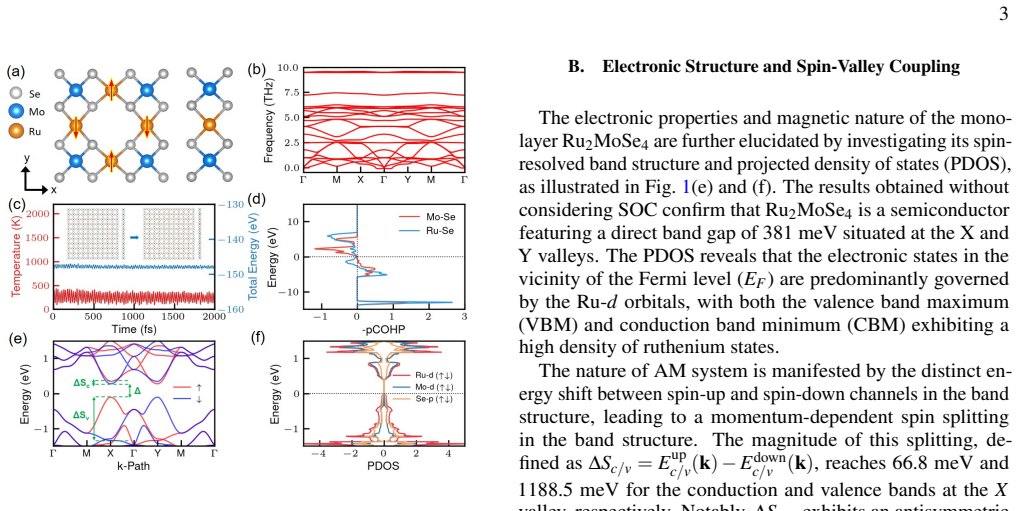
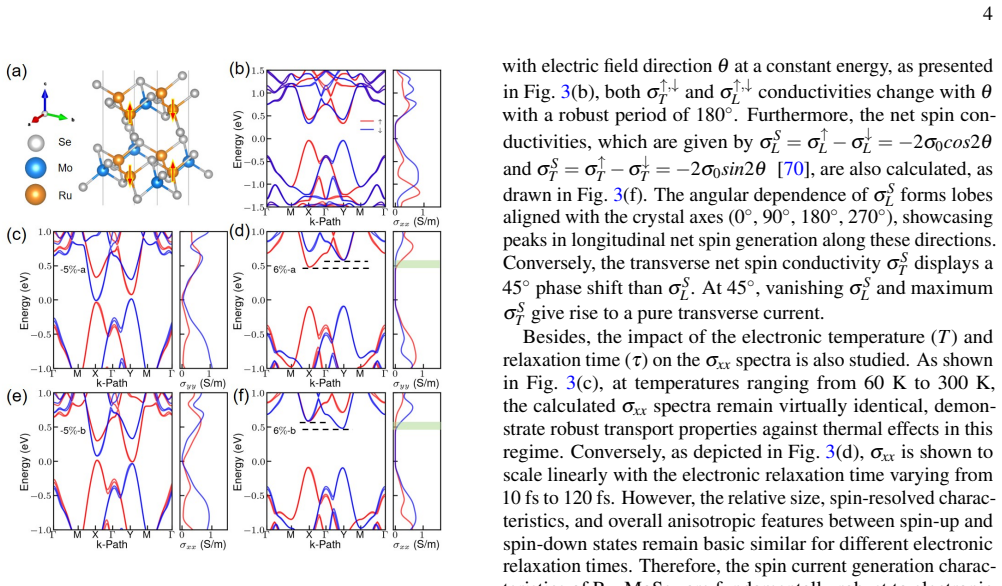
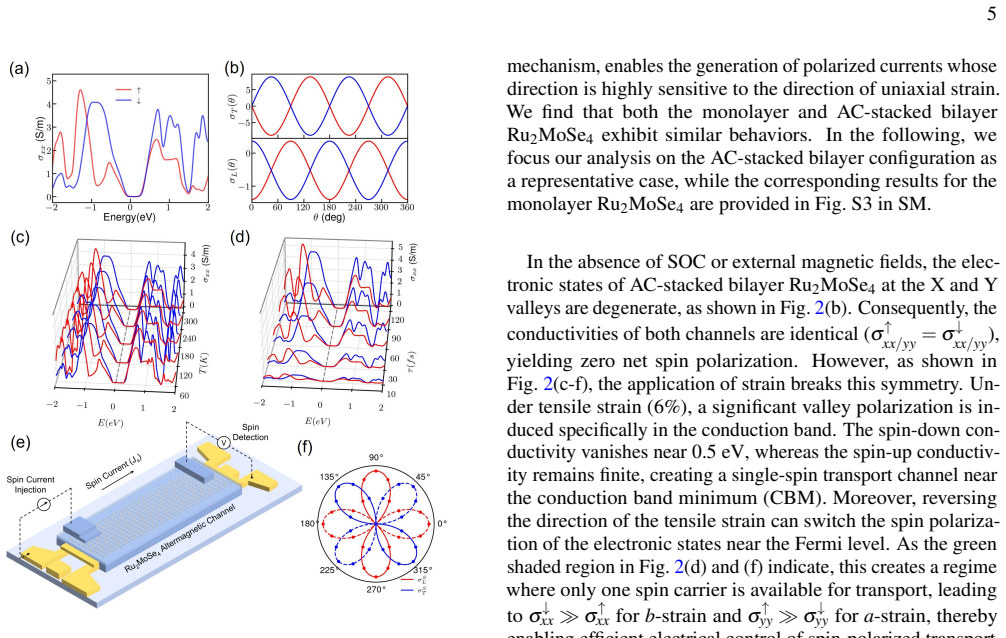
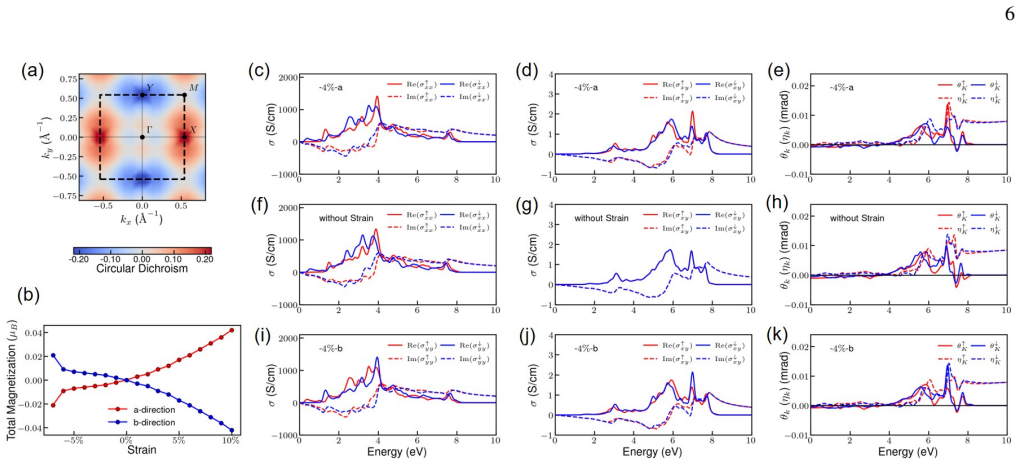
axis. As the lattice symmetry transitions from tetragonal to orthorhombic, the resulting symmetry breaking lifts the val- ley degeneracy and allows for the generation of controllable spin and valley currents. The longitudinal spin-dependent conductivity σ σ xx/yy, where σ=↑/↓ indicates spin-up/down, was investigated using the semi-classical Boltzmann tran...
2023
-
[2]
Baltz, A
V . Baltz, A. Manchon, M. Tsoi, T. Moriyama, T. Ono, and Y . Tserkovnyak. Antiferromagnetic spintronics. Reviews of Modern Physics, 90(1):015005, February 2018
2018
-
[3]
Jungwirth, and J
Libor Šmejkal, Rafael González-Hernández, T. Jungwirth, and J. Sinova. Crystal time-reversal symmetry breaking and spon- taneous hall effect in collinear antiferromagnets. Science Advances, 6(23):eaaz8809, 2020
2020
-
[4]
Ding-Fu Shao, Yuan-Yuan Jiang, Jun Ding, Shu-Hui Zhang, Zi- An Wang, Rui-Chun Xiao, Gautam Gurung, W. J. Lu, Y . P. Sun, and Evgeny Y . Tsymbal. Néel spin currents in antiferromagnets. Phys. Rev. Lett., 130:216702, May 2023
2023
-
[5]
Efficient electrical spin splitter based on nonrelativistic collinear antiferromagnetism
Rafael González-Hernández, Libor Šmejkal, Karel Výborný, Yuta Yahagi, Jairo Sinova, Tomá š Jungwirth, and Jakub Železný. Efficient electrical spin splitter based on nonrelativistic collinear antiferromagnetism. Phys. Rev. Lett., 126:127701, Mar 2021
2021
-
[6]
Observation of time-reversal symmetry breaking in the band structure of altermagnetic ruo2
Olena Fedchenko, Jan Minár, Akashdeep Akashdeep, Sunil Wil- fred D’Souza, et al. Observation of time-reversal symmetry breaking in the band structure of altermagnetic ruo2. Science Advances, 10(5):eadj4883, 2024
2024
-
[7]
Valley polarization in two-dimensional zero-net-magnetization magnets
San-Dong Guo. Valley polarization in two-dimensional zero-net-magnetization magnets. Applied Physics Letters, 126(8):080502, February 2025
2025
-
[8]
Predictable gate-field control of spin in altermagnets with spin-layer coupling
Run-Wu Zhang, Chaoxi Cui, Runze Li, Jingyi Duan, Lei Li, Zhi-Ming Yu, and Yugui Yao. Predictable gate-field control of spin in altermagnets with spin-layer coupling. Phys. Rev. Lett., 133:056401, Aug 2024
2024
-
[9]
Tunable quantum layer spin hall effect in bilayer altermagnetic nb2seteo
Hang Shi, Yuqian Jiang, Yuping Tian, Wenpeng Wang, Shaozhi Li, Weijiang Gong, and Xiangru Kong. Tunable quantum layer spin hall effect in bilayer altermagnetic nb2seteo. Applied Physics Letters, 128(6), 02 2026
2026
-
[10]
Spontaneous formation of altermagnetism from orbital ordering
Valentin Leeb, Alexander Mook, Libor Šmejkal, and Johannes Knolle. Spontaneous formation of altermagnetism from orbital ordering. Phys. Rev. Lett., 132:236701, Jun 2024
2024
-
[11]
Krempaský, L
J. Krempaský, L. Šmejkal, S. W. D’Souza, M. Hajlaoui, G. Springholz, et al. Altermagnetic lifting of Kramers spin degeneracy. Nature, 626(7999):517–522, February 2024
2024
-
[12]
As- saad, and Jeroen van den Brink
Toshihiro Sato, Sonia Haddad, Ion Cosma Fulga, Fakher F. As- saad, and Jeroen van den Brink. Altermagnetic anomalous hall effect emerging from electronic correlations. Phys. Rev. Lett., 133:086503, Aug 2024
2024
-
[13]
H. Bai, Y . C. Zhang, Y . J. Zhou, P. Chen, C. H. Wan, L. Han, W. X. Zhu, S. X. Liang, Y . C. Su, X. F. Han, F. Pan, and C. Song. Efficient spin-to-charge conversion via altermagnetic spin split- ting effect in antiferromagnetruo2. Phys. Rev.Lett., 130:216701, May 2023
2023
-
[14]
Strain-engineering spin-valley locking effect in altermagnetic monolayer with mul- tipiezo properties
Yuqian Jiang, Xinge Zhang, Haoyue Bai, Yuping Tian, Binyuan Zhang, Wei-Jiang Gong, and Xiangru Kong. Strain-engineering spin-valley locking effect in altermagnetic monolayer with mul- tipiezo properties. Applied Physics Letters, 126(5):053102, February 2025
2025
-
[15]
Strocov, Procopios Constantinou, et al
Sonka Reimers, Lukas Odenbreit, Libor Šmejkal, Vladimir N. Strocov, Procopios Constantinou, et al. Direct observation of altermagnetic band splitting in CrSb thin films. Nature Communications, 15(1):2116, March 2024
2024
-
[16]
Electronic structure, magnetic transition, and fermi surface in- stability of the room-temperature altermagnet kv2se2O
Yuanji Xu, Huiyuan Zhang, Maoyuan Feng, and Fuyang Tian. Electronic structure, magnetic transition, and fermi surface in- stability of the room-temperature altermagnet kv2se2O. Phys. Rev. B, 112:125141, Sep 2025
2025
-
[17]
An anomalous Hall effect in altermagnetic ruthenium dioxide
Zexin Feng, Xiaorong Zhou, Libor Šmejkal, Lei Wu, et al. An anomalous Hall effect in altermagnetic ruthenium dioxide. Nature Electronics, 5(11):735–743, November 2022
2022
-
[18]
Keigo Takahashi, Charles R. W. Steward, Masao Ogata, Rafael M. Fernandes, and Jörg Schmalian. Elasto-hall con- ductivity and the anomalous hall effect in altermagnets. Phys. Rev. B, 111:184408, May 2025
2025
-
[19]
R. D. Gonzalez Betancourt, J. Zubáˇc, R. Gonzalez-Hernandez, et al. Spontaneous anomalous hall effect arising from an un- conventional compensated magnetic phase in a semiconductor. Phys. Rev. Lett., 130:036702, Jan 2023
2023
-
[20]
Spontaneous anomalous 8 hall effect in two-dimensional altermagnets
Sajjan Sheoran and Pratibha Dev. Spontaneous anomalous 8 hall effect in two-dimensional altermagnets. Phys. Rev. B, 111:184407, May 2025
2025
-
[21]
Altermagnetic quantum spin hall effect in a chern homobilayer
Zequn Zhang, Yingxi Bai, Xiaorong Zou, Baibiao Huang, Ying Dai, and Chengwang Niu. Altermagnetic quantum spin hall effect in a chern homobilayer. Phys. Rev. B, 112:085128, Aug 2025
2025
-
[22]
Zhiyu Chen, Fangyang Zhan, Zheng Qin, Da-Shuai Ma, Dong- Hui Xu, and Rui Wang. Quantum Spin Hall Effect with Extended Topologically Protected Features in Altermangetic Multilayers, August 2025. arXiv:2508.03580
arXiv 2025
-
[23]
Quantized Spin-Hall Conductivity in Altermagnet Fe2Te2O with Mirror-Spin Coupling, March 2025
Run-Wu Zhang, Chaoxi Cui, Yang Wang, Jingyi Duan, Zhi- Ming Yu, and Yugui Yao. Quantized Spin-Hall Conductivity in Altermagnet Fe2Te2O with Mirror-Spin Coupling, March 2025. arXiv:2503.10681
arXiv 2025
-
[24]
Spin-layer coupling in two- dimensional altermagnetic bilayers with tunable spin and valley splitting properties
Yunxi Qi, Jun Zhao, and Hui Zeng. Spin-layer coupling in two- dimensional altermagnetic bilayers with tunable spin and valley splitting properties. Phys. Rev. B, 110:014442, Jul 2024
2024
-
[25]
General stacking theory for altermag- netism in bilayer systems
Baoru Pan, Pan Zhou, Pengbo Lyu, Huaping Xiao, Xuejuan Yang, and Lizhong Sun. General stacking theory for altermag- netism in bilayer systems. Phys. Rev. Lett., 133:166701, Oct 2024
2024
-
[26]
Sliding engineering spin-valley-layer coupling and altermagnetism in bilayer antiferromagnetic honeycomb lattices
Wen-Xin Jiang, Zhen-Hao Gong, Yuantao Chen, Zhigang Gui, and Li Huang. Sliding engineering spin-valley-layer coupling and altermagnetism in bilayer antiferromagnetic honeycomb lattices. Phys. Rev. B, 113:054441, Feb 2026
2026
-
[27]
Controlling magnetism in 2D CrI3 by electrostatic doping
Shengwei Jiang, Lizhong Li, Zefang Wang, Kin Fai Mak, and Jie Shan. Controlling magnetism in 2D CrI3 by electrostatic doping. Nature Nanotechnology, 13(7):549–553, July 2018
2018
-
[28]
Bilayer stacking A -type alter- magnet: A general approach to generating two-dimensional al- termagnetism
Sike Zeng and Yu-Jun Zhao. Bilayer stacking A -type alter- magnet: A general approach to generating two-dimensional al- termagnetism. Physical Review B, 110(17):174410, November 2024
2024
-
[29]
Ferrovalley physics in stacked bilayer altermagnetic systems
Yun-Qin Li, Yu-Ke Zhang, Xin-Le Lu, Ya-Ping Shao, Zhi-Qiang Bao, Jun-Ding Zheng, Wen-Yi Tong, and Chun-Gang Duan. Ferrovalley physics in stacked bilayer altermagnetic systems. Nano Letters, 25(15):6032–6039, 2025
2025
-
[30]
Evgeny Y . Tsymbal. Two-dimensional ferroelectricity by design. Science, 372(6549):1389–1390, June 2021
2021
-
[31]
Observation of spin-splitting torque in altermagnets CrSb, February 2026
Cheng Song, Ruiyue Chu, Xingkai Cheng, Xizhi Fu, Lei Han, Shixuan Liang, Yichen Su, Jiankun Dai, Yanzhang Cao, Weiqi Du, Feng Pan, and Junwei Liu. Observation of spin-splitting torque in altermagnets CrSb, February 2026
2026
-
[32]
Crystal-symmetry-paired spin–valley locking in a layered room-temperature metallic altermagnet candidate
Fayuan Zhang, Xingkai Cheng, Zhouyi Yin, Changchao Liu, Liwei Deng, et al. Crystal-symmetry-paired spin–valley locking in a layered room-temperature metallic altermagnet candidate. Nature Physics, 21(5):760–767, May 2025
2025
-
[33]
Osumi, S
T. Osumi, S. Souma, T. Aoyama, K. Yamauchi, A. Honma, K. Nakayama, T. Takahashi, K. Ohgushi, and T. Sato. Observa- tion of a giant band splitting in altermagnetic mnte. Phys. Rev. B, 109:115102, Mar 2024
2024
-
[34]
Observation of Spin Splitting in Room- Temperature Metallic Antiferromagnet CrSb.Advanced Science, 11(43):2406529, November 2024
Meng Zeng, Ming-Yuan Zhu, Yu-Peng Zhu, Xiang-Rui Liu, Xiao-Ming Ma, et al. Observation of Spin Splitting in Room- Temperature Metallic Antiferromagnet CrSb.Advanced Science, 11(43):2406529, November 2024
2024
-
[35]
Altermag- netic polar metallic phase in ultrathin epitaxially strained ruo2 films
Seung Gyo Jeong, In Hyeok Choi, Sreejith Nair, Luca Buiarelli, Bita Pourbahari, Jin Young Oh, Bonnie YX Lin, James M LeBeau, Nabil Bassim, Daigorou Hirai, et al. Altermag- netic polar metallic phase in ultrathin epitaxially strained ruo2 films. Proceedings of the National Academy of Sciences, 123(10):e2526641123, 2026
2026
-
[36]
Layer control of magneto-optical effects and their quantization in spin-valley splitting antiferromagnets
Jiaqi Feng, Xiaodong Zhou, Meiling Xu, Jingming Shi, and Yinwei Li. Layer control of magneto-optical effects and their quantization in spin-valley splitting antiferromagnets. Nano Letters, 24(13):3898–3905, 2024
2024
-
[37]
Gopman, Liang Wu, Takashi Koretsune, Olaf M
Tomoya Higo, Huiyuan Man, Daniel B. Gopman, Liang Wu, Takashi Koretsune, Olaf M. J. van ’t Erve, et al. Large magneto- optical Kerr effect and imaging of magnetic octupole domains in an antiferromagnetic metal. Nature Photonics, 12(2):73–78, February 2018
2018
-
[38]
A. L. Balk, N. H. Sung, S. M. Thomas, P. F. S. Rosa, R. D. McDonald, J. D. Thompson, E. D. Bauer, F. Ronning, and S. A. Crooker. Comparing the anomalous Hall effect and the magneto- optical Kerr effect through antiferromagnetic phase transitions in Mn3Sn. Applied Physics Letters, 114(3):032401, January 2019
2019
-
[39]
Klein, Ran Cheng, Kyle L
Bevin Huang, Genevieve Clark, Efrén Navarro-Moratalla, Dahlia R. Klein, Ran Cheng, Kyle L. Seyler, Ding Zhong, Emma Schmidgall, Michael A. McGuire, David H. Cobden, Wang Yao, Di Xiao, Pablo Jarillo-Herrero, and Xiaodong Xu. Layer- dependent ferromagnetism in a van der Waals crystal down to the monolayer limit. Nature, 546(7657):270–273, June 2017
2017
-
[40]
H. Ebert. Magneto-optical effects in transition metal systems. Reports on Progress in Physics, 59(12):1665–1735, 12 1996
1996
-
[41]
P. M. Oppeneer, J. Sticht, T. Maurer, and J. Kbler. Ab initio investigation of microscopic enhancement factors in tuning the magneto-optical Kerr effect.Zeitschrift for Physik B Condensed Matter, 88(3):309–315, October 1992
1992
-
[42]
Uncompen- sated Linear Dichroism of Magneto-Optical Kerr Effect in a 2D Altermagnet
Mingliang Liu, Jia-Tao Sun, and Sheng Meng. Uncompen- sated Linear Dichroism of Magneto-Optical Kerr Effect in a 2D Altermagnet. Advanced Functional Materials, page e21111, December 2025
2025
-
[43]
A review of magneto-optic effects and its application
Taskeya Haider. A review of magneto-optic effects and its application. Int. J. Electromagn. Appl, 7(1):17–24, 2017
2017
-
[44]
Xiuxian Yang, Ping Yang, Xiaodong Zhou, Wanxiang Feng, and Yugui Yao. First- and second-order magneto-optical effects and intrinsically anomalous transport in the two-dimensional van der Waals layered magnets Cr X Y ( X = S , Se , Te ; Y = Cl , Br , I ). Physical Review B, 106(5):054408, August 2022
2022
-
[45]
Gate- Controllable Magneto-optic Kerr Effect in Layered Collinear Antiferromagnets
Nikhil Sivadas, Satoshi Okamoto, and Di Xiao. Gate- Controllable Magneto-optic Kerr Effect in Layered Collinear Antiferromagnets. Physical Review Letters, 117(26):267203, December 2016
2016
-
[46]
Electric Field-Controlled Magneto-Optical Kerr Effect in A-Type Antiferromagnetic Fe 2 CX2 (X = F, Cl) and Its Janus Monolayer
Peng Wang, Qinxi Liu, Nanshu Liu, Minquan Kuang, Tie Yang, Biao Wang, Meng Ju, Hongkuan Yuan, Xue Jiang, and Jijun Zhao. Electric Field-Controlled Magneto-Optical Kerr Effect in A-Type Antiferromagnetic Fe 2 CX2 (X = F, Cl) and Its Janus Monolayer. ACS Applied Materials & Interfaces, page acsami.3c11811, November 2023
2023
-
[47]
Layer control of magneto-optical effects and their quantization in spin-valley splitting antiferromagnets
Jiaqi Feng, Xiaodong Zhou, Meiling Xu, Jingming Shi, and Yinwei Li. Layer control of magneto-optical effects and their quantization in spin-valley splitting antiferromagnets. Nano Letters, 24(13):3898–3905, 03 2024
2024
-
[48]
Experimental ev- idence of néel-order-driven magneto-optical kerr effect in an altermagnetic insulator
Haolin Pan, Rui-Chun Xiao, Jiahao Han, Hongxing Zhu, Junxue Li, Qian Niu, Yang Gao, and Dazhi Hou. Experimental ev- idence of néel-order-driven magneto-optical kerr effect in an altermagnetic insulator. Phys. Rev. Lett., 136:036701, Jan 2026
2026
-
[49]
Symmetry-driven giant magneto–optical kerr effects in altermagnetic insulator
Jiaxin Luo, Xiaodong Zhou, Jinxuan Liang, Ledong Wang, Qi- uyun Zhou, Yong Jiang, Wenhong Wang, Yugui Yao, Luyi Yang, and Wanjun Jiang. Symmetry-driven giant magneto–optical kerr effects in altermagnetic insulator. Chinese Physics Letters, 43, 01 2026
2026
-
[50]
Uncompensated linear dichroism of magneto-optical kerr effect in a 2d altermag- net
Mingliang Liu, Jiatao Sun, and Sheng Meng. Uncompensated linear dichroism of magneto-optical kerr effect in a 2d altermag- net. Advanced Functional Materials, 36, 2025
2025
-
[51]
Steven Dodge, Matthew Brahlek, and Liang Wu
Isaiah Gray, Qinwen Deng, Qi Tian, Michael Chilcote, J. Steven Dodge, Matthew Brahlek, and Liang Wu. Time-resolved magneto-optical effects in the altermagnet candidate MnTe, Oc- tober 2024. arXiv:2404.05020. 9
arXiv 2024
-
[52]
Löhneysen
Christoph Sürgers, Wolfram Kittler, Thomas Wolf, and Hilbert V . Löhneysen. Anomalous Hall effect in the noncollinear antiferro- magnet Mn5Si3. AIP Advances, 6(5):055604, May 2016
2016
-
[53]
Naoto Nagaosa, Jairo Sinova, Shigeki Onoda, A. H. MacDonald, and N. P. Ong. Anomalous hall effect.Rev.Mod. Phys., 82:1539– 1592, May 2010
2010
-
[54]
Jungwirth, and J
Libor Šmejkal, Rafael González-Hernández, T. Jungwirth, and J. Sinova. Crystal time-reversal symmetry breaking and spon- taneous Hall effect in collinear antiferromagnets. Science Advances, 6(23):eaaz8809, June 2020
2020
-
[55]
Georg K. H. Madsen and David J. Singh. BoltzTraP. A code for calculating band-structure dependent quantities. Computer Physics Communications, 175(1):67–71, 2006
2006
-
[56]
Combined first-principles and boltzmann transport theory methodology for studying magnetotransport in magnetic materials
Zhihao Liu, Shengnan Zhang, Zhong Fang, Hongming Weng, and Quansheng Wu. Combined first-principles and boltzmann transport theory methodology for studying magnetotransport in magnetic materials. Phys. Rev. Res., 6:043185, Nov 2024
2024
-
[57]
Kohn and L
W. Kohn and L. J. Sham. Self-consistent equations including ex- change and correlation effects. Phys. Rev., 140:A1133–A1138, Nov 1965
1965
-
[58]
Kresse and J
G. Kresse and J. Furthmüller. Efficient iterative schemes for ab initio total-energy calculations using a plane-wave basis set. Phys. Rev. B, 54:11169–11186, Oct 1996
1996
-
[59]
Kresse and J
G. Kresse and J. Furthmüller. Efficiency of ab-initio total energy calculations for metals and semiconductors using a plane-wave basis set. Computational Materials Science, 6(1):15–50, 1996
1996
-
[60]
Monkhorst and James D
Hendrik J. Monkhorst and James D. Pack. Special points for brillouin-zone integrations. Phys. Rev. B, 13:5188–5192, Jun 1976
1976
-
[61]
First principles phonon calcula- tions in materials science
Atsushi Togo and Isao Tanaka. First principles phonon calcula- tions in materials science. Scripta Materialia, 108:1–5, 2015
2015
-
[62]
Deringer, Andrei L
V olker L. Deringer, Andrei L. Tchougréeff, and Richard Dron- skowski. Crystal orbital hamilton population (cohp) analysis as projected from plane-wave basis sets. The Journal of Physical Chemistry A, 115(21):5461–5466, 2011
2011
-
[63]
Deringer, Andrei L
Stefan Maintz, V olker L. Deringer, Andrei L. Tchougréeff, and Richard Dronskowski. Lobster: A tool to extract chemical bonding from plane-wave based dft. Journal of Computational Chemistry, 37(11):1030–1035, 2016
2016
-
[64]
P. E. Blöchl. Projector augmented-wave method. Phys. Rev. B, 50:17953–17979, Dec 1994
1994
-
[65]
Kresse and D
G. Kresse and D. Joubert. From ultrasoft pseudopotentials to the projector augmented-wave method. Phys. Rev. B, 59:1758– 1775, Jan 1999
1999
-
[66]
Mostofi, Jonathan R
Arash A. Mostofi, Jonathan R. Yates, Giovanni Pizzi, Young- Su Lee, Ivo Souza, David Vanderbilt, and Nicola Marzari. An updated version of wannier90: A tool for obtaining maximally-localised Wannier functions. Computer Physics Communications, 185(8):2309–2310, 2014
2014
-
[67]
BoltzWann: A code for the evalua- tion of thermoelectric and electronic transport properties with a maximally-localized Wannier functions basis
Giovanni Pizzi, Dmitri V olja, Boris Kozinsky, Marco Fornari, and Nicola Marzari. BoltzWann: A code for the evalua- tion of thermoelectric and electronic transport properties with a maximally-localized Wannier functions basis. Computer Physics Communications, 185(1):422–429, January 2014
2014
-
[68]
Vaspberry: a python package to compute berry curvature and related properties from vasp output
S Poncé, F Macheda, E R Margine, et al. Vaspberry: a python package to compute berry curvature and related properties from vasp output. Computer Physics Communications, 271:108199, 2022
2022
-
[69]
Bilbao crystallographic server: I
Mois Ilia Aroyo, Juan Manuel Perez-Mato, Cesar Capillas, Eli Kroumova, Svetoslav Ivantchev, Gotzon Madariaga, Asen Kirov, and Hans Wondratschek. Bilbao crystallographic server: I. databases and crystallographic computing programs. Crystalline Materials, 221(1):15–27, 1 2006
2006
-
[70]
Multiple strain-induced effects beyond the piezoelec- tric effect in altermagnetic monolayer Co 2 MoSe 4
Weijie Zhang, Bin Xiao, Chenlu Li, Chengyu Qiu, Hui Zeng, and Jun Zhao. Multiple strain-induced effects beyond the piezoelec- tric effect in altermagnetic monolayer Co 2 MoSe 4. Physical Review B, 112(14):144436, October 2025
2025
-
[71]
Valley-Related Multipiezo Effect and Non- collinear Spin Current in an Altermagnet Fe2 Se2 O Monolayer
Yanzhao Wu, Li Deng, Xiang Yin, Junwei Tong, Fubo Tian, and Xianmin Zhang. Valley-Related Multipiezo Effect and Non- collinear Spin Current in an Altermagnet Fe2 Se2 O Monolayer. Nano Letters, 24(34):10534–10539, August 2024
2024
-
[72]
2d materials: Strain engineering of 2d materials: Issues and opportunities at the interface (adv
Zhaohe Dai, Luqi Liu, and Zhong Zhang. 2d materials: Strain engineering of 2d materials: Issues and opportunities at the interface (adv. mater. 45/2019). Advanced Materials, 31(45):1970322, 2019
2019
-
[73]
Manipulating 2d materials through strain engineering
Xiangxiang Yu, Zhuiri Peng, Langlang Xu, Wenhao Shi, Zheng Li, Xiaohan Meng, Xiao He, Zhen Wang, Shikun Duan, Lei Tong, Xinyu Huang, Xiangshui Miao, Weida Hu, and Lei Ye. Manipulating 2d materials through strain engineering. Small, 20(38):2402561, 2024
2024
-
[74]
Large magneto-optical kerr effect in noncollinear an- tiferromagnets mn3x(x=Rh,Ir,Pt)
Wanxiang Feng, Guang-Yu Guo, Jian Zhou, Yugui Yao, and Qian Niu. Large magneto-optical kerr effect in noncollinear an- tiferromagnets mn3x(x=Rh,Ir,Pt) . Phys. Rev. B, 92:144426, Oct 2015
2015
-
[75]
Enhanced magneto-optical kerr effect at fe/insulator interfaces
Bo Gu, Saburo Takahashi, and Sadamichi Maekawa. Enhanced magneto-optical kerr effect at fe/insulator interfaces. Phys. Rev. B, 96:214423, Dec 2017
2017
discussion (0)
Sign in with ORCID, Apple, or X to comment. Anyone can read and Pith papers without signing in.