Designing electronic magnetoelectric matter with organic quantum spin trimers
Pith reviewed 2026-06-27 15:13 UTC · model grok-4.3
The pith
Organic quantum spin trimers generate electric dipoles via electronic fluctuations and organize them into collective magnetoelectric states through geometric frustration.
A machine-rendered reading of the paper's core claim, the machinery that carries it, and where it could break.
Core claim
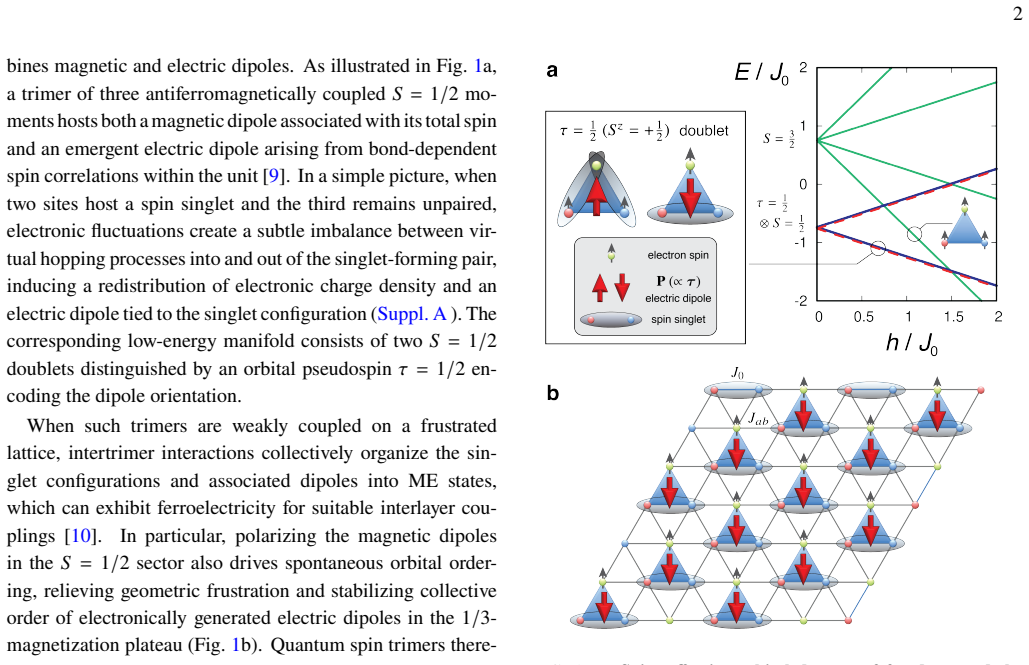
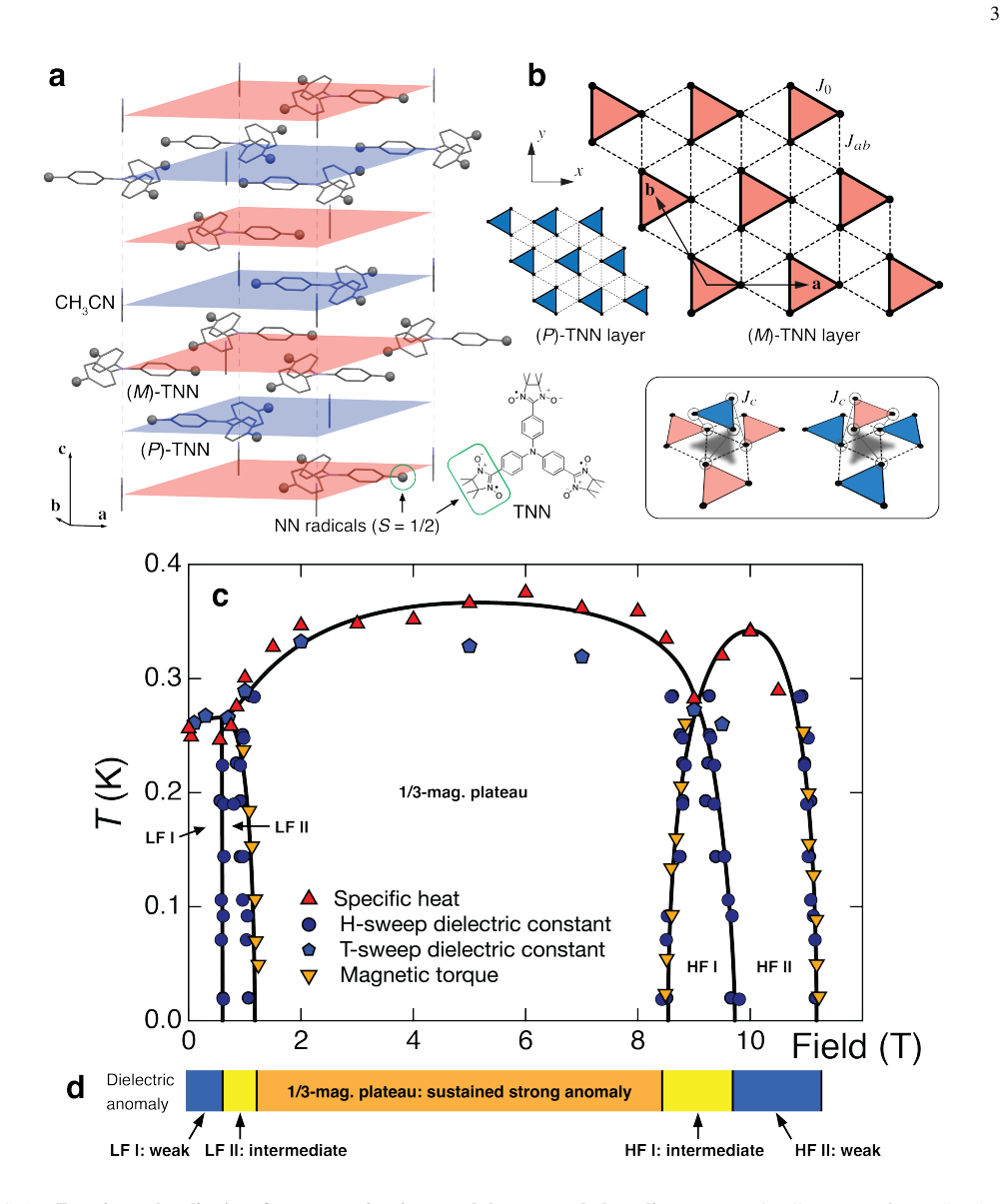
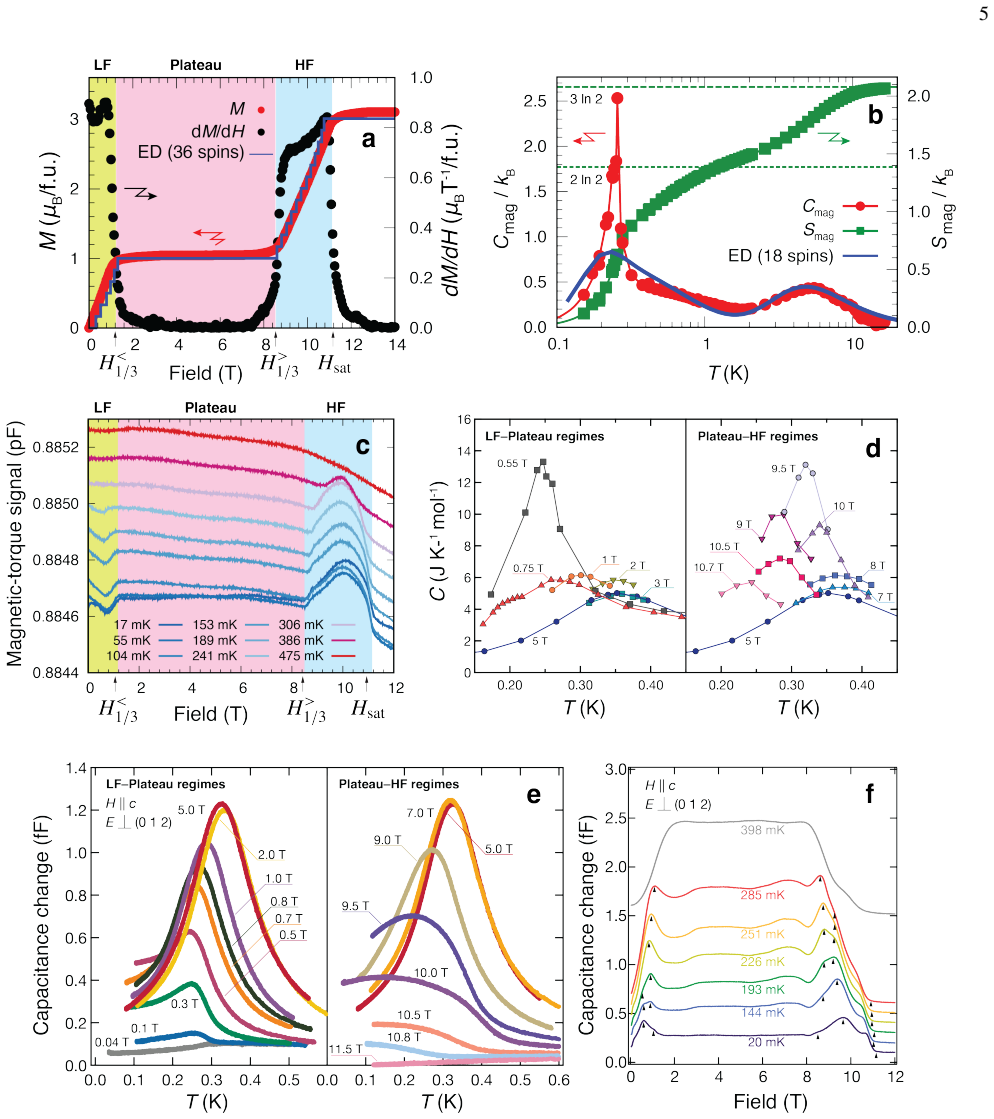
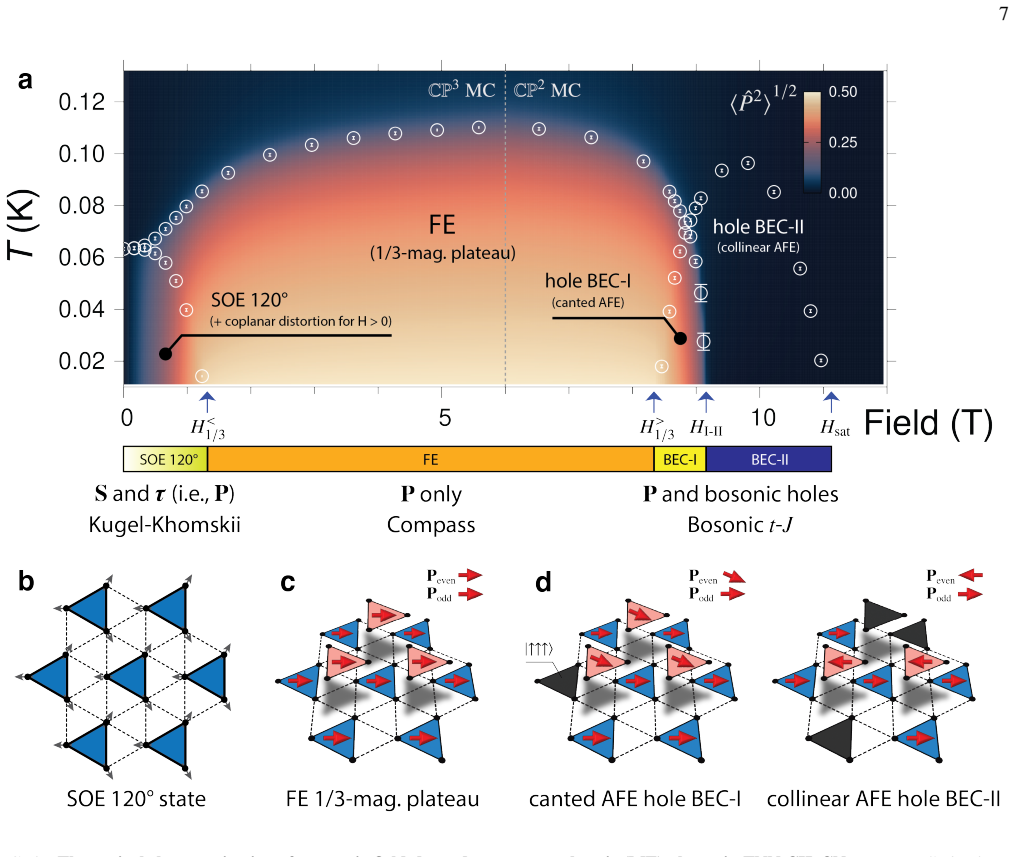
In TNN·CH3CN, correlated electronic fluctuations within each trimer generate electric dipoles, while geometrically frustrated intertrimer interactions organize them into collective ME states, as evidenced by multiple magnetic-field-induced phases including the 1/3-magnetization plateau marked by pronounced dielectric anomalies. Effective low-energy theories and numerical simulations show that these phenomena are driven by electronically generated trimer dipoles whose collective order is stabilized by frustration relief of the intertrimer interactions, establishing a direct connection between geometric frustration and emergent magnetoelectricity.
What carries the argument
The equilateral S=1/2 spin trimer, whose correlated electronic fluctuations intrinsically generate electric dipoles that interact via geometric frustration to produce collective magnetoelectric order.
If this is right
- Multiple magnetic-field-induced phases appear, including a 1/3-magnetization plateau marked by pronounced dielectric anomalies.
- The dielectric response originates from electronically generated trimer dipoles whose collective order is stabilized by frustration relief.
- Quantum spin trimers function as multifunctional building blocks for designing correlated magnetoelectric materials from electronically active quantum spin clusters.
- Geometric frustration provides a direct route to emergent magnetoelectricity without relying on spin-lattice coupling.
Where Pith is reading between the lines
- This molecular design could be extended to other organic radical crystals containing spin trimers by chemical substitution to adjust frustration strength and tune the ME phases.
- Analogous electronic dipole generation might be identifiable in inorganic triangular-lattice magnets if similar fluctuation-driven mechanisms can be isolated from lattice effects.
- Low-energy effective theories for the trimer dipoles could be used to predict additional field-induced phases or temperature scales in related frustrated cluster systems.
Load-bearing premise
The dielectric response arises specifically from electronically generated trimer dipoles in a weakly coupled lattice of equilateral S=1/2 spin trimers rather than from conventional spin-lattice coupling or extrinsic effects.
What would settle it
Dielectric measurements on a modified crystal with the same trimer spin structure but suppressed electronic fluctuations (for example by altering the organic framework) that show no anomalies at the 1/3-magnetization plateau would falsify the electronic dipole mechanism.
Figures
read the original abstract
Magnetoelectric (ME) phenomena are commonly driven by spin-lattice coupling. Here we demonstrate a different route based on frustrated quantum spin trimers that intrinsically intertwine magnetic moments and electric dipoles. Using molecular design principles, we realize a weakly coupled lattice of equilateral $S=1/2$ spin trimers in the organic radical crystal TNN$\cdot$CH$_3$CN. In this material, correlated electronic fluctuations within each trimer generate electric dipoles, while geometrically frustrated intertrimer interactions organize them into collective ME states. Magnetization, thermodynamic, and dielectric measurements reveal multiple magnetic-field-induced phases, including the $1/3$-magnetization plateau marked by pronounced dielectric anomalies. Effective low-energy theories and numerical simulations show that these phenomena are driven by electronically generated trimer dipoles whose collective order is stabilized by frustration relief of the intertrimer interactions, establishing a direct connection between geometric frustration and emergent magnetoelectricity. Our results identify quantum spin trimers as multifunctional building blocks, providing a bottom-up route for designing correlated ME materials from electronically active quantum spin clusters.
Editorial analysis
A structured set of objections, weighed in public.
Referee Report
Summary. The manuscript claims to demonstrate magnetoelectric phenomena in the organic radical crystal TNN·CH3CN via a weakly coupled lattice of equilateral S=1/2 quantum spin trimers. Correlated electronic fluctuations within each trimer are said to intrinsically generate electric dipoles, which are organized into collective ME states by geometrically frustrated intertrimer interactions. This is evidenced by magnetization, thermodynamic, and dielectric measurements revealing multiple field-induced phases (including a 1/3-magnetization plateau with pronounced dielectric anomalies), together with effective low-energy theories and numerical simulations that link the phenomena to electronically generated trimer dipoles stabilized by frustration relief.
Significance. If the central interpretation is confirmed, the work identifies quantum spin trimers as multifunctional building blocks and provides a bottom-up molecular-design route to correlated magnetoelectric materials that is distinct from conventional spin-lattice coupling. This would directly connect geometric frustration to emergent magnetoelectricity and expand the design space for quantum materials.
major comments (2)
- [Abstract] Abstract: the claim that 'measurements and simulations support the claim' and that dielectric anomalies arise specifically from electronically generated trimer dipoles rests on an unverified interpretation; no details are supplied on data quality, error bars, simulation parameters, or quantitative linkage between the anomalies and trimer dipoles, leaving the central claim load-bearing on an assumption that standard thermodynamic/dielectric data alone cannot distinguish from conventional spin-lattice coupling.
- [Driving mechanism description] Driving mechanism (abstract and associated discussion): the weakest assumption—that the material realizes a weakly coupled lattice of equilateral S=1/2 trimers whose dielectric response originates from electronic fluctuations rather than spin-lattice coupling or extrinsic lattice effects—is not supported by direct microscopic validation (e.g., ab initio dipole calculations or isotope-effect tests). This is a correctness-risk concern because the effective low-energy theories and simulations presuppose the electronic origin; a concrete test would be required to falsify the conventional mechanism.
Simulated Author's Rebuttal
We thank the referee for their careful reading of the manuscript and for highlighting points that require clarification. We address each major comment below, providing additional context from the full text and indicating where revisions will be made.
read point-by-point responses
-
Referee: [Abstract] Abstract: the claim that 'measurements and simulations support the claim' and that dielectric anomalies arise specifically from electronically generated trimer dipoles rests on an unverified interpretation; no details are supplied on data quality, error bars, simulation parameters, or quantitative linkage between the anomalies and trimer dipoles, leaving the central claim load-bearing on an assumption that standard thermodynamic/dielectric data alone cannot distinguish from conventional spin-lattice coupling.
Authors: The abstract is intentionally concise. The full manuscript supplies the requested details: experimental figures include error bars and data quality metrics; simulation parameters and the effective Hamiltonian are specified in the methods and theory sections; and the linkage between dielectric anomalies and trimer dipoles is quantified by showing that the field positions of the anomalies coincide with the 1/3-magnetization plateau and match the predictions of the low-energy trimer model (including frustration-relief terms) without additional spin-lattice coupling. We will revise the abstract to reference these supporting elements explicitly. revision: partial
-
Referee: [Driving mechanism description] Driving mechanism (abstract and associated discussion): the weakest assumption—that the material realizes a weakly coupled lattice of equilateral S=1/2 trimers whose dielectric response originates from electronic fluctuations rather than spin-lattice coupling or extrinsic lattice effects—is not supported by direct microscopic validation (e.g., ab initio dipole calculations or isotope-effect tests). This is a correctness-risk concern because the effective low-energy theories and simulations presuppose the electronic origin; a concrete test would be required to falsify the conventional mechanism.
Authors: We agree that the manuscript does not contain direct microscopic validation such as ab initio dipole calculations or isotope-substitution experiments. The equilateral trimer geometry follows from the reported crystal structure, and the electronic origin is inferred from the absence of detectable lattice anomalies in the thermodynamic data together with the quantitative match between the observed phase diagram and the purely electronic trimer-dipole model. We will add an explicit limitations paragraph in the discussion section acknowledging the indirect nature of the evidence and outlining possible future tests. revision: yes
Circularity Check
No circularity; derivation rests on independent measurements and simulations
full rationale
The paper's central claims are supported by magnetization, thermodynamic, and dielectric measurements on TNN·CH3CN, combined with effective low-energy theories and numerical simulations of a weakly coupled trimer lattice. No load-bearing step reduces a prediction to a fitted parameter by construction, nor does any uniqueness theorem or ansatz trace exclusively to self-citation. The attribution of dielectric anomalies to electronically generated trimer dipoles is presented as an interpretation of the data rather than a definitional equivalence, and external benchmarks (experimental phases, 1/3 plateau) remain falsifiable outside the model's fitted values. This is the normal case of a self-contained experimental-theoretical study.
Axiom & Free-Parameter Ledger
Reference graph
Works this paper leans on
-
[1]
Khomskii, Classifying multiferroics: Mechanisms and ef- fects, Physics2, 20 (2009)
D. Khomskii, Classifying multiferroics: Mechanisms and ef- fects, Physics2, 20 (2009)
2009
-
[2]
Y.Tokura,S.Seki,andN.Nagaosa,Multiferroicsofspinorigin, Rep. Prog. Phys.77, 076501 (2014)
2014
-
[3]
Cheong and M
S. Cheong and M. Mostovoy, Multiferroics: a magnetic twist for ferroelectricity, Nature Mater.6, 13 (2007)
2007
-
[4]
Bibes and A
M. Bibes and A. Barthélémy, Towards a magnetoelectric mem- ory, Nature Materials7, 425 (2008)
2008
-
[5]
Phys.64, 519 (2015)
S.Dong,J.-M.Liu,S.-W.Cheong,andZ.Ren,Multiferroicma- terials and magnetoelectric physics: symmetry, entanglement, excitation, and topology, Adv. Phys.64, 519 (2015)
2015
-
[6]
Katsura, N
H. Katsura, N. Nagaosa, and A. V. Balatsky, Spin current and magnetoelectriceffectinnoncollinearmagnets,Phys.Rev.Lett. 95, 057205 (2005)
2005
-
[7]
I. A. Sergienko and E. Dagotto, Role of the Dzyaloshinskii- Moriya interaction in multiferroic perovskites, Phys. Rev. B73, 10 094434 (2006)
2006
-
[8]
M.Mostovoy,Multiferroics: differentroutestomagnetoelectric coupling, npj Spintronics2, 18 (2024)
2024
-
[9]
L. N. Bulaevskii, C. D. Batista, M. V. Mostovoy, and D. I. Khomskii, Electronic orbital currents and polarization in Mott insulators, Phys. Rev. B78, 024402 (2008)
2008
-
[10]
Y.KamiyaandC.D.Batista,Multiferroicbehaviorintrimerized Mott insulators, Phys. Rev. Lett.108, 097202 (2012)
2012
-
[11]
Zheludev, V
A. Zheludev, V. Barone, M. Bonnet, B. Delley, A. Grand, E. Ressouche, P. Rey, R. Subra, and J. Schweizer, Spin density inanitronylnitroxidefreeradical.polarizedneutrondiffraction investigationandabinitiocalculations,J.Am.Chem.Soc.116, 2019 (1994)
2019
-
[12]
Nakano, T
Y. Nakano, T. Yagyu, T. Hirayama, A. Ito, and K. Tanaka, Synthesis and intramolecular magnetic interaction of tripheny- lamine derivatives with nitronyl nitroxide radicals, Polyhedron 24, 2141 (2005)
2005
-
[13]
I. E. Dzyaloshinskii, On the magneto-electrical effects in anti- ferromagnets, Sov. Phys. JETP10, 628 (1960)
1960
-
[14]
Astrov, The magnetoelectric effect in antiferromagnetics, Sov
D. Astrov, The magnetoelectric effect in antiferromagnetics, Sov. Phys. JETP11, 708 (1960)
1960
-
[15]
M. P. Sainz,Non-collinear magnetism in chiral, spinel and or- ganic magnets, Ph.D. thesis, Facultad de Ciencias, Universidad de Zaragoza and Graduate School of Science, Osaka Prefecture University (2024)
2024
-
[16]
Z. Y. Xie, J. Chen, J. F. Yu, X. Kong, B. Normand, and T. Xi- ang,Tensorrenormalizationofquantummany-bodysystemsus- ing projected entangled simplex states, Phys. Rev. X4, 011025 (2014)
2014
-
[17]
Boninsegni, Phase separation in mixtures of hard core bosons, Phys
M. Boninsegni, Phase separation in mixtures of hard core bosons, Phys. Rev. Lett.87, 087201 (2001)
2001
-
[18]
C. D. Batista, G. Ortiz, and J. E. Gubernatis, Unveiling order behind complexity: Coexistence of ferromagnetism and Bose- Einstein condensation, Phys. Rev. B65, 180402 (2002)
2002
-
[19]
K.Aoki,K.Sakakibara,I.Ichinose,andT.Matsui,Magneticor- der, Bose-Einstein condensation, and superfluidity in a bosonic 𝑡-𝐽model ofCP 1 spinons and doped Higgs holons, Phys. Rev. B80, 144510 (2009)
2009
-
[20]
H.-K. Zhang, J.-X. Zhang, J.-S. Xu, and Z.-Y. Weng, Quantum- interference-induced pairing in antiferromagnetic bosonic𝑡-𝐽 model (2024), arXiv:2409.15424 [cond-mat.str-el]
arXiv 2024
-
[21]
T. J. Harris, U. Schollwöck, A. Bohrdt, and F. Grusdt, Kinetic magnetismandstripeorderintheantiferromagneticbosonic𝑡-𝐽 model (2024), arXiv:2410.00904 [cond-mat.quant-gas]
arXiv 2024
-
[22]
Nagaoka, Ferromagnetism in a narrow, almost half-filled𝑠 band, Phys
Y. Nagaoka, Ferromagnetism in a narrow, almost half-filled𝑠 band, Phys. Rev.147, 392 (1966)
1966
-
[23]
J. T. Haraldsen, Evolution of thermodynamic properties and inelastic neutron scattering intensities for spin-1 2 antiferromag- netic quantum rings, Phys. Rev. B94, 054436 (2016)
2016
-
[24]
D. I. Khomskii, Spin chirality and nontrivial charge dynamics in frustrated Mott insulators: spontaneous currents and charge redistribution, J. Phys.: Condens. Matter22, 164209 (2010)
2010
-
[25]
Jpn.87, 033709 (2018)
S.HayamiandH.Kusunose,Microscopicdescriptionofelectric andmagnetictoroidalmultipolesinhybridorbitals,J.Phys.Soc. Jpn.87, 033709 (2018)
2018
-
[26]
P. Zhao, J. Yang, and G. v. Chen, Multipolar ferroelectricity in the mott regime, Phys. Rev. B111, 224416 (2025)
2025
-
[27]
Takahashi, and T
Y.Hosokoshi,Y.Nakazawa,K.Inoue,K.Takizawa,H.Nakano, M. Takahashi, and T. Goto, Magnetic properties of low- dimensional quantum spin systems made of stable organic bi- radicals PNNNO,F 2PNNNO, and PIMNO, Phys. Rev. B60, 12924 (1999)
1999
-
[28]
S. J. Blundell and F. L. Pratt, Organic and molecular magnets, J. Phys.: Condens. Matter16, R771 (2004)
2004
-
[29]
Tang and X
S. Tang and X. Wang, Spin frustration in organic radicals, Angew. Chem. Int. Ed.63, e202310147 (2024)
2024
-
[30]
E. F. Ulman, J. H. Osjecki, D. G. B. Boocock, and R. Darcy, Studies of stable free radicals. X. nitronyl nitroxide monorad- icals and biradicals as possible small molecule spin labels, J. Am. Chem. Soc.94, 7049 (1972)
1972
-
[31]
Hosokoshi, M
Y. Hosokoshi, M. Tamura, M. Kinoshita, H. Sawa, R. Kato, Y.Fujiwara,andY.Ueda,Magneticpropertiesandcrystalstruc- ture of the𝑝-fluorophenyl nitronyl nitroxide radical crystal: ferromagnetic intermolecular interactions leading to a three- dimensional network of ground triplet dimeric molecules, J. Mater. Chem.4, 1219 (1994)
1994
-
[32]
Phys.33, 5067 (1994)
T.Sakakibara,H.Mitamura,T.Tayama,andH.Amitsuka,Fara- dayforcemagnetometerforhigh-sensitivitymagnetizationmea- surementsatverylowtemperaturesandhighfields,Jpn.J.Appl. Phys.33, 5067 (1994)
1994
-
[33]
Shimizu, Y
Y. Shimizu, Y. Kono, T. Sugiyama, S. Kittaka, Y. Shimura, A. Miyake, D. Aoki, and T. Sakakibara, Development of high- resolutioncapacitiveFaradaymagnetometersforsub-Kelvinre- gion, Rev. Sci. Instrum.92, 123908 (2021)
2021
-
[34]
H.Tsujii,B.Andraka,E.C.Palm,T.P.Murphy,andY.Takano, Calorimeter for a top-loading dilution refrigerator in high mag- netic fields, PhysicaB329–333, 1638 (2002)
2002
-
[35]
E. M. Stoudenmire, S. Trebst,and L. Balents, Quadrupolarcor- relations and spin freezing in𝑆=1triangular lattice antiferro- magnets, Phys. Rev. B79, 214436 (2009)
2009
-
[36]
Zhang and C
H. Zhang and C. D. Batista, Classical spin dynamics based on SU(𝑁)coherent states, Phys. Rev. B104, 104409 (2021)
2021
-
[37]
U. F. P. Seifert and L. Savary, Phase diagrams and excitations of anisotropic𝑆=1quantum magnets on the triangular lattice, Phys. Rev. B106, 195147 (2022)
2022
-
[38]
Remund, R
K. Remund, R. Pohle, Y. Akagi, J. Romhányi, and N. Shannon, Semi-classical simulation of spin-1 magnets, Phys. Rev. Res.4, 033106 (2022)
2022
-
[39]
Pohle, N
R. Pohle, N. Shannon, and Y. Motome, Spin nematics meet spin liquids: Exotic quantum phases in the spin-1 bilinear- biquadratic model with Kitaev interactions, Phys. Rev. B107, L140403 (2023)
2023
-
[40]
Iwazaki, H
R. Iwazaki, H. Shinaoka, and S. Hoshino, Material-based anal- ysis of spin-orbital Mott insulators, Phys. Rev. B108, L241108 (2023)
2023
-
[41]
Orús and G
R. Orús and G. Vidal, Simulation of two-dimensional quantum 11 systems on an infinite lattice revisited: Corner transfer matrix for tensor contraction, Phys. Rev. B80, 094403 (2009)
2009
-
[42]
Corboz, T
P. Corboz, T. M. Rice, and M. Troyer, Competing states in the 𝑡-𝐽model: Uniform𝑑-wave state versus stripe state, Phys. Rev. Lett.113, 046402 (2014)
2014
-
[43]
Innes, Don’t unroll adjoint: Differentiating SSA-form pro- grams (2018), arXiv:1810.07951
M. Innes, Don’t unroll adjoint: Differentiating SSA-form pro- grams (2018), arXiv:1810.07951
Pith/arXiv arXiv 2018
-
[44]
L.Devos,M.VanDamme,J.Haegeman,andcontributors,Ten- soroperations.jl (2023)
2023
-
[45]
Liao, J.-G
H.-J. Liao, J.-G. Liu, L. Wang, and T. Xiang, Differentiable programming tensor networks, Phys. Rev. X9, 031041 (2019)
2019
-
[46]
P. M. Chaikin and T. C. Lubensky,Principles of Condensed Matter Physics(Cambridge University Press, 1995)
1995
-
[47]
M.Ferrero,F.Becca,andF.Mila,Freezingandlargetimescales induced by geometrical frustration, Phys. Rev. B68, 214431 (2003)
2003
-
[48]
Designing electronic magnetoelectric matter with organic quantum spin trimers
I.TanakaandH.Tsunetsugu,Nematicityliquidinatrimerized- kagome antiferromagnet, J. Phys. Soc. Jpn.90, 063707 (2021). VI. Methods A. Sample preparation and X-ray diffraction The organic neutral radical TNN was synthesized by the conventional method [30, 31] from 2,3-bis(hydroxylamino)- 2,3-dimethylbutane and tris(4-formylphenyl)amine. Tris(4- formylphenyl)a...
2021
-
[49]
ThiscorrespondstoreplacingS↦→ (0,0,1/2)foralltrimersinEq.(B5). Allterms linear in the pseudospin operators cancel by symmetry, yielding the orbital compass Hamiltonian, ˆHComp = ∑︁ r∈even ∑︁ 0≤𝜇<2 𝐽 𝜏 𝑎𝑏 ˆτr ·n 𝜇 ˆτr+e𝑎𝑏𝜇 ·n 𝜇 +𝐽 𝜏 𝑐 ˆτr ·n 𝜇 ˆτr+e𝑐,even 𝜇 ·n 𝜇 + ∑︁ r∈odd ∑︁ 0≤𝜇<2 𝐽 𝜏 𝑎𝑏 ˆτr ·n 𝜇 ˆτr−e 𝑎𝑏𝜇 ·n 𝜇 +𝐽 𝜏 𝑐 ˆτr ·n 𝜇 ˆτr+e𝑐,odd 𝜇 ·n 𝜇 ,(B8) wher...
discussion (0)
Sign in with ORCID, Apple, or X to comment. Anyone can read and Pith papers without signing in.