BSE+ calculations for 2D materials: a unified description of excitons and plasmons
Pith reviewed 2026-06-27 15:56 UTC · model grok-4.3
The pith
BSE+ treats low-energy electron-hole pairs with the full Bethe-Salpeter equation while adding high-energy transitions at the random-phase level to remove artificial plasmons in two-dimensional spectra.
A machine-rendered reading of the paper's core claim, the machinery that carries it, and where it could break.
Core claim
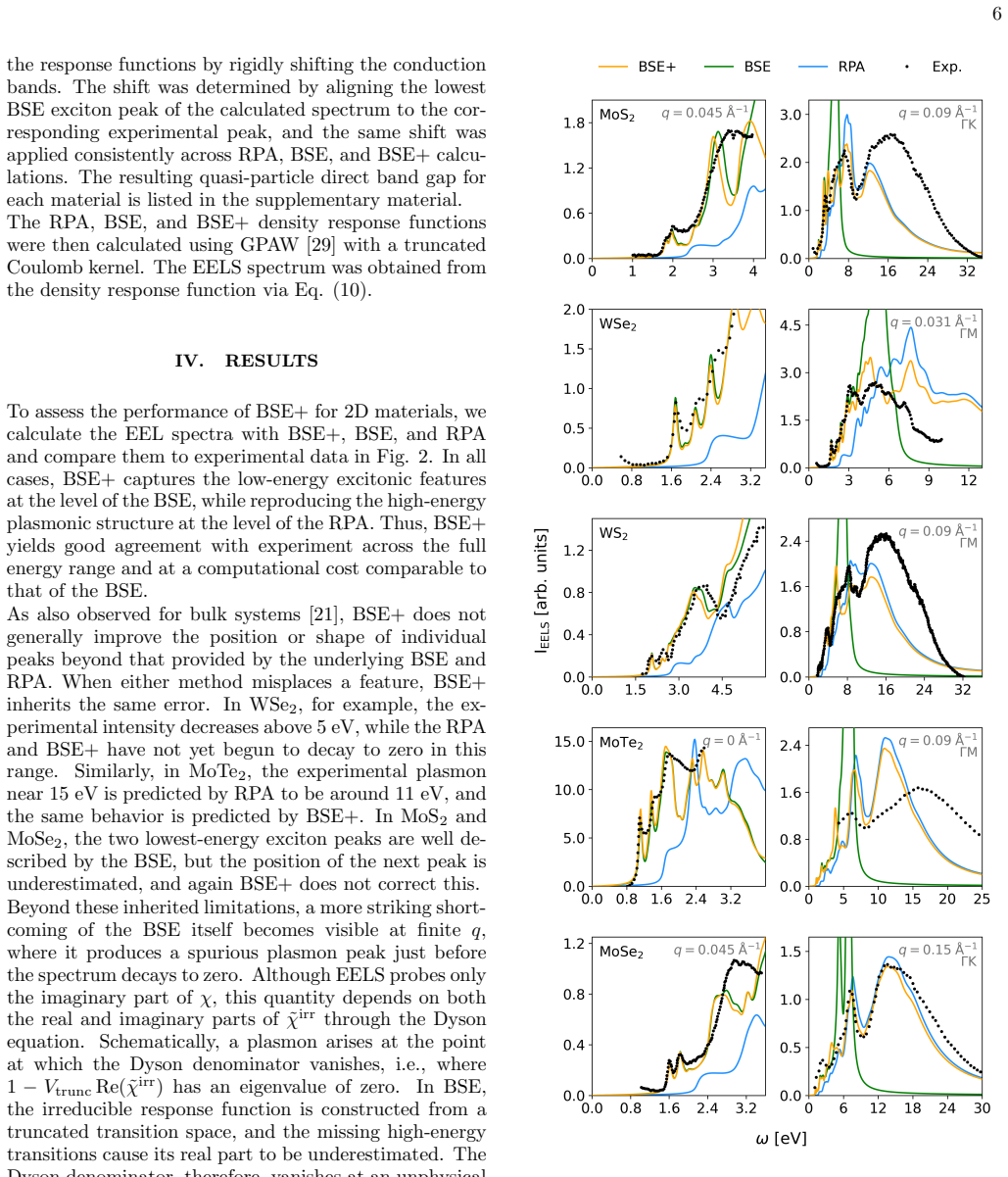
BSE+ preserves the excitonic features of the BSE at low energies while reproducing the plasmonic structure of the RPA at higher energies, yielding good agreement with experimental EELS data across the full energy range and strongly suppressing the spurious plasmon.
What carries the argument
The BSE+ scheme, which solves a four-point BSE-like equation for the irreducible polarisability of low-energy transitions and inserts the result into a two-point Dyson equation that adds the high-energy transitions at the RPA level.
If this is right
- The low-energy excitonic peaks remain essentially unchanged from a standard BSE calculation.
- The high-energy loss spectrum matches the plasmon dispersion obtained from a full RPA calculation.
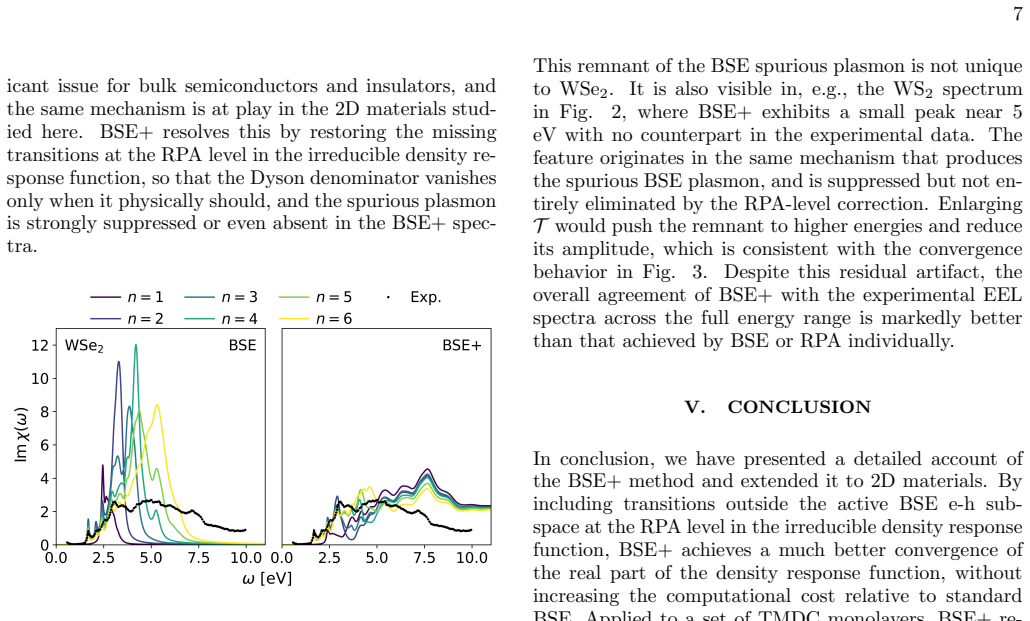
- The spurious plasmon that arises from an incomplete real-part dielectric function is strongly suppressed.
- Convergence with respect to the number of included electron-hole pairs is reached with a much smaller basis than a direct BSE calculation.
- The computational cost stays comparable to a standard BSE run while covering the entire energy window.
Where Pith is reading between the lines
- The same separation of energy scales may allow BSE+ to be used for other reduced-dimensional systems where the density of high-energy transitions is large.
- Because the high-energy part is handled by a two-point equation, the method could be combined with existing RPA codes for periodic systems without rewriting the four-point kernel.
- If the RPA treatment of high-energy transitions proves accurate for other 2D semiconductors, BSE+ could become the default route for computing loss spectra over the full optical-to-plasmon range.
Load-bearing premise
High-energy electron-hole transitions can be treated at the RPA level inside the two-point Dyson equation without feeding errors back into the low-energy excitonic physics when the method is applied to two-dimensional materials.
What would settle it
An experimental EELS spectrum for a transition-metal dichalcogenide monolayer that shows the spurious plasmon peak persisting at the position and strength predicted by a truncated BSE calculation.
Figures
read the original abstract
The Bethe-Salpeter equation (BSE) accurately describes low-energy optical spectra in materials with strong excitonic effects, but its high computational cost limits the number of electron-hole transitions that can be included. Neglecting high-energy transitions leads to an underestimation of the real part of the dielectric function, often producing a spurious plasmon peak in the BSE electron energy loss spectrum (EELS). The recently introduced BSE+ method addresses this by combining a four-point BSE-like equation for the irreducible polarisability with a two-point Dyson equation that includes the high-energy transitions at the Random Phase Approximation (RPA) level. Here, we present a detailed account of the method, extend it to two-dimensional materials, and apply it to a set of transition metal dichalcogenide monolayers. BSE+ preserves the excitonic features of the BSE at low energies while reproducing the plasmonic structure of the RPA at higher energies, yielding good agreement with experimental EELS data across the full energy range and strongly suppressing the spurious plasmon. BSE+ converges much faster than BSE with respect to the electron-hole basis size, at a comparable computational cost, and is implemented in the GPAW code.
Editorial analysis
A structured set of objections, weighed in public.
Referee Report
Summary. The manuscript details the BSE+ approach, which augments a four-point BSE-like treatment of the irreducible polarizability for low-energy electron-hole transitions with a two-point Dyson equation that incorporates high-energy transitions at the RPA level. The method is extended to two-dimensional materials and applied to transition-metal dichalcogenide monolayers; the central claims are that BSE+ retains the low-energy excitonic structure of standard BSE, reproduces the high-energy plasmonic features of RPA, eliminates the spurious plasmon artifact in EELS, achieves quantitative agreement with experimental EELS spectra across the full energy range, and converges with respect to the electron-hole basis size at far lower cost than full BSE.
Significance. If the separation of energy windows is rigorously justified and the numerical results hold, BSE+ would provide a computationally tractable route to wide-range spectra in 2D materials that simultaneously captures strong excitonic binding at low energy and collective plasmon modes at higher energy, directly addressing a known limitation of truncated BSE calculations in reduced dimensions.
major comments (2)
- [method section (BSE+ construction)] The central construction (four-point low-energy piece plus two-point RPA high-energy piece in the Dyson equation for W) is load-bearing for the claim that excitonic eigenvalues remain unchanged. No explicit derivation or numerical test is supplied showing that the RPA contribution to the real part of the dielectric function factors out of the low-energy block when the 2D Coulomb interaction (2πe²/q or Keldysh form) is used; the stronger q-dependence in 2D makes back-coupling into the exciton binding energies a concrete risk that must be quantified by varying the energy cutoff separating the two pieces.
- [results for TMDs] Table or figure reporting exciton binding energies or peak positions for the TMD monolayers: the manuscript must demonstrate that these quantities are insensitive to the choice of energy window used to partition low- and high-energy transitions; without such a test the preservation of BSE excitonic features cannot be considered established for the 2D case.
minor comments (2)
- Notation for the screened interaction W and the irreducible polarizability should be made uniform between the four-point and two-point formulations to avoid ambiguity when the two are combined.
- The abstract states 'good agreement with experimental EELS data'; the corresponding figure should include the experimental spectra overlaid with both BSE+ and reference RPA/BSE curves for direct visual assessment.
Simulated Author's Rebuttal
We thank the referee for the thorough review and insightful comments on the BSE+ method for 2D materials. The points raised concerning the formal separation in the presence of the 2D Coulomb interaction and the need for explicit numerical verification are well taken. We address each major comment below and will revise the manuscript to incorporate the requested tests and clarifications.
read point-by-point responses
-
Referee: [method section (BSE+ construction)] The central construction (four-point low-energy piece plus two-point RPA high-energy piece in the Dyson equation for W) is load-bearing for the claim that excitonic eigenvalues remain unchanged. No explicit derivation or numerical test is supplied showing that the RPA contribution to the real part of the dielectric function factors out of the low-energy block when the 2D Coulomb interaction (2πe²/q or Keldysh form) is used; the stronger q-dependence in 2D makes back-coupling into the exciton binding energies a concrete risk that must be quantified by varying the energy cutoff separating the two pieces.
Authors: The BSE+ equations are constructed so that the low-energy four-point irreducible polarizability is solved first, after which the high-energy RPA screening enters only through the two-point Dyson equation for the screened Coulomb interaction; this block structure is intended to prevent back-coupling into the low-energy eigenvalues regardless of the form of the Coulomb kernel. We acknowledge, however, that an explicit derivation specialized to the 2D case and a numerical quantification of any residual effect have not been provided. In the revised manuscript we will add both a short derivation clarifying the factoring of the RPA term and a numerical test in which the energy cutoff is varied, confirming that exciton binding energies remain stable for the TMD monolayers. revision: yes
-
Referee: [results for TMDs] Table or figure reporting exciton binding energies or peak positions for the TMD monolayers: the manuscript must demonstrate that these quantities are insensitive to the choice of energy window used to partition low- and high-energy transitions; without such a test the preservation of BSE excitonic features cannot be considered established for the 2D case.
Authors: We agree that a direct demonstration of insensitivity to the energy-window choice is required to substantiate the claim for 2D systems. The revised manuscript will include a new table (or supplementary figure) that reports exciton binding energies and the positions of the main low-energy peaks for the TMD monolayers at several values of the cutoff separating low- and high-energy transitions, thereby establishing that these quantities are unchanged within the range used in the calculations. revision: yes
Circularity Check
No significant circularity; BSE+ construction and 2D application are self-contained
full rationale
The paper defines BSE+ via an explicit split of the irreducible polarizability into a four-point low-energy BSE-like term plus a two-point RPA term for high-energy transitions entering the Dyson equation for the screened interaction. This construction is applied to TMD monolayers with direct comparison to experimental EELS spectra; no equation reduces by construction to a fitted parameter or prior self-citation that forces the reported preservation of excitonic features or suppression of the spurious plasmon. The 'recently introduced' phrasing refers to prior work but is not load-bearing for the present claims, which rest on the stated combination and numerical results rather than tautological re-derivation.
Axiom & Free-Parameter Ledger
Reference graph
Works this paper leans on
-
[1]
C. D. Spataru, S. Ismail-Beigi, L. X. Benedict, and S. G. Louie, Excitonic effects and optical spectra of single- walled carbon nanotubes, Physical Review Letters92, 077402 (2004)
2004
-
[2]
H¨ user, T
F. H¨ user, T. Olsen, and K. S. Thygesen, How dielec- tric screening in two-dimensional crystals affects the con- vergence of excited-state calculations: Monolayer mos 2, Physical Review B88, 245309 (2013)
2013
-
[3]
Onida, L
G. Onida, L. Reining, and A. Rubio, Electronic exci- tations: density-functional versus many-body green’s- function approaches, Reviews of Modern Physics74, 601 (2002). 8
2002
-
[4]
Onida, L
G. Onida, L. Reining, R. Godby, R. Del Sole, and W. An- dreoni, Ab initio calculations of the quasiparticle and ab- sorption spectra of clusters: the sodium tetramer, Phys- ical Review Letters75, 818 (1995)
1995
-
[5]
Albrecht, L
S. Albrecht, L. Reining, R. Del Sole, and G. Onida, Ab initio calculation of excitonic effects in the optical spec- tra of semiconductors, Physical Review Letters80, 4510 (1998)
1998
-
[6]
L. X. Benedict, E. L. Shirley, and R. B. Bohn, Theory of optical absorption in diamond, si, ge, and gaas, Physical Review B57, R9385 (1998)
1998
-
[7]
Rohlfing and S
M. Rohlfing and S. G. Louie, Electron-hole excitations in semiconductors and insulators, Physical Review Letters 81, 2312 (1998)
1998
-
[8]
Marini, C
A. Marini, C. Hogan, M. Gr¨ uning, and D. Varsano, Yambo: an ab initio tool for excited state calculations, Computer Physics Communications180, 1392 (2009)
2009
-
[9]
J. Yan, K. W. Jacobsen, and K. S. Thygesen, Optical properties of bulk semiconductors and graphene/boron nitride: The bethe-salpeter equation with derivative discontinuity-corrected density functional energies, Phys- ical Review B86, 045208 (2012)
2012
-
[10]
Rocca, Y
D. Rocca, Y. Ping, R. Gebauer, and G. Galli, Solution of the bethe-salpeter equation without empty electronic states: Application to the absorption spectra of bulk sys- tems, Physical Review B85, 045116 (2012)
2012
-
[11]
Fuchs, C
F. Fuchs, C. R¨ odl, A. Schleife, and F. Bechstedt, Efficient o (n 2) approach to solve the bethe-salpeter equation for excitonic bound states, Physical Review B78, 085103 (2008)
2008
-
[12]
Gr¨ uning, A
M. Gr¨ uning, A. Marini, and X. Gonze, Implementation and testing of lanczos-based algorithms for random-phase approximation eigenproblems, Comput. Mater. Sci.50, 2148 (2011)
2011
-
[13]
Kammerlander, S
D. Kammerlander, S. Botti, M. A. Marques, A. Marini, and C. Attaccalite, Speeding up the solution of the bethe- salpeter equation by a double-grid method and wannier interpolation, Physical Review B86, 125203 (2012)
2012
-
[14]
Gillet, M
Y. Gillet, M. Giantomassi, and X. Gonze, Efficient on- the-fly interpolation technique for bethe–salpeter calcu- lations of optical spectra, Computer Physics Communi- cations203, 83 (2016)
2016
-
[15]
I. M. Alliati, D. Sangalli, and M. Gr¨ uning, Double k-grid method for solving the bethe-salpeter equation via lanc- zos approaches, Frontiers in Chemistry9, 763946 (2022)
2022
-
[16]
Runge and E
E. Runge and E. K. Gross, Density-functional theory for time-dependent systems, Physical Review Letters52, 997 (1984)
1984
-
[17]
Reining, V
L. Reining, V. Olevano, A. Rubio, and G. Onida, Ex- citonic effects in solids described by time-dependent density-functional theory, Physical Review Letters88, 066404 (2002)
2002
-
[18]
Sharma, J
S. Sharma, J. Dewhurst, A. Sanna, and E. Gross, Boot- strap approximation for the exchange-correlation kernel of time-dependent density-functional theory, Physical re- view letters107, 186401 (2011)
2011
-
[19]
Byun and C
Y.-M. Byun and C. Ullrich, Assessment of long-range- corrected exchange-correlation kernels for solids: Accu- rate exciton binding energies via an empirically scaled bootstrap kernel, Physical review B95, 205136 (2017)
2017
-
[20]
Sottile, V
F. Sottile, V. Olevano, and L. Reining, Parameter- free calculation of response functions in time-dependent density-functional theory, Physical Review Letters91, 056402 (2003)
2003
-
[21]
A. H. Søndersted, M. Kuisma, J. K. Svaneborg, M. K. Svendsen, and K. S. Thygesen, Improved dielectric re- sponse of solids: Combining the bethe-salpeter equation with the random phase approximation, Physical review letters133, 026403 (2024)
2024
-
[22]
Olsen and K
T. Olsen and K. S. Thygesen, Static correlation beyond the random phase approximation: Dissociating h2 with the bethe-salpeter equation and time-dependent gw, The Journal of Chemical Physics140(2014)
2014
-
[23]
K. S. Thygesen, Calculating excitons, plasmons, and quasiparticles in 2d materials and van der waals het- erostructures, 2D Mater.4, 022004 (2017)
2017
-
[24]
Latini,Excitons in van der Waals Heterostructures: A theoretical study, Ph.D
S. Latini,Excitons in van der Waals Heterostructures: A theoretical study, Ph.D. thesis, DTU, Department of Physics (2016)
2016
-
[25]
Bruus and K
H. Bruus and K. Flensberg,Many-Body Quantum Theory in Condensed Matter Physics(Oxford Graduate Texts, 2004 (Corrected version: 2016))
2004
-
[26]
Haastrup, M
S. Haastrup, M. Strange, M. Pandey, T. Deilmann, P. S. Schmidt, N. F. Hinsche, M. N. Gjerding, D. Torelli, P. M. Larsen, A. C. Riis-Jensen, J. Gath, K. W. Jacobsen, J. J. Mortensen, T. Olsen, and K. S. Thygesen, The computa- tional 2d materials database: High-throughput modeling and discovery of atomically thin crystals, 2D Materials5 (2018)
2018
-
[27]
M. N. Gjerding, A. Taghizadeh, A. Rasmussen, S. Ali, F. Bertoldo, T. Deilmann, U. P. Holguin, N. R. Knøsgaard, M. Kruse, A. H. Larsen, S. Manti, T. G. Pedersen, T. Skovhus, M. K. Svendsen, J. J. Mortensen, T. Olsen, and K. S. Thygesen, Recent progress of the computational 2d materials database (c2db), 2D Materi- als8(2021)
2021
-
[28]
J. P. Perdew, K. Burke, and M. Ernzerhof, Generalized gradient approximation made simple, Physical Review Letters77, 3865 (1996)
1996
-
[29]
Du lak, V
M. Du lak, V. Haikola, H. Hansen,et al., Electronic struc- ture calculations with gpaw: a real-space implementa- tion of the projector augmented-wave method, Journal of physics: Condensed matter22, 253202 (2010)
2010
-
[30]
J. Hong, M. Koshino, R. Senga, T. Pichler, H. Xu, and K. Suenaga, Deciphering the intense postgap absorptions of monolayer transition metal dichalco- genides, ACS Nano15, 7783 (2021), pMID: 33818068, https://doi.org/10.1021/acsnano.1c01868
-
[31]
K¨ oster, A
J. K¨ oster, A. Storm, T. E. Gorelik, M. J. Mohn, F. Port, M. R. Gon¸ calves, and U. Kaiser, Evaluation of tem meth- ods for their signature of the number of layers in mono- and few-layer tmds as exemplified by mos 2 and mote 2, Micron160, 103303 (2022)
2022
-
[32]
J. Hong, R. Senga, T. Pichler, and K. Suenaga, Probing exciton dispersions of freestanding monolayer wse 2 by momentum-resolved electron energy-loss spectroscopy, Physical Review Letters124, 087401 (2020)
2020
-
[33]
Tiukalova, O
E. Tiukalova, O. Olunloyo, K. Xiao, A. R. Lupini, and M. Chi, Probing atomic structure and excitons in 2d het- erostructures through cryogenic stem-eels, Microscopy and Microanalysis30(2024)
2024
discussion (0)
Sign in with ORCID, Apple, or X to comment. Anyone can read and Pith papers without signing in.