GRB 250706B/C: Insight-HXMT Discovery of a High-Luminosity Burst as a Candidate for Fallback-Regulated Accretion in the Prompt Emission
Pith reviewed 2026-06-27 15:49 UTC · model grok-4.3
The pith
GRB 250706B/C indicates fallback accretion supports high luminosity
A machine-rendered reading of the paper's core claim, the machinery that carries it, and where it could break.
Core claim
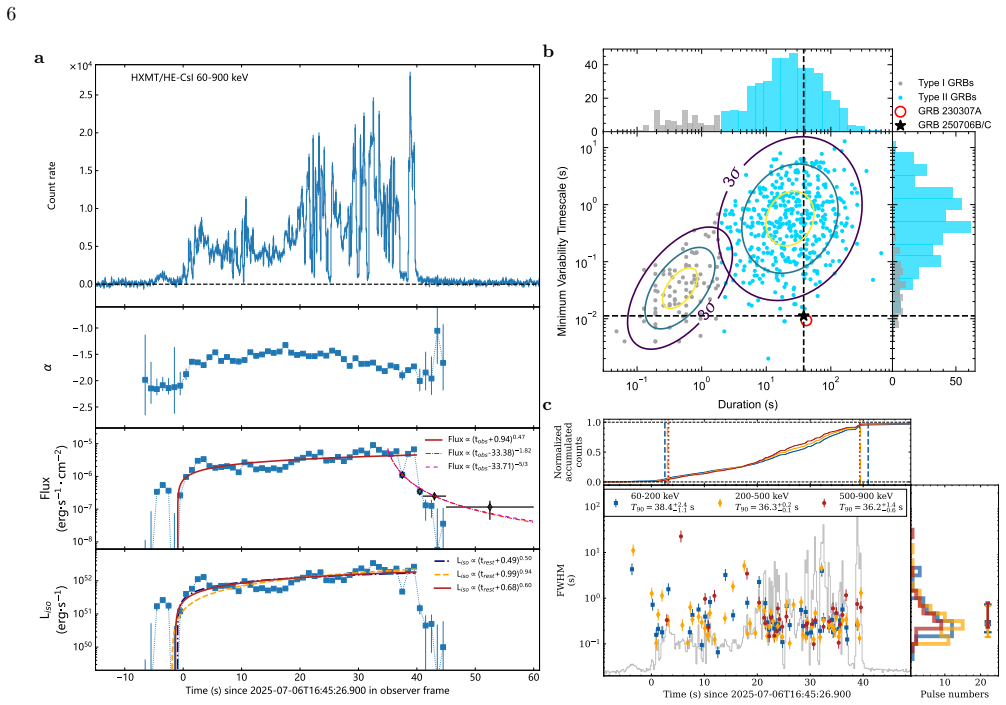
GRB 250706B/C is a high-luminosity long GRB whose prompt emission consists of many short pulses superimposed on a slowly rising envelope F(t) proportional to (t - t0) to the power 0.47. The absence of secular evolution in pulse properties points to a separation between the engine-feeding history, governed by fallback accretion, and the internal jet dissipation that produces the pulses, allowing the collapsar to operate on a high-luminosity branch.
What carries the argument
The time-dependent engine-feeding history from fallback accretion, which sets the rising luminosity envelope while internal dissipation produces the pulse structure.
If this is right
- Fallback-fed collapsars can produce high-luminosity GRBs.
- The luminosity scale of GRBs is not necessarily limited by fallback accretion.
- Large-scale temporal evolution in GRB prompt emission can be regulated separately from small-scale pulse variability.
- Similar events may be identified by their power-law rising envelopes without evolving pulse characteristics.
Where Pith is reading between the lines
- Models of GRB engines may need to include high-luminosity fallback branches to explain observed diversity.
- Targeted searches in archival data for GRBs with similar rising envelopes could reveal more such events.
- This separation of scales might apply to other transients where accretion regulates overall output but internal processes create variability.
Load-bearing premise
The observed rising luminosity envelope and the lack of secular evolution in pulse widths and waiting times are produced by time-dependent engine-feeding history from fallback accretion rather than by other jet or dissipation processes.
What would settle it
Observation of a GRB with a similar rising envelope but with clear secular evolution in pulse widths or waiting times during the rise, or a high-luminosity GRB lacking any power-law rise.
Figures
read the original abstract
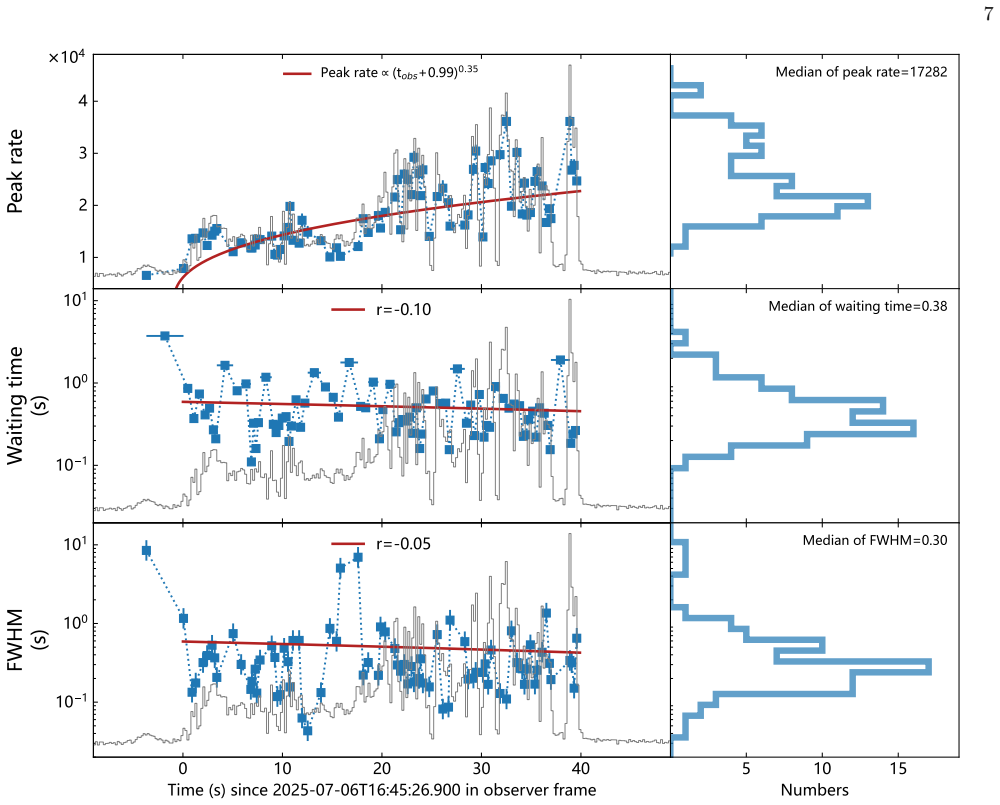
Fallback accretion in collapsar models is often associated with underluminous gamma-ray bursts (GRBs), leading to the widespread view that fallback-fed engines may be intrinsically inefficient at producing high-luminosity events. In this Letter, we present GRB 250706B/C, a luminous long GRB observed by \textit{Insight}-HXMT that exhibits an unusual combination of extreme short-timescale variability and coherent large-scale temporal evolution. The prompt emission contains at least 79 resolved pulses and a minimum variability timescale of $\sim11$ ms. The pulse widths are nearly independent of photon energy and span a broad distribution with a median FWHM of $\sim0.30$ s, while the waiting times between adjacent pulses have a median of $\sim0.38$ s. The prompt-emission envelope exhibits a prolonged rise described by $F(t)\propto (t-t_0)^{0.47\pm0.01}$ followed by a rapid decline. Despite substantial pulse-to-pulse fluctuations, neither the pulse widths nor the waiting times show significant secular evolution during the main emission episode. These features indicate the coexistence of two distinct temporal components, including a slow evolving rising luminosity envelope and rapid stochastic variability. Such behavior is consistent with scenarios in which a time-dependent engine-feeding history regulates the large-scale emission while internal dissipation within the relativistic outflow produces the pulse structure. Within this context, GRB~250706B/C may represent a fallback-fed collapsar operating on a high-luminosity branch, suggesting that fallback itself does not necessarily limit the luminosity scale of GRBs.
Editorial analysis
A structured set of objections, weighed in public.
Referee Report
Summary. The manuscript reports Insight-HXMT observations of the luminous long GRB 250706B/C, which exhibits at least 79 resolved pulses, a minimum variability timescale of ~11 ms, energy-independent pulse widths (median FWHM ~0.30 s) and waiting times (median ~0.38 s) with no significant secular evolution, and a prompt-emission envelope that rises as F(t) ∝ (t−t0)^{0.47±0.01} before a rapid decline. The authors interpret the coexistence of a slow-evolving rising envelope and rapid stochastic variability as consistent with time-dependent engine feeding from fallback accretion in a collapsar, suggesting that fallback does not intrinsically limit GRB luminosity to underluminous events.
Significance. If the interpretive link to fallback is substantiated by quantitative modeling, the result would challenge the prevailing association of fallback accretion with underluminous GRBs and expand the viable parameter space for collapsar engines to include high-luminosity branches. The manuscript's observational strengths include the precise power-law characterization of the envelope and the statistical description of pulse properties, which supply a concrete benchmark for engine models; however, the absence of any model comparison limits the immediate impact.
major comments (1)
- [Abstract and interpretive discussion] Abstract and interpretive discussion: The central claim that the observed rising envelope F(t)∝(t−t0)^{0.47±0.01} together with stationary pulse widths and waiting times are produced by fallback-regulated engine feeding rests solely on qualitative consistency. No quantitative fallback accretion-rate evolution is derived or simulated, no predicted light-curve shape or pulse statistics are compared to the data, and no explicit test excludes alternative mechanisms (e.g., jet-internal dissipation or propagation effects) that could produce an identical slow envelope plus rapid variability. This renders the inference that “fallback itself does not necessarily limit the luminosity scale” an untested attribution rather than a demonstrated result.
minor comments (1)
- [Abstract] The abstract mixes observational results and interpretation in a single paragraph; separating the two would improve clarity for readers.
Simulated Author's Rebuttal
We thank the referee for the constructive review and for acknowledging the observational strengths of the manuscript. We address the major comment on the abstract and interpretive discussion below.
read point-by-point responses
-
Referee: The central claim that the observed rising envelope F(t)∝(t−t0)^{0.47±0.01} together with stationary pulse widths and waiting times are produced by fallback-regulated engine feeding rests solely on qualitative consistency. No quantitative fallback accretion-rate evolution is derived or simulated, no predicted light-curve shape or pulse statistics are compared to the data, and no explicit test excludes alternative mechanisms (e.g., jet-internal dissipation or propagation effects) that could produce an identical slow envelope plus rapid variability. This renders the inference that “fallback itself does not necessarily limit the luminosity scale” an untested attribution rather than a demonstrated result.
Authors: We agree that the interpretive link to fallback accretion is based on qualitative consistency with the observed slow-rising envelope (F(t)∝(t−t0)^{0.47±0.01}), stationary pulse widths and waiting times, and the absence of secular evolution, rather than on quantitative modeling, predicted light-curve comparisons, or explicit exclusion of alternatives such as jet-internal dissipation. As this is a concise observational Letter, performing dedicated accretion simulations or systematic tests against other mechanisms lies outside its scope. We will revise the abstract and discussion to clarify that GRB 250706B/C provides an observational example whose temporal features are consistent with fallback-regulated feeding on a high-luminosity branch, without claiming a definitive demonstration that fallback cannot limit luminosity. The revised text will explicitly note that the reported properties serve as a benchmark for future quantitative engine models. revision: partial
Circularity Check
No significant circularity; observational interpretation remains self-contained
full rationale
The manuscript reports measured temporal properties of GRB 250706B/C (F(t)∝(t−t0)^{0.47±0.01} envelope, energy-independent pulse widths with median 0.30 s, waiting times with median 0.38 s, minimum variability ~11 ms) and states that these features are 'consistent with' a time-dependent engine-feeding history from fallback while internal dissipation produces pulses. This attribution is offered as qualitative consistency and a possible high-luminosity example, without any derivation, simulation, or equation that reduces the conclusion to fitted parameters by construction, without self-citation chains invoked as uniqueness theorems, and without renaming known results as new derivations. The central claim therefore does not collapse to its inputs and is self-contained as an observational hypothesis.
Axiom & Free-Parameter Ledger
axioms (1)
- domain assumption Long GRBs arise from collapsars with relativistic jets
Reference graph
Works this paper leans on
-
[3]
Chevalier , R. A. 1989, title Neutron Star Accretion in a Supernova , , 346, 847, 10.1086/168066
-
[4]
D'Agostini , G. 2005, title Fits, and especially linear fits, with errors on both axes, extra variance of the data points and other complications , arXiv e-prints, physics/0511182, 10.48550/arXiv.physics/0511182
work page internal anchor Pith review Pith/arXiv arXiv doi:10.48550/arxiv.physics/0511182 2005
-
[5]
Fenimore , E. E., in 't Zand , J. J. M., Norris , J. P., Bonnell , J. T., & Nemiroff , R. J. 1995, title Gamma-Ray Burst Peak Duration as a Function of Energy , , 448, L101, 10.1086/309603
-
[6]
and Lang, Dustin and Goodman, Jonathan , year=
Foreman-Mackey , D., Hogg , D. W., Lang , D., & Goodman , J. 2013, title emcee: The MCMC Hammer , , 125, 306, 10.1086/670067
-
[7]
2025 a , title GRB 250706C: Konus-Wind detection of a very bright GRB -0.5ex 1200 s before GRB 250706B , GRB Coordinates Network, 41013, 1
Frederiks , D., Lysenko , A., Ridnaia , A., et al. 2025 a , title GRB 250706C: Konus-Wind detection of a very bright GRB -0.5ex 1200 s before GRB 250706B , GRB Coordinates Network, 41013, 1
2025
-
[8]
2025 b , title GRB 250706B/C: Konus-Wind analysis of the prompt emission , GRB Coordinates Network, 41027, 1
Frederiks , D., Lysenko , A., Ridnaia , A., et al. 2025 b , title GRB 250706B/C: Konus-Wind analysis of the prompt emission , GRB Coordinates Network, 41027, 1
2025
-
[10]
Guidorzi , C. 2015, title MEPSA: A flexible peak search algorithm designed for uniformly spaced time series , Astronomy and Computing, 10, 54, 10.1016/j.ascom.2015.01.001
-
[16]
S., Golovin , D
Kozyrev , A. S., Golovin , D. V., Litvak , M. L., et al. 2025, title IPN triangulation of GRB 250706C (consistent with the GRB 250706B) , GRB Coordinates Network, 41041, 1
2025
-
[18]
Kumar , P., Narayan , R., & Johnson , J. L. 2008 b , title Mass fall-back and accretion in the central engine of gamma-ray bursts , , 388, 1729, 10.1111/j.1365-2966.2008.13493.x
-
[20]
2025, title GRB 250706B/C: Fermi-LAT detection , GRB Coordinates Network, 41019, 1
Longo , F., Di Lalla , N., Holzmann Airasca , A., et al. 2025, title GRB 250706B/C: Fermi-LAT detection , GRB Coordinates Network, 41019, 1
2025
-
[23]
MacFadyen , A. I., & Woosley , S. E. 1999, title Collapsars: Gamma-Ray Bursts and Explosions in ``Failed Supernovae'' , , 524, 262, 10.1086/307790
work page internal anchor Pith review doi:10.1086/307790 1999
-
[24]
MacFadyen , A. I., Woosley , S. E., & Heger , A. 2001, title Supernovae, Jets, and Collapsars , , 550, 410, 10.1086/319698
-
[27]
Moradi , R., Wang , C. W., Zhang , B., et al. 2024, title Temporal and Spectral Analysis of the Unique and Second-brightest Gamma-Ray Burst GRB 230307A: Insights from GECAM and Fermi/GBM Observations , , 977, 155, 10.3847/1538-4357/ad8a64
-
[30]
T., Schneider , B., Saccardi , A., et al
Palmerio , J. T., Schneider , B., Saccardi , A., et al. 2025, title GRB 250706B/C: VLT/X-shooter redshift z = 0.942 , GRB Coordinates Network, 41022, 1
2025
-
[32]
Qin , Y. P., Dong , Y. M., Lu , R. J., Zhang , B. B., & Jia , L. W. 2005, title Relationship between the Gamma-Ray Burst Pulse Width and Energy Due to the Doppler Effect of Fireballs , , 632, 1008, 10.1086/444408
-
[34]
2004, title The Cooling Behavior of Thermal Pulses in Gamma-Ray Bursts , , 614, 827, 10.1086/423782
Ryde , F. 2004, title The Cooling Behavior of Thermal Pulses in Gamma-Ray Bursts , , 614, 827, 10.1086/423782
-
[36]
2025 a , title GRB 250706B/C: Insight-HXMT detection , GRB Coordinates Network, 41049, 1
Wang , C.-W., Xiong , S.-L., Li , C.-K., et al. 2025 a , title GRB 250706B/C: Insight-HXMT detection , GRB Coordinates Network, 41049, 1
2025
-
[37]
Wang , C.-W., Tan , W.-J., Xiong , S.-L., et al. 2025 b , title A Subclass of Gamma-Ray Burst Originating from Compact Binary Merger , , 979, 73, 10.3847/1538-4357/ad98ec
-
[39]
Woosley , S. E. 1993, title Gamma-ray bursts from stellar mass accretion disks around black holes , , 405, 273, 10.1086/172359
-
[40]
Wu , X.-F., Hou , S.-J., & Lei , W.-H. 2013, title Giant X-Ray Bump in GRB 121027A: Evidence for Fall-back Disk Accretion , , 767, L36, 10.1088/2041-8205/767/2/L36
-
[41]
2024, title ELISA: Efficient Library for Spectral Analysis in High-Energy Astrophysics, , v0.1.17 https://github.com/wcxve/elisa
Xue, W.-C., Li, X.-B., Xiong, S.-L., et al. 2024, title ELISA: Efficient Library for Spectral Analysis in High-Energy Astrophysics, , v0.1.17 https://github.com/wcxve/elisa
2024
-
[47]
Individual power density spectra of Swift gamma-ray bursts
Individual power density spectra of Swift gamma-ray bursts. , keywords =. doi:10.1051/0004-6361/201527642 , archivePrefix =. 1603.06890 , primaryClass =
work page internal anchor Pith review Pith/arXiv arXiv doi:10.1051/0004-6361/201527642
-
[48]
POLAR-2 -- Latest Developments of the Next Generation GRB Polarimeter. arXiv e-prints , keywords =. doi:10.48550/arXiv.2511.09419 , archivePrefix =. 2511.09419 , primaryClass =
-
[49]
Science China Physics, Mechanics, and Astronomy , year = 2025, month = sep, volume =
White papers on eXTP the enhanced X-ray Timing and Polarimetry mission for launch in 2030. Science China Physics, Mechanics, and Astronomy , year = 2025, month = sep, volume =. doi:10.1007/s11433-025-2800-5 , adsurl =
-
[50]
GRB 130427A: A Nearby Ordinary Monster. Science , keywords =. doi:10.1126/science.1242279 , archivePrefix =. 1311.5254 , primaryClass =
-
[51]
The First Pulse of the Extremely Bright GRB 130427A: A Test Lab for Synchrotron Shocks
The First Pulse of the Extremely Bright GRB 130427A: A Test Lab for Synchrotron Shocks. Science , keywords =. doi:10.1126/science.1242302 , archivePrefix =. 1311.5581 , primaryClass =
work page internal anchor Pith review Pith/arXiv arXiv doi:10.1126/science.1242302
-
[52]
Evidence of Minijet Emission in a Large Emission Zone from a Magnetically Dominated Gamma-Ray Burst Jet. , keywords =. doi:10.3847/1538-4357/adcf98 , archivePrefix =. 2310.07205 , primaryClass =
-
[53]
National Science Review , keywords =
Magnetar emergence in a peculiar gamma-ray burst from a compact star merger. National Science Review , keywords =. doi:10.1093/nsr/nwae401 , archivePrefix =. 2307.05689 , primaryClass =
-
[54]
Fall-Back Disks in Long and Short GRBs
Fall-back Disks in Long and Short Gamma-Ray Bursts. , keywords =. doi:10.1088/0004-637X/734/1/35 , archivePrefix =. 1104.0456 , primaryClass =
work page internal anchor Pith review Pith/arXiv arXiv doi:10.1088/0004-637x/734/1/35
-
[55]
Hyper-Accreting Black Holes and Gamma-Ray Bursts
Hyperaccreting Black Holes and Gamma-Ray Bursts. , keywords =. doi:10.1086/307259 , archivePrefix =. astro-ph/9807028 , primaryClass =
work page internal anchor Pith review Pith/arXiv arXiv doi:10.1086/307259
-
[56]
Black hole to breakout: 3D GRMHD simulations of collapsar jets reveal a wide range of transients. , keywords =. doi:10.1093/mnras/stab3784 , archivePrefix =. 2109.14619 , primaryClass =
-
[57]
Black Hole Spin-down in Collapsars in 3D Neutrino Transport GRMHD Simulations
Black Hole Spin-down in Collapsars in 3D Neutrino Transport GRMHD Simulations. arXiv e-prints , keywords =. doi:10.48550/arXiv.2502.08732 , archivePrefix =. 2502.08732 , primaryClass =
work page internal anchor Pith review Pith/arXiv arXiv doi:10.48550/arxiv.2502.08732
-
[58]
An Accretion-Modulated Internal Shock Model for Long GRBs. , keywords =. doi:10.3847/1538-4357/ae42c4 , archivePrefix =. 2602.05278 , primaryClass =
-
[59]
Accretion Models of Gamma-Ray Bursts
Accretion Models of Gamma-Ray Bursts. , keywords =. doi:10.1086/322267 , archivePrefix =. astro-ph/0103360 , primaryClass =
work page internal anchor Pith review Pith/arXiv arXiv doi:10.1086/322267
-
[60]
Hot Accretion Flows Around Black Holes
Hot Accretion Flows Around Black Holes. , keywords =. doi:10.1146/annurev-astro-082812-141003 , archivePrefix =. 1401.0586 , primaryClass =
work page internal anchor Pith review Pith/arXiv arXiv doi:10.1146/annurev-astro-082812-141003
-
[61]
An Accretion-Modulated Internal Shock Model for Long GRBs. arXiv e-prints , keywords =. doi:10.48550/arXiv.2602.05278 , archivePrefix =. 2602.05278 , primaryClass =
-
[62]
GRB Coordinates Network , year = 2025, month = jul, volume =
GRB 250706B/C: Konus-Wind analysis of the prompt emission. GRB Coordinates Network , year = 2025, month = jul, volume =
2025
-
[63]
GRB Precursors in the Fallback Collapsar Scenario
GRB Precursors in the Fallback Collapsar Scenario. , keywords =. doi:10.1086/522820 , archivePrefix =. astro-ph/0702441 , primaryClass =
work page internal anchor Pith review Pith/arXiv arXiv doi:10.1086/522820
-
[64]
BREAKFAST: A Framework for general joint BA duty and follow-up guidance of multiple γ -ray monitors. , keywords =. doi:10.3847/1538-4357/ae2eae , archivePrefix =. 2510.15816 , primaryClass =
-
[65]
Journal of High Energy Astrophysics , keywords =
A set of distinctive properties ruling the prompt emission of GRB 230307A and other long -ray bursts from compact object mergers. Journal of High Energy Astrophysics , keywords =. doi:10.1016/j.jheap.2025.100456 , archivePrefix =. 2509.05628 , primaryClass =
-
[66]
Distribution of the number of peaks within a long gamma-ray burst. , keywords =. doi:10.1051/0004-6361/202449200 , archivePrefix =. 2402.17282 , primaryClass =
-
[67]
GRB Coordinates Network , year = 2025, month = jul, volume =
GRB 250706B/C: Fermi-LAT detection. GRB Coordinates Network , year = 2025, month = jul, volume =
2025
-
[68]
Black hole central engine for ultra-long gamma-ray burst 111209A and its associated supernova 2011kl
The Black Hole Central Engine for Ultra-long Gamma-Ray Burst 111209A and Its Associated Supernova 2011kl. , keywords =. doi:10.3847/0004-637X/826/2/141 , archivePrefix =. 1605.04660 , primaryClass =
work page internal anchor Pith review Pith/arXiv arXiv doi:10.3847/0004-637x/826/2/141
-
[69]
Wang-Chen Xue and Xiao-Bo Li and Shao-Lin Xiong and Yong Chen and Sheng-Lun Xie and Chao Zheng and Yan-Qiu Zhang and Jia-Cong Liu , title =
-
[70]
Science China Physics, Mechanics, and Astronomy , keywords =
Improved performance of Insight-HXMT/HE CsI detectors. Science China Physics, Mechanics, and Astronomy , keywords =. doi:10.1007/s11433-025-2676-5 , adsurl =
-
[71]
Journal of High Energy Astrophysics , keywords =
Calibration of the instrumental response of Insight-HXMT/HE CsI detectors for gamma-ray monitoring. Journal of High Energy Astrophysics , keywords =. doi:10.1016/j.jheap.2020.04.004 , archivePrefix =. 2005.01367 , primaryClass =
-
[72]
Space Telescopes and Instrumentation 2018: Ultraviolet to Gamma Ray , year = 2018, editor =
The insight-HXMT mission and its recent progresses. Space Telescopes and Instrumentation 2018: Ultraviolet to Gamma Ray , year = 2018, editor =. doi:10.1117/12.2311835 , archivePrefix =. 1910.04434 , primaryClass =
-
[73]
Science China Physics, Mechanics, and Astronomy , keywords =
Overview to the Hard X-ray Modulation Telescope (Insight-HXMT) Satellite. Science China Physics, Mechanics, and Astronomy , keywords =. doi:10.1007/s11433-019-1432-6 , archivePrefix =. 1910.09613 , primaryClass =
-
[74]
Journal of High Energy Astrophysics , keywords =
In-flight calibration of the Insight-Hard X-ray Modulation Telescope. Journal of High Energy Astrophysics , keywords =. doi:10.1016/j.jheap.2020.02.009 , archivePrefix =. 2003.06998 , primaryClass =
-
[75]
Implications for progenitor models, dissipation physics, and GRB classifications
GRB minimum variability timescale with Insight-HXMT and Swift. Implications for progenitor models, dissipation physics, and GRB classifications. , keywords =. doi:10.1051/0004-6361/202245657 , archivePrefix =. 2301.01176 , primaryClass =
-
[76]
GRB Coordinates Network , year = 2025, month = jul, volume =
GRB 250706B/C: Insight-HXMT detection. GRB Coordinates Network , year = 2025, month = jul, volume =
2025
-
[77]
GRB Coordinates Network , year = 2025, month = jul, volume =
GRB 250706B: SVOM detection of a long burst. GRB Coordinates Network , year = 2025, month = jul, volume =
2025
-
[78]
GRB Coordinates Network , year = 2025, month = jul, volume =
GRB 250706B: SVOM observations interpreted as the afterglow of GRB 250706C. GRB Coordinates Network , year = 2025, month = jul, volume =
2025
-
[79]
GRB Coordinates Network , year = 2025, month = jul, volume =
GRB 250706B/C: VLT/X-shooter redshift z = 0.942. GRB Coordinates Network , year = 2025, month = jul, volume =
2025
-
[80]
GRB Coordinates Network , year = 2025, month = jul, volume =
IPN triangulation of GRB 250706C (consistent with the GRB 250706B). GRB Coordinates Network , year = 2025, month = jul, volume =
2025
-
[81]
GRB Coordinates Network , year = 2025, month = jul, volume =
GRB 250706C: Konus-Wind detection of a very bright GRB -0.5ex 1200 s before GRB 250706B. GRB Coordinates Network , year = 2025, month = jul, volume =
2025
-
[82]
GRB Coordinates Network , year = 2019, month = sep, volume =
Konus-Wind observation of GRB 190829A. GRB Coordinates Network , year = 2019, month = sep, volume =
2019
-
[83]
Temporal and Spectral Analysis of the Unique and Second Brightest Gamma-Ray Burst GRB 230307A: Insights from GECAM and Fermi/GBM Observations. arXiv e-prints , keywords =. doi:10.48550/arXiv.2410.17189 , archivePrefix =. 2410.17189 , primaryClass =
-
[84]
Gamma-ray bursts from internal shocks in a relativistic wind: temporal and spectral properties. , keywords =. doi:10.1046/j.1365-8711.1998.01305.x , archivePrefix =. astro-ph/9801245 , primaryClass =
-
[85]
Gamma-ray Bursts: 3rd Huntsville Symposium , year = 1996, editor =
Hydrodynamic time scales and temporal structure of GRBs. Gamma-ray Bursts: 3rd Huntsville Symposium , year = 1996, editor =. doi:10.1063/1.51659 , adsurl =
-
[86]
Cosmological GRBs: Internal vs. External Shocks
Cosmological gamma-ray bursts: internal versus external shocks. , keywords =. doi:10.1093/mnras/287.1.110 , archivePrefix =. astro-ph/9608152 , primaryClass =
work page internal anchor Pith review Pith/arXiv arXiv doi:10.1093/mnras/287.1.110
-
[87]
Galaxies , year = 2022, month = feb, volume =
The GRB Prompt Emission: An Unsolved Puzzle. Galaxies , year = 2022, month = feb, volume =. doi:10.3390/galaxies10020038 , adsurl =
-
[88]
Spectral evolution in gamma-ray bursts: Predictions of the internal shock model and comparison to observations. , keywords =. doi:10.1051/0004-6361/201322341 , archivePrefix =. 1404.4577 , primaryClass =
work page internal anchor Pith review Pith/arXiv arXiv doi:10.1051/0004-6361/201322341
-
[89]
The physics of pulses in gamma-ray bursts: emission processes, temporal profiles and time-lags. , keywords =. doi:10.1046/j.1365-8711.2003.06575.x , archivePrefix =. astro-ph/0303287 , primaryClass =
-
[90]
Electron Acceleration and Efficiency in Nonthermal Gamma-Ray Sources
Electron Acceleration and Efficiency in Nonthermal Gamma-Ray Sources. , keywords =. doi:10.1086/309999 , archivePrefix =. astro-ph/9602016 , primaryClass =
work page internal anchor Pith review Pith/arXiv arXiv doi:10.1086/309999
-
[91]
GRB Coordinates Network , year = 2022, month = oct, volume =
GRB 221009A: Fermi LAT data rate effects due to extremely high flux. GRB Coordinates Network , year = 2022, month = oct, volume =
2022
-
[92]
Gamma-Ray Burst Prompt Emission
Gamma-Ray Burst Prompt Emission. International Journal of Modern Physics D , keywords =. doi:10.1142/S021827181430002X , archivePrefix =. 1402.7022 , primaryClass =
work page internal anchor Pith review Pith/arXiv arXiv doi:10.1142/s021827181430002x
-
[93]
M., 2011, @doi [ ] 10.1111/j.1365-2966.2010.17821.x , 411, 1917
The long rapid decay phase of the extended emission from the short GRB 080503. , keywords =. doi:10.1111/j.1365-2966.2010.16492.x , archivePrefix =. 0911.1503 , primaryClass =
-
[94]
Evolution patterns of the peak energy in the GRB prompt emission. , keywords =. doi:10.1051/0004-6361/202141647 , archivePrefix =. 2109.11212 , primaryClass =
-
[95]
GRB Prompt Emission: Observed Correlations and Their Interpretations. Universe , keywords =. doi:10.3390/universe8060310 , archivePrefix =. 2204.09729 , primaryClass =
-
[96]
Temporal and Spectral Evolution of Gamma-Ray Burst Broad Pulses: Identification of High-latitude Emission in the Prompt Emission. , keywords =. doi:10.3847/1538-4357/acc581 , archivePrefix =. 2212.07095 , primaryClass =
-
[97]
Radiative transfer in ultra-relativistic outflows
Radiative Transfer in Ultrarelativistic Outflows. , keywords =. doi:10.1088/0004-637X/737/2/68 , archivePrefix =. 1011.6005 , primaryClass =
work page internal anchor Pith review Pith/arXiv arXiv doi:10.1088/0004-637x/737/2/68
-
[98]
Temporal Evolution Of Thermal Emission From Relativistically Expanding Plasma
Temporal Evolution of Thermal Emission from Relativistically Expanding Plasma. , keywords =. doi:10.1086/588136 , archivePrefix =. 0802.0725 , primaryClass =
work page internal anchor Pith review Pith/arXiv arXiv doi:10.1086/588136
-
[99]
Accounting for the XRT early steep decay in models of the prompt GRB emission
Accounting for the XRT early steep decay in models of the prompt gamma-ray burst emission. , keywords =. doi:10.1051/0004-6361/201219339 , archivePrefix =. 1206.6770 , primaryClass =
work page internal anchor Pith review Pith/arXiv arXiv doi:10.1051/0004-6361/201219339
-
[100]
Gamma-ray Bursts: 3rd Huntsville Symposium , year = 1996, editor =
How exponential are FREDs?. Gamma-ray Bursts: 3rd Huntsville Symposium , year = 1996, editor =. doi:10.1063/1.51628 , adsurl =
-
[101]
The efficiency of electron acceleration in collisionless shocks and GRB energetics
The Efficiency of Electron Acceleration in Collisionless Shocks and Gamma-Ray Burst Energetics. , keywords =. doi:10.1086/430596 , archivePrefix =. astro-ph/0502070 , primaryClass =
work page internal anchor Pith review Pith/arXiv arXiv doi:10.1086/430596
-
[102]
The First BATSE Gamma-Ray Burst Catalog. , keywords =. doi:10.1086/191968 , adsurl =
-
[103]
Gamma-ray Bursts: 3rd Huntsville Symposium , year = 1996, editor =
Exponential decay of gamma ray burst spectral break energy with photon fluence. Gamma-ray Bursts: 3rd Huntsville Symposium , year = 1996, editor =. doi:10.1063/1.51664 , adsurl =
-
[104]
Correlation between luminosity and temperature in -ray burst sources. , keywords =. doi:10.1038/306451a0 , adsurl =
-
[105]
The Unique Signature of Shell Curvature in Gamma-Ray Bursts
The Unique Signature of Shell Curvature in Gamma-Ray Bursts. Gamma-ray Bursts in the Afterglow Era , year = 2001, editor =. doi:10.1007/10853853_24 , archivePrefix =. astro-ph/0103277 , primaryClass =
work page internal anchor Pith review Pith/arXiv arXiv doi:10.1007/10853853_24 2001
discussion (0)
Sign in with ORCID, Apple, or X to comment. Anyone can read and Pith papers without signing in.