Introducing multiplex semantic networks as multifaceted representations of creative associative knowledge across multilingual samples
Pith reviewed 2026-06-27 16:54 UTC · model grok-4.3
The pith
Multiplex semantic networks from six cognitive tasks capture distinct non-redundant facets of associative knowledge that together improve creativity-score prediction by 50%.
A machine-rendered reading of the paper's core claim, the machinery that carries it, and where it could break.
Core claim
Multiplex semantic networks assembled from six cognitive tasks capture distinct, non-redundant information about semantic organization underlying creativity; combining structurally similar layers from these networks in a ridge-regression model using network measures, emotional scores, and spreading-activation simulations improves prediction of individual creativity scores by 50 percent over single-layer baselines.
What carries the argument
Multiplex semantic networks: layered graphs in which each layer is built from responses to a different cognitive task, with structural reducibility used to identify which layers add unique information.
If this is right
- Different task layers supply non-redundant information about semantic organization.
- High- and low-creativity human groups produce structurally distinct networks.
- AI-generated networks remain nearly identical across creativity groups.
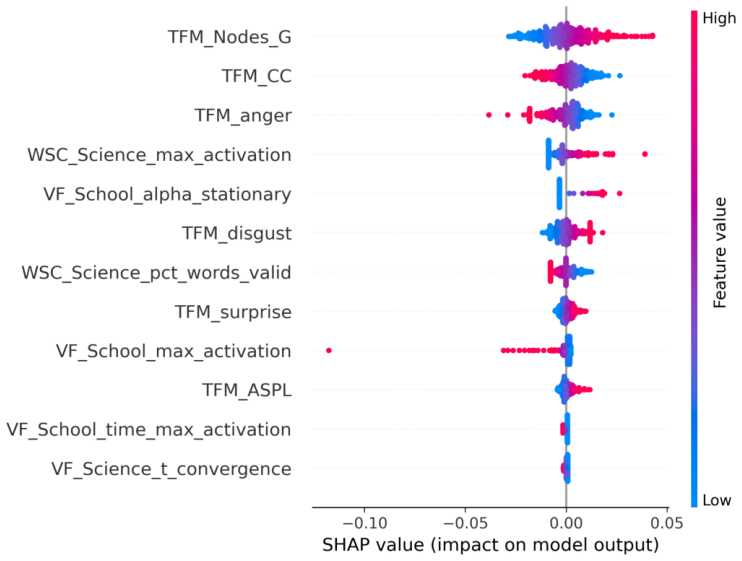
- Structural network measures rank highest in feature importance for creativity prediction.
- Spreading-activation dynamics add predictive power beyond static measures.
Where Pith is reading between the lines
- The same multiplex construction could be tested on other cognitive abilities such as memory retrieval or analogical reasoning to check whether multiple tasks routinely reveal hidden structure.
- Releasing the cross-cultural dataset opens direct comparisons of how language communities differ in the semantic organization linked to creativity.
- If only a subset of layers proves sufficient, future studies could reduce participant burden while retaining most of the predictive gain.
- The contrast between human and AI network structures suggests a possible signature for distinguishing generative processes that could be probed in controlled generation experiments.
Load-bearing premise
The six task-derived layers reflect genuinely distinct facets of semantic organization rather than artifacts of task format or participant fatigue.
What would settle it
Re-running the structural reducibility analysis after randomizing task order and adding fatigue controls to see whether the layers still remain non-reducible.
Figures
read the original abstract
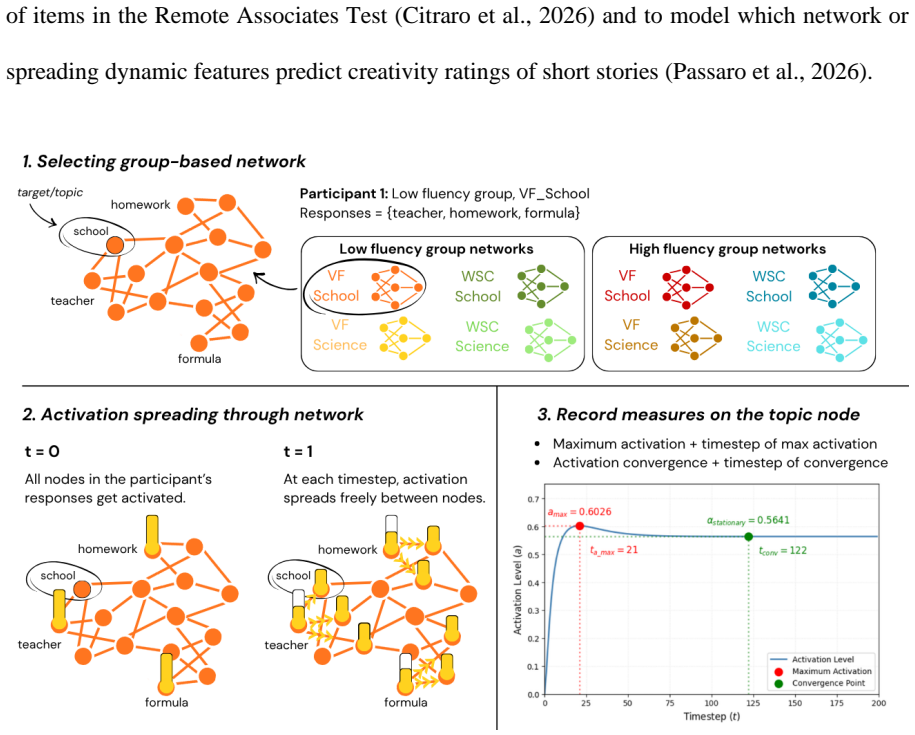
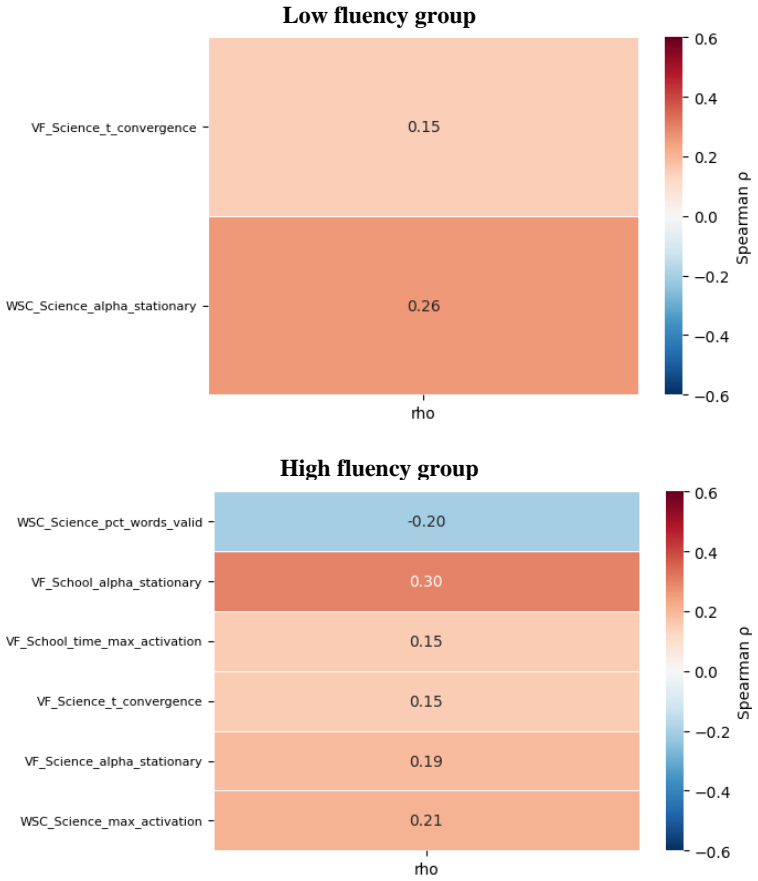
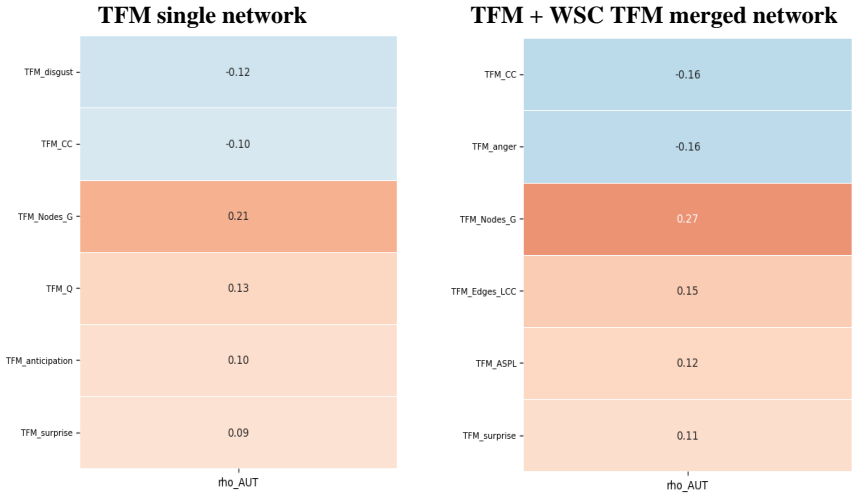
Creativity is a complex cognitive ability that relies on knowledge organisation and retrieval from semantic memory. Yet most research uses a single task to measure it, capturing only a fraction of this complexity. This study investigates multiplex networks - layered semantic networks obtained from six cognitive tasks - as a more comprehensive approach to modelling the associative knowledge underlying creativity. We collected data from N=518 individuals from four countries (Austria, USA, Singapore, Italy). From their responses to verbal fluency, sentence-chain, free association, and narrative writing tasks, we constructed semantic networks and assembled them in a multiplex structure. AI persona-based responses provided a comparison baseline. Structural reducibility analyses showed that different task layers captured distinct, non-redundant information about semantic organisation, supporting the use of multiple tasks over any single one. The networks from high- and low-creative groups remained structurally distinct, while AI-generated networks showed near-identical structures regardless of creativity group. Finally, we used 12 features (network measures, emotional scores, and spreading activation simulations) in a machine learning model using ridge regression to predict individual creativity scores. The combination of structurally similar layers, as identified in the previous stage, improved a proof-of-concept prediction accuracy by 50%. Structural measures showed the highest feature importance, with spreading activation dynamics providing additional predictive power. Together, these findings indicate that multiplex semantic networks capture a richer, cross-cultural picture of associative knowledge underlying creativity. We also release our diverse dataset and code to foster diverse computational approaches within the creativity community.
Editorial analysis
A structured set of objections, weighed in public.
Referee Report
Summary. The paper constructs multiplex semantic networks from six cognitive tasks (verbal fluency, sentence-chain, free association, narrative writing) administered to N=518 participants across Austria, USA, Singapore, and Italy. Structural reducibility analysis is used to claim that the task-derived layers capture non-redundant information about semantic organization; high- versus low-creativity groups show distinct network structures while AI-generated networks do not; and combining structurally similar layers in a ridge-regression model on 12 features (network measures, emotional scores, spreading activation) improves creativity-score prediction accuracy by 50% relative to a baseline. The dataset and code are released.
Significance. If the structural reducibility results and the 50% prediction gain survive proper controls for task format and pre-specification of layer selection, the work would offer a concrete, cross-cultural demonstration that single-task semantic networks under-sample the associative knowledge relevant to creativity. The release of a multilingual dataset and code is a clear strength that enables follow-up computational work.
major comments (3)
- [Abstract] Abstract: the claim that layer combination 'improved a proof-of-concept prediction accuracy by 50%' is presented without a stated single-task baseline, cross-validation scheme, error bars, or confirmation that the subset of 'structurally similar layers' was fixed before inspecting creativity scores; this directly raises the post-hoc selection concern noted in the circularity assessment.
- [Abstract] Abstract (structural reducibility paragraph): the analysis is said to show 'distinct, non-redundant information,' yet the six tasks differ systematically in output format (single-word vs. sentence chains vs. full narratives) and likely in cognitive load; no control is described that isolates semantic organization from these surface differences, leaving open the possibility that reducibility simply reflects task format rather than distinct semantic facets.
- [Abstract] Abstract (methods summary): no equations, participant exclusion criteria, or validation details are supplied for either the reducibility metric or the ridge-regression pipeline, making it impossible to assess whether the reported non-redundancy and accuracy gain are robust to reasonable analytic choices.
minor comments (1)
- [Abstract] The abstract refers to 'AI persona-based responses' as a baseline but does not specify the prompting procedure or how creativity-group labels were assigned to the generated text.
Simulated Author's Rebuttal
We thank the referee for their constructive and detailed comments. We respond point by point to the major comments on the abstract, indicating where we will revise the manuscript to improve clarity and address concerns about reporting and potential confounds.
read point-by-point responses
-
Referee: [Abstract] Abstract: the claim that layer combination 'improved a proof-of-concept prediction accuracy by 50%' is presented without a stated single-task baseline, cross-validation scheme, error bars, or confirmation that the subset of 'structurally similar layers' was fixed before inspecting creativity scores; this directly raises the post-hoc selection concern noted in the circularity assessment.
Authors: We agree the abstract omits these specifics. The full manuscript reports the 50% gain relative to the strongest single-layer ridge-regression baseline, employs 5-fold cross-validation, and provides standard errors. Layer selection was performed exclusively via the preceding structural reducibility analysis; creativity scores were not inspected until after layer grouping was fixed. We will revise the abstract to state the single-task baseline, note the cross-validation scheme, mention error bars, and explicitly confirm the pre-specified sequential workflow to eliminate any appearance of post-hoc selection. revision: yes
-
Referee: [Abstract] Abstract (structural reducibility paragraph): the analysis is said to show 'distinct, non-redundant information,' yet the six tasks differ systematically in output format (single-word vs. sentence chains vs. full narratives) and likely in cognitive load; no control is described that isolates semantic organization from these surface differences, leaving open the possibility that reducibility simply reflects task format rather than distinct semantic facets.
Authors: The referee correctly notes that task formats differ by design. We did not include an explicit control condition that holds output format constant while varying only semantic content. The current evidence for non-redundancy rests on the reducibility metric applied to the observed networks plus the contrast that human high- versus low-creativity groups produce distinguishable structures while AI-generated networks (matched for generation constraints) do not. We will add a dedicated limitations paragraph acknowledging the format confound and will explore supplementary analyses that partial out surface features if data permit. revision: partial
-
Referee: [Abstract] Abstract (methods summary): no equations, participant exclusion criteria, or validation details are supplied for either the reducibility metric or the ridge-regression pipeline, making it impossible to assess whether the reported non-redundancy and accuracy gain are robust to reasonable analytic choices.
Authors: Abstract length constraints preclude equations and full methodological detail. The manuscript Methods section supplies the reducibility equations, states the exclusion criteria that yielded the final N=518, and describes the ridge-regression pipeline together with its cross-validation procedure. We will lengthen the abstract methods summary by one sentence to mention cross-validation and will add a parenthetical reference directing readers to the Methods for equations and exclusion criteria. revision: yes
Circularity Check
No significant circularity in derivation chain
full rationale
The paper's central claims rest on empirical structural reducibility computations applied to multiplex networks built from six distinct tasks and on a subsequent ridge-regression model that predicts creativity scores from network-derived features. These steps are data-driven analyses performed on participant responses; the reducibility metric and the reported 50% accuracy gain are not shown to reduce by construction to the input data via any equation or self-citation chain. No self-definitional loops, fitted-input predictions, or load-bearing self-citations appear in the provided text. The derivation therefore remains self-contained against the collected multilingual dataset.
Axiom & Free-Parameter Ledger
axioms (1)
- domain assumption Responses to verbal fluency, free association, sentence-chain and narrative tasks can be converted into semantic networks whose structure reflects associative knowledge.
invented entities (1)
-
multiplex semantic network
no independent evidence
Reference graph
Works this paper leans on
-
[1]
Acar, S., Burnett, C., & Cabra, J. F. (2017). Ingredients of creativity: Originality and more. Creativity Research Journal, 29(2), 133–144. Ahmed, S. T., & Feist, G. J. (2021). The language of creativity: Validating linguistic analysis to assess creative scientists and artists. Frontiers in Psychology, 12, 724083. Aleta, A., Teixeira, A. S., Ferraz de Arr...
Pith/arXiv arXiv 2017
-
[2]
Battiston, F., Nicosia, V., & Latora, V. (2014). Structural measures for multiplex networks. Physical Review E, 89(3), 032804. Beaty, R. E., Johnson, D. R., Zeitlen, D. C., & Forthmann, B. (2022). Semantic distance and the alternate uses task: Recommendations for reliable automated assessment of originality. Creativity Research Journal, 34(3), 245–260. Be...
2014
-
[3]
be creative
Benedek, M., Kenett, Y. N., Umdasch, K., Anaki, D., Faust, M., & Neubauer, A. C. (2017). How semantic memory structure and intelligence contribute to creative thought: A network science approach. Thinking & Reasoning, 23(2), 158–183. Benedek, M., & Neubauer, A. C. (2013). Revisiting Medni ck’s model on creativity‐related differences in associative hierarc...
2017
-
[4]
P., Kenett, Y
Christensen, A. P., Kenett, Y. N., Cotter, K. N., Beaty, R. E., & Silvia, P. J. (2018). Remotely close associations: Openness to experience and semantic memory structure. European Journal of Personality, 32(4), 480–492. Citraro, S., Haim, E., Carini, A., Siew, C. S., Rossetti, G., & Stella, M. (2026). SpreadPy: A Python tool for modelling spreading activa...
2018
-
[5]
Corazza, G. E. (2016). Potential originality and effectiveness: The dynamic definition of creativity. Creativity Research Journal, 28(3), 258–267. De Deyne, S., Navarro, D. J., & Storms, G. (2013). Better explanations of lexical and semantic cognition using networks derived from continued rather than single -word associations. Behavior Research Methods, 4...
2016
-
[6]
K., Baas, M., & Nijstad, B
De Dreu, C. K., Baas, M., & Nijstad, B. A. (2008). Hedonic tone and activation level in the mood-creativity link: Toward a dual pathway to creativity m odel. Journal of Personality and Social Psychology, 94(5),
2008
-
[7]
Domanti, U., Mock, M., Agnoli, S., & De Angeli, A. (2026). The Effect of Idea Elaboration on the Automatic Assessment of Idea Originality. arXiv Preprint arXiv:2604.20569. Forgeard, M. J., & Elstein, J. G. (2014). Advancing the clinical science of creativity. Frontiers in Psychology, 5,
Pith/arXiv arXiv 2026
-
[8]
Forthmann, B., Oyebade, O., Ojo, A., Günther, F., & Holling, H. (2019). Application of latent semantic analysis to divergent thinking is biased by elaboration. The Journal of Creative Behavior, 53(4), 559–575. Ganor, O., Samuel, G., Stella, M., & Kenett, Y. N. (2025). A cognitive multiplex network approach to investigate mental navigation and predict high...
2019
-
[9]
J., Fioratou, E., Anthony, S
Gilhooly, K. J., Fioratou, E., Anthony, S. H., & Wynn, V. (2007). Divergent thinking: Strategies and executive involvement in generating novel uses for familiar objects. British Journal of Psychology, 98(4), 611–625. Griffiths, T. L., Steyvers, M., & Firl, A. (2007). Google and the mind: Predicting fluency with PageRank. Psychological Science, 18(12), 106...
2007
-
[10]
Haim, E., Lai, C., Beaty, R. E., & Stella, M. (2026). The word-sentence construction task versus the verbal fluency task: Capturing features of scientific creativity via semantic networks. Psychology of Aesthetics, Creativity, and the Arts , 20(3), 781 –793. https://doi.org/10.1037/aca0000731 Haim, E., & Stella, M. (2026). Cognitive Networks for Knowledge...
-
[11]
K., Seavey, J
Jacobson, S. K., Seavey, J. R., & Mueller, R. C. (2016). Integrated science and art education for creative climate change communication. Ecology and Society, 21(3). Kaufman, S., Rosset, S., Perlich, C., & Stitelman, O. (2012). Leakage in data mining: Formulation, detection, and avoidance. ACM Transactions on Knowledge Discovery from Data (TKDD), 6(4), 1–2...
2016
-
[12]
N., Beaty, R
Kenett, Y. N., Beaty, R. E., Silvia, P. J., Anaki, D., & Faust, M. (2016). Structure and flexibility: Investigating the relation between the structure of the mental lexicon, fluid intelligence, and creative achievement. Psychology of Aesthetics, Creativity, and the Arts, 10(4),
2016
-
[13]
N., & Faust, M
Kenett, Y. N., & Faust, M. (2019). A semantic network cartography of the creative mind. Trends in Cognitive Sciences, 23(4), 271–274. Khalil, R., Frühholz, S., & Godde, B. (2025). Emotion induction modulates neural dynamics related to the originality of ideational creativity. Human Brain Mapping, 46(4), e70182. Lai, C. K., Haim, E., Aschauer, W., Haim, K....
2019
-
[14]
P., Di Matteo, T., & Aste, T
Massara, G. P., Di Matteo, T., & Aste, T. (2016). Network filtering for big data: Triangulated maximally filtered graph. Journal of Complex Networks, 5(2), 161–178. Mednick, S. (1962). The associative basis of the creative process. Psychological Review, 69(3),
2016
-
[15]
Mohammad, S. M., & Turney, P. D. (2013). Crowdsourcing a word –emotion association lexicon. Computational Intelligence, 29(3), 436–465. Moon, K., Green, A. E., & Kushlev, K. (2025). Homogenizing effect of large language models (LLMs) on creative diversity: An empirical comparison of human and ChatGPT writing. Computers in Human Behavior: Artificial Humans...
-
[16]
Peirce, J. (2007). PsychoPy —Psychophysics software in Python. Journal of Neuroscience Methods, 162(1–2), 8–13. Peirce, J., Gray, J. R., Simpson, S., MacAskill, M., Höchenberger, R., Sogo, H., Kastman, E., & Lindeløv, J. K. (2019). PsychoPy2: Experiments in behavior made easy. Behavior Research Methods, 51(1), 195–203. Plutchik, R. (1980). Emotion. A Psyc...
2007
-
[17]
S., Mohammad, S
Semeraro, A., Vilella, S., Improta, R., De Duro, E. S., Mohammad, S. M., Ruffo, G., & Stella, M. (2025). EmoAtlas: An emotional network analyzer of texts that merges psychological lexicons, artificial intelligence, and network science. Behavior Research Methods, 57(2),
2025
-
[18]
Siew, C. S. (2019). spreadr: An R package to simulate spreading activation in a network. Behavior Research Methods, 51(2), 910–929. Siew, C. S., & Guru, A. (2023). Investigating the network structure of domain -specific knowledge using the semantic fluency task. Memory & Cognition, 51(3), 623–646. Stella, M. (2020). Text -mining forma mentis networks reco...
2019
-
[19]
Stella, M., & Zaytseva, A. (2020). Forma mentis netwo rks map how nursing and engineering students enhance their mindsets about innovation and health during professional growth. PeerJ Computer Science, 6, e255. Steyvers, M., & Tenenbaum, J. B. (2005). The large‐scale structure of semantic networks: Statistical analyses and a model of semantic growth. Cogn...
arXiv 2020
discussion (0)
Sign in with ORCID, Apple, or X to comment. Anyone can read and Pith papers without signing in.