Modifying ΛCDM dynamics via out-of-equilibrium axions: reconciling SH0ES and DESI H₀ values
Pith reviewed 2026-06-27 15:51 UTC · model grok-4.3
The pith
A small fraction of out-of-equilibrium axions modifies late dark matter density to yield H0 of 73 km/s/Mpc while fitting DESI data.
A machine-rendered reading of the paper's core claim, the machinery that carries it, and where it could break.
Core claim
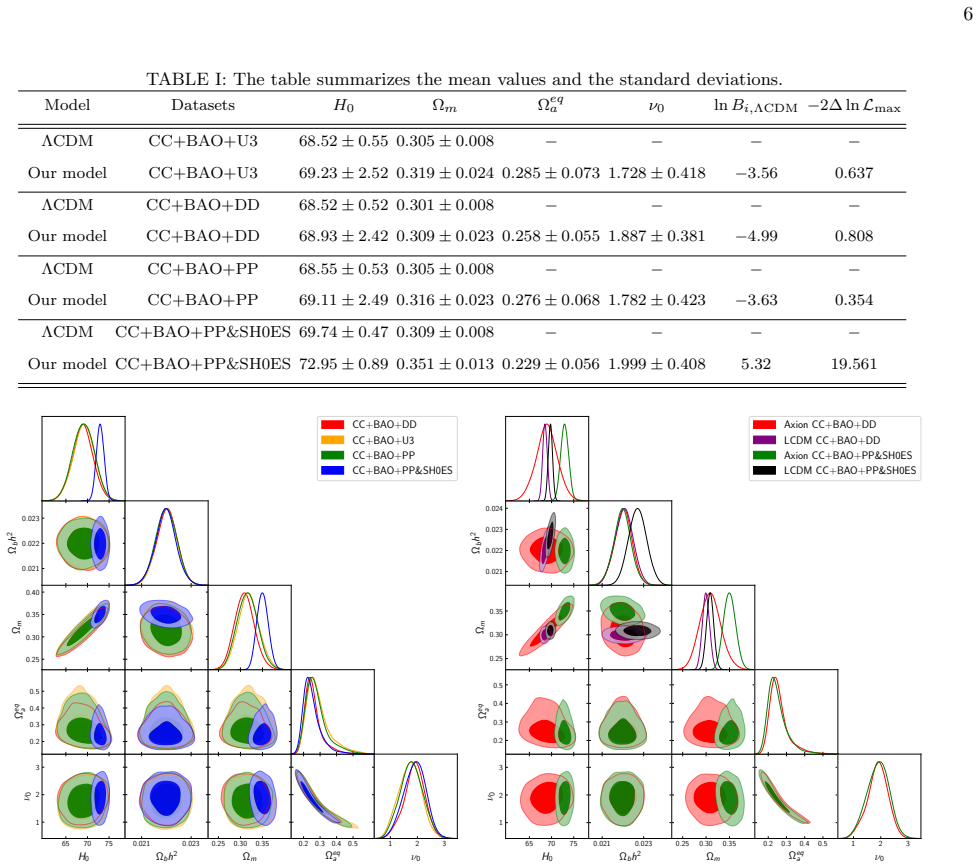
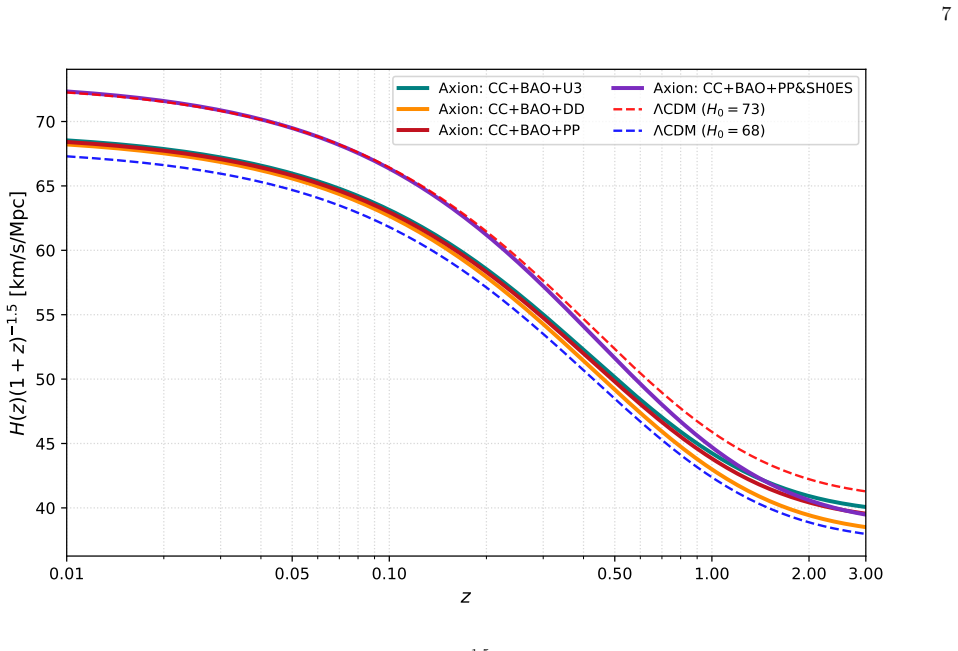
Using kinetic and classical-field methods for axions produces an identical equation governing dark-matter density evolution; the resulting dynamics alter Lambda CDM only for z less than or equal to 1, asymptotically recovering the standard model at higher redshifts. Statistical comparison with late-universe datasets shows that inclusion of the SH0ES calibration strongly favors the collisional axion scenario over Lambda CDM, with best-fit H0 approximately 73 km s^{-1} Mpc^{-1}, while preserving excellent agreement with DESI baryon acoustic oscillation data.
What carries the argument
The macroscopic dark-matter density evolution equation obtained from out-of-equilibrium axion dynamics, which governs the collisional axion model and produces redshift-dependent deviations only at z less than or equal to 1.
If this is right
- The model recovers standard Lambda CDM behavior at high redshifts.
- It accommodates the higher local Hubble constant from SH0ES distance-ladder measurements.
- It maintains consistency with DESI baryon acoustic oscillation observations.
- The best-fit Hubble constant reaches approximately 73 km s^{-1} Mpc^{-1} when local calibration is included.
Where Pith is reading between the lines
- Axion mass and interaction parameters could be further constrained by combining additional low-redshift probes.
- Deviations in the matter power spectrum or growth rate at z less than 1 might provide independent tests of the out-of-equilibrium effect.
- Similar late-time modifications could be explored for other cosmological tensions if the same non-equilibrium mechanism applies.
Load-bearing premise
A small fraction of axions is assumed to drive the dark-matter component away from thermal equilibrium, producing a modified density evolution that affects only redshifts below 1.
What would settle it
A high-precision measurement of the Hubble parameter or dark-matter density at redshifts 0.5 to 2 that shows no deviation from standard Lambda CDM predictions would rule out the model.
Figures
read the original abstract
We investigate late-Universe dynamics in which the dark matter component is described by axion particles. The proposed framework departs from the standard $\Lambda$CDM paradigm due to a small fraction of axions driving the system away from thermal equilibrium. We analyze the evolution of the axion energy density using both a kinetic and a classical field approach, yielding an identical macroscopic evolution equation for the dark matter density. The resulting scenario modifies $\Lambda$CDM dynamics in the late Universe (specifically at $z \lesssim 1$), while asymptotically recovering the standard baseline at earlier cosmic epochs. We compare the theoretical predictions of our formulation against a comprehensive suite of late-Universe datasets. Our statistical analysis reveals that when the SH0ES local calibration is included, the collisional axion model becomes significantly favored over $\Lambda$CDM, yielding a best-fit Hubble constant of $H_0 \simeq 73~{\rm km\,s^{-1}\,Mpc^{-1}}$. Ultimately, this cosmological scenario successfully accommodates local distance-ladder measurements while maintaining excellent agreement with Baryon Acoustic Oscillation data from the DESI Collaboration.
Editorial analysis
A structured set of objections, weighed in public.
Referee Report
Summary. The manuscript proposes a model of out-of-equilibrium axions that modifies the dark-matter density evolution only at z ≲ 1 while asymptotically recovering standard ΛCDM at higher redshifts. Kinetic and classical-field treatments are shown to yield the same macroscopic evolution equation. When SH0ES local calibration is included in the fit, the model is reported to be statistically favored over ΛCDM and to yield a best-fit H₀ ≃ 73 km s⁻¹ Mpc⁻¹ while remaining consistent with DESI BAO measurements.
Significance. If the claimed redshift restriction can be derived without additional free parameters or early-universe leakage, the scenario would provide a late-time-only modification capable of addressing the Hubble tension. The explicit demonstration that the two independent treatments produce identical evolution equations is a methodological strength that should be retained.
major comments (1)
- [Abstract] Abstract, paragraph 2: the central claim that a small axion fraction automatically confines the density modification to z ≲ 1 (leaving the sound horizon and pre-recombination physics untouched) is load-bearing, yet no explicit expression for the equilibrium-restoration redshift or the interaction rate that enforces this separation is supplied; if that rate depends on the same parameters controlling the low-z deviation, the one-parameter character of the model is not guaranteed.
Simulated Author's Rebuttal
We thank the referee for their careful reading of the manuscript and for identifying a point that requires clarification in the abstract. We address the major comment below and will revise the manuscript accordingly to strengthen the presentation.
read point-by-point responses
-
Referee: [Abstract] Abstract, paragraph 2: the central claim that a small axion fraction automatically confines the density modification to z ≲ 1 (leaving the sound horizon and pre-recombination physics untouched) is load-bearing, yet no explicit expression for the equilibrium-restoration redshift or the interaction rate that enforces this separation is supplied; if that rate depends on the same parameters controlling the low-z deviation, the one-parameter character of the model is not guaranteed.
Authors: We agree that an explicit expression for the equilibrium-restoration redshift would make the load-bearing claim more transparent. The model is constructed with a single free parameter (the axion fraction f_a that sets the strength of the out-of-equilibrium interaction). The interaction rate Γ is proportional to f_a, so the redshift at which equilibrium is restored is a derived quantity that scales with f_a; for the small values of f_a required to fit the data, this automatically places the onset of the deviation at z ≲ 1 while ensuring standard evolution at higher redshifts. No additional parameters are introduced. In the revised manuscript we will add the explicit expression for the restoration redshift (derived from the macroscopic evolution equation obtained in both the kinetic and classical-field treatments) directly in the abstract and in the relevant methods section, thereby confirming the one-parameter character and the absence of early-universe leakage. revision: yes
Circularity Check
Fit to SH0ES presented as model accommodation; central dynamics claim lacks quoted reduction to inputs
specific steps
-
fitted input called prediction
[Abstract]
"when the SH0ES local calibration is included, the collisional axion model becomes significantly favored over ΛCDM, yielding a best-fit Hubble constant of H₀ ≃ 73 km s^{-1} Mpc^{-1}. Ultimately, this cosmological scenario successfully accommodates local distance-ladder measurements while maintaining excellent agreement with Baryon Acoustic Oscillation data from the DESI Collaboration."
The quoted best-fit H0 and 'accommodates' language are the direct output of fitting the model's parameters to the SH0ES dataset; the reconciliation statement is therefore equivalent to the input fit rather than an independent derivation or out-of-sample test.
full rationale
The paper derives a macroscopic DM density equation from kinetic and classical-field treatments that is asserted to modify only z ≲ 1 while recovering ΛCDM earlier. This is presented as following from a small axion fraction. The statistical claim then fits parameters to SH0ES (plus other data) and states that the model 'accommodates' the local H0. No load-bearing step reduces by construction to a self-citation or to the target H0 value itself; the fit is explicit and the dynamics derivation is independent of the H0 tension data. The interpretation of the fit as 'reconciliation' is interpretive rather than a hidden definitional loop. No other enumerated circularity patterns are exhibited with direct quotes showing reduction.
Axiom & Free-Parameter Ledger
free parameters (1)
- out-of-equilibrium axion fraction
axioms (2)
- domain assumption Kinetic and classical field approaches produce identical macroscopic evolution equation for dark matter density
- ad hoc to paper Modification affects only z ≲ 1 and recovers standard ΛCDM at earlier epochs
invented entities (1)
-
out-of-equilibrium axions
no independent evidence
Reference graph
Works this paper leans on
-
[1]
Steven Weinberg,Cosmology(Oxford University Press, Oxford, UK) (2008)
2008
-
[2]
Kolb and Michael S
Edward W. Kolb and Michael S. Turner,The Early Universe, Frontiers in Physics (Addison-Wesley, Redwood City, CA) (1990)
1990
-
[3]
Verde, T
L. Verde, T. Treu and A. G. Riess,Nature Astron.3, 891 (2019)
2019
-
[4]
Phys.131, 102605 (2021)
Eleonora Di Valentinoet al.,Astropart. Phys.131, 102605 (2021)
2021
-
[5]
Mota, Adam G
Eleonora Di Valentino, Olga Mena, Supriya Pan, Luca Visinelli, Weiqiang Yang, Alessandro Melchiorri, David F. Mota, Adam G. Riess and Joseph Silk,Class. Quant. Grav.38, 153001 (2021)
2021
-
[6]
Rev.95, 101659 (2022)
Leandros Perivolaropoulos and Foteini Skara,New Astron. Rev.95, 101659 (2022)
2022
-
[7]
Witte, Vivian Poulin and Julien Lesgour- gues,Phys
Nils Sch¨ oneberg, Guillermo Franco Abell´ an, Andrea P´ erez S´ anchez, Samuel J. Witte, Vivian Poulin and Julien Lesgour- gues,Phys. Rept.984, 1 (2022)
2022
-
[8]
Astrophys
Paul Shah, Pablo Lemos and Ofer Lahav,Astron. Astrophys. Rev.29, 9 (2021)
2021
-
[9]
Elcio Abdallaet al.,JHEAp34, 49 (2022)
2022
-
[10]
Eleonora Di Valentino,Universe8, 399 (2022)
2022
-
[11]
Riess,Ann
Marc Kamionkowski and Adam G. Riess,Ann. Rev. Nucl. Part. Sci.73, 153 (2023)
2023
-
[12]
Jian-Ping Hu and Fa-Yin Wang,Universe9, 94 (2023)
2023
-
[13]
William Giar` e,≪CMB Anomalies and the Hubble Tension ≫, (2023)
2023
-
[14]
Sunny Vagnozzi,Universe9, 393 (2023)
2023
-
[15]
Licia Verde, Nils Sch¨ oneberg and H´ ector Gil-Mar´ ın,arXiv e-prints(2023)
2023
-
[16]
Eleonora Di Valentino and Dillon Brout (Ed.),The Hubble Constant Tension, Springer Series in Astrophysics and Cos- mology (Springer) (2024)
2024
-
[17]
Leandros Perivolaropoulos, ≪Hubble Tension or Distance Ladder Crisis? ≫, (2024)
2024
-
[18]
Colg´ ain, Anjan A
¨Ozg¨ ur Akarsu, Eoin´O. Colg´ ain, Anjan A. Sen and M. M. Sheikh-Jabbari,Universe10, 305 (2024)
2024
-
[19]
Dark Univ.49, 101965 (2025)
Eleonora Di Valentinoet al.,Phys. Dark Univ.49, 101965 (2025)
2025
-
[20]
Riesset al.,Astrophys
Adam G. Riesset al.,Astrophys. J. Lett.934, L7 (2022)
2022
-
[21]
Riess, Stefano Casertano, Wenlong Yuan, Lucas M
Louise Breuval, Adam G. Riess, Stefano Casertano, Wenlong Yuan, Lucas M. Macri, Martino Romaniello, Yukei S. Murakami, Daniel Scolnic, Gagandeep S. Anand and Igor Soszy´ nski,arXiv:2404.08038973, 30 (2024)
arXiv 2024
-
[22]
Aghanimet al.,A& A641, A6 (2020), [Erratum: Astron.Astrophys
N. Aghanimet al.,A& A641, A6 (2020), [Erratum: Astron.Astrophys. 652, C4 (2021)]
2020
-
[23]
Camphuiset al., ≪SPT-3G D1: CMB temperature and polarization power spectra and cosmology from 2019 and 2020 observations of the SPT-3G Main field ≫, (2025)
E. Camphuiset al., ≪SPT-3G D1: CMB temperature and polarization power spectra and cosmology from 2019 and 2020 observations of the SPT-3G Main field ≫, (2025)
2019
-
[24]
Stefano Casertanoet al., ≪The Local Distance Network: a community consensus report on the measurement of the Hubble constant at 1% precision ≫, (2025)
2025
-
[25]
Riess,Annual Review of Nuclear and Particle Science73, 153 (2023)
Marc Kamionkowski and Adam G. Riess,Annual Review of Nuclear and Particle Science73, 153 (2023)
2023
-
[26]
Carlos Silva,Classical and Quantum Gravity42, 245002 (2025)
2025
-
[27]
Smith, Tanvi Karwal and Marc Kamionkowski,Phys
Vivian Poulin, Tristan L. Smith, Tanvi Karwal and Marc Kamionkowski,Phys. Rev. Lett.122, 221301 (2019)
2019
-
[28]
Tanvi Karwal and Marc Kamionkowski,Phys. Rev. D94, 103523 (2016). 9
2016
-
[29]
Colin Hill, Evan McDonough, Michael W
J. Colin Hill, Evan McDonough, Michael W. Toomey and Stephon Alexander,Phys. Rev. D102, 043507 (2020)
2020
-
[30]
Ivanov, Evan McDonough, J
Mikhail M. Ivanov, Evan McDonough, J. Colin Hill, Marko Simonovi´ c, Michael W. Toomey, Stephon Alexander and Matias Zaldarriaga,Phys. Rev. D102, 103502 (2020)
2020
-
[31]
Jeremy Sakstein and Mark Trodden,Phys. Rev. Lett.124, 161301 (2020)
2020
-
[32]
Sloth,Phys
Florian Niedermann and Martin S. Sloth,Phys. Rev. D103, L041303 (2021)
2021
-
[33]
Sloth,Phys
Florian Niedermann and Martin S. Sloth,Phys. Rev. D102, 063527 (2020)
2020
-
[34]
Smith and Tanvi Karwal,Phys
Vivian Poulin, Tristan L. Smith and Tanvi Karwal,Phys. Dark Univ.42, 101348 (2023)
2023
-
[35]
Adam Smith, Philippe Brax, Carsten van de Bruck, C. P. Burgess and Anne-Christine Davis,Eur. Phys. J. C85, 1062 (2025)
2025
-
[36]
Smith, Rodrigo Calder´ on and Th´ eo Simon,≪Impact of ACT DR6 and DESI DR2 for Early Dark Energy and the Hubble tension ≫, (2025)
Vivian Poulin, Tristan L. Smith, Rodrigo Calder´ on and Th´ eo Simon,≪Impact of ACT DR6 and DESI DR2 for Early Dark Energy and the Hubble tension ≫, (2025)
2025
-
[37]
A. R. Khalifeet al., ≪SPT-3G D1: Axion Early Dark Energy with CMB experiments and DESI ≫, (2025)
2025
-
[38]
Chiara Caprini and Nicola Tamanini,JCAP10, 006 (2016)
2016
-
[39]
Nunes, Supriya Pan and Emmanuel N
Rafael C. Nunes, Supriya Pan and Emmanuel N. Saridakis,Phys. Rev. D94, 023508 (2016)
2016
-
[40]
Nunes,Phys
Suresh Kumar and Rafael C. Nunes,Phys. Rev. D96, 103511 (2017)
2017
-
[41]
Eleonora Di Valentino, Alessandro Melchiorri and Olga Mena,Phys. Rev. D96, 043503 (2017)
2017
-
[42]
Mota,Phys
Weiqiang Yang, Supriya Pan and David F. Mota,Phys. Rev. D96, 123508 (2017)
2017
-
[43]
Costa, Ricardo C
Andre A. Costa, Ricardo C. G. Landim, Bin Wang and E. Abdalla,Eur. Phys. J. C78, 746 (2018)
2018
-
[44]
von Marttens, L
R. von Marttens, L. Casarini, D. F. Mota and W. Zimdahl,Phys. Dark Univ.23, 100248 (2019)
2019
-
[45]
Nunes, Sunny Vagnozzi and David F
Weiqiang Yang, Supriya Pan, Eleonora Di Valentino, Rafael C. Nunes, Sunny Vagnozzi and David F. Mota,JCAP09, 019 (2018)
2018
-
[46]
Weiqiang Yang, Ankan Mukherjee, Eleonora Di Valentino and Supriya Pan,Phys. Rev. D98, 123527 (2018)
2018
-
[47]
Saridakis and Subenoy Chakraborty,Phys
Supriya Pan, Weiqiang Yang, Eleonora Di Valentino, Emmanuel N. Saridakis and Subenoy Chakraborty,Phys. Rev. D 100, 103520 (2019)
2019
-
[48]
Nunes and Santosh Kumar Yadav,Eur
Suresh Kumar, Rafael C. Nunes and Santosh Kumar Yadav,Eur. Phys. J. C79, 576 (2019)
2019
-
[49]
Eleonora Di Valentino, Alessandro Melchiorri, Olga Mena and Sunny Vagnozzi,Phys. Rev. D101, 063502 (2020)
2020
-
[50]
Dark Univ.30, 100666 (2020)
Eleonora Di Valentino, Alessandro Melchiorri, Olga Mena and Sunny Vagnozzi,Phys. Dark Univ.30, 100666 (2020)
2020
-
[51]
Eleonora Di Valentino, Alessandro Melchiorri, Olga Mena, Supriya Pan and Weiqiang Yang,Mon. Not. Roy. Astron. Soc. 502, L23 (2021)
2021
-
[52]
Adri` a G´ omez-Valent, Valeria Pettorino and Luca Amendola,Phys. Rev. D101, 123513 (2020)
2020
-
[53]
Hooper,Phys
Matteo Lucca and Deanna C. Hooper,Phys. Rev. D102, 123502 (2020)
2020
-
[54]
Sharov and Weiqiang Yang,Phys
Supriya Pan, German S. Sharov and Weiqiang Yang,Phys. Rev. D101, 103533 (2020)
2020
-
[55]
Li-Yang Gao, Ze-Wei Zhao, She-Sheng Xue and Xin Zhang,JCAP07, 005 (2021)
2021
-
[56]
Dark Univ.33, 100862 (2021)
Suresh Kumar,Phys. Dark Univ.33, 100862 (2021)
2021
-
[57]
Weiqiang Yang, Supriya Pan, Eleonora Di Valentino, Olga Mena and Alessandro Melchiorri,JCAP10, 008 (2021)
2021
-
[58]
Nunes, Sunny Vagnozzi, Suresh Kumar, Eleonora Di Valentino and Olga Mena,Phys
Rafael C. Nunes, Sunny Vagnozzi, Suresh Kumar, Eleonora Di Valentino and Olga Mena,Phys. Rev. D105, 123506 (2022)
2022
-
[59]
Nunes,Phys
Armando Bernui, Eleonora Di Valentino, William Giar` e, Suresh Kumar and Rafael C. Nunes,Phys. Rev. D107, 103531 (2023)
2023
-
[60]
Escamilla, Ozgur Akarsu, Eleonora Di Valentino and J
Luis A. Escamilla, Ozgur Akarsu, Eleonora Di Valentino and J. Alberto Vazquez,JCAP11, 051 (2023)
2023
-
[61]
William Giar` e, Miguel A. Sabogal, Rafael C. Nunes and Eleonora Di Valentino,arXiv:2404.15232133, 251003 (2024)
arXiv 2024
-
[62]
J.976, 1 (2024)
Tian-Nuo Li, Peng-Ju Wu, Guo-Hong Du, Shang-Jie Jin, Hai-Li Li, Jing-Fei Zhang and Xin Zhang,Astrophys. J.976, 1 (2024)
2024
-
[63]
Sabogal, Emanuelly Silva, Rafael C
Miguel A. Sabogal, Emanuelly Silva, Rafael C. Nunes, Suresh Kumar and Eleonora Di Valentino,Phys. Rev. D111, 043531 (2025)
2025
-
[64]
Sabogal, Mateus Scherer, Rafael C
Emanuelly Silva, Miguel A. Sabogal, Mateus Scherer, Rafael C. Nunes, Eleonora Di Valentino and Suresh Kumar,Phys. Rev. D111, 123511 (2025)
2025
-
[65]
Weiqiang Yang, Sibo Zhang, Olga Mena, Supriya Pan and Eleonora Di Valentino, ≪Dark Energy Is Not That Into You: Variable Couplings after DESI DR2 BAO ≫, (2025)
2025
-
[66]
Dark Univ.50, 102121 (2025)
Marcel van der Westhuizen, Amare Abebe and Eleonora Di Valentino,Phys. Dark Univ.50, 102121 (2025)
2025
-
[67]
China Phys
Tian-Nuo Li, Guo-Hong Du, Yun-He Li, Peng-Ju Wu, Shang-Jie Jin, Jing-Fei Zhang and Xin Zhang,Sci. China Phys. Mech. Astron.69, 210413 (2026)
2026
-
[68]
Tian-Nuo Li, William Giar` e, Guo-Hong Du, Yun-He Li, Eleonora Di Valentino, Jing-Fei Zhang and Xin Zhang, ≪Strong Evidence for Dark Sector Interactions ≫, (2026)
2026
-
[69]
Feng,Ann
Jonathan L. Feng,Ann. Rev. Astron. Astrophys.48, 495 (2010)
2010
-
[70]
Widrow,Phys
Scott Dodelson and Lawrence M. Widrow,Phys. Rev. Lett.72, 17 (1994)
1994
-
[71]
Rept.568, 1 (2015)
Austin Joyce, Bhuvnesh Jain, Justin Khoury and Mark Trodden,Phys. Rept.568, 1 (2015)
2015
-
[72]
K. N. Abazajianet al., ≪Light Sterile Neutrinos: A White Paper ≫, (2012)
2012
-
[73]
Copeland, M
Edmund J. Copeland, M. Sami and Shinji Tsujikawa,Int. J. Mod. Phys. D15, 1753 (2006)
2006
-
[74]
Astrophys.668, A135 (2022)
Denitsa Staicova and David Benisty,Astron. Astrophys.668, A135 (2022)
2022
-
[75]
Astrophys.647, A38 (2021)
David Benisty and Denitsa Staicova,Astron. Astrophys.647, A38 (2021)
2021
-
[76]
Odintsov,Astrophys
Kazuharu Bamba, Salvatore Capozziello, Shin’ichi Nojiri and Sergei D. Odintsov,Astrophys. Space Sci.342, 155 (2012)
2012
-
[77]
Wolf, Carlos Garc´ ıa-Garc´ ıa, Deaglan J
William J. Wolf, Carlos Garc´ ıa-Garc´ ıa, Deaglan J. Bartlett and Pedro G. Ferreira,Phys. Rev. D110, 083528 (2024)
2024
-
[78]
Ferreira, Antonio Padilla and Constantinos Skordis,Phys
Timothy Clifton, Pedro G. Ferreira, Antonio Padilla and Constantinos Skordis,Phys. Rept.513, 1 (2012). 10
2012
-
[79]
An Update by the CANTATA Network(Springer) (2021)
Yashar Akramiet al.,Modified Gravity and Cosmology. An Update by the CANTATA Network(Springer) (2021)
2021
-
[80]
Dialektopoulos, Celia Escamilla-Rivera, Gabriel Farrugia, Viktor Gakis, Martin Hendry, Manuel Hohmann, Jackson Levi Said, Jurgen Mifsud and Eleonora Di Valentino,Rept
Sebastian Bahamonde, Konstantinos F. Dialektopoulos, Celia Escamilla-Rivera, Gabriel Farrugia, Viktor Gakis, Martin Hendry, Manuel Hohmann, Jackson Levi Said, Jurgen Mifsud and Eleonora Di Valentino,Rept. Prog. Phys.86, 026901 (2023)
2023
discussion (0)
Sign in with ORCID, Apple, or X to comment. Anyone can read and Pith papers without signing in.