MRI-triggered instability at the inner dead zone edge: disc evolution and burst modes tied to magnetic field strengths
Pith reviewed 2026-06-27 14:58 UTC · model grok-4.3
The pith
Magnetic field strength sets whether dead-zone-edge instabilities produce wide or narrow accretion bursts.
A machine-rendered reading of the paper's core claim, the machinery that carries it, and where it could break.
Core claim
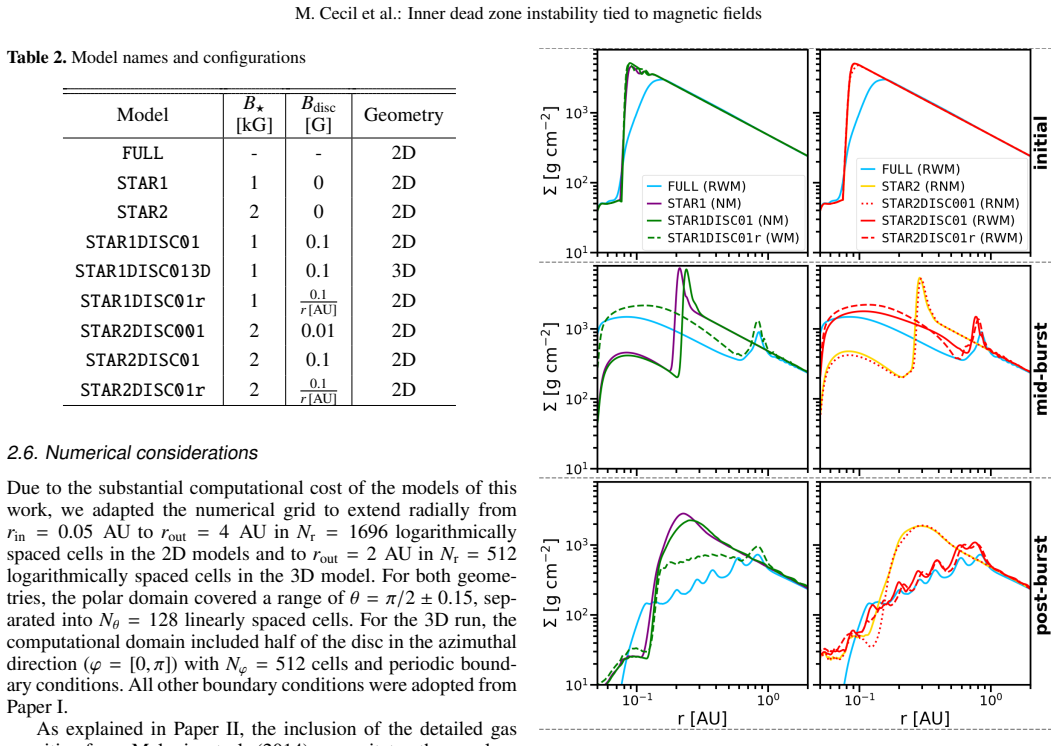
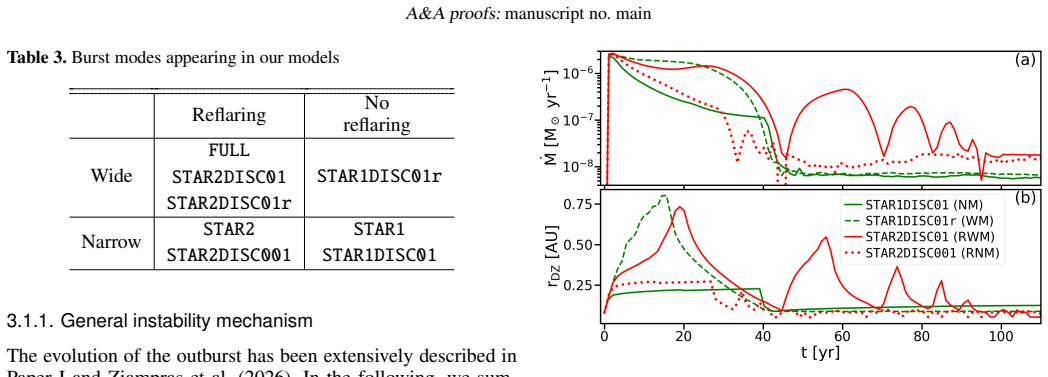
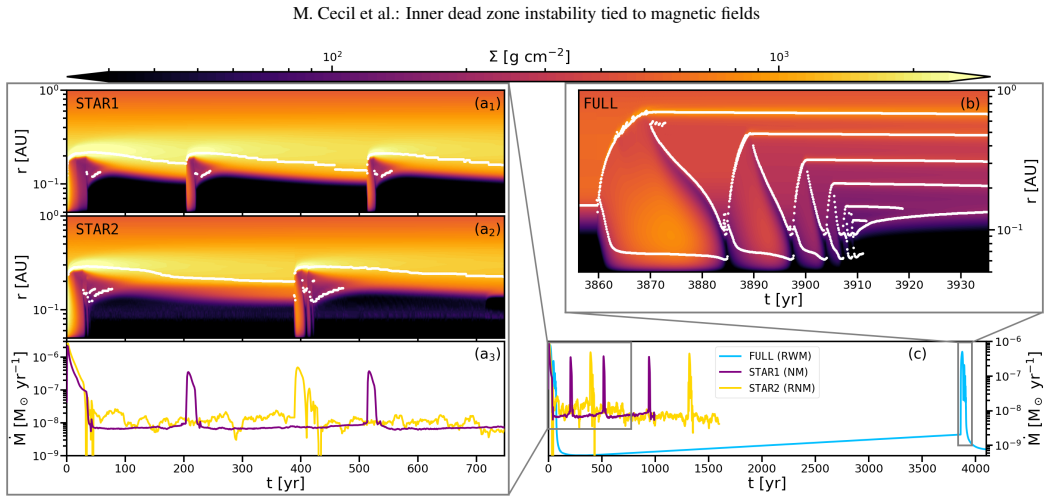
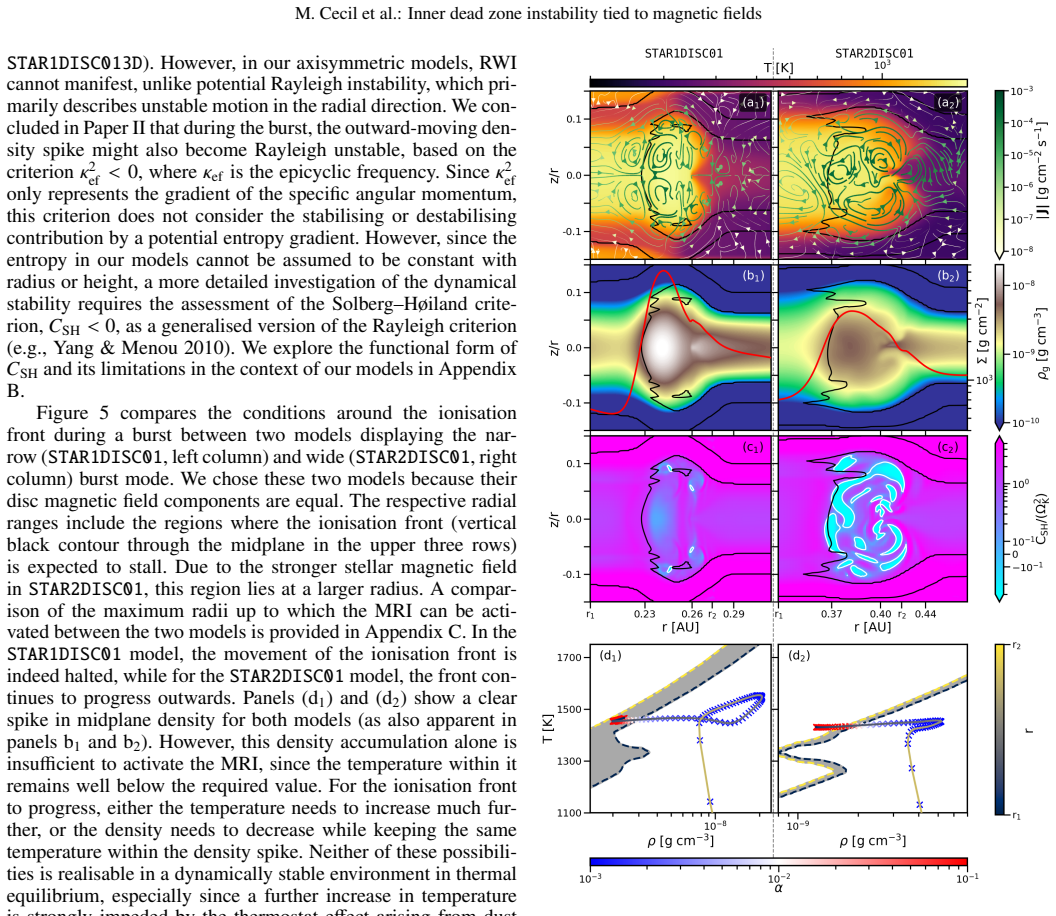
Coupling MRI activity directly to different magnetic field strengths, rather than using simple temperature thresholds, enables a variety of burst modes. Each mode exhibits characteristic accretion burst signatures and has different consequences for planet formation and migration conditions. The properties and consequences of the episodic accretion events are highly sensitive to the magnetic field strength. A new burst mode is revealed, in which the midplane MRI activity is restricted to small radii in the presence of weak magnetic fields. A distinct dichotomy between the wide and narrow modes is established by the hydrodynamic (in)stability of the ionisation front.
What carries the argument
MRI activation criteria based on ambipolar and Ohmic diffusion coupled to magnetic field strength profiles comprising stellar and disc components
If this is right
- Stronger magnetic fields produce wide burst modes whose ionisation fronts remain hydrodynamically stable.
- Weaker magnetic fields produce narrow burst modes in which midplane MRI activity stays confined to small radii and the pressure bump moves during quiescence.
- The wide/narrow distinction is set by the hydrodynamic stability of the ionisation front.
- Neither mode triggers classical thermal instability from hydrogen ionisation.
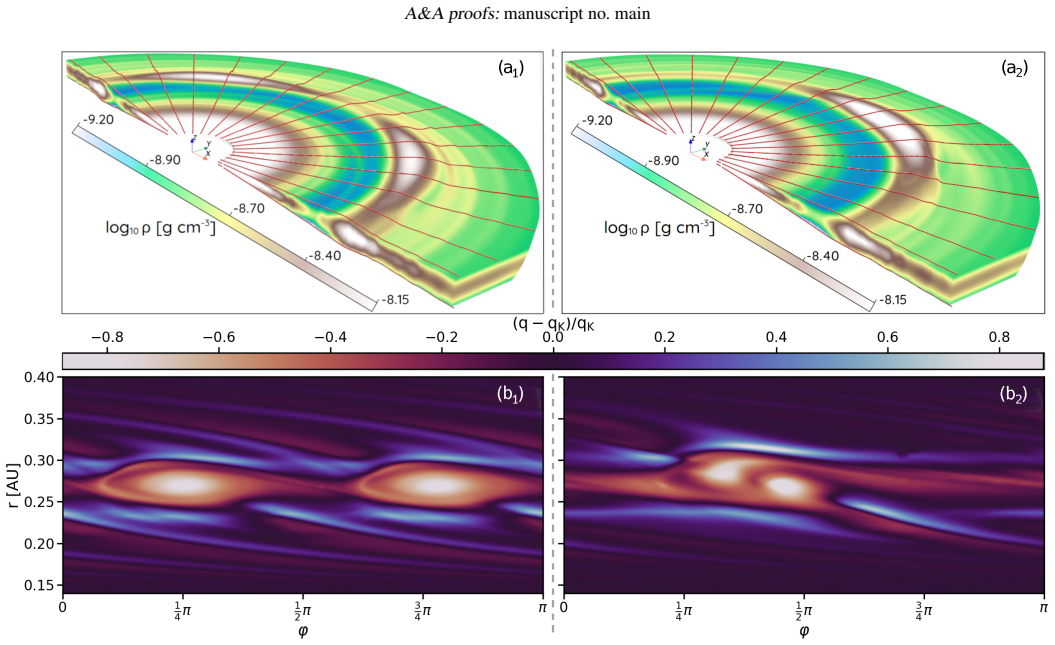
- In 3D the narrow mode breaks into vortices at radii smaller than 0.5 AU.
Where Pith is reading between the lines
- If observed magnetic field profiles differ from the assumed stellar-plus-disc combination, the predicted wide/narrow mode split would not appear.
- The narrow-mode vortices could trap dust at radii well inside 0.5 AU and thereby change planetesimal formation locations.
- Replacing temperature-threshold prescriptions with diffusion-based MRI criteria in population-synthesis models would alter predicted inner-disc migration and accretion histories.
Load-bearing premise
The chosen ambipolar and Ohmic diffusion thresholds for MRI activation, together with the assumed stellar-plus-disc magnetic field profiles, correctly describe the ionisation and diffusion conditions that actually occur at the inner dead zone edge.
What would settle it
A direct measurement of magnetic field strength in a disc that shows only one burst morphology (wide or narrow) while the ionisation front stability does not match the predicted hydrodynamic criterion would falsify the claimed dichotomy.
Figures
read the original abstract
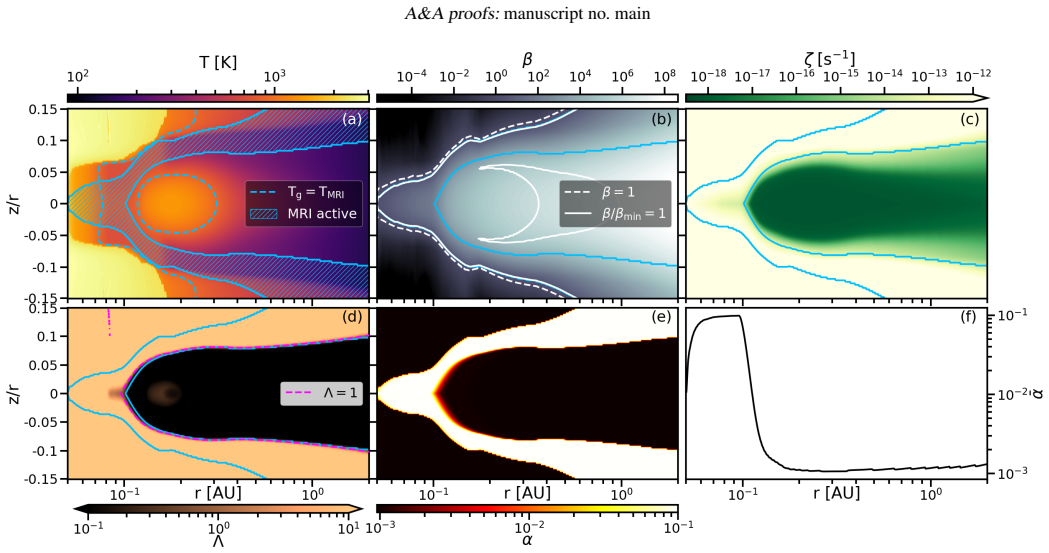
The inner edge of the dead zone (DZIE) in protoplanetary discs is prone to episodic instability caused by the activation of the magneto-rotational instability (MRI) in the weakly turbulent regions. We show how different magnetic field configurations set the inner disc structure and regulate the morphologies of instability cycles. We performed 2D and 3D radiation hydrodynamic simulations of the regions around the DZIE of a Class II disc over a thousand-year timescale. We implemented MRI activation criteria based on ambipolar and Ohmic diffusion coupled to magnetic field strength profiles comprising stellar and disc components. The properties and consequences of the episodic accretion events are highly sensitive to the magnetic field strength. We recover previously reported behaviour by considering relatively strongly magnetised discs. A new burst mode is revealed, in which the midplane MRI activity is restricted to small radii in the presence of weak magnetic fields. In this narrow mode, the pressure bump at the DZIE does not remain static even during quiescence. A distinct dichotomy between the wide and narrow modes is established by the hydrodynamic (in)stability of the ionisation front. Both modes are additionally separated into a reflaring and a non-reflaring version. Our setup does not lead to the classical thermal instability by hydrogen ionisation. In quiescence, the MRI active region shows a layered structure that converges towards the midplane near the star. Our 3D model reveals the breaking of density features produced in the narrow mode, leading to vortices at radii smaller than 0.5 AU. Coupling MRI activity directly to different magnetic field strengths, rather than using simple temperature thresholds, enables a variety of burst modes. Each mode exhibits characteristic accretion burst signatures and has different consequences for planet formation and migration conditions.
Editorial analysis
A structured set of objections, weighed in public.
Referee Report
Summary. The manuscript reports 2D and 3D radiation-hydrodynamic simulations of the inner dead zone edge (DZIE) in Class II protoplanetary discs. MRI activation criteria are based on ambipolar and Ohmic diffusion coupled to prescribed magnetic field strength profiles that include stellar and disc components. The central claims are that episodic accretion burst properties are highly sensitive to magnetic field strength, recovering prior behavior for strong fields while revealing a new narrow burst mode (midplane MRI restricted to small radii) for weak fields; a wide/narrow mode dichotomy is set by the hydrodynamic (in)stability of the ionization front, with further separation into reflaring/non-reflaring variants; the setup produces no classical hydrogen-ionization thermal instability, shows layered MRI-active regions in quiescence, and yields vortices from density-feature breaking in 3D.
Significance. If the results hold, the work provides a useful demonstration that linking MRI activity directly to magnetic field strength profiles (rather than temperature thresholds alone) can generate a richer set of burst morphologies with distinct consequences for accretion signatures and planet-formation conditions. The long-timescale radiation-hydrodynamic approach and inclusion of both 2D and 3D runs are positive features for exploring thermal-magnetic-hydrodynamic coupling at the DZIE.
major comments (2)
- [Abstract] Abstract: the central claim that burst modes and the wide/narrow dichotomy are established by the hydrodynamic (in)stability of the ionization front rests on the use of fixed magnetic field strength profiles (stellar + disc components) rather than dynamically evolved B. Because the profiles are imposed and coupled only through the diffusion thresholds, any back-reaction that would advect or diffuse the field or alter local Elsasser numbers could erase or shift the reported dichotomy; this assumption is load-bearing for the sensitivity result and requires either explicit justification or additional tests with evolved fields.
- [Abstract] Abstract (methods description): no convergence tests, resolution studies, or quantitative error bars are mentioned for the reported burst properties, mode distinctions, or ionization-front stability criterion. Given that the results are stated to be highly sensitive to the input B-field strength, demonstration that the wide/narrow separation and reflaring/non-reflaring variants are robust to numerical parameters is needed to support the claims.
minor comments (2)
- The abstract would be strengthened by stating the specific range of magnetic field strengths explored and the functional form of the stellar versus disc components.
- Clarify how the reflaring versus non-reflaring distinction is diagnosed (e.g., via specific figures or quantitative metrics) to aid reproducibility.
Simulated Author's Rebuttal
We thank the referee for their constructive comments and positive assessment of the work's significance. We address each major comment below.
read point-by-point responses
-
Referee: [Abstract] Abstract: the central claim that burst modes and the wide/narrow dichotomy are established by the hydrodynamic (in)stability of the ionization front rests on the use of fixed magnetic field strength profiles (stellar + disc components) rather than dynamically evolved B. Because the profiles are imposed and coupled only through the diffusion thresholds, any back-reaction that would advect or diffuse the field or alter local Elsasser numbers could erase or shift the reported dichotomy; this assumption is load-bearing for the sensitivity result and requires either explicit justification or additional tests with evolved fields.
Authors: We agree that the use of prescribed magnetic field strength profiles is a central modeling assumption. This choice enables the long-timescale radiation-hydrodynamic runs and the systematic variation of field strength needed to identify the wide/narrow mode dichotomy. We will revise the methods and discussion sections to provide explicit justification: the profiles are constructed from standard stellar and disc contributions, and the MRI activation depends only on the local comparison of field strength to the ambipolar and Ohmic diffusion thresholds. We will also note that full dynamical evolution of the field is an important direction for future MHD work and could modify the results, but that the present controlled setup isolates the hydrodynamic stability of the ionization front as the controlling factor within the adopted framework. revision: partial
-
Referee: [Abstract] Abstract (methods description): no convergence tests, resolution studies, or quantitative error bars are mentioned for the reported burst properties, mode distinctions, or ionization-front stability criterion. Given that the results are stated to be highly sensitive to the input B-field strength, demonstration that the wide/narrow separation and reflaring/non-reflaring variants are robust to numerical parameters is needed to support the claims.
Authors: We acknowledge that the original manuscript omitted explicit documentation of numerical convergence. Although the resolutions used are consistent with those in the prior literature on DZIE simulations, we will add a new subsection (or appendix) in the revised manuscript that presents resolution studies for representative strong- and weak-field cases. These will include direct comparisons of burst periods, amplitudes, and the location of the ionization front, together with quantitative estimates of variation across resolutions to demonstrate that the wide/narrow mode separation and reflaring/non-reflaring variants remain robust. revision: yes
Circularity Check
No circularity; results from direct numerical simulations with prescribed inputs
full rationale
The paper reports outcomes from 2D/3D radiation hydrodynamic simulations in which MRI activation thresholds (ambipolar/Ohmic) are coupled to fixed stellar+disc magnetic field strength profiles as inputs. The claimed sensitivity of burst modes, the wide/narrow dichotomy, and hydrodynamic stability of the ionization front are direct simulation results obtained by varying those inputs; no output quantity is defined in terms of itself, no parameter is fitted to a subset and then relabeled as a prediction, and no self-citation chain is invoked to justify a uniqueness theorem or ansatz. The derivation chain is therefore self-contained numerical experimentation rather than an analytical reduction that loops back on its own definitions.
Axiom & Free-Parameter Ledger
free parameters (1)
- magnetic field strength profiles
axioms (1)
- domain assumption MRI activation criteria based on ambipolar and Ohmic diffusion
Reference graph
Works this paper leans on
-
[1]
The influence of metallicity on a combined stellar and disk evolution. A&A , keywords =. doi:10.1051/0004-6361/202244408 , archivePrefix =. 2211.05331 , primaryClass =
-
[2]
Effect of multi-dust species on the inner rim of magnetized protoplanetary disks. , keywords =. doi:10.1051/0004-6361/202453124 , archivePrefix =. 2508.04254 , primaryClass =
-
[3]
The post-disk (or primordial) spin distribution of M dwarf stars. A&A , keywords =. doi:10.1051/0004-6361/202243521 , archivePrefix =. 2306.02657 , primaryClass =
-
[4]
Time-dependent, long-term hydrodynamic simulations of the inner protoplanetary disk. II. The importance of stellar rotation. A&A , keywords =. doi:10.1051/0004-6361/202243549 , archivePrefix =. 2208.08852 , primaryClass =
-
[5]
Magnetic disk winds in protoplanetary disks: Description of the model and impact on global disk evolution. A&A , keywords =. doi:10.1051/0004-6361/202450236 , archivePrefix =. 2502.00161 , primaryClass =
-
[6]
Transport of magnetic flux and the vertical structure of accretion discs - I. Uniform diffusion coefficients. MNRAS , keywords =. doi:10.1111/j.1365-2966.2012.21361.x , archivePrefix =. 1205.6468 , primaryClass =
-
[7]
Global three-dimensional simulations of outer protoplanetary discs with ambipolar diffusion. , keywords =. doi:10.1093/mnras/stab2220 , archivePrefix =. 2106.10167 , primaryClass =
-
[8]
Guilet, Jerome and Ogilvie, Gordon I. , doi =. MNRAS , keywords =. arXiv , arxivId =:1403.3732 , issn =
-
[9]
On the Stability of Magnetic Wind-Driven Accretion Discs. , keywords =. doi:10.1093/mnras/268.4.1010 , adsurl =
-
[10]
Accretion funnels onto weakly magnetized young stars
Accretion funnels onto weakly magnetized young stars. , keywords =. doi:10.1051/0004-6361:20078328 , archivePrefix =. 0712.2921 , primaryClass =
work page internal anchor Pith review Pith/arXiv arXiv doi:10.1051/0004-6361:20078328
-
[11]
Planet formation at the inner edge of the dead zone -- I: the interplay between accretion outbursts and dust growth , url =
Alexandros Ziampras and Tilman Birnstiel and Nicolas Kaufmann and Michael Cecil and Thomas Pfeil and Alexandros Ziampras and Tilman Birnstiel and Nicolas Kaufmann and Michael Cecil and Thomas Pfeil and Ziampras and Alexandros and Birnstiel and Tilman and Kaufmann and Nicolas and Cecil and Michael and Pfeil and Thomas , journal =. Planet formation at the i...
-
[12]
Cecil and M
M. Cecil and M. Flock and M. G. Malygin and R. Kuiper and P. Sudarshan and A. Ziampras and V. G. Elbakyan , doi =. The role of detailed gas and dust opacities in shaping the evolution of the inner disc edge subject to episodic accretion , volume =. A&A , keywords =
-
[13]
Ciardi and Jonathan Swift and Stephen R
Andrew Vanderburg and Peter Plavchan and John Asher Johnson and David R. Ciardi and Jonathan Swift and Stephen R. Kane , doi =. Radial velocity planet detection biases at the stellar rotational period , volume =. MNRAS , keywords =
-
[14]
Hara and Eric B
Nathan C. Hara and Eric B. Ford , doi =. Statistical Methods for Exoplanet Detection with Radial Velocities , volume =. Annu. Rev. Stat. Appl. , keywords =
-
[15]
Vladislava Ananyeva and Anastasiia Ivanova and Inna Shashkova and Oleg Yakovlev and Alexander Tavrov and Oleg Korablev and Jean-Loup Bertaux and Vladislava Ananyeva and Anastasiia Ivanova and Inna Shashkova and Oleg Yakovlev and Alexander Tavrov and Oleg Korablev and Jean-Loup Bertaux and Ananyeva and Vladislava and Ivanova and Anastasiia and Shashkova an...
-
[16]
Matthew J. O. Roberts and Henrik N. Latter and Geoffroy Lesur , journal =. Global magnetohydrodynamic simulations of the inner regions of protoplanetary discs. II. Vertical-net-flux regime , volume =
-
[17]
Dorfi and Bernhard Ratschiner and Lukas Gehrig and Daniel Steiner and Alexander Stökl and Colin P
Florian Ragossnig and Ernst A. Dorfi and Bernhard Ratschiner and Lukas Gehrig and Daniel Steiner and Alexander Stökl and Colin P. Johnstone , doi =. 1+1D implicit disk computations , volume =. Comp. Phys. Commun. , keywords =
-
[18]
Latter and Jerome Guilet , doi =
Johnathan Ross and Henrik N. Latter and Jerome Guilet , doi =. The stress-pressure relationship in simulations of MRI-induced turbulence , volume =. MNRAS , keywords =
-
[19]
Tan , doi =
Xiao Hu and Jonathan C. Tan , doi =. Inside-out Planet Formation. VIII. Onset of Planet Formation and the Transition Disk Phase , volume =. ApJ , keywords =
-
[20]
Machida and Shantanu Basu , doi =
Masahiro N. Machida and Shantanu Basu , doi =. The First Two Thousand Years of Star Formation , volume =. ApJ , keywords =
-
[21]
Vaytet and B
N. Vaytet and B. Commerçon and J. Masson and M. González and G. Chabrier , doi =. Protostellar birth with ambipolar and ohmic diffusion , volume =. A&A , keywords =
-
[22]
Weiss and Xue-Ning Bai and Roger R
Benjamin P. Weiss and Xue-Ning Bai and Roger R. Fu , doi =. History of the Solar Nebula from Meteorite Paleomagnetism , volume =. SciA , keywords =
-
[23]
Fu and Sarah C
Roger R. Fu and Sarah C. Steele and Jacob B. Simon and Richard Teague and Joan Najita and David Rea and Roger R. Fu and Sarah C. Steele and Jacob B. Simon and Richard Teague and Joan Najita and David Rea and Fu and Roger R. and Steele and Sarah C. and Simon and Jacob B. and Teague and Richard and Najita and Joan and Rea and David , doi =. Implications for...
-
[24]
Birth of magnetized low-mass protostars and circumstellar disks , volume =
Adnan Ali Ahmad and Matthias González and Patrick Hennebelle and Ugo Lebreuilly and Benoît Commerçon , doi =. Birth of magnetized low-mass protostars and circumstellar disks , volume =. A&A , keywords =
-
[25]
Ambipolar diffusion in low-mass star formation
Jacques Masson and Gilles Chabrier and Patrick Hennebelle and Neil Vaytet and Benoit Commerçon , doi =. Ambipolar diffusion in low-mass star formation. I. General comparison with the ideal MHD case , volume =. A&A , keywords =
-
[26]
J. M.Y. Woo and A. Morbidelli and S. L. Grimm and J. Stadel and R. Brasser , doi =. Terrestrial planet formation from a ring , volume =. Icarus , keywords =
-
[27]
Bottke and Rogerio Deienno and Max Goldberg and David Nesvorný and Alessandro Morbidelli and William F
David Nesvorný and Alessandro Morbidelli and William F. Bottke and Rogerio Deienno and Max Goldberg and David Nesvorný and Alessandro Morbidelli and William F. Bottke and Rogerio Deienno and Max Goldberg and Nesvorný and David and Morbidelli and Alessandro and Bottke and William F. and Deienno and Rogerio and Goldberg and Max , doi =. Terrestrial Planet F...
-
[28]
Masset and Gordon Ogilvie and Hidekazu Tanaka , journal =
Sijme-Jan Paardekooper and Ruobing Dong and Paul Duffell and Jeffrey Fung and Frederic S. Masset and Gordon Ogilvie and Hidekazu Tanaka , journal =. Planet-Disk Interactions , volume =
-
[29]
Setterholm and John D
Benjamin R. Setterholm and John D. Monnier and Fabien Baron and Jaehan Bae and Jacques Kluska and Stefan Kraus and Nuria Calvet and Nour Ibrahim and Evan Rich and Narsireddy Anugu and Claire L. Davies and Jacob Ennis and Tyler Gardner and Aaron Labdon and Cyprien Lanthermann and Gail Schaefer , doi =. The Dynamic Inner Disk of a Planet Forming Star , volu...
-
[30]
Raymond and Alessandro Morbidelli and Arnaud Pierens and Bertram Bitsch and Christophe Cossou and Franck Hersant , doi =
Andre Izidoro and Masahiro Ogihara and Sean N. Raymond and Alessandro Morbidelli and Arnaud Pierens and Bertram Bitsch and Christophe Cossou and Franck Hersant , doi =. Breaking the chains: Hot super-Earth systems from migration and disruption of compact resonant chains , volume =. MNRAS , keywords =
-
[31]
S. A. Khaibrakhmanov , doi =. Magnetic fields of protoplanetary disks , volume =. AApTr , keywords =
-
[32]
A. E. Dudorov and S. N. Zamozdra , doi =. Effect of Dust Evaporation on the Fossil Magnetic Field of Young Stars and Their Accretion Disks , volume =. ARep , keywords =
-
[33]
Johns‐Krull , doi =
Christopher M. Johns‐Krull , doi =. The Magnetic Fields of Classical T Tauri Stars , volume =. ApJ , keywords =
-
[34]
Morris and Z
C. Morris and Z. Guo and P. W. Lucas and N. Miller and C. ContrerasPeña and M. A. Kuhn , doi =. Eruptive YSOs in Cygnus-X: a mid-infrared variability study with NEOWISE and spicy , volume =. MNRAS , keywords =
-
[35]
Andrews and Chunhua Qi and Roger R
Richard Teague and Boy Lankhaar and Sean M. Andrews and Chunhua Qi and Roger R. Fu and David J. Wilner and John B. Biersteker and Joan R. Najita , doi =. A Radially Resolved Magnetic Field Threading the Disk of TW Hya , volume =. ApJL , keywords =
-
[36]
F. S. Masset and P. Benítez-Llambay , doi =. HORSESHOE DRAG IN THREE-DIMENSIONAL GLOBALLY ISOTHERMAL DISKS , volume =. ApJ , keywords =
-
[37]
P. J. Rodenkirch and H. Klahr and C. Fendt and C. P. Dullemond , doi =. Global axisymmetric simulations of photoevaporation and magnetically driven protoplanetary disk winds , volume =. A&A , keywords =
-
[38]
Fu and Michael W
Roger R. Fu and Michael W. R. Volk and Dario Bilardello and Guy Libourel and Geoffroy R. J. Lesur and Oren Ben Dor and Roger R. Fu and Michael W. R. Volk and Dario Bilardello and Guy Libourel and Geoffroy R. J. Lesur and Oren Ben Dor and Fu and Roger R. and Volk and Michael W. R. and Bilardello and Dario and Libourel and Guy and Lesur and Geoffroy R. J. a...
-
[39]
Fu and Benjamin P
Roger R. Fu and Benjamin P. Weiss and Eduardo A. Lima and Richard J. Harrison and Xue-Ning Bai and Steven J. Desch and Denton S. Ebel and Clément Suavet and Huapei Wang and David Glenn and David Le Sage and Takeshi Kasama and Ronald L. Walsworth and Aaron T. Kuan and Roger R. Fu and Benjamin P. Weiss and Eduardo A. Lima and Richard J. Harrison and Xue-Nin...
-
[40]
Mansbach and Benjamin P
Elias N. Mansbach and Benjamin P. Weiss and Eduardo A. Lima and Michael Sowell and Joseph L. Kirschvink and Roger R. Fu and Saverio Cambioni and Xue-Ning Bai and Jodie B. Ream and Chisato Anai and Atsuko Kobayashi and Hironori Hidaka and Elias N. Mansbach and Benjamin P. Weiss and Eduardo A. Lima and Michael Sowell and Joseph L. Kirschvink and Roger R. Fu...
-
[41]
A 4,565-My-old record of the solar nebula field , volume =
Clara Maurel and Jérôme Gattacceca and Clara Maurel and Jérôme Gattacceca and Maurel and Clara and Gattacceca and Jérôme , doi =. A 4,565-My-old record of the solar nebula field , volume =. PNAS , keywords =
-
[42]
Roberts and Henrik N
Matthew J.O. Roberts and Henrik N. Latter and Geoffroy Lesur , doi =. Global magnetohydrodynamic simulations of the inner regions of protoplanetary discs. I. Zero-net flux regime , volume =. MNRAS , keywords =
-
[43]
Güdel and K
M. Güdel and K. R. Briggs and K. Arzner and M. Audard and J. Bouvier and E. D. Feigelson and E. Franciosini and A. Glauser and N. Grosso and G. Micela and J. L. Monin and T. Montmerle and D. L. Padgett and F. Palla and I. Pillitteri and L. Rebull and L. Scelsi and B. Silva and S. L. Skinner and B. Stelzer and A. Telleschi , doi =. The XMM-Newton extended ...
-
[44]
Igea and A
J. Igea and A. E. Glassgold , doi =. X-Ray Ionization of the Disks of Young Stellar Objects , volume =. ApJ , keywords =
-
[45]
Heat and Dust in Active Layers of Protostellar Disks , volume =
Xue-Ning Bai and Jeremy Goodman , doi =. Heat and Dust in Active Layers of Protostellar Disks , volume =. ApJ , keywords =
-
[46]
A. E. Dudorov and S. A. Khaibrakhmanov , doi =. Fossil magnetic field of accretion disks of young stars , volume =. Ap&SS , keywords =
-
[47]
MAGNETO-THERMAL DISK WINDS FROM PROTOPLANETARY DISKS , volume =
Xue-Ning Bai and Jiani Ye and Jeremy Goodman and Feng Yuan , doi =. MAGNETO-THERMAL DISK WINDS FROM PROTOPLANETARY DISKS , volume =. ApJ , keywords =
-
[48]
Stone , doi =
Xue Ning Bai and James M. Stone , doi =. Effect of ambipolar diffusion on the nonlinear evolution of magnetorotational instability in weakly ionized disks , volume =. ApJ , keywords =
-
[49]
Stone , doi =
Takayoshi Sano and James M. Stone , doi =. The Effect of the Hall Term on the Nonlinear Evolution of the Magnetorotational Instability: II. Saturation Level and Critical Magnetic Reynolds Number , volume =. ApJ , keywords =
-
[50]
Dodson-Robinson and Neal J
Russell Landry and Sarah E. Dodson-Robinson and Neal J. Turner and Greg Abram , doi =. Protostellar disk evolution over million-year timescales with a prescription for magnetized turbulence , volume =. ApJ , keywords =
-
[51]
Teed and Henrik N
Robert J. Teed and Henrik N. Latter , doi =. Axisymmetric simulations of the convective overstability in protoplanetary discs , volume =. MNRAS , keywords =
-
[52]
Latter , doi =
Henrik N. Latter , doi =. On the convective overstability in protoplanetary discs , volume =. MNRAS , keywords =
-
[53]
Convective overstability in radially stratified accretion disks under thermal relaxation , volume =
Hubert Klahr and Alexander Hubbard , doi =. Convective overstability in radially stratified accretion disks under thermal relaxation , volume =. ApJ , keywords =
-
[54]
Vorobyov and Sergey Khaibrakhmanov and Shantanu Basu and Marc Audard , doi =
Eduard I. Vorobyov and Sergey Khaibrakhmanov and Shantanu Basu and Marc Audard , doi =. Accretion bursts in magnetized gas-dust protoplanetary disks , volume =. A&A , keywords =
-
[55]
Steiner and L
D. Steiner and L. Gehrig and M. Güdel , doi =. Protoplanetary disks around magnetized young stars with large-scale magnetic fields I: Steady-state solutions , volume =. A&A , keywords =
-
[56]
Ilsedore Cleeves and Fred C
L. Ilsedore Cleeves and Fred C. Adams and Edwin A. Bergin and Ruud Visser , doi =. Radionuclide ionization in protoplanetary disks: Calculations of decay product radiative transfer , volume =. ApJ , keywords =
-
[57]
Effects of Radionuclides on the Ionization State of Protoplanetary Disks and Dense Cloud Cores , volume =
Toyoharu Umebayashi and Takenori Nakano , doi =. Effects of Radionuclides on the Ionization State of Protoplanetary Disks and Dense Cloud Cores , volume =. ApJ , keywords =
-
[58]
Delage and Satoshi Okuzumi and Mario Flock and Paola Pinilla and Natalia Dzyurkevich , doi =
Timmy N. Delage and Satoshi Okuzumi and Mario Flock and Paola Pinilla and Natalia Dzyurkevich , doi =. Steady-state accretion in magnetized protoplanetary disks , volume =. A&A , keywords =
-
[59]
Starlight-driven flared-staircase geometry in radiation hydrodynamic models of protoplanetary disks , url =
Prakruti Sudarshan and Mario Flock and Alexandros Ziampras and David Melon Fuksman and Tilman Birnstiel , doi =. Starlight-driven flared-staircase geometry in radiation hydrodynamic models of protoplanetary disks , url =. in press in A&A , keywords =
-
[60]
Contreras Peña and J
C. Contreras Peña and J. -E. Lee and G. Herczeg and D. Johnstone and P. Ábrahám and S. Antoniucci and M. Audard and M. Ashraf and G. Baek and A. Caratti o Garatti and A. Carvalho and L. Cieza and F. Cruz-Saénz de Miera and J. Eislöffel and D. Froebrich and T. Giannini and J. Green and A. Ghosh and Z. Guo and L. Hillenbrand and K. Hodapp and H. Jheonn and ...
-
[61]
Freedman and Mark S
Richard S. Freedman and Mark S. Marley and Katharina Lodders , doi =. Line and Mean Opacities for Ultracool Dwarfs and Extrasolar Planets , volume =. ApJS , keywords =
-
[62]
Three-temperature radiation hydrodynamics with PLUTO: Tests and applications to protoplanetary disks , volume =
Dhruv Muley and Julio David Melon Fuksman and Hubert Klahr , doi =. Three-temperature radiation hydrodynamics with PLUTO: Tests and applications to protoplanetary disks , volume =. A&A , keywords =
-
[63]
Grassi and B
T. Grassi and B. Ercolano and L. Szucs and J. Jennings and G. Picogna , doi =. Modelling thermochemical processes in protoplanetary discs I: Numerical methods , volume =. MNRAS , keywords =
-
[64]
Güdel and P
Ch Rab and M. Güdel and P. Woitke and I. Kamp and W. F. Thi and M. Min and G. Aresu and R. Meijerink , doi =. X-ray radiative transfer in protoplanetary disks: The role of dust and X-ray background fields , volume =. A&A , keywords =
-
[65]
Woitke and I
P. Woitke and I. Kamp and W. -F. Thi , doi =. Radiation thermo-chemical models of protoplanetary disks: I. Hydrostatic disk structure and inner rim , volume =. A&A , keywords =
-
[66]
Sellek and Tommaso Grassi and Giovanni Picogna and Christian Rab and Cathie J
Andrew D. Sellek and Tommaso Grassi and Giovanni Picogna and Christian Rab and Cathie J. Clarke and Barbara Ercolano , doi =. Photoevaporation of protoplanetary discs with PLUTO+PRIZMO I. Lower X-ray-driven mass-loss rates due to enhanced cooling , volume =. A&A , keywords =
-
[67]
Woitke and Ch Helling and G
P. Woitke and Ch Helling and G. H. Hunter and J. D. Millard and G. E. Turner and M. Worters and J. Blecic and J. W. Stock , doi =. Equilibrium chemistry down to 100 K: Impact of silicates and phyllosilicates on the carbon to oxygen ratio , volume =. A&A , keywords =
-
[68]
Hydrodynamic Photoevaporation of Protoplanetary Disks with Consistent Thermochemistry , volume =
Lile Wang and Jeremy Goodman , doi =. Hydrodynamic Photoevaporation of Protoplanetary Disks with Consistent Thermochemistry , volume =. ApJ , keywords =
-
[69]
Episodic accretion in high-mass star formation: An analysis of thermal instability for axially symmetric disks , volume =
Vardan Elbakyan and Dennis Wehner and Rolf Kuiper and Sergei Nayakshin and Alessio Caratti o Garatti and Zhen Guo , doi =. Episodic accretion in high-mass star formation: An analysis of thermal instability for axially symmetric disks , volume =. A&A , keywords =
-
[70]
J. S. Mathis and W. Rumpl and K. H. Nordsieck and J. S. Mathis and W. Rumpl and K. H. Nordsieck , doi =. The size distribution of interstellar grains. , volume =. ApJ , keywords =
-
[71]
Kuiper and R
R. Kuiper and R. S. Klessen , doi =. The reliability of approximate radiation transport methods for irradiated disk studies , volume =. A&A , keywords =
-
[72]
Yorke , doi =
Rolf Kuiper and Harold W. Yorke , doi =. On the effects of optically thick gas (disks) around massive stars , volume =. ApJ , keywords =
-
[73]
L. M. Jordan and D. Wehner and R. Kuiper , doi =. Two-dimensional simulations of disks in close binaries Simulating outburst cycles in cataclysmic variables , volume =. A&A , keywords =
-
[74]
S. I. Laznevoi and V. V. Akimkin and Ya. N. Pavlyuchenkov and V. B. Il'in and Á. Kóspál and P. Ábrahám and S. I. Laznevoi and V. V. Akimkin and Ya. N. Pavlyuchenkov and V. B. Il'in and Á. Kóspál and P. Ábrahám , doi =. Time-dependent response of protoplanetary disk temperature to an FU Ori-type luminosity outburst , volume =. A&A , keywords =
-
[75]
E. I. Chiang and P. Goldreich , doi =. Spectral Energy Distributions of T Tauri Stars with Passive Circumstellar Disks , volume =. ApJ , keywords =
-
[76]
Outbursts in Global Protoplanetary Disk Simulations , volume =
Kundan Kadam and Eduard Vorobyov and Zsolt Regály and. Outbursts in Global Protoplanetary Disk Simulations , volume =. ApJ , keywords =. doi:10.3847/1538-4357/ab8bd8 , issn =
-
[77]
Helling and J
Ch. Helling and J. M. Winters and E. Sedlmayr , doi =. Circumstellar dust shells around long-period variables. VII. The role of molecular opacities , volume =. A&A , keywords =
-
[78]
Ferguson and David R
Jason W. Ferguson and David R. Alexander and France Allard and Travis Barman and Julia G. Bodnarik and Peter H. Hauschildt and Amanda Heffner‐Wong and Akemi Tamanai , doi =. Low‐Temperature Opacities , volume =. ApJ , keywords =
-
[79]
Dullemond and Tilman Birnstiel and Jane Huang and Nicolás T
Cornelis P. Dullemond and Tilman Birnstiel and Jane Huang and Nicolás T. Kurtovic and Sean M. Andrews and Viviana V. Guzmán and Laura M. Pérez and Andrea Isella and Zhaohuan Zhu and Myriam Benisty and David J. Wilner and Xue-Ning Bai and John M. Carpenter and Shangjia Zhang and Luca Ricci , doi =. The Disk Substructures at High Angular Resolution Project ...
-
[80]
Lodato and C
G. Lodato and C. J. Clarke , doi =. Massive planets in FU Orionis discs: Implications for thermal instability models , volume =. MNRAS , keywords =
discussion (0)
Sign in with ORCID, Apple, or X to comment. Anyone can read and Pith papers without signing in.