Relocate and Emulate: Re-Hosting Android's Application Layer
Pith reviewed 2026-06-27 15:25 UTC · model grok-4.3
The pith
A re-hosting method extracts Android framework components from real firmware and injects them into AOSP builds to produce working vendor-flavored emulator images.
A machine-rendered reading of the paper's core claim, the machinery that carries it, and where it could break.
Core claim
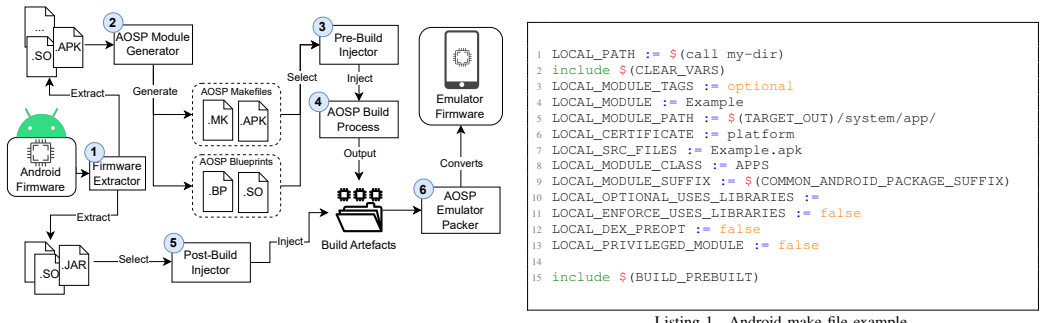
Our approach integrates vendor-specific components into the Android Open Source Project (AOSP) build system using tailored extraction and injection strategies, producing vendor-flavoured emulator images that preserve system integrity and runtime compatibility. This enables dynamic execution of real-world framework and application-layer components, including proprietary binaries and pre-installed apps, across multiple SDK versions.
What carries the argument
Tailored extraction and injection strategies that relocate and integrate vendor-specific firmware components into AOSP builds.
If this is right
- Dynamic execution of real framework components and pre-installed apps becomes possible inside emulators rather than on physical devices.
- Vendor-flavored images can be produced for multiple SDK versions while keeping system integrity.
- Modular injection strategies can be extended for additional firmware families to increase coverage.
- Scalable and reproducible dynamic analysis of application-layer behavior is supported without hardware constraints.
Where Pith is reading between the lines
- Security researchers could test the same proprietary app against many vendor variants in parallel without acquiring devices.
- Automated selection of injection strategies based on firmware metadata could reduce manual adaptation effort.
- The same relocation technique might be adapted to study system-level behaviors under controlled emulator conditions.
Load-bearing premise
Tailored extraction and injection strategies can be developed modularly for diverse vendor firmware while still preserving runtime compatibility.
What would settle it
Building and booting emulator images from a new set of firmware samples and checking whether core services initialize and proprietary apps execute without unresolvable failures.
Figures
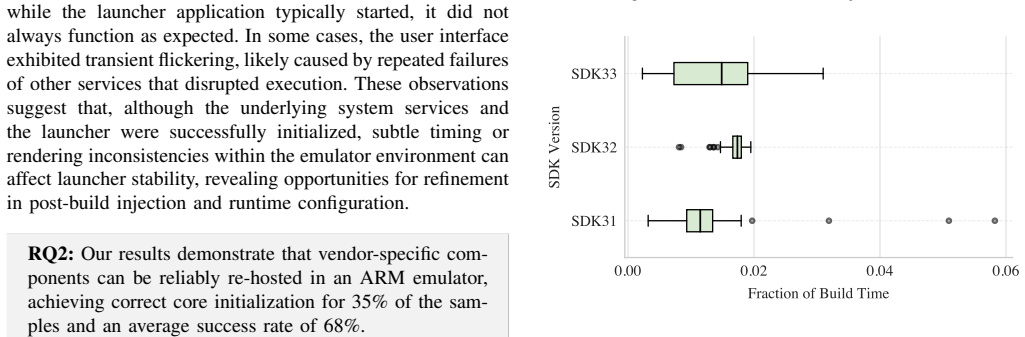
read the original abstract
Dynamic analysis of Android's application layer typically relies on physical devices, limiting scalability and reproducibility. To compensate, we introduce a systematic re-hosting method that relocates the Android framework and pre-installed software from real device firmware into a fully emulated environment. Our approach integrates vendor-specific components into the Android Open Source Project (AOSP) build system using tailored extraction and injection strategies, producing vendor-flavoured emulator images that preserve system integrity and runtime compatibility. This enables dynamic execution of real-world framework and application-layer components, including proprietary binaries and pre-installed apps, across multiple SDK versions. We evaluate our method on 184 firmware samples from SDK 31-33. It achieves high build and boot success rates, with residual failures primarily occurring during core-service initialization due to baseline strategy limitations, missing dependencies, device-protection checks, or emulator constraints. However, the modular design allows injection strategies to be extended for specific firmware, supporting broader compatibility and future research on automated, adaptive re-hosting. Though we identified potential for optimization through engineering vendor-specific solutions, our research demonstrates the feasibility of vendor-flavoured emulators for scalable, reproducible dynamic analysis.
Editorial analysis
A structured set of objections, weighed in public.
Referee Report
Summary. The paper introduces a re-hosting method ('Relocate and Emulate') that extracts vendor-specific components from Android firmware and injects them into the AOSP build system via tailored strategies, producing emulated images claimed to preserve system integrity and runtime compatibility. This enables dynamic analysis of framework and pre-installed apps (including proprietary binaries) across SDK versions. Evaluation on 184 firmware samples (SDK 31-33) reports high build and boot success rates, with residual failures attributed to baseline limitations, missing dependencies, device checks, or emulator constraints; the modular design is asserted to support future extensions.
Significance. If the runtime-compatibility claim holds, the work would enable scalable, reproducible dynamic analysis of real-world Android application-layer components without physical devices, addressing a key limitation in Android security and software engineering research. The empirical scale (184 samples) and engineering focus on modular injection strategies are strengths, though the absence of post-boot validation metrics limits immediate impact.
major comments (2)
- [Results/Evaluation] Results/Evaluation section: The central claim that the produced images 'preserve ... runtime compatibility' enabling 'dynamic execution of real-world framework and application-layer components' is not supported by the reported metrics. Only aggregate build and boot success rates are given; no data on post-boot execution (e.g., app launch success, framework service calls, or behavioral equivalence) or detailed error analysis of the residual failures is provided, leaving the primary contribution under-validated.
- [Abstract and Evaluation] Abstract and evaluation description: The assertion that 'the modular design allows injection strategies to be extended for specific firmware' is presented without demonstration on the failure cases or evidence of extensibility beyond the baseline strategy, which directly bears on the claim of broader compatibility.
minor comments (1)
- [Abstract] The abstract states 'high build and boot success rates' without quantifying the rates or providing a breakdown by SDK version or failure mode; adding these would improve clarity.
Simulated Author's Rebuttal
We thank the referee for the detailed and constructive review. We address each major comment below and indicate where revisions will be made to strengthen the manuscript.
read point-by-point responses
-
Referee: [Results/Evaluation] Results/Evaluation section: The central claim that the produced images 'preserve ... runtime compatibility' enabling 'dynamic execution of real-world framework and application-layer components' is not supported by the reported metrics. Only aggregate build and boot success rates are given; no data on post-boot execution (e.g., app launch success, framework service calls, or behavioral equivalence) or detailed error analysis of the residual failures is provided, leaving the primary contribution under-validated.
Authors: We agree that the evaluation focuses on build and boot success rates as the primary quantitative metrics, which we use as indicators that the relocated components integrate sufficiently for the system to reach a runnable state. Boot success is a necessary precondition for any subsequent dynamic execution. However, we acknowledge that direct evidence of post-boot runtime compatibility (such as app launch rates or service call success) is not reported. In the revised manuscript we will add a new subsection with post-boot validation results on a representative subset of the successful images, including attempts to launch pre-installed apps and invoke framework services, plus a more granular breakdown of the residual failure modes. revision: yes
-
Referee: [Abstract and Evaluation] Abstract and evaluation description: The assertion that 'the modular design allows injection strategies to be extended for specific firmware' is presented without demonstration on the failure cases or evidence of extensibility beyond the baseline strategy, which directly bears on the claim of broader compatibility.
Authors: The manuscript describes the modular architecture in Section 4, where each injection strategy is implemented as an independent module that can be selected or extended per firmware. We did not, however, apply alternative strategies to the failure cases within the current evaluation. We will revise the evaluation section to include a brief case study demonstrating how one additional strategy could address a subset of the reported failures, thereby providing concrete evidence of extensibility. revision: partial
Circularity Check
No circularity: empirical engineering method with direct evaluation on external samples
full rationale
The paper describes a re-hosting technique via extraction/injection into AOSP, evaluated by build/boot success rates on 184 external firmware samples. No equations, fitted parameters renamed as predictions, or self-citation chains appear in the provided text. The runtime-compatibility claim is supported (or not) by the reported metrics rather than being definitionally equivalent to the method itself. This matches the default case of a self-contained empirical systems contribution with no load-bearing reductions to inputs.
Axiom & Free-Parameter Ledger
axioms (1)
- domain assumption Vendor-specific components from real device firmware can be extracted and injected into AOSP while preserving system integrity and runtime compatibility.
Reference graph
Works this paper leans on
-
[1]
From zygote to morula: Fortifying weakened aslr on android,
B. Lee, L. Lu, T. Wang, T. Kim, and W. Lee, “From zygote to morula: Fortifying weakened aslr on android,” inProceedings of the 2014 IEEE Symposium on Security and Privacy. San Jose, California, USA: IEEE, 2014, pp. 424–439, presented at IEEE S&P 2014. [Online]. Available: https://ieeexplore.ieee.org/document/6853550
arXiv 2014
-
[2]
Keep me updated: An empirical study of proprietary vendor blobs in android firmware,
E. Wen, J. Shen, and B. Wuensche, “Keep me updated: An empirical study of proprietary vendor blobs in android firmware,” inProceedings of the 2024 IEEE 30th International Conference on Parallel and Distributed Systems (ICPADS). Singapore: IEEE, 2024, pp. 116–125, accepted for publication; presented at ICPADS 2024. [Online]. Available: https://www.computer...
2024
-
[3]
Do androids dream of electric sheep? on privacy in the android supply chain,
J. A. P. Gamba, “Do androids dream of electric sheep? on privacy in the android supply chain,” Ph.D. dissertation, Universidad Carlos III de Madrid (UC3M), Madrid, Spain, 2022, awarded the CNIL-INRIA Privacy Protection Award and the 2020 AEPD Emilio Aced Prize. [Online]. Available: https://e-archivo.uc3m.es/bitstream/handle/10016/ 35812/tesis gamba.pdf
2022
-
[4]
Taming android fragmentation: characterizing and detecting compatibility issues for android apps,
L. Wei, Y . Liu, and S.-C. Cheung, “Taming android fragmentation: characterizing and detecting compatibility issues for android apps,” inProceedings of the 31st IEEE/ACM International Conference on Automated Software Engineering, ser. ASE ’16. New York, NY , USA: Association for Computing Machinery, 2016, p. 226–237. [Online]. Available: https://doi.org/1...
-
[5]
Under- standing and detecting fragmentation-induced compatibility issues for android apps,
L. Wei, Y . Liu, S.-C. Cheung, H. Huang, X. Lu, and X. Liu, “Under- standing and detecting fragmentation-induced compatibility issues for android apps,”IEEE Transactions on Software Engineering, vol. 46, no. 11, pp. 1176–1199, 2020
2020
-
[6]
The impact of vendor customizations on android security,
L. Wu, M. Grace, Y . Zhou, C. Wu, and X. Jiang, “The impact of vendor customizations on android security,” inProceedings of the 2013 ACM SIGSAC Conference on Computer & Communications Security, ser. CCS ’13. New York, NY , USA: Association for Computing Machinery, 2013, p. 623–634. [Online]. Available: https: //doi.org/10.1145/2508859.2516728
-
[7]
Elegant: Towards effective location of fragmentation-induced compatibility issues for android apps,
C. Li, C. Xu, L. Wei, J. Wang, J. Ma, and J. Lu, “Elegant: Towards effective location of fragmentation-induced compatibility issues for android apps,” inProceedings of the 2018 25th Asia-Pacific Software Engineering Conference (APSEC). Nara, Japan: IEEE, 2018, pp. 278–287, accepted for publication; presented at APSEC 2018. [Online]. Available: https://iee...
arXiv 2018
-
[8]
Definit: An analysis of exposed android init routines,
Y . Ji, M. Elsabagh, R. Johnson, and A. Stavrou, “Definit: An analysis of exposed android init routines,” inProceedings of the 30th USENIX Security Symposium (USENIX Security ’21). Virtual: USENIX Association, 2021, pp. 3685–3702. [Online]. Available: https://www.usenix.org/conference/usenixsecurity21/presentation/ji
2021
-
[9]
FIRMSCOPE: Automatic uncovering of privilege- escalation vulnerabilities in pre-installed apps in android firmware,
M. Elsabagh, R. Johnson, A. Stavrou, C. Zuo, Q. Zhao, and Z. Lin, “FIRMSCOPE: Automatic uncovering of privilege- escalation vulnerabilities in pre-installed apps in android firmware,” inProceedings of the 29th USENIX Security Symposium (USENIX Security ’20). Boston, MA, USA: USENIX Association, Aug. 2020, pp. 2379–2396. [Online]. Available: https: //www.u...
2020
-
[10]
Towards understanding android system vulnerabilities: Techniques and insights,
D. Wu, D. Gao, E. K. T. Cheng, Y . Cao, J. Jiang, and R. H. Deng, “Towards understanding android system vulnerabilities: Techniques and insights,” inProceedings of the 2019 ACM Asia Conference on Computer and Communications Security, ser. Asia CCS ’19. New York, NY , USA: Association for Computing Machinery, 2019, p. 295–306. [Online]. Available: https://...
-
[11]
Dynamic security analysis on android: A systematic literature review,
T. Sutter, T. Kehrer, M. Rennhard, B. Tellenbach, and J. Klein, “Dynamic security analysis on android: A systematic literature review,”IEEE Access, vol. 12, pp. 57 261–57 287, 2024
2024
-
[12]
An analysis of pre-installed android software,
J. Gamba, M. Rashed, A. Razaghpanah, J. Tapiador, and N. Vallina- Rodriguez, “An analysis of pre-installed android software,” inProceed- ings of the 2020 IEEE Symposium on Security and Privacy (SP). San Francisco, CA, USA: IEEE, 2020, pp. 1039–1055
2020
-
[13]
Firmwaredroid: Towards automated static analysis of pre-installed android apps,
T. Sutter and B. Tellenbach, “Firmwaredroid: Towards automated static analysis of pre-installed android apps,” inProceedings of the 2023 IEEE/ACM 10th International Conference on Mobile Software Engineer- ing and Systems (MOBILESoft). Melbourne, Australia: IEEE/ACM, 2023, pp. 12–22
2023
-
[14]
BigMAC: Fine-grained policy analysis of android firmware,
G. Hernandez, D. J. Tian, A. S. Yadav, B. J. Williams, and K. R. Butler, “BigMAC: Fine-grained policy analysis of android firmware,” inProceedings of the 29th USENIX Security Symposium (USENIX Security ’20). Boston, MA, USA: USENIX Association, Aug. 2020, pp. 271–287. [Online]. Available: https://www.usenix.org/conference/ usenixsecurity20/presentation/hernandez
2020
-
[15]
An analysis of pre-installed android software,
J. Gamba, M. Rashed, A. Razaghpanah, J. Tapiador, and N. Vallina- Rodriguez, “An analysis of pre-installed android software,” in2020 IEEE symposium on security and privacy (SP). IEEE, 2020, pp. 1039–1055
2020
-
[16]
Android rooting: Methods, detection, and evasion,
S.-T. Sun, A. Cuadros, and K. Beznosov, “Android rooting: Methods, detection, and evasion,” inProceedings of the 5th Annual ACM CCS Workshop on Security and Privacy in Smartphones and Mobile Devices, ser. SPSM ’15. New York, NY , USA: Association for Computing Machinery, 2015, p. 3–14. [Online]. Available: https://doi.org/10.1145/2808117.2808126
-
[17]
Pandawan: Quantifying progress in linux-based firmware rehosting,
I. Angelakopoulos, G. Stringhini, and M. Egele, “Pandawan: Quantifying progress in linux-based firmware rehosting,” in 33rd USENIX Security Symposium (USENIX Security 24). Philadelphia, PA: USENIX Association, Aug. 2024, pp. 5859–5876. [Online]. Available: https://www.usenix.org/conference/ usenixsecurity24/presentation/angelakopoulos
2024
-
[18]
Towards automated dynamic analysis for linux-based embedded firmware,
D. D. Chen, M. Woo, D. Brumley, and M. Egele, “Towards automated dynamic analysis for linux-based embedded firmware,” inProceedings of the Network and Distributed System Security Symposium (NDSS). San Diego, CA, USA: Internet Society, Feb. 2016, pp. 1–10. [Online]. Available: https://www.ndss-symposium.org/wp-content/uploads/2017/09/ towards-automated-dyn...
2016
-
[19]
Firmae: Towards large-scale emulation of iot firmware for dynamic analysis,
M. Kim, D. Kim, E. Kim, S. Kim, Y . Jang, and Y . Kim, “Firmae: Towards large-scale emulation of iot firmware for dynamic analysis,” inProceedings of the 36th Annual Computer Security Applications Conference, ser. ACSAC ’20. New York, NY , USA: Association for Computing Machinery, 2020, p. 733–745. [Online]. Available: https://doi.org/10.1145/3427228.3427294
-
[20]
Firmporter: Porting rtoses at the binary level for firmware re-hosting,
M. Xin, H. Wen, L. Deng, H. Li, Q. Li, and L. Sun, “Firmporter: Porting rtoses at the binary level for firmware re-hosting,” inInformation and Communications Security: 26th International Conference, ICICS 2024, Mytilene, Greece, August 26–28, 2024, Proceedings, Part II. Berlin, Heidelberg: Springer-Verlag, 2024, p. 310–331. [Online]. Available: https://do...
-
[21]
HALucinator: Firmware re-hosting through abstraction layer emulation,
A. A. Clements, E. Gustafson, T. Scharnowski, P. Grosen, D. Fritz, C. Kruegel, G. Vigna, S. Bagchi, and M. Payer, “HALucinator: Firmware re-hosting through abstraction layer emulation,” inProceedings of the 29th USENIX Security Symposium (USENIX Security ’20). Boston, MA, USA: USENIX Association, Aug. 2020, pp. 1201–1218. [Online]. Available: https: //www...
2020
-
[22]
Bringing balance to the force: Dynamic analysis of the android application framework,
A. Dawoud and S. Bugiel, “Bringing balance to the force: Dynamic analysis of the android application framework,” in Proceedings of the 28th USENIX Security Symposium (USENIX Security 19). Vancouver, BC, Canada: USENIX Association, Feb. 2021. [Online]. Available: https://www.ndss-symposium.org/ wp-content/uploads/ndss2021 2B-1 23106 paper.pdf
2021
-
[23]
Emulation versus instrumentation for android malware detection,
A. Sinha, F. Di Troia, P. Heller, and M. Stamp, “Emulation versus instrumentation for android malware detection,” inDigital Forensic Investigation of Internet of Things (IoT) Devices. Springer, 2020, pp. 1–20
2020
-
[24]
Appjitsu: Investigating the resiliency of android applications,
O. Zungur, A. Bianchi, G. Stringhini, and M. Egele, “Appjitsu: Investigating the resiliency of android applications,” in2021 IEEE European Symposium on Security and Privacy (EuroS&P), 2021, pp. 457–471. [Online]. Available: https://seclab.bu.edu/papers/appjitsu-eurosp2021.pdf
2021
-
[25]
Apex file format,
Android Open Source Project, “Apex file format,” https://source. android.com/docs/core/ota/apex, 2023, accessed: 2025-09-17. [Online]. Available: https://source.android.com/docs/core/ota/apex
2023
-
[26]
Wohlin, P
C. Wohlin, P. Runeson, M. H ¨ost, M. C. Ohlsson, B. Regnell, A. Wessl´en et al.,Experimentation in software engineering. Springer, 2012, vol. 236
2012
-
[27]
Firmdiff: Improving the configuration of linux kernels geared towards firmware re- hosting,
I. Angelakopoulos, G. Stringhini, and M. Egele, “Firmdiff: Improving the configuration of linux kernels geared towards firmware re- hosting,” inProceedings of the Workshop on Binary Analysis Research (BAR’24), N. P. Committee, Ed. San Diego, CA, USA: Internet Society, Mar. 2024, pp. 1–10. [Online]. Available: https: //www.ndss-symposium.org/wp-content/upl...
2024
-
[28]
Surgeon: Performant, flexible, and accurate re-hosting via transplantation,
F. Hofhammer, M. Busch, Q. Wang, M. Egele, and M. Payer, “Surgeon: Performant, flexible, and accurate re-hosting via transplantation,” in Proceedings of the Workshop on Binary Analysis Research (BAR’24). Reston, V A, USA: Internet Society, Mar. 2024, pp. 1–10. [Online]. Available: https://www.ndss-symposium.org/ndss-paper/auto-draft-430/
2024
-
[29]
Challenges in firmware re-hosting, emulation, and analysis,
C. Wright, W. A. Moeglein, S. Bagchi, M. Kulkarni, and A. A. Clements, “Challenges in firmware re-hosting, emulation, and analysis,” ACM Comput. Surv., vol. 54, no. 1, jan 2021. [Online]. Available: https://doi.org/10.1145/3423167
-
[30]
Toward the analysis of embedded firmware through automated re-hosting,
E. Gustafson, M. Muench, C. Spensky, N. Redini, A. Machiry, Y . Fratantonio, D. Balzarotti, A. Francillon, Y . R. Choe, C. Kruegel, and G. Vigna, “Toward the analysis of embedded firmware through automated re-hosting,” in22nd International Symposium on Research in Attacks, Intrusions and Defenses (RAID 2019). Chaoyang District, Beijing: USENIX Association...
2019
-
[31]
Angr: The next generation of binary analysis,
F. Wang and Y . Shoshitaishvili, “Angr: The next generation of binary analysis,” inProceedings of the 2017 IEEE Cybersecurity Development Conference (SecDev). San Francisco, CA, USA: IEEE, 2017, pp. 8–9. [Online]. Available: https://doi.org/10.1109/SecDev.2017.14
discussion (0)
Sign in with ORCID, Apple, or X to comment. Anyone can read and Pith papers without signing in.