Entanglement Generation through Coherent and Non-Coherent Control
Pith reviewed 2026-06-27 16:12 UTC · model grok-4.3
The pith
Coherently superposing alternative sets of local unitary transformations generates Bell, GHZ and W entangled states deterministically from separable inputs
A machine-rendered reading of the paper's core claim, the machinery that carries it, and where it could break.
Core claim
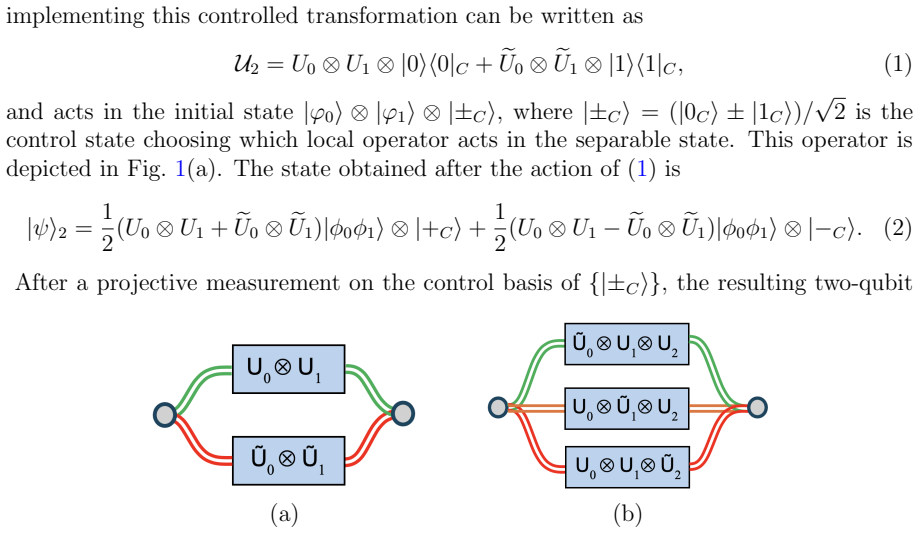
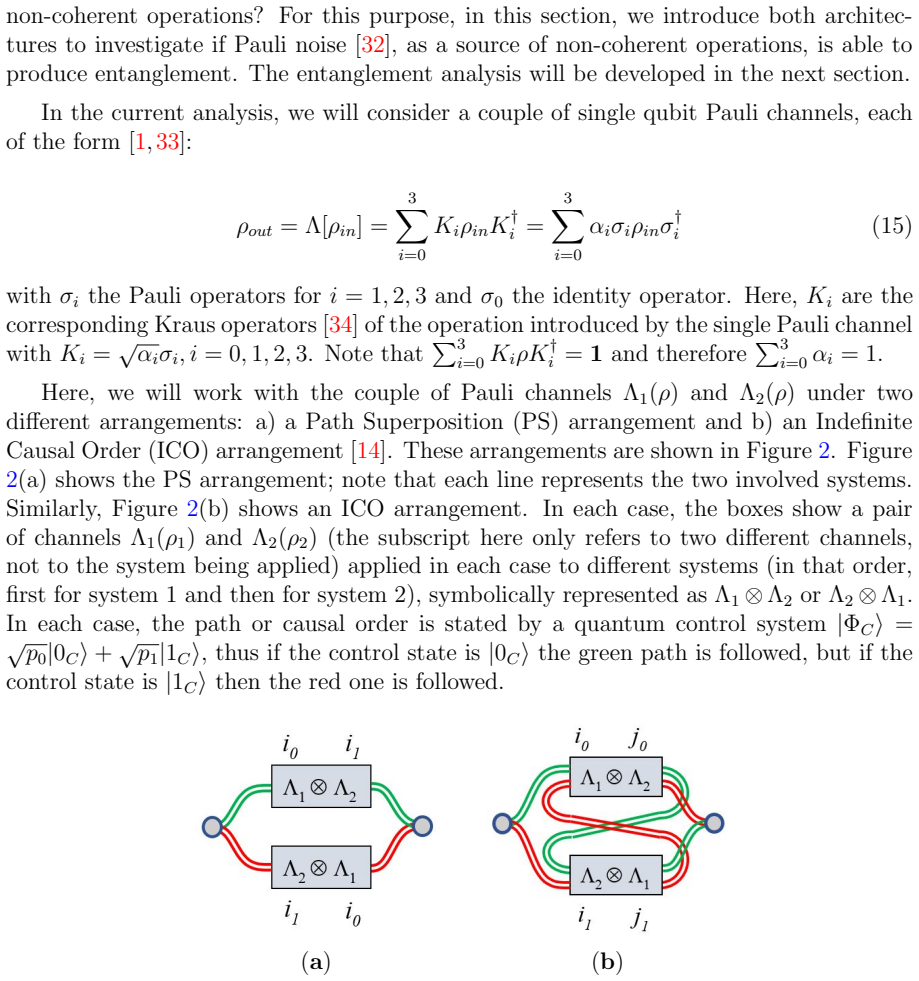
Entangled states belonging to the Bell, GHZ and W classes can be deterministically generated from fully separable inputs by coherently superposing alternative sets of local unitary transformations. Conditions on the local operators for entanglement generation are derived, and the resulting states are shown to be locally unitary equivalent to standard multipartite entangled states. The analysis extends to noisy scenarios with pairs of Pauli channels arranged in path-superposition and indefinite causal order configurations, where closed-form expressions for the output states are obtained and entanglement is quantified using concurrence.
What carries the argument
Coherent path superposition of local unitary operations, allowing deterministic entanglement production by coherently combining alternative control paths applied to separable inputs.
If this is right
- Specific conditions on the local operators determine when the superposition produces entanglement.
- The generated states are locally unitary equivalent to the standard Bell, GHZ, and W classes.
- Closed-form expressions describe the output states for Pauli channels in superposition and indefinite causal order.
- Regimes in channel parameter space exist where stochastic entanglement appears, with explicit success probabilities.
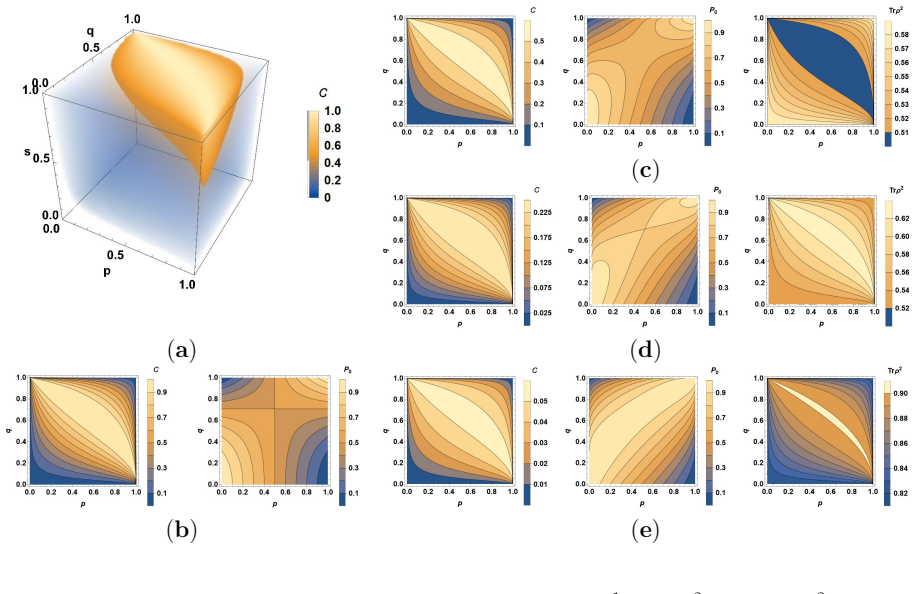
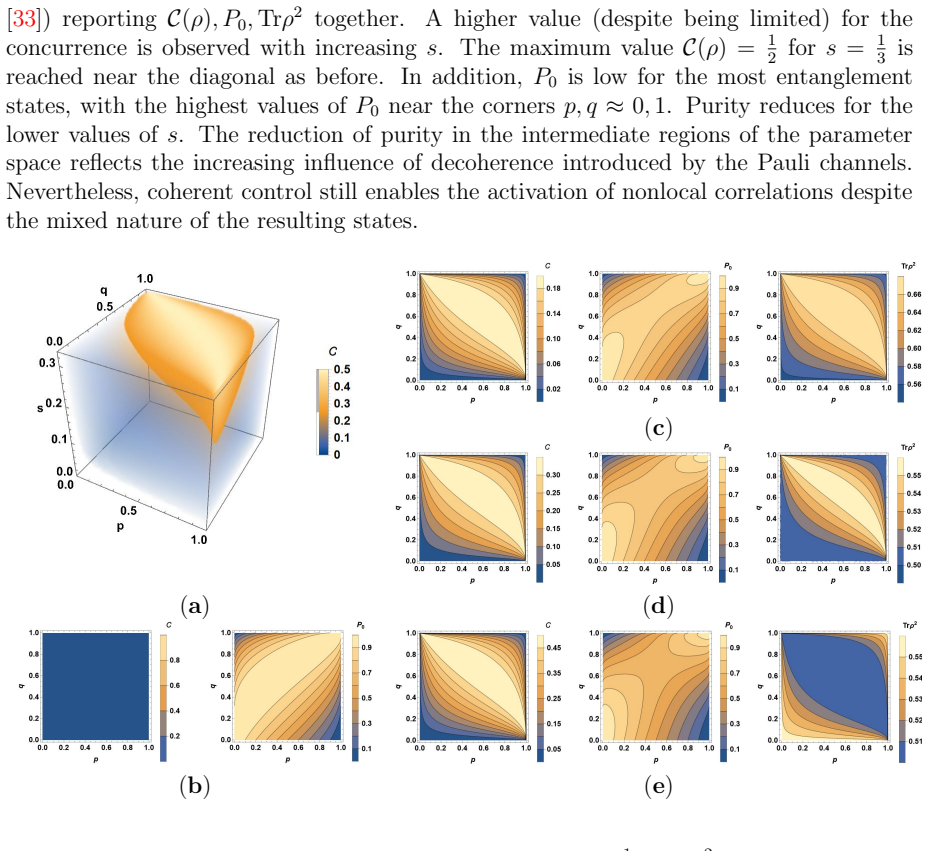
- Trade-offs between the amount of generated entanglement and the purity of the output state are characterized across representative channel families.
Where Pith is reading between the lines
- The method could allow on-demand entanglement creation in quantum networks without requiring pre-distributed entangled resources.
- Indefinite causal order versions might enable new quantum communication protocols that exploit ordering uncertainty.
- Small-scale experiments on two or three qubits could directly test the superposition mechanism and its coherence requirements.
- Similar superposition control might be used to generate other forms of quantum correlation beyond entanglement.
Load-bearing premise
Coherent superposition of the local unitary operations can be realized without introducing extra decoherence or loss of control coherence.
What would settle it
An experiment that prepares two different local unitary operations on separate paths for a pair of qubits, superposes the paths coherently, applies them to a product input state, and measures whether the output is a Bell state; absence of the predicted entanglement would falsify the deterministic generation claim.
Figures
read the original abstract
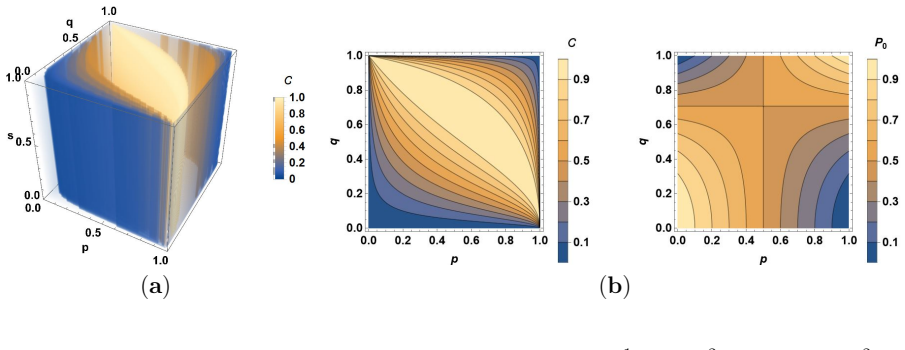
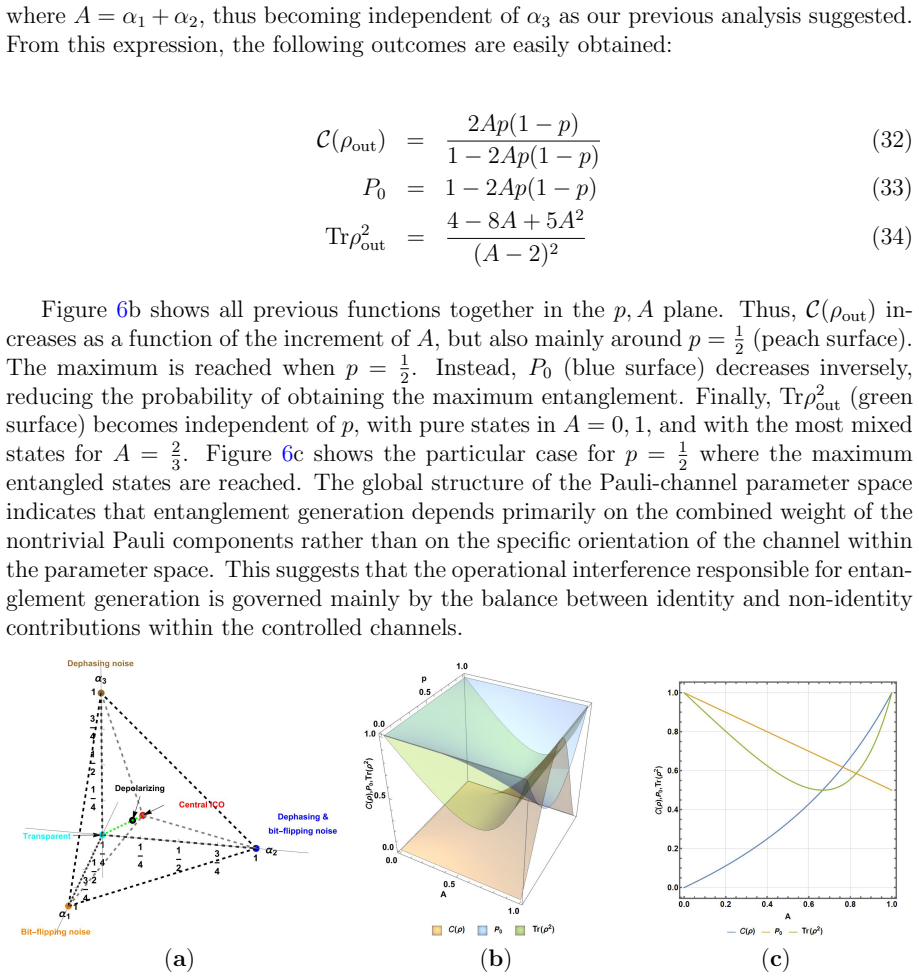
The controlled generation of quantum entanglement from separable states remains a central challenge in quantum information science. Here, we investigate entanglement generation using two related control paradigms: coherent path superposition of local unitary operations and stochastic implementations of Pauli channels under coherent control. We show that entangled states belonging to the Bell, GHZ and W classes, can be deterministically generated from fully separable inputs by coherently superposing alternative sets of local unitary transformations. Conditions on the local operators for entanglement generation are derived, and the resulting states are shown to be locally unitary equivalent to standard multipartite entangled states. We further extend the analysis to noisy scenarios, where separable mixed states evolve through pairs of Pauli channels arranged in path-superposition and indefinite causal order configurations. Closed-form expressions for the output states are obtained, and entanglement is quantified using concurrence. By exploring representative channel families across their parameter space, we identify regimes where stochastic entanglement emerges, determine the associated success probabilities, and characterize trade-offs between entanglement and purity.
Editorial analysis
A structured set of objections, weighed in public.
Referee Report
Summary. The manuscript examines entanglement generation via two paradigms: coherent path superposition of local unitary operations on separable inputs, and stochastic Pauli channels under coherent control or indefinite causal order. It claims that pure states in the Bell, GHZ, and W classes can be deterministically generated from fully separable states by coherently superposing sets of local unitaries, derives conditions on the operators for this to occur, establishes local unitary equivalence to standard entangled states, and for the noisy case obtains closed-form output states, quantifies entanglement via concurrence, and identifies parameter regimes yielding stochastic entanglement along with associated probabilities and purity trade-offs.
Significance. A verified construction for deterministic pure-state entanglement generation from separable inputs via coherent control would be a useful addition to quantum information protocols, especially if it avoids post-selection. The closed-form expressions for the noisy cases and the exploration of indefinite causal order provide concrete, checkable results that could aid further work on open-system entanglement.
major comments (1)
- [Abstract] Abstract and the section on coherent superposition: the central claim of deterministic generation of pure Bell/GHZ/W states is load-bearing, yet the standard physical realization of path superposition (ancilla control qubit in superposition, conditional local unitaries, followed by partial trace) produces a mixed reduced state on the targets. The manuscript must explicitly show how purity is preserved without post-selection or additional assumptions that would render the process probabilistic.
minor comments (2)
- Provide explicit intermediate steps for the closed-form output-state expressions in the noisy-channel sections to allow direct verification.
- Clarify the precise definition of 'success probability' in the stochastic-entanglement regimes and how it is computed from the concurrence and purity values.
Simulated Author's Rebuttal
We thank the referee for their careful reading of the manuscript and for identifying this important point about the physical implementation of coherent superposition. We address the comment below and will revise the manuscript accordingly.
read point-by-point responses
-
Referee: [Abstract] Abstract and the section on coherent superposition: the central claim of deterministic generation of pure Bell/GHZ/W states is load-bearing, yet the standard physical realization of path superposition (ancilla control qubit in superposition, conditional local unitaries, followed by partial trace) produces a mixed reduced state on the targets. The manuscript must explicitly show how purity is preserved without post-selection or additional assumptions that would render the process probabilistic.
Authors: We agree that the standard ancilla-based implementation of path superposition, when followed by a partial trace over the control, generally yields a mixed state on the target systems. The manuscript presents the coherent superposition of local unitaries in an abstract operator framework, deriving conditions under which the effective map produces states locally equivalent to Bell, GHZ, or W states. However, we acknowledge that an explicit discussion of the physical realization and purity preservation is missing. In the revised manuscript we will add a new subsection clarifying that (i) when the control qubit is retained, the joint state remains pure and the reduced target state is entangled only conditionally on control measurement outcomes, and (ii) an alternative global-unitary realization (equivalent to the superposed local operators) can preserve purity on the targets without post-selection. If neither construction satisfies the deterministic pure-state claim without additional assumptions, we will adjust the abstract and main text to qualify the generation as conditional or probabilistic, consistent with the stochastic analysis already present in the paper. revision: yes
Circularity Check
No circularity: derivations follow from standard QM rules without self-reference or fitted inputs
full rationale
The paper starts from standard definitions of unitary operators, coherent superposition, and Pauli channels. It derives conditions on local operators for producing Bell/GHZ/W states and obtains closed-form output expressions for noisy cases. No equations reduce by construction to fitted parameters, no self-citations are invoked as uniqueness theorems, and no ansatz is smuggled via prior work. The central claims are obtained by direct application of partial traces and concurrence calculations to the superposed channels, remaining independent of the target results.
Axiom & Free-Parameter Ledger
axioms (1)
- standard math Standard postulates of quantum mechanics including unitary evolution of closed systems and the definition of entanglement via concurrence
Reference graph
Works this paper leans on
-
[1]
Nielsen, M.A.; Chuang, I.L.Quantum Computation and Quantum Information; Cambridge University Press: Cambridge, UK, 2010
2010
-
[2]
Bengtsson, I.; ˙Zyczkowski, K.Geometry of Quantum States: An Introduction to Quantum Entanglement; Cambridge University Press: Cambridge, UK, 2017
2017
-
[3]
Yang, Z.-B.; Wang, Y.-P.; Li, J.; Hu, C.-M.; You, J. Q. Entanglement emerges from dissipation-driven quantum self-organization.J. Magn. Magn. Mater.2022,564, 170139. 17
2022
-
[4]
Fast adiabatic quantum state transfer and entanglement generation between two atoms via dressed states.Sci
Wu, J.-L.; Ji, X.; Zhang, S. Fast adiabatic quantum state transfer and entanglement generation between two atoms via dressed states.Sci. Rep.2017,7, 46255
2017
-
[5]
S.; Ord´ o˜ nez, A
Bhattacharya, U.; Lamprou, T.; Maxwell, A. S.; Ord´ o˜ nez, A. F.; Pisanty, E.; Rivera- Dean, J.; Stammer, P.; Ciappina, M. F.; Lewenstein, M.; Tzallas, P. Strong-laser- field physics, non-classical light states and quantum information science.Rep. Prog. Phys.2023,86, 094401
2023
-
[6]
F.; Lewenstein, M.; Tzallas, P
Lamprou, T.; Stammer, P.; Rivera-Dean, J.; Tsatrafyllis, N.; Ciappina, M. F.; Lewenstein, M.; Tzallas, P. Recent developments in the generation of non-classical and entangled light states using intense laser–matter interactions.arXiv2024, arXiv:2410.17452
-
[7]
Mixed-state entanglement
Gour, G. Mixed-state entanglement. InQuantum Resource Theories; Cambridge University Press: Cambridge, UK, 2025; pp. 538–623
2025
-
[8]
Mixed-State Entanglement and Dis- tillation: Is There a Bound Entanglement in Nature?Phys
Horodecki, M.; Horodecki, P.; Horodecki, R. Mixed-State Entanglement and Dis- tillation: Is There a Bound Entanglement in Nature?Phys. Rev. Lett.1998,80, 5239–5242
1998
-
[9]
Asymptotic Manipulations of Entan- glement Can Exhibit Genuine Irreversibility.Phys
Horodecki, M.; Horodecki, P.; Horodecki, R. Asymptotic Manipulations of Entan- glement Can Exhibit Genuine Irreversibility.Phys. Rev. Lett.2000,84, 4260–4263
2000
-
[10]
Secure Key from Bound Entanglement.Phys
Horodecki, K.; Horodecki, M.; Horodecki, P.; Oppenheim, J. Secure Key from Bound Entanglement.Phys. Rev. Lett.2005,94, 160502
2005
-
[11]
Activation of genuine multipartite entanglement: Beyond the single-copy paradigm of entanglement characterisation.Quantum2022,6, 695
Yamasaki, H.; Morelli, S.; Miethlinger, M.; Bavaresco, J.; Friis, N.; Huber, M. Activation of genuine multipartite entanglement: Beyond the single-copy paradigm of entanglement characterisation.Quantum2022,6, 695
-
[12]
Generation of entanglement in mixed states via quantum operations.Results Phys.2022,40, 105830
Singh, U.; Bandyopadhyay, S.; Adhikari, S. Generation of entanglement in mixed states via quantum operations.Results Phys.2022,40, 105830
2022
-
[13]
A.; Wang, C.; Hsieh, T
Moharramipour, A.; Lessa, L. A.; Wang, C.; Hsieh, T. H.; Sahu, S. Symmetry- Enforced Entanglement in Maximally Mixed States.PRX Quantum2024,5, 040336
-
[14]
M.; Perinotti, P.; Valiron, B
Chiribella, G.; D’Ariano, G. M.; Perinotti, P.; Valiron, B. Quantum computations without definite causal structure.Phys. Rev. A2013,88, 022318
-
[15]
A.; Feix, A.; Ara´ ujo, M.; Zeuner, J
Rubino, G.; Rozema, L. A.; Feix, A.; Ara´ ujo, M.; Zeuner, J. M.; Procopio, L. M.; Brukner, ˇC.; Walther, P. Experimental verification of an indefinite causal order.Sci. Adv.2017,3, e1602589
2017
-
[16]
Enhanced communication with the assistance of indefinite causal order.Phys
Ebler, D.; Salek, S.; Chiribella, G. Enhanced communication with the assistance of indefinite causal order.Phys. Rev. Lett.2018,120, 120502. 18
2018
-
[17]
Communi- cation enhancement through quantum coherent control of N channels in an indefinite causal-order scenario.Entropy2019,21, 1012
Procopio, L.M.; Delgado, F.; Enr´ ıquez, M.; Belabas, N.; Levenson, J.A. Communi- cation enhancement through quantum coherent control of N channels in an indefinite causal-order scenario.Entropy2019,21, 1012
-
[18]
Bavaresco, J.; Murao, M.; Quintino, M.T. Unitary channel discrimination beyond group structures: Advantages of sequential and indefinite-causal-order strategies. arXiv2021, arXiv:2105.13369
-
[19]
Quantum metrology with indefinite causal order
Zhao, X.; Yang, Y.; Chiribella, G. Quantum metrology with indefinite causal order. Phys. Rev. Lett.2020,124, 190503
2020
-
[20]
Noisy quantum parameter estimation with indefinite causal order.Phys
Del Santo, F.; Ebler, D.; Chiribella, G. Noisy quantum parameter estimation with indefinite causal order.Phys. Rev. A2024,109, 012603
-
[21]
Communication through coherent control of quantum channels.Quantum2018,2, 76
Abbott, A.A.; Wechs, J.; Horsman, C.; Mhalla, M.; Branciard, C. Communication through coherent control of quantum channels.Quantum2018,2, 76
-
[22]
Quantum Shannon theory with superpositions of trajectories.Proc
Chiribella, G.; Kristj´ ansson, H. Quantum Shannon theory with superpositions of trajectories.Proc. R. Soc. A2019,475, 20180903
-
[23]
Experimen- tal quantum communication enhancement by superposing trajectories.Phys
Rubino, G.; Rozema, L.A.; Ebler, D.; Kristj´ ansson, H.; Salek, S.; Gu´ erin, P.A.; Abbott, A.A.; Branciard, C.; Brukner, ˇC.; Chiribella, G.; Walther, P. Experimen- tal quantum communication enhancement by superposing trajectories.Phys. Rev. Research2021,3, 013093
-
[24]
Parametric symmetries in architectures involving indefinite causal or- der and path superposition for quantum parameter estimation of Pauli channels
Delgado, F. Parametric symmetries in architectures involving indefinite causal or- der and path superposition for quantum parameter estimation of Pauli channels. Symmetry2023,15, 1097
-
[25]
Mondal, S.; Ghosh, P.; Sen, U. Path superposition as a resource for perfect quantum teleportation with separable states.arXiv2025, arXiv:2505.11398
-
[26]
Coherent control of two Jaynes–Cummings cavities.Sci
Casta˜ nos-Cervantes, L.O.; Procopio, L.M.; Enr´ ıquez, M. Coherent control of two Jaynes–Cummings cavities.Sci. Rep.2024,14, 3790
2024
-
[27]
Sørensen, A. S. and Mølmer, K. Measurement Induced Entanglement and Quantum Computation with Atoms in Optical Cavities,Phys. Rev. Lett.2003, em 91(9), 097905
2003
-
[28]
S., Lee, J
Kim, Y. S., Lee, J. C., Kwon, O. et al. Protecting entanglement from decoherence using weak measurement and quantum measurement reversal,Nature Phys2012, 8, 117–120
-
[29]
White, T., Mutus, J., Dressel, J. et al. Preserving entanglement during weak mea- surement demonstrated with a violation of the Bell–Leggett–Garg inequality.npj Quantum Inf.2016,2, 15022. 19
2016
-
[30]
V., Filippov, S
Grimaudo, R., Messina, A., Sergi, A., Vitanov, N. V., Filippov, S. N. Two-Qubit En- tanglement Generation through Non-Hermitian Hamiltonians Induced by Repeated Measurements on an Ancilla.Entropy2020,22(10), 1184
-
[31]
S.; Caleffi, M
Koudia, S.; Cacciapuoti, A. S.; Caleffi, M. Deterministic generation of multipartite entanglement via causal activation in the quantum internet.IEEE Access2023,11, 73863–73878
-
[32]
Flammia, S. T. and Wallman, J. J., Efficient Estimation of Pauli Channels,ACM Transactions on Quantum Computing,2020,1(1), 32
2020
-
[33]
Performance characterization of Pauli chan- nels assisted by indefinite causal order and post-measurement.Quantum Inf
Delgado, F.; Cardoso-Isidoro, Carlos. Performance characterization of Pauli chan- nels assisted by indefinite causal order and post-measurement.Quantum Inf. Com- put.2020,20, 1261–1280
2020
-
[34]
Kraus, K.States, Effects and Operations: Fundamental Notions of Quantum The- ory; Springer: Berlin, Germany, 1983
1983
-
[35]
A.; Wootters, W
Hill, S. A.; Wootters, W. K. Entanglement of a pair of quantum bits.Phys. Rev. Lett.1997,78, 5022
1997
-
[36]
Entanglement of formation for any arbitrary state of two qubits, Phys
Wootters, W.K. Entanglement of formation for any arbitrary state of two qubits, Phys. Rev. Lett.1998,80, 2245. 20
1998
discussion (0)
Sign in with ORCID, Apple, or X to comment. Anyone can read and Pith papers without signing in.