Crystallography of periodic nanotextures in a strained Mott insulator
Pith reviewed 2026-06-27 15:38 UTC · model grok-4.3
The pith
Satellite intensities from 24 Bragg reflections in strained Ca2RuO4 collapse onto one parameter-free curve, identifying a martensitic laminate of few-nm domains.
A machine-rendered reading of the paper's core claim, the machinery that carries it, and where it could break.
Core claim
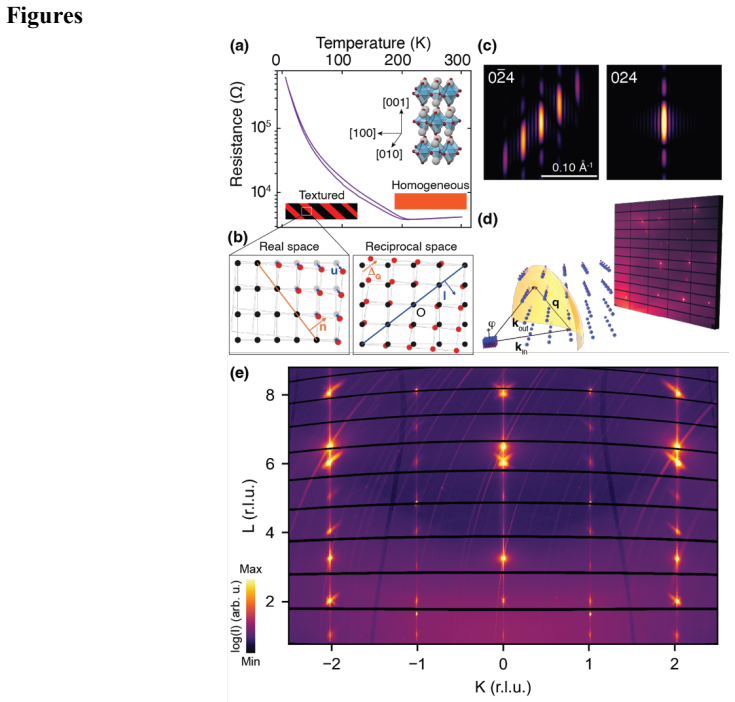
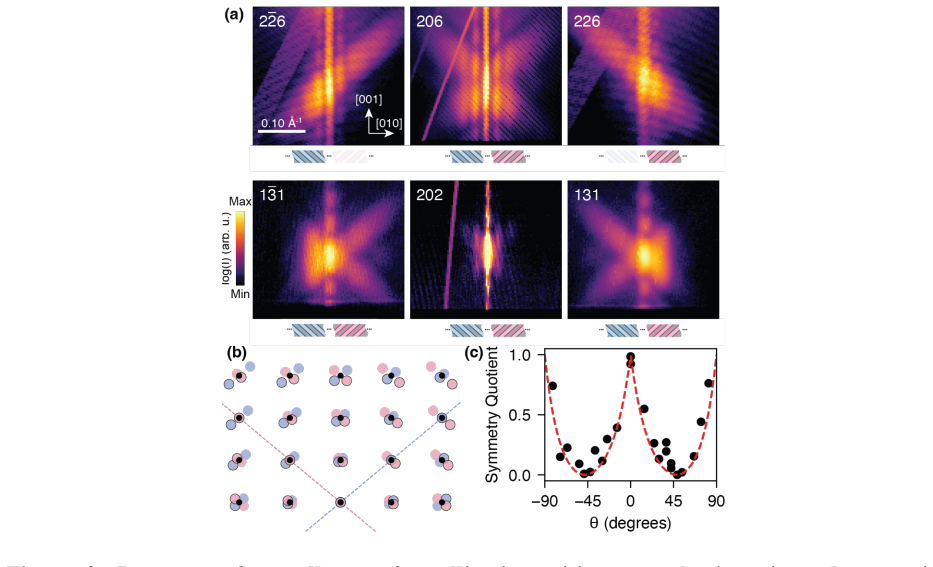
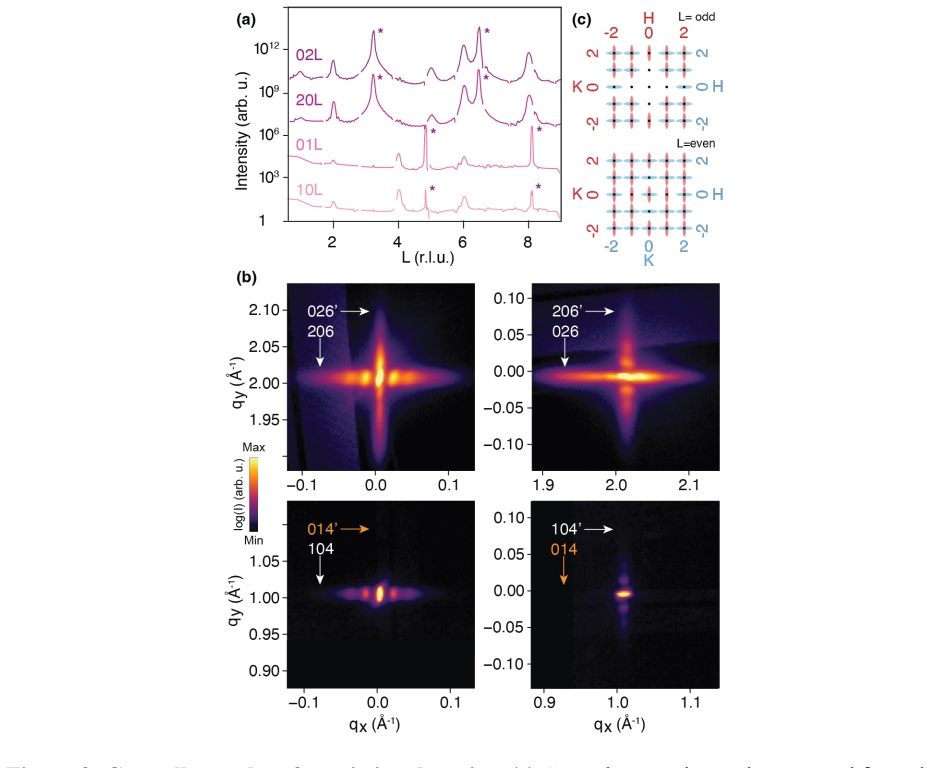
Satellite-pattern intensities across 24 symmetry-inequivalent Bragg reflections collapse onto a single parameter-free curve. The collapse identifies a coherent martensitic laminate of few-nm-wide domains separated by {012} interfaces, with displacements along <01-2>. Classical invariant-plane-strain crystallography thus governs the nanoscale domain geometry of a Mott insulator with intertwined magnetic, electronic, and lattice order. Satellite-extinction analysis demonstrates that both coexisting phases retain the bulk orthorhombic space group despite the pseudocubic LaAlO3 substrate, biaxial epitaxial strain, and intrinsic strain at the interfaces.
What carries the argument
The collapse of satellite intensities from 24 symmetry-inequivalent Bragg reflections onto a single parameter-free curve, which identifies the {012}-interface martensitic laminate with <01-2> displacements.
If this is right
- The domain geometry in the film follows classical invariant-plane-strain rules even though magnetic, electronic, and lattice orders are intertwined.
- The two coexisting phases both preserve the bulk orthorhombic space group under epitaxial and interface strain.
- The laminate consists of few-nm-wide domains separated by {012} interfaces with <01-2> displacements.
- Satellite-extinction rules confirm the space-group retention across the nanotexture.
Where Pith is reading between the lines
- The same intensity-collapse method could be applied to map domain structures in other strained oxide films with periodic nanotextures.
- If the laminate geometry controls transport, similar films on different substrates might show predictable changes in metal-insulator behavior.
- The result raises the question whether invariant-plane-strain selection operates in bulk Mott insulators under uniaxial pressure rather than epitaxial strain.
Load-bearing premise
The observed intensity collapse onto a single parameter-free curve is produced uniquely by the proposed {012}-interface martensitic laminate and cannot be reproduced by other domain geometries, strain distributions, or multiple scattering effects.
What would settle it
A measurement showing that satellite intensities from the 24 Bragg reflections fail to collapse onto one curve under higher-resolution mapping or when modeled with alternative domain arrangements would falsify the identification of the martensitic laminate.
Figures
read the original abstract
Here we investigate stripes of alternating structural phases spontaneously forming in epitaxially strained $Ca_2RuO_4$ thin films below the metal-insulator transition. Using large-volume X-ray reciprocal-space mapping, we show that satellite-pattern intensities across 24 symmetry-inequivalent Bragg reflections collapse onto a single parameter-free curve. The collapse identifies a coherent martensitic laminate of few-nm-wide domains separated by ${012}$ interfaces, with displacements along $\left\langle01\bar{2}\right\rangle$. Satellite-extinction analysis demonstrates that both coexisting phases retain the bulk orthorhombic space group despite the pseudocubic $LaAlO_3$ substrate, biaxial epitaxial strain, and intrinsic strain at the interfaces. Classical invariant-plane-strain crystallography thus governs the nanoscale domain geometry of a Mott insulator with intertwined magnetic, electronic, and lattice order.
Editorial analysis
A structured set of objections, weighed in public.
Referee Report
Summary. The manuscript reports large-volume X-ray reciprocal-space mapping of satellite patterns in epitaxially strained Ca2RuO4 thin films below the metal-insulator transition. It claims that intensities across 24 symmetry-inequivalent Bragg reflections collapse onto a single parameter-free curve, identifying a coherent martensitic laminate of few-nm-wide domains separated by {012} interfaces with displacements along <01-2>. Satellite-extinction rules are used to show that both coexisting phases retain the bulk orthorhombic space group despite substrate strain and interface strain.
Significance. If the central identification holds, the result demonstrates that classical invariant-plane-strain crystallography governs nanoscale domain geometry in a Mott insulator with intertwined magnetic, electronic, and lattice order. The parameter-free intensity collapse is a clear strength, as it avoids adjustable parameters and provides a falsifiable link between observed satellites and the proposed laminate geometry.
major comments (1)
- [Abstract] Abstract and main-text claim of identification: the intensity collapse is presented as uniquely selecting the {012}-interface martensitic laminate with <01-2> displacements. However, the manuscript does not report forward simulations of alternative periodic domain geometries (different interface planes, non-lamellar arrangements), inhomogeneous strain fields, or multiple-scattering contributions to show that these are incompatible with the same collapse onto one curve. This uniqueness assumption is load-bearing for the central claim.
Simulated Author's Rebuttal
We thank the referee for their careful reading and constructive comments on our manuscript. We respond to the major comment below.
read point-by-point responses
-
Referee: [Abstract] Abstract and main-text claim of identification: the intensity collapse is presented as uniquely selecting the {012}-interface martensitic laminate with <01-2> displacements. However, the manuscript does not report forward simulations of alternative periodic domain geometries (different interface planes, non-lamellar arrangements), inhomogeneous strain fields, or multiple-scattering contributions to show that these are incompatible with the same collapse onto one curve. This uniqueness assumption is load-bearing for the central claim.
Authors: We agree that the uniqueness claim would be strengthened by explicit forward simulations of alternatives. Our identification rests on the parameter-free collapse of intensities from 24 symmetry-inequivalent reflections onto a single curve together with satellite-extinction rules that enforce the orthorhombic space group. These constraints are highly specific to the proposed {012} laminate. Nevertheless, to address the referee's concern directly, the revised manuscript will include forward simulations of alternative periodic domain geometries (different interface planes and non-lamellar arrangements), inhomogeneous strain fields, and multiple-scattering contributions to demonstrate their incompatibility with the observed data. revision: yes
Circularity Check
No significant circularity; experimental collapse matches external classical crystallography
full rationale
The paper's central result is an experimental observation: satellite intensities across 24 Bragg reflections collapse onto a single parameter-free curve derived from classical invariant-plane-strain crystallography. This collapse is presented as identifying the {012}-interface martensitic laminate. No steps reduce by construction to the paper's own inputs, no parameters are fitted and then renamed as predictions, and the core claim relies on external classical theory rather than self-citation chains or ansatzes smuggled from prior author work. The derivation chain is self-contained against external benchmarks.
Axiom & Free-Parameter Ledger
axioms (2)
- domain assumption Invariant-plane-strain crystallography governs domain geometry in epitaxial films
- domain assumption Satellite intensities are produced solely by the proposed laminate geometry
Reference graph
Works this paper leans on
-
[1]
Dietl et al., Tailoring the electronic properties of Ca2RuO4 via epitaxial strain, Applied Physics Letters 112, (2018)
C. Dietl et al., Tailoring the electronic properties of Ca2RuO4 via epitaxial strain, Applied Physics Letters 112, (2018). [22] A. Tsurumaki-Fukuchi, K. Tsubaki, T. Katase, T. Kamiya, M. Arita, and Y. Takahashi, Stable and Tunable Current-Induced Phase Transition in Epitaxial Thin Films of Ca2 RuO4, ACS Appl. Mater. Interfaces 12, 28368 (2020). [23] N. Sc...
2018
-
[2]
F𝐮)=𝑒A𝐪⋅𝐫
C. Chluba, W. Ge, R. Lima De Miranda, J. Strobel, L. Kienle, E. Quandt, and M. Wuttig, Ultralow-fatigue shape memory alloy films, Science 348, 1004 (2015). [42] G. Mattoni et al., Striped nanoscale phase separation at the metal–insulator transition of heteroepitaxial nickelates, Nat Commun 7, 13141 (2016). [43] L. Rodríguez, F. Sandiumenge, C. Frontera, J...
2015
discussion (0)
Sign in with ORCID, Apple, or X to comment. Anyone can read and Pith papers without signing in.