Suppressing the Motion of Rydberg Atoms in Inhomogeneous Electric Fields via Stark Echo
Pith reviewed 2026-06-27 14:08 UTC · model grok-4.3
The pith
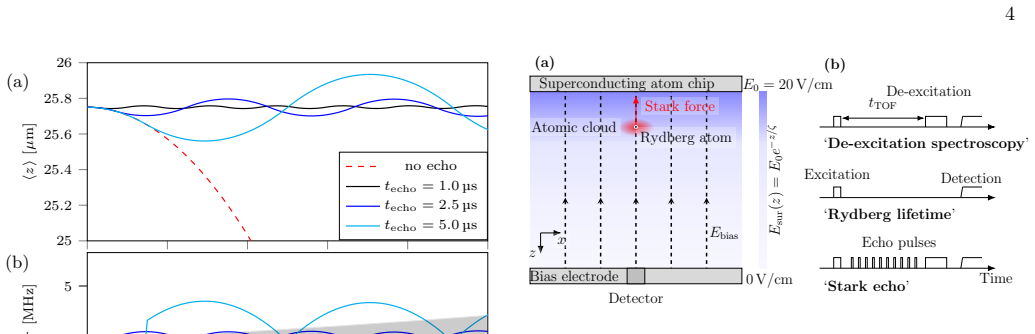
A Stark echo sequence reverses position-dependent forces to suppress Rydberg atom motion and preserve resonance near surfaces.
A machine-rendered reading of the paper's core claim, the machinery that carries it, and where it could break.
Core claim
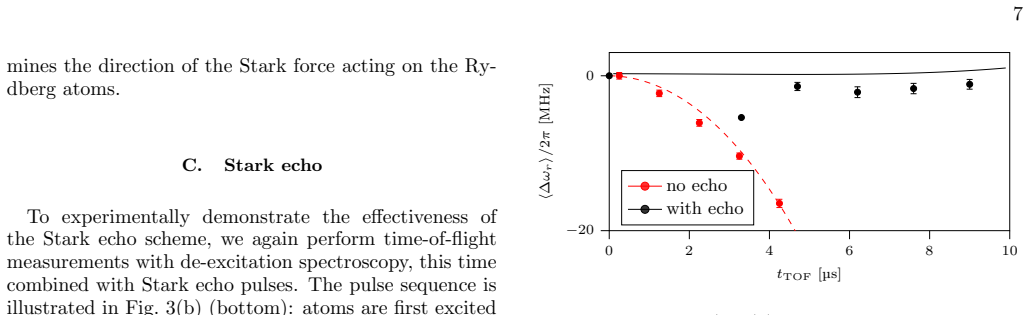
A Stark echo sequence that dynamically reverses the Stark force suppresses the atomic motion and maintains the atomic resonance in the presence of inhomogeneous electric fields near surfaces.
What carries the argument
The Stark echo sequence, which applies timed global electric field pulses to invert the direction of the position-dependent force and counteract atomic displacement.
If this is right
- Atomic resonance is preserved over longer times using only global field adjustments.
- Signal loss from field-induced motion is reduced in spectroscopic measurements.
- The technique integrates with atom-resonator coupling on superconducting chips.
- Coherence of Rydberg atoms is maintained without requiring position-specific corrections.
Where Pith is reading between the lines
- The method may allow Rydberg atoms to remain usable at distances of tens of micrometers from surfaces for quantum devices.
- Similar pulse sequences could address motion in other systems with inhomogeneous fields, such as trapped ions or polar molecules.
- Direct comparison of resonance linewidths with and without the echo pulses would quantify the improvement in coherence time.
Load-bearing premise
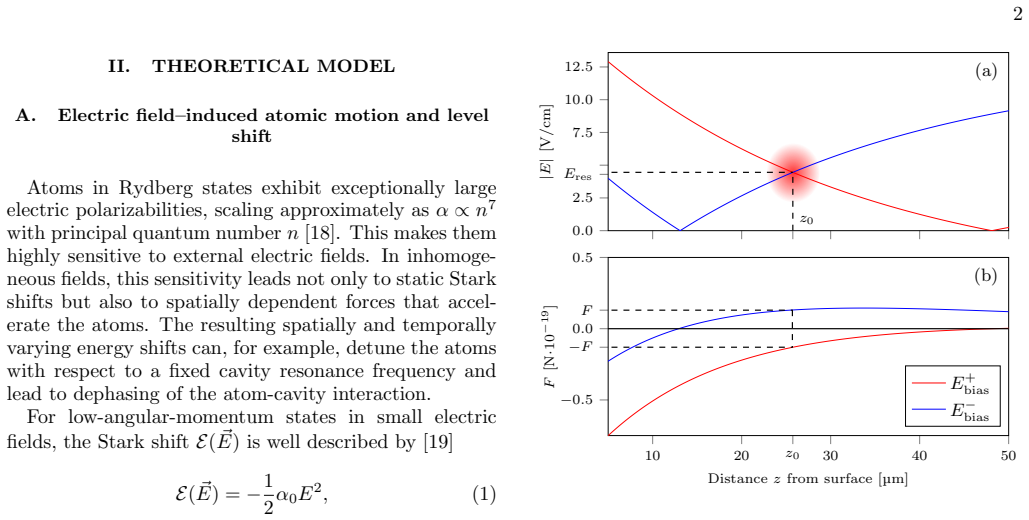
The theoretical model of an exponentially decaying surface field with a superimposed bias accurately reproduces the observed atomic dynamics.
What would settle it
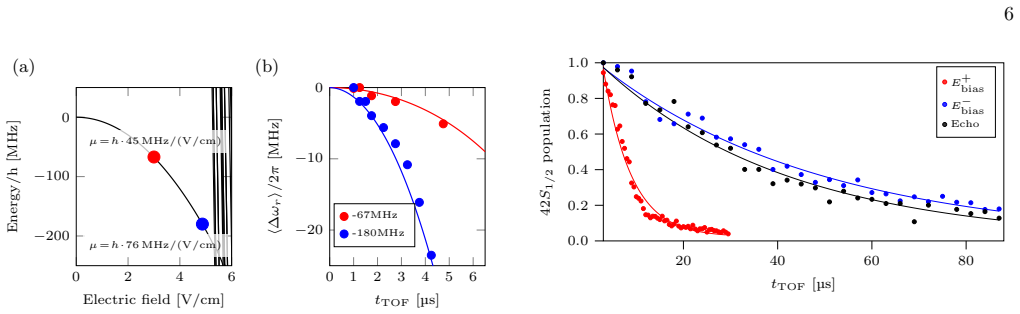
Continued observation of level shifts or signal loss in time-of-flight measurements after applying the Stark echo sequence would show the sequence does not suppress the motion.
Figures

read the original abstract
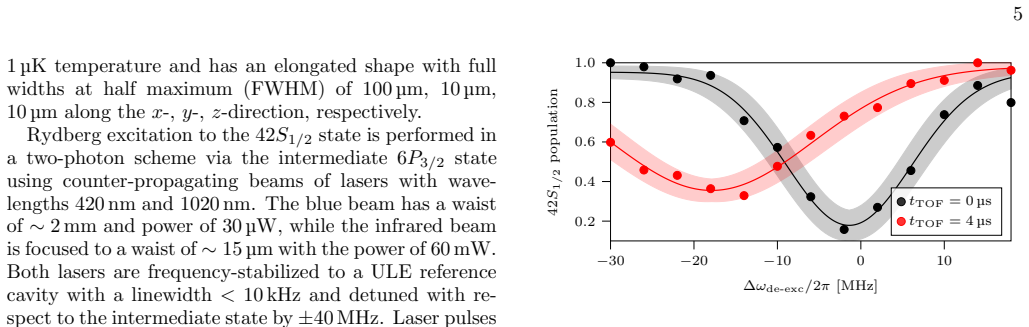
Rydberg atoms possess strong electric dipole transitions and tunable energy levels, making them promising candidates for microwave to optical conversion on integrated superconducting atom chips. Achieving strong coupling of the atoms to e.g. the microwave field of an on-chip resonator requires placing the atoms within tens of micrometers from the chip surface. However, inhomogeneous stray electric fields originating from the surface can induce position-dependent Stark forces, resulting in atomic motion and leading to time-dependent shifts of the Rydberg energy levels. We experimentally investigate these effects using time-of-flight and spectroscopic techniques, observing substantial level shifts and signal loss attributable to field-induced atomic motion. A theoretical model incorporating an exponentially decaying surface field with a superimposed bias accurately reproduces the observed dynamics. To mitigate the level shift, we introduce a Stark echo sequence that dynamically reverses the force. This approach suppresses the atomic motion and maintains the atomic resonance. The method relies solely on global field control and is compatible with atom-resonator coupling architectures, providing a robust strategy for preserving coherence of Rydberg atoms in inhomogeneous electric fields near surfaces.
Editorial analysis
A structured set of objections, weighed in public.
Referee Report
Summary. The manuscript claims that inhomogeneous stray electric fields from surfaces induce position-dependent Stark forces on Rydberg atoms, causing motion and time-dependent level shifts that are observed via time-of-flight and spectroscopic techniques. A theoretical model with an exponentially decaying surface field superimposed on a controllable bias reproduces the observed dynamics. The authors introduce a Stark echo sequence that dynamically reverses the force using global field control, suppressing atomic motion and maintaining the atomic resonance, with the method being compatible with atom-resonator coupling architectures.
Significance. If the central claim holds, the work addresses a practical obstacle to placing Rydberg atoms close to chip surfaces for strong coupling in quantum devices such as microwave-optical converters. The Stark echo approach relies only on global control and is therefore broadly applicable. The experimental observation of motion-induced shifts combined with a model that matches the dynamics constitutes a concrete strength; the technique's falsifiability via resonance maintenance under reversal is also a positive feature.
major comments (2)
- [Abstract] Abstract: the claim that the model 'accurately reproduces the observed dynamics' is load-bearing for the assertion that the Stark echo suppresses net displacement and resonance shift. The free parameters (exponential decay length/amplitude and bias strength) are adjusted to the data rather than independently constrained, so it remains unclear whether the functional form would correctly predict the post-reversal force on already-displaced atoms if the real field contains unmodeled spatial structure.
- [Abstract] Abstract (experimental results): the support for the central claim rests on observed effects and model agreement, yet the manuscript provides no explicit error bars, exclusion criteria, or statistical measures on the time-of-flight and spectroscopic data. This makes it difficult to assess whether residual motion after the echo sequence is statistically consistent with zero or merely reduced.
minor comments (1)
- [Abstract] The abstract would benefit from a brief statement of the typical atom-surface distance and the magnitude of the observed level shifts to allow readers to gauge the practical relevance.
Simulated Author's Rebuttal
We thank the referee for their careful reading and constructive comments. We address the two major comments point by point below, indicating where revisions have been made to the manuscript.
read point-by-point responses
-
Referee: [Abstract] Abstract: the claim that the model 'accurately reproduces the observed dynamics' is load-bearing for the assertion that the Stark echo suppresses net displacement and resonance shift. The free parameters (exponential decay length/amplitude and bias strength) are adjusted to the data rather than independently constrained, so it remains unclear whether the functional form would correctly predict the post-reversal force on already-displaced atoms if the real field contains unmodeled spatial structure.
Authors: We acknowledge that the exponential surface-field model is phenomenological, with its three free parameters determined by fitting to the observed pre-echo dynamics. The functional form is chosen because it is the simplest physically motivated profile consistent with the expected decay of patch potentials, but we agree it is not independently validated for post-reversal trajectories. In the revised manuscript we have added an explicit paragraph in the discussion section stating the model assumptions, noting that unmodeled spatial structure could in principle alter the post-reversal force, and emphasizing that the echo sequence's efficacy is supported by direct experimental observables (suppressed time-of-flight spread and maintained spectroscopic resonance) rather than by model extrapolation alone. We have also inserted a forward-looking sentence that independent field mapping would be required for a stricter test. revision: partial
-
Referee: [Abstract] Abstract (experimental results): the support for the central claim rests on observed effects and model agreement, yet the manuscript provides no explicit error bars, exclusion criteria, or statistical measures on the time-of-flight and spectroscopic data. This makes it difficult to assess whether residual motion after the echo sequence is statistically consistent with zero or merely reduced.
Authors: The original submission indeed omitted error bars, data-selection criteria, and quantitative statistical measures. In the revised manuscript we have (i) added standard-error-of-the-mean error bars to all time-of-flight and spectroscopic data points, (ii) included a methods paragraph describing the acquisition protocol and outlier exclusion criteria, and (iii) reported a statistical comparison (including a t-test result) showing that the residual resonance shift after the echo sequence is consistent with zero within the experimental uncertainty. revision: yes
Circularity Check
No circularity: experimental demonstration of Stark echo is independent of model fit
full rationale
The paper's central result is an experimental demonstration that a Stark echo sequence suppresses atomic motion and maintains resonance, shown via time-of-flight and spectroscopy. The model of an exponentially decaying surface field plus bias is introduced only to interpret the observed dynamics and is stated to 'accurately reproduce' them; this is a standard post-hoc fit rather than a load-bearing prediction that reduces to its own inputs by construction. No equations, self-citations, or uniqueness theorems are invoked to derive the echo effect from the model. The derivation chain remains self-contained against the experimental data without circular reduction.
Axiom & Free-Parameter Ledger
free parameters (2)
- exponential decay length and amplitude of surface field
- bias field strength
axioms (1)
- domain assumption Surface electric field decays exponentially away from the chip with a uniform bias component.
Reference graph
Works this paper leans on
-
[1]
and can be conveniently integrated on superconduct- ing atom chips [6] that allow trapping ultracold ensem- bles nearby. Achieving strong atom–resonator coupling requires placing the atoms within tens of micrometers of the chip surface, where the microwave field is sufficiently strong [7]. However, at these distances, stray electric fields originating fro...
Pith/arXiv arXiv 2026
-
[2]
J. Han, T. Vogt, C. Gross, D. Jaksch, M. Kiffner, and W. Li, Phys. Rev. Lett.120, 093201 (2018)
2018
-
[3]
Kumar, A
A. Kumar, A. Suleymanzade, M. Stone, L. Taneja, A. Anferov, D. I. Schuster, and J. Simon, Nature615, 614 (2023)
2023
-
[4]
Bor´ owka, U
S. Bor´ owka, U. Pylypenko, M. Mazelanik, and M. Par- niak, Nat. Photonics18, 32–38 (2024)
2024
-
[5]
Morgan and S
A. Morgan and S. Hogan, Phys. Rev. Lett.124, 193604 (2020)
2020
-
[6]
Blais, A
A. Blais, A. L. Grimsmo, S. M. Girvin, and A. Wallraff, Rev. Mod. Phys.93, 025005 (2021)
2021
-
[7]
Kaiser, C
M. Kaiser, C. Glaser, L. Y. Ley, J. Grimmel, H. Hatter- mann, D. Bothner, D. Koelle, R. Kleiner, D. Petrosyan, A. G¨ unther, and J. Fort´ agh, Phys. Rev. Res.4, 013207 (2022)
2022
-
[8]
Petrosyan, K
D. Petrosyan, K. Mølmer, J. Fort´ agh, and M. Saffman, New J. Phys.21, 073033 (2019)
2019
-
[9]
Hattermann, M
H. Hattermann, M. Mack, F. Karlewski, F. Jessen, D. Cano, and J. Fort´ agh, Phys. Rev. A86, 022511 (2012)
2012
-
[10]
J. D. Carter and J. D. D. Martin, Phys. Rev. A83, 032902 (2011)
2011
-
[11]
R. P. Abel, C. Carr, U. Krohn, and C. S. Adams, Phys. Rev. A84, 023408 (2011)
2011
-
[12]
Panja, Y
A. Panja, Y. Wang, X. Wang, J. Wang, S. Subhankar, and Q.-Y. Liang, AIP Advances14, 125013 (2024)
2024
-
[13]
Glaser, D
C. Glaser, D. Jakab, F. Jessen, M. Kaiser, J. Fort´ agh, and A. G¨ unther, Phys. Rev. A113, 043318 (2026)
2026
-
[14]
Davtyan, S
D. Davtyan, S. Machluf, M. L. Soudijn, J. B. Naber, N. J. van Druten, H. B. van Linden van den Heuvell, and R. J. C. Spreeuw, Phys. Rev. A97, 023418 (2018)
2018
-
[15]
P. L. Ocola, I. Dimitrova, B. Grinkemeyer, E. Guardado- Sanchez, T. Dordevic, P. Samutpraphoot, V. Vuletic, and M. D. Lukin, Phys. Rev. Lett.132, 113601 (2024)
2024
-
[16]
Hermann-Avigliano, R
C. Hermann-Avigliano, R. C. Teixeira, T. L. Nguyen, T. Cantat-Moltrecht, G. Nogues, I. Dotsenko, S. Gleyzes, J. M. Raimond, S. Haroche, and M. Brune, Phys. Rev. A90, 040502 (2014)
2014
-
[17]
S. D. Hogan, EPJ Tech. Instrum.3, 1–50 (2016)
2016
-
[18]
S´ ark´ any, J
L. S´ ark´ any, J. Fort´ agh, and D. Petrosyan, Phys. Rev. A 97, 032341 (2018)
2018
-
[19]
Gallagher, Rydberg atoms, in Springer Handb
T. Gallagher, Rydberg atoms, in Springer Handb. At. Mol. Opt. Phys. (Springer, 2006) pp. 235–245
2006
-
[20]
R. W. Schmieder, A. Lurio, and W. Happer, Phys. Rev. A3, 1209 (1971)
1971
-
[21]
V. A. Yerokhin, S. Y. Buhmann, S. Fritzsche, and A. Surzhykov, Phys. Rev. A94, 032503 (2016)
2016
-
[22]
M. L. Zimmerman, M. G. Littman, M. M. Kash, and D. Kleppner, Phys. Rev. A20, 2251 (1979)
1979
-
[23]
Grimmel, M
J. Grimmel, M. Mack, F. Karlewski, F. Jessen, M. Rein- schmidt, N. S´ andor, and J. Fort´ agh, New J. Phys.17, 053005 (2015)
2015
-
[24]
J. M. Obrecht, R. Wild, and E. A. Cornell, Phys. Rev. A 75, 062903 (2007). 9
2007
-
[25]
Hattermann, D
H. Hattermann, D. Bothner, L. Y. Ley, B. Ferdinand, D. Wiedmaier, L. S´ ark´ any, R. Kleiner, D. Koelle, and J. Fort´ agh, Nat. Commun.8, 2254 (2017)
2017
-
[26]
D. B. Branden, T. Juhasz, T. Mahlokozera, C. Vesa, R. O. Wilson, M. Zheng, A. Kortyna, and D. A. Tate, J. Phys. B At. Mol. Opt. Phys.43, 015002 (2009)
2009
-
[27]
I. I. Beterov, I. I. Ryabtsev, D. B. Tretyakov, and V. M. Entin, Phys. Rev. A79, 052504 (2009)
2009
discussion (0)
Sign in with ORCID, Apple, or X to comment. Anyone can read and Pith papers without signing in.